This philosophical essay examines how ancient Greek tragedy grew from music and religious festivals. The gods Apollo and Dionysus represent the competing artistic forces behind its account of tragic drama.
185 pages 3h 36m reading time
Nietzsche's first book, and one of the most influential works ever written about art and why people make it.
Argues that great art comes from a balance between calm order and beauty (the side of Apollo) and wild, emotional, self-forgetting energy (the side of Dionysus).
Argues that tragedy lets audiences face the pain and chaos of life and still say yes to it, and blames the thinker Socrates and his trust in pure reason for its decline.
Its pairing of "Apollonian" and "Dionysian" became a common way to talk about art and culture, used by critics, writers, and thinkers well beyond philosophy.
It shaped later thinking about art, theater, and the human mind, influencing writers such as Thomas Mann and the psychologist Carl Jung.
Wrecked a young career
A leading scholar of ancient Greek attacked it in print, and Nietzsche's own students began avoiding his classes.
Dedicated to Richard Wagner
Nietzsche wrote it while close friends with the composer, and its final part praises Wagner's operas as tragedy reborn.
Shaped by war
He worked on it in 1870, after serving as a medical orderly in the Franco-Prussian War.
Its author's harsh review
In 1886 Nietzsche added a new preface, "An Attempt at Self-Criticism," calling his own book badly written and overblown.


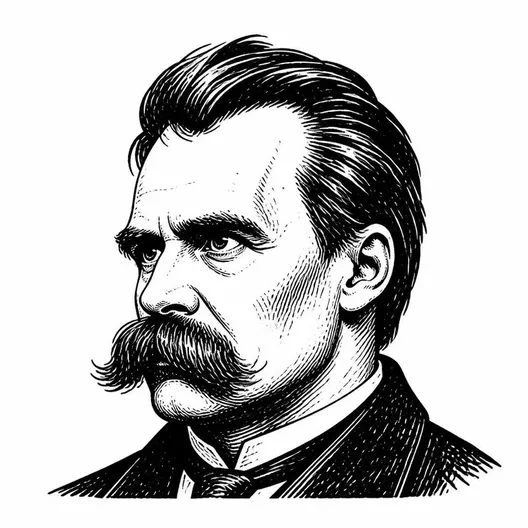 Friedrich Nietzsche 1872