Part Two, Chapter 8
At the Spy-glass
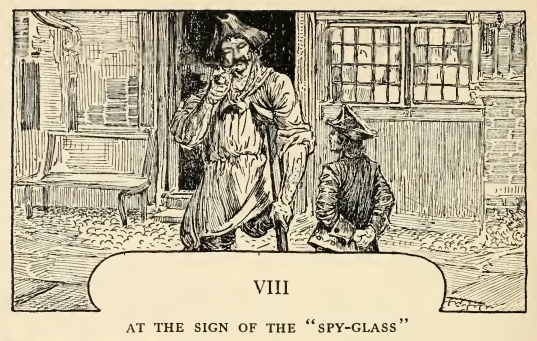
When I had done breakfasting the squire gave me a note addressed to John Silver, at the sign of the Spy-glass, and told me I should easily find the place by following the line of the docks and keeping a bright lookout for a little tavern with a large brass telescope for sign. I set off, overjoyed at this opportunity to see some more of the ships and seamen, and picked my way among a great crowd of people and carts and bales, for the dock was now at its busiest, until I found the tavern in question.
After breakfast, the squire gave me a note addressed to John Silver at the Spy-glass. He told me I could easily find it by following the docks. I was to look out for a small tavern with a large brass telescope as its sign. I set off, delighted by the chance to see more ships and sailors. The dock was at its busiest, so I made my way through a large crowd of people, carts, and bales until I found the tavern.
It was a bright enough little place of entertainment. The sign was newly painted; the windows had neat red curtains; the floor was cleanly sanded. There was a street on each side and an open door on both, which made the large, low room pretty clear to see in, in spite of clouds of tobacco smoke.
It was a cheerful little place. The sign was newly painted, the windows had neat red curtains, and the floor was clean and covered with sand. There was a street on each side, with an open door facing each one. The doors let in enough light to see fairly clearly across the large, low room, despite the clouds of tobacco smoke.
The customers were mostly seafaring men, and they talked so loudly that I hung at the door, almost afraid to enter.
Most of the customers were sailors, and they talked so loudly that I lingered at the door, almost afraid to enter.
As I was waiting, a man came out of a side room, and at a glance I was sure he must be Long John. His left leg was cut off close by the hip, and under the left shoulder he carried a crutch, which he managed with wonderful dexterity, hopping about upon it like a bird. He was very tall and strong, with a face as big as a ham—plain and pale, but intelligent and smiling. Indeed, he seemed in the most cheerful spirits, whistling as he moved about among the tables, with a merry word or a slap on the shoulder for the more favoured of his guests.
As I waited, a man came out of a side room. One look convinced me he must be Long John. His left leg had been cut off near the hip. He carried a crutch under his left shoulder and used it with amazing skill, hopping around like a bird. He was very tall and strong, with a face as big as a ham. His face was plain and pale, but intelligent and smiling. He seemed very cheerful, whistling as he moved among the tables. He had a cheerful word or a slap on the shoulder for the guests he liked best.
Now, to tell you the truth, from the very first mention of Long John in Squire Trelawney’s letter I had taken a fear in my mind that he might prove to be the very one-legged sailor whom I had watched for so long at the old Benbow. But one look at the man before me was enough. I had seen the captain, and Black Dog, and the blind man, Pew, and I thought I knew what a buccaneer was like—a very different creature, according to me, from this clean and pleasant-tempered landlord.
To tell the truth, I had been afraid from the moment Squire Trelawney mentioned Long John in his letter. I feared he might be the one-legged sailor I had watched for so long at the old Benbow. But one look at the man before me was enough to put that fear to rest. I had seen the captain, Black Dog, and the blind man, Pew. I thought I knew what a pirate was like. To me, a pirate was very different from this clean and good-natured landlord.
I plucked up courage at once, crossed the threshold, and walked right up to the man where he stood, propped on his crutch, talking to a customer.
I gathered my courage at once, stepped inside, and walked straight up to the man. He stood leaning on his crutch, talking to a customer.
“Mr. Silver, sir?” I asked, holding out the note.
“Mr. Silver, sir?” I asked, holding out the note.
“Yes, my lad,” said he; “such is my name, to be sure. And who may you be?” And then as he saw the squire’s letter, he seemed to me to give something almost like a start.
“Yes, my boy,” he said. “That is indeed my name. And who might you be?” Then, when he saw the squire’s letter, he seemed to me to almost start in surprise.
“Oh!” said he, quite loud, and offering his hand. “I see. You are our new cabin-boy; pleased I am to see you.”
“Oh!” he said loudly, offering his hand. “I see. You’re our new cabin boy. I’m pleased to see you.”
And he took my hand in his large firm grasp.
And he took my hand in his large, firm grip.
Just then one of the customers at the far side rose suddenly and made for the door. It was close by him, and he was out in the street in a moment. But his hurry had attracted my notice, and I recognized him at glance. It was the tallow-faced man, wanting two fingers, who had come first to the Admiral Benbow.
Just then, a customer on the far side suddenly stood up and headed for the door. He was close to it and was out in the street in a moment. But his hurry caught my attention, and I recognized him at once. He was the pale-faced man with two fingers missing who had come first to the Admiral Benbow.
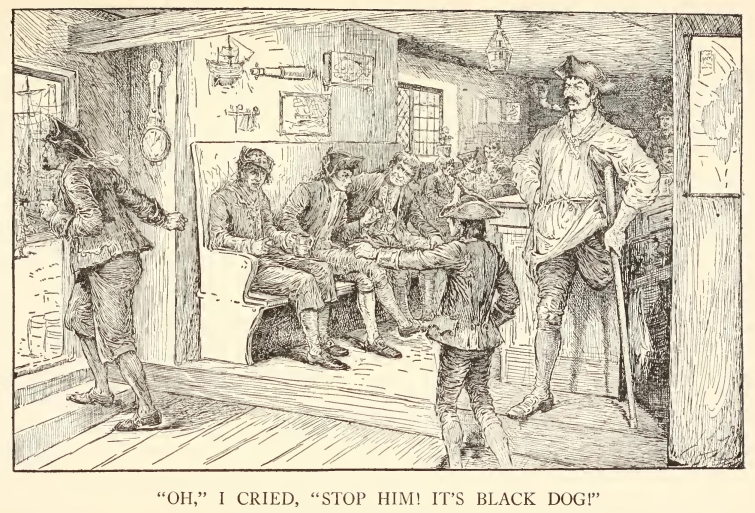
“Oh,” I cried, “stop him! It’s Black Dog!”
“Oh,” I shouted, “stop him! It’s Black Dog!”
“I don’t care two coppers who he is,” cried Silver. “But he hasn’t paid his score. Harry, run and catch him.”
“I don’t care at all who he is,” cried Silver. “But he hasn’t paid his bill. Harry, run and catch him.”
One of the others who was nearest the door leaped up and started in pursuit.
One of the others, who was closest to the door, jumped up and started to chase after them.
“If he were Admiral Hawke he shall pay his score,” cried Silver; and then, relinquishing my hand, “Who did you say he was?” he asked. “Black what?”
“Even if he were Admiral Hawke, he’ll pay his bill,” cried Silver. Then he let go of my hand. “Who did you say he was?” he asked. “Black what?”
“Dog, sir,” said I. “Has Mr. Trelawney not told you of the buccaneers? He was one of them.”
“Dog, sir,” I said. “Didn't Mr. Trelawney tell you about the pirates? He was one of them.”
“So?” cried Silver. “In my house! Ben, run and help Harry. One of those swabs, was he? Was that you drinking with him, Morgan? Step up here.”
“So?” cried Silver. “In my house! Ben, run and help Harry. He was one of those scoundrels, was he? Was that you drinking with him, Morgan? Come here.”
The man whom he called Morgan—an old, grey-haired, mahogany-faced sailor—came forward pretty sheepishly, rolling his quid.
The man he called Morgan came forward rather sheepishly, rolling a wad of chewing tobacco in his mouth. Morgan was an old sailor with gray hair and a mahogany-colored face.
“Now, Morgan,” said Long John very sternly, “you never clapped your eyes on that Black—Black Dog before, did you, now?”
“Now, Morgan,” said Long John sternly, “you’ve never seen that Black, Black Dog before, have you?”
“Not I, sir,” said Morgan with a salute.
“Not me, sir,” said Morgan, saluting.
“You didn’t know his name, did you?”
“You didn’t know his name, did you?”
“No, sir.”
“No, sir.”
“By the powers, Tom Morgan, it’s as good for you!” exclaimed the landlord. “If you had been mixed up with the like of that, you would never have put another foot in my house, you may lay to that. And what was he saying to you?”
“By God, Tom Morgan, it’s a good thing for you!” exclaimed the landlord. “If you’d been involved in anything like that, you’d never set foot in my house again, you can be sure of that. And what was he saying to you?”
“I don’t rightly know, sir,” answered Morgan.
“I don’t really know, sir,” answered Morgan.
“Do you call that a head on your shoulders, or a blessed dead-eye?” cried Long John. “Don’t rightly know, don’t you! Perhaps you don’t happen to rightly know who you was speaking to, perhaps? Come, now, what was he jawing—v’yages, cap’ns, ships? Pipe up! What was it?”
“Is that a head on your shoulders, or a wooden pulley?” cried Long John. “You don’t really know, do you? Perhaps you don’t even know who you were talking to, perhaps? Come on, what was he talking about? Voyages, captains, ships? Speak up! What was it?”
“We was a-talkin’ of keel-hauling,” answered Morgan.
“We were talking about keel-hauling,” answered Morgan.
“Keel-hauling, was you? And a mighty suitable thing, too, and you may lay to that. Get back to your place for a lubber, Tom.”
“Talking about keel-hauling, were you? A fitting punishment, too, you can be sure of that. Get back to your place, you useless sailor, Tom.”
And then, as Morgan rolled back to his seat, Silver added to me in a confidential whisper that was very flattering, as I thought, “He’s quite an honest man, Tom Morgan, on’y stupid. And now,” he ran on again, aloud, “let’s see—Black Dog? No, I don’t know the name, not I. Yet I kind of think I’ve—yes, I’ve seen the swab. He used to come here with a blind beggar, he used.”
As Morgan shuffled back to his seat, Silver spoke to me in a confidential whisper. I found his confidence very flattering. “Tom Morgan is quite an honest man, just stupid. And now,” he continued aloud, “let’s see. Black Dog? No, I don’t know the name, not me. But I think I’ve, yes, I’ve seen the fellow. He used to come here with a blind beggar.”
“That he did, you may be sure,” said I. “I knew that blind man too. His name was Pew.”
“He certainly did,” I said. “I knew that blind man too. His name was Pew.”
“It was!” cried Silver, now quite excited. “Pew! That were his name for certain. Ah, he looked a shark, he did! If we run down this Black Dog, now, there’ll be news for Cap’n Trelawney! Ben’s a good runner; few seamen run better than Ben. He should run him down, hand over hand, by the powers! He talked o’ keel-hauling, did he? I’ll keel-haul him!”
“It was!” cried Silver, now very excited. “Pew! That was his name, for certain. Ah, he looked like a shark, he did! If we catch this Black Dog, there’ll be news for Captain Trelawney! Ben’s a good runner. Few sailors run better than Ben. He should catch Black Dog easily, by the powers! He talked about keel-hauling, did he? I’ll keel-haul him!”
All the time he was jerking out these phrases he was stumping up and down the tavern on his crutch, slapping tables with his hand, and giving such a show of excitement as would have convinced an Old Bailey judge or a Bow Street runner. My suspicions had been thoroughly reawakened on finding Black Dog at the Spy-glass, and I watched the cook narrowly. But he was too deep, and too ready, and too clever for me, and by the time the two men had come back out of breath and confessed that they had lost the track in a crowd, and been scolded like thieves, I would have gone bail for the innocence of Long John Silver.
All the while, he was blurting out these words and pacing up and down the tavern on his crutch. He slapped tables with his hand and put on such a show of excitement that even an Old Bailey judge or a Bow Street runner would have believed him. Finding Black Dog at the Spy-glass had fully awakened my suspicions again, and I watched the cook closely. But he was too cunning, too quick, and too clever for me. The two men came back out of breath and admitted they had lost the trail in a crowd. After the cook scolded them like thieves, I would have sworn that Long John Silver was innocent.
“See here, now, Hawkins,” said he, “here’s a blessed hard thing on a man like me, now, ain’t it? There’s Cap’n Trelawney—what’s he to think? Here I have this confounded son of a Dutchman sitting in my own house drinking of my own rum! Here you comes and tells me of it plain; and here I let him give us all the slip before my blessed deadlights! Now, Hawkins, you do me justice with the cap’n. You’re a lad, you are, but you’re as smart as paint. I see that when you first come in. Now, here it is: What could I do, with this old timber I hobble on? When I was an A B master mariner I’d have come up alongside of him, hand over hand, and broached him to in a brace of old shakes, I would; but now—”
“Look here, Hawkins,” he said, “this is a pretty hard situation for a man like me, isn’t it? There’s Cap’n Trelawney. What’s he going to think? I have this damned Dutchman’s son sitting in my own house, drinking my own rum! You come and tell me about him plainly, and I let him slip away right before my eyes! Now, Hawkins, make sure you tell the captain I did my best. You’re a lad, but you’re sharp as can be. I saw that when you first came in. Now, what could I do with this old wooden leg I hobble on? When I was an able-bodied master mariner, I’d have caught up with him and stopped him in no time. But now...”
And then, all of a sudden, he stopped, and his jaw dropped as though he had remembered something.
Then, all of a sudden, he stopped. His jaw dropped as if he had remembered something.
“The score!” he burst out. “Three goes o’ rum! Why, shiver my timbers, if I hadn’t forgotten my score!”
“The bill!” he burst out. “Three drinks of rum! Well, shiver my timbers, I’d forgotten my bill!”
And falling on a bench, he laughed until the tears ran down his cheeks. I could not help joining, and we laughed together, peal after peal, until the tavern rang again.
He collapsed onto a bench and laughed until tears ran down his cheeks. I couldn’t help joining in. We laughed together, again and again, until the tavern rang with laughter.
“Why, what a precious old sea-calf I am!” he said at last, wiping his cheeks. “You and me should get on well, Hawkins, for I’ll take my davy I should be rated ship’s boy. But come now, stand by to go about. This won’t do. Dooty is dooty, messmates. I’ll put on my old cockerel hat, and step along of you to Cap’n Trelawney, and report this here affair. For mind you, it’s serious, young Hawkins; and neither you nor me’s come out of it with what I should make so bold as to call credit. Nor you neither, says you; not smart—none of the pair of us smart. But dash my buttons! That was a good un about my score.”
“What a silly old sea calf I am!” he said at last, wiping his cheeks. “You and I should get along well, Hawkins. I’d swear I deserve to be ranked as a ship’s boy. But come on now, it’s time to change course. This won’t do. Duty is duty, shipmates. I’ll put on my old rooster hat and go with you to Captain Trelawney to report this affair. Mind you, it’s serious, young Hawkins. Neither of us has come out of it looking particularly good. ‘Nor you either,’ you say. No, neither of us was smart. But blast it! That was a good joke about my bill.”
And he began to laugh again, and that so heartily, that though I did not see the joke as he did, I was again obliged to join him in his mirth.
And he began to laugh again, so heartily that I had to join him, though I didn't see the joke as he did.
On our little walk along the quays, he made himself the most interesting companion, telling me about the different ships that we passed by, their rig, tonnage, and nationality, explaining the work that was going forward—how one was discharging, another taking in cargo, and a third making ready for sea—and every now and then telling me some little anecdote of ships or seamen or repeating a nautical phrase till I had learned it perfectly. I began to see that here was one of the best of possible shipmates.
On our short walk along the docks, he proved to be a fascinating companion. He told me about the ships we passed, their rigging, tonnage, and nationality. He explained the work going on around us. One ship was unloading, another was taking on cargo, and a third was getting ready to sail. Now and then, he told me a little story about ships or sailors. He also repeated nautical phrases until I had learned them perfectly. I began to see that he was one of the best shipmates I could possibly have.
When we got to the inn, the squire and Dr. Livesey were seated together, finishing a quart of ale with a toast in it, before they should go aboard the schooner on a visit of inspection.
When we reached the inn, the squire and Dr. Livesey were sitting together, finishing a quart of ale with toast in it. Afterward, they planned to go aboard the schooner to inspect it.
Long John told the story from first to last, with a great deal of spirit and the most perfect truth. “That was how it were, now, weren’t it, Hawkins?” he would say, now and again, and I could always bear him entirely out.
Long John told the whole story from beginning to end, with great energy and perfect honesty. Every now and then he would say, “That was how it happened, wasn’t it, Hawkins?” I could always confirm everything he said.
The two gentlemen regretted that Black Dog had got away, but we all agreed there was nothing to be done, and after he had been complimented, Long John took up his crutch and departed.
The two gentlemen were sorry that Black Dog had escaped. But we all agreed that nothing could be done. After they praised Long John, he picked up his crutch and left.
“All hands aboard by four this afternoon,” shouted the squire after him.
“Everyone aboard by four this afternoon,” the squire shouted after him.
“Aye, aye, sir,” cried the cook, in the passage.
“Yes, sir,” the cook called from the hallway.
“Well, squire,” said Dr. Livesey, “I don’t put much faith in your discoveries, as a general thing; but I will say this, John Silver suits me.”
“Well, squire,” said Dr. Livesey, “I generally don’t have much faith in your discoveries. But I will say that I like John Silver.”
“The man’s a perfect trump,” declared the squire.
“The man is absolutely wonderful,” said the squire.
“And now,” added the doctor, “Jim may come on board with us, may he not?”
“And now,” the doctor added, “Jim can come aboard with us, can’t he?”
“To be sure he may,” says squire. “Take your hat, Hawkins, and we’ll see the ship.”
“Of course he may,” says the squire. “Get your hat, Hawkins, and we’ll go see the ship.”