Part 2, Chapter 9
Gunpowder and Weapons
The Hispaniola lay some way out, and we went under the figureheads and round the sterns of many other ships, and their cables sometimes grated underneath our keel, and sometimes swung above us. At last, however, we got alongside, and were met and saluted as we stepped aboard by the mate, Mr. Arrow, a brown old sailor with earrings in his ears and a squint. He and the squire were very thick and friendly, but I soon observed that things were not the same between Mr. Trelawney and the captain.
The Hispaniola lay some distance out. We passed under the figureheads and around the sterns of many other ships. Their cables sometimes scraped beneath our keel and sometimes swung above us. At last, though, we came alongside the Hispaniola. As we stepped aboard, the mate, Mr. Arrow, greeted us. He was an old sailor with brown skin, earrings, and a squint. He and the squire were very close and friendly. But I soon noticed that things were different between Mr. Trelawney and the captain.
This last was a sharp-looking man who seemed angry with everything on board and was soon to tell us why, for we had hardly got down into the cabin when a sailor followed us.
The last man was sharp-looking and seemed angry about everything on board. We would soon learn why, because we had hardly reached the cabin when a sailor followed us in.
“Captain Smollett, sir, axing to speak with you,” said he.
“Captain Smollett is asking to speak with you, sir,” he said.
“I am always at the captain’s orders. Show him in,” said the squire.
“I am always ready to obey the captain. Show him in,” said the squire.
The captain, who was close behind his messenger, entered at once and shut the door behind him.
The captain was close behind his messenger. He came in immediately and shut the door behind him.
“Well, Captain Smollett, what have you to say? All well, I hope; all shipshape and seaworthy?”
“Well, Captain Smollett, what do you have to say? I hope everything is well. Is everything in order and ready to sail?”
“Well, sir,” said the captain, “better speak plain, I believe, even at the risk of offence. I don’t like this cruise; I don’t like the men; and I don’t like my officer. That’s short and sweet.”
“Well, sir,” said the captain, “I think I’d better speak plainly, even if it offends you. I don’t like this voyage. I don’t like the men, and I don’t like my officer. That’s the long and short of it.”
“Perhaps, sir, you don’t like the ship?” inquired the squire, very angry, as I could see.
“Perhaps, sir, you don’t like the ship?” the squire asked. I could see that he was very angry.
“I can’t speak as to that, sir, not having seen her tried,” said the captain. “She seems a clever craft; more I can’t say.”
“I can’t say, sir, because I haven’t seen her tested,” said the captain. “She seems like a capable vessel. I can’t say more than that.”
“Possibly, sir, you may not like your employer, either?” says the squire.
“Perhaps you don't like your employer either, sir?” says the squire.
But here Dr. Livesey cut in.
But at this point, Dr. Livesey interrupted.
“Stay a bit,” said he, “stay a bit. No use of such questions as that but to produce ill feeling. The captain has said too much or he has said too little, and I’m bound to say that I require an explanation of his words. You don’t, you say, like this cruise. Now, why?”
“Wait a moment,” he said. “Wait a moment. Questions like that only cause bad feelings. The captain has said too much or too little, and I must say I need him to explain. You say you don’t like this voyage. Why?”
“I was engaged, sir, on what we call sealed orders, to sail this ship for that gentleman where he should bid me,” said the captain. “So far so good. But now I find that every man before the mast knows more than I do. I don’t call that fair, now, do you?”
“I was hired, sir, under what we call sealed orders,” said the captain. “I was to sail this ship for that gentleman wherever he told me to go. So far, so good. But now I find that every sailor on board knows more than I do. I don’t call that fair, do you?”
“No,” said Dr. Livesey, “I don’t.”
“No,” said Dr. Livesey, “I don’t.”
“Next,” said the captain, “I learn we are going after treasure—hear it from my own hands, mind you. Now, treasure is ticklish work; I don’t like treasure voyages on any account, and I don’t like them, above all, when they are secret and when (begging your pardon, Mr. Trelawney) the secret has been told to the parrot.”
“Next,” said the captain, “I learn that we’re going after treasure. And mind you, I heard it from my own crew. Now, treasure hunting is risky business. I don’t like treasure voyages at all. I like them even less when they’re secret and the secret has been told to the parrot. Begging your pardon, Mr. Trelawney.”
“Silver’s parrot?” asked the squire.
“Silver’s parrot?” asked the squire.
“It’s a way of speaking,” said the captain. “Blabbed, I mean. It’s my belief neither of you gentlemen know what you are about, but I’ll tell you my way of it—life or death, and a close run.”
“That’s just a figure of speech,” said the captain. “I mean you let the secret slip. I believe neither of you gentlemen knows what you’re doing. But I’ll tell you how I see it. It’s a matter of life or death, and it’ll be a close call.”
“That is all clear, and, I dare say, true enough,” replied Dr. Livesey. “We take the risk, but we are not so ignorant as you believe us. Next, you say you don’t like the crew. Are they not good seamen?”
“That is all clear, and I expect it’s true enough,” replied Dr. Livesey. “We’re taking the risk, but we’re not as ignorant as you think. Next, you say you don’t like the crew. Aren’t they good sailors?”
“I don’t like them, sir,” returned Captain Smollett. “And I think I should have had the choosing of my own hands, if you go to that.”
“I don’t like them, sir,” replied Captain Smollett. “And for that matter, I think I should have chosen my own crew.”
“Perhaps you should,” replied the doctor. “My friend should, perhaps, have taken you along with him; but the slight, if there be one, was unintentional. And you don’t like Mr. Arrow?”
“Perhaps you should,” the doctor replied. “Perhaps my friend should have taken you with him. But if he slighted you, he didn’t mean to. And you don’t like Mr. Arrow?”
“I don’t, sir. I believe he’s a good seaman, but he’s too free with the crew to be a good officer. A mate should keep himself to himself—shouldn’t drink with the men before the mast!”
“I don’t, sir. I believe he’s a good sailor, but he’s too friendly with the crew to be a good officer. A mate should keep his distance. He shouldn’t drink with the ordinary sailors!”
“Do you mean he drinks?” cried the squire.
“Do you mean he drinks?” the squire exclaimed.
“No, sir,” replied the captain, “only that he’s too familiar.”
“No, sir,” the captain replied, “only that he’s too forward.”
“Well, now, and the short and long of it, captain?” asked the doctor. “Tell us what you want.”
“Well, captain, what’s the bottom line?” asked the doctor. “Tell us what you want.”
“Well, gentlemen, are you determined to go on this cruise?”
“Well, gentlemen, are you determined to go on this voyage?”
“Like iron,” answered the squire.
“Like iron,” said the squire.
“Very good,” said the captain. “Then, as you’ve heard me very patiently, saying things that I could not prove, hear me a few words more. They are putting the powder and the arms in the fore hold. Now, you have a good place under the cabin; why not put them there?—first point. Then, you are bringing four of your own people with you, and they tell me some of them are to be berthed forward. Why not give them the berths here beside the cabin?—second point.”
“Very well,” said the captain. “You’ve listened patiently to things I couldn’t prove, so hear me out a little longer. They’re putting the gunpowder and weapons in the forward hold. You have a good space under the cabin. Why not put them there? That’s my first point. You’re also bringing four of your own men, and I’m told some are to sleep in the front of the ship. Why not give them bunks here beside the cabin? That’s my second point.”
“Any more?” asked Mr. Trelawney.
“Any more?” asked Mr. Trelawney.
“One more,” said the captain. “There’s been too much blabbing already.”
“One more,” said the captain. “There’s been too much talking already.”
“Far too much,” agreed the doctor.
“Far too much,” agreed the doctor.
“I’ll tell you what I’ve heard myself,” continued Captain Smollett: “that you have a map of an island, that there’s crosses on the map to show where treasure is, and that the island lies—” And then he named the latitude and longitude exactly.
“I’ll tell you what I’ve heard myself,” Captain Smollett continued. “You have a map of an island. Crosses on the map show where the treasure is, and the island is at...” Then he gave the exact latitude and longitude.
“I never told that,” cried the squire, “to a soul!”
“I never told anyone that!” cried the squire.
“The hands know it, sir,” returned the captain.
“The crew knows it, sir,” replied the captain.
“Livesey, that must have been you or Hawkins,” cried the squire.
“Livesey, that must have been you or Hawkins,” shouted the squire.
“It doesn’t much matter who it was,” replied the doctor. And I could see that neither he nor the captain paid much regard to Mr. Trelawney’s protestations. Neither did I, to be sure, he was so loose a talker; yet in this case I believe he was really right and that nobody had told the situation of the island.
“It doesn’t much matter who it was,” replied the doctor. I could see that neither he nor the captain put much faith in Mr. Trelawney’s claims. I didn’t either, of course, because he talked so freely. But in this case, I believe he was really right and that nobody had revealed where the island was.
“Well, gentlemen,” continued the captain, “I don’t know who has this map; but I make it a point, it shall be kept secret even from me and Mr. Arrow. Otherwise I would ask you to let me resign.”
“Well, gentlemen,” the captain continued, “I don’t know who has this map. But I insist that it be kept secret even from me and Mr. Arrow. Otherwise, I would ask you to let me resign.”
“I see,” said the doctor. “You wish us to keep this matter dark and to make a garrison of the stern part of the ship, manned with my friend’s own people, and provided with all the arms and powder on board. In other words, you fear a mutiny.”
“I see,” said the doctor. “You want us to keep this secret and turn the rear of the ship into a stronghold. You want my friend’s own men to guard it, with all the weapons and gunpowder on board. In other words, you fear a mutiny.”
“Sir,” said Captain Smollett, “with no intention to take offence, I deny your right to put words into my mouth. No captain, sir, would be justified in going to sea at all if he had ground enough to say that. As for Mr. Arrow, I believe him thoroughly honest; some of the men are the same; all may be for what I know. But I am responsible for the ship’s safety and the life of every man Jack aboard of her. I see things going, as I think, not quite right. And I ask you to take certain precautions or let me resign my berth. And that’s all.”
“Sir,” said Captain Smollett, “I don’t mean to take offence, but you have no right to put words in my mouth. No captain, sir, would be justified in going to sea if he had enough reason to say that. As for Mr. Arrow, I believe he is completely honest. Some of the men are honest too. For all I know, all of them may be. But I am responsible for the ship’s safety and the life of every man aboard. I see things happening that I don’t think are quite right. I ask you to take certain precautions or let me resign my post. That’s all.”
“Captain Smollett,” began the doctor with a smile, “did ever you hear the fable of the mountain and the mouse? You’ll excuse me, I dare say, but you remind me of that fable. When you came in here, I’ll stake my wig, you meant more than this.”
“Captain Smollett,” the doctor began with a smile, “have you ever heard the fable of the mountain and the mouse? I hope you’ll excuse me, but you remind me of that fable. I’d bet my wig that when you came in here, you meant to say more than this.”
“Doctor,” said the captain, “you are smart. When I came in here I meant to get discharged. I had no thought that Mr. Trelawney would hear a word.”
“Doctor,” said the captain, “you’re clever. When I came in here, I meant to ask to be discharged. I didn’t think Mr. Trelawney would hear a word about it.”
“No more I would,” cried the squire. “Had Livesey not been here I should have seen you to the deuce. As it is, I have heard you. I will do as you desire, but I think the worse of you.”
“No, I wouldn’t either,” cried the squire. “If Livesey hadn’t been here, I would have told you to go to hell. But since he is here, I’ve heard you out. I’ll do as you ask, but I think less of you for it.”
“That’s as you please, sir,” said the captain. “You’ll find I do my duty.”
“That’s up to you, sir,” said the captain. “You’ll find that I do my duty.”
And with that he took his leave.
And with that, he left.
“Trelawney,” said the doctor, “contrary to all my notions, I believed you have managed to get two honest men on board with you—that man and John Silver.”
“Trelawney,” said the doctor, “against all my expectations, I believed you had managed to bring two honest men aboard: that man and John Silver.”
“Silver, if you like,” cried the squire; “but as for that intolerable humbug, I declare I think his conduct unmanly, unsailorly, and downright un-English.”
“Silver, if you like,” cried the squire. “But as for that unbearable fraud, I think his conduct is unmanly, unseamanlike, and downright un-English.”
“Well,” says the doctor, “we shall see.”
“Well,” says the doctor, “we’ll see.”
When we came on deck, the men had begun already to take out the arms and powder, yo-ho-ing at their work, while the captain and Mr. Arrow stood by superintending.
When we came on deck, the men had already begun taking out the weapons and gunpowder. They sang “yo-ho” as they worked, while the captain and Mr. Arrow stood by and supervised.
The new arrangement was quite to my liking. The whole schooner had been overhauled; six berths had been made astern out of what had been the after-part of the main hold; and this set of cabins was only joined to the galley and forecastle by a sparred passage on the port side. It had been originally meant that the captain, Mr. Arrow, Hunter, Joyce, the doctor, and the squire were to occupy these six berths. Now Redruth and I were to get two of them and Mr. Arrow and the captain were to sleep on deck in the companion, which had been enlarged on each side till you might almost have called it a round-house. Very low it was still, of course; but there was room to swing two hammocks, and even the mate seemed pleased with the arrangement. Even he, perhaps, had been doubtful as to the crew, but that is only guess, for as you shall hear, we had not long the benefit of his opinion.
I was quite pleased with the new arrangement. The whole schooner had been refitted. Six berths had been made at the stern, in what had been the rear of the main hold. A passage with a slatted wall ran along the port side, connecting the cabins to the galley and forecastle. The six berths had originally been intended for the captain, Mr. Arrow, Hunter, Joyce, the doctor, and the squire. Now Redruth and I were to have two of them. Mr. Arrow and the captain were to sleep on deck in the companion. It had been enlarged on each side until you could almost call it a round-house. Of course, the ceiling was still very low, but there was room to hang two hammocks. Even the mate seemed pleased with the arrangement. Perhaps he, too, had doubts about the crew, but that is only a guess. As you will hear, we did not have the benefit of his opinion for long.
We were all hard at work, changing the powder and the berths, when the last man or two, and Long John along with them, came off in a shore-boat.
We were all hard at work moving the gunpowder and changing the sleeping berths. Then the last man or two came from shore in a boat, along with Long John.
The cook came up the side like a monkey for cleverness, and as soon as he saw what was doing, “So ho, mates!” says he. “What’s this?”
The cook climbed up the side as nimbly as a monkey. As soon as he saw what was happening, he said, “Hey, mates! What’s this?”
“We’re a-changing of the powder, Jack,” answers one.
“We’re changing the powder, Jack,” one of them answers.
“Why, by the powers,” cried Long John, “if we do, we’ll miss the morning tide!”
“Why, for heaven’s sake,” cried Long John, “if we do, we’ll miss the morning tide!”
“My orders!” said the captain shortly. “You may go below, my man. Hands will want supper.”
“My orders!” the captain said sharply. “You can go below, my man. Hands will want supper.”
“Aye, aye, sir,” answered the cook, and touching his forelock, he disappeared at once in the direction of his galley.
“Aye, aye, sir,” the cook answered. He touched his forelock and immediately disappeared in the direction of his galley.
“That’s a good man, captain,” said the doctor.
“That’s a good man, captain,” said the doctor.
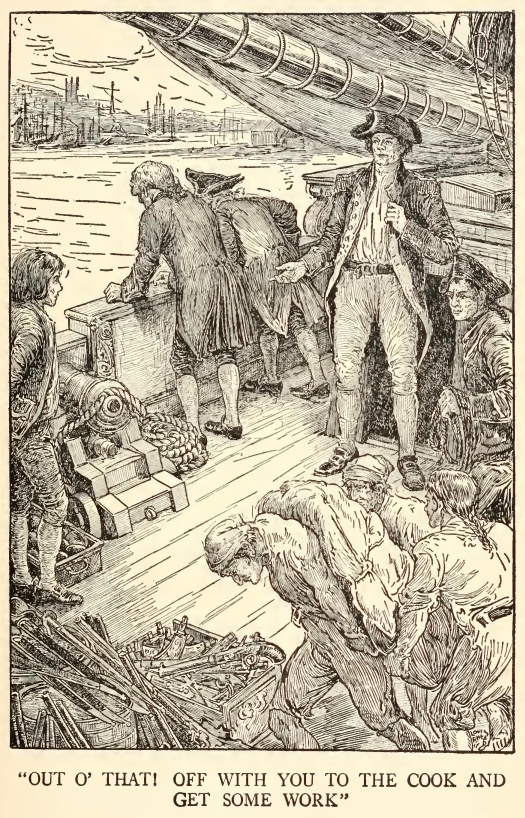
“Very likely, sir,” replied Captain Smollett. “Easy with that, men—easy,” he ran on, to the fellows who were shifting the powder; and then suddenly observing me examining the swivel we carried amidships, a long brass nine, “Here you, ship’s boy,” he cried, “out o’ that! Off with you to the cook and get some work.”
“Very likely, sir,” replied Captain Smollett. “Careful with that, men, careful,” he continued, speaking to the men moving the gunpowder. Then he suddenly noticed me examining the swivel gun we carried amidships. It was a long brass nine-pounder. “Here, ship’s boy,” he cried, “get away from there! Go to the cook and find some work.”
And then as I was hurrying off I heard him say, quite loudly, to the doctor, “I’ll have no favourites on my ship.”
And as I hurried off, I heard him say loudly to the doctor, “I won’t have favorites on my ship.”
I assure you I was quite of the squire’s way of thinking, and hated the captain deeply.
I can assure you that I completely agreed with the squire and hated the captain deeply.