Part 3, Chapter 15
The Island Man
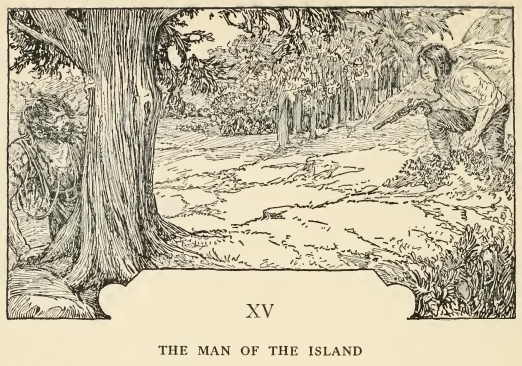
From the side of the hill, which was here steep and stony, a spout of gravel was dislodged and fell rattling and bounding through the trees. My eyes turned instinctively in that direction, and I saw a figure leap with great rapidity behind the trunk of a pine. What it was, whether bear or man or monkey, I could in no wise tell. It seemed dark and shaggy; more I knew not. But the terror of this new apparition brought me to a stand.
The hillside was steep and stony here. A stream of gravel came loose and fell, rattling and bouncing through the trees. I instinctively looked that way and saw a figure leap quickly behind the trunk of a pine tree. I could not tell whether it was a bear, a man, or a monkey. It looked dark and shaggy, but I knew nothing more. The sight of this new figure terrified me, and I stopped in my tracks.
I was now, it seemed, cut off upon both sides; behind me the murderers, before me this lurking nondescript. And immediately I began to prefer the dangers that I knew to those I knew not. Silver himself appeared less terrible in contrast with this creature of the woods, and I turned on my heel, and looking sharply behind me over my shoulder, began to retrace my steps in the direction of the boats.
I seemed to be trapped on both sides. Behind me were the murderers, and ahead was this strange figure lurking nearby. At once, I began to prefer the dangers I knew to those I did not. Even Silver seemed less frightening than this creature of the woods. I turned around and began to make my way back toward the boats, looking carefully over my shoulder as I went.
Instantly the figure reappeared, and making a wide circuit, began to head me off. I was tired, at any rate; but had I been as fresh as when I rose, I could see it was in vain for me to contend in speed with such an adversary. From trunk to trunk the creature flitted like a deer, running manlike on two legs, but unlike any man that I had ever seen, stooping almost double as it ran. Yet a man it was, I could no longer be in doubt about that.
At once, the figure reappeared and made a wide circle to cut me off. I was tired, but even if I had been as fresh as when I got up, I could see that racing such an opponent was hopeless. The creature darted from tree to tree like a deer. It ran on two legs like a man, but unlike any man I had ever seen, it stooped almost double as it ran. Yet it was a man. I could no longer doubt that.
I began to recall what I had heard of cannibals. I was within an ace of calling for help. But the mere fact that he was a man, however wild, had somewhat reassured me, and my fear of Silver began to revive in proportion. I stood still, therefore, and cast about for some method of escape; and as I was so thinking, the recollection of my pistol flashed into my mind. As soon as I remembered I was not defenceless, courage glowed again in my heart and I set my face resolutely for this man of the island and walked briskly towards him.
I began to remember what I had heard about cannibals. I nearly called for help. But the fact that he was a man, however wild, had somewhat reassured me. As I felt less afraid of him, my fear of Silver began to return. So I stood still and looked for a way to escape. As I thought, I suddenly remembered my pistol. Knowing I was not defenseless, I felt my courage return. I turned resolutely toward the island man and walked briskly toward him.
He was concealed by this time behind another tree trunk; but he must have been watching me closely, for as soon as I began to move in his direction he reappeared and took a step to meet me. Then he hesitated, drew back, came forward again, and at last, to my wonder and confusion, threw himself on his knees and held out his clasped hands in supplication.
By then, he was hidden behind another tree trunk. But he must have been watching me closely. As soon as I began to move toward him, he reappeared and took a step toward me. Then he hesitated and stepped back. He came forward again and, to my surprise and confusion, finally fell to his knees. He held out his clasped hands, pleading with me.
At that I once more stopped.
At that, I stopped again.
“Who are you?” I asked.
“Who are you?” I asked.
“Ben Gunn,” he answered, and his voice sounded hoarse and awkward, like a rusty lock. “I’m poor Ben Gunn, I am; and I haven’t spoke with a Christian these three years.”
“Ben Gunn,” he answered. His voice sounded hoarse and awkward, like a rusty lock. “I’m poor Ben Gunn, I am. I haven’t spoken to another person in three years.”
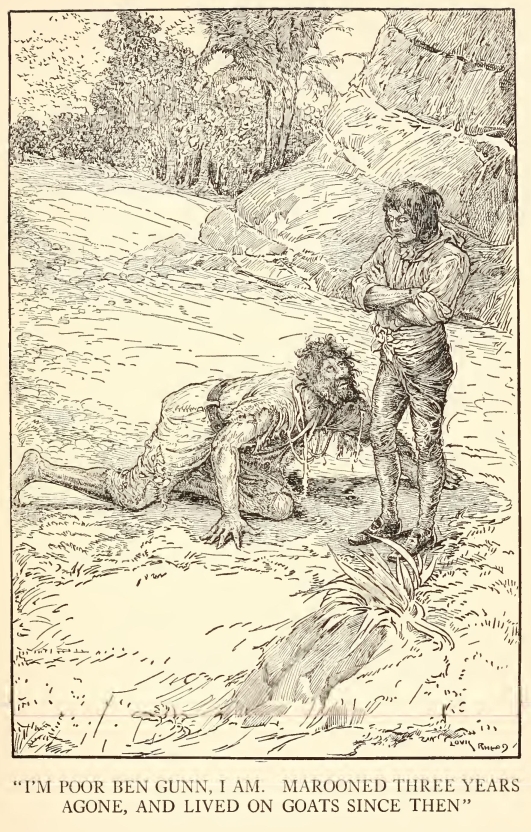
I could now see that he was a white man like myself and that his features were even pleasing. His skin, wherever it was exposed, was burnt by the sun; even his lips were black, and his fair eyes looked quite startling in so dark a face. Of all the beggar-men that I had seen or fancied, he was the chief for raggedness. He was clothed with tatters of old ship’s canvas and old sea-cloth, and this extraordinary patchwork was all held together by a system of the most various and incongruous fastenings, brass buttons, bits of stick, and loops of tarry gaskin. About his waist he wore an old brass-buckled leather belt, which was the one thing solid in his whole accoutrement.
I could now see that he was a white man like me, and that his features were even pleasing. His exposed skin was sunburned, and even his lips were black. His light-colored eyes looked startling against his dark face. Of all the beggars I had seen or imagined, he was the most ragged. He wore scraps of old ship’s canvas and sailcloth. This strange patchwork was held together by all sorts of mismatched fastenings: brass buttons, bits of stick, and loops of tarred rope. Around his waist he wore an old leather belt with a brass buckle. It was the only solid thing in his entire outfit.
“Three years!” I cried. “Were you shipwrecked?”
“Three years!” I exclaimed. “Were you shipwrecked?”
“Nay, mate,” said he; “marooned.”
“No, mate,” he said. “Marooned.”
I had heard the word, and I knew it stood for a horrible kind of punishment common enough among the buccaneers, in which the offender is put ashore with a little powder and shot and left behind on some desolate and distant island.
I had heard the word, and I knew it meant a horrible punishment that was common among pirates. The offender was left on a remote, deserted island with a little gunpowder and shot.
“Marooned three years agone,” he continued, “and lived on goats since then, and berries, and oysters. Wherever a man is, says I, a man can do for himself. But, mate, my heart is sore for Christian diet. You mightn’t happen to have a piece of cheese about you, now? No? Well, many’s the long night I’ve dreamed of cheese—toasted, mostly—and woke up again, and here I were.”
“I was marooned three years ago,” he continued, “and I’ve lived on goats, berries, and oysters since then. Wherever a man is, I say, he can take care of himself. But, mate, I’m aching for civilized food. You wouldn’t happen to have a piece of cheese on you, would you? No? Well, I’ve spent many long nights dreaming of cheese, mostly toasted. Then I’d wake up and find myself still here.”
“If ever I can get aboard again,” said I, “you shall have cheese by the stone.”
“If I can ever get back aboard,” I said, “you’ll have cheese in 14-pound lots.”
All this time he had been feeling the stuff of my jacket, smoothing my hands, looking at my boots, and generally, in the intervals of his speech, showing a childish pleasure in the presence of a fellow creature. But at my last words he perked up into a kind of startled slyness.
All this time, he had been feeling the fabric of my jacket, smoothing my hands, and looking at my boots. Between his words, he showed a childlike pleasure in being with another person. But at my last words, he perked up, suddenly looking startled and sly.
“If ever you can get aboard again, says you?” he repeated. “Why, now, who’s to hinder you?”
“‘If you can ever get back aboard,’ you say?” he repeated. “Well, who’s going to stop you?”
“Not you, I know,” was my reply.
“Not you, I know,” I replied.
“And right you was,” he cried. “Now you—what do you call yourself, mate?”
“And you were right,” he cried. “Now, you, what's your name, mate?”
“Jim,” I told him.
“Jim,” I told him.
“Jim, Jim,” says he, quite pleased apparently. “Well, now, Jim, I’ve lived that rough as you’d be ashamed to hear of. Now, for instance, you wouldn’t think I had had a pious mother—to look at me?” he asked.
“Jim, Jim,” he said, apparently quite pleased. “Well, Jim, I’ve lived such a rough life you’d be ashamed to hear about it. For instance, you wouldn’t think I’d had a religious mother, would you, just by looking at me?” he asked.
“Why, no, not in particular,” I answered.
“No, not really,” I answered.
“Ah, well,” said he, “but I had—_re_markable pious. And I was a civil, pious boy, and could rattle off my catechism that fast, as you couldn’t tell one word from another. And here’s what it come to, Jim, and it begun with chuck-farthen on the blessed grave-stones! That’s what it begun with, but it went further’n that; and so my mother told me, and predicked the whole, she did, the pious woman! But it were Providence that put me here. I’ve thought it all out in this here lonely island, and I’m back on piety. You don’t catch me tasting rum so much, but just a thimbleful for luck, of course, the first chance I have. I’m bound I’ll be good, and I see the way to. And, Jim”—looking all round him and lowering his voice to a whisper—“I’m rich.”
“Ah, well,” he said, “but I was. I was _re_markably pious. I was a polite, pious boy. I could rattle off my catechism so fast that you couldn’t tell one word from another. And look what became of me, Jim. It began with chuck-farthen on the blessed gravestones! That’s how it began, but it went further than that. My mother told me it would. The pious woman predicted the whole thing! But Providence put me here. I’ve thought it all out on this lonely island, and I’m pious again. You won’t catch me drinking much rum, except a thimbleful for luck, of course, at the first chance I get. I’m determined to be good, and I can see how to do it. And, Jim,” he said, looking all around him and lowering his voice to a whisper, “I’m rich.”
I now felt sure that the poor fellow had gone crazy in his solitude, and I suppose I must have shown the feeling in my face, for he repeated the statement hotly: “Rich! Rich! I says. And I’ll tell you what: I’ll make a man of you, Jim. Ah, Jim, you’ll bless your stars, you will, you was the first that found me!”
I was now sure the poor fellow had gone crazy from being alone. I suppose my face must have shown it, because he repeated himself angrily: “Rich! Rich, I tell you! And I’ll tell you what: I’ll make a man of you, Jim. Ah, Jim, you’ll thank your lucky stars you were the first to find me!”
And at this there came suddenly a lowering shadow over his face, and he tightened his grasp upon my hand and raised a forefinger threateningly before my eyes.
At this, his face suddenly darkened. He tightened his grip on my hand and raised a finger threateningly in front of my eyes.
“Now, Jim, you tell me true: that ain’t Flint’s ship?” he asked.
“Now, Jim, tell me the truth: that isn’t Flint’s ship, is it?” he asked.
At this I had a happy inspiration. I began to believe that I had found an ally, and I answered him at once.
At that, I had a happy idea. I began to believe I had found an ally, and I answered him right away.
“It’s not Flint’s ship, and Flint is dead; but I’ll tell you true, as you ask me—there are some of Flint’s hands aboard; worse luck for the rest of us.”
“It’s not Flint’s ship, and Flint is dead. But since you asked, I’ll tell you the truth. Some of Flint’s crew are aboard, and that’s bad luck for the rest of us.”
“Not a man—with one—leg?” he gasped.
“Not a man with one leg?” he gasped.
“Silver?” I asked.
“Silver?” I asked.
“Ah, Silver!” says he. “That were his name.”
“Ah, Silver!” he said. “That was his name.”
“He’s the cook, and the ringleader too.”
“He’s the cook and the ringleader too.”
He was still holding me by the wrist, and at that he give it quite a wring.
He was still holding my wrist, and at that, he gave it a hard twist.
“If you was sent by Long John,” he said, “I’m as good as pork, and I know it. But where was you, do you suppose?”
“If Long John sent you,” he said, “I’m as good as dead, and I know it. But where do you think you were?”
I had made my mind up in a moment, and by way of answer told him the whole story of our voyage and the predicament in which we found ourselves. He heard me with the keenest interest, and when I had done he patted me on the head.
I made up my mind at once. In answer, I told him the whole story of our voyage and the trouble we were in. He listened with great interest. When I finished, he patted me on the head.
“You’re a good lad, Jim,” he said; “and you’re all in a clove hitch, ain’t you? Well, you just put your trust in Ben Gunn—Ben Gunn’s the man to do it. Would you think it likely, now, that your squire would prove a liberal-minded one in case of help—him being in a clove hitch, as you remark?”
“You’re a good lad, Jim,” he said. “And you’re all in a tight spot, aren’t you? Well, just put your trust in Ben Gunn. Ben Gunn’s the man to help. Do you think your squire would be generous if he got help, since he’s in a tight spot, as you say?”
I told him the squire was the most liberal of men.
I told him the squire was the most generous of men.
“Aye, but you see,” returned Ben Gunn, “I didn’t mean giving me a gate to keep, and a suit of livery clothes, and such; that’s not my mark, Jim. What I mean is, would he be likely to come down to the toon of, say one thousand pounds out of money that’s as good as a man’s own already?”
“Yes, but you see,” replied Ben Gunn, “I didn’t mean giving me a gate to guard, a servant’s uniform, and the like. That’s not what I’m after, Jim. What I mean is, would he be likely to pay, say, one thousand pounds? That’s from money that’s already as good as his own.”
“I am sure he would,” said I. “As it was, all hands were to share.”
“I’m sure he would,” I said. “As things stood, everyone was supposed to share.”
“And a passage home?” he added with a look of great shrewdness.
“And a trip home?” he added with a very shrewd look.
“Why,” I cried, “the squire’s a gentleman. And besides, if we got rid of the others, we should want you to help work the vessel home.”
“Why,” I cried, “the squire is a gentleman. Besides, if we got rid of the others, we would need you to help sail the ship home.”
“Ah,” said he, “so you would.” And he seemed very much relieved.
“Ah,” he said, “so you would.” He seemed very relieved.
“Now, I’ll tell you what,” he went on. “So much I’ll tell you, and no more. I were in Flint’s ship when he buried the treasure; he and six along—six strong seamen. They was ashore nigh on a week, and us standing off and on in the old Walrus. One fine day up went the signal, and here come Flint by himself in a little boat, and his head done up in a blue scarf. The sun was getting up, and mortal white he looked about the cutwater. But, there he was, you mind, and the six all dead—dead and buried. How he done it, not a man aboard us could make out. It was battle, murder, and sudden death, leastways—him against six. Billy Bones was the mate; Long John, he was quartermaster; and they asked him where the treasure was. ‘Ah,’ says he, ‘you can go ashore, if you like, and stay,’ he says; ‘but as for the ship, she’ll beat up for more, by thunder!’ That’s what he said.
“Now, I’ll tell you what,” he went on. “I’ll tell you this much, and no more. I was aboard Flint’s ship when he buried the treasure. He went ashore with six strong sailors. They stayed ashore for nearly a week, while we sailed back and forth offshore in the old Walrus. One fine day, the signal went up, and Flint came back alone in a small boat. His head was wrapped in a blue scarf. The sun was rising, and he looked deathly pale as he approached the ship’s bow. But there he was, you see, and all six men were dead and buried. Not a man aboard could figure out how he had done it. Whatever happened, it was a fight, murder, and sudden death, him against six. Billy Bones was the mate. Long John was the quartermaster. They asked Flint where the treasure was. ‘Ah,’ he says, ‘you can go ashore if you like, and stay there. But as for the ship, she’ll sail on to get more treasure, by thunder!’ That’s what he said.
“Well, I was in another ship three years back, and we sighted this island. ‘Boys,’ said I, ‘here’s Flint’s treasure; let’s land and find it.’ The cap’n was displeased at that, but my messmates were all of a mind and landed. Twelve days they looked for it, and every day they had the worse word for me, until one fine morning all hands went aboard. ‘As for you, Benjamin Gunn,’ says they, ‘here’s a musket,’ they says, ‘and a spade, and pick-axe. You can stay here and find Flint’s money for yourself,’ they says.
“Well, I was on another ship three years ago, and we spotted this island. ‘Boys,’ I said, ‘here’s Flint’s treasure. Let’s land and find it.’ The captain wasn’t pleased, but my shipmates all agreed and went ashore. They searched for twelve days, and each day they had harsher words for me. Then one fine morning, everyone went back aboard. ‘As for you, Benjamin Gunn,’ they said, ‘here’s a musket, a spade, and a pickaxe. You can stay here and find Flint’s money for yourself,’ they said.
“Well, Jim, three years have I been here, and not a bite of Christian diet from that day to this. But now, you look here; look at me. Do I look like a man before the mast? No, says you. Nor I weren’t, neither, I says.”
“Well, Jim, I’ve been here three years, and I haven’t had a bite of decent food all that time. But now, look here. Look at me. Do I look like an ordinary sailor? No, you say. And I wasn’t one either, I say.”
And with that he winked and pinched me hard.
With that, he winked and pinched me hard.
“Just you mention them words to your squire, Jim,” he went on. “Nor he weren’t, neither—that’s the words. Three years he were the man of this island, light and dark, fair and rain; and sometimes he would maybe think upon a prayer (says you), and sometimes he would maybe think of his old mother, so be as she’s alive (you’ll say); but the most part of Gunn’s time (this is what you’ll say)—the most part of his time was took up with another matter. And then you’ll give him a nip, like I do.”
“Just tell your squire those words, Jim,” he went on. “‘And he wasn’t, either.’ Those are the words. He was the man of this island for three years, day and night, in fair weather and rain. And sometimes he might have thought about saying a prayer, you’ll say. Sometimes he might have thought of his old mother, if she’s still alive, you’ll say. But most of Gunn’s time was taken up with another matter. That’s what you’ll say. And then you’ll give him a pinch, like I do.”
And he pinched me again in the most confidential manner.
And he pinched me again, as if sharing a secret.
“Then,” he continued, “then you’ll up, and you’ll say this: Gunn is a good man (you’ll say), and he puts a precious sight more confidence—a precious sight, mind that—in a gen’leman born than in these gen’leman of fortune, having been one hisself.”
“Then,” he continued, “you’ll stand up and say: Gunn is a good man. You’ll say he trusts a man born a gentleman much more than these gentlemen of fortune. Mind you say much more, since Gunn was one of them himself.”
“Well,” I said, “I don’t understand one word that you’ve been saying. But that’s neither here nor there; for how am I to get on board?”
“Well,” I said, “I don’t understand a word you’ve said. But that doesn’t matter. How am I supposed to get on board?”
“Ah,” said he, “that’s the hitch, for sure. Well, there’s my boat, that I made with my two hands. I keep her under the white rock. If the worst come to the worst, we might try that after dark. Hi!” he broke out. “What’s that?”
“Ah,” he said, “that’s the problem, all right. Well, I have a boat I made with my own hands. I keep it under the white rock. If the worst happens, we might try the boat after dark. Hey!” he cried. “What’s that?”
For just then, although the sun had still an hour or two to run, all the echoes of the island awoke and bellowed to the thunder of a cannon.
For just then, although the sun was still an hour or two from setting, a cannon thundered. All the island's echoes awoke and roared in response.
“They have begun to fight!” I cried. “Follow me.”
“They've started fighting!” I cried. “Follow me.”
And I began to run towards the anchorage, my terrors all forgotten, while close at my side the marooned man in his goatskins trotted easily and lightly.
I began to run toward the anchorage, all my fears forgotten. Beside me, the stranded man in goatskins trotted easily and lightly.
“Left, left,” says he; “keep to your left hand, mate Jim! Under the trees with you! Theer’s where I killed my first goat. They don’t come down here now; they’re all mastheaded on them mountings for the fear of Benjamin Gunn. Ah! And there’s the cetemery”—cemetery, he must have meant. “You see the mounds? I come here and prayed, nows and thens, when I thought maybe a Sunday would be about doo. It weren’t quite a chapel, but it seemed more solemn like; and then, says you, Ben Gunn was short-handed—no chapling, nor so much as a Bible and a flag, you says.”
“Left, left,” he said. “Keep to your left, mate Jim! Get under the trees! That’s where I killed my first goat. The goats don’t come down here now. They’re all perched up on those mountains for fear of Benjamin Gunn. Ah! And there’s the cetemery.” He must have meant cemetery. “You see the mounds? I came here and prayed now and then, when I thought it might be about Sunday. It wasn’t quite a chapel, but it seemed more solemn. And, as you’d say, Ben Gunn was short-handed. No chaplain, not even a Bible and a flag, you’d say.”
So he kept talking as I ran, neither expecting nor receiving any answer.
So he kept talking as I ran. He didn't expect an answer, and he didn't get one.
The cannon-shot was followed after a considerable interval by a volley of small arms.
A long time after the cannon shot, a volley of gunfire followed.
Another pause, and then, not a quarter of a mile in front of me, I beheld the Union Jack flutter in the air above a wood.
There was another pause. Then I saw the Union Jack fluttering above a wood, less than a quarter mile ahead of me.