Part 4, Chapter 16
The Doctor Continues: How the Ship Was Abandoned
It was about half past one—three bells in the sea phrase—that the two boats went ashore from the Hispaniola. The captain, the squire, and I were talking matters over in the cabin. Had there been a breath of wind, we should have fallen on the six mutineers who were left aboard with us, slipped our cable, and away to sea. But the wind was wanting; and to complete our helplessness, down came Hunter with the news that Jim Hawkins had slipped into a boat and was gone ashore with the rest.
At about half past one, the two boats went ashore from the Hispaniola. At sea, that time is called three bells. The captain, the squire, and I were discussing matters in the cabin. If there had been even a breath of wind, we would have attacked the six mutineers left aboard with us. Then we would have cast off our anchor cable and sailed away. But there was no wind. To make us even more helpless, Hunter came down with news. Jim Hawkins had slipped into a boat and gone ashore with the rest.
It never occurred to us to doubt Jim Hawkins, but we were alarmed for his safety. With the men in the temper they were in, it seemed an even chance if we should see the lad again. We ran on deck. The pitch was bubbling in the seams; the nasty stench of the place turned me sick; if ever a man smelt fever and dysentery, it was in that abominable anchorage. The six scoundrels were sitting grumbling under a sail in the forecastle; ashore we could see the gigs made fast and a man sitting in each, hard by where the river runs in. One of them was whistling “Lillibullero.”
We never thought to doubt Jim Hawkins, but we feared for his safety. Given the men’s mood, there seemed to be only an even chance we would see the boy again. We ran on deck. The pitch was bubbling in the seams between the planks. The foul stench of the place made me sick. If a man could ever smell fever and dysentery, he could smell them in that terrible anchorage. The six scoundrels sat grumbling under a sail in the forecastle. Near shore, we could see the gigs tied up near the river mouth, with a man sitting in each boat. One of them was whistling “Lillibullero.”
Waiting was a strain, and it was decided that Hunter and I should go ashore with the jolly-boat in quest of information.
Waiting was stressful, so it was decided that Hunter and I would take the small boat ashore to gather information.
The gigs had leaned to their right, but Hunter and I pulled straight in, in the direction of the stockade upon the chart. The two who were left guarding their boats seemed in a bustle at our appearance; “Lillibullero” stopped off, and I could see the pair discussing what they ought to do. Had they gone and told Silver, all might have turned out differently; but they had their orders, I suppose, and decided to sit quietly where they were and hark back again to “Lillibullero.”
The gigs had turned to their right, but Hunter and I rowed straight toward the stockade shown on the chart. The two men left guarding the boats seemed agitated when we appeared. “Lillibullero” stopped, and I could see the pair discussing what to do. If they had gone and told Silver, everything might have turned out differently. But I suppose they had their orders, so they decided to stay quietly where they were and return to “Lillibullero.”
There was a slight bend in the coast, and I steered so as to put it between us; even before we landed we had thus lost sight of the gigs. I jumped out and came as near running as I durst, with a big silk handkerchief under my hat for coolness’ sake and a brace of pistols ready primed for safety.
The coast curved slightly, and I steered so that the bend came between us and the gigs. As a result, we lost sight of the boats before we landed. I jumped out and went as close to a run as I dared. I had a large silk handkerchief under my hat to keep cool and two loaded pistols ready for protection.
I had not gone a hundred yards when I reached the stockade.
I had gone less than a hundred yards when I reached the stockade.
This was how it was: a spring of clear water rose almost at the top of a knoll. Well, on the knoll, and enclosing the spring, they had clapped a stout loghouse fit to hold two score of people on a pinch and loopholed for musketry on either side. All round this they had cleared a wide space, and then the thing was completed by a paling six feet high, without door or opening, too strong to pull down without time and labour and too open to shelter the besiegers. The people in the log-house had them in every way; they stood quiet in shelter and shot the others like partridges. All they wanted was a good watch and food; for, short of a complete surprise, they might have held the place against a regiment.
This was how it was: a spring of clear water rose almost at the top of a small hill. On the hill, they had built a sturdy log house around the spring. It could hold forty people at a squeeze and had openings on either side for firing muskets. They had cleared a wide space all around the house. Then they had surrounded it with a six-foot fence that had no door or opening. The fence was too strong to pull down without time and labor. Its gaps were too wide to give shelter to anyone attacking it. The people in the log house had every advantage. They could stay safe under cover and shoot the others like partridges. All they needed was a good watch and food. Unless they were taken completely by surprise, they could have held the place against a regiment.
What particularly took my fancy was the spring. For though we had a good enough place of it in the cabin of the Hispaniola, with plenty of arms and ammunition, and things to eat, and excellent wines, there had been one thing overlooked—we had no water. I was thinking this over when there came ringing over the island the cry of a man at the point of death. I was not new to violent death—I have served his Royal Highness the Duke of Cumberland, and got a wound myself at Fontenoy—but I know my pulse went dot and carry one. “Jim Hawkins is gone,” was my first thought.
What I especially liked was the spring. We were well enough supplied in the cabin of the Hispaniola, with plenty of arms, ammunition, food, and excellent wines. But one thing had been overlooked. We had no water. I was thinking about this when a dying man’s cry rang out across the island. I was no stranger to violent death. I had served his Royal Highness the Duke of Cumberland and been wounded myself at Fontenoy. But I know my pulse began to beat irregularly. “Jim Hawkins is gone,” was my first thought.
It is something to have been an old soldier, but more still to have been a doctor. There is no time to dilly-dally in our work. And so now I made up my mind instantly, and with no time lost returned to the shore and jumped on board the jolly-boat.
Having been a soldier helps, but having been a doctor helps even more. There is no time to waste in our work. So I made up my mind at once, returned to the shore, and jumped aboard the small boat.
By good fortune Hunter pulled a good oar. We made the water fly, and the boat was soon alongside and I aboard the schooner.
Luckily, Hunter was a strong rower. We rowed hard, and soon the boat was alongside the schooner and I was aboard.
I found them all shaken, as was natural. The squire was sitting down, as white as a sheet, thinking of the harm he had led us to, the good soul! And one of the six forecastle hands was little better.
I found them all shaken, which was natural. The squire was sitting down, pale as a sheet, thinking of the danger he had led us into. He was a good soul! One of the six crewmen from the forecastle was little better.
“There’s a man,” says Captain Smollett, nodding towards him, “new to this work. He came nigh-hand fainting, doctor, when he heard the cry. Another touch of the rudder and that man would join us.”
“That man is new to this work,” says Captain Smollett, nodding toward him. “He almost fainted, doctor, when he heard the cry. Another turn of the rudder and he would join us.”
I told my plan to the captain, and between us we settled on the details of its accomplishment.
I told the captain my plan, and together we worked out the details of how to carry it out.
We put old Redruth in the gallery between the cabin and the forecastle, with three or four loaded muskets and a mattress for protection. Hunter brought the boat round under the stern-port, and Joyce and I set to work loading her with powder tins, muskets, bags of biscuits, kegs of pork, a cask of cognac, and my invaluable medicine chest.
We stationed old Redruth in the passage between the cabin and the forecastle. We gave him three or four loaded muskets and a mattress for protection. Hunter brought the boat around beneath the stern window. Joyce and I began loading it with tins of gunpowder, muskets, bags of biscuits, kegs of pork, a cask of cognac, and my invaluable medicine chest.
In the meantime, the squire and the captain stayed on deck, and the latter hailed the coxswain, who was the principal man aboard.
Meanwhile, the squire and the captain stayed on deck. The captain called out to the coxswain, the man in charge aboard.
“Mr. Hands,” he said, “here are two of us with a brace of pistols each. If any one of you six make a signal of any description, that man’s dead.”
“Mr. Hands,” he said, “there are two of us here, each with two pistols. If any of you six makes any kind of signal, that man is dead.”
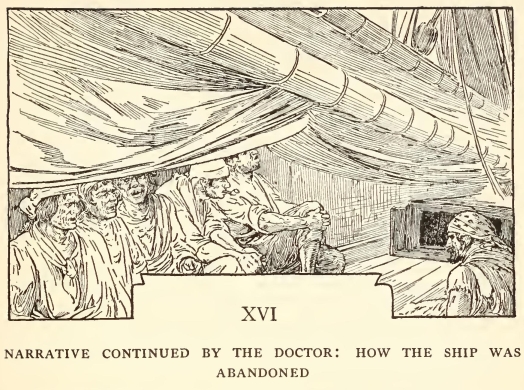
They were a good deal taken aback, and after a little consultation one and all tumbled down the fore companion, thinking no doubt to take us on the rear. But when they saw Redruth waiting for them in the sparred galley, they went about ship at once, and a head popped out again on deck.
They were quite startled. After a brief discussion, they all hurried down the forward stairway, no doubt hoping to attack us from behind. But when they saw Redruth waiting for them in the barred galley, they turned right around. A head popped back up on deck.
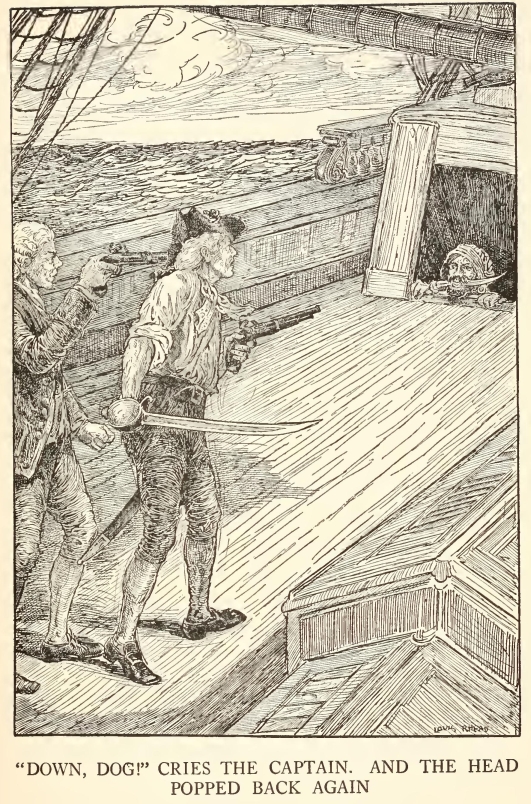
“Down, dog!” cries the captain.
“Down, dog!” the captain shouts.
And the head popped back again; and we heard no more, for the time, of these six very faint-hearted seamen.
The head popped back out of sight. For the time being, we heard no more from the six very timid sailors.
By this time, tumbling things in as they came, we had the jolly-boat loaded as much as we dared. Joyce and I got out through the stern-port, and we made for shore again as fast as oars could take us.
By then, we had tossed things into the jolly-boat as they came, loading it as full as we dared. Joyce and I climbed out through the stern opening. We rowed back to shore as fast as we could.
This second trip fairly aroused the watchers along shore. “Lillibullero” was dropped again; and just before we lost sight of them behind the little point, one of them whipped ashore and disappeared. I had half a mind to change my plan and destroy their boats, but I feared that Silver and the others might be close at hand, and all might very well be lost by trying for too much.
This second trip really stirred up the men watching along the shore. They stopped singing “Lillibullero” again. Just before the little point hid them from view, one of them rushed ashore and disappeared. I almost changed my plan and destroyed their boats. But I feared that Silver and the others might be nearby. We might very well lose everything by trying to do too much.
We had soon touched land in the same place as before and set to provision the block house. All three made the first journey, heavily laden, and tossed our stores over the palisade. Then, leaving Joyce to guard them—one man, to be sure, but with half a dozen muskets—Hunter and I returned to the jolly-boat and loaded ourselves once more. So we proceeded without pausing to take breath, till the whole cargo was bestowed, when the two servants took up their position in the block house, and I, with all my power, sculled back to the Hispaniola.
We soon landed at the same place as before and began stocking the block house. All three of us made the first trip, carrying heavy loads, and tossed our supplies over the palisade. Then we left Joyce to guard the supplies. He was only one man, it is true, but he had half a dozen muskets. Hunter and I returned to the jolly-boat and loaded ourselves once more. We continued without stopping to catch our breath until the whole cargo was stored. Then the two servants took up their positions in the block house, and I rowed back to the Hispaniola with all my strength.
That we should have risked a second boat load seems more daring than it really was. They had the advantage of numbers, of course, but we had the advantage of arms. Not one of the men ashore had a musket, and before they could get within range for pistol shooting, we flattered ourselves we should be able to give a good account of a half-dozen at least.
Risking a second boatload seems bolder than it really was. The men ashore had more people, of course, but we had the weapons. Not one of them had a musket. We believed we could take down at least half a dozen before they got close enough to shoot with pistols.
The squire was waiting for me at the stern window, all his faintness gone from him. He caught the painter and made it fast, and we fell to loading the boat for our very lives. Pork, powder, and biscuit was the cargo, with only a musket and a cutlass apiece for the squire and me and Redruth and the captain. The rest of the arms and powder we dropped overboard in two fathoms and a half of water, so that we could see the bright steel shining far below us in the sun, on the clean, sandy bottom.
The squire was waiting for me at the stern window, no longer feeling faint at all. He caught the boat’s rope and tied it fast. Then we loaded the boat as if our lives depended on it. The cargo was pork, gunpowder, and biscuits. The squire, Redruth, the captain, and I each had only a musket and a cutlass. We dropped the rest of the weapons and gunpowder overboard in fifteen feet of water. We could see the bright steel shining in the sun far below us, on the clean, sandy bottom.
By this time the tide was beginning to ebb, and the ship was swinging round to her anchor. Voices were heard faintly halloaing in the direction of the two gigs; and though this reassured us for Joyce and Hunter, who were well to the eastward, it warned our party to be off.
By this time, the tide was beginning to go out, and the ship was swinging around its anchor. We faintly heard voices calling out from the direction of the two gigs. This reassured us about Joyce and Hunter, who were well to the east. But it also warned our party to leave.
Redruth retreated from his place in the gallery and dropped into the boat, which we then brought round to the ship’s counter, to be handier for Captain Smollett.
Redruth left his position in the gallery and dropped into the boat. We then brought the boat around to the ship’s stern, so it would be closer to Captain Smollett.
“Now, men,” said he, “do you hear me?”
“Now, men,” he said, “can you hear me?”
There was no answer from the forecastle.
There was no answer from the crew's quarters.
“It’s to you, Abraham Gray—it’s to you I am speaking.”
“It’s you, Abraham Gray. I’m speaking to you.”
Still no reply.
Still no reply.
“Gray,” resumed Mr. Smollett, a little louder, “I am leaving this ship, and I order you to follow your captain. I know you are a good man at bottom, and I dare say not one of the lot of you’s as bad as he makes out. I have my watch here in my hand; I give you thirty seconds to join me in.”
“Gray,” Mr. Smollett continued, a little louder, “I am leaving this ship, and I order you to follow your captain. I know you are a good man at heart. I dare say none of you is as bad as he makes himself out to be. I have my watch in my hand. I give you thirty seconds to join me.”
There was a pause.
There was a pause.
“Come, my fine fellow,” continued the captain; “don’t hang so long in stays. I’m risking my life and the lives of these good gentlemen every second.”
“Come on, my good fellow,” the captain continued. “Don’t take so long to make up your mind. Every second, I’m risking my life and the lives of these good gentlemen.”
There was a sudden scuffle, a sound of blows, and out burst Abraham Gray with a knife cut on the side of the cheek, and came running to the captain like a dog to the whistle.
There was a sudden scuffle and the sound of blows. Abraham Gray burst out with a knife cut on his cheek. He ran to the captain like a dog answering a whistle.
“I’m with you, sir,” said he.
“I’m with you, sir,” he said.
And the next moment he and the captain had dropped aboard of us, and we had shoved off and given way.
The next moment, he and the captain climbed aboard our boat. We pushed off and began rowing.
We were clear out of the ship, but not yet ashore in our stockade.
We were completely off the ship, but we had not yet reached our stockade on shore.