Part 6, Chapter 31
The Treasure Hunt: Flint’s Pointer
Jim,” said Silver when we were alone, “if I saved your life, you saved mine; and I’ll not forget it. I seen the doctor waving you to run for it—with the tail of my eye, I did; and I seen you say no, as plain as hearing. Jim, that’s one to you. This is the first glint of hope I had since the attack failed, and I owe it you. And now, Jim, we’re to go in for this here treasure-hunting, with sealed orders too, and I don’t like it; and you and me must stick close, back to back like, and we’ll save our necks in spite o’ fate and fortune.”
“Jim,” said Silver when we were alone, “if I saved your life, you saved mine, and I won’t forget it. I saw the doctor waving for you to run, out of the corner of my eye. And I saw you say no, as clearly as if I’d heard you. Jim, that’s a point in your favor. It’s the first glimmer of hope I’ve had since the attack failed, and I owe it to you. And now, Jim, we’re going treasure hunting under sealed orders, and I don’t like it. You and I must stick close, back to back, so we can save our necks despite fate and fortune.”
Just then a man hailed us from the fire that breakfast was ready, and we were soon seated here and there about the sand over biscuit and fried junk. They had lit a fire fit to roast an ox, and it was now grown so hot that they could only approach it from the windward, and even there not without precaution. In the same wasteful spirit, they had cooked, I suppose, three times more than we could eat; and one of them, with an empty laugh, threw what was left into the fire, which blazed and roared again over this unusual fuel. I never in my life saw men so careless of the morrow; hand to mouth is the only word that can describe their way of doing; and what with wasted food and sleeping sentries, though they were bold enough for a brush and be done with it, I could see their entire unfitness for anything like a prolonged campaign.
Just then, a man called from the fire that breakfast was ready. Soon we were sitting here and there on the sand, eating biscuits and fried salt meat. They had built a fire big enough to roast an ox. It had grown so hot that they could only approach it from the side the wind was blowing from. Even there, they had to be careful. In the same wasteful spirit, they had cooked, I suppose, three times more than we could eat. One of them gave a hollow laugh and threw the leftovers into the fire. It blazed and roared again as it burned this unusual fuel. I had never seen men so careless about tomorrow. “Hand to mouth” is the only way to describe how they lived. They wasted food and let sentries sleep on duty. Though they were bold enough for a quick fight, I could see they were completely unfit for a long campaign.
Even Silver, eating away, with Captain Flint upon his shoulder, had not a word of blame for their recklessness. And this the more surprised me, for I thought he had never shown himself so cunning as he did then.
Even Silver, eating with Captain Flint on his shoulder, said nothing against their recklessness. This surprised me even more because I thought he had never shown himself to be so cunning as he did then.
“Aye, mates,” said he, “it’s lucky you have Barbecue to think for you with this here head. I got what I wanted, I did. Sure enough, they have the ship. Where they have it, I don’t know yet; but once we hit the treasure, we’ll have to jump about and find out. And then, mates, us that has the boats, I reckon, has the upper hand.”
“Yes, mates,” he said, “you’re lucky to have Barbecue here to do your thinking for you. I got what I wanted. Sure enough, they have the ship. I don’t know where they have it yet. But once we find the treasure, we’ll have to hurry and find out. And then, mates, I reckon we’ll have the upper hand because we have the boats.”
Thus he kept running on, with his mouth full of the hot bacon; thus he restored their hope and confidence, and, I more than suspect, repaired his own at the same time.
He kept talking with his mouth full of hot bacon. In this way, he restored their hope and confidence. I’m more than sure he restored his own at the same time.
“As for hostage,” he continued, “that’s his last talk, I guess, with them he loves so dear. I’ve got my piece o’ news, and thanky to him for that; but it’s over and done. I’ll take him in a line when we go treasure-hunting, for we’ll keep him like so much gold, in case of accidents, you mark, and in the meantime. Once we got the ship and treasure both and off to sea like jolly companions, why then we’ll talk Mr. Hawkins over, we will, and we’ll give him his share, to be sure, for all his kindness.”
“As for the hostage,” he continued, “I guess that was his last talk with the people he loves so dearly. I got my news, and I thank him for that, but the talk is over. I’ll keep him on a rope when we go treasure hunting. We’ll guard him like gold in case anything goes wrong, you understand, and until then. Once we have both the ship and the treasure and are at sea like good friends, we’ll discuss Mr. Hawkins. And we’ll give him his share, of course, for all his kindness.”
It was no wonder the men were in a good humour now. For my part, I was horribly cast down. Should the scheme he had now sketched prove feasible, Silver, already doubly a traitor, would not hesitate to adopt it. He had still a foot in either camp, and there was no doubt he would prefer wealth and freedom with the pirates to a bare escape from hanging, which was the best he had to hope on our side.
It was no wonder the men were in good spirits now. For my part, I was terribly discouraged. If the plan Silver had just outlined proved possible, he would not hesitate to follow it. He had already betrayed both sides, and he still had a foothold in each camp. There was no doubt he would prefer wealth and freedom with the pirates. On our side, the best he could hope for was to escape hanging.
Nay, and even if things so fell out that he was forced to keep his faith with Dr. Livesey, even then what danger lay before us! What a moment that would be when the suspicions of his followers turned to certainty and he and I should have to fight for dear life—he a cripple and I a boy—against five strong and active seamen!
But even if things turned out so that he was forced to keep his promise to Dr. Livesey, what danger still lay ahead of us! His followers' suspicions would turn to certainty, and he and I would have to fight for our lives. He was a cripple and I was a boy, and we would be fighting five strong, active sailors!
Add to this double apprehension the mystery that still hung over the behaviour of my friends, their unexplained desertion of the stockade, their inexplicable cession of the chart, or harder still to understand, the doctor’s last warning to Silver, “Look out for squalls when you find it,” and you will readily believe how little taste I found in my breakfast and with how uneasy a heart I set forth behind my captors on the quest for treasure.
Along with these two fears, I was still puzzled by my friends’ behavior. I could not explain why they had abandoned the stockade or given up the map. Even harder to understand was the doctor’s last warning to Silver: “Look out for squalls when you find it.” You can easily imagine how little appetite I had for breakfast. I set off behind my captors in search of the treasure with a deeply uneasy heart.
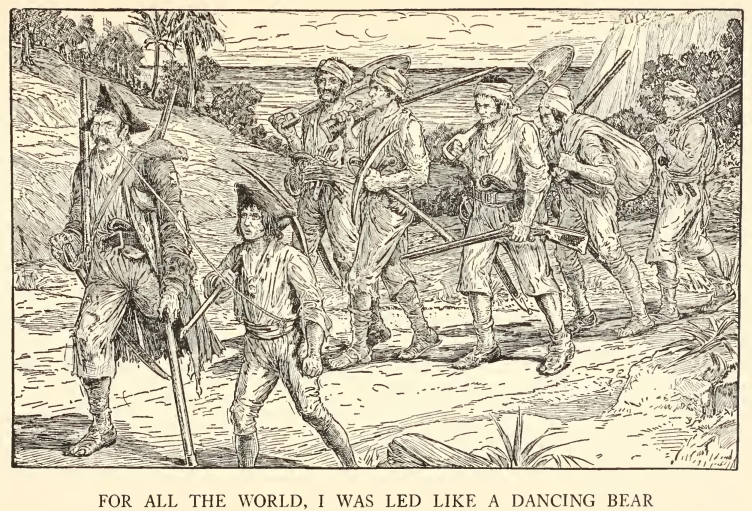
We made a curious figure, had anyone been there to see us—all in soiled sailor clothes and all but me armed to the teeth. Silver had two guns slung about him—one before and one behind—besides the great cutlass at his waist and a pistol in each pocket of his square-tailed coat. To complete his strange appearance, Captain Flint sat perched upon his shoulder and gabbling odds and ends of purposeless sea-talk. I had a line about my waist and followed obediently after the sea-cook, who held the loose end of the rope, now in his free hand, now between his powerful teeth. For all the world, I was led like a dancing bear.
We would have made a strange sight if anyone had been there to see us. We all wore dirty sailor clothes, and everyone but me was armed to the teeth. Silver had two guns slung over him, one in front and one behind. He also had a large cutlass at his waist and a pistol in each pocket of his square-tailed coat. To complete his strange appearance, Captain Flint perched on his shoulder, chattering scraps of meaningless sailor talk. I had a rope around my waist and followed obediently behind the sea-cook. He held the loose end of the rope, sometimes in his free hand and sometimes between his powerful teeth. I was led exactly like a dancing bear.
The other men were variously burthened, some carrying picks and shovels—for that had been the very first necessary they brought ashore from the Hispaniola—others laden with pork, bread, and brandy for the midday meal. All the stores, I observed, came from our stock, and I could see the truth of Silver’s words the night before. Had he not struck a bargain with the doctor, he and his mutineers, deserted by the ship, must have been driven to subsist on clear water and the proceeds of their hunting. Water would have been little to their taste; a sailor is not usually a good shot; and besides all that, when they were so short of eatables, it was not likely they would be very flush of powder.
The other men carried different loads. Some carried picks and shovels, the very first necessities they had brought ashore from the Hispaniola. Others carried pork, bread, and brandy for the midday meal. I noticed that all the supplies came from our stock, and I could see the truth of Silver’s words the night before. If he had not made a deal with the doctor, he and his mutineers would have been left without the ship. They would have had to live on plain water and whatever they could hunt. They would not have liked the water much. A sailor is not usually a good shot. Besides, since they were so short of food, they were not likely to have much gunpowder either.
Well, thus equipped, we all set out—even the fellow with the broken head, who should certainly have kept in shadow—and straggled, one after another, to the beach, where the two gigs awaited us. Even these bore trace of the drunken folly of the pirates, one in a broken thwart, and both in their muddy and unbailed condition. Both were to be carried along with us for the sake of safety; and so, with our numbers divided between them, we set forth upon the bosom of the anchorage.
Well, equipped like this, we all set out. Even the fellow with the broken head came, though he certainly should have stayed out of sight. We straggled one after another to the beach, where the two small boats awaited us. Even the boats showed signs of the pirates’ drunken foolishness. One had a broken bench, and both were muddy and still had water in them. We were taking both boats with us for safety. So we divided ourselves between them and set out across the anchorage.
As we pulled over, there was some discussion on the chart. The red cross was, of course, far too large to be a guide; and the terms of the note on the back, as you will hear, admitted of some ambiguity. They ran, the reader may remember, thus:
As we rowed over, we discussed the map. The red cross was, of course, far too large to serve as a guide. The wording of the note on the back was also open to interpretation, as you will hear. You may remember that the note read as follows:
Tall tree, Spy-glass shoulder, bearing a point to the N. of N.N.E. Skeleton Island E.S.E. and by E. Ten feet.
Tall tree, the shoulder of Spy-glass, bearing one point north of north-northeast. Skeleton Island, east-southeast and by east. Ten feet.
A tall tree was thus the principal mark. Now, right before us the anchorage was bounded by a plateau from two to three hundred feet high, adjoining on the north the sloping southern shoulder of the Spy-glass and rising again towards the south into the rough, cliffy eminence called the Mizzenmast Hill. The top of the plateau was dotted thickly with pine-trees of varying height. Every here and there, one of a different species rose forty or fifty feet clear above its neighbours, and which of these was the particular “tall tree” of Captain Flint could only be decided on the spot, and by the readings of the compass.
A tall tree was therefore the main landmark. Directly ahead of us, a plateau bordered the anchorage. The plateau was two to three hundred feet high. To the north, it joined the sloping southern shoulder of the Spy-glass. To the south, it rose again into the rugged, cliff-lined height called the Mizzenmast Hill. The top of the plateau was thickly covered with pine trees of varying heights. Here and there, a tree of a different species rose forty or fifty feet above its neighbors. Only on the spot, with compass readings, could we determine which was Captain Flint’s “tall tree”.
Yet, although that was the case, every man on board the boats had picked a favourite of his own ere we were half-way over, Long John alone shrugging his shoulders and bidding them wait till they were there.
Even so, before we were halfway across, every man in the boats had picked a favorite. Only Long John shrugged and told them to wait until they got there.
We pulled easily, by Silver’s directions, not to weary the hands prematurely, and after quite a long passage, landed at the mouth of the second river—that which runs down a woody cleft of the Spy-glass. Thence, bending to our left, we began to ascend the slope towards the plateau.
Following Silver’s directions, we rowed gently so we would not tire the crew too soon. After quite a long journey, we landed at the mouth of the second river. It runs down a wooded ravine on the Spy-glass. From there, we turned left and began climbing the slope toward the plateau.
At the first outset, heavy, miry ground and a matted, marish vegetation greatly delayed our progress; but by little and little the hill began to steepen and become stony under foot, and the wood to change its character and to grow in a more open order. It was, indeed, a most pleasant portion of the island that we were now approaching. A heavy-scented broom and many flowering shrubs had almost taken the place of grass. Thickets of green nutmeg-trees were dotted here and there with the red columns and the broad shadow of the pines; and the first mingled their spice with the aroma of the others. The air, besides, was fresh and stirring, and this, under the sheer sunbeams, was a wonderful refreshment to our senses.
At first, heavy, muddy ground and tangled marsh plants greatly slowed our progress. But little by little, the hill grew steeper and stony underfoot. The woods changed too, becoming more open. We were approaching a very pleasant part of the island. Strongly scented broom and many flowering shrubs had almost replaced the grass. Pines stood here and there among thickets of green nutmeg trees, with red trunks and broad shadows. The spicy scent of the nutmeg trees mingled with the aroma of the pines. The air was fresh and moving too, which was wonderfully refreshing to our senses under the direct sunlight.
The party spread itself abroad, in a fan shape, shouting and leaping to and fro. About the centre, and a good way behind the rest, Silver and I followed—I tethered by my rope, he ploughing, with deep pants, among the sliding gravel. From time to time, indeed, I had to lend him a hand, or he must have missed his footing and fallen backward down the hill.
The group spread out in a fan shape, shouting and jumping back and forth. Silver and I followed near the center, well behind the others. I was tied to him by a rope, while he struggled through the sliding gravel, panting heavily. From time to time, I had to give him a hand. Otherwise, he would have lost his footing and fallen backward down the hill.
We had thus proceeded for about half a mile and were approaching the brow of the plateau when the man upon the farthest left began to cry aloud, as if in terror. Shout after shout came from him, and the others began to run in his direction.
We had gone about half a mile and were approaching the edge of the plateau. Then the man on the far left began to cry out, as if terrified. He shouted again and again, and the others began to run toward him.
“He can’t ’a found the treasure,” said old Morgan, hurrying past us from the right, “for that’s clean a-top.”
“He can’t have found the treasure,” said old Morgan, hurrying past us from the right, “because it’s right on top.”
Indeed, as we found when we also reached the spot, it was something very different. At the foot of a pretty big pine and involved in a green creeper, which had even partly lifted some of the smaller bones, a human skeleton lay, with a few shreds of clothing, on the ground. I believe a chill struck for a moment to every heart.
Indeed, when we reached the spot, we found something very different. A human skeleton lay on the ground at the foot of a fairly large pine tree. A few shreds of clothing lay with it. The skeleton was tangled in a green vine, which had even partly lifted some of the smaller bones. I believe everyone felt a chill for a moment.
“He was a seaman,” said George Merry, who, bolder than the rest, had gone up close and was examining the rags of clothing. “Leastways, this is good sea-cloth.”
“He was a sailor,” said George Merry. Bolder than the others, he had gone close and was examining the rags of clothing. “At least, this is good sailor’s cloth.”
“Aye, aye,” said Silver; “like enough; you wouldn’t look to find a bishop here, I reckon. But what sort of a way is that for bones to lie? ’Tain’t in natur’.”
“Yes, yes,” said Silver. “Probably. I don’t suppose you’d expect to find a bishop here. But why are the bones lying like that? It’s not natural.”
Indeed, on a second glance, it seemed impossible to fancy that the body was in a natural position. But for some disarray (the work, perhaps, of the birds that had fed upon him or of the slow-growing creeper that had gradually enveloped his remains) the man lay perfectly straight—his feet pointing in one direction, his hands, raised above his head like a diver’s, pointing directly in the opposite.
Indeed, on a second look, it seemed impossible to believe the body was in a natural position. Apart from some disorder, the man lay perfectly straight. (The disorder was perhaps caused by birds that had fed on him or by the slow-growing vine that had gradually covered his remains.) His feet pointed one way, and his hands were raised above his head like a diver’s, pointing directly the other way.
“I’ve taken a notion into my old numbskull,” observed Silver. “Here’s the compass; there’s the tip-top p’int o’ Skeleton Island, stickin’ out like a tooth. Just take a bearing, will you, along the line of them bones.”
“I’ve got an idea in my old numbskull,” said Silver. “Here’s the compass. There’s the highest point of Skeleton Island, sticking out like a tooth. Take a bearing along the line of those bones, will you?”
It was done. The body pointed straight in the direction of the island, and the compass read duly E.S.E. and by E.
It was done. The body pointed straight toward the island, and the compass read E.S.E. and by E.
“I thought so,” cried the cook; “this here is a p’inter. Right up there is our line for the Pole Star and the jolly dollars. But, by thunder! If it don’t make me cold inside to think of Flint. This is one of his jokes, and no mistake. Him and these six was alone here; he killed ’em, every man; and this one he hauled here and laid down by compass, shiver my timbers! They’re long bones, and the hair’s been yellow. Aye, that would be Allardyce. You mind Allardyce, Tom Morgan?”
“I thought so,” cried the cook. “This here is a pointer. It points right up there, toward the Pole Star and the treasure. But, by thunder! Thinking of Flint makes me cold inside. This is one of his jokes, no mistake. He was alone here with these six men, and he killed every one of them. Then he dragged this one here and laid him down using a compass, shiver my timbers! The bones are long, and the hair was yellow. Yes, that would be Allardyce. Do you remember Allardyce, Tom Morgan?”
“Aye, aye,” returned Morgan; “I mind him; he owed me money, he did, and took my knife ashore with him.”
“Yes, yes,” Morgan replied. “I remember him. He owed me money, and he took my knife ashore with him.”
“Speaking of knives,” said another, “why don’t we find his’n lying round? Flint warn’t the man to pick a seaman’s pocket; and the birds, I guess, would leave it be.”
“Speaking of knives,” said another, “why don’t we find his lying around? Flint wasn’t the kind of man to pick a sailor’s pocket. And I guess the birds would leave the knife alone.”
“By the powers, and that’s true!” cried Silver.
“Good heavens, that’s true!” cried Silver.
“There ain’t a thing left here,” said Merry, still feeling round among the bones; “not a copper doit nor a baccy box. It don’t look nat’ral to me.”
“There’s nothing left here,” said Merry, still feeling around among the bones. “Not a single coin or tobacco box. It doesn’t look natural to me.”
“No, by gum, it don’t,” agreed Silver; “not nat’ral, nor not nice, says you. Great guns! Messmates, but if Flint was living, this would be a hot spot for you and me. Six they were, and six are we; and bones is what they are now.”
“No, by gum, it doesn’t,” Silver agreed. “Not natural or nice, as you say. Good grief, mates! If Flint were alive, this would be a dangerous spot for you and me. There were six of them, and there are six of us. And they’re nothing but bones now.”
“I saw him dead with these here deadlights,” said Morgan. “Billy took me in. There he laid, with penny-pieces on his eyes.”
“I saw him dead with my own eyes,” said Morgan. “Billy took me in. He was lying there with pennies on his eyes.”
“Dead—aye, sure enough he’s dead and gone below,” said the fellow with the bandage; “but if ever sperrit walked, it would be Flint’s. Dear heart, but he died bad, did Flint!”
“Dead, yes, he’s certainly dead and gone below,” said the man with the bandage. “But if any spirit ever walked, it would be Flint’s. Good Lord, Flint died badly!”
“Aye, that he did,” observed another; “now he raged, and now he hollered for the rum, and now he sang. ‘Fifteen Men’ were his only song, mates; and I tell you true, I never rightly liked to hear it since. It was main hot, and the windy was open, and I hear that old song comin’ out as clear as clear—and the death-haul on the man already.”
“Yes, he did,” said another. “Sometimes he raged, sometimes he shouted for rum, and sometimes he sang. ‘Fifteen Men’ was his only song, mates. And I tell you, I’ve never liked hearing it since. It was very hot, and the window was open. I heard that old song coming out as clear as could be, though death already had its grip on the man.”
“Come, come,” said Silver; “stow this talk. He’s dead, and he don’t walk, that I know; leastways, he won’t walk by day, and you may lay to that. Care killed a cat. Fetch ahead for the doubloons.”
“Come on,” said Silver. “Stop talking like that. He’s dead, and I know he doesn’t walk as a ghost. At least, he won’t walk by day, you can be sure of that. Worry killed a cat. Let’s go after the doubloons.”
We started, certainly; but in spite of the hot sun and the staring daylight, the pirates no longer ran separate and shouting through the wood, but kept side by side and spoke with bated breath. The terror of the dead buccaneer had fallen on their spirits.
We did set off. But despite the hot sun and bright daylight, the pirates no longer ran separately through the woods, shouting. They stayed side by side and spoke in hushed voices. The dead buccaneer had filled them with terror.