Part 6, Chapter 32
The Treasure Hunt: The Voice Among the Trees
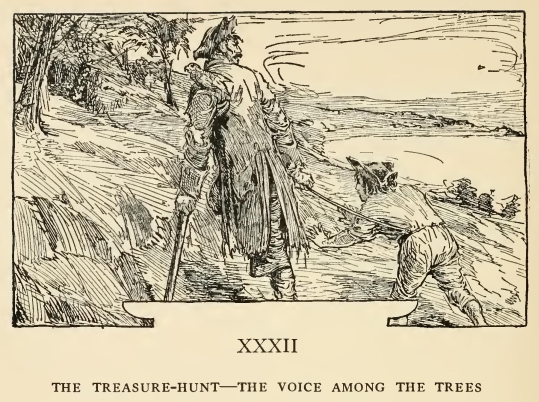
Partly from the damping influence of this alarm, partly to rest Silver and the sick folk, the whole party sat down as soon as they had gained the brow of the ascent.
The alarm had dampened their spirits, and Silver and the sick people needed rest. So the whole party sat down as soon as they reached the top of the climb.
The plateau being somewhat tilted towards the west, this spot on which we had paused commanded a wide prospect on either hand. Before us, over the tree-tops, we beheld the Cape of the Woods fringed with surf; behind, we not only looked down upon the anchorage and Skeleton Island, but saw—clear across the spit and the eastern lowlands—a great field of open sea upon the east. Sheer above us rose the Spy-glass, here dotted with single pines, there black with precipices. There was no sound but that of the distant breakers, mounting from all round, and the chirp of countless insects in the brush. Not a man, not a sail, upon the sea; the very largeness of the view increased the sense of solitude.
Because the plateau sloped slightly westward, the spot where we paused gave us a wide view in both directions. Ahead, above the treetops, we saw the Cape of the Woods, edged with surf. Behind us, we could look down on the anchorage and Skeleton Island. We could also see a vast stretch of open sea to the east, across the spit and the eastern lowlands. The Spy-glass rose steeply above us, dotted with lone pines in some places and dark with cliffs in others. The only sounds were the distant breakers rising from all around and the chirping of countless insects in the brush. There was not a person or a sail on the sea. The sheer size of the view made us feel even more alone.
Silver, as he sat, took certain bearings with his compass.
As Silver sat, he took some bearings with his compass.
“There are three ‘tall trees,’” said he, “about in the right line from Skeleton Island. ‘Spy-glass shoulder,’ I take it, means that lower p’int there. It’s child’s play to find the stuff now. I’ve half a mind to dine first.”
“There are three ‘tall trees,’” he said, “roughly in the right line from Skeleton Island. I think ‘Spy-glass shoulder’ means that lower point there. Finding the stuff is child’s play now. I’m half tempted to eat first.”
“I don’t feel sharp,” growled Morgan. “Thinkin’ o’ Flint—I think it were—as done me.”
“I don’t feel well,” growled Morgan. “I think it was thinking about Flint that did it to me.”
“Ah, well, my son, you praise your stars he’s dead,” said Silver.
“Ah, well, my son, count yourself lucky he’s dead,” said Silver.
“He were an ugly devil,” cried a third pirate with a shudder; “that blue in the face too!”
“He was an ugly devil,” cried a third pirate with a shudder. “And his face was so blue, too!”
“That was how the rum took him,” added Merry. “Blue! Well, I reckon he was blue. That’s a true word.”
“That’s how the rum affected him,” Merry added. “Blue! Well, I’d say he was blue. That’s the right word.”
Ever since they had found the skeleton and got upon this train of thought, they had spoken lower and lower, and they had almost got to whispering by now, so that the sound of their talk hardly interrupted the silence of the wood. All of a sudden, out of the middle of the trees in front of us, a thin, high, trembling voice struck up the well-known air and words:
Ever since they found the skeleton and began thinking along these lines, they had spoken more and more quietly. By now, they were almost whispering, so their talk hardly disturbed the silence of the woods. Suddenly, a thin, high, trembling voice came from among the trees ahead of us. It began singing the familiar tune and words:
“Fifteen men on the dead man’s chest— Yo-ho-ho, and a bottle of rum!”
“Fifteen men on the dead man’s chest, Yo-ho-ho, and a bottle of rum!”
I never have seen men more dreadfully affected than the pirates. The colour went from their six faces like enchantment; some leaped to their feet, some clawed hold of others; Morgan grovelled on the ground.
I had never seen men so terrified as the pirates. All six faces went pale as if by magic. Some jumped to their feet, and some grabbed hold of others. Morgan cowered on the ground.
“It’s Flint, by ——!” cried Merry.
“It’s Flint, damn it!” cried Merry.
The song had stopped as suddenly as it began—broken off, you would have said, in the middle of a note, as though someone had laid his hand upon the singer’s mouth. Coming through the clear, sunny atmosphere among the green tree-tops, I thought it had sounded airily and sweetly; and the effect on my companions was the stranger.
The song stopped as suddenly as it had begun. It broke off in the middle of a note, as if someone had put a hand over the singer’s mouth. Coming through the clear, sunny air among the green treetops, the song had sounded light and sweet to me. That made its effect on my companions all the stranger.
“Come,” said Silver, struggling with his ashen lips to get the word out; “this won’t do. Stand by to go about. This is a rum start, and I can’t name the voice, but it’s someone skylarking—someone that’s flesh and blood, and you may lay to that.”
“Come on,” said Silver, struggling to get the words past his ashen lips. “This won’t do. Get ready to turn the ship around. This is a strange situation, and I don’t recognize the voice. But someone is playing a trick. It’s someone made of flesh and blood, and you can be sure of that.”
His courage had come back as he spoke, and some of the colour to his face along with it. Already the others had begun to lend an ear to this encouragement and were coming a little to themselves, when the same voice broke out again—not this time singing, but in a faint distant hail that echoed yet fainter among the clefts of the Spy-glass.
As he spoke, his courage returned, and some color came back to his face. The others had begun to listen to his encouragement and were recovering a little. Then the same voice called out again. This time it was not singing, but calling faintly from a distance. The call echoed even more faintly among the clefts of the Spy-glass.
“Darby M’Graw,” it wailed—for that is the word that best describes the sound—“Darby M’Graw! Darby M’Graw!” again and again and again; and then rising a little higher, and with an oath that I leave out: “Fetch aft the rum, Darby!”
“Darby M’Graw,” it wailed. Wailed is the best word for the sound. “Darby M’Graw! Darby M’Graw!” it cried again and again. Then its voice rose a little higher, and it added an oath I will leave out: “Bring the rum aft, Darby!”
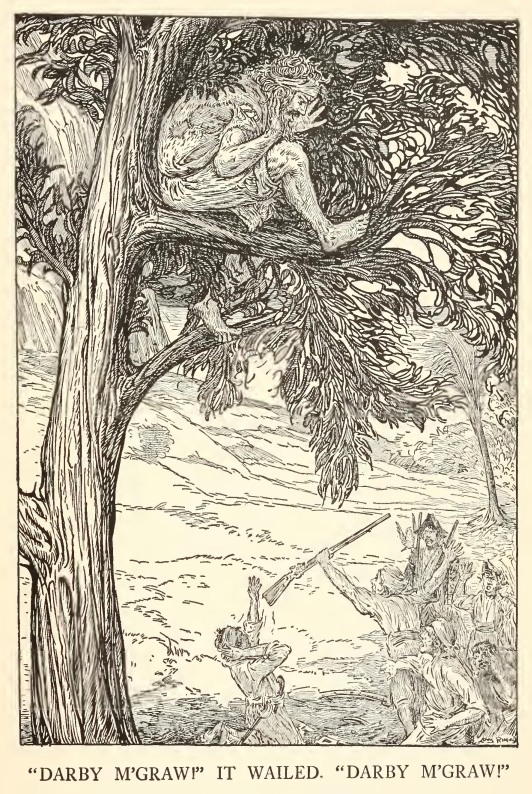
The buccaneers remained rooted to the ground, their eyes starting from their heads. Long after the voice had died away they still stared in silence, dreadfully, before them.
The buccaneers stood frozen, their eyes wide. Long after the voice had faded, they still stared ahead in silence, terrified.
“That fixes it!” gasped one. “Let’s go.”
“That settles it!” one of them gasped. “Let’s go.”
“They was his last words,” moaned Morgan, “his last words above board.”
“Those were his last words,” Morgan moaned, “his last words on deck.”
Dick had his Bible out and was praying volubly. He had been well brought up, had Dick, before he came to sea and fell among bad companions.
Dick had his Bible out and was praying at length. He had been well brought up before he went to sea and fell in with bad company.
Still Silver was unconquered. I could hear his teeth rattle in his head, but he had not yet surrendered.
Still, Silver was not beaten. I could hear his teeth chattering, but he had not yet surrendered.
“Nobody in this here island ever heard of Darby,” he muttered; “not one but us that’s here.” And then, making a great effort: “Shipmates,” he cried, “I’m here to get that stuff, and I’ll not be beat by man or devil. I never was feared of Flint in his life, and, by the powers, I’ll face him dead. There’s seven hundred thousand pound not a quarter of a mile from here. When did ever a gentleman o’ fortune show his stern to that much dollars for a boozy old seaman with a blue mug—and him dead too?”
“Nobody on this island has ever heard of Darby,” he muttered, “except those of us here.” Then, making a great effort, he cried, “Shipmates, I’m here to get that treasure. I won’t be beaten by man or devil. I was never afraid of Flint when he was alive, and, by heaven, I’ll face him dead. There’s seven hundred thousand pounds less than a quarter of a mile from here. When did a pirate ever turn his back on that much money because of a drunken old sailor with a blue face, especially when the sailor was dead?”
But there was no sign of reawakening courage in his followers, rather, indeed, of growing terror at the irreverence of his words.
But his followers showed no sign of renewed courage. Instead, they seemed increasingly terrified by the disrespect in his words.
“Belay there, John!” said Merry. “Don’t you cross a sperrit.”
“Stop right there, John!” said Merry. “Don’t you defy a spirit.”
And the rest were all too terrified to reply. They would have run away severally had they dared; but fear kept them together, and kept them close by John, as if his daring helped them. He, on his part, had pretty well fought his weakness down.
And all the others were too terrified to reply. They would each have run away if they had dared. But fear kept them together and close to John, as if his courage helped them. John, for his part, had almost overcome his weakness.
“Sperrit? Well, maybe,” he said. “But there’s one thing not clear to me. There was an echo. Now, no man ever seen a sperrit with a shadow; well then, what’s he doing with an echo to him, I should like to know? That ain’t in natur’, surely?”
“Spirit? Well, maybe,” he said. “But there’s one thing I don’t understand. There was an echo. Now, no one has ever seen a spirit with a shadow. So I’d like to know why a spirit would have an echo. Surely that’s not natural?”
This argument seemed weak enough to me. But you can never tell what will affect the superstitious, and to my wonder, George Merry was greatly relieved.
The argument seemed weak enough to me. But you can never tell what will affect superstitious people. To my surprise, George Merry was greatly relieved.
“Well, that’s so,” he said. “You’ve a head upon your shoulders, John, and no mistake. ’Bout ship, mates! This here crew is on a wrong tack, I do believe. And come to think on it, it was like Flint’s voice, I grant you, but not just so clear-away like it, after all. It was liker somebody else’s voice now—it was liker—”
“Well, that’s true,” he said. “You’ve got a good head on your shoulders, John, no mistake. Change course, mates! I believe this crew is on the wrong track. And now that I think about it, I admit the voice sounded like Flint’s, but not quite like his after all. It sounded more like someone else’s voice. It sounded more like . . .”
“By the powers, Ben Gunn!” roared Silver.
“Good heavens, Ben Gunn!” roared Silver.
“Aye, and so it were,” cried Morgan, springing on his knees. “Ben Gunn it were!”
“Yes, it was!” cried Morgan, springing to his knees. “It was Ben Gunn!”
“It don’t make much odds, do it, now?” asked Dick. “Ben Gunn’s not here in the body any more’n Flint.”
“It doesn’t make much difference now, does it?” asked Dick. “Ben Gunn isn’t here in person any more than Flint is.”
But the older hands greeted this remark with scorn.
But the more experienced sailors greeted the remark with scorn.
“Why, nobody minds Ben Gunn,” cried Merry; “dead or alive, nobody minds him.”
“Nobody cares about Ben Gunn,” cried Merry. “Dead or alive, nobody cares about him.”
It was extraordinary how their spirits had returned and how the natural colour had revived in their faces. Soon they were chatting together, with intervals of listening; and not long after, hearing no further sound, they shouldered the tools and set forth again, Merry walking first with Silver’s compass to keep them on the right line with Skeleton Island. He had said the truth: dead or alive, nobody minded Ben Gunn.
It was remarkable how quickly their spirits returned and color came back to their faces. Soon they were chatting together, pausing now and then to listen. Before long, having heard nothing more, they picked up the tools and set off again. Merry walked first, using Silver’s compass to keep them on course with Skeleton Island. He had told the truth: dead or alive, nobody worried about Ben Gunn.
Dick alone still held his Bible, and looked around him as he went, with fearful glances; but he found no sympathy, and Silver even joked him on his precautions.
Only Dick still held his Bible, glancing around fearfully as he went. But no one sympathized with him, and Silver even mocked him for taking precautions.
“I told you,” said he—“I told you you had sp’iled your Bible. If it ain’t no good to swear by, what do you suppose a sperrit would give for it? Not that!” and he snapped his big fingers, halting a moment on his crutch.
“I told you,” he said. “I told you you had spoiled your Bible. If it’s no good to swear by, what do you suppose a spirit would give for it? Not that!” He snapped his big fingers, stopping for a moment on his crutch.
But Dick was not to be comforted; indeed, it was soon plain to me that the lad was falling sick; hastened by heat, exhaustion, and the shock of his alarm, the fever, predicted by Dr. Livesey, was evidently growing swiftly higher.
But Dick could not be comforted. Soon, I could see that the lad was falling sick. The fever Dr. Livesey had predicted was clearly rising fast, made worse by heat, exhaustion, and the shock of his fright.
It was fine open walking here, upon the summit; our way lay a little downhill, for, as I have said, the plateau tilted towards the west. The pines, great and small, grew wide apart; and even between the clumps of nutmeg and azalea, wide open spaces baked in the hot sunshine. Striking, as we did, pretty near north-west across the island, we drew, on the one hand, ever nearer under the shoulders of the Spy-glass, and on the other, looked ever wider over that western bay where I had once tossed and trembled in the coracle.
The summit was open and pleasant to walk on. Our path led slightly downhill because, as I have said, the plateau sloped west. Pines of all sizes stood far apart. Even between the clumps of nutmeg and azalea, wide open spaces baked in the hot sunshine. We headed almost northwest across the island, drawing ever closer to the slopes of the Spy-glass on one side. On the other, we had an ever wider view of the western bay, where I had once tossed and trembled in the coracle.
The first of the tall trees was reached, and by the bearings proved the wrong one. So with the second. The third rose nearly two hundred feet into the air above a clump of underwood—a giant of a vegetable, with a red column as big as a cottage, and a wide shadow around in which a company could have manoeuvred. It was conspicuous far to sea both on the east and west and might have been entered as a sailing mark upon the chart.
They reached the first tall tree, but the bearings showed it was the wrong one. The second was wrong too. The third rose nearly two hundred feet above a clump of bushes. It was a giant of a tree, with a red trunk as big as a cottage. Its shadow spread wide enough for a company of men to manoeuvre in. The tree could be seen far out at sea to both the east and west. It could have been marked on the chart as a landmark for sailors.
But it was not its size that now impressed my companions; it was the knowledge that seven hundred thousand pounds in gold lay somewhere buried below its spreading shadow. The thought of the money, as they drew nearer, swallowed up their previous terrors. Their eyes burned in their heads; their feet grew speedier and lighter; their whole soul was bound up in that fortune, that whole lifetime of extravagance and pleasure, that lay waiting there for each of them.
But it was not its size that impressed my companions now. They knew that seven hundred thousand pounds in gold lay buried somewhere beneath its spreading shadow. As they drew nearer, the thought of the money drove away their earlier fears. Their eyes burned, and their steps grew quicker and lighter. Their whole souls were fixed on that fortune, which promised each of them a lifetime of luxury and pleasure.
Silver hobbled, grunting, on his crutch; his nostrils stood out and quivered; he cursed like a madman when the flies settled on his hot and shiny countenance; he plucked furiously at the line that held me to him and from time to time turned his eyes upon me with a deadly look. Certainly he took no pains to hide his thoughts, and certainly I read them like print. In the immediate nearness of the gold, all else had been forgotten: his promise and the doctor’s warning were both things of the past, and I could not doubt that he hoped to seize upon the treasure, find and board the Hispaniola under cover of night, cut every honest throat about that island, and sail away as he had at first intended, laden with crimes and riches.
Silver hobbled along on his crutch, grunting. His nostrils flared and quivered. He cursed like a madman when flies settled on his hot, shiny face. He tugged furiously at the rope that bound me to him. From time to time, he turned his eyes on me with a deadly look. He certainly made no effort to hide his thoughts, and I could certainly read them as plainly as print. Now that the gold was so close, he had forgotten everything else. His promise and the doctor’s warning were both things of the past. I had no doubt about his hopes. He meant to seize the treasure, find and board the Hispaniola under cover of night, and cut every honest throat on the island. Then he would sail away as he had originally planned, laden with crimes and riches.
Shaken as I was with these alarms, it was hard for me to keep up with the rapid pace of the treasure-hunters. Now and again I stumbled, and it was then that Silver plucked so roughly at the rope and launched at me his murderous glances. Dick, who had dropped behind us and now brought up the rear, was babbling to himself both prayers and curses as his fever kept rising. This also added to my wretchedness, and to crown all, I was haunted by the thought of the tragedy that had once been acted on that plateau, when that ungodly buccaneer with the blue face—he who died at Savannah, singing and shouting for drink—had there, with his own hand, cut down his six accomplices. This grove that was now so peaceful must then have rung with cries, I thought; and even with the thought I could believe I heard it ringing still.
Shaken by these alarms, I struggled to keep up with the treasure hunters’ fast pace. Now and then I stumbled. When I did, Silver pulled roughly at the rope and shot me murderous glances. Dick had fallen behind us and was now at the rear. As his fever rose, he muttered prayers and curses to himself. This made me even more miserable. Worst of all, I was haunted by the thought of the tragedy that had once taken place on that plateau. There, the godless buccaneer with the blue face had killed his six accomplices with his own hand. He was the man who died at Savannah, singing and shouting for drink. I thought the grove, so peaceful now, must have echoed with cries then. Even as I thought of it, I could almost believe I still heard those cries echoing.
We were now at the margin of the thicket.
We were now at the edge of the thicket.
“Huzza, mates, all together!” shouted Merry; and the foremost broke into a run.
“Hooray, mates, all together!” shouted Merry, and those in front broke into a run.
And suddenly, not ten yards further, we beheld them stop. A low cry arose. Silver doubled his pace, digging away with the foot of his crutch like one possessed; and next moment he and I had come also to a dead halt.
Suddenly, we saw them stop less than ten yards ahead. A low cry went up. Silver doubled his pace, driving the foot of his crutch into the ground like a man possessed. A moment later, he and I also stopped dead.
Before us was a great excavation, not very recent, for the sides had fallen in and grass had sprouted on the bottom. In this were the shaft of a pick broken in two and the boards of several packing-cases strewn around. On one of these boards I saw, branded with a hot iron, the name Walrus—the name of Flint’s ship.
Before us was a large pit that had been dug some time ago. Its sides had collapsed, and grass had grown on the bottom. Inside lay a pick handle broken in two and boards from several packing cases. On one board, I saw the name Walrus branded into the wood with a hot iron. It was the name of Flint’s ship.
All was clear to probation. The cache had been found and rifled; the seven hundred thousand pounds were gone!
Everything was clear beyond doubt. The cache had been found and emptied. The seven hundred thousand pounds were gone!