Part 6, Chapter 30
On Parole
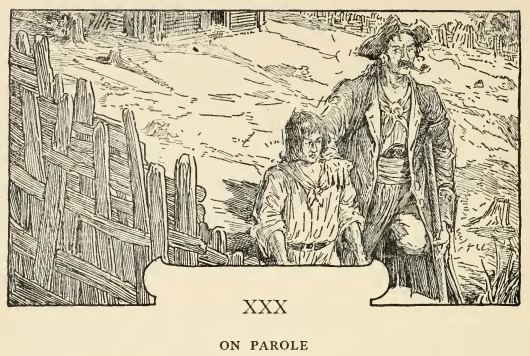
I was wakened—indeed, we were all wakened, for I could see even the sentinel shake himself together from where he had fallen against the door-post—by a clear, hearty voice hailing us from the margin of the wood:
I was woken by a clear, hearty voice calling to us from the edge of the woods. In fact, we were all woken. I could see even the sentry rousing himself from where he had slumped against the doorpost:
“Block house, ahoy!” it cried. “Here’s the doctor.”
“Hello, blockhouse!” it called. “Here’s the doctor.”
And the doctor it was. Although I was glad to hear the sound, yet my gladness was not without admixture. I remembered with confusion my insubordinate and stealthy conduct, and when I saw where it had brought me—among what companions and surrounded by what dangers—I felt ashamed to look him in the face.
And it was the doctor. Although I was glad to hear his voice, my happiness was mixed with other feelings. I remembered with embarrassment how I had disobeyed orders and acted secretly. I saw where my actions had brought me, among such companions and surrounded by such dangers. I felt ashamed to look him in the face.
He must have risen in the dark, for the day had hardly come; and when I ran to a loophole and looked out, I saw him standing, like Silver once before, up to the mid-leg in creeping vapour.
He must have gotten up in the dark, because the day had hardly begun. When I ran to a lookout opening and looked out, I saw him standing in mist that drifted halfway up his legs. Silver had stood there the same way once before.
“You, doctor! Top o’ the morning to you, sir!” cried Silver, broad awake and beaming with good nature in a moment. “Bright and early, to be sure; and it’s the early bird, as the saying goes, that gets the rations. George, shake up your timbers, son, and help Dr. Livesey over the ship’s side. All a-doin’ well, your patients was—all well and merry.”
“Doctor! Good morning to you, sir!” cried Silver, instantly wide awake and beaming with good cheer. “Bright and early, indeed. And as the saying goes, the early bird gets the rations. George, get moving, son, and help Dr. Livesey over the side of the ship. Your patients were all doing well, all well and cheerful.”
So he pattered on, standing on the hilltop with his crutch under his elbow and one hand upon the side of the log-house—quite the old John in voice, manner, and expression.
He kept chattering as he stood on the hilltop, his crutch under his arm and one hand on the log cabin. His voice, manner, and expression were just like the old John.
“We’ve quite a surprise for you too, sir,” he continued. “We’ve a little stranger here—he! he! A noo boarder and lodger, sir, and looking fit and taut as a fiddle; slep’ like a supercargo, he did, right alongside of John—stem to stem we was, all night.”
“We have quite a surprise for you too, sir,” he continued. “We have a little stranger here, he! he! A new boarder and lodger, sir, looking as fit as a fiddle. He slept like a supercargo, right alongside John. We were head to head all night.”
Dr. Livesey was by this time across the stockade and pretty near the cook, and I could hear the alteration in his voice as he said, “Not Jim?”
By then, Dr. Livesey had crossed the stockade and was close to the cook. I could hear his voice change as he said, “Not Jim?”
“The very same Jim as ever was,” says Silver.
“Same old Jim as ever,” says Silver.
The doctor stopped outright, although he did not speak, and it was some seconds before he seemed able to move on.
The doctor stopped suddenly, though he said nothing. It was a few seconds before he seemed able to move on.
“Well, well,” he said at last, “duty first and pleasure afterwards, as you might have said yourself, Silver. Let us overhaul these patients of yours.”
“Well, well,” he said at last, “work first and pleasure afterward, as you might say yourself, Silver. Let’s examine these patients of yours.”
A moment afterwards he had entered the block house and with one grim nod to me proceeded with his work among the sick. He seemed under no apprehension, though he must have known that his life, among these treacherous demons, depended on a hair; and he rattled on to his patients as if he were paying an ordinary professional visit in a quiet English family. His manner, I suppose, reacted on the men, for they behaved to him as if nothing had occurred, as if he were still ship’s doctor and they still faithful hands before the mast.
A moment later, he entered the blockhouse. He gave me one grim nod and went to work among the sick. He seemed unafraid, though he must have known his life hung by a thread among these treacherous demons. He chatted away to his patients as if he were making an ordinary professional visit to a quiet English family. I suppose his manner influenced the men, for they treated him as if nothing had happened. They acted as if he were still the ship’s doctor and they were still loyal sailors.
“You’re doing well, my friend,” he said to the fellow with the bandaged head, “and if ever any person had a close shave, it was you; your head must be as hard as iron. Well, George, how goes it? You’re a pretty colour, certainly; why, your liver, man, is upside down. Did you take that medicine? Did he take that medicine, men?”
“You’re doing well, my friend,” he said to the man with the bandaged head. “If anyone ever had a close call, it was you. Your head must be as hard as iron. Well, George, how are you? You’re certainly a strange color. Why, man, your liver is upside down. Did you take that medicine? Men, did he take that medicine?”
“Aye, aye, sir, he took it, sure enough,” returned Morgan.
“Yes, sir, he definitely took it,” Morgan replied.
“Because, you see, since I am mutineers’ doctor, or prison doctor as I prefer to call it,” says Doctor Livesey in his pleasantest way, “I make it a point of honour not to lose a man for King George (God bless him!) and the gallows.”
“Because, you see, I’m the mutineers’ doctor, or the prison doctor, as I prefer to call myself,” says Doctor Livesey in his most pleasant manner, “I make it a point of honor not to lose a single man meant for King George (God bless him!) and the gallows.”
The rogues looked at each other but swallowed the home-thrust in silence.
The rogues looked at each other but took the pointed remark in silence.
“Dick don’t feel well, sir,” said one.
“Dick doesn’t feel well, sir,” said one.
“Don’t he?” replied the doctor. “Well, step up here, Dick, and let me see your tongue. No, I should be surprised if he did! The man’s tongue is fit to frighten the French. Another fever.”
“Doesn’t he?” replied the doctor. “Well, step up here, Dick, and let me see your tongue. No, I’d be surprised if he did! The man’s tongue is enough to frighten the French. Another fever.”
“Ah, there,” said Morgan, “that comed of sp’iling Bibles.”
“Ah, there,” said Morgan, “that’s what comes of spoiling Bibles.”
“That comes—as you call it—of being arrant asses,” retorted the doctor, “and not having sense enough to know honest air from poison, and the dry land from a vile, pestiferous slough. I think it most probable—though of course it’s only an opinion—that you’ll all have the deuce to pay before you get that malaria out of your systems. Camp in a bog, would you? Silver, I’m surprised at you. You’re less of a fool than many, take you all round; but you don’t appear to me to have the rudiments of a notion of the rules of health.
“That comes, as you call it, from being complete idiots,” the doctor shot back. “You don’t have enough sense to tell fresh air from poison, or dry land from a filthy, disease-ridden swamp. I think it’s very likely you’ll all suffer badly before you get that malaria out of your systems. Of course, that’s only my opinion. Camping in a bog, are you? Silver, I’m surprised at you. All things considered, you’re less of a fool than many. But you don’t seem to have even the slightest idea how to stay healthy.
“Well,” he added after he had dosed them round and they had taken his prescriptions, with really laughable humility, more like charity schoolchildren than blood-guilty mutineers and pirates—“well, that’s done for today. And now I should wish to have a talk with that boy, please.”
“Well,” he added after he had given them all their medicine. They had taken it with almost laughable humility, more like charity schoolchildren than murderous mutineers and pirates. “That’s done for today. Now I’d like to talk to that boy, please.”
And he nodded his head in my direction carelessly.
And he casually nodded in my direction.
George Merry was at the door, spitting and spluttering over some bad-tasted medicine; but at the first word of the doctor’s proposal he swung round with a deep flush and cried “No!” and swore.
George Merry was at the door, spitting and spluttering over some foul-tasting medicine. But as soon as the doctor began to make his proposal, George spun around, his face deeply flushed. He cried “No!” and swore.
Silver struck the barrel with his open hand.
Silver hit the barrel with his open hand.
“Si-lence!” he roared and looked about him positively like a lion. “Doctor,” he went on in his usual tones, “I was a-thinking of that, knowing as how you had a fancy for the boy. We’re all humbly grateful for your kindness, and as you see, puts faith in you and takes the drugs down like that much grog. And I take it I’ve found a way as’ll suit all. Hawkins, will you give me your word of honour as a young gentleman—for a young gentleman you are, although poor born—your word of honour not to slip your cable?”
“Silence!” he roared, looking around him just like a lion. “Doctor,” he continued in his usual voice, “I was thinking about that, knowing you’re fond of the boy. We’re all humbly grateful for your kindness. As you can see, we trust you and swallow the medicine as readily as grog. And I think I’ve found a way that will suit everyone. Hawkins, you’re a young gentleman, though you were born poor. Will you give me your word of honor as a young gentleman that you won’t run away?”
I readily gave the pledge required.
I willingly made the promise they required.
“Then, doctor,” said Silver, “you just step outside o’ that stockade, and once you’re there I’ll bring the boy down on the inside, and I reckon you can yarn through the spars. Good day to you, sir, and all our dooties to the squire and Cap’n Smollett.”
“Then, doctor,” said Silver, “just step outside the stockade. Once you’re outside, I’ll bring the boy down on the inside. I reckon you can talk through the wooden posts. Good day to you, sir, and give all our respects to the squire and Captain Smollett.”
The explosion of disapproval, which nothing but Silver’s black looks had restrained, broke out immediately the doctor had left the house. Silver was roundly accused of playing double—of trying to make a separate peace for himself, of sacrificing the interests of his accomplices and victims, and, in one word, of the identical, exact thing that he was doing. It seemed to me so obvious, in this case, that I could not imagine how he was to turn their anger. But he was twice the man the rest were, and his last night’s victory had given him a huge preponderance on their minds. He called them all the fools and dolts you can imagine, said it was necessary I should talk to the doctor, fluttered the chart in their faces, asked them if they could afford to break the treaty the very day they were bound a-treasure-hunting.
As soon as the doctor left the house, the men burst out in protest. Only Silver’s angry looks had held them back. They openly accused Silver of playing both sides. They said he was trying to make a separate peace for himself and sacrificing the interests of his accomplices and victims. In short, they accused him of doing exactly what he was doing. It seemed so obvious to me that I could not imagine how he would calm their anger. But he was twice the man any of the others were, and his victory the night before had given him enormous influence over them. He called them every kind of fool and idiot you can imagine. He said it was necessary for me to talk to the doctor. He waved the map in their faces and asked if they could afford to break the treaty on the very day they were setting out to hunt for treasure.
“No, by thunder!” he cried. “It’s us must break the treaty when the time comes; and till then I’ll gammon that doctor, if I have to ile his boots with brandy.”
“No, by thunder!” he cried. “We must be the ones to break the treaty when the time comes. Until then, I’ll fool that doctor, even if I have to oil his boots with brandy.”
And then he bade them get the fire lit, and stalked out upon his crutch, with his hand on my shoulder, leaving them in a disarray, and silenced by his volubility rather than convinced.
Then he told them to light the fire and strode out on his crutch, with his hand on my shoulder. He left them in confusion, silenced by his torrent of words rather than convinced.
“Slow, lad, slow,” he said. “They might round upon us in a twinkle of an eye if we was seen to hurry.”
“Slowly, lad, slowly,” he said. “They might turn on us in an instant if they saw us rushing.”
Very deliberately, then, did we advance across the sand to where the doctor awaited us on the other side of the stockade, and as soon as we were within easy speaking distance Silver stopped.
We walked very deliberately across the sand toward the doctor, who was waiting on the other side of the stockade. As soon as we were close enough to speak easily, Silver stopped.
“You’ll make a note of this here also, doctor,” says he, “and the boy’ll tell you how I saved his life, and were deposed for it too, and you may lay to that. Doctor, when a man’s steering as near the wind as me—playing chuck-farthing with the last breath in his body, like—you wouldn’t think it too much, mayhap, to give him one good word? You’ll please bear in mind it’s not my life only now—it’s that boy’s into the bargain; and you’ll speak me fair, doctor, and give me a bit o’ hope to go on, for the sake of mercy.”
“You’ll make a note of this too, doctor,” he said. “And the boy will tell you how I saved his life and was removed as captain for it. You can count on that. Doctor, when a man is as close to danger as I am, gambling with his last breath, perhaps you wouldn’t think it too much to give him one good word? Please remember, it’s not just my life now. The boy’s life is at stake too. So speak kindly to me, doctor, and give me a little hope to carry on, for mercy’s sake.”
Silver was a changed man once he was out there and had his back to his friends and the block house; his cheeks seemed to have fallen in, his voice trembled; never was a soul more dead in earnest.
Silver was a changed man once he was out there, with his back to his friends and the blockhouse. His cheeks seemed sunken, and his voice trembled. No one had ever been more genuinely serious.
“Why, John, you’re not afraid?” asked Dr. Livesey.
“John, you’re not afraid, are you?” asked Dr. Livesey.
“Doctor, I’m no coward; no, not I—not so much!” and he snapped his fingers. “If I was I wouldn’t say it. But I’ll own up fairly, I’ve the shakes upon me for the gallows. You’re a good man and a true; I never seen a better man! And you’ll not forget what I done good, not any more than you’ll forget the bad, I know. And I step aside—see here—and leave you and Jim alone. And you’ll put that down for me too, for it’s a long stretch, is that!”
“Doctor, I’m no coward. No, not me, not that much!” He snapped his fingers. “If I were a coward, I wouldn’t say so. But I’ll admit it, I’m scared of the gallows. You’re a good and honest man. I’ve never seen a better one! And I know you won’t forget the good I’ve done, any more than you’ll forget the bad. And I’m stepping aside, see, and leaving you and Jim alone. You’ll give me credit for that too, because it’s a lot to ask!”
So saying, he stepped back a little way, till he was out of earshot, and there sat down upon a tree-stump and began to whistle, spinning round now and again upon his seat so as to command a sight, sometimes of me and the doctor and sometimes of his unruly ruffians as they went to and fro in the sand between the fire—which they were busy rekindling—and the house, from which they brought forth pork and bread to make the breakfast.
After saying this, he stepped back until he was out of earshot. He sat down on a tree stump and began to whistle. Now and then, he turned on his seat so he could watch me and the doctor, then his unruly ruffians. The ruffians were going back and forth across the sand between the fire and the house. They were busy rekindling the fire and bringing pork and bread out of the house for breakfast.
“So, Jim,” said the doctor sadly, “here you are. As you have brewed, so shall you drink, my boy. Heaven knows, I cannot find it in my heart to blame you, but this much I will say, be it kind or unkind: when Captain Smollett was well, you dared not have gone off; and when he was ill and couldn’t help it, by George, it was downright cowardly!”
“So, Jim,” said the doctor sadly, “here you are. You’ll have to live with the consequences of what you’ve done, my boy. Heaven knows, I can’t bring myself to blame you. But I will say this, whether it’s kind or not: when Captain Smollett was well, you wouldn’t have dared to go off. And when he was ill and couldn’t stop you, by George, it was downright cowardly!”
I will own that I here began to weep. “Doctor,” I said, “you might spare me. I have blamed myself enough; my life’s forfeit anyway, and I should have been dead by now if Silver hadn’t stood for me; and doctor, believe this, I can die—and I dare say I deserve it—but what I fear is torture. If they come to torture me—”
I admit that I began to cry. “Doctor,” I said, “you could spare me this. I’ve blamed myself enough. My life is already forfeit, and I’d be dead by now if Silver hadn’t stood up for me. And doctor, believe me, I can die. I dare say I deserve to. But what I fear is torture. If they come to torture me...”
“Jim,” the doctor interrupted, and his voice was quite changed, “Jim, I can’t have this. Whip over, and we’ll run for it.”
“Jim,” the doctor interrupted. His voice had changed completely. “Jim, I can’t allow this. Come over, and we’ll run for it.”
“Doctor,” said I, “I passed my word.”
“Doctor,” I said, “I gave my word.”
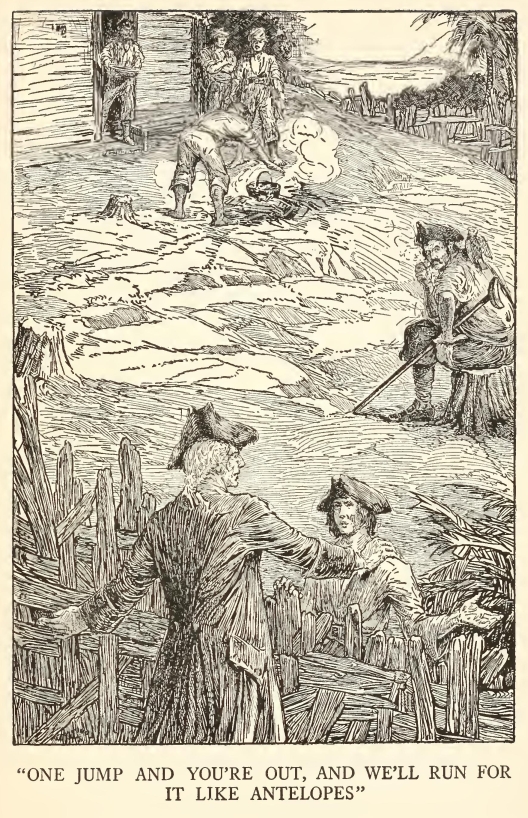
“I know, I know,” he cried. “We can’t help that, Jim, now. I’ll take it on my shoulders, holus bolus, blame and shame, my boy; but stay here, I cannot let you. Jump! One jump, and you’re out, and we’ll run for it like antelopes.”
“I know, I know,” he cried. “We can’t help that now, Jim. I’ll take all the blame and shame on myself, my boy. But I can’t let you stay here. Jump! One jump and you’re out, and we’ll run for it like antelopes.”
“No,” I replied; “you know right well you wouldn’t do the thing yourself—neither you nor squire nor captain; and no more will I. Silver trusted me; I passed my word, and back I go. But, doctor, you did not let me finish. If they come to torture me, I might let slip a word of where the ship is, for I got the ship, part by luck and part by risking, and she lies in North Inlet, on the southern beach, and just below high water. At half tide she must be high and dry.”
“No,” I replied. “You know very well you wouldn’t do it yourself. Neither would the squire or the captain, and neither will I. Silver trusted me. I gave my word, and I’m going back. But, doctor, you didn’t let me finish. If they torture me, I might let slip where the ship is. I got the ship partly through luck and partly by taking risks. She’s in North Inlet, on the southern beach, just below the high water mark. At half tide, she must be high and dry.”
“The ship!” exclaimed the doctor.
“The ship!” the doctor exclaimed.
Rapidly I described to him my adventures, and he heard me out in silence.
I quickly told him about my adventures, and he listened in silence until I finished.
“There is a kind of fate in this,” he observed when I had done. “Every step, it’s you that saves our lives; and do you suppose by any chance that we are going to let you lose yours? That would be a poor return, my boy. You found out the plot; you found Ben Gunn—the best deed that ever you did, or will do, though you live to ninety. Oh, by Jupiter, and talking of Ben Gunn! Why, this is the mischief in person. Silver!” he cried. “Silver! I’ll give you a piece of advice,” he continued as the cook drew near again; “don’t you be in any great hurry after that treasure.”
“There’s a kind of fate at work here,” he said when I had finished. “At every turn, you save our lives. Do you really think we’re going to let you lose yours? That would be a poor way to repay you, my boy. You uncovered the plot. You found Ben Gunn. That’s the best thing you’ve ever done or ever will do, even if you live to ninety. Oh, by Jupiter, speaking of Ben Gunn! Why, here comes trouble himself. Silver!” he cried. “Silver! I’ll give you some advice,” he continued as the cook came near again. “Don’t be in too much of a hurry to get that treasure.”
“Why, sir, I do my possible, which that ain’t,” said Silver. “I can only, asking your pardon, save my life and the boy’s by seeking for that treasure; and you may lay to that.”
“Why, sir, I do what I can, and that isn’t possible,” said Silver. “Begging your pardon, I can only save my life and the boy’s by looking for that treasure. You can be sure of that.”
“Well, Silver,” replied the doctor, “if that is so, I’ll go one step further: look out for squalls when you find it.”
“Well, Silver,” the doctor replied, “if that’s true, I’ll go one step further: watch out for trouble when you find it.”
“Sir,” said Silver, “as between man and man, that’s too much and too little. What you’re after, why you left the block house, why you given me that there chart, I don’t know, now, do I? And yet I done your bidding with my eyes shut and never a word of hope! But no, this here’s too much. If you won’t tell me what you mean plain out, just say so and I’ll leave the helm.”
“Sir,” said Silver, “speaking man to man, that’s too much and too little. I don’t know what you’re after, why you left the blockhouse, or why you gave me that map, do I? Yet I did what you asked without question, and you never gave me a word of hope! But no, this is too much. If you won’t tell me plainly what you mean, just say so, and I’ll leave the helm.”
“No,” said the doctor musingly; “I’ve no right to say more; it’s not my secret, you see, Silver, or, I give you my word, I’d tell it you. But I’ll go as far with you as I dare go, and a step beyond, for I’ll have my wig sorted by the captain or I’m mistaken! And first, I’ll give you a bit of hope; Silver, if we both get alive out of this wolf-trap, I’ll do my best to save you, short of perjury.”
“No,” the doctor said thoughtfully. “I have no right to say more. It’s not my secret, you see, Silver. Otherwise, I give you my word, I’d tell you. But I’ll tell you as much as I dare, and a little more. I expect the captain will give me a scolding for it! First, I’ll give you some hope. Silver, if we both get out of this wolf-trap alive, I’ll do my best to save you. But I won’t lie under oath.”
Silver’s face was radiant. “You couldn’t say more, I’m sure, sir, not if you was my mother,” he cried.
Silver’s face lit up. “I’m sure you couldn’t say more, sir, even if you were my mother,” he cried.
“Well, that’s my first concession,” added the doctor. “My second is a piece of advice: keep the boy close beside you, and when you need help, halloo. I’m off to seek it for you, and that itself will show you if I speak at random. Good-bye, Jim.”
“Well, that’s my first concession,” the doctor added. “My second is a piece of advice: keep the boy close beside you, and shout when you need help. I’m going to find help for you, and that alone will show you whether I know what I’m talking about. Goodbye, Jim.”
And Dr. Livesey shook hands with me through the stockade, nodded to Silver, and set off at a brisk pace into the wood.
Dr. Livesey shook hands with me through the stockade and nodded to Silver. Then he set off quickly into the woods.