Part 6, Chapter 29
The Black Spot Again
The council of buccaneers had lasted some time, when one of them re-entered the house, and with a repetition of the same salute, which had in my eyes an ironical air, begged for a moment’s loan of the torch. Silver briefly agreed, and this emissary retired again, leaving us together in the dark.
The buccaneers had been meeting for some time when one of them came back into the house. He gave the same salute again, which seemed ironic to me, and asked to borrow the torch for a moment. Silver briefly agreed, and the messenger left again, leaving us together in the dark.
“There’s a breeze coming, Jim,” said Silver, who had by this time adopted quite a friendly and familiar tone.
“There’s a breeze coming, Jim,” said Silver. By now, he was speaking in a very friendly and familiar way.
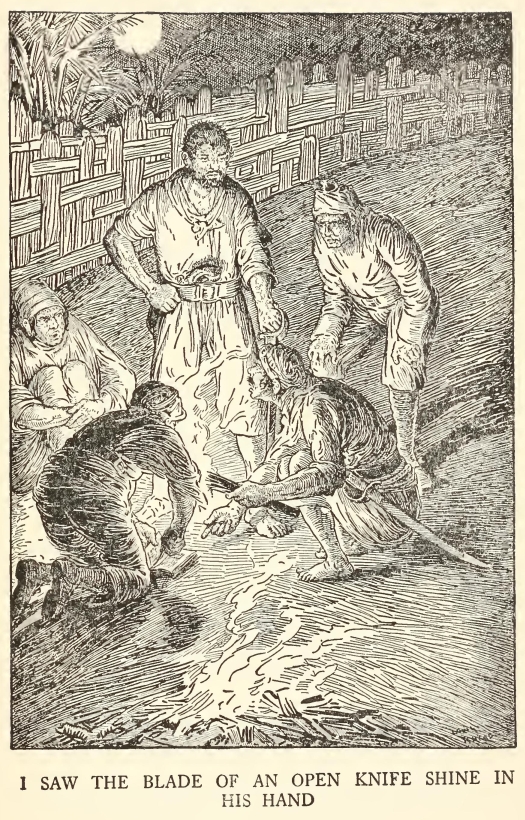
I turned to the loophole nearest me and looked out. The embers of the great fire had so far burned themselves out and now glowed so low and duskily that I understood why these conspirators desired a torch. About half-way down the slope to the stockade, they were collected in a group; one held the light, another was on his knees in their midst, and I saw the blade of an open knife shine in his hand with varying colours in the moon and torchlight. The rest were all somewhat stooping, as though watching the manoeuvres of this last. I could just make out that he had a book as well as a knife in his hand, and was still wondering how anything so incongruous had come in their possession when the kneeling figure rose once more to his feet and the whole party began to move together towards the house.
I turned to the nearest loophole and looked out. The embers of the great fire had burned so low and dim that I understood why the conspirators wanted a torch. They had gathered in a group about halfway down the slope to the stockade. One held the torch, while another knelt among them. I saw the blade of an open knife in his hand, shining in changing colors in the moonlight and torchlight. The rest were all bending slightly forward, as if watching what the kneeling man was doing. I could just make out that he held a book as well as a knife. I was still wondering how they had come to have something so out of place when the kneeling man stood up again. Then the whole group began to move toward the house together.
“Here they come,” said I; and I returned to my former position, for it seemed beneath my dignity that they should find me watching them.
“Here they come,” I said, and returned to my previous position. It seemed beneath my dignity to let them find me watching them.
“Well, let ’em come, lad—let ’em come,” said Silver cheerily. “I’ve still a shot in my locker.”
“Well, let them come, lad. Let them come,” said Silver cheerfully. “I still have a trick up my sleeve.”
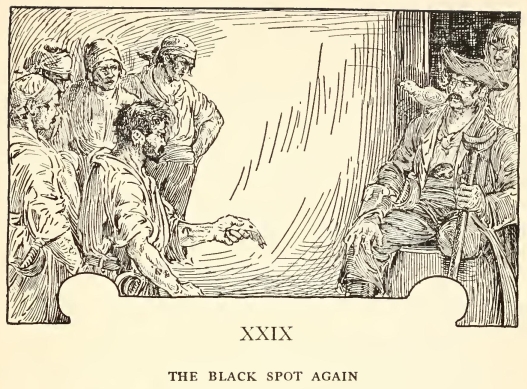
The door opened, and the five men, standing huddled together just inside, pushed one of their number forward. In any other circumstances it would have been comical to see his slow advance, hesitating as he set down each foot, but holding his closed right hand in front of him.
The door opened, and the five men huddled just inside pushed one of their group forward. In any other circumstances, his slow advance would have been comical. He hesitated with each step, but held his closed right hand out in front of him.
“Step up, lad,” cried Silver. “I won’t eat you. Hand it over, lubber. I know the rules, I do; I won’t hurt a depytation.”
“Come closer, lad,” cried Silver. “I won’t eat you. Hand it over, you fool. I know the rules, I do. I won’t hurt a representative.”
Thus encouraged, the buccaneer stepped forth more briskly, and having passed something to Silver, from hand to hand, slipped yet more smartly back again to his companions.
Encouraged by this, the buccaneer stepped forward more quickly and passed something into Silver’s hand. Then he hurried back to his companions even more quickly.
The sea-cook looked at what had been given him.
The ship's cook looked at what he had been given.
“The black spot! I thought so,” he observed. “Where might you have got the paper? Why, hillo! Look here, now; this ain’t lucky! You’ve gone and cut this out of a Bible. What fool’s cut a Bible?”
“The black spot! I thought so,” he said. “Where did you get the paper? Wait! Look at this. This is bad luck! You’ve cut it out of a Bible. What fool cut up a Bible?”
“Ah, there!” said Morgan. “There! Wot did I say? No good’ll come o’ that, I said.”
“Ah, there!” said Morgan. “There! What did I say? I said no good would come of that.”
“Well, you’ve about fixed it now, among you,” continued Silver. “You’ll all swing now, I reckon. What soft-headed lubber had a Bible?”
“Well, you’ve all made a mess of things now,” Silver continued. “I reckon you’ll all be hanged now. What fool had a Bible?”
“It was Dick,” said one.
“It was Dick,” said one.
“Dick, was it? Then Dick can get to prayers,” said Silver. “He’s seen his slice of luck, has Dick, and you may lay to that.”
“Dick, was it? Then Dick can start praying,” said Silver. “Dick’s had his share of luck, and you can count on that.”
But here the long man with the yellow eyes struck in.
But at this point, the tall man with yellow eyes interrupted.
“Belay that talk, John Silver,” he said. “This crew has tipped you the black spot in full council, as in dooty bound; just you turn it over, as in dooty bound, and see what’s wrote there. Then you can talk.”
“Stop that talk, John Silver,” he said. “The crew gave you the black spot in full council, as duty requires. Now turn it over, as duty requires, and see what’s written there. Then you can talk.”
“Thanky, George,” replied the sea-cook. “You always was brisk for business, and has the rules by heart, George, as I’m pleased to see. Well, what is it, anyway? Ah! ‘Deposed’—that’s it, is it? Very pretty wrote, to be sure; like print, I swear. Your hand o’ write, George? Why, you was gettin’ quite a leadin’ man in this here crew. You’ll be cap’n next, I shouldn’t wonder. Just oblige me with that torch again, will you? This pipe don’t draw.”
“Thanks, George,” replied the sea-cook. “You’ve always been quick to get down to business, and you know the rules by heart. I’m pleased to see that, George. Well, what is it, anyway? Ah! ‘Deposed.’ So that’s it, is it? Very nicely written, I must say. It’s like print, I swear. Is that your handwriting, George? Why, you’re becoming quite a leading man in this crew. I wouldn’t be surprised if you were captain next. Just hand me that torch again, will you? This pipe won’t draw.”
“Come, now,” said George, “you don’t fool this crew no more. You’re a funny man, by your account; but you’re over now, and you’ll maybe step down off that barrel and help vote.”
“Come on,” said George, “you can’t fool this crew anymore. You think you’re a funny man, but you’re finished now. Maybe you’ll step down from that barrel and help us vote.”
“I thought you said you knowed the rules,” returned Silver contemptuously. “Leastways, if you don’t, I do; and I wait here—and I’m still your cap’n, mind—till you outs with your grievances and I reply; in the meantime, your black spot ain’t worth a biscuit. After that, we’ll see.”
“I thought you said you knew the rules,” Silver replied contemptuously. “Anyway, if you don’t, I do. And I’ll wait here until you state your grievances and I answer them. Mind you, I’m still your captain. Until then, your black spot isn’t worth a biscuit. After that, we’ll see.”
“Oh,” replied George, “you don’t be under no kind of apprehension; we’re all square, we are. First, you’ve made a hash of this cruise—you’ll be a bold man to say no to that. Second, you let the enemy out o’ this here trap for nothing. Why did they want out? I dunno, but it’s pretty plain they wanted it. Third, you wouldn’t let us go at them upon the march. Oh, we see through you, John Silver; you want to play booty, that’s what’s wrong with you. And then, fourth, there’s this here boy.”
“Oh,” replied George, “don’t you worry. We’re all agreed. First, you’ve made a mess of this voyage. You’d have to be bold to deny that. Second, you let the enemy out of this trap for nothing. Why did they want out? I don’t know, but it’s pretty clear they did. Third, you wouldn’t let us attack them while they were on the march. Oh, we see through you, John Silver. You want to play both sides. That’s what’s wrong with you. And then, fourth, there’s this boy.”
“Is that all?” asked Silver quietly.
“Is that all?” Silver asked quietly.
“Enough, too,” retorted George. “We’ll all swing and sun-dry for your bungling.”
“More than enough,” George snapped. “We’ll all be hanged and left to dry in the sun because you messed up.”
“Well now, look here, I’ll answer these four p’ints; one after another I’ll answer ’em. I made a hash o’ this cruise, did I? Well now, you all know what I wanted, and you all know if that had been done that we’d ’a been aboard the Hispaniola this night as ever was, every man of us alive, and fit, and full of good plum-duff, and the treasure in the hold of her, by thunder! Well, who crossed me? Who forced my hand, as was the lawful cap’n? Who tipped me the black spot the day we landed and began this dance? Ah, it’s a fine dance—I’m with you there—and looks mighty like a hornpipe in a rope’s end at Execution Dock by London town, it does. But who done it? Why, it was Anderson, and Hands, and you, George Merry! And you’re the last above board of that same meddling crew; and you have the Davy Jones’s insolence to up and stand for cap’n over me—you, that sank the lot of us! By the powers! But this tops the stiffest yarn to nothing.”
“Well, look here, I’ll answer these four points, one after another. I made a mess of this voyage, did I? Well, you all know what I wanted. And you all know that if we’d done it, we’d be aboard the Hispaniola tonight. Every man of us would be alive, healthy, and full of good plum-duff, with the treasure in the hold, by thunder! Well, who opposed me? Who forced my hand, though I was the lawful captain? Who gave me the black spot on the day we landed and started this dance? Ah, it’s a fine dance, I agree with you there. It looks very much like dancing at the end of a hanging rope at Execution Dock in London. But who did it? Why, it was Anderson, Hands, and you, George Merry! You’re the last one alive from that same meddling crew. And you have the devil’s own nerve to stand for captain against me, you who sank us all! By the powers! This beats the wildest story ever told.”
Silver paused, and I could see by the faces of George and his late comrades that these words had not been said in vain.
Silver paused. I could see from the faces of George and his former comrades that his words had made an impression.
“That’s for number one,” cried the accused, wiping the sweat from his brow, for he had been talking with a vehemence that shook the house. “Why, I give you my word, I’m sick to speak to you. You’ve neither sense nor memory, and I leave it to fancy where your mothers was that let you come to sea. Sea! Gentlemen o’ fortune! I reckon tailors is your trade.”
“That’s number one,” cried the accused, wiping the sweat from his brow. He had been speaking so fiercely that he shook the house. “I give you my word, I’m sick of talking to you. You have neither sense nor memory. I can only imagine where your mothers were when they let you go to sea. Sea! Gentlemen of fortune! I reckon you’re tailors by trade.”
“Go on, John,” said Morgan. “Speak up to the others.”
“Go on, John,” said Morgan. “Tell the others.”
“Ah, the others!” returned John. “They’re a nice lot, ain’t they? You say this cruise is bungled. Ah! By gum, if you could understand how bad it’s bungled, you would see! We’re that near the gibbet that my neck’s stiff with thinking on it. You’ve seen ’em, maybe, hanged in chains, birds about ’em, seamen p’inting ’em out as they go down with the tide. ‘Who’s that?’ says one. ‘That! Why, that’s John Silver. I knowed him well,’ says another. And you can hear the chains a-jangle as you go about and reach for the other buoy. Now, that’s about where we are, every mother’s son of us, thanks to him, and Hands, and Anderson, and other ruination fools of you. And if you want to know about number four, and that boy, why, shiver my timbers, isn’t he a hostage? Are we a-going to waste a hostage? No, not us; he might be our last chance, and I shouldn’t wonder. Kill that boy? Not me, mates! And number three? Ah, well, there’s a deal to say to number three. Maybe you don’t count it nothing to have a real college doctor to see you every day—you, John, with your head broke—or you, George Merry, that had the ague shakes upon you not six hours agone, and has your eyes the colour of lemon peel to this same moment on the clock? And maybe, perhaps, you didn’t know there was a consort coming either? But there is, and not so long till then; and we’ll see who’ll be glad to have a hostage when it comes to that. And as for number two, and why I made a bargain—well, you came crawling on your knees to me to make it—on your knees you came, you was that downhearted—and you’d have starved too if I hadn’t—but that’s a trifle! You look there—that’s why!”
“Ah, the others!” John replied. “They’re a fine lot, aren’t they? You say this voyage is a mess. Ah! By gum, if you knew how badly it’s gone wrong, you’d see! We’re so close to the gallows that my neck aches from thinking about it. Maybe you’ve seen them, hanged and left in chains, with birds around them. Sailors point them out as they sail down with the tide. ‘Who’s that?’ one asks. ‘That? Why, that’s John Silver. I knew him well,’ says another. And you can hear the chains rattling as you turn the ship toward the other buoy. That’s about where we all stand, every last one of us. We can thank him, and Hands, and Anderson, and the other ruinous fools among you. “And if you want to know about number four and that boy, well, shiver my timbers, isn’t he a hostage? Are we going to waste a hostage? No, not us. He might be our last chance, and I wouldn’t be surprised if he was. Kill that boy? Not me, mates! “And number three? Ah, well, there’s a lot to say about number three. Maybe you think it’s nothing to have a real, college-trained doctor see you every day. You, John, with your head split open, or you, George Merry. You were shaking with fever less than six hours ago, and your eyes are still as yellow as lemon peel. And maybe you didn’t know another ship was coming either? But one is coming, and it won’t be long now. We’ll see who’ll be glad to have a hostage when that happens. “And as for number two, and why I made a bargain, well, you came crawling on your knees to me. You were so downhearted that you begged me to make it. And you’d have starved if I hadn’t, but that’s a small matter! Look there. That’s why!”
And he cast down upon the floor a paper that I instantly recognized—none other than the chart on yellow paper, with the three red crosses, that I had found in the oilcloth at the bottom of the captain’s chest. Why the doctor had given it to him was more than I could fancy.
He threw a paper onto the floor, and I recognized it at once. It was the chart on yellow paper with three red crosses. I had found it in the oilcloth at the bottom of the captain’s chest. I couldn’t imagine why the doctor had given him the chart.
But if it were inexplicable to me, the appearance of the chart was incredible to the surviving mutineers. They leaped upon it like cats upon a mouse. It went from hand to hand, one tearing it from another; and by the oaths and the cries and the childish laughter with which they accompanied their examination, you would have thought, not only they were fingering the very gold, but were at sea with it, besides, in safety.
But if I could not explain the chart’s appearance, the surviving mutineers could hardly believe it. They leaped on the chart like cats on a mouse. It passed from hand to hand, each man tearing it from another. As they examined it, they swore, shouted, and laughed like children. You would have thought they were already handling the gold itself and were safely out at sea with it.
“Yes,” said one, “that’s Flint, sure enough. J. F., and a score below, with a clove hitch to it; so he done ever.”
“Yes,” said one, “that’s Flint, all right. J. F., with a line below and a clove hitch on it. That’s how he always did it.”
“Mighty pretty,” said George. “But how are we to get away with it, and us no ship.”
“Very pretty,” said George. “But how are we going to get away with it when we have no ship?”
Silver suddenly sprang up, and supporting himself with a hand against the wall: “Now I give you warning, George,” he cried. “One more word of your sauce, and I’ll call you down and fight you. How? Why, how do I know? You had ought to tell me that—you and the rest, that lost me my schooner, with your interference, burn you! But not you, you can’t; you hain’t got the invention of a cockroach. But civil you can speak, and shall, George Merry, you may lay to that.”
Silver suddenly sprang up, steadying himself with one hand against the wall. “Now I’m warning you, George,” he cried. “One more disrespectful word, and I’ll call you down and fight you. How? Why, how should I know? You ought to tell me that, you and the rest who lost me my schooner by interfering. Damn you! But you can’t. You haven’t got the imagination of a cockroach. But you can speak politely, and you will, George Merry. You can count on that.”
“That’s fair enow,” said the old man Morgan.
“That’s fair enough,” said old Morgan.
“Fair! I reckon so,” said the sea-cook. “You lost the ship; I found the treasure. Who’s the better man at that? And now I resign, by thunder! Elect whom you please to be your cap’n now; I’m done with it.”
“Fair! I’d say so,” said the sea-cook. “You lost the ship. I found the treasure. Which of us did better? And now I resign, by thunder! Choose whoever you want as your captain now. I’m done with it.”
“Silver!” they cried. “Barbecue forever! Barbecue for cap’n!”
“Silver!” they cried. “Barbecue forever! Barbecue for captain!”
“So that’s the toon, is it?” cried the cook. “George, I reckon you’ll have to wait another turn, friend; and lucky for you as I’m not a revengeful man. But that was never my way. And now, shipmates, this black spot? ’Tain’t much good now, is it? Dick’s crossed his luck and spoiled his Bible, and that’s about all.”
“So that’s how it is, is it?” cried the cook. “George, I reckon you’ll have to wait another turn, friend. You’re lucky I’m not a vengeful man. But I’ve never been that way. And now, shipmates, what about this black spot? It’s not much good now, is it? Dick’s brought himself bad luck and spoiled his Bible, and that’s about all.”
“It’ll do to kiss the book on still, won’t it?” growled Dick, who was evidently uneasy at the curse he had brought upon himself.
“It’s still good enough to kiss the book, isn’t it?” growled Dick. He was clearly uneasy about the curse he had brought upon himself.
“A Bible with a bit cut out!” returned Silver derisively. “Not it. It don’t bind no more’n a ballad-book.”
“A Bible with a bit cut out!” Silver replied mockingly. “No. It’s no more binding than a songbook.”
“Don’t it, though?” cried Dick with a sort of joy. “Well, I reckon that’s worth having too.”
“Doesn’t it, though?” cried Dick with a kind of joy. “Well, I think that’s worth having too.”
“Here, Jim—here’s a cur’osity for you,” said Silver, and he tossed me the paper.
“Here, Jim, here’s something curious for you,” said Silver, and he tossed me the paper.
It was around about the size of a crown piece. One side was blank, for it had been the last leaf; the other contained a verse or two of Revelation—these words among the rest, which struck sharply home upon my mind: “Without are dogs and murderers.” The printed side had been blackened with wood ash, which already began to come off and soil my fingers; on the blank side had been written with the same material the one word “Depposed.” I have that curiosity beside me at this moment, but not a trace of writing now remains beyond a single scratch, such as a man might make with his thumb-nail.
It was about the size of a crown coin. One side was blank because it had been the last page. The other side contained a verse or two from Revelation. Among them were words that struck me deeply: “Without are dogs and murderers.” The printed side had been blackened with wood ash, which had already begun to rub off and stain my fingers. On the blank side, the single word “Depposed” had been written in the same ash. I have that curious object beside me now, but no trace of the writing remains. There is only a single scratch, like one a person might make with a thumbnail.
That was the end of the night’s business. Soon after, with a drink all round, we lay down to sleep, and the outside of Silver’s vengeance was to put George Merry up for sentinel and threaten him with death if he should prove unfaithful.
That was the end of the night’s business. Soon after, we all had a drink and lay down to sleep. Silver’s revenge went no further than making George Merry stand guard and threatening to kill him if he proved unfaithful.
It was long ere I could close an eye, and heaven knows I had matter enough for thought in the man whom I had slain that afternoon, in my own most perilous position, and above all, in the remarkable game that I saw Silver now engaged upon—keeping the mutineers together with one hand and grasping with the other after every means, possible and impossible, to make his peace and save his miserable life. He himself slept peacefully and snored aloud, yet my heart was sore for him, wicked as he was, to think on the dark perils that environed and the shameful gibbet that awaited him.
It was a long time before I could sleep. Heaven knows I had plenty to think about: the man I had killed that afternoon, my own dangerously precarious position, and above all, the remarkable game I saw Silver playing. With one hand, he was keeping the mutineers together. With the other, he was trying every possible and impossible way to make peace and save his miserable life. Silver himself slept peacefully and snored aloud. Yet, wicked as he was, my heart ached for him when I thought of the dark dangers surrounding him and the shameful gallows that awaited him.