Part 6, Chapter 28
In the Enemy’s Camp
The red glare of the torch, lighting up the interior of the block house, showed me the worst of my apprehensions realized. The pirates were in possession of the house and stores: there was the cask of cognac, there were the pork and bread, as before, and what tenfold increased my horror, not a sign of any prisoner. I could only judge that all had perished, and my heart smote me sorely that I had not been there to perish with them.
The red light of the torch lit up the inside of the blockhouse, revealing that my worst fears had come true. The pirates had taken the house and its supplies. The cask of cognac was there, along with the pork and bread, just as before. But what increased my horror tenfold was that there was no sign of any prisoner. I could only conclude that all had died. My heart ached with guilt that I had not been there to die with them.
There were six of the buccaneers, all told; not another man was left alive. Five of them were on their feet, flushed and swollen, suddenly called out of the first sleep of drunkenness. The sixth had only risen upon his elbow; he was deadly pale, and the blood-stained bandage round his head told that he had recently been wounded, and still more recently dressed. I remembered the man who had been shot and had run back among the woods in the great attack, and doubted not that this was he.
There were six buccaneers in all. Not another man was left alive. Five were on their feet, flushed and swollen, suddenly awakened from their first drunken sleep. The sixth had only raised himself on one elbow. He was deathly pale, and the bloodstained bandage around his head showed that he had recently been wounded. His wound had been dressed even more recently. I remembered the man who had been shot and had run back into the woods during the great attack. I had no doubt that this was the same man.
The parrot sat, preening her plumage, on Long John’s shoulder. He himself, I thought, looked somewhat paler and more stern than I was used to. He still wore the fine broadcloth suit in which he had fulfilled his mission, but it was bitterly the worse for wear, daubed with clay and torn with the sharp briers of the wood.
The parrot sat on Long John’s shoulder, grooming her feathers. I thought he looked a little paler and more stern than usual. He still wore the fine broadcloth suit he had worn on his mission. But it was in very bad shape, smeared with clay and torn by the sharp briers in the woods.
“So,” said he, “here’s Jim Hawkins, shiver my timbers! Dropped in, like, eh? Well, come, I take that friendly.”
“So,” he said, “here’s Jim Hawkins, shiver my timbers! Just dropped in, did you? Well, I take your visit as a friendly gesture.”
And thereupon he sat down across the brandy cask and began to fill a pipe.
Then he sat down on the brandy barrel and began to fill a pipe.
“Give me a loan of the link, Dick,” said he; and then, when he had a good light, “That’ll do, lad,” he added; “stick the glim in the wood heap; and you, gentlemen, bring yourselves to! You needn’t stand up for Mr. Hawkins; he’ll excuse you, you may lay to that. And so, Jim”—stopping the tobacco—“here you were, and quite a pleasant surprise for poor old John. I see you were smart when first I set my eyes on you, but this here gets away from me clean, it do.”
“Lend me the torch, Dick,” he said. Once he had enough light, he added, “That’s enough, lad. Stick the torch in the woodpile. And you gentlemen, get back to work! You don’t need to stand up for Mr. Hawkins. He’ll excuse you, you can be sure of that. And so, Jim.” He packed the tobacco into his pipe. “Here you were, and quite a pleasant surprise for poor old John. I could see you were smart when I first laid eyes on you, but this completely beats me.”
To all this, as may be well supposed, I made no answer. They had set me with my back against the wall, and I stood there, looking Silver in the face, pluckily enough, I hope, to all outward appearance, but with black despair in my heart.
As you might expect, I said nothing in answer to all this. They had placed me with my back against the wall. I stood there looking Silver in the face, and I hope I seemed brave enough. But in my heart, I felt utter despair.
Silver took a whiff or two of his pipe with great composure and then ran on again.
Silver calmly took a puff or two from his pipe, then continued speaking.
“Now, you see, Jim, so be as you are here,” says he, “I’ll give you a piece of my mind. I’ve always liked you, I have, for a lad of spirit, and the picter of my own self when I was young and handsome. I always wanted you to jine and take your share, and die a gentleman, and now, my cock, you’ve got to. Cap’n Smollett’s a fine seaman, as I’ll own up to any day, but stiff on discipline. ‘Dooty is dooty,’ says he, and right he is. Just you keep clear of the cap’n. The doctor himself is gone dead again’ you—‘ungrateful scamp’ was what he said; and the short and the long of the whole story is about here: you can’t go back to your own lot, for they won’t have you; and without you start a third ship’s company all by yourself, which might be lonely, you’ll have to jine with Cap’n Silver.”
“Now, Jim, since you are here,” he says, “I’ll tell you what I think. I’ve always liked you. You’re a spirited lad, and you’re just like me when I was young and handsome. I always wanted you to join us, take your share, and die a gentleman. And now, my lad, you have to. Captain Smollett is a fine sailor, and I’ll admit that any day, but he’s strict about discipline. ‘Duty is duty,’ he says, and he’s right. Just keep away from the captain. The doctor himself has turned completely against you. He called you an ‘ungrateful scamp’. And the long and short of it is this: you can’t go back to your own people, because they won’t have you. Unless you start a third crew all by yourself, which might be lonely, you’ll have to join Captain Silver.”
So far so good. My friends, then, were still alive, and though I partly believed the truth of Silver’s statement, that the cabin party were incensed at me for my desertion, I was more relieved than distressed by what I heard.
So far, so good. My friends were still alive. I partly believed Silver’s claim that the people in the cabin were furious with me for deserting them. Even so, I was more relieved than upset by what I heard.
“I don’t say nothing as to your being in our hands,” continued Silver, “though there you are, and you may lay to it. I’m all for argyment; I never seen good come out o’ threatening. If you like the service, well, you’ll jine; and if you don’t, Jim, why, you’re free to answer no—free and welcome, shipmate; and if fairer can be said by mortal seaman, shiver my sides!”
“I’m not saying anything about you being in our hands,” Silver continued, “though you are, and you can be sure of it. I’m all for talking things over. I’ve never seen any good come from threats. If you like the work, well, you’ll join. And if you don’t, Jim, you’re free to say no. You’re free and welcome to, shipmate. And if any living sailor can say anything fairer, shiver my sides!”
“Am I to answer, then?” I asked with a very tremulous voice. Through all this sneering talk, I was made to feel the threat of death that overhung me, and my cheeks burned and my heart beat painfully in my breast.
“Am I supposed to answer, then?” I asked in a trembling voice. Throughout all the mocking talk, I felt the threat of death hanging over me. My cheeks burned, and my heart beat painfully in my chest.
“Lad,” said Silver, “no one’s a-pressing of you. Take your bearings. None of us won’t hurry you, mate; time goes so pleasant in your company, you see.”
“Lad,” said Silver, “no one’s pressuring you. Take your time and think. None of us will hurry you, mate. Time passes so pleasantly in your company, you see.”
“Well,” says I, growing a bit bolder, “if I’m to choose, I declare I have a right to know what’s what, and why you’re here, and where my friends are.”
“Well,” I said, growing a little bolder, “if I have to choose, I have a right to know what’s going on. I also have a right to know why you’re here and where my friends are.”
“Wot’s wot?” repeated one of the buccaneers in a deep growl. “Ah, he’d be a lucky one as knowed that!”
“What’s what?” repeated one of the pirates in a deep growl. “Ah, anyone who knew that would be lucky!”
“You’ll perhaps batten down your hatches till you’re spoke to, my friend,” cried Silver truculently to this speaker. And then, in his first gracious tones, he replied to me, “Yesterday morning, Mr. Hawkins,” said he, “in the dog-watch, down came Doctor Livesey with a flag of truce. Says he, ‘Cap’n Silver, you’re sold out. Ship’s gone.’ Well, maybe we’d been taking a glass, and a song to help it round. I won’t say no. Leastways, none of us had looked out. We looked out, and by thunder, the old ship was gone! I never seen a pack o’ fools look fishier; and you may lay to that, if I tells you that looked the fishiest. ‘Well,’ says the doctor, ‘let’s bargain.’ We bargained, him and I, and here we are: stores, brandy, block house, the firewood you was thoughtful enough to cut, and in a manner of speaking, the whole blessed boat, from cross-trees to kelson. As for them, they’ve tramped; I don’t know where’s they are.”
“Perhaps you’ll keep your mouth shut until someone speaks to you, my friend,” Silver shouted aggressively at the man. Then he turned back to me and spoke in his earlier, friendly tone. “Yesterday morning, Mr. Hawkins,” he said, “during the dog-watch, Doctor Livesey came down with a flag of truce. He said, ‘Captain Silver, you’ve been betrayed. The ship’s gone.’ Well, maybe we’d been drinking and singing to keep the drinks going. I won’t deny it. At any rate, none of us had looked outside. We looked, and by thunder, the old ship was gone! I never saw a bunch of fools look more stunned. And you can believe me when I say I looked the most stunned of all. ‘Well,’ said the doctor, ‘let’s bargain.’ He and I bargained, and this is what we got: supplies, brandy, the blockhouse, and the firewood you were thoughtful enough to cut. We got, in a manner of speaking, the whole blessed boat, from its highest spars to its keel. As for the others, they’ve gone off. I don’t know where they are.”
He drew again quietly at his pipe.
He quietly took another puff from his pipe.
“And lest you should take it into that head of yours,” he went on, “that you was included in the treaty, here’s the last word that was said: ‘How many are you,’ says I, ‘to leave?’ ‘Four,’ says he; ‘four, and one of us wounded. As for that boy, I don’t know where he is, confound him,’ says he, ‘nor I don’t much care. We’re about sick of him.’ These was his words.”
“And so you don’t get it into your head that you were included in the agreement,” he went on, “here’s the last thing that was said: ‘How many of you are leaving?’ I asked. ‘Four,’ he said. ‘Four, and one of us is wounded. As for that boy, I don’t know where he is, damn him, and I don’t much care. We’re about sick of him.’ Those were his words.”
“Is that all?” I asked.
“Is that all?” I asked.
“Well, it’s all that you’re to hear, my son,” returned Silver.
“Well, that’s all you’re going to hear, my son,” replied Silver.
“And now I am to choose?”
“And now I have to choose?”
“And now you are to choose, and you may lay to that,” said Silver.
“Now you have to choose, and you can count on that,” said Silver.
“Well,” said I, “I am not such a fool but I know pretty well what I have to look for. Let the worst come to the worst, it’s little I care. I’ve seen too many die since I fell in with you. But there’s a thing or two I have to tell you,” I said, and by this time I was quite excited; “and the first is this: here you are, in a bad way—ship lost, treasure lost, men lost, your whole business gone to wreck; and if you want to know who did it—it was I! I was in the apple barrel the night we sighted land, and I heard you, John, and you, Dick Johnson, and Hands, who is now at the bottom of the sea, and told every word you said before the hour was out. And as for the schooner, it was I who cut her cable, and it was I that killed the men you had aboard of her, and it was I who brought her where you’ll never see her more, not one of you. The laugh’s on my side; I’ve had the top of this business from the first; I no more fear you than I fear a fly. Kill me, if you please, or spare me. But one thing I’ll say, and no more; if you spare me, bygones are bygones, and when you fellows are in court for piracy, I’ll save you all I can. It is for you to choose. Kill another and do yourselves no good, or spare me and keep a witness to save you from the gallows.”
“Well,” I said, “I’m not such a fool that I don’t know what to expect. Even if the worst happens, I hardly care. I’ve seen too many people die since I joined you. But there are a few things I have to tell you,” I said, growing quite excited. “First, you’re in a bad way. Your ship is lost, your treasure is lost, your men are lost, and your whole plan has fallen apart. And if you want to know who did it, it was me! I was in the apple barrel the night we sighted land. I heard you, John, and you, Dick Johnson, and Hands, who is now at the bottom of the sea. Within the hour, I told them every word you said. And as for the schooner, I cut her anchor cable. I killed the men you had aboard her. And I took her somewhere none of you will ever see her again. The laugh’s on my side. I’ve had the upper hand from the first. I’m no more afraid of you than I am of a fly. Kill me if you like, or spare me. But I’ll say one thing more, and nothing else. If you spare me, we’ll put the past behind us. And when you fellows are in court for piracy, I’ll do all I can to save you. The choice is yours. Kill one more person and gain nothing, or spare me and keep a witness who can save you from the gallows.”
I stopped, for, I tell you, I was out of breath, and to my wonder, not a man of them moved, but all sat staring at me like as many sheep. And while they were still staring, I broke out again, “And now, Mr. Silver,” I said, “I believe you’re the best man here, and if things go to the worst, I’ll take it kind of you to let the doctor know the way I took it.”
I stopped because I was out of breath, I tell you. To my surprise, not one of them moved. They all sat staring at me like sheep. While they were still staring, I spoke up again. “And now, Mr. Silver,” I said, “I believe you’re the best man here. If things come to the worst, I’d be grateful if you’d tell the doctor how I took it.”
“I’ll bear it in mind,” said Silver with an accent so curious that I could not, for the life of me, decide whether he were laughing at my request or had been favourably affected by my courage.
“I’ll remember that,” said Silver in such a curious tone that I couldn’t tell what he meant. Was he laughing at my request, or had my courage impressed him?
“I’ll put one to that,” cried the old mahogany-faced seaman—Morgan by name—whom I had seen in Long John’s public-house upon the quays of Bristol. “It was him that knowed Black Dog.”
“I can add to that,” cried the old, dark-faced sailor named Morgan. I had seen him at Long John’s pub on the Bristol waterfront. “He was the one who knew Black Dog.”
“Well, and see here,” added the sea-cook. “I’ll put another again to that, by thunder! For it was this same boy that faked the chart from Billy Bones. First and last, we’ve split upon Jim Hawkins!”
“Well, look here,” added the sea-cook. “I’ll add another point to that, by thunder! Because this same boy stole the chart from Billy Bones. From first to last, Jim Hawkins has been our downfall!”
“Then here goes!” said Morgan with an oath.
“Then here goes!” Morgan said, swearing.
And he sprang up, drawing his knife as if he had been twenty.
And he jumped up, pulling out his knife as if he were twenty.
“Avast, there!” cried Silver. “Who are you, Tom Morgan? Maybe you thought you was cap’n here, perhaps. By the powers, but I’ll teach you better! Cross me, and you’ll go where many a good man’s gone before you, first and last, these thirty year back—some to the yard-arm, shiver my timbers, and some by the board, and all to feed the fishes. There’s never a man looked me between the eyes and seen a good day a’terwards, Tom Morgan, you may lay to that.”
“Stop right there!” cried Silver. “Who do you think you are, Tom Morgan? Maybe you thought you were captain here, perhaps. By God, I’ll teach you better! Cross me, and you’ll go where many a good man has gone over the past thirty years. Some went to the yardarm, damn it, and some went overboard. All ended up feeding the fish. No man who has stared me in the eyes has seen a good day afterward, Tom Morgan. You can count on that.”
Morgan paused, but a hoarse murmur rose from the others.
Morgan paused, but the others began to murmur hoarsely.
“Tom’s right,” said one.
“Tom’s right,” said one.
“I stood hazing long enough from one,” added another. “I’ll be hanged if I’ll be hazed by you, John Silver.”
“I put up with being bullied by one man long enough,” another added. “I’ll be damned if I’ll be bullied by you, John Silver.”
“Did any of you gentlemen want to have it out with me?” roared Silver, bending far forward from his position on the keg, with his pipe still glowing in his right hand. “Put a name on what you’re at; you ain’t dumb, I reckon. Him that wants shall get it. Have I lived this many years, and a son of a rum puncheon cock his hat athwart my hawse at the latter end of it? You know the way; you’re all gentlemen o’ fortune, by your account. Well, I’m ready. Take a cutlass, him that dares, and I’ll see the colour of his inside, crutch and all, before that pipe’s empty.”
“Did any of you gentlemen want to settle things with me?” roared Silver. He leaned far forward from his seat on the keg, his pipe still glowing in his right hand. “Say what you’re after. You’re not dumb, I reckon. Whoever wants a fight shall get one. Have I lived all these years just to have some son of a rum barrel defy me at the end? You know how it’s done. You all call yourselves gentlemen of fortune. Well, I’m ready. Whoever dares, take a cutlass. Crutch and all, I’ll see the color of his insides before this pipe is empty.”
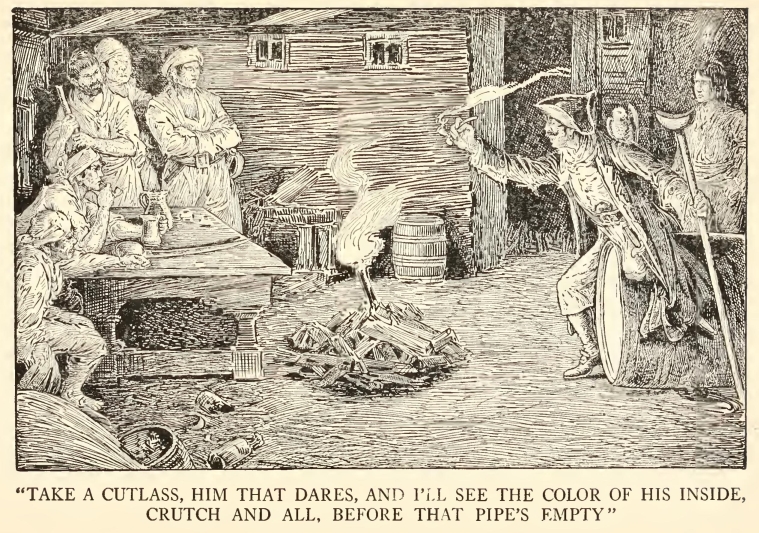
Not a man stirred; not a man answered.
Not a man moved. Not a man answered.
“That’s your sort, is it?” he added, returning his pipe to his mouth. “Well, you’re a gay lot to look at, anyway. Not much worth to fight, you ain’t. P’r’aps you can understand King George’s English. I’m cap’n here by ’lection. I’m cap’n here because I’m the best man by a long sea-mile. You won’t fight, as gentlemen o’ fortune should; then, by thunder, you’ll obey, and you may lay to it! I like that boy, now; I never seen a better boy than that. He’s more a man than any pair of rats of you in this here house, and what I say is this: let me see him that’ll lay a hand on him—that’s what I say, and you may lay to it.”
“Is that what you’re like?” he added, putting his pipe back in his mouth. “Well, you’re a cheerful-looking bunch, anyway. But you’re not much good in a fight. Perhaps you can understand King George’s English. I’m captain here because I was elected. I’m captain because I’m the best man by a long sea mile. You won’t fight as gentlemen of fortune should. Then, by thunder, you’ll obey, and you can count on that! I like that boy. I’ve never seen a better one. He’s more of a man than any two of you rats in this house. And I say this: just let me see anyone lay a hand on him. That’s what I say, and you can count on it.”
There was a long pause after this. I stood straight up against the wall, my heart still going like a sledge-hammer, but with a ray of hope now shining in my bosom. Silver leant back against the wall, his arms crossed, his pipe in the corner of his mouth, as calm as though he had been in church; yet his eye kept wandering furtively, and he kept the tail of it on his unruly followers. They, on their part, drew gradually together towards the far end of the block house, and the low hiss of their whispering sounded in my ear continuously, like a stream. One after another, they would look up, and the red light of the torch would fall for a second on their nervous faces; but it was not towards me, it was towards Silver that they turned their eyes.
There was a long pause after this. I stood upright against the wall, my heart still pounding like a sledgehammer, but now I felt a ray of hope. Silver leaned back against the wall with his arms crossed and his pipe in the corner of his mouth. He was as calm as if he were in church. Yet his eyes kept moving, and he watched his unruly followers out of the corner of his eye. Meanwhile, the followers gradually gathered at the far end of the blockhouse. The low hiss of their whispers sounded in my ear without stopping, like a stream. One after another, they looked up, and the torch’s red light fell briefly on their nervous faces. But they were not looking at me. They were looking at Silver.
“You seem to have a lot to say,” remarked Silver, spitting far into the air. “Pipe up and let me hear it, or lay to.”
“You seem to have a lot to say,” Silver said, spitting into the air. “Speak up and let me hear it, or shut up.”
“Ax your pardon, sir,” returned one of the men; “you’re pretty free with some of the rules; maybe you’ll kindly keep an eye upon the rest. This crew’s dissatisfied; this crew don’t vally bullying a marlin-spike; this crew has its rights like other crews, I’ll make so free as that; and by your own rules, I take it we can talk together. I ax your pardon, sir, acknowledging you for to be capting at this present; but I claim my right, and steps outside for a council.”
“Beg your pardon, sir,” replied one of the men. “You’re pretty casual about some of the rules. Maybe you’ll be kind enough to pay attention to the rest. This crew is dissatisfied. This crew doesn’t care a bit for bullying. This crew has its rights, like other crews, if I may say so. And by your own rules, I believe we can talk together. Beg your pardon, sir. I acknowledge that you’re captain for now. But I claim my right, and I’m stepping outside for a council.”
And with an elaborate sea-salute, this fellow, a long, ill-looking, yellow-eyed man of five and thirty, stepped coolly towards the door and disappeared out of the house. One after another the rest followed his example, each making a salute as he passed, each adding some apology. “According to rules,” said one. “Forecastle council,” said Morgan. And so with one remark or another all marched out and left Silver and me alone with the torch.
The man gave an elaborate sailor’s salute, then calmly walked to the door and left the house. He was a tall, sinister-looking man of thirty-five, with yellow eyes. One by one, the rest followed him. Each saluted as he passed and offered some apology. “According to the rules,” said one. “Forecastle council,” said Morgan. With one remark or another, they all marched out, leaving Silver and me alone with the torch.
The sea-cook instantly removed his pipe.
The ship's cook immediately took out his pipe.
“Now, look you here, Jim Hawkins,” he said in a steady whisper that was no more than audible, “you’re within half a plank of death, and what’s a long sight worse, of torture. They’re going to throw me off. But, you mark, I stand by you through thick and thin. I didn’t mean to; no, not till you spoke up. I was about desperate to lose that much blunt, and be hanged into the bargain. But I see you was the right sort. I says to myself, you stand by Hawkins, John, and Hawkins’ll stand by you. You’re his last card, and by the living thunder, John, he’s yours! Back to back, says I. You save your witness, and he’ll save your neck!”
“Now, listen here, Jim Hawkins,” he said in a steady whisper that was barely audible. “You’re a hair’s breadth from death, and worse yet, from torture. They’re going to turn against me. But mark my words, I’ll stand by you through thick and thin. I didn’t mean to, not until you spoke up. I was nearly desperate at the thought of losing all that money and being hanged as well. But I saw you were the right sort. I said to myself, stand by Hawkins, John, and Hawkins will stand by you. You’re his last hope, and by the living thunder, John, he’s yours! Back to back, I said. You save your witness, and he’ll save your neck!”
I began dimly to understand.
I began to understand a little.
“You mean all’s lost?” I asked.
“You mean everything’s lost?” I asked.
“Aye, by gum, I do!” he answered. “Ship gone, neck gone—that’s the size of it. Once I looked into that bay, Jim Hawkins, and seen no schooner—well, I’m tough, but I gave out. As for that lot and their council, mark me, they’re outright fools and cowards. I’ll save your life—if so be as I can—from them. But, see here, Jim—tit for tat—you save Long John from swinging.”
“Yes, I sure do!” he answered. “The ship’s gone, and that means I’ll be hanged. When I looked into that bay, Jim Hawkins, and saw no schooner, well, I’m tough, but I gave up. As for that lot and their council, mark my words, they’re complete fools and cowards. I’ll save your life from them if I can. But listen, Jim, fair’s fair. You save Long John from hanging.”
I was bewildered; it seemed a thing so hopeless he was asking—he, the old buccaneer, the ringleader throughout.
I was confused. What he was asking seemed so hopeless, and he was the old pirate who had led them all along.
“What I can do, that I’ll do,” I said.
“I’ll do what I can,” I said.
“It’s a bargain!” cried Long John. “You speak up plucky, and by thunder, I’ve a chance!”
“It’s a deal!” cried Long John. “You speak bravely, and by thunder, I have a chance!”
He hobbled to the torch, where it stood propped among the firewood, and took a fresh light to his pipe.
He hobbled to the torch propped among the firewood and relit his pipe.
“Understand me, Jim,” he said, returning. “I’ve a head on my shoulders, I have. I’m on squire’s side now. I know you’ve got that ship safe somewheres. How you done it, I don’t know, but safe it is. I guess Hands and O’Brien turned soft. I never much believed in neither of them. Now you mark me. I ask no questions, nor I won’t let others. I know when a game’s up, I do; and I know a lad that’s staunch. Ah, you that’s young—you and me might have done a power of good together!”
“Understand me, Jim,” he said when he returned. “I’ve got a head on my shoulders. I’m on the squire’s side now. I know you’ve got that ship safe somewhere. I don’t know how you did it, but the ship is safe. I guess Hands and O’Brien lost their nerve. I never had much faith in either of them. Now listen to me. I won’t ask questions, and I won’t let anyone else ask them. I know when a game is up. And I know a loyal lad when I see one. Ah, you’re young. You and I could have done a lot of good together!”
He drew some cognac from the cask into a tin cannikin.
He poured some cognac from the cask into a small tin cup.
“Will you taste, messmate?” he asked; and when I had refused: “Well, I’ll take a dram myself, Jim,” said he. “I need a caulker, for there’s trouble on hand. And talking o’ trouble, why did that doctor give me the chart, Jim?”
“Would you like a drink, mate?” he asked. When I refused, he said, “Well, I’ll have a drink myself, Jim. I need one because there’s trouble ahead. Speaking of trouble, why did that doctor give me the chart, Jim?”
My face expressed a wonder so unaffected that he saw the needlessness of further questions.
My face showed such genuine surprise that he saw there was no need to ask more questions.
“Ah, well, he did, though,” said he. “And there’s something under that, no doubt—something, surely, under that, Jim—bad or good.”
“Ah, well, he did, though,” he said. “And there’s something behind that, no doubt. There’s certainly something behind it, Jim, whether good or bad.”
And he took another swallow of the brandy, shaking his great fair head like a man who looks forward to the worst.
And he took another swallow of brandy, shaking his large, fair-haired head like a man expecting the worst.