Part 1, Chapter 6
The Captain’s Papers
We rode hard all the way till we drew up before Dr. Livesey’s door. The house was all dark to the front.
We rode hard all the way until we stopped in front of Dr. Livesey’s door. The front of the house was completely dark.
Mr. Dance told me to jump down and knock, and Dogger gave me a stirrup to descend by. The door was opened almost at once by the maid.
Mr. Dance told me to jump down and knock. Dogger held a stirrup for me to step down from. The maid opened the door almost at once.
“Is Dr. Livesey in?” I asked.
“Is Dr. Livesey in?” I asked.
No, she said, he had come home in the afternoon but had gone up to the hall to dine and pass the evening with the squire.
No, she said, he had come home that afternoon. But he had gone up to the hall to have dinner and spend the evening with the squire.
“So there we go, boys,” said Mr. Dance.
“So here we go, boys,” said Mr. Dance.
This time, as the distance was short, I did not mount, but ran with Dogger’s stirrup-leather to the lodge gates and up the long, leafless, moonlit avenue to where the white line of the hall buildings looked on either hand on great old gardens. Here Mr. Dance dismounted, and taking me along with him, was admitted at a word into the house.
This time, because the distance was short, I did not get on the horse. Instead, I ran beside Dogger, holding his stirrup leather. We went through the lodge gates and up the long, leafless avenue, lit by the moon. At the end, the white row of hall buildings overlooked great old gardens on either side. There, Mr. Dance dismounted and took me with him. A word from him was enough to get us into the house.
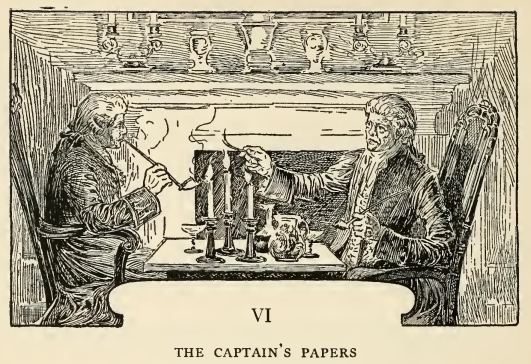
The servant led us down a matted passage and showed us at the end into a great library, all lined with bookcases and busts upon the top of them, where the squire and Dr. Livesey sat, pipe in hand, on either side of a bright fire.
The servant led us down a passage with matting on the floor. At the end, he showed us into a large library. The walls were lined with bookcases, with busts on top of them. The squire and Dr. Livesey sat on either side of a bright fire, each holding a pipe.
I had never seen the squire so near at hand. He was a tall man, over six feet high, and broad in proportion, and he had a bluff, rough-and-ready face, all roughened and reddened and lined in his long travels. His eyebrows were very black, and moved readily, and this gave him a look of some temper, not bad, you would say, but quick and high.
I had never seen the squire so close before. He was tall, over six feet, and broad to match. His face was frank and rugged, all roughened, reddened, and lined by his long travels. His eyebrows were very black and moved easily. They gave him the look of a man with a temper. You would not have called it a bad temper, but it was quick and fiery.
“Come in, Mr. Dance,” says he, very stately and condescending.
“Come in, Mr. Dance,” he said in a very dignified and patronizing manner.
“Good evening, Dance,” says the doctor with a nod. “And good evening to you, friend Jim. What good wind brings you here?”
“Good evening, Dance,” says the doctor with a nod. “And good evening to you, my friend Jim. What brings you here?”
The supervisor stood up straight and stiff and told his story like a lesson; and you should have seen how the two gentlemen leaned forward and looked at each other, and forgot to smoke in their surprise and interest. When they heard how my mother went back to the inn, Dr. Livesey fairly slapped his thigh, and the squire cried “Bravo!” and broke his long pipe against the grate. Long before it was done, Mr. Trelawney (that, you will remember, was the squire’s name) had got up from his seat and was striding about the room, and the doctor, as if to hear the better, had taken off his powdered wig and sat there looking very strange indeed with his own close-cropped black poll.
The supervisor stood straight and stiff and told his story as if reciting a lesson. You should have seen how the two gentlemen leaned forward and looked at each other. They were so surprised and interested that they forgot to smoke. When they heard how my mother went back to the inn, Dr. Livesey slapped his thigh. The squire cried “Bravo!” and broke his long pipe against the grate. Long before the story was finished, Mr. Trelawney had risen from his seat and was striding around the room. You will remember that Mr. Trelawney was the squire’s name. The doctor had taken off his powdered wig, as if to hear better. He sat there looking very strange indeed, with his own close-cropped black hair.
At last Mr. Dance finished the story.
At last, Mr. Dance finished the story.
“Mr. Dance,” said the squire, “you are a very noble fellow. And as for riding down that black, atrocious miscreant, I regard it as an act of virtue, sir, like stamping on a cockroach. This lad Hawkins is a trump, I perceive. Hawkins, will you ring that bell? Mr. Dance must have some ale.”
“Mr. Dance,” said the squire, “you are a very fine man. And riding down that wicked, horrible villain was a good deed, sir, like stamping on a cockroach. I can see that young Hawkins is a fine fellow. Hawkins, will you ring that bell? Mr. Dance must have some ale.”
“And so, Jim,” said the doctor, “you have the thing that they were after, have you?”
“So, Jim,” said the doctor, “you have what they were after, do you?”
“Here it is, sir,” said I, and gave him the oilskin packet.
“Here it is, sir,” I said, and handed him the oilskin packet.
The doctor looked it all over, as if his fingers were itching to open it; but instead of doing that, he put it quietly in the pocket of his coat.
The doctor looked it over, as if his fingers were itching to open it. But instead, he quietly put it in his coat pocket.
“Squire,” said he, “when Dance has had his ale he must, of course, be off on his Majesty’s service; but I mean to keep Jim Hawkins here to sleep at my house, and with your permission, I propose we should have up the cold pie and let him sup.”
“Squire,” he said, “once Dance has had his ale, he must, of course, leave on his Majesty’s business. But I intend to keep Jim Hawkins here to sleep at my house. With your permission, I suggest we bring up the cold pie and let him have supper.”
“As you will, Livesey,” said the squire; “Hawkins has earned better than cold pie.”
“As you wish, Livesey,” said the squire. “Hawkins has earned better than cold pie.”
So a big pigeon pie was brought in and put on a sidetable, and I made a hearty supper, for I was as hungry as a hawk, while Mr. Dance was further complimented and at last dismissed.
So a large pigeon pie was brought in and placed on a side table. I ate a hearty supper because I was as hungry as a hawk. Meanwhile, Mr. Dance received more compliments and was finally dismissed.
“And now, squire,” said the doctor.
“And now, squire,” said the doctor.
“And now, Livesey,” said the squire in the same breath.
“And now, Livesey,” the squire continued without pausing.
“One at a time, one at a time,” laughed Dr. Livesey. “You have heard of this Flint, I suppose?”
“One at a time, one at a time,” laughed Dr. Livesey. “I suppose you’ve heard of Flint?”
“Heard of him!” cried the squire. “Heard of him, you say! He was the bloodthirstiest buccaneer that sailed. Blackbeard was a child to Flint. The Spaniards were so prodigiously afraid of him that, I tell you, sir, I was sometimes proud he was an Englishman. I’ve seen his top-sails with these eyes, off Trinidad, and the cowardly son of a rum-puncheon that I sailed with put back—put back, sir, into Port of Spain.”
“Heard of him!” cried the squire. “You ask if I’ve heard of him! He was the most bloodthirsty pirate who ever sailed. Blackbeard was a child compared to Flint. The Spaniards were so terribly afraid of him that I was sometimes proud he was an Englishman, I tell you, sir. I saw his topsails with my own eyes, off Trinidad. And the cowardly drunkard I was sailing with turned back. He turned back into Port of Spain, sir.”
“Well, I’ve heard of him myself, in England,” said the doctor. “But the point is, had he money?”
“Well, I’ve heard of him myself, in England,” said the doctor. “But the point is, did he have money?”
“Money!” cried the squire. “Have you heard the story? What were these villains after but money? What do they care for but money? For what would they risk their rascal carcasses but money?”
“Money!” cried the squire. “Have you heard the story? What were these villains after but money? What do they care about but money? What else would they risk their worthless lives for but money?”
“That we shall soon know,” replied the doctor. “But you are so confoundedly hot-headed and exclamatory that I cannot get a word in. What I want to know is this: Supposing that I have here in my pocket some clue to where Flint buried his treasure, will that treasure amount to much?”
“We’ll soon find out,” replied the doctor. “But you’re so terribly hot-headed and keep interrupting that I can’t get a word in. Here’s what I want to know. Suppose I have a clue in my pocket to where Flint buried his treasure. Would the treasure be worth much?”
“Amount, sir!” cried the squire. “It will amount to this: If we have the clue you talk about, I fit out a ship in Bristol dock, and take you and Hawkins here along, and I’ll have that treasure if I search a year.”
“Amount, sir!” cried the squire. “Here’s what it will amount to: If we have the clue you’re talking about, I’ll equip a ship in Bristol dock. I’ll take you and Hawkins here with me. And I’ll get that treasure, even if I have to search for a year.”
“Very well,” said the doctor. “Now, then, if Jim is agreeable, we’ll open the packet”; and he laid it before him on the table.
“All right,” said the doctor. “Now, if Jim agrees, we’ll open the packet.” He laid the packet on the table in front of him.
The bundle was sewn together, and the doctor had to get out his instrument case and cut the stitches with his medical scissors. It contained two things—a book and a sealed paper.
The bundle was sewn shut, so the doctor took out his instrument case and cut the stitches with his medical scissors. The bundle contained two things: a book and a sealed paper.
“First of all we’ll try the book,” observed the doctor.
“First, we’ll try the book,” said the doctor.
The squire and I were both peering over his shoulder as he opened it, for Dr. Livesey had kindly motioned me to come round from the side-table, where I had been eating, to enjoy the sport of the search. On the first page there were only some scraps of writing, such as a man with a pen in his hand might make for idleness or practice. One was the same as the tattoo mark, “Billy Bones his fancy”; then there was “Mr. W. Bones, mate,” “No more rum,” “Off Palm Key he got itt,” and some other snatches, mostly single words and unintelligible. I could not help wondering who it was that had “got itt,” and what “itt” was that he got. A knife in his back as like as not.
The squire and I were both looking over his shoulder as he opened it. Dr. Livesey had kindly invited me to leave the side table, where I had been eating, and enjoy the search. On the first page were only a few scribbles, the kind a man might make with a pen out of boredom or for practice. One was the same as the tattoo: “Billy Bones his fancy”. Then there were “Mr. W. Bones, mate,” “No more rum,” “Off Palm Key he got itt,” and some other fragments, mostly single words that made no sense. I couldn't help wondering who had “got itt,” and what “itt” was. Most likely a knife in his back.
“Not much instruction there,” said Dr. Livesey as he passed on.
“Not much to learn there,” said Dr. Livesey as he moved on.
The next ten or twelve pages were filled with a curious series of entries. There was a date at one end of the line and at the other a sum of money, as in common account-books, but instead of explanatory writing, only a varying number of crosses between the two. On the 12th of June, 1745, for instance, a sum of seventy pounds had plainly become due to someone, and there was nothing but six crosses to explain the cause. In a few cases, to be sure, the name of a place would be added, as “Offe Caraccas,” or a mere entry of latitude and longitude, as “62° 17′ 20″, 19° 2′ 40″.”
The next ten or twelve pages were filled with a strange series of entries. Each line had a date at one end and a sum of money at the other, as in ordinary account books. But instead of an explanation, there was a varying number of crosses between them. On June 12, 1745, for example, seventy pounds had clearly become due to someone. But there were only six crosses to explain why. In a few cases, a place name was added, such as “Offe Caraccas.” Or there was simply a latitude and longitude, such as “62° 17′ 20″, 19° 2′ 40″.”
The record lasted over nearly twenty years, the amount of the separate entries growing larger as time went on, and at the end a grand total had been made out after five or six wrong additions, and these words appended, “Bones, his pile.”
The record covered nearly twenty years, and the amounts in each entry grew larger over time. At the end, a grand total had been calculated after five or six incorrect additions. The words “Bones, his pile” had been added after it.
“I can’t make head or tail of this,” said Dr. Livesey.
“I can’t make sense of this,” said Dr. Livesey.
“The thing is as clear as noonday,” cried the squire. “This is the black-hearted hound’s account-book. These crosses stand for the names of ships or towns that they sank or plundered. The sums are the scoundrel’s share, and where he feared an ambiguity, you see he added something clearer. ‘Offe Caraccas,’ now; you see, here was some unhappy vessel boarded off that coast. God help the poor souls that manned her—coral long ago.”
“It's as clear as day,” cried the squire. “This is the black-hearted dog's account book. These crosses stand for the names of ships or towns they sank or plundered. The sums are the scoundrel's share. Where he feared there might be confusion, you can see he added something clearer. Take ‘Offe Caraccas’. You can see that some unfortunate ship was boarded off that coast. God help the poor souls who crewed her. They became coral long ago.”
“Right!” said the doctor. “See what it is to be a traveller. Right! And the amounts increase, you see, as he rose in rank.”
“Right!” said the doctor. “That shows you what travel teaches you. Right! And you can see that the amounts increased as he rose in rank.”
There was little else in the volume but a few bearings of places noted in the blank leaves towards the end and a table for reducing French, English, and Spanish moneys to a common value.
The book contained little else. A few bearings of places were noted on the blank pages near the end. There was also a table for converting French, English, and Spanish money to a common value.
“Thrifty man!” cried the doctor. “He wasn’t the one to be cheated.”
“What a thrifty man!” the doctor exclaimed. “He wasn’t someone you could cheat.”
“And now,” said the squire, “for the other.”
“Now,” said the squire, “for the other one.”
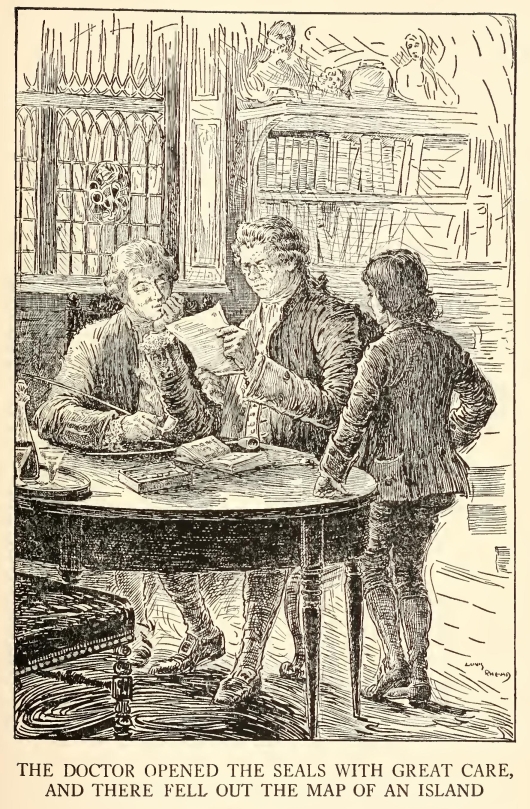
The paper had been sealed in several places with a thimble by way of seal; the very thimble, perhaps, that I had found in the captain’s pocket. The doctor opened the seals with great care, and there fell out the map of an island, with latitude and longitude, soundings, names of hills and bays and inlets, and every particular that would be needed to bring a ship to a safe anchorage upon its shores. It was about nine miles long and five across, shaped, you might say, like a fat dragon standing up, and had two fine land-locked harbours, and a hill in the centre part marked “The Spy-glass.” There were several additions of a later date, but above all, three crosses of red ink—two on the north part of the island, one in the southwest—and beside this last, in the same red ink, and in a small, neat hand, very different from the captain’s tottery characters, these words: “Bulk of treasure here.”
The paper had been sealed in several places using a thimble. Perhaps it was the very thimble I had found in the captain’s pocket. The doctor opened the seals very carefully, and a map of an island fell out. It showed the latitude and longitude, water depths, and the names of hills, bays, and inlets. It included every detail needed to bring a ship to a safe anchorage along the shore. The island was about nine miles long and five miles across. You might say it was shaped like a fat dragon standing up. It had two fine harbours sheltered by land and a hill near the centre marked “The Spy-glass.” Several things had been added later. Most striking were three red ink crosses, two in the north of the island and one in the southwest. Beside the southwestern cross were the words “Bulk of treasure here.” They were written in the same red ink, in a small, neat hand very different from the captain’s shaky writing.
Over on the back the same hand had written this further information:
On the back, the same person had written this additional information:
Tall tree, Spy-glass shoulder, bearing a point to the N. of N.N.E. Skeleton Island E.S.E. and by E. Ten feet. The bar silver is in the north cache; you can find it by the trend of the east hummock, ten fathoms south of the black crag with the face on it. The arms are easy found, in the sand-hill, N. point of north inlet cape, bearing E. and a quarter N.
Tall tree, shoulder of Spy-glass, bearing one point north of north-northeast. Skeleton Island east-southeast and by east. Ten feet. The silver bars are in the north cache. Find them by following the line of the east hummock. They are ten fathoms south of the black crag with a face on it. The weapons are easy to find in the sand hill at the north point of the north inlet cape, bearing east and a quarter point north.
J.F.
J.F.
That was all; but brief as it was, and to me incomprehensible, it filled the squire and Dr. Livesey with delight.
That was all. But though it was brief and made no sense to me, it delighted the squire and Dr. Livesey.
“Livesey,” said the squire, “you will give up this wretched practice at once. Tomorrow I start for Bristol. In three weeks’ time—three weeks!—two weeks—ten days—we’ll have the best ship, sir, and the choicest crew in England. Hawkins shall come as cabin-boy. You’ll make a famous cabin-boy, Hawkins. You, Livesey, are ship’s doctor; I am admiral. We’ll take Redruth, Joyce, and Hunter. We’ll have favourable winds, a quick passage, and not the least difficulty in finding the spot, and money to eat, to roll in, to play duck and drake with ever after.”
“Livesey,” said the squire, “you must give up this miserable practice at once. Tomorrow I leave for Bristol. In three weeks, three weeks! Two weeks, ten days! We’ll have the best ship and the finest crew in England, sir. Hawkins will come as cabin boy. You’ll make a splendid cabin boy, Hawkins. You, Livesey, are the ship’s doctor. I am the admiral. We’ll take Redruth, Joyce, and Hunter. We’ll have favorable winds and a quick voyage. We won’t have the slightest difficulty finding the spot. Then we’ll have money to eat, roll in, and throw away for the rest of our lives.”
“Trelawney,” said the doctor, “I’ll go with you; and I’ll go bail for it, so will Jim, and be a credit to the undertaking. There’s only one man I’m afraid of.”
“Trelawney,” said the doctor, “I’ll go with you. And I’m sure Jim will go too and be a credit to the venture. There’s only one man I’m afraid of.”
“And who’s that?” cried the squire. “Name the dog, sir!”
“And who’s that?” the squire cried. “Name the scoundrel, sir!”
“You,” replied the doctor; “for you cannot hold your tongue. We are not the only men who know of this paper. These fellows who attacked the inn tonight—bold, desperate blades, for sure—and the rest who stayed aboard that lugger, and more, I dare say, not far off, are, one and all, through thick and thin, bound that they’ll get that money. We must none of us go alone till we get to sea. Jim and I shall stick together in the meanwhile; you’ll take Joyce and Hunter when you ride to Bristol, and from first to last, not one of us must breathe a word of what we’ve found.”
“You,” replied the doctor, “because you can’t keep your mouth shut. We aren’t the only men who know about this paper. The men who attacked the inn tonight are certainly bold and desperate. There are also the men who stayed aboard that lugger, and I dare say more are not far away. Every one of them is determined to get that money, no matter what. None of us must go alone until we put to sea. Jim and I will stay together in the meantime. You’ll take Joyce and Hunter with you when you ride to Bristol. And from beginning to end, none of us must say a word about what we’ve found.”
“Livesey,” returned the squire, “you are always in the right of it. I’ll be as silent as the grave.”
“Livesey,” the squire replied, “you’re always right. I’ll be as silent as the grave.”