Part 1, Chapter 5
The Blind Man's End
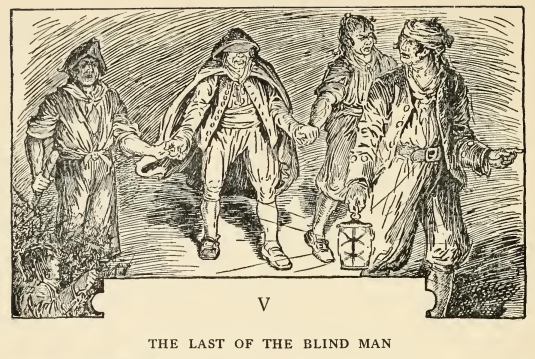
My curiosity, in a sense, was stronger than my fear, for I could not remain where I was, but crept back to the bank again, whence, sheltering my head behind a bush of broom, I might command the road before our door. I was scarcely in position ere my enemies began to arrive, seven or eight of them, running hard, their feet beating out of time along the road and the man with the lantern some paces in front. Three men ran together, hand in hand; and I made out, even through the mist, that the middle man of this trio was the blind beggar. The next moment his voice showed me that I was right.
In a way, my curiosity was stronger than my fear. I could not stay where I was, so I crept back to the bank. There, I hid my head behind a broom bush and watched the road in front of our door. I had barely settled into position when my enemies began to arrive. Seven or eight of them were running hard, their feet beating out of time along the road. The man with the lantern was a few paces ahead. Three men ran together, hand in hand. Even through the mist, I could see that the man in the middle was the blind beggar. The next moment, his voice proved me right.
“Down with the door!” he cried.
“Break down the door!” he shouted.
“Aye, aye, sir!” answered two or three; and a rush was made upon the Admiral Benbow, the lantern-bearer following; and then I could see them pause, and hear speeches passed in a lower key, as if they were surprised to find the door open. But the pause was brief, for the blind man again issued his commands. His voice sounded louder and higher, as if he were afire with eagerness and rage.
“Yes, sir!” two or three answered. They rushed toward the Admiral Benbow, followed by the person carrying the lantern. Then I saw them pause and heard them speak more quietly, as if surprised to find the door open. But the pause was brief, because the blind man gave more orders. His voice sounded louder and higher, as if he were burning with eagerness and rage.
“In, in, in!” he shouted, and cursed them for their delay.
“In, in, in!” he shouted, cursing them for taking so long.
Four or five of them obeyed at once, two remaining on the road with the formidable beggar. There was a pause, then a cry of surprise, and then a voice shouting from the house, “Bill’s dead.”
Four or five of them obeyed at once. Two stayed on the road with the fearsome beggar. There was a pause, then a cry of surprise. Then a voice shouted from the house, “Bill’s dead.”
But the blind man swore at them again for their delay.
But the blind man cursed at them again for taking too long.
“Search him, some of you shirking lubbers, and the rest of you aloft and get the chest,” he cried.
“Some of you lazy fools, search him. The rest of you, go up and get the chest,” he cried.
I could hear their feet rattling up our old stairs, so that the house must have shook with it. Promptly afterwards, fresh sounds of astonishment arose; the window of the captain’s room was thrown open with a slam and a jingle of broken glass, and a man leaned out into the moonlight, head and shoulders, and addressed the blind beggar on the road below him.
I could hear their feet pounding up our old stairs. The whole house must have shaken. Soon afterward, I heard more cries of surprise. The captain’s bedroom window was thrown open with a slam and a jingle of broken glass. A man leaned out into the moonlight, his head and shoulders outside, and spoke to the blind beggar on the road below.
“Pew,” he cried, “they’ve been before us. Someone’s turned the chest out alow and aloft.”
“Pew,” he cried, “they got here before us. Someone has searched the chest from top to bottom.”
“Is it there?” roared Pew.
“Is it there?” roared Pew.
“The money’s there.”
“The money’s there.”
The blind man cursed the money.
The blind man cursed the money.
“Flint’s fist, I mean,” he cried.
“Flint’s handwriting, I mean,” he cried.
“We don’t see it here nohow,” returned the man.
“We don’t see it here, anyway,” replied the man.
“Here, you below there, is it on Bill?” cried the blind man again.
“Hey, you down there, does Bill have it?” the blind man shouted again.
At that another fellow, probably him who had remained below to search the captain’s body, came to the door of the inn. “Bill’s been overhauled a’ready,” said he; “nothin’ left.”
At that, another man came to the inn’s door. He was probably the one who had stayed downstairs to search the captain’s body. “Bill’s already been searched,” he said. “Nothing left.”
“It’s these people of the inn—it’s that boy. I wish I had put his eyes out!” cried the blind man, Pew. “There were no time ago—they had the door bolted when I tried it. Scatter, lads, and find ’em.”
“It’s the people from the inn. It’s that boy. I wish I had put his eyes out!” cried Pew, the blind man. “They were here not long ago. They had bolted the door when I tried it. Spread out, boys, and find them.”
“Sure enough, they left their glim here,” said the fellow from the window.
“Sure enough, they left their light here,” said the man at the window.
“Scatter and find ’em! Rout the house out!” reiterated Pew, striking with his stick upon the road.
“Split up and find them! Search the whole house!” Pew repeated, striking the road with his stick.
Then there followed a great to-do through all our old inn, heavy feet pounding to and fro, furniture thrown over, doors kicked in, until the very rocks re-echoed and the men came out again, one after another, on the road and declared that we were nowhere to be found. And just the same whistle that had alarmed my mother and myself over the dead captain’s money was once more clearly audible through the night, but this time twice repeated. I had thought it to be the blind man’s trumpet, so to speak, summoning his crew to the assault, but I now found that it was a signal from the hillside towards the hamlet, and from its effect upon the buccaneers, a signal to warn them of approaching danger.
Then a great commotion broke out throughout our old inn. Heavy feet pounded back and forth, furniture was thrown over, and doors were kicked in. The noise echoed off the rocks. At last the men came out onto the road, one after another, and declared that we were nowhere to be found. Once more, the same whistle that had alarmed my mother and me as we collected the dead captain’s money rang clearly through the night. But this time it sounded twice. I had thought the whistle was the blind man’s trumpet, so to speak, calling his crew to attack. But I now realized it was a signal from the hillside toward the hamlet. From its effect on the buccaneers, I could tell it warned them of approaching danger.
“There’s Dirk again,” said one. “Twice! We’ll have to budge, mates.”
“There’s Dirk again,” one of them said. “Twice! We’ll have to move, mates.”
“Budge, you skulk!” cried Pew. “Dirk was a fool and a coward from the first—you wouldn’t mind him. They must be close by; they can’t be far; you have your hands on it. Scatter and look for them, dogs! Oh, shiver my soul,” he cried, “if I had eyes!”
“Move, you coward!” cried Pew. “Dirk was a fool and a coward from the start. You wouldn’t listen to him. They must be close by. They can’t be far away. You’ve almost got it. Spread out and look for them, you dogs! Oh, curse it,” he cried, “if only I had eyes!”
This appeal seemed to produce some effect, for two of the fellows began to look here and there among the lumber, but half-heartedly, I thought, and with half an eye to their own danger all the time, while the rest stood irresolute on the road.
The appeal seemed to have some effect. Two of the men began looking around among the piled-up objects, but I thought they searched half-heartedly. They kept an eye on their own danger all the while, while the others stood on the road, unsure what to do.
“You have your hands on thousands, you fools, and you hang a leg! You’d be as rich as kings if you could find it, and you know it’s here, and you stand there skulking. There wasn’t one of you dared face Bill, and I did it—a blind man! And I’m to lose my chance for you! I’m to be a poor, crawling beggar, sponging for rum, when I might be rolling in a coach! If you had the pluck of a weevil in a biscuit you would catch them still.”
“You have thousands within your grasp, you fools, and you’re hesitating! You’d be as rich as kings if you could find it. You know it’s here, yet you stand there hiding. Not one of you dared face Bill, but I did, and I’m blind! And now I’m supposed to lose my chance because of you! I’m supposed to be a poor, crawling beggar, begging for rum, when I could be riding in a coach! If you had the courage of a weevil in a biscuit, you could still catch them.”
“Hang it, Pew, we’ve got the doubloons!” grumbled one.
“Damn it, Pew, we’ve got the doubloons!” one of them grumbled.
“They might have hid the blessed thing,” said another. “Take the Georges, Pew, and don’t stand here squalling.”
“They might have hidden the damn thing,” said another. “Take the Georges, Pew, and stop standing here shouting.”
Squalling was the word for it; Pew’s anger rose so high at these objections till at last, his passion completely taking the upper hand, he struck at them right and left in his blindness and his stick sounded heavily on more than one.
Squalling was the word for it. The objections made Pew angrier and angrier. At last, his rage took over. Blind, he struck at them right and left, and his stick landed heavily on more than one of them.
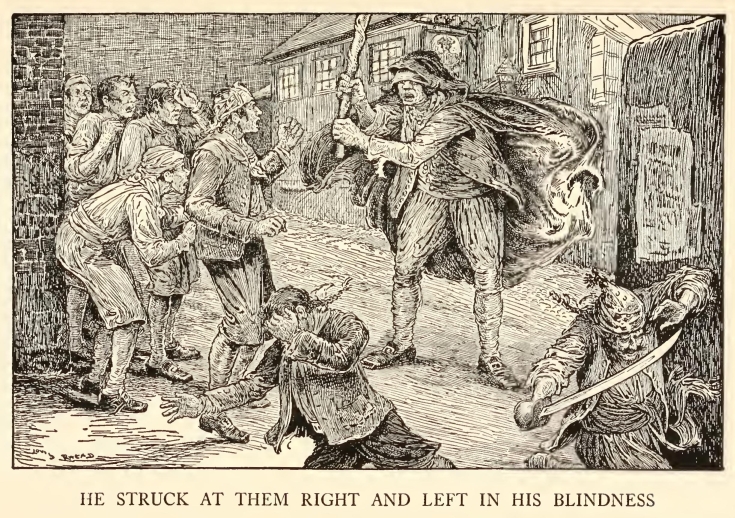
These, in their turn, cursed back at the blind miscreant, threatened him in horrid terms, and tried in vain to catch the stick and wrest it from his grasp.
They cursed the blind villain back and threatened him in terrible terms. They tried to grab the stick and wrench it from his grasp, but failed.
This quarrel was the saving of us, for while it was still raging, another sound came from the top of the hill on the side of the hamlet—the tramp of horses galloping. Almost at the same time a pistol-shot, flash and report, came from the hedge side. And that was plainly the last signal of danger, for the buccaneers turned at once and ran, separating in every direction, one seaward along the cove, one slant across the hill, and so on, so that in half a minute not a sign of them remained but Pew. Him they had deserted, whether in sheer panic or out of revenge for his ill words and blows I know not; but there he remained behind, tapping up and down the road in a frenzy, and groping and calling for his comrades. Finally he took a wrong turn and ran a few steps past me, towards the hamlet, crying, “Johnny, Black Dog, Dirk,” and other names, “you won’t leave old Pew, mates—not old Pew!”
The quarrel saved us. While it was still raging, another sound came from the hilltop on the village side: horses galloping. Almost at the same time, a pistol flashed and fired from beside the hedge. This was clearly the final warning of danger. The buccaneers immediately turned and scattered in every direction. One ran toward the sea along the cove, another ran diagonally across the hill, and the others fled in different directions. Within half a minute, only Pew remained. They had abandoned him, but I do not know whether they fled in panic or left him out of revenge for his insults and blows. Pew was left tapping his way up and down the road in a frenzy, feeling around and calling for his companions. Finally, he took a wrong turn and ran a few steps past me toward the village, crying, “Johnny, Black Dog, Dirk,” and other names. “You won’t leave old Pew, mates, not old Pew!”
Just then the noise of horses topped the rise, and four or five riders came in sight in the moonlight and swept at full gallop down the slope.
Just then, the sound of horses came over the rise. Four or five riders appeared in the moonlight and galloped down the slope at full speed.
At this Pew saw his error, turned with a scream, and ran straight for the ditch, into which he rolled. But he was on his feet again in a second and made another dash, now utterly bewildered, right under the nearest of the coming horses.
At this, Pew realized his mistake. He screamed, turned, and ran straight for the ditch, where he rolled in. But he was back on his feet in a second. Now utterly confused, he ran again, straight under the nearest of the approaching horses.
The rider tried to save him, but in vain. Down went Pew with a cry that rang high into the night; and the four hoofs trampled and spurned him and passed by. He fell on his side, then gently collapsed upon his face and moved no more.
The rider tried to save him, but failed. Pew fell with a cry that rang out into the night. The four hooves trampled and kicked him as they passed. He fell on his side, then gently collapsed face down and moved no more.
I leaped to my feet and hailed the riders. They were pulling up, at any rate, horrified at the accident; and I soon saw what they were. One, tailing out behind the rest, was a lad that had gone from the hamlet to Dr. Livesey’s; the rest were revenue officers, whom he had met by the way, and with whom he had had the intelligence to return at once. Some news of the lugger in Kitt’s Hole had found its way to Supervisor Dance and set him forth that night in our direction, and to that circumstance my mother and I owed our preservation from death.
I jumped to my feet and called out to the riders. They were already pulling up, horrified by the accident. I soon saw who they were. A boy was riding behind the others. He had gone from the hamlet to Dr. Livesey’s. The rest were revenue officers he had met on the way. He had the good sense to return at once with them. News of the lugger in Kitt’s Hole had somehow reached Supervisor Dance, prompting him to head our way that night. That was why my mother and I escaped death.
Pew was dead, stone dead. As for my mother, when we had carried her up to the hamlet, a little cold water and salts and that soon brought her back again, and she was none the worse for her terror, though she still continued to deplore the balance of the money. In the meantime the supervisor rode on, as fast as he could, to Kitt’s Hole; but his men had to dismount and grope down the dingle, leading, and sometimes supporting, their horses, and in continual fear of ambushes; so it was no great matter for surprise that when they got down to the Hole the lugger was already under way, though still close in. He hailed her. A voice replied, telling him to keep out of the moonlight or he would get some lead in him, and at the same time a bullet whistled close by his arm. Soon after, the lugger doubled the point and disappeared. Mr. Dance stood there, as he said, “like a fish out of water,” and all he could do was to dispatch a man to B—— to warn the cutter. “And that,” said he, “is just about as good as nothing. They’ve got off clean, and there’s an end. Only,” he added, “I’m glad I trod on Master Pew’s corns,” for by this time he had heard my story.
Pew was dead, stone dead. After we carried my mother up to the hamlet, a little cold water and smelling salts soon revived her. Her fright had done her no lasting harm, though she still regretted the rest of the money. Meanwhile, the supervisor rode as fast as he could to Kitt’s Hole. But his men had to dismount and feel their way down the ravine. They led their horses, sometimes supporting them, and were constantly afraid of ambushes. So it was hardly surprising that the lugger was already sailing when they reached the Hole, though still close to shore. The supervisor called out to the lugger. A voice answered, telling him to stay out of the moonlight or he would get a bullet in him. At the same time, a bullet whistled close to his arm. Soon afterward, the lugger rounded the point and disappeared. Mr. Dance stood there, as he said, “like a fish out of water.” All he could do was send a man to B—— to warn the cutter. “And that,” he said, “is just about as good as nothing. They’ve got away clean, and that’s the end of it. Still,” he added, “I’m glad I stepped on Master Pew’s toes.” By then he had heard my story.
I went back with him to the Admiral Benbow, and you cannot imagine a house in such a state of smash; the very clock had been thrown down by these fellows in their furious hunt after my mother and myself; and though nothing had actually been taken away except the captain’s money-bag and a little silver from the till, I could see at once that we were ruined. Mr. Dance could make nothing of the scene.
I went back with him to the Admiral Benbow. You cannot imagine what a wreck the house was. The men had even knocked down the clock in their furious search for my mother and me. They had taken nothing except the captain’s money bag and a little silver from the till. Even so, I could see at once that we were ruined. Mr. Dance could not make sense of the scene.
“They got the money, you say? Well, then, Hawkins, what in fortune were they after? More money, I suppose?”
“They got the money, you say? Well, Hawkins, what on earth were they after? More money, I suppose?”
“No, sir; not money, I think,” replied I. “In fact, sir, I believe I have the thing in my breast pocket; and to tell you the truth, I should like to get it put in safety.”
“No, sir, I don't think it's money,” I replied. “In fact, sir, I believe I have the thing in my chest pocket. To tell you the truth, I'd like to put it somewhere safe.”
“To be sure, boy; quite right,” said he. “I’ll take it, if you like.”
“Of course, boy. You’re quite right,” he said. “I’ll take it, if you like.”
“I thought perhaps Dr. Livesey—” I began.
“I thought perhaps Dr. Livesey...” I began.
“Perfectly right,” he interrupted very cheerily, “perfectly right—a gentleman and a magistrate. And, now I come to think of it, I might as well ride round there myself and report to him or squire. Master Pew’s dead, when all’s done; not that I regret it, but he’s dead, you see, and people will make it out against an officer of his Majesty’s revenue, if make it out they can. Now, I’ll tell you, Hawkins, if you like, I’ll take you along.”
“Exactly right,” he interrupted cheerfully. “Exactly right. A gentleman and a magistrate. Now that I think of it, I might as well ride over there myself and report to him or the squire. After all, Master Pew is dead. Not that I regret it, but he is dead, you see. And people will hold his death against an officer of His Majesty’s revenue if they can. Now, Hawkins, I’ll take you along if you like.”
I thanked him heartily for the offer, and we walked back to the hamlet where the horses were. By the time I had told mother of my purpose they were all in the saddle.
I thanked him warmly for the offer, and we walked back to the village where the horses were. By the time I had told my mother what I planned to do, they were all on horseback.
“Dogger,” said Mr. Dance, “you have a good horse; take up this lad behind you.”
“Dogger,” said Mr. Dance, “you have a good horse. Let this boy ride behind you.”
As soon as I was mounted, holding on to Dogger’s belt, the supervisor gave the word, and the party struck out at a bouncing trot on the road to Dr. Livesey’s house.
As soon as I was on the horse and holding on to Dogger’s belt, the supervisor gave the signal. The group set off at a bouncing trot down the road to Dr. Livesey’s house.