Part 1, Chapter 4
The Sea Chest
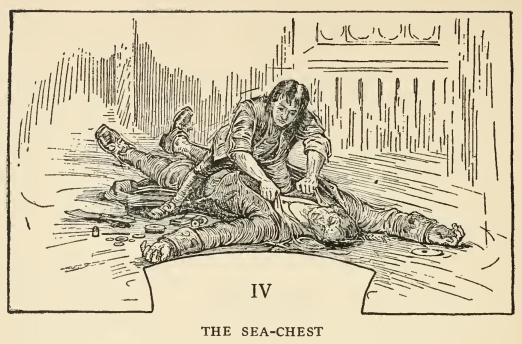
I lost no time, of course, in telling my mother all that I knew, and perhaps should have told her long before, and we saw ourselves at once in a difficult and dangerous position. Some of the man’s money—if he had any—was certainly due to us, but it was not likely that our captain’s shipmates, above all the two specimens seen by me, Black Dog and the blind beggar, would be inclined to give up their booty in payment of the dead man’s debts. The captain’s order to mount at once and ride for Doctor Livesey would have left my mother alone and unprotected, which was not to be thought of. Indeed, it seemed impossible for either of us to remain much longer in the house; the fall of coals in the kitchen grate, the very ticking of the clock, filled us with alarms. The neighbourhood, to our ears, seemed haunted by approaching footsteps; and what between the dead body of the captain on the parlour floor and the thought of that detestable blind beggar hovering near at hand and ready to return, there were moments when, as the saying goes, I jumped in my skin for terror. Something must speedily be resolved upon, and it occurred to us at last to go forth together and seek help in the neighbouring hamlet. No sooner said than done. Bare-headed as we were, we ran out at once in the gathering evening and the frosty fog.
I wasted no time, of course, telling my mother all I knew. Perhaps I should have told her long before. We saw at once that we were in a difficult and dangerous position. Some of the man’s money, if he had any, was certainly owed to us. But our captain’s shipmates were unlikely to give up their loot to pay the dead man’s debts. That was especially true of the two I had seen, Black Dog and the blind beggar. The captain had ordered me to get on a horse at once and ride for Doctor Livesey. But that would have left my mother alone and unprotected, so it was out of the question. In fact, neither of us seemed able to stay in the house much longer. The coals falling in the kitchen grate and even the ticking of the clock filled us with alarm. Every sound outside seemed to us like approaching footsteps. The captain’s body lay on the parlour floor. And we could not stop thinking of that detestable blind beggar, lurking nearby and ready to return. Between the two, there were moments when, as the saying goes, I nearly jumped out of my skin with terror. We had to decide quickly what to do. At last, we thought of going together to seek help in the nearby hamlet. No sooner said than done. Without even putting on our hats, we ran out at once into the gathering darkness and frosty fog.
The hamlet lay not many hundred yards away, though out of view, on the other side of the next cove; and what greatly encouraged me, it was in an opposite direction from that whence the blind man had made his appearance and whither he had presumably returned. We were not many minutes on the road, though we sometimes stopped to lay hold of each other and hearken. But there was no unusual sound—nothing but the low wash of the ripple and the croaking of the inmates of the wood.
The hamlet lay only a few hundred yards away, though we could not see it, on the other side of the next cove. What greatly encouraged me was that the hamlet lay in the opposite direction from where the blind man had appeared and presumably returned. We were on the road for only a few minutes, though we sometimes stopped to hold on to each other and listen. But there was no unusual sound, only the soft wash of the ripples and the croaking of the creatures in the woods.
It was already candle-light when we reached the hamlet, and I shall never forget how much I was cheered to see the yellow shine in doors and windows; but that, as it proved, was the best of the help we were likely to get in that quarter. For—you would have thought men would have been ashamed of themselves—no soul would consent to return with us to the Admiral Benbow. The more we told of our troubles, the more—man, woman, and child—they clung to the shelter of their houses. The name of Captain Flint, though it was strange to me, was well enough known to some there and carried a great weight of terror. Some of the men who had been to field-work on the far side of the Admiral Benbow remembered, besides, to have seen several strangers on the road, and taking them to be smugglers, to have bolted away; and one at least had seen a little lugger in what we called Kitt’s Hole. For that matter, anyone who was a comrade of the captain’s was enough to frighten them to death. And the short and the long of the matter was, that while we could get several who were willing enough to ride to Dr. Livesey’s, which lay in another direction, not one would help us to defend the inn.
It was already dark enough for candles when we reached the hamlet. I shall never forget how much the yellow light in the doors and windows cheered me. But as it turned out, that was the best help we were likely to get there. You would have thought the villagers would be ashamed of themselves. Not one would agree to return with us to the Admiral Benbow. The more we told them about our troubles, the more they clung to the shelter of their houses, men, women, and children alike. The name of Captain Flint was unfamiliar to me, but some people there knew it well and were terrified of it. Some men had been working in the fields beyond the Admiral Benbow. They also remembered seeing several strangers on the road. Taking them for smugglers, they had run away. At least one man had seen a small lugger in the place we called Kitt’s Hole. For that matter, anyone who was a companion of the captain was enough to frighten them to death. In short, several people were willing enough to ride to Dr. Livesey’s, which lay in another direction. But not one would help us defend the inn.
They say cowardice is infectious; but then argument is, on the other hand, a great emboldener; and so when each had said his say, my mother made them a speech. She would not, she declared, lose money that belonged to her fatherless boy; “If none of the rest of you dare,” she said, “Jim and I dare. Back we will go, the way we came, and small thanks to you big, hulking, chicken-hearted men. We’ll have that chest open, if we die for it. And I’ll thank you for that bag, Mrs. Crossley, to bring back our lawful money in.”
They say cowardice is contagious, but arguing can also make people much braver. So, after everyone had spoken, my mother gave them a speech. She declared that she would not lose money that belonged to her fatherless boy. “If none of the rest of you dare,” she said, “Jim and I dare. We’ll go back the way we came, and no thanks to you big, hulking cowards. We’ll open that chest, even if we die for it. And I’ll take that bag, Mrs. Crossley, to bring back the money that’s rightfully ours.”
Of course I said I would go with my mother, and of course they all cried out at our foolhardiness, but even then not a man would go along with us. All they would do was to give me a loaded pistol lest we were attacked, and to promise to have horses ready saddled in case we were pursued on our return, while one lad was to ride forward to the doctor’s in search of armed assistance.
Of course I said I would go with my mother. Of course they all cried out that we were being reckless. But even then, not one man would go with us. All they would do was give me a loaded pistol in case we were attacked. They also promised to have horses saddled and ready in case we were chased on our return. One young man was to ride ahead to the doctor’s to look for armed help.
My heart was beating finely when we two set forth in the cold night upon this dangerous venture. A full moon was beginning to rise and peered redly through the upper edges of the fog, and this increased our haste, for it was plain, before we came forth again, that all would be as bright as day, and our departure exposed to the eyes of any watchers. We slipped along the hedges, noiseless and swift, nor did we see or hear anything to increase our terrors, till, to our relief, the door of the Admiral Benbow had closed behind us.
My heart was pounding as we set out together on this dangerous venture into the cold night. A full moon was beginning to rise, glowing red through the upper edges of the fog. The sight made us hurry, for it was clear that before we came out again, everything would be as bright as day. Any watchers would see us leave. We slipped along the hedges, silent and swift. We saw and heard nothing to increase our fears, until, to our relief, the door of the Admiral Benbow closed behind us.
I slipped the bolt at once, and we stood and panted for a moment in the dark, alone in the house with the dead captain’s body. Then my mother got a candle in the bar, and holding each other’s hands, we advanced into the parlour. He lay as we had left him, on his back, with his eyes open and one arm stretched out.
I slid the bolt shut at once. We stood panting for a moment in the dark, alone in the house with the dead captain’s body. Then my mother got a candle from the bar. Holding hands, we went into the sitting room. He lay as we had left him, on his back, with his eyes open and one arm stretched out.
“Draw down the blind, Jim,” whispered my mother; “they might come and watch outside. And now,” said she when I had done so, “we have to get the key off that; and who’s to touch it, I should like to know!” and she gave a kind of sob as she said the words.
“Pull down the blind, Jim,” my mother whispered. “They might come and watch from outside.” When I had done so, she said, “And now we have to get the key off that. But who’s going to touch it, I’d like to know!” She gave a little sob as she spoke.
I went down on my knees at once. On the floor close to his hand there was a little round of paper, blackened on the one side. I could not doubt that this was the black spot; and taking it up, I found written on the other side, in a very good, clear hand, this short message: “You have till ten tonight.”
I dropped to my knees at once. On the floor near his hand was a small round piece of paper, blackened on one side. I had no doubt it was the black spot. I picked it up and found a short message on the other side, written in very clear handwriting: “You have till ten tonight.”
“He had till ten, Mother,” said I; and just as I said it, our old clock began striking. This sudden noise startled us shockingly; but the news was good, for it was only six.
“He had until ten, Mother,” I said. Just as I said it, our old clock began to strike. The sudden noise startled us terribly, but the news was good. It was only six.
“Now, Jim,” she said, “that key.”
“Now, Jim,” she said, “that key.”
I felt in his pockets, one after another. A few small coins, a thimble, and some thread and big needles, a piece of pigtail tobacco bitten away at the end, his gully with the crooked handle, a pocket compass, and a tinder box were all that they contained, and I began to despair.
I searched his pockets one by one. They contained only a few small coins, a thimble, some thread and large needles, and a piece of twisted tobacco with the end bitten off. There was also his knife with the crooked handle, a pocket compass, and a tinderbox. I began to lose hope.
“Perhaps it’s round his neck,” suggested my mother.
“Perhaps it’s around his neck,” suggested my mother.
Overcoming a strong repugnance, I tore open his shirt at the neck, and there, sure enough, hanging to a bit of tarry string, which I cut with his own gully, we found the key. At this triumph we were filled with hope and hurried upstairs without delay to the little room where he had slept so long and where his box had stood since the day of his arrival.
I overcame my strong disgust and tore open his shirt at the neck. Sure enough, we found the key hanging from a piece of tar-covered string. I cut the string with his own knife. This triumph filled us with hope, and we hurried upstairs without delay to the little room. He had slept there for so long, and his box had stood there since the day he arrived.
It was like any other seaman’s chest on the outside, the initial “B” burned on the top of it with a hot iron, and the corners somewhat smashed and broken as by long, rough usage.
On the outside, it looked like any other sailor’s chest. The initial “B” was burned into the top with a hot iron. The corners were somewhat smashed and broken, as if from long, rough use.
“Give me the key,” said my mother; and though the lock was very stiff, she had turned it and thrown back the lid in a twinkling.
“Give me the key,” said my mother. Though the lock was very stiff, she quickly turned the key and threw open the lid.
A strong smell of tobacco and tar rose from the interior, but nothing was to be seen on the top except a suit of very good clothes, carefully brushed and folded. They had never been worn, my mother said. Under that, the miscellany began—a quadrant, a tin canikin, several sticks of tobacco, two brace of very handsome pistols, a piece of bar silver, an old Spanish watch and some other trinkets of little value and mostly of foreign make, a pair of compasses mounted with brass, and five or six curious West Indian shells. I have often wondered since why he should have carried about these shells with him in his wandering, guilty, and hunted life.
A strong smell of tobacco and tar rose from inside. But on top there was only a very good suit of clothes, carefully brushed and folded. My mother said the clothes had never been worn. Under the suit was a jumble of things: a quadrant, a small tin cup, several sticks of tobacco, and four very handsome pistols. There was also a piece of silver bar, an old Spanish watch, and some other trinkets of little value, mostly foreign-made. Alongside them were a pair of brass-mounted compasses and five or six curious West Indian shells. I have often wondered why he carried these shells with him through his wandering, guilty life, always on the run.
In the meantime, we had found nothing of any value but the silver and the trinkets, and neither of these were in our way. Underneath there was an old boat-cloak, whitened with sea-salt on many a harbour-bar. My mother pulled it up with impatience, and there lay before us, the last things in the chest, a bundle tied up in oilcloth, and looking like papers, and a canvas bag that gave forth, at a touch, the jingle of gold.
Meanwhile, we had found nothing valuable except the silver and trinkets, and neither was what we were looking for. Underneath was an old boat-cloak, whitened by sea salt from many a harbour entrance. My mother impatiently pulled it out. Beneath it lay the last things in the chest: a bundle wrapped in oilcloth, which looked like papers, and a canvas bag that jingled with gold when touched.
“I’ll show these rogues that I’m an honest woman,” said my mother. “I’ll have my dues, and not a farthing over. Hold Mrs. Crossley’s bag.” And she began to count over the amount of the captain’s score from the sailor’s bag into the one that I was holding.
“I’ll show these rogues that I’m an honest woman,” my mother said. “I’ll take what I’m owed, and not a penny more. Hold Mrs. Crossley’s bag.” She began counting the money the captain owed her from the sailor’s bag into the bag I was holding.
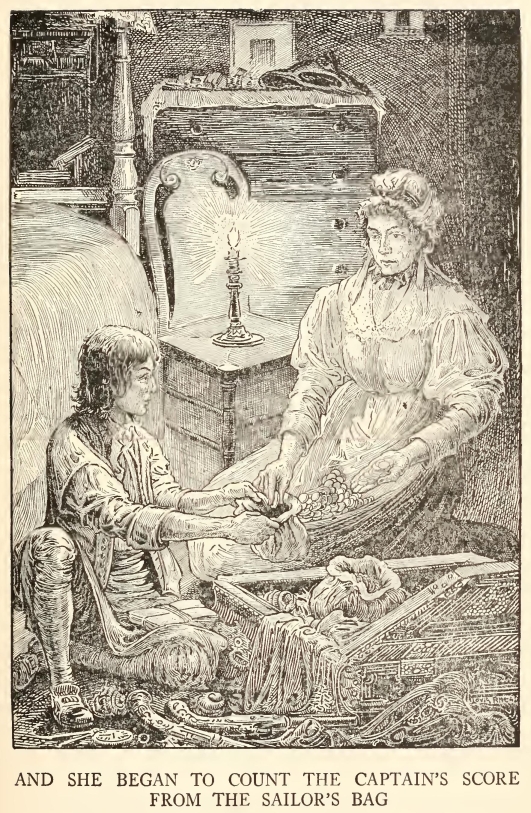
It was a long, difficult business, for the coins were of all countries and sizes—doubloons, and louis d’ors, and guineas, and pieces of eight, and I know not what besides, all shaken together at random. The guineas, too, were about the scarcest, and it was with these only that my mother knew how to make her count.
It was a long, difficult job because the coins came from all countries and were all different sizes. There were doubloons, louis d’ors, guineas, pieces of eight, and I don’t know what else, all mixed together at random. Guineas were among the scarcest coins, and my mother only knew how to count using guineas.
When we were about half-way through, I suddenly put my hand upon her arm, for I had heard in the silent frosty air a sound that brought my heart into my mouth—the tap-tapping of the blind man’s stick upon the frozen road. It drew nearer and nearer, while we sat holding our breath. Then it struck sharp on the inn door, and then we could hear the handle being turned and the bolt rattling as the wretched being tried to enter; and then there was a long time of silence both within and without. At last the tapping recommenced, and, to our indescribable joy and gratitude, died slowly away again until it ceased to be heard.
When we were about halfway through, I suddenly put my hand on her arm. In the silent, freezing air, I had heard a sound that made my heart leap into my throat. It was the tap-tapping of the blind man’s stick on the frozen road. It came closer and closer as we sat holding our breath. Then the stick struck the inn door sharply. We heard the handle turn and the bolt rattle as the wretched man tried to enter. After that, there was a long silence inside and outside the inn. At last the tapping started again. To our indescribable joy and gratitude, it slowly faded away until we could no longer hear it.
“Mother,” said I, “take the whole and let’s be going,” for I was sure the bolted door must have seemed suspicious and would bring the whole hornet’s nest about our ears, though how thankful I was that I had bolted it, none could tell who had never met that terrible blind man.
“Mother,” I said, “take it all and let’s go.” I was sure the bolted door must have looked suspicious and would bring the whole gang down on us. Still, no one who had never met that terrible blind man could know how thankful I was that I had bolted the door.
But my mother, frightened as she was, would not consent to take a fraction more than was due to her and was obstinately unwilling to be content with less. It was not yet seven, she said, by a long way; she knew her rights and she would have them; and she was still arguing with me when a little low whistle sounded a good way off upon the hill. That was enough, and more than enough, for both of us.
But frightened as my mother was, she would not agree to take even a fraction more than she was owed. She was just as stubborn about not accepting less. It was still a long way from seven, she said. She knew her rights, and she would have them. She was still arguing with me when we heard a faint, low whistle from far off on the hill. That was enough, and more than enough, for both of us.
“I’ll take what I have,” she said, jumping to her feet.
“I’ll take what I have,” she said, jumping to her feet.
“And I’ll take this to square the count,” said I, picking up the oilskin packet.
“And I’ll take this to settle the score,” I said, picking up the oilskin packet.
Next moment we were both groping downstairs, leaving the candle by the empty chest; and the next we had opened the door and were in full retreat. We had not started a moment too soon. The fog was rapidly dispersing; already the moon shone quite clear on the high ground on either side; and it was only in the exact bottom of the dell and round the tavern door that a thin veil still hung unbroken to conceal the first steps of our escape. Far less than half-way to the hamlet, very little beyond the bottom of the hill, we must come forth into the moonlight. Nor was this all, for the sound of several footsteps running came already to our ears, and as we looked back in their direction, a light tossing to and fro and still rapidly advancing showed that one of the newcomers carried a lantern.
The next moment, we were both feeling our way downstairs, leaving the candle by the empty chest. Moments later, we opened the door and fled. We had not started a moment too soon. The fog was quickly clearing, and the moon already shone clearly on the high ground on either side. Only at the very bottom of the hollow and around the tavern door did a thin veil of fog remain unbroken. It concealed the first steps of our escape. But we would have to come out into the moonlight well before we were halfway to the hamlet. We would barely be past the bottom of the hill. And that was not all. We could already hear several people running. When we looked back toward the footsteps, we saw a light bobbing back and forth and rapidly approaching. One of the newcomers was carrying a lantern.
“My dear,” said my mother suddenly, “take the money and run on. I am going to faint.”
“My dear,” my mother said suddenly, “take the money and keep running. I’m going to faint.”
This was certainly the end for both of us, I thought. How I cursed the cowardice of the neighbours; how I blamed my poor mother for her honesty and her greed, for her past foolhardiness and present weakness! We were just at the little bridge, by good fortune; and I helped her, tottering as she was, to the edge of the bank, where, sure enough, she gave a sigh and fell on my shoulder. I do not know how I found the strength to do it at all, and I am afraid it was roughly done, but I managed to drag her down the bank and a little way under the arch. Farther I could not move her, for the bridge was too low to let me do more than crawl below it. So there we had to stay—my mother almost entirely exposed and both of us within earshot of the inn.
I thought this was surely the end for both of us. How I cursed the neighbors for their cowardice! How I blamed my poor mother for her honesty and greed, for her earlier recklessness and her weakness now! Luckily, we were just at the little bridge. I helped her to the edge of the bank as she staggered. Sure enough, she sighed and fell against my shoulder. I do not know how I found the strength, and I am afraid I was rough with her. But I managed to drag her down the bank and a little way under the arch. I could not move her any farther because the bridge was so low I could only crawl beneath it. So we had to stay there, with my mother almost entirely exposed. We were both close enough to hear sounds from the inn.