Part 1, Chapter 3
The Black Spot
About noon I stopped at the captain’s door with some cooling drinks and medicines. He was lying very much as we had left him, only a little higher, and he seemed both weak and excited.
Around noon, I stopped at the captain’s door with some cool drinks and medicines. He was lying much as we had left him, only slightly higher up. He seemed both weak and excited.
“Jim,” he said, “you’re the only one here that’s worth anything, and you know I’ve been always good to you. Never a month but I’ve given you a silver fourpenny for yourself. And now you see, mate, I’m pretty low, and deserted by all; and Jim, you’ll bring me one noggin of rum, now, won’t you, matey?”
“Jim,” he said, “you’re the only one here worth anything, and you know I’ve always been good to you. Every month, I’ve given you a silver fourpenny coin to keep. And now, mate, you can see I’m in a bad way, and everyone has deserted me. Jim, you’ll bring me a small drink of rum, won’t you, mate?”
“The doctor—” I began.
“The doctor...” I began.
But he broke in cursing the doctor, in a feeble voice but heartily. “Doctors is all swabs,” he said; “and that doctor there, why, what do he know about seafaring men? I been in places hot as pitch, and mates dropping round with Yellow Jack, and the blessed land a-heaving like the sea with earthquakes—what do the doctor know of lands like that?—and I lived on rum, I tell you. It’s been meat and drink, and man and wife, to me; and if I’m not to have my rum now I’m a poor old hulk on a lee shore, my blood’ll be on you, Jim, and that doctor swab”; and he ran on again for a while with curses. “Look, Jim, how my fingers fidges,” he continued in the pleading tone. “I can’t keep ’em still, not I. I haven’t had a drop this blessed day. That doctor’s a fool, I tell you. If I don’t have a dram o’ rum, Jim, I’ll have the horrors; I seen some on ’em already. I seen old Flint in the corner there, behind you; as plain as print, I seen him; and if I get the horrors, I’m a man that has lived rough, and I’ll raise Cain. Your doctor hisself said one glass wouldn’t hurt me. I’ll give you a golden guinea for a noggin, Jim.”
But he interrupted, cursing the doctor in a weak voice, though with feeling. “Doctors are all swabs,” he said. “And that doctor there, what does he know about sailors? I’ve been in places hot as pitch, with mates dropping around me from Yellow Jack. I’ve seen the blessed land heave like the sea with earthquakes. What does the doctor know about lands like that? And I lived on rum, I tell you. It’s been food and drink to me, husband and wife both. If I can’t have my rum now, I’m a poor old wreck on a dangerous shore. My blood will be on your hands, Jim, and on that doctor swab’s.” He went on cursing for a while. “Look, Jim, how my fingers twitch,” he continued pleadingly. “I can’t keep them still. I haven’t had a drop all blessed day. That doctor’s a fool, I tell you. If I don’t have a drink of rum, Jim, I’ll get the horrors. I’ve seen some of them already. I saw old Flint in the corner there, behind you. I saw him as plain as day. And if I get the horrors, I’m a man who’s lived rough, and I’ll raise hell. Your doctor himself said one glass wouldn’t hurt me. I’ll give you a gold guinea for a small drink, Jim.”
He was growing more and more excited, and this alarmed me for my father, who was very low that day and needed quiet; besides, I was reassured by the doctor’s words, now quoted to me, and rather offended by the offer of a bribe.
He was getting more and more excited, and I worried about my father, who was very weak that day and needed quiet. Besides, I felt reassured when he quoted the doctor’s words to me, and I was rather offended by the offer of a bribe.
“I want none of your money,” said I, “but what you owe my father. I’ll get you one glass, and no more.”
“I only want the money you owe my father,” I said. “I’ll get you one glass, and no more.”
When I brought it to him, he seized it greedily and drank it out.
When I brought it to him, he grabbed it eagerly and drank it all.
“Aye, aye,” said he, “that’s some better, sure enough. And now, matey, did that doctor say how long I was to lie here in this old berth?”
“Yes, yes,” he said, “that’s a little better, sure enough. Now, mate, did the doctor say how long I have to stay in this old bunk?”
“A week at least,” said I.
“At least a week,” I said.
“Thunder!” he cried. “A week! I can’t do that; they’d have the black spot on me by then. The lubbers is going about to get the wind of me this blessed moment; lubbers as couldn’t keep what they got, and want to nail what is another’s. Is that seamanly behaviour, now, I want to know? But I’m a saving soul. I never wasted good money of mine, nor lost it neither; and I’ll trick ’em again. I’m not afraid on ’em. I’ll shake out another reef, matey, and daddle ’em again.”
“Damn it!” he cried. “A week! I can’t wait that long. They’d have given me the black spot by then. Those fools are trying to track me down this very moment. They couldn’t hold on to what they had, and now they want to take what belongs to someone else. Is that how a sailor should behave? I want to know. But I’m a careful man. I’ve never wasted my own good money or lost it either. And I’ll trick them again. I’m not afraid of them. I’ll put on more sail, mate, and fool them again.”
As he was thus speaking, he had risen from bed with great difficulty, holding to my shoulder with a grip that almost made me cry out, and moving his legs like so much dead weight. His words, spirited as they were in meaning, contrasted sadly with the weakness of the voice in which they were uttered. He paused when he had got into a sitting position on the edge.
As he spoke, he struggled to get out of bed. He gripped my shoulder so tightly that I almost cried out, and his legs moved like dead weight. Though his words were spirited, his voice was sadly weak. He paused once he was sitting on the edge of the bed.
“That doctor’s done me,” he murmured. “My ears is singing. Lay me back.”
“That doctor has finished me off,” he murmured. “My ears are ringing. Lay me back.”
Before I could do much to help him he had fallen back again to his former place, where he lay for a while silent.
Before I could do much to help him, he fell back to where he had been. He lay there silently for a while.
“Jim,” he said at length, “you saw that seafaring man today?”
“Jim,” he said finally, “did you see that sailor today?”
“Black Dog?” I asked.
“Black Dog?” I asked.
“Ah! Black Dog,” says he. “He’s a bad ’un; but there’s worse that put him on. Now, if I can’t get away nohow, and they tip me the black spot, mind you, it’s my old sea-chest they’re after; you get on a horse—you can, can’t you? Well, then, you get on a horse, and go to—well, yes, I will!—to that eternal doctor swab, and tell him to pipe all hands—magistrates and sich—and he’ll lay ’em aboard at the Admiral Benbow—all old Flint’s crew, man and boy, all on ’em that’s left. I was first mate, I was, old Flint’s first mate, and I’m the on’y one as knows the place. He gave it me at Savannah, when he lay a-dying, like as if I was to now, you see. But you won’t peach unless they get the black spot on me, or unless you see that Black Dog again or a seafaring man with one leg, Jim—him above all.”
“Ah! Black Dog,” he says. “He’s a bad one, but worse men sent him. Now, if I can’t get away and they give me the black spot, remember, it’s my old sea-chest they’re after. Get on a horse. You can ride, can’t you? Well, then, get on a horse and go to that blasted doctor. Yes, I’ll say it! Tell him to call everyone together, the magistrates and such. Then he’ll catch them at the Admiral Benbow. All old Flint’s crew, every man and boy still left. I was first mate, I was, old Flint’s first mate. And I’m the only one who knows the place. He gave it to me at Savannah when he was dying, as I might be now, you see. But don’t tell anyone unless they give me the black spot, or you see Black Dog again. Or if you see a seafaring man with one leg, Jim, him above all.”
“But what is the black spot, captain?” I asked.
“But what is the black spot, captain?” I asked.
“That’s a summons, mate. I’ll tell you if they get that. But you keep your weather-eye open, Jim, and I’ll share with you equals, upon my honour.”
“That’s a summons, mate. I’ll tell you if they get it. But keep a sharp lookout, Jim, and I’ll share equally with you. You have my word.”
He wandered a little longer, his voice growing weaker; but soon after I had given him his medicine, which he took like a child, with the remark, “If ever a seaman wanted drugs, it’s me,” he fell at last into a heavy, swoon-like sleep, in which I left him. What I should have done had all gone well I do not know. Probably I should have told the whole story to the doctor, for I was in mortal fear lest the captain should repent of his confessions and make an end of me. But as things fell out, my poor father died quite suddenly that evening, which put all other matters on one side. Our natural distress, the visits of the neighbours, the arranging of the funeral, and all the work of the inn to be carried on in the meanwhile kept me so busy that I had scarcely time to think of the captain, far less to be afraid of him.
He rambled a little longer, his voice growing weaker. Soon after I gave him his medicine, he finally fell into a deep, faint-like sleep, and I left him there. He had taken the medicine like a child, saying, “If ever a sailor needed medicine, it’s me.” I don’t know what I would have done if all had gone well. I probably would have told the doctor the whole story. I was terrified that the captain might regret what he had confessed and kill me. But my poor father died quite suddenly that evening, and everything else was set aside. Our grief, the neighbours’ visits, the funeral arrangements, and the work of running the inn kept me very busy. I had hardly any time to think about the captain, much less to be afraid of him.
He got downstairs next morning, to be sure, and had his meals as usual, though he ate little and had more, I am afraid, than his usual supply of rum, for he helped himself out of the bar, scowling and blowing through his nose, and no one dared to cross him. On the night before the funeral he was as drunk as ever; and it was shocking, in that house of mourning, to hear him singing away at his ugly old sea-song; but weak as he was, we were all in the fear of death for him, and the doctor was suddenly taken up with a case many miles away and was never near the house after my father’s death. I have said the captain was weak, and indeed he seemed rather to grow weaker than regain his strength. He clambered up and down stairs, and went from the parlour to the bar and back again, and sometimes put his nose out of doors to smell the sea, holding on to the walls as he went for support and breathing hard and fast like a man on a steep mountain. He never particularly addressed me, and it is my belief he had as good as forgotten his confidences; but his temper was more flighty, and allowing for his bodily weakness, more violent than ever. He had an alarming way now when he was drunk of drawing his cutlass and laying it bare before him on the table. But with all that, he minded people less and seemed shut up in his own thoughts and rather wandering. Once, for instance, to our extreme wonder, he piped up to a different air, a kind of country love-song that he must have learned in his youth before he had begun to follow the sea.
He did come downstairs the next morning and had his meals as usual, though he ate little. I am afraid he drank even more rum than usual. He helped himself from the bar, scowling and snorting through his nose, and no one dared oppose him. On the night before the funeral, he was as drunk as ever. It was shocking to hear him singing his ugly old sea song in a house of mourning. But weak as he was, we were all terrified of him. The doctor had been called away suddenly to a case many miles away. He had not been near the house since my father’s death. I have said the captain was weak, and he seemed to be growing weaker rather than recovering his strength. He struggled up and down the stairs and went from the parlour to the bar and back again. Sometimes he poked his nose outside to smell the sea. He held on to the walls for support and breathed hard and fast, like a man climbing a steep mountain. He never spoke to me in particular, and I believe he had almost forgotten what he had told me in confidence. But his temper was more unpredictable and, given how weak he was, more violent than ever. Now, when he was drunk, he had an alarming habit of drawing his cutlass and laying it on the table before him. Even so, he paid less attention to people. He seemed lost in his own thoughts and rather confused. Once, to our great surprise, he started singing a different tune. It was a kind of country love song that he must have learned as a young man, before he went to sea.
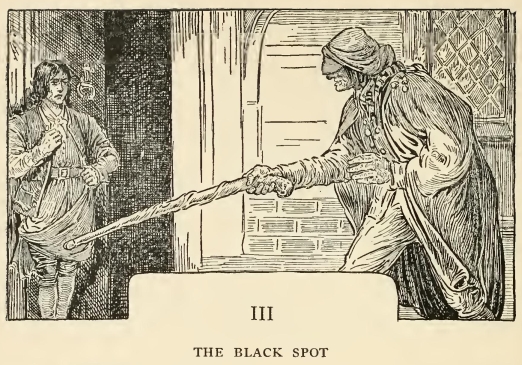
So things passed until, the day after the funeral, and about three o’clock of a bitter, foggy, frosty afternoon, I was standing at the door for a moment, full of sad thoughts about my father, when I saw someone drawing slowly near along the road. He was plainly blind, for he tapped before him with a stick and wore a great green shade over his eyes and nose; and he was hunched, as if with age or weakness, and wore a huge old tattered sea-cloak with a hood that made him appear positively deformed. I never saw in my life a more dreadful-looking figure. He stopped a little from the inn, and raising his voice in an odd sing-song, addressed the air in front of him, “Will any kind friend inform a poor blind man, who has lost the precious sight of his eyes in the gracious defence of his native country, England—and God bless King George!—where or in what part of this country he may now be?”
Things went on like this until the day after the funeral. At about three o’clock that bitter, foggy, frosty afternoon, I stood at the door for a moment, thinking sadly about my father. Then I saw someone slowly approaching along the road. He was clearly blind. He tapped the ground ahead of him with a stick and wore a large green shade over his eyes and nose. He was hunched over, as if from age or weakness. He wore a huge, old, tattered sea cloak with a hood that made him look almost deformed. I had never seen a more frightening figure. He stopped a short distance from the inn and raised his voice in a strange sing-song. Speaking into the air in front of him, he said, “Will some kind friend tell a poor blind man where he is? I lost my precious sight defending my native country, England. God bless King George! Can anyone tell me what part of the country I am in?”
“You are at the Admiral Benbow, Black Hill Cove, my good man,” said I.
“You’re at the Admiral Benbow in Black Hill Cove, sir,” I said.
“I hear a voice,” said he, “a young voice. Will you give me your hand, my kind young friend, and lead me in?”
“I hear a voice,” he said. “A young voice. Will you take my hand, my kind young friend, and lead me in?”
I held out my hand, and the horrible, soft-spoken, eyeless creature gripped it in a moment like a vise. I was so much startled that I struggled to withdraw, but the blind man pulled me close up to him with a single action of his arm.
I held out my hand, and the horrible, soft-spoken, eyeless creature immediately gripped it like a vise. I was so startled that I tried to pull away. But the blind man pulled me close with one movement of his arm.
“Now, boy,” he said, “take me in to the captain.”
“Now, boy,” he said, “take me to the captain.”
“Sir,” said I, “upon my word I dare not.”
“Sir,” I said, “I swear I don’t dare.”
“Oh,” he sneered, “that’s it! Take me in straight or I’ll break your arm.”
“Oh,” he sneered, “that’s it! Take me inside now, or I’ll break your arm.”
And he gave it, as he spoke, a wrench that made me cry out.
And as he spoke, he gave it a twist that made me cry out.
“Sir,” said I, “it is for yourself I mean. The captain is not what he used to be. He sits with a drawn cutlass. Another gentleman—”
“Sir,” I said, “I mean for your own sake. The captain is not what he used to be. He sits with his cutlass drawn. Another gentleman...”
“Come, now, march,” interrupted he; and I never heard a voice so cruel, and cold, and ugly as that blind man’s. It cowed me more than the pain, and I began to obey him at once, walking straight in at the door and towards the parlour, where our sick old buccaneer was sitting, dazed with rum. The blind man clung close to me, holding me in one iron fist and leaning almost more of his weight on me than I could carry. “Lead me straight up to him, and when I’m in view, cry out, ‘Here’s a friend for you, Bill.’ If you don’t, I’ll do this,” and with that he gave me a twitch that I thought would have made me faint. Between this and that, I was so utterly terrified of the blind beggar that I forgot my terror of the captain, and as I opened the parlour door, cried out the words he had ordered in a trembling voice.
“Come on, march,” he interrupted. I had never heard a voice as cruel, cold, and ugly as the blind man’s. His voice frightened me more than the pain, and I obeyed him at once. I walked straight through the door and toward the parlour. Our sick old pirate was sitting there, dazed with rum. The blind man stayed close to me, gripping me in one iron fist. He leaned on me with almost more weight than I could carry. “Lead me straight up to him, and when he can see me, call out, ‘Here’s a friend for you, Bill.’ If you don’t, I’ll do this.” Then he gave me a sharp twist that I thought would make me faint. By now I was so terrified of the blind beggar that I forgot my fear of the captain. As I opened the parlour door, I called out the words he had ordered me to say. My voice was trembling.
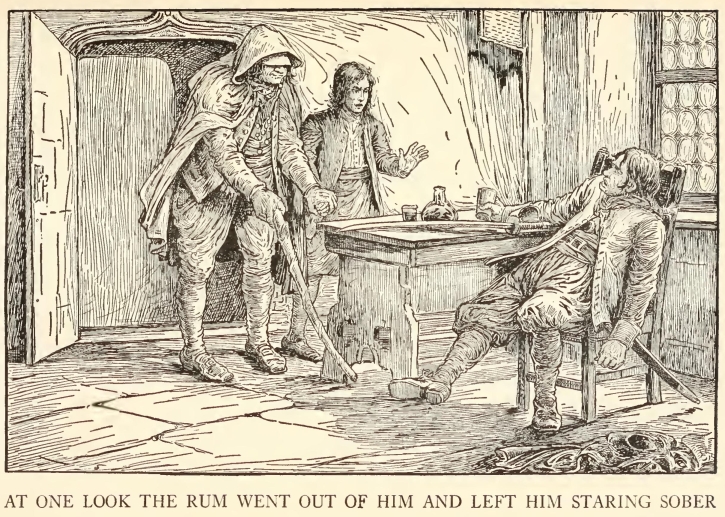
The poor captain raised his eyes, and at one look the rum went out of him and left him staring sober. The expression of his face was not so much of terror as of mortal sickness. He made a movement to rise, but I do not believe he had enough force left in his body.
The poor captain looked up. At a single glance, the rum’s effect vanished, and he stared, suddenly sober. His face showed not so much terror as a deadly sickness. He tried to rise, but I do not believe he had enough strength left in his body.
“Now, Bill, sit where you are,” said the beggar. “If I can’t see, I can hear a finger stirring. Business is business. Hold out your left hand. Boy, take his left hand by the wrist and bring it near to my right.”
“Now, Bill, stay where you are,” said the beggar. “If I can’t see, I can hear a finger move. Business is business. Hold out your left hand. Boy, take his left hand by the wrist and bring it close to my right hand.”
We both obeyed him to the letter, and I saw him pass something from the hollow of the hand that held his stick into the palm of the captain’s, which closed upon it instantly.
We both did exactly as he told us. I saw him pass something from the palm of the hand holding his stick into the captain’s palm. The captain’s hand closed around it at once.
“And now that’s done,” said the blind man; and at the words he suddenly left hold of me, and with incredible accuracy and nimbleness, skipped out of the parlour and into the road, where, as I still stood motionless, I could hear his stick go tap-tap-tapping into the distance.
“And now that’s done,” said the blind man. As he spoke, he suddenly let go of me. With incredible precision and agility, he skipped out of the room and into the road. I still stood motionless, listening to his stick tap-tap-tapping into the distance.
It was some time before either I or the captain seemed to gather our senses, but at length, and about at the same moment, I released his wrist, which I was still holding, and he drew in his hand and looked sharply into the palm.
It took some time before the captain or I seemed to recover our senses. But at last, almost at the same moment, I let go of his wrist, which I was still holding. He pulled his hand back and looked closely at his palm.
“Ten o’clock!” he cried. “Six hours. We’ll do them yet,” and he sprang to his feet.
“Ten o’clock!” he cried. “Six hours. We’ll beat them yet!” He jumped to his feet.
Even as he did so, he reeled, put his hand to his throat, stood swaying for a moment, and then, with a peculiar sound, fell from his whole height face foremost to the floor.
Even as he did so, he staggered and put his hand to his throat. He stood swaying for a moment, then made a strange sound and fell face first to the floor.
I ran to him at once, calling to my mother. But haste was all in vain. The captain had been struck dead by thundering apoplexy. It is a curious thing to understand, for I had certainly never liked the man, though of late I had begun to pity him, but as soon as I saw that he was dead, I burst into a flood of tears. It was the second death I had known, and the sorrow of the first was still fresh in my heart.
I ran to him at once, calling to my mother. But rushing to him was no use. The captain had been struck dead by a massive stroke. My reaction was strange. I had certainly never liked the man, though lately I had begun to pity him. But as soon as I saw that he was dead, I burst into tears. It was the second death I had known, and the sorrow of the first was still fresh in my heart.