Part 4, Chapter 18
The Doctor Continues: First Day’s Fighting Ends
We made our best speed across the strip of wood that now divided us from the stockade, and at every step we took the voices of the buccaneers rang nearer. Soon we could hear their footfalls as they ran and the cracking of the branches as they breasted across a bit of thicket.
We hurried across the strip of woods that now separated us from the stockade. With every step, the pirates’ voices sounded closer. Soon we could hear their footsteps as they ran and branches cracking as they pushed through a patch of thick undergrowth.
I began to see we should have a brush for it in earnest and looked to my priming.
I began to see that we were in for a serious fight, and I checked my gun's priming.
“Captain,” said I, “Trelawney is the dead shot. Give him your gun; his own is useless.”
“Captain,” I said, “Trelawney is an excellent shot. Give him your gun. His own gun is useless.”
They exchanged guns, and Trelawney, silent and cool as he had been since the beginning of the bustle, hung a moment on his heel to see that all was fit for service. At the same time, observing Gray to be unarmed, I handed him my cutlass. It did all our hearts good to see him spit in his hand, knit his brows, and make the blade sing through the air. It was plain from every line of his body that our new hand was worth his salt.
They exchanged guns. Trelawney paused to make sure everything was ready for use. He was as quiet and calm as he had been since the commotion began. At the same time, I saw that Gray was unarmed and handed him my cutlass. It cheered us all to see him spit in his hand, frown, and make the blade sing through the air. Every line of his body showed that our new man knew his job.
Forty paces farther we came to the edge of the wood and saw the stockade in front of us. We struck the enclosure about the middle of the south side, and almost at the same time, seven mutineers—Job Anderson, the boatswain, at their head—appeared in full cry at the southwestern corner.
Forty paces farther on, we reached the edge of the woods and saw the stockade ahead. We reached the enclosure near the middle of its south side. Almost at the same time, seven mutineers appeared at the southwestern corner, shouting as they came. Job Anderson, the boatswain, led them.
They paused as if taken aback, and before they recovered, not only the squire and I, but Hunter and Joyce from the block house, had time to fire. The four shots came in rather a scattering volley, but they did the business: one of the enemy actually fell, and the rest, without hesitation, turned and plunged into the trees.
The enemy paused as if surprised. Before they recovered, the squire and I had time to fire, as did Hunter and Joyce from the blockhouse. The four shots were somewhat scattered, but they did the job. One of the enemy fell, and the rest immediately turned and plunged into the trees.
After reloading, we walked down the outside of the palisade to see to the fallen enemy. He was stone dead—shot through the heart.
After reloading, we walked along the outside of the palisade to check on the fallen enemy. He was dead, shot through the heart.
We began to rejoice over our good success when just at that moment a pistol cracked in the bush, a ball whistled close past my ear, and poor Tom Redruth stumbled and fell his length on the ground. Both the squire and I returned the shot, but as we had nothing to aim at, it is probable we only wasted powder. Then we reloaded and turned our attention to poor Tom.
We began to celebrate our success. Just then, a pistol fired from the bushes, and a bullet whistled close past my ear. Poor Tom Redruth stumbled and fell flat on the ground. The squire and I both fired back. But we had nothing to aim at, so we probably just wasted powder. Then we reloaded and turned our attention to poor Tom.
The captain and Gray were already examining him, and I saw with half an eye that all was over.
The captain and Gray were already examining him, and I could see at a glance that it was all over.
I believe the readiness of our return volley had scattered the mutineers once more, for we were suffered without further molestation to get the poor old gamekeeper hoisted over the stockade and carried, groaning and bleeding, into the log-house.
I believe our swift return volley had scattered the mutineers once more. We were able to lift the poor old gamekeeper over the stockade without further interference. Then we carried him into the log-house, groaning and bleeding.
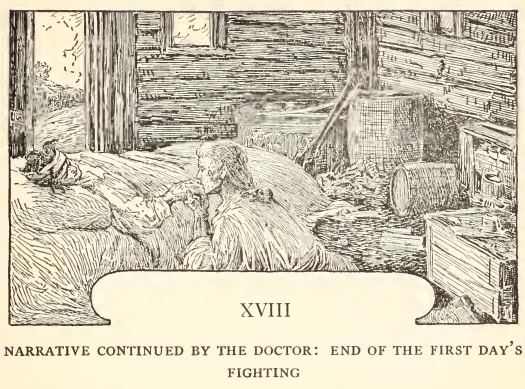
Poor old fellow, he had not uttered one word of surprise, complaint, fear, or even acquiescence from the very beginning of our troubles till now, when we had laid him down in the log-house to die. He had lain like a Trojan behind his mattress in the gallery; he had followed every order silently, doggedly, and well; he was the oldest of our party by a score of years; and now, sullen, old, serviceable servant, it was he that was to die.
Poor old fellow. From the beginning of our troubles until now, he had not said a word of surprise, complaint, fear, or even acceptance. Now we had laid him down in the log-house to die. He had fought bravely from behind his mattress in the gallery. He had followed every order silently, stubbornly, and well. He was twenty years older than anyone else in our party. And now this sullen, old, useful servant was the one who was going to die.
The squire dropped down beside him on his knees and kissed his hand, crying like a child.
The squire fell to his knees beside him and kissed his hand, crying like a child.
“Be I going, doctor?” he asked.
“Am I going, doctor?” he asked.
“Tom, my man,” said I, “you’re going home.”
“Tom, my friend,” I said, “you’re going home.”
“I wish I had had a lick at them with the gun first,” he replied.
“I wish I’d had a chance to shoot at them first,” he replied.
“Tom,” said the squire, “say you forgive me, won’t you?”
“Tom,” said the squire, “tell me you forgive me, please.”
“Would that be respectful like, from me to you, squire?” was the answer. “Howsoever, so be it, amen!”
“Would that be respectful of me, squire?” came the reply. “Anyway, so be it, amen!”
After a little while of silence, he said he thought somebody might read a prayer. “It’s the custom, sir,” he added apologetically. And not long after, without another word, he passed away.
After a brief silence, he said he thought someone might read a prayer. “It’s the custom, sir,” he added apologetically. Not long after, he died without saying another word.
In the meantime the captain, whom I had observed to be wonderfully swollen about the chest and pockets, had turned out a great many various stores—the British colours, a Bible, a coil of stoutish rope, pen, ink, the log-book, and pounds of tobacco. He had found a longish fir-tree lying felled and trimmed in the enclosure, and with the help of Hunter he had set it up at the corner of the log-house where the trunks crossed and made an angle. Then, climbing on the roof, he had with his own hand bent and run up the colours.
Meanwhile, the captain unpacked a great many supplies. I had noticed that his chest and pockets looked remarkably swollen. The supplies included the British flag, a Bible, a coil of fairly strong rope, pen, ink, the logbook, and pounds of tobacco. He had found a fairly long fir tree lying in the enclosure, already cut down and trimmed. With Hunter’s help, he had set it upright at a corner of the log house, where the logs crossed. Then he had climbed onto the roof and attached and raised the flag himself.
This seemed mightily to relieve him. He re-entered the log-house and set about counting up the stores as if nothing else existed. But he had an eye on Tom’s passage for all that, and as soon as all was over, came forward with another flag and reverently spread it on the body.
This seemed to relieve him greatly. He went back into the log-house and began counting the supplies as if nothing else existed. But he still kept an eye on Tom’s passing. As soon as it was over, he came forward with another flag and respectfully spread it over the body.
“Don’t you take on, sir,” he said, shaking the squire’s hand. “All’s well with him; no fear for a hand that’s been shot down in his duty to captain and owner. It mayn’t be good divinity, but it’s a fact.”
“Don’t be upset, sir,” he said, shaking the squire’s hand. “All is well with him. There’s no need to fear for a man shot down while doing his duty to captain and owner. That may not be good theology, but it’s a fact.”
Then he pulled me aside.
Then he pulled me aside.
“Dr. Livesey,” he said, “in how many weeks do you and squire expect the consort?”
“Dr. Livesey,” he said, “how many weeks until you and the squire expect the accompanying ship?”
I told him it was a question not of weeks but of months, that if we were not back by the end of August Blandly was to send to find us, but neither sooner nor later. “You can calculate for yourself,” I said.
I told him it would take months, not weeks. If we weren’t back by the end of August, Blandly was to send someone to find us, but neither sooner nor later. “You can work it out for yourself,” I said.
“Why, yes,” returned the captain, scratching his head; “and making a large allowance, sir, for all the gifts of Providence, I should say we were pretty close hauled.”
“Why, yes,” replied the captain, scratching his head. “Even allowing plenty for all the gifts of Providence, sir, I’d say we’re in a tight spot.”
“How do you mean?” I asked.
“What do you mean?” I asked.
“It’s a pity, sir, we lost that second load. That’s what I mean,” replied the captain. “As for powder and shot, we’ll do. But the rations are short, very short—so short, Dr. Livesey, that we’re perhaps as well without that extra mouth.”
“It’s a pity we lost the second load, sir. That’s what I mean,” the captain replied. “We have enough powder and shot. But we’re very short of food, Dr. Livesey. We’re so short that perhaps we’re better off without that extra mouth to feed.”
And he pointed to the dead body under the flag.
And he pointed to the dead body under the flag.
Just then, with a roar and a whistle, a round-shot passed high above the roof of the log-house and plumped far beyond us in the wood.
Just then, a cannonball roared and whistled high over the roof of the log cabin. It landed far beyond us in the woods.
“Oho!” said the captain. “Blaze away! You’ve little enough powder already, my lads.”
“Oh!” said the captain. “Keep firing! You don’t have much gunpowder left already, lads.”
At the second trial, the aim was better, and the ball descended inside the stockade, scattering a cloud of sand but doing no further damage.
The second shot was better aimed. The ball landed inside the stockade, kicking up a cloud of sand but causing no further damage.
“Captain,” said the squire, “the house is quite invisible from the ship. It must be the flag they are aiming at. Would it not be wiser to take it in?”
“Captain,” said the squire, “the house can’t be seen from the ship. They must be aiming at the flag. Wouldn’t it be wiser to take the flag down?”
“Strike my colours!” cried the captain. “No, sir, not I”; and as soon as he had said the words, I think we all agreed with him. For it was not only a piece of stout, seamanly, good feeling; it was good policy besides and showed our enemies that we despised their cannonade.
“Lower my flag!” cried the captain. “No, sir, not me.” As soon as he said it, I think we all agreed with him. His refusal showed not only brave, sailorly spirit but also good judgment. It showed our enemies that we had no fear of their cannon fire.
All through the evening they kept thundering away. Ball after ball flew over or fell short or kicked up the sand in the enclosure, but they had to fire so high that the shot fell dead and buried itself in the soft sand. We had no ricochet to fear, and though one popped in through the roof of the log-house and out again through the floor, we soon got used to that sort of horse-play and minded it no more than cricket.
All evening they kept firing. Cannonball after cannonball flew over, fell short, or kicked up sand inside the enclosure. But they had to aim so high that the balls landed without bouncing and buried themselves in the soft sand. We had no ricochets to fear. Although one ball came through the roof of the log-house and went out through the floor, we soon got used to that kind of rough play. We thought no more of it than we would a game of cricket.
“There is one good thing about all this,” observed the captain; “the wood in front of us is likely clear. The ebb has made a good while; our stores should be uncovered. Volunteers to go and bring in pork.”
“There is one good thing about all this,” said the captain. “The woods in front of us are probably clear. The tide has been going out for a while, so our supplies should be uncovered. I need volunteers to go and bring back pork.”
Gray and Hunter were the first to come forward. Well armed, they stole out of the stockade, but it proved a useless mission. The mutineers were bolder than we fancied or they put more trust in Israel’s gunnery. For four or five of them were busy carrying off our stores and wading out with them to one of the gigs that lay close by, pulling an oar or so to hold her steady against the current. Silver was in the stern-sheets in command; and every man of them was now provided with a musket from some secret magazine of their own.
Gray and Hunter were the first to come forward. Well armed, they slipped out of the stockade, but their mission proved useless. The mutineers were bolder than we had thought, or they had more faith in Israel’s skill with the gun. Four or five of them were carrying off our supplies. They waded out with them to one of the small boats lying nearby. The boat was being held steady against the current with an oar or two. Silver was in command at the stern. Every one of the mutineers now had a musket from some secret store of their own.
The captain sat down to his log, and here is the beginning of the entry:
The captain sat down to write in his log. Here is the beginning of his entry:
Alexander Smollett, master; David Livesey, ship’s doctor; Abraham Gray, carpenter’s mate; John Trelawney, owner; John Hunter and Richard Joyce, owner’s servants, landsmen—being all that is left faithful of the ship’s company—with stores for ten days at short rations, came ashore this day and flew British colours on the log-house in Treasure Island. Thomas Redruth, owner’s servant, landsman, shot by the mutineers; James Hawkins, cabin-boy—
Alexander Smollett, captain, David Livesey, ship’s doctor, Abraham Gray, carpenter’s mate, and John Trelawney, owner, came ashore today. So did John Hunter and Richard Joyce, the owner’s servants and landsmen. They were all who remained faithful among the ship’s crew. They had enough supplies for ten days on reduced rations. They raised the British flag over the log-house on Treasure Island. Thomas Redruth, the owner’s servant and a landsman, was shot by the mutineers. James Hawkins, cabin-boy...
And at the same time, I was wondering over poor Jim Hawkins’ fate.
And at the same time, I was wondering what would happen to poor Jim Hawkins.
A hail on the land side.
A call from the shore.
“Somebody hailing us,” said Hunter, who was on guard.
“Someone is calling out to us,” said Hunter, who was on guard.
“Doctor! Squire! Captain! Hullo, Hunter, is that you?” came the cries.
“Doctor! Squire! Captain! Hello, Hunter, is that you?” people called out.
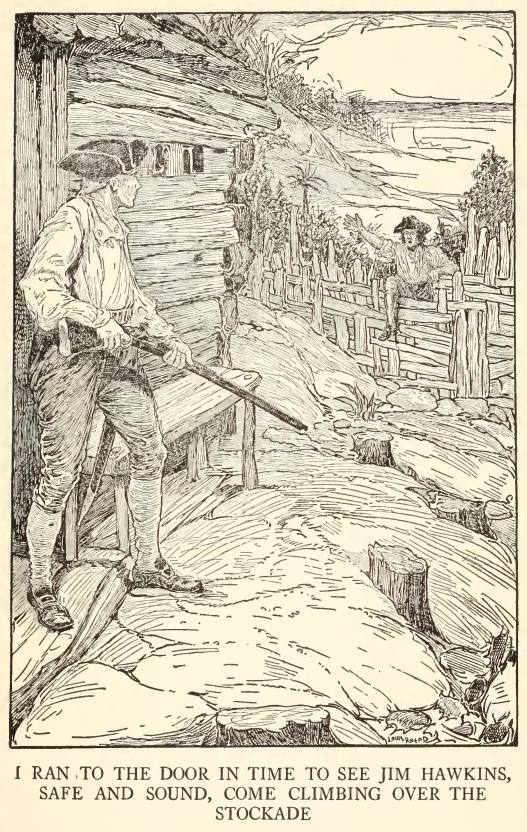
And I ran to the door in time to see Jim Hawkins, safe and sound, come climbing over the stockade.
I ran to the door just in time to see Jim Hawkins climbing over the stockade, safe and sound.