Part 4, Chapter 19
Jim Hawkins Resumes the Story: The Garrison in the Stockade
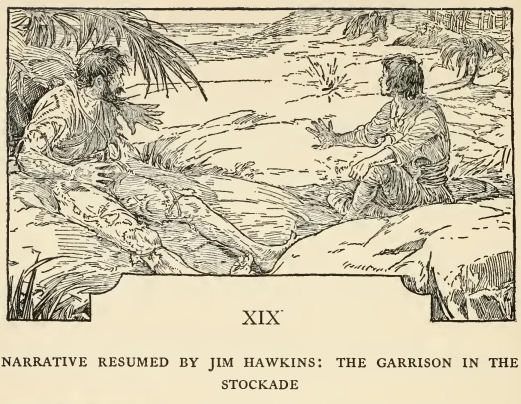
As soon as Ben Gunn saw the colours he came to a halt, stopped me by the arm, and sat down.
As soon as Ben Gunn saw the flag, he stopped, grabbed my arm to stop me, and sat down.
“Now,” said he, “there’s your friends, sure enough.”
“Now,” he said, “those are your friends, all right.”
“Far more likely it’s the mutineers,” I answered.
“It’s much more likely to be the mutineers,” I replied.
“That!” he cried. “Why, in a place like this, where nobody puts in but gen’lemen of fortune, Silver would fly the Jolly Roger, you don’t make no doubt of that. No, that’s your friends. There’s been blows too, and I reckon your friends has had the best of it; and here they are ashore in the old stockade, as was made years and years ago by Flint. Ah, he was the man to have a headpiece, was Flint! Barring rum, his match were never seen. He were afraid of none, not he; on’y Silver—Silver was that genteel.”
“That!” he cried. “Why, in a place like this, where only pirates come, Silver would fly the Jolly Roger. You can be sure of that. No, those are your friends. There’s been a fight too, and I reckon your friends got the better of it. Now they’re ashore in the old stockade that Flint built years and years ago. Ah, Flint had a clever head on him! Except for his weakness for rum, he had no equal. He wasn’t afraid of anyone, except Silver. Silver was that refined.”
“Well,” said I, “that may be so, and so be it; all the more reason that I should hurry on and join my friends.”
“Well,” I said, “that may be true, and if so, let it be. That’s all the more reason for me to hurry and join my friends.”
“Nay, mate,” returned Ben, “not you. You’re a good boy, or I’m mistook; but you’re on’y a boy, all told. Now, Ben Gunn is fly. Rum wouldn’t bring me there, where you’re going—not rum wouldn’t, till I see your born gen’leman and gets it on his word of honour. And you won’t forget my words; ‘A precious sight (that’s what you’ll say), a precious sight more confidence’—and then nips him.”
“No, mate,” Ben replied, “not you. You’re a good boy, if I’m not mistaken. But you’re only a boy, after all. Now, Ben Gunn is clever. Not even rum would bring me where you’re going, not until I see your true gentleman and get it on his word of honor. And don’t forget my words. ‘A great deal more confidence.’ That’s what you’ll say. And then pinch him.”
And he pinched me the third time with the same air of cleverness.
And he pinched me a third time, with the same clever look.
“And when Ben Gunn is wanted, you know where to find him, Jim. Just wheer you found him today. And him that comes is to have a white thing in his hand, and he’s to come alone. Oh! And you’ll say this: ‘Ben Gunn,’ says you, ‘has reasons of his own.’”
“And when someone wants Ben Gunn, you know where to find him, Jim. Right where you found him today. Whoever comes must have something white in his hand, and he must come alone. Oh! And you’ll say this: ‘Ben Gunn has his own reasons.’”
“Well,” said I, “I believe I understand. You have something to propose, and you wish to see the squire or the doctor, and you’re to be found where I found you. Is that all?”
“Well,” I said, “I think I understand. You have something to propose, and you want to see the squire or the doctor. You can be found where I found you. Is that all?”
“And when? says you,” he added. “Why, from about noon observation to about six bells.”
“And when, you ask?” he added. “Why, from around the noon observation until about six bells.”
“Good,” said I, “and now may I go?”
“Good,” I said, “and may I go now?”
“You won’t forget?” he inquired anxiously. “Precious sight, and reasons of his own, says you. Reasons of his own; that’s the mainstay; as between man and man. Well, then”—still holding me—“I reckon you can go, Jim. And, Jim, if you was to see Silver, you wouldn’t go for to sell Ben Gunn? Wild horses wouldn’t draw it from you? No, says you. And if them pirates camp ashore, Jim, what would you say but there’d be widders in the morning?”
“You won’t forget?” he asked anxiously. “A great sight, and reasons of his own, you say. Reasons of his own. That’s the main thing, between one man and another. Well, then,” he said, still holding me, “I reckon you can go, Jim. And, Jim, if you saw Silver, you wouldn’t betray Ben Gunn, would you? Wild horses couldn’t drag it out of you? No, you say. And if those pirates camp ashore, Jim, what else would you say but that there’d be widows in the morning?”
Here he was interrupted by a loud report, and a cannonball came tearing through the trees and pitched in the sand not a hundred yards from where we two were talking. The next moment each of us had taken to his heels in a different direction.
A loud blast interrupted him. A cannonball tore through the trees and landed in the sand less than a hundred yards from where we were talking. The next moment, we each ran off in a different direction.
For a good hour to come frequent reports shook the island, and balls kept crashing through the woods. I moved from hiding-place to hiding-place, always pursued, or so it seemed to me, by these terrifying missiles. But towards the end of the bombardment, though still I durst not venture in the direction of the stockade, where the balls fell oftenest, I had begun, in a manner, to pluck up my heart again, and after a long detour to the east, crept down among the shore-side trees.
For another hour, frequent blasts shook the island, and cannonballs kept crashing through the woods. I moved from one hiding place to another. It seemed that the terrifying cannonballs pursued me everywhere. But toward the end of the bombardment, I began to regain some courage. I still dared not go toward the stockade, where the cannonballs fell most often. Instead, I made a long detour to the east and crept down among the trees along the shore.
The sun had just set, the sea breeze was rustling and tumbling in the woods and ruffling the grey surface of the anchorage; the tide, too, was far out, and great tracts of sand lay uncovered; the air, after the heat of the day, chilled me through my jacket.
The sun had just set. The sea breeze rustled and swirled through the woods and rippled the gray water in the anchorage. The tide was far out, leaving wide stretches of sand exposed. After the heat of the day, the air chilled me through my jacket.
The Hispaniola still lay where she had anchored; but, sure enough, there was the Jolly Roger—the black flag of piracy—flying from her peak. Even as I looked, there came another red flash and another report that sent the echoes clattering, and one more round-shot whistled through the air. It was the last of the cannonade.
The Hispaniola was still where she had anchored. But sure enough, the Jolly Roger, the black flag of piracy, was flying from her mast. As I watched, there was another red flash and another cannon blast that sent echoes clattering. One more cannonball whistled through the air. It was the last shot of the barrage.
I lay for some time watching the bustle which succeeded the attack. Men were demolishing something with axes on the beach near the stockade—the poor jolly-boat, I afterwards discovered. Away, near the mouth of the river, a great fire was glowing among the trees, and between that point and the ship one of the gigs kept coming and going, the men, whom I had seen so gloomy, shouting at the oars like children. But there was a sound in their voices which suggested rum.
I lay watching the activity that followed the attack. On the beach near the stockade, men were breaking something up with axes. I later discovered it was the poor jolly-boat. Far away, near the river’s mouth, a great fire glowed among the trees. One of the small boats kept going back and forth between the fire and the ship. The men I had seen looking so gloomy were shouting like children as they rowed. But something in their voices suggested rum.
At length I thought I might return towards the stockade. I was pretty far down on the low, sandy spit that encloses the anchorage to the east, and is joined at half-water to Skeleton Island; and now, as I rose to my feet, I saw, some distance further down the spit and rising from among low bushes, an isolated rock, pretty high, and peculiarly white in colour. It occurred to me that this might be the white rock of which Ben Gunn had spoken and that some day or other a boat might be wanted and I should know where to look for one.
At last, I thought I could return to the stockade. I was quite far down the low, sandy spit that enclosed the anchorage on the east. The spit joined Skeleton Island at half tide. As I stood up, I saw a lone rock rising above the low bushes farther down the spit. It was quite tall and an unusual white color. I thought it might be the white rock Ben Gunn had mentioned. Someday a boat might be needed, and I would know where to look for one.
Then I skirted among the woods until I had regained the rear, or shoreward side, of the stockade, and was soon warmly welcomed by the faithful party.
Then I made my way through the woods until I reached the rear of the stockade, on the shore side. The loyal group soon welcomed me warmly.
I had soon told my story and began to look about me. The log-house was made of unsquared trunks of pine—roof, walls, and floor. The latter stood in several places as much as a foot or a foot and a half above the surface of the sand. There was a porch at the door, and under this porch the little spring welled up into an artificial basin of a rather odd kind—no other than a great ship’s kettle of iron, with the bottom knocked out, and sunk “to her bearings,” as the captain said, among the sand.
I soon finished telling my story and began to look around. The log house was made of rough pine trunks. The roof, walls, and floor were all made of them. In several places, the floor stood as much as a foot or a foot and a half above the sand. There was a porch at the door. Under the porch, a small spring bubbled up into a rather odd man-made basin. It was a large iron ship’s kettle with its bottom knocked out. It had been sunk “to her bearings,” as the captain said, in the sand.
Little had been left besides the framework of the house, but in one corner there was a stone slab laid down by way of hearth and an old rusty iron basket to contain the fire.
Little was left of the house besides its frame. But in one corner, a stone slab served as a hearth, and an old, rusty iron basket held the fire.
The slopes of the knoll and all the inside of the stockade had been cleared of timber to build the house, and we could see by the stumps what a fine and lofty grove had been destroyed. Most of the soil had been washed away or buried in drift after the removal of the trees; only where the streamlet ran down from the kettle a thick bed of moss and some ferns and little creeping bushes were still green among the sand. Very close around the stockade—too close for defence, they said—the wood still flourished high and dense, all of fir on the land side, but towards the sea with a large admixture of live-oaks.
The trees on the slopes of the knoll and inside the stockade had all been cleared to build the house. The stumps showed us what a fine, tall grove had been destroyed. After the trees were removed, most of the soil had washed away or been buried under drifting sand. Only where the small stream ran down from the kettle did a thick bed of moss, some ferns, and little creeping bushes remain green among the sand. The forest still grew tall and thick very close around the stockade. They said it was too close for defense. On the landward side, the trees were all firs, but toward the sea there were many live oaks mixed in.
The cold evening breeze, of which I have spoken, whistled through every chink of the rude building and sprinkled the floor with a continual rain of fine sand. There was sand in our eyes, sand in our teeth, sand in our suppers, sand dancing in the spring at the bottom of the kettle, for all the world like porridge beginning to boil. Our chimney was a square hole in the roof; it was but a little part of the smoke that found its way out, and the rest eddied about the house and kept us coughing and piping the eye.
The cold evening breeze I mentioned whistled through every crack in the rough building. It sprinkled the floor with a steady rain of fine sand. There was sand in our eyes, sand in our teeth, and sand in our suppers. Sand danced in the spring water at the bottom of the kettle, just like porridge beginning to boil. Our chimney was a square hole in the roof. Only a little of the smoke escaped through it. The rest swirled around the house, making us cough and our eyes water.
Add to this that Gray, the new man, had his face tied up in a bandage for a cut he had got in breaking away from the mutineers and that poor old Tom Redruth, still unburied, lay along the wall, stiff and stark, under the Union Jack.
Add to this that Gray, the new man, had a bandage around his face. He had been cut while breaking away from the mutineers. Poor old Tom Redruth still lay unburied along the wall, stiff and lifeless under the Union Jack.
If we had been allowed to sit idle, we should all have fallen in the blues, but Captain Smollett was never the man for that. All hands were called up before him, and he divided us into watches. The doctor and Gray and I for one; the squire, Hunter, and Joyce upon the other. Tired though we all were, two were sent out for firewood; two more were set to dig a grave for Redruth; the doctor was named cook; I was put sentry at the door; and the captain himself went from one to another, keeping up our spirits and lending a hand wherever it was wanted.
If we had been allowed to sit around doing nothing, we would all have grown depressed. But Captain Smollett would never allow that. He called everyone together and divided us into watches. The doctor, Gray, and I were on one watch. The squire, Hunter, and Joyce were on the other. Though we were all tired, two of us were sent out for firewood. Two more were set to dig a grave for Redruth. The doctor was put in charge of cooking, and I was stationed as sentry at the door. The captain himself went from one person to another, keeping our spirits up and helping wherever he was needed.
From time to time the doctor came to the door for a little air and to rest his eyes, which were almost smoked out of his head, and whenever he did so, he had a word for me.
From time to time, the doctor came to the door for some air and to rest his eyes. The smoke had almost blinded him. Whenever he came to the door, he spoke to me.
“That man Smollett,” he said once, “is a better man than I am. And when I say that it means a deal, Jim.”
“That man Smollett,” he once said, “is a better man than I am. And coming from me, Jim, that means a lot.”
Another time he came and was silent for a while. Then he put his head on one side, and looked at me.
Another time, he came and stayed silent for a while. Then he tilted his head and looked at me.
“Is this Ben Gunn a man?” he asked.
“Is this Ben Gunn a man?” he asked.
“I do not know, sir,” said I. “I am not very sure whether he’s sane.”
“I don't know, sir,” I said. “I'm not very sure he's sane.”
“If there’s any doubt about the matter, he is,” returned the doctor. “A man who has been three years biting his nails on a desert island, Jim, can’t expect to appear as sane as you or me. It doesn’t lie in human nature. Was it cheese you said he had a fancy for?”
“If there’s any doubt about it, he is,” the doctor replied. “Jim, a man who has spent three years biting his nails on a deserted island can’t expect to seem as sane as you or me. That’s not humanly possible. Did you say he had a craving for cheese?”
“Yes, sir, cheese,” I answered.
“Yes, sir, cheese,” I answered.
“Well, Jim,” says he, “just see the good that comes of being dainty in your food. You’ve seen my snuff-box, haven’t you? And you never saw me take snuff, the reason being that in my snuff-box I carry a piece of Parmesan cheese—a cheese made in Italy, very nutritious. Well, that’s for Ben Gunn!”
“Well, Jim,” he said, “just see what good comes from being particular about your food. You’ve seen my snuff-box, haven’t you? And you’ve never seen me take snuff. That’s because I keep a piece of Parmesan cheese in my snuff-box. It’s a very nutritious cheese made in Italy. Well, that cheese is for Ben Gunn!”
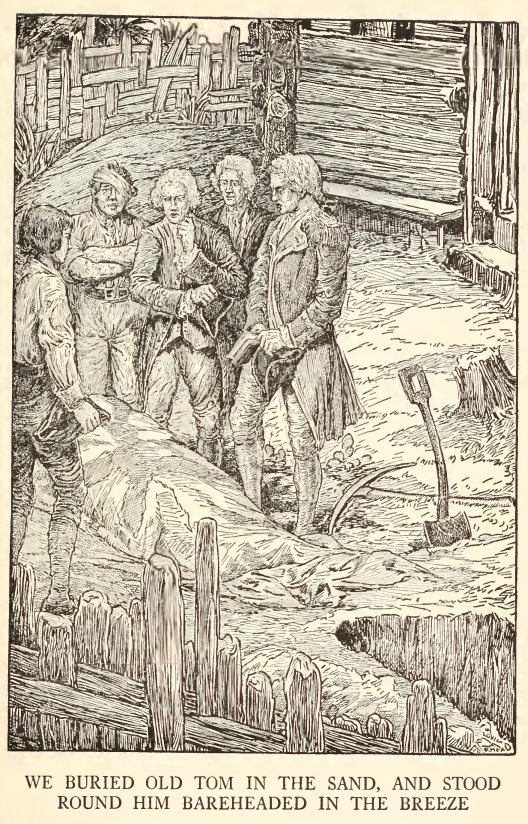
Before supper was eaten we buried old Tom in the sand and stood round him for a while bare-headed in the breeze. A good deal of firewood had been got in, but not enough for the captain’s fancy, and he shook his head over it and told us we “must get back to this tomorrow rather livelier.” Then, when we had eaten our pork and each had a good stiff glass of brandy grog, the three chiefs got together in a corner to discuss our prospects.
Before supper, we buried old Tom in the sand. We stood around him for a while, bareheaded in the breeze. We had gathered a lot of firewood, but not enough to satisfy the captain. He shook his head and told us we “must get back to this tomorrow with more energy.” After we ate our pork and each had a good strong glass of brandy grog, the three leaders gathered in a corner to discuss our prospects.
It appears they were at their wits’ end what to do, the stores being so low that we must have been starved into surrender long before help came. But our best hope, it was decided, was to kill off the buccaneers until they either hauled down their flag or ran away with the Hispaniola. From nineteen they were already reduced to fifteen, two others were wounded, and one at least—the man shot beside the gun—severely wounded, if he were not dead. Every time we had a crack at them, we were to take it, saving our own lives, with the extremest care. And besides that, we had two able allies—rum and the climate.
It seems they were at a loss about what to do. Our supplies were so low that we would have been starved into surrender long before help arrived. But they decided our best hope was to kill off the buccaneers until they either lowered their flag or escaped with the Hispaniola. Their numbers had already dropped from nineteen to fifteen. Two others were wounded. At least one of them, the man shot beside the gun, was badly wounded, if not dead. Whenever we had a chance to shoot at them, we were to take it, while taking the greatest care to protect our own lives. Besides that, we had two strong allies: rum and the climate.
As for the first, though we were about half a mile away, we could hear them roaring and singing late into the night; and as for the second, the doctor staked his wig that, camped where they were in the marsh and unprovided with remedies, the half of them would be on their backs before a week.
As for the first, though we were about half a mile away, we could hear them roaring and singing late into the night. As for the second, the doctor bet his wig that half of them would be bedridden within a week. They were camped in the marsh without any medicines.
“So,” he added, “if we are not all shot down first they’ll be glad to be packing in the schooner. It’s always a ship, and they can get to buccaneering again, I suppose.”
“So,” he added, “if we aren’t all shot down first, they’ll be glad to leave in the schooner. It’s a ship, after all, and I suppose they can go back to piracy.”
“First ship that ever I lost,” said Captain Smollett.
“This is the first ship I’ve ever lost,” said Captain Smollett.
I was dead tired, as you may fancy; and when I got to sleep, which was not till after a great deal of tossing, I slept like a log of wood.
I was exhausted, as you can imagine. I tossed and turned for a long time before falling asleep, but then I slept like a log.
The rest had long been up and had already breakfasted and increased the pile of firewood by about half as much again when I was wakened by a bustle and the sound of voices.
The others had been up for a long time and had already eaten breakfast. They had also increased the firewood pile by about half. Then I was awakened by a commotion and the sound of voices.
“Flag of truce!” I heard someone say; and then, immediately after, with a cry of surprise, “Silver himself!”
“Flag of truce!” I heard someone say. Immediately afterward, someone cried out in surprise, “Silver himself!”
And at that, up I jumped, and rubbing my eyes, ran to a loophole in the wall.
At that, I jumped up, rubbed my eyes, and ran to an opening in the wall.