Part 4, Chapter 17
The Doctor Continues: The Jolly Boat's Last Trip
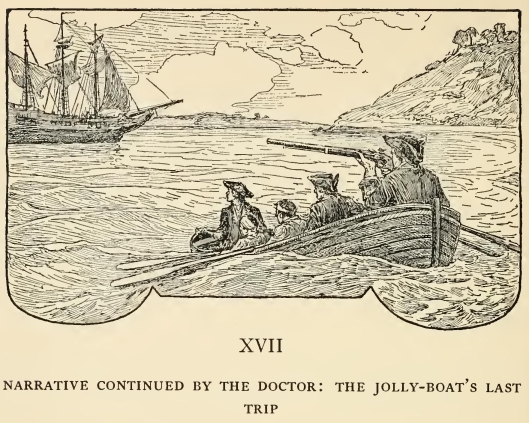
This fifth trip was quite different from any of the others. In the first place, the little gallipot of a boat that we were in was gravely overloaded. Five grown men, and three of them—Trelawney, Redruth, and the captain—over six feet high, was already more than she was meant to carry. Add to that the powder, pork, and bread-bags. The gunwale was lipping astern. Several times we shipped a little water, and my breeches and the tails of my coat were all soaking wet before we had gone a hundred yards.
This fifth trip was quite different from the others. To begin with, our little pot of a boat was dangerously overloaded. Five grown men were already more than she was meant to carry. Three of them, Trelawney, Redruth, and the captain, were over six feet tall. On top of that, we had the gunpowder, pork, and bags of bread. The back of the boat was so low that the water touched its rim. Several times, a little water came aboard. My trousers and coat tails were soaking wet before we had gone a hundred yards.
The captain made us trim the boat, and we got her to lie a little more evenly. All the same, we were afraid to breathe.
The captain had us balance the boat, and we got it to sit a little more evenly. Even so, we were afraid to breathe.
In the second place, the ebb was now making—a strong rippling current running westward through the basin, and then south’ard and seaward down the straits by which we had entered in the morning. Even the ripples were a danger to our overloaded craft, but the worst of it was that we were swept out of our true course and away from our proper landing-place behind the point. If we let the current have its way we should come ashore beside the gigs, where the pirates might appear at any moment.
Second, the tide was now going out. A strong, rippling current flowed west through the basin, then south toward the sea through the straits we had entered that morning. Even the ripples were dangerous to our overloaded boat. But worse, the current swept us off course and away from our intended landing place behind the point. If we let the current carry us, we would land beside the gigs, where the pirates might appear at any moment.
“I cannot keep her head for the stockade, sir,” said I to the captain. I was steering, while he and Redruth, two fresh men, were at the oars. “The tide keeps washing her down. Could you pull a little stronger?”
“I can’t keep the boat pointed toward the stockade, sir,” I said to the captain. I was steering while he and Redruth, both fresh, were rowing. “The tide keeps pushing the boat away. Could you row a little harder?”
“Not without swamping the boat,” said he. “You must bear up, sir, if you please—bear up until you see you’re gaining.”
“Not without swamping the boat,” he said. “Please steer away from the wind, sir, until you can see that you’re gaining.”
I tried and found by experiment that the tide kept sweeping us westward until I had laid her head due east, or just about right angles to the way we ought to go.
I tried different directions and found that the tide kept sweeping us westward until I pointed the boat due east. That was almost at right angles to the direction we needed to go.
“We’ll never get ashore at this rate,” said I.
“We’ll never get to shore at this rate,” I said.
“If it’s the only course that we can lie, sir, we must even lie it,” returned the captain. “We must keep upstream. You see, sir,” he went on, “if once we dropped to leeward of the landing-place, it’s hard to say where we should get ashore, besides the chance of being boarded by the gigs; whereas, the way we go the current must slacken, and then we can dodge back along the shore.”
“If it’s the only course we can take, sir, then we must take it,” replied the captain. “We must keep going upstream. You see, sir,” he continued, “if we drifted downwind of the landing place, it’s hard to say where we could get ashore. We might also be boarded by the gigs. But on our present course, the current must weaken, and then we can turn back along the shore.”
“The current’s less a’ready, sir,” said the man Gray, who was sitting in the fore-sheets; “you can ease her off a bit.”
“The current is already weaker, sir,” said Gray, who was sitting in the bow of the boat. “You can ease her off a bit.”
“Thank you, my man,” said I, quite as if nothing had happened, for we had all quietly made up our minds to treat him like one of ourselves.
“Thank you, my friend,” I said, as if nothing had happened. We had all quietly decided to treat him like one of us.
Suddenly the captain spoke up again, and I thought his voice was a little changed.
Suddenly, the captain spoke again, and I thought his voice sounded a little different.
“The gun!” said he.
“The gun!” he said.
“I have thought of that,” said I, for I made sure he was thinking of a bombardment of the fort. “They could never get the gun ashore, and if they did, they could never haul it through the woods.”
“I’ve thought of that,” I said. I was sure he was thinking of bombarding the fort. “They could never get the gun ashore. Even if they did, they could never drag it through the woods.”
“Look astern, doctor,” replied the captain.
“Look behind the ship, doctor,” replied the captain.
We had entirely forgotten the long nine; and there, to our horror, were the five rogues busy about her, getting off her jacket, as they called the stout tarpaulin cover under which she sailed. Not only that, but it flashed into my mind at the same moment that the round-shot and the powder for the gun had been left behind, and a stroke with an axe would put it all into the possession of the evil ones abroad.
We had completely forgotten the long nine. To our horror, the five rogues were busy removing its jacket. That was what they called the thick tarpaulin cover it sailed under. At the same moment, I suddenly remembered that the round shot and powder for the gun had been left behind. A single blow with an axe would put it all in the hands of those villains out there.
“Israel was Flint’s gunner,” said Gray hoarsely.
“Israel was Flint’s gunner,” Gray said in a hoarse voice.
At any risk, we put the boat’s head direct for the landing-place. By this time we had got so far out of the run of the current that we kept steerage way even at our necessarily gentle rate of rowing, and I could keep her steady for the goal. But the worst of it was that with the course I now held we turned our broadside instead of our stern to the Hispaniola and offered a target like a barn door.
Whatever the risk, we pointed the boat straight toward the landing place. By then, we were far enough out of the current to steer, even though we had to row gently. I could keep the boat steady on course. But the worst part was that this course turned our side toward the Hispaniola instead of our stern. We made a target as big as a barn door.
I could hear as well as see that brandy-faced rascal Israel Hands plumping down a round-shot on the deck.
I could hear and see that red-faced rascal Israel Hands dropping a cannonball onto the deck.
“Who’s the best shot?” asked the captain.
“Who’s the best shot?” asked the captain.
“Mr. Trelawney, out and away,” said I.
“Mr. Trelawney, by far,” I said.
“Mr. Trelawney, will you please pick me off one of these men, sir? Hands, if possible,” said the captain.
“Mr. Trelawney, please shoot one of those men for me, sir. Hands, if possible,” said the captain.
Trelawney was as cool as steel. He looked to the priming of his gun.
Trelawney was as calm as steel. He checked the priming powder in his gun.
“Now,” cried the captain, “easy with that gun, sir, or you’ll swamp the boat. All hands stand by to trim her when he aims.”
“Now,” shouted the captain, “be careful with that gun, sir, or you’ll swamp the boat. Everyone, be ready to balance the boat when he aims.”
The squire raised his gun, the rowing ceased, and we leaned over to the other side to keep the balance, and all was so nicely contrived that we did not ship a drop.
The squire raised his gun, and the rowing stopped. We leaned over to the other side to keep the boat balanced. Everything was done so carefully that not a drop of water came aboard.
They had the gun, by this time, slewed round upon the swivel, and Hands, who was at the muzzle with the rammer, was in consequence the most exposed. However, we had no luck, for just as Trelawney fired, down he stooped, the ball whistled over him, and it was one of the other four who fell.
By this time, they had turned the gun on its swivel. Hands was at the muzzle with the rammer, so he was the most exposed. But we had no luck. Just as Trelawney fired, Hands ducked, and the ball whistled over him. One of the other four fell instead.
The cry he gave was echoed not only by his companions on board but by a great number of voices from the shore, and looking in that direction I saw the other pirates trooping out from among the trees and tumbling into their places in the boats.
His companions on board echoed his cry, as did many voices from the shore. I looked toward the shore and saw the other pirates streaming out from among the trees. They scrambled into their places in the boats.
“Here come the gigs, sir,” said I.
“Here come the boats, sir,” I said.
“Give way, then,” cried the captain. “We mustn’t mind if we swamp her now. If we can’t get ashore, all’s up.”
“Row, then,” cried the captain. “We mustn’t worry if we swamp the boat now. If we can’t get ashore, we’re finished.”
“Only one of the gigs is being manned, sir,” I added; “the crew of the other most likely going round by shore to cut us off.”
“Only one of the boats is being crewed, sir,” I added. “The crew of the other is most likely going along the shore to cut us off.”
“They’ll have a hot run, sir,” returned the captain. “Jack ashore, you know. It’s not them I mind; it’s the round-shot. Carpet bowls! My lady’s maid couldn’t miss. Tell us, squire, when you see the match, and we’ll hold water.”
“They’ll have a wild time, sir,” replied the captain. “You know what sailors are like ashore. But they don’t worry me. It’s the cannonballs. It’s as easy as a game of carpet bowls! My lady’s maid couldn’t miss. Tell us, squire, when you see the lit match, and we’ll use the oars to stop the boat.”
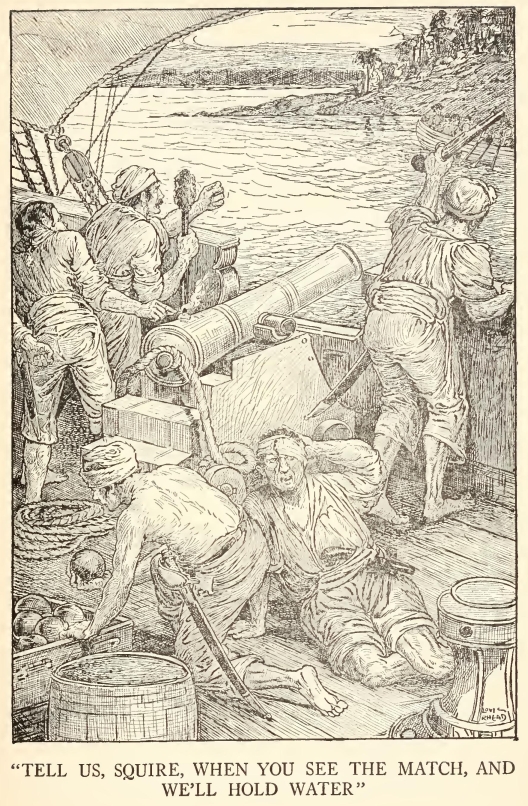
In the meanwhile we had been making headway at a good pace for a boat so overloaded, and we had shipped but little water in the process. We were now close in; thirty or forty strokes and we should beach her, for the ebb had already disclosed a narrow belt of sand below the clustering trees. The gig was no longer to be feared; the little point had already concealed it from our eyes. The ebb-tide, which had so cruelly delayed us, was now making reparation and delaying our assailants. The one source of danger was the gun.
Meanwhile, we had been making good progress for such an overloaded boat, and little water had come aboard. We were close to shore now. Another thirty or forty strokes would bring us onto the beach. The falling tide had already revealed a narrow strip of sand below the clustered trees. We no longer had to fear the gig. The small point of land had already hidden it from view. The falling tide, which had delayed us so cruelly, was now making up for it by delaying our attackers. The gun was the only remaining danger.
“If I durst,” said the captain, “I’d stop and pick off another man.”
“If I dared,” said the captain, “I’d stop and shoot another man.”
But it was plain that they meant nothing should delay their shot. They had never so much as looked at their fallen comrade, though he was not dead, and I could see him trying to crawl away.
But it was clear they would let nothing delay their shot. They had not even looked at their fallen comrade, though he was not dead. I could see him trying to crawl away.
“Ready!” cried the squire.
“Ready!” shouted the squire.
“Hold!” cried the captain, quick as an echo.
“Stop!” cried the captain, as quick as an echo.
And he and Redruth backed with a great heave that sent her stern bodily under water. The report fell in at the same instant of time. This was the first that Jim heard, the sound of the squire’s shot not having reached him. Where the ball passed, not one of us precisely knew, but I fancy it must have been over our heads and that the wind of it may have contributed to our disaster.
He and Redruth pulled hard on the oars, sending the boat’s stern deep underwater. At that same instant, the gun went off. This was the first shot Jim heard, because the sound of the squire’s shot had not reached him. None of us knew exactly where the ball went. But I think it must have passed over our heads, and the rush of air from it may have contributed to our disaster.
At any rate, the boat sank by the stern, quite gently, in three feet of water, leaving the captain and myself, facing each other, on our feet. The other three took complete headers, and came up again drenched and bubbling.
At any rate, the boat sank stern first, quite gently, in three feet of water. The captain and I were left standing, facing each other. The other three fell headfirst into the water and came up drenched and bubbling.
So far there was no great harm. No lives were lost, and we could wade ashore in safety. But there were all our stores at the bottom, and to make things worse, only two guns out of five remained in a state for service. Mine I had snatched from my knees and held over my head, by a sort of instinct. As for the captain, he had carried his over his shoulder by a bandoleer, and like a wise man, lock uppermost. The other three had gone down with the boat.
So far, no great harm had been done. No one had died, and we could wade safely ashore. But all our supplies were at the bottom. Worse still, only two of our five guns could still be used. I had instinctively snatched mine from my knees and held it over my head. The captain had carried his over his shoulder on a strap. Wisely, he had kept the lock facing upward. The other three guns had gone down with the boat.
To add to our concern, we heard voices already drawing near us in the woods along shore, and we had not only the danger of being cut off from the stockade in our half-crippled state but the fear before us whether, if Hunter and Joyce were attacked by half a dozen, they would have the sense and conduct to stand firm. Hunter was steady, that we knew; Joyce was a doubtful case—a pleasant, polite man for a valet and to brush one’s clothes, but not entirely fitted for a man of war.
Adding to our concern, we heard voices approaching through the woods along the shore. In our partly disabled state, we risked being cut off from the stockade. We also feared that, if half a dozen men attacked Hunter and Joyce, they might not have the sense and discipline to stand firm. We knew Hunter was steady, but Joyce was uncertain. He was a pleasant, polite man, well suited to serving as a valet and brushing clothes, but not entirely suited to being a soldier.
With all this in our minds, we waded ashore as fast as we could, leaving behind us the poor jolly-boat and a good half of all our powder and provisions.
With all this in mind, we waded ashore as fast as we could. We left behind the poor jolly-boat and a good half of all our gunpowder and supplies.