Part 5, Chapter 27
“Pieces of Eight”
Owing to the cant of the vessel, the masts hung far out over the water, and from my perch on the cross-trees I had nothing below me but the surface of the bay. Hands, who was not so far up, was in consequence nearer to the ship and fell between me and the bulwarks. He rose once to the surface in a lather of foam and blood and then sank again for good. As the water settled, I could see him lying huddled together on the clean, bright sand in the shadow of the vessel’s sides. A fish or two whipped past his body. Sometimes, by the quivering of the water, he appeared to move a little, as if he were trying to rise. But he was dead enough, for all that, being both shot and drowned, and was food for fish in the very place where he had designed my slaughter.
Because the ship was tilted, its masts hung far out over the water. From my perch on the cross-trees, I could see nothing below me but the surface of the bay. Hands was not as high up, so he was closer to the ship. He fell between me and the bulwarks. He rose to the surface once in a froth of foam and blood, then sank for good. As the water settled, I could see him lying curled up on the clean, bright sand, in the shadow of the ship’s sides. A fish or two darted past his body. Sometimes the rippling water made him seem to move a little, as if he were trying to rise. But he was dead enough, having been both shot and drowned. He was food for fish in the very place where he had planned to kill me.
I was no sooner certain of this than I began to feel sick, faint, and terrified. The hot blood was running over my back and chest. The dirk, where it had pinned my shoulder to the mast, seemed to burn like a hot iron; yet it was not so much these real sufferings that distressed me, for these, it seemed to me, I could bear without a murmur; it was the horror I had upon my mind of falling from the cross-trees into that still green water, beside the body of the coxswain.
As soon as I was certain of this, I began to feel sick, faint, and terrified. Hot blood ran over my back and chest. The dirk that pinned my shoulder to the mast seemed to burn like a hot iron. Yet it was not so much these real pains that distressed me. I felt I could bear them without a complaint. What horrified me was the thought of falling from the cross-trees into the still green water beside the coxswain’s body.
I clung with both hands till my nails ached, and I shut my eyes as if to cover up the peril. Gradually my mind came back again, my pulses quieted down to a more natural time, and I was once more in possession of myself.
I held on with both hands until my nails ached, and I shut my eyes as if to block out the danger. Gradually, my mind cleared. My pulse slowed to a more natural pace, and I regained control of myself.
It was my first thought to pluck forth the dirk, but either it stuck too hard or my nerve failed me, and I desisted with a violent shudder. Oddly enough, that very shudder did the business. The knife, in fact, had come the nearest in the world to missing me altogether; it held me by a mere pinch of skin, and this the shudder tore away. The blood ran down the faster, to be sure, but I was my own master again and only tacked to the mast by my coat and shirt.
My first thought was to pull out the dirk. But either it was stuck too firmly or I lost my nerve, and I stopped with a violent shudder. Strangely enough, that shudder did the trick. The knife had very nearly missed me altogether. It held me by only a pinch of skin, and the shudder tore the skin free. The blood ran faster, of course, but I was free again, held to the mast only by my coat and shirt.
These last I broke through with a sudden jerk, and then regained the deck by the starboard shrouds. For nothing in the world would I have again ventured, shaken as I was, upon the overhanging port shrouds from which Israel had so lately fallen.
I broke through these with a sudden jerk, then climbed back onto the deck by the starboard shrouds. I was shaken, and nothing in the world would have made me climb the overhanging port shrouds again. Israel had fallen from them only moments before.
I went below and did what I could for my wound; it pained me a good deal and still bled freely, but it was neither deep nor dangerous, nor did it greatly gall me when I used my arm. Then I looked around me, and as the ship was now, in a sense, my own, I began to think of clearing it from its last passenger—the dead man, O’Brien.
I went below and did what I could to treat my wound. It hurt quite a bit and was still bleeding freely, but it was neither deep nor dangerous. It did not bother me much when I used my arm. Then I looked around. Since the ship was now, in a sense, my own, I began to think about removing its last passenger, the dead man, O’Brien.
He had pitched, as I have said, against the bulwarks, where he lay like some horrible, ungainly sort of puppet, life-size, indeed, but how different from life’s colour or life’s comeliness! In that position I could easily have my way with him, and as the habit of tragical adventures had worn off almost all my terror for the dead, I took him by the waist as if he had been a sack of bran and with one good heave, tumbled him overboard. He went in with a sounding plunge; the red cap came off and remained floating on the surface; and as soon as the splash subsided, I could see him and Israel lying side by side, both wavering with the tremulous movement of the water. O’Brien, though still quite a young man, was very bald. There he lay, with that bald head across the knees of the man who had killed him and the quick fishes steering to and fro over both.
As I said, he had fallen against the bulwarks. He lay there like some horrible, awkward puppet, life-size, but utterly unlike the color or beauty of a living person. In that position, I could easily do what I wanted with him. My many tragic adventures had worn away almost all my fear of the dead, so I took him by the waist as if he were a sack of bran. With one good heave, I threw him overboard. He hit the water with a loud splash. His red cap came off and stayed floating on the surface. As soon as the splash died down, I could see him and Israel lying side by side, both wavering with the rippling water. O’Brien was very bald, though he was still quite a young man. He lay there with his bald head across the knees of the man who had killed him, while quick fish darted back and forth over them both.
I was now alone upon the ship; the tide had just turned. The sun was within so few degrees of setting that already the shadow of the pines upon the western shore began to reach right across the anchorage and fall in patterns on the deck. The evening breeze had sprung up, and though it was well warded off by the hill with the two peaks upon the east, the cordage had begun to sing a little softly to itself and the idle sails to rattle to and fro.
I was now alone on the ship, and the tide had just turned. The sun was nearly set. The shadows of the pines on the western shore had begun to stretch across the anchorage, casting patterns on the deck. The evening breeze had picked up. Though the hill with two peaks to the east largely blocked the wind, the ropes had begun to hum softly, and the loose sails rattled back and forth.
I began to see a danger to the ship. The jibs I speedily doused and brought tumbling to the deck, but the main-sail was a harder matter. Of course, when the schooner canted over, the boom had swung out-board, and the cap of it and a foot or two of sail hung even under water. I thought this made it still more dangerous; yet the strain was so heavy that I half feared to meddle. At last I got my knife and cut the halyards. The peak dropped instantly, a great belly of loose canvas floated broad upon the water, and since, pull as I liked, I could not budge the downhall, that was the extent of what I could accomplish. For the rest, the Hispaniola must trust to luck, like myself.
I began to see that the ship was in danger. I quickly lowered the jibs and brought them tumbling onto the deck, but the mainsail was harder to handle. When the schooner tilted over, the boom had swung out over the side. Its end and a foot or two of sail hung beneath the water. I thought this made the situation even more dangerous, yet the strain was so heavy that I was half afraid to interfere. At last, I took my knife and cut the halyards. The peak of the sail dropped at once, and a great bulge of loose canvas spread across the water. But however hard I pulled, I could not move the downhaul, so that was all I could do. For the rest, the Hispaniola would have to trust to luck, just as I did.
By this time the whole anchorage had fallen into shadow—the last rays, I remember, falling through a glade of the wood and shining bright as jewels on the flowery mantle of the wreck. It began to be chill; the tide was rapidly fleeting seaward, the schooner settling more and more on her beam-ends.
By this time, the whole anchorage was in shadow. I remember the last rays falling through a clearing in the woods. They shone like jewels on the flowers covering the wreck. The air was growing chilly. The tide was flowing rapidly out to sea, and the schooner was tipping farther and farther onto her side.
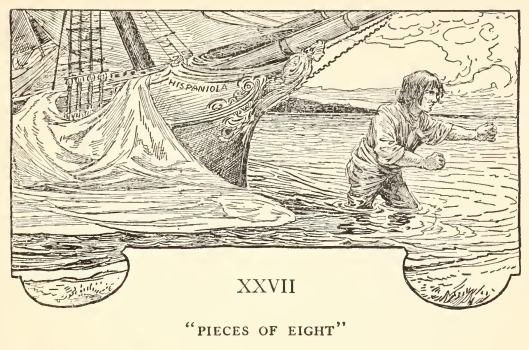
I scrambled forward and looked over. It seemed shallow enough, and holding the cut hawser in both hands for a last security, I let myself drop softly overboard. The water scarcely reached my waist; the sand was firm and covered with ripple marks, and I waded ashore in great spirits, leaving the Hispaniola on her side, with her main-sail trailing wide upon the surface of the bay. About the same time, the sun went fairly down and the breeze whistled low in the dusk among the tossing pines.
I scrambled forward and looked over the side. The water seemed shallow enough. Holding the cut rope in both hands for safety, I lowered myself gently overboard. The water barely reached my waist. The sand was firm and covered with ripple marks. I waded ashore in high spirits, leaving the Hispaniola on her side. Her mainsail trailed across the surface of the bay. Around the same time, the sun set completely, and the breeze whistled softly among the swaying pines in the dusk.
At least, and at last, I was off the sea, nor had I returned thence empty-handed. There lay the schooner, clear at last from buccaneers and ready for our own men to board and get to sea again. I had nothing nearer my fancy than to get home to the stockade and boast of my achievements. Possibly I might be blamed a bit for my truantry, but the recapture of the Hispaniola was a clenching answer, and I hoped that even Captain Smollett would confess I had not lost my time.
At last, I was off the sea, and I had not come back empty-handed. There lay the schooner, finally free of pirates and ready for our men to board and sail again. More than anything, I wanted to get home to the stockade and boast about what I had done. I might be blamed a little for running off, but recapturing the Hispaniola was a conclusive answer. I hoped even Captain Smollett would admit that I had not wasted my time.
So thinking, and in famous spirits, I began to set my face homeward for the block house and my companions. I remembered that the most easterly of the rivers which drain into Captain Kidd’s anchorage ran from the two-peaked hill upon my left, and I bent my course in that direction that I might pass the stream while it was small. The wood was pretty open, and keeping along the lower spurs, I had soon turned the corner of that hill, and not long after waded to the mid-calf across the watercourse.
With these thoughts and in high spirits, I started back toward the block house and my companions. I remembered that the easternmost river flowing into Captain Kidd’s anchorage came from the two-peaked hill on my left. I headed that way so I could cross the stream while it was still small. The woods were fairly open, and I followed the lower slopes. Soon I had rounded the hill, and not long afterward I waded across the stream. The water reached halfway up my calves.
This brought me near to where I had encountered Ben Gunn, the maroon; and I walked more circumspectly, keeping an eye on every side. The dusk had come nigh hand completely, and as I opened out the cleft between the two peaks, I became aware of a wavering glow against the sky, where, as I judged, the man of the island was cooking his supper before a roaring fire. And yet I wondered, in my heart, that he should show himself so careless. For if I could see this radiance, might it not reach the eyes of Silver himself where he camped upon the shore among the marshes?
This brought me near the place where I had met Ben Gunn, the marooned man. I walked more cautiously, looking in every direction. Dusk had almost fully fallen. As the gap between the two peaks came into view, I saw a flickering glow against the sky. I guessed the man of the island was cooking his supper over a roaring fire. Yet I wondered why he was being so careless. If I could see the glow, might Silver see it too, from his camp on the shore among the marshes?
Gradually the night fell blacker; it was all I could do to guide myself even roughly towards my destination; the double hill behind me and the Spy-glass on my right hand loomed faint and fainter; the stars were few and pale; and in the low ground where I wandered I kept tripping among bushes and rolling into sandy pits.
Gradually, the night grew darker. I could barely find my way toward my destination. The double hill behind me and the Spy-glass to my right grew fainter and fainter. The stars were few and dim. As I wandered through the low ground, I kept tripping over bushes and tumbling into sandy pits.
Suddenly a kind of brightness fell about me. I looked up; a pale glimmer of moonbeams had alighted on the summit of the Spy-glass, and soon after I saw something broad and silvery moving low down behind the trees, and knew the moon had risen.
Suddenly, a sort of brightness fell around me. I looked up and saw a pale glimmer of moonlight on the summit of the Spy-glass. Soon afterward, I saw something broad and silvery moving low behind the trees. I knew the moon had risen.
With this to help me, I passed rapidly over what remained to me of my journey, and sometimes walking, sometimes running, impatiently drew near to the stockade. Yet, as I began to thread the grove that lies before it, I was not so thoughtless but that I slacked my pace and went a trifle warily. It would have been a poor end of my adventures to get shot down by my own party in mistake.
With this help, I quickly covered the rest of my journey. Sometimes walking, sometimes running, I eagerly approached the stockade. But as I started through the grove in front of it, I was careful enough to slow down. I went on with some caution. It would have been a poor end to my adventures to be shot by my own people by mistake.
The moon was climbing higher and higher, its light began to fall here and there in masses through the more open districts of the wood, and right in front of me a glow of a different colour appeared among the trees. It was red and hot, and now and again it was a little darkened—as it were, the embers of a bonfire smouldering.
The moon climbed higher and higher. Its light fell in patches through the more open parts of the woods. Straight ahead, a glow of a different color appeared among the trees. It was red and hot, and every now and then it dimmed a little, like the smoldering embers of a bonfire.
For the life of me I could not think what it might be.
I couldn't imagine what it might be.
At last I came right down upon the borders of the clearing. The western end was already steeped in moonshine; the rest, and the block house itself, still lay in a black shadow chequered with long silvery streaks of light. On the other side of the house an immense fire had burned itself into clear embers and shed a steady, red reverberation, contrasted strongly with the mellow paleness of the moon. There was not a soul stirring nor a sound beside the noises of the breeze.
At last I reached the edge of the clearing. The western end was already bathed in moonlight. The rest of the clearing and the blockhouse itself still lay in deep shadow, crossed by long, silvery streaks of light. On the other side of the house, a huge fire had burned down to glowing embers. The fire cast a steady red glow that contrasted sharply with the soft, pale moonlight. No one was moving, and the only sound was the breeze.
I stopped, with much wonder in my heart, and perhaps a little terror also. It had not been our way to build great fires; we were, indeed, by the captain’s orders, somewhat niggardly of firewood, and I began to fear that something had gone wrong while I was absent.
I stopped, filled with wonder and perhaps a little fear. We did not usually build big fires. In fact, the captain had ordered us to be careful with our firewood. So I began to fear that something had gone wrong while I was away.
I stole round by the eastern end, keeping close in shadow, and at a convenient place, where the darkness was thickest, crossed the palisade.
I crept around the eastern end, staying close to the shadows. Where it was darkest, I found a good place to cross the palisade.
To make assurance surer, I got upon my hands and knees and crawled, without a sound, towards the corner of the house. As I drew nearer, my heart was suddenly and greatly lightened. It is not a pleasant noise in itself, and I have often complained of it at other times, but just then it was like music to hear my friends snoring together so loud and peaceful in their sleep. The sea-cry of the watch, that beautiful “All’s well,” never fell more reassuringly on my ear.
To be sure, I got on my hands and knees and crawled silently toward the corner of the house. As I got closer, I suddenly felt much less worried. Snoring is not a pleasant sound, and I have often complained about it. But just then, it was like music to hear my friends snoring together, sleeping so loudly and peacefully. Even the watchman’s beautiful cry at sea, “All’s well,” had never sounded more reassuring to me.
In the meantime, there was no doubt of one thing; they kept an infamous bad watch. If it had been Silver and his lads that were now creeping in on them, not a soul would have seen daybreak. That was what it was, thought I, to have the captain wounded; and again I blamed myself sharply for leaving them in that danger with so few to mount guard.
Meanwhile, one thing was certain: they were keeping a terribly bad watch. If Silver and his men had been creeping up on them, none of them would have lived to see daybreak. I thought that was what happened when the captain was wounded. Once again, I blamed myself bitterly for leaving them in such danger, with so few people to stand guard.
By this time I had got to the door and stood up. All was dark within, so that I could distinguish nothing by the eye. As for sounds, there was the steady drone of the snorers and a small occasional noise, a flickering or pecking that I could in no way account for.
By then I had reached the door and stood up. It was completely dark inside, so I could see nothing. I could hear the steady drone of snoring. Now and then, there was also a faint flickering or pecking sound that I could not explain.
With my arms before me I walked steadily in. I should lie down in my own place (I thought with a silent chuckle) and enjoy their faces when they found me in the morning.
With my arms held out in front of me, I walked steadily inside. I chuckled silently at the thought of lying down in my usual place. I would enjoy seeing their faces when they found me in the morning.
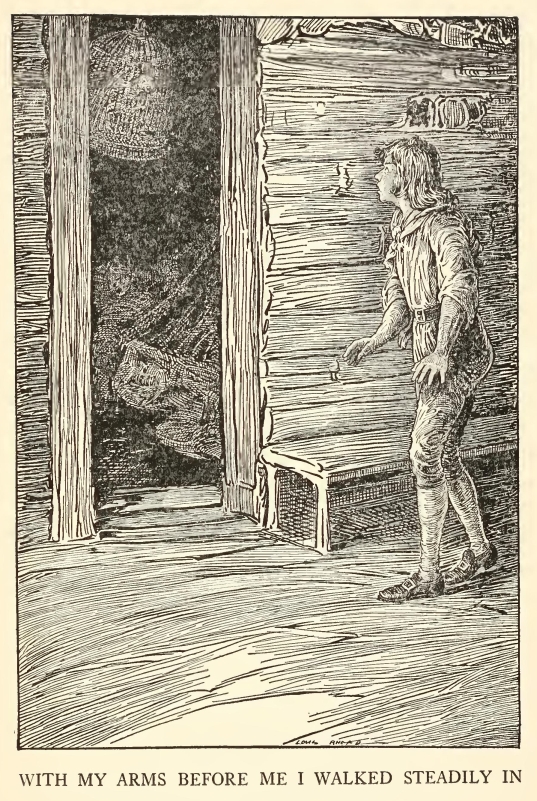
My foot struck something yielding—it was a sleeper’s leg; and he turned and groaned, but without awaking.
My foot struck something soft. It was the leg of a sleeping person, who turned and groaned but did not wake up.
And then, all of a sudden, a shrill voice broke forth out of the darkness:
Then, all of a sudden, a shrill voice rang out from the darkness:
“Pieces of eight! Pieces of eight! Pieces of eight! Pieces of eight! Pieces of eight!” and so forth, without pause or change, like the clacking of a tiny mill.
“Pieces of eight! Pieces of eight! Pieces of eight! Pieces of eight! Pieces of eight!” The words went on without pause or change, like the clacking of a tiny mill.
Silver’s green parrot, Captain Flint! It was she whom I had heard pecking at a piece of bark; it was she, keeping better watch than any human being, who thus announced my arrival with her wearisome refrain.
Silver’s green parrot, Captain Flint! She was the one I had heard pecking at a piece of bark. She kept better watch than any human and announced my arrival with her tiresome refrain.
I had no time left me to recover. At the sharp, clipping tone of the parrot, the sleepers awoke and sprang up; and with a mighty oath, the voice of Silver cried, “Who goes?”
I had no time to recover. At the parrot’s sharp, clipped cry, the sleepers woke and sprang up. With a loud curse, Silver cried, “Who’s there?”
I turned to run, struck violently against one person, recoiled, and ran full into the arms of a second, who for his part closed upon and held me tight.
I turned to run and slammed into someone. I stumbled back and ran straight into the arms of a second person, who grabbed me and held me tight.
“Bring a torch, Dick,” said Silver when my capture was thus assured.
“Bring a torch, Dick,” said Silver once my capture was assured.
And one of the men left the log-house and presently returned with a lighted brand.
One of the men left the log house and soon returned with a burning piece of wood.