Part 5, Chapter 26
Israel Hands
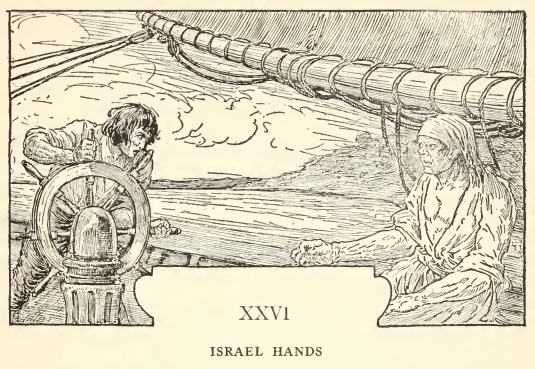
The wind, serving us to a desire, now hauled into the west. We could run so much the easier from the north-east corner of the island to the mouth of the North Inlet. Only, as we had no power to anchor and dared not beach her till the tide had flowed a good deal farther, time hung on our hands. The coxswain told me how to lay the ship to; after a good many trials I succeeded, and we both sat in silence over another meal.
The wind shifted to the west, just as we wanted. This made it much easier to sail from the northeast corner of the island to the mouth of the North Inlet. But we had no way to anchor, and we did not dare beach the ship until the tide had risen much farther. So we had time to spare. The coxswain told me how to bring the ship to a stop. After many attempts, I managed it, and we both sat in silence over another meal.
“Cap’n,” said he at length with that same uncomfortable smile, “here’s my old shipmate, O’Brien; s’pose you was to heave him overboard. I ain’t partic’lar as a rule, and I don’t take no blame for settling his hash, but I don’t reckon him ornamental now, do you?”
“Captain,” he said at last, with the same uneasy smile, “here’s my old shipmate, O’Brien. How about throwing him overboard? I’m not usually particular, and I don’t blame myself for killing him. But I don’t think he’s much of an ornament now, do you?”
“I’m not strong enough, and I don’t like the job; and there he lies, for me,” said I.
“I’m not strong enough, and I don’t like the job. As far as I’m concerned, he can stay where he is,” I said.
“This here’s an unlucky ship, this Hispaniola, Jim,” he went on, blinking. “There’s a power of men been killed in this Hispaniola—a sight o’ poor seamen dead and gone since you and me took ship to Bristol. I never seen sich dirty luck, not I. There was this here O’Brien now—he’s dead, ain’t he? Well now, I’m no scholar, and you’re a lad as can read and figure, and to put it straight, do you take it as a dead man is dead for good, or do he come alive again?”
“This is an unlucky ship, this Hispaniola, Jim,” he went on, blinking. “A lot of men have been killed on this Hispaniola. A great many poor sailors have died since you and I sailed from Bristol. I’ve never seen such bad luck. There’s O’Brien, for example. He’s dead, isn’t he? Well, I’m no scholar, and you’re a lad who can read and do sums. So, to put it straight, do you think a dead man stays dead for good, or does he come alive again?”
“You can kill the body, Mr. Hands, but not the spirit; you must know that already,” I replied. “O’Brien there is in another world, and may be watching us.”
“You can kill the body, Mr. Hands, but not the spirit. You must know that already,” I replied. “O’Brien is in another world now, and he may be watching us.”
“Ah!” says he. “Well, that’s unfort’nate—appears as if killing parties was a waste of time. Howsomever, sperrits don’t reckon for much, by what I’ve seen. I’ll chance it with the sperrits, Jim. And now, you’ve spoke up free, and I’ll take it kind if you’d step down into that there cabin and get me a—well, a—shiver my timbers! I can’t hit the name on ’t; well, you get me a bottle of wine, Jim—this here brandy’s too strong for my head.”
“Ah!” he says. “Well, that’s unfortunate. It seems killing people is a waste of time. Still, from what I’ve seen, spirits don’t amount to much. I’ll take my chances with the spirits, Jim. Now, you’ve spoken openly, and I’d appreciate it if you’d go down to the cabin and get me a, well, a, shiver my timbers! I can’t remember what it’s called. Well, get me a bottle of wine, Jim. This brandy is too strong for my head.”
Now, the coxswain’s hesitation seemed to be unnatural, and as for the notion of his preferring wine to brandy, I entirely disbelieved it. The whole story was a pretext. He wanted me to leave the deck—so much was plain; but with what purpose I could in no way imagine. His eyes never met mine; they kept wandering to and fro, up and down, now with a look to the sky, now with a flitting glance upon the dead O’Brien. All the time he kept smiling and putting his tongue out in the most guilty, embarrassed manner, so that a child could have told that he was bent on some deception. I was prompt with my answer, however, for I saw where my advantage lay and that with a fellow so densely stupid I could easily conceal my suspicions to the end.
Now, the coxswain’s hesitation seemed unnatural, and I didn’t believe for a moment that he preferred wine to brandy. The whole story was an excuse. He clearly wanted me to leave the deck, but I couldn’t imagine why. His eyes never met mine. They kept wandering back and forth, up and down. Now he looked at the sky, now he glanced at the dead O’Brien. All the while, he smiled and stuck out his tongue, looking so guilty and embarrassed that even a child could tell he was trying to deceive me. Still, I answered promptly, because I saw where my advantage lay. With a fellow so utterly stupid, I could easily hide my suspicions to the end.
“Some wine?” I said. “Far better. Will you have white or red?”
“Some wine?” I said. “Much better. Would you like white or red?”
“Well, I reckon it’s about the blessed same to me, shipmate,” he replied; “so it’s strong, and plenty of it, what’s the odds?”
“Well, it’s all the same to me, shipmate,” he replied. “As long as it’s strong and there’s plenty of it, what does it matter?”
“All right,” I answered. “I’ll bring you port, Mr. Hands. But I’ll have to dig for it.”
“All right,” I said. “I’ll bring you port, Mr. Hands. But I’ll have to look for it.”
With that I scuttled down the companion with all the noise I could, slipped off my shoes, ran quietly along the sparred gallery, mounted the forecastle ladder, and popped my head out of the fore companion. I knew he would not expect to see me there, yet I took every precaution possible, and certainly the worst of my suspicions proved too true.
With that, I hurried down the companionway, making as much noise as I could. Then I slipped off my shoes and ran quietly along the gallery lined with wooden bars. I climbed the ladder to the forecastle and poked my head out of the forward hatch. I knew he would not expect to see me there, but I took every possible precaution. And the worst of my suspicions proved all too true.
He had risen from his position to his hands and knees, and though his leg obviously hurt him pretty sharply when he moved—for I could hear him stifle a groan—yet it was at a good, rattling rate that he trailed himself across the deck. In half a minute he had reached the port scuppers and picked, out of a coil of rope, a long knife, or rather a short dirk, discoloured to the hilt with blood. He looked upon it for a moment, thrusting forth his under jaw, tried the point upon his hand, and then, hastily concealing it in the bosom of his jacket, trundled back again into his old place against the bulwark.
He had risen onto his hands and knees. His leg clearly hurt sharply when he moved, because I could hear him hold back a groan. Even so, he dragged himself across the deck at a good, fast pace. Within half a minute, he reached the port scuppers and picked a long knife from a coil of rope. It was more of a short dirk, stained with blood up to the hilt. He looked at it for a moment, jutting out his lower jaw, and tested the point against his hand. Then he quickly hid the dirk inside his jacket and dragged himself back to his old place against the bulwark.
This was all that I required to know. Israel could move about, he was now armed, and if he had been at so much trouble to get rid of me, it was plain that I was meant to be the victim. What he would do afterwards—whether he would try to crawl right across the island from North Inlet to the camp among the swamps or whether he would fire Long Tom, trusting that his own comrades might come first to help him—was, of course, more than I could say.
That was all I needed to know. Israel could move around, and he was now armed. If he had gone to so much trouble to get rid of me, I was clearly meant to be the victim. What he would do afterward, of course, I could not say. He might try to crawl all the way across the island from North Inlet to the camp among the swamps. Or he might fire Long Tom, trusting that his own comrades would be the first to come to his aid.
Yet I felt sure that I could trust him in one point, since in that our interests jumped together, and that was in the disposition of the schooner. We both desired to have her stranded safe enough, in a sheltered place, and so that, when the time came, she could be got off again with as little labour and danger as might be; and until that was done I considered that my life would certainly be spared.
Yet I felt sure I could trust him on one point, because our interests were the same. That was what to do with the schooner. We both wanted to beach her safely in a sheltered place. We also wanted to get her afloat again when the time came, with as little work and danger as possible. Until that was done, I believed my life would certainly be spared.
While I was thus turning the business over in my mind, I had not been idle with my body. I had stolen back to the cabin, slipped once more into my shoes, and laid my hand at random on a bottle of wine, and now, with this for an excuse, I made my reappearance on the deck.
While I was thinking the matter over, I had not been idle. I had slipped back to the cabin, put my shoes on again, and picked up a bottle of wine at random. Now, using the wine as an excuse, I came back on deck.
Hands lay as I had left him, all fallen together in a bundle and with his eyelids lowered as though he were too weak to bear the light. He looked up, however, at my coming, knocked the neck off the bottle like a man who had done the same thing often, and took a good swig, with his favourite toast of “Here’s luck!” Then he lay quiet for a little, and then, pulling out a stick of tobacco, begged me to cut him a quid.
Hands lay as I had left him, all slumped in a heap, his eyelids lowered as if he were too weak to bear the light. But he looked up when I came in. He knocked the neck off the bottle like a man who had done it often. Then he took a good swig, with his favourite toast of “Here’s luck!” He lay quietly for a while. Then he pulled out a stick of tobacco and begged me to cut him a piece to chew.
“Cut me a junk o’ that,” says he, “for I haven’t no knife and hardly strength enough, so be as I had. Ah, Jim, Jim, I reckon I’ve missed stays! Cut me a quid, as’ll likely be the last, lad, for I’m for my long home, and no mistake.”
“Cut me a piece of that,” he said, “because I don’t have a knife. Even if I did, I’d hardly have the strength. Ah, Jim, Jim, I reckon I’ve failed to turn things around! Cut me a chew, lad. It’ll likely be my last, because I’m going to my grave, and there’s no doubt about it.”
“Well,” said I, “I’ll cut you some tobacco, but if I was you and thought myself so badly, I would go to my prayers like a Christian man.”
“Well,” I said, “I’ll cut you some tobacco. But if I were you and thought I was so ill, I’d say my prayers like a Christian man.”
“Why?” said he. “Now, you tell me why.”
“Why?” he said. “Now, you tell me why.”
“Why?” I cried. “You were asking me just now about the dead. You’ve broken your trust; you’ve lived in sin and lies and blood; there’s a man you killed lying at your feet this moment, and you ask me why! For God’s mercy, Mr. Hands, that’s why.”
“Why?” I cried. “You were just asking me about the dead. You’ve betrayed the trust placed in you. You’ve lived a life of sin, lies, and bloodshed. A man you killed is lying at your feet right now, and you ask me why! For God’s mercy, Mr. Hands, that’s why.”
I spoke with a little heat, thinking of the bloody dirk he had hidden in his pocket and designed, in his ill thoughts, to end me with. He, for his part, took a great draught of the wine and spoke with the most unusual solemnity.
I spoke somewhat angrily, thinking of the bloody dagger he had hidden in his pocket and intended to kill me with. He took a long drink of wine and spoke with unusual seriousness.
“For thirty years,” he said, “I’ve sailed the seas and seen good and bad, better and worse, fair weather and foul, provisions running out, knives going, and what not. Well, now I tell you, I never seen good come o’ goodness yet. Him as strikes first is my fancy; dead men don’t bite; them’s my views—amen, so be it. And now, you look here,” he added, suddenly changing his tone, “we’ve had about enough of this foolery. The tide’s made good enough by now. You just take my orders, Cap’n Hawkins, and we’ll sail slap in and be done with it.”
“For thirty years,” he said, “I’ve sailed the seas and seen good and bad, better and worse. I’ve seen fair weather and foul, supplies running out, knives drawn, and all sorts of things. Well, I’m telling you, I’ve never seen any good come from being good. I favor the man who strikes first. Dead men don’t bite. Those are my views, amen, so be it. And now, look here,” he added, suddenly changing his tone, “we’ve had about enough of this foolishness. The tide’s high enough by now. Just take my orders, Captain Hawkins, and we’ll sail straight in and be done with it.”
All told, we had scarce two miles to run; but the navigation was delicate, the entrance to this northern anchorage was not only narrow and shoal, but lay east and west, so that the schooner must be nicely handled to be got in. I think I was a good, prompt subaltern, and I am very sure that Hands was an excellent pilot, for we went about and about and dodged in, shaving the banks, with a certainty and a neatness that were a pleasure to behold.
In all, we had barely two miles to sail, but the navigation was tricky. The entrance to the northern anchorage was narrow and shallow, and it ran east to west. So the schooner had to be handled with great care to get in. I think I was a good and quick assistant, and I am sure Hands was an excellent pilot. We tacked back and forth and slipped in, passing close to the banks. We did it with such confidence and skill that it was a pleasure to watch.
Scarcely had we passed the heads before the land closed around us. The shores of North Inlet were as thickly wooded as those of the southern anchorage, but the space was longer and narrower and more like, what in truth it was, the estuary of a river. Right before us, at the southern end, we saw the wreck of a ship in the last stages of dilapidation. It had been a great vessel of three masts but had lain so long exposed to the injuries of the weather that it was hung about with great webs of dripping seaweed, and on the deck of it shore bushes had taken root and now flourished thick with flowers. It was a sad sight, but it showed us that the anchorage was calm.
We had barely passed the headlands when the land closed around us. The shores of North Inlet were as thickly wooded as those of the southern anchorage. But North Inlet was longer and narrower, and more like a river mouth, which was what it really was. Straight ahead, at the southern end, we saw a shipwreck in the final stages of decay. It had been a great ship with three masts. But it had been exposed to the weather for so long that great webs of dripping seaweed hung from it. On its deck, shore bushes had taken root and were now thriving, thick with flowers. It was a sad sight, but it showed us that the anchorage was calm.
“Now,” said Hands, “look there; there’s a pet bit for to beach a ship in. Fine flat sand, never a cat’s paw, trees all around of it, and flowers a-blowing like a garding on that old ship.”
“Now,” said Hands, “look there. That’s a lovely spot to beach a ship. Fine, flat sand, not a ripple on the water, and trees all around it. And flowers blooming like a garden on that old ship.”
“And once beached,” I inquired, “how shall we get her off again?”
“And once she’s beached,” I asked, “how will we get her off the beach again?”
“Why, so,” he replied: “you take a line ashore there on the other side at low water, take a turn about one of them big pines; bring it back, take a turn around the capstan, and lie to for the tide. Come high water, all hands take a pull upon the line, and off she comes as sweet as natur’. And now, boy, you stand by. We’re near the bit now, and she’s too much way on her. Starboard a little—so—steady—starboard—larboard a little—steady—steady!”
“Here’s how,” he replied. “At low tide, take a rope ashore on the other side and loop it around one of those big pines. Bring it back and loop it around the capstan, then wait for the tide. At high tide, everyone pulls on the rope, and the ship comes free as easy as can be. Now, boy, be ready. We’re nearly at the spot, and she’s moving too fast. A little to starboard, there, steady, starboard, a little to port, steady, steady!”
So he issued his commands, which I breathlessly obeyed, till, all of a sudden, he cried, “Now, my hearty, luff!” And I put the helm hard up, and the Hispaniola swung round rapidly and ran stem on for the low, wooded shore.
So he gave orders, and I obeyed them breathlessly. Then, all of a sudden, he cried, “Now, my hearty, luff!” I put the helm hard up, and the Hispaniola swung around quickly and headed straight for the low, wooded shore.
The excitement of these last manoeuvres had somewhat interfered with the watch I had kept hitherto, sharply enough, upon the coxswain. Even then I was still so much interested, waiting for the ship to touch, that I had quite forgot the peril that hung over my head and stood craning over the starboard bulwarks and watching the ripples spreading wide before the bows. I might have fallen without a struggle for my life had not a sudden disquietude seized upon me and made me turn my head. Perhaps I had heard a creak or seen his shadow moving with the tail of my eye; perhaps it was an instinct like a cat’s; but, sure enough, when I looked round, there was Hands, already half-way towards me, with the dirk in his right hand.
The excitement of these last maneuvers had distracted me somewhat from keeping the sharp watch I had maintained on the coxswain. Even then, I was so interested in waiting for the ship to touch shore that I had completely forgotten the danger hanging over me. I stood leaning over the starboard bulwarks, watching the ripples spread wide ahead of the bow. I might have died without a struggle if a sudden unease had not made me turn my head. Perhaps I had heard a creak or caught sight of his shadow moving out of the corner of my eye. Perhaps it was an instinct like a cat’s. But sure enough, when I looked around, Hands was already halfway toward me, with the dirk in his right hand.
We must both have cried out aloud when our eyes met, but while mine was the shrill cry of terror, his was a roar of fury like a charging bully’s. At the same instant, he threw himself forward and I leapt sideways towards the bows. As I did so, I let go of the tiller, which sprang sharp to leeward, and I think this saved my life, for it struck Hands across the chest and stopped him, for the moment, dead.
We must both have cried out when our eyes met. But mine was a shrill cry of terror, while his was a roar of fury, like a charging bully’s. At the same instant, he lunged forward and I jumped sideways toward the bow. As I did, I let go of the tiller, which swung sharply to leeward. I think this saved my life, because the tiller struck Hands across the chest and stopped him in his tracks for the moment.
Before he could recover, I was safe out of the corner where he had me trapped, with all the deck to dodge about. Just forward of the main-mast I stopped, drew a pistol from my pocket, took a cool aim, though he had already turned and was once more coming directly after me, and drew the trigger. The hammer fell, but there followed neither flash nor sound; the priming was useless with sea-water. I cursed myself for my neglect. Why had not I, long before, reprimed and reloaded my only weapons? Then I should not have been as now, a mere fleeing sheep before this butcher.
Before he could recover, I escaped the corner where he had trapped me. I now had the whole deck to dodge around. Just in front of the mainmast, I stopped and pulled a pistol from my pocket. Though he had already turned and was coming straight at me again, I took careful aim and pulled the trigger. The hammer fell, but there was no flash or sound. Sea water had ruined the priming powder. I cursed myself for being careless. Why hadn't I reprimed and reloaded my only weapons long ago? Then I wouldn't have been like a sheep fleeing from this butcher.
Wounded as he was, it was wonderful how fast he could move, his grizzled hair tumbling over his face, and his face itself as red as a red ensign with his haste and fury. I had no time to try my other pistol, nor indeed much inclination, for I was sure it would be useless. One thing I saw plainly: I must not simply retreat before him, or he would speedily hold me boxed into the bows, as a moment since he had so nearly boxed me in the stern. Once so caught, and nine or ten inches of the blood-stained dirk would be my last experience on this side of eternity. I placed my palms against the main-mast, which was of a goodish bigness, and waited, every nerve upon the stretch.
Though he was wounded, it was amazing how fast he could move. His gray hair fell over his face, which was as red as a red ensign from haste and fury. I had no time to try my other pistol, and I hardly wanted to, because I was sure it would be useless. One thing was clear: I must not simply retreat before him. If I did, he would soon trap me at the bow, just as he had nearly trapped me at the stern moments before. Once trapped, the nine or ten inches of his bloodstained dirk would be the last thing I experienced before death. I pressed my palms against the mainmast, which was fairly thick, and waited with every nerve on edge.
Seeing that I meant to dodge, he also paused; and a moment or two passed in feints on his part and corresponding movements upon mine. It was such a game as I had often played at home about the rocks of Black Hill Cove, but never before, you may be sure, with such a wildly beating heart as now. Still, as I say, it was a boy’s game, and I thought I could hold my own at it against an elderly seaman with a wounded thigh. Indeed my courage had begun to rise so high that I allowed myself a few darting thoughts on what would be the end of the affair, and while I saw certainly that I could spin it out for long, I saw no hope of any ultimate escape.
When he saw that I meant to dodge him, he stopped too. For a moment or two, he made feints, and I moved to match him. It was a game I had often played at home among the rocks of Black Hill Cove. But you can be sure my heart had never beaten so wildly before. Still, as I say, it was a boy’s game. I thought I could hold my own against an elderly sailor with a wounded thigh. In fact, my courage had risen so high that I let myself wonder briefly how the struggle would end. I could see that I could keep it going for a long time, but I saw no hope of escaping in the end.
Well, while things stood thus, suddenly the Hispaniola struck, staggered, ground for an instant in the sand, and then, swift as a blow, canted over to the port side till the deck stood at an angle of forty-five degrees and about a puncheon of water splashed into the scupper holes and lay, in a pool, between the deck and bulwark.
Well, while things stood this way, the Hispaniola suddenly struck and staggered, grinding against the sand for a moment. Then, as swiftly as a blow, the ship tilted to the port side until the deck stood at a forty-five-degree angle. About a barrel of water splashed into the drain holes and pooled between the deck and the ship’s side.
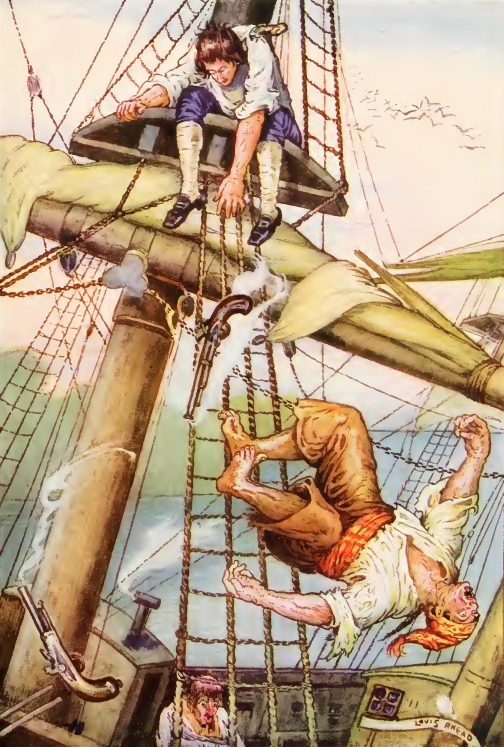
We were both of us capsized in a second, and both of us rolled, almost together, into the scuppers, the dead red-cap, with his arms still spread out, tumbling stiffly after us. So near were we, indeed, that my head came against the coxswain’s foot with a crack that made my teeth rattle. Blow and all, I was the first afoot again, for Hands had got involved with the dead body. The sudden canting of the ship had made the deck no place for running on; I had to find some new way of escape, and that upon the instant, for my foe was almost touching me. Quick as thought, I sprang into the mizzen shrouds, rattled up hand over hand, and did not draw a breath till I was seated on the cross-trees.
We were both thrown off our feet in a second and rolled almost together into the scuppers. The dead man in the red cap tumbled stiffly after us, his arms still spread out. We were so close that my head hit the coxswain’s foot with a crack that made my teeth rattle. Despite the blow, I was the first back on my feet, because Hands had become tangled up with the dead body. The ship had suddenly tilted, making it impossible to run across the deck. I had to find another way to escape at once, because my enemy was almost touching me. As quick as thought, I sprang into the mizzen shrouds and climbed hand over hand. I did not draw a breath until I was sitting on the cross-trees.
I had been saved by being prompt; the dirk had struck not half a foot below me as I pursued my upward flight; and there stood Israel Hands with his mouth open and his face upturned to mine, a perfect statue of surprise and disappointment.
I had saved myself by moving quickly. As I climbed, the dirk struck less than half a foot below me. There stood Israel Hands, his mouth open and his face turned up toward mine. He was a perfect statue of surprise and disappointment.
Now that I had a moment to myself, I lost no time in changing the priming of my pistol, and then, having one ready for service, and to make assurance doubly sure, I proceeded to draw the load of the other and recharge it afresh from the beginning.
Now that I had a moment to myself, I immediately replaced the priming powder in one pistol. With that pistol ready to use, I wanted to be doubly sure. So I removed the load from the other pistol and loaded it again from scratch.
My new employment struck Hands all of a heap; he began to see the dice going against him, and after an obvious hesitation, he also hauled himself heavily into the shrouds, and with the dirk in his teeth, began slowly and painfully to mount. It cost him no end of time and groans to haul his wounded leg behind him, and I had quietly finished my arrangements before he was much more than a third of the way up. Then, with a pistol in either hand, I addressed him.
My new task caught Hands completely off guard. He began to see that his luck was turning against him. After a clear hesitation, he too hauled himself heavily into the rigging. With the dirk between his teeth, he began to climb slowly and painfully. Dragging his wounded leg behind him took him a very long time and made him groan. I had quietly finished my preparations before he was much more than a third of the way up. Then, with a pistol in each hand, I spoke to him.
“One more step, Mr. Hands,” said I, “and I’ll blow your brains out! Dead men don’t bite, you know,” I added with a chuckle.
“One more step, Mr. Hands,” I said, “and I’ll blow your brains out! Dead men don’t bite, you know,” I added with a chuckle.
He stopped instantly. I could see by the working of his face that he was trying to think, and the process was so slow and laborious that, in my new-found security, I laughed aloud. At last, with a swallow or two, he spoke, his face still wearing the same expression of extreme perplexity. In order to speak he had to take the dagger from his mouth, but in all else he remained unmoved.
He stopped at once. I could see from his changing expression that he was trying to think. He thought so slowly and with such effort that I laughed aloud, feeling safe now. At last, after swallowing once or twice, he spoke. His face still showed the same utter confusion. He had to take the dagger from his mouth to speak, but otherwise he did not move.
“Jim,” says he, “I reckon we’re fouled, you and me, and we’ll have to sign articles. I’d have had you but for that there lurch, but I don’t have no luck, not I; and I reckon I’ll have to strike, which comes hard, you see, for a master mariner to a ship’s younker like you, Jim.”
“Jim,” he says, “I reckon you and I are tangled up, and we’ll have to come to terms. I’d have had you if the ship hadn’t lurched, but I never have any luck. So I reckon I’ll have to surrender. That’s hard for a master mariner, you see, surrendering to a ship’s boy like you, Jim.”
I was drinking in his words and smiling away, as conceited as a cock upon a wall, when, all in a breath, back went his right hand over his shoulder. Something sang like an arrow through the air; I felt a blow and then a sharp pang, and there I was pinned by the shoulder to the mast. In the horrid pain and surprise of the moment—I scarce can say it was by my own volition, and I am sure it was without a conscious aim—both my pistols went off, and both escaped out of my hands. They did not fall alone; with a choked cry, the coxswain loosed his grasp upon the shrouds and plunged head first into the water.
I was hanging on his words and smiling, as proud as a rooster on a wall. Then, in an instant, his right hand swung back over his shoulder. Something whistled through the air like an arrow. I felt a blow, then a sharp pain, and found myself pinned by the shoulder to the mast. In that moment of terrible pain and surprise, both my pistols went off and slipped from my hands. I can hardly say I fired them on purpose, and I’m sure I didn’t aim consciously. The pistols were not the only things to fall. With a choked cry, the coxswain let go of the shrouds and plunged headfirst into the water.