Part 5, Chapter 25
I Lower the Jolly Roger
I had scarce gained a position on the bowsprit when the flying jib flapped and filled upon the other tack, with a report like a gun. The schooner trembled to her keel under the reverse, but next moment, the other sails still drawing, the jib flapped back again and hung idle.
I had barely reached the bowsprit when the flying jib flapped and caught the wind on the opposite side with a bang like a gunshot. The schooner trembled down to her keel from the sudden reversal. But the other sails were still catching the wind, and the jib soon flapped back and hung slack.
This had nearly tossed me off into the sea; and now I lost no time, crawled back along the bowsprit, and tumbled head foremost on the deck.
This had nearly thrown me into the sea. I wasted no time crawling back along the bowsprit and tumbling headfirst onto the deck.
I was on the lee side of the forecastle, and the mainsail, which was still drawing, concealed from me a certain portion of the after-deck. Not a soul was to be seen. The planks, which had not been swabbed since the mutiny, bore the print of many feet, and an empty bottle, broken by the neck, tumbled to and fro like a live thing in the scuppers.
I was on the sheltered side of the forecastle. The mainsail was still full of wind, blocking my view of part of the deck behind it. Not a soul was in sight. The deck had not been washed since the mutiny, and many footprints marked the planks. An empty bottle with a broken neck rolled back and forth in the scuppers like a living thing.
Suddenly the Hispaniola came right into the wind. The jibs behind me cracked aloud, the rudder slammed to, the whole ship gave a sickening heave and shudder, and at the same moment the main-boom swung inboard, the sheet groaning in the blocks, and showed me the lee after-deck.
Suddenly, the Hispaniola turned straight into the wind. The jibs behind me cracked loudly, and the rudder slammed over. The whole ship lurched and shuddered sickeningly. At the same moment, the main boom swung inward, its rope groaning through the pulleys. It revealed the rear deck on the sheltered side of the ship.
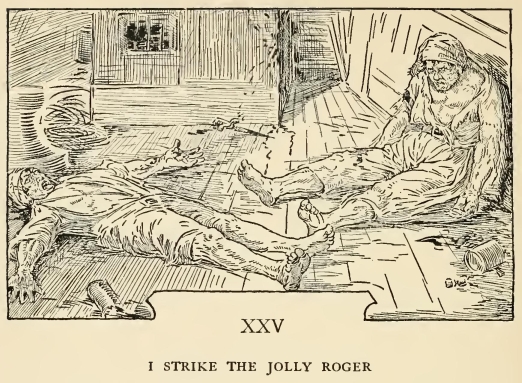
There were the two watchmen, sure enough: red-cap on his back, as stiff as a handspike, with his arms stretched out like those of a crucifix and his teeth showing through his open lips; Israel Hands propped against the bulwarks, his chin on his chest, his hands lying open before him on the deck, his face as white, under its tan, as a tallow candle.
Sure enough, the two watchmen were there. Red-cap lay on his back, as stiff as a handspike. His arms were stretched out like those of a figure on a crucifix, and his teeth showed through his open lips. Israel Hands was propped against the ship’s side, his chin on his chest. His hands lay open on the deck before him. Beneath his tan, his face was as white as a tallow candle.
For a while the ship kept bucking and sidling like a vicious horse, the sails filling, now on one tack, now on another, and the boom swinging to and fro till the mast groaned aloud under the strain. Now and again too there would come a cloud of light sprays over the bulwark and a heavy blow of the ship’s bows against the swell; so much heavier weather was made of it by this great rigged ship than by my home-made, lop-sided coracle, now gone to the bottom of the sea.
For a while, the ship bucked and swerved like a vicious horse. The sails filled as the ship turned first one way, then another. The boom swung back and forth until the mast groaned under the strain. Now and then, a cloud of fine spray came over the ship’s side, and the bow struck the swell heavily. The great rigged ship handled the rough water much worse than my homemade, lopsided coracle, which had now sunk to the bottom of the sea.
At every jump of the schooner, red-cap slipped to and fro, but—what was ghastly to behold—neither his attitude nor his fixed teeth-disclosing grin was anyway disturbed by this rough usage. At every jump too, Hands appeared still more to sink into himself and settle down upon the deck, his feet sliding ever the farther out, and the whole body canting towards the stern, so that his face became, little by little, hid from me; and at last I could see nothing beyond his ear and the frayed ringlet of one whisker.
With every lurch of the schooner, red-cap slid back and forth. It was a ghastly sight. Despite the rough movement, his position and his fixed, tooth-baring grin did not change at all. With every lurch, Hands also seemed to sink farther into himself and slump down on the deck. His feet slid farther out, and his whole body tilted toward the stern. Little by little, his face disappeared from my view. At last, all I could see was his ear and one frayed curl of his whiskers.
At the same time, I observed, around both of them, splashes of dark blood upon the planks and began to feel sure that they had killed each other in their drunken wrath.
At the same time, I noticed splashes of dark blood on the planks around both of them. I began to feel sure they had killed each other in a drunken rage.
While I was thus looking and wondering, in a calm moment, when the ship was still, Israel Hands turned partly round and with a low moan writhed himself back to the position in which I had seen him first. The moan, which told of pain and deadly weakness, and the way in which his jaw hung open went right to my heart. But when I remembered the talk I had overheard from the apple barrel, all pity left me.
As I watched and wondered, the ship grew still for a moment. Israel Hands turned partly around and, with a low moan, twisted back into the position where I had first seen him. His moan revealed pain and deadly weakness, and his jaw hung open. The sight and sound went straight to my heart. But when I remembered the conversation I had overheard from the apple barrel, all my pity vanished.
I walked aft until I reached the main-mast.
I walked toward the back of the ship until I reached the main mast.
“Come aboard, Mr. Hands,” I said ironically.
“Come aboard, Mr. Hands,” I said ironically.
He rolled his eyes round heavily, but he was too far gone to express surprise. All he could do was to utter one word, “Brandy.”
He looked around slowly, but he was too far gone to show surprise. All he could say was one word: “Brandy.”
It occurred to me there was no time to lose, and dodging the boom as it once more lurched across the deck, I slipped aft and down the companion stairs into the cabin.
I realized there was no time to lose. As the boom swung across the deck again, I ducked under it. Then I slipped toward the back of the ship and down the stairs into the cabin.
It was such a scene of confusion as you can hardly fancy. All the lockfast places had been broken open in quest of the chart. The floor was thick with mud where ruffians had sat down to drink or consult after wading in the marshes round their camp. The bulkheads, all painted in clear white and beaded round with gilt, bore a pattern of dirty hands. Dozens of empty bottles clinked together in corners to the rolling of the ship. One of the doctor’s medical books lay open on the table, half of the leaves gutted out, I suppose, for pipelights. In the midst of all this the lamp still cast a smoky glow, obscure and brown as umber.
The scene was so chaotic you can hardly imagine it. Every locked place had been broken open in search of the chart. Mud covered the floor where the ruffians had sat down to drink or talk after wading through the marshes around their camp. Dirty handprints covered the bulkheads, which were painted bright white and trimmed with gold. Dozens of empty bottles clinked together in the corners as the ship rolled. One of the doctor’s medical books lay open on the table. Half its pages had been torn out, I suppose, to light pipes. Amid all this, the lamp still cast a smoky glow, dim and brown as umber.
I went into the cellar; all the barrels were gone, and of the bottles a most surprising number had been drunk out and thrown away. Certainly, since the mutiny began, not a man of them could ever have been sober.
I went into the cellar. All the barrels were gone, and a surprising number of bottles had been emptied and thrown away. Surely, not one of the men could have been sober since the mutiny began.
Foraging about, I found a bottle with some brandy left, for Hands; and for myself I routed out some biscuit, some pickled fruits, a great bunch of raisins, and a piece of cheese. With these I came on deck, put down my own stock behind the rudder head and well out of the coxswain’s reach, went forward to the water-breaker, and had a good deep drink of water, and then, and not till then, gave Hands the brandy.
Searching around, I found a bottle with some brandy left in it for Hands. For myself, I found some biscuits, some pickled fruit, a large bunch of raisins, and a piece of cheese. I carried everything on deck and put my food behind the rudder head, well out of Hands’s reach. Then I went forward to the water barrel and took a long drink. Only then did I give Hands the brandy.
He must have drunk a gill before he took the bottle from his mouth.
He must have drunk a quarter of a pint before he took the bottle from his mouth.
“Aye,” said he, “by thunder, but I wanted some o’ that!”
“Yes,” he said, “by thunder, I wanted some of that!”
I had sat down already in my own corner and begun to eat.
I had already sat down in my corner and started eating.
“Much hurt?” I asked him.
“Are you badly hurt?” I asked him.
He grunted, or rather, I might say, he barked.
He grunted, or rather, I would say he barked.
“If that doctor was aboard,” he said, “I’d be right enough in a couple of turns, but I don’t have no manner of luck, you see, and that’s what’s the matter with me. As for that swab, he’s good and dead, he is,” he added, indicating the man with the red cap. “He warn’t no seaman anyhow. And where mought you have come from?”
“If that doctor were aboard,” he said, “I’d be all right in no time. But I don’t have any luck, you see, and that’s what’s wrong with me. As for that swab, he’s good and dead,” he added, pointing to the man in the red cap. “He wasn’t a sailor anyway. And where did you come from?”
“Well,” said I, “I’ve come aboard to take possession of this ship, Mr. Hands; and you’ll please regard me as your captain until further notice.”
“Well,” I said, “I’ve come aboard to take control of this ship, Mr. Hands. Please consider me your captain until further notice.”
He looked at me sourly enough but said nothing. Some of the colour had come back into his cheeks, though he still looked very sick and still continued to slip out and settle down as the ship banged about.
He gave me a sour look but said nothing. Some color had returned to his cheeks, though he still looked very sick. He kept slipping out and settling down as the ship jolted about.
“By the by,” I continued, “I can’t have these colours, Mr. Hands; and by your leave, I’ll strike ’em. Better none than these.”
“By the way,” I continued, “I can’t have this flag flying, Mr. Hands. With your permission, I’ll take it down. No flag is better than this one.”
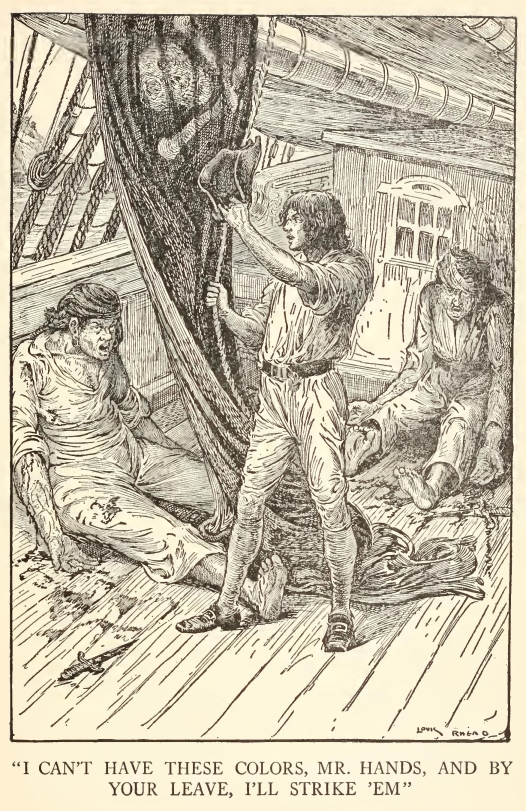
And again dodging the boom, I ran to the colour lines, handed down their cursed black flag, and chucked it overboard.
Again, I ducked the boom and ran to the flag lines. I lowered their cursed black flag and threw it overboard.
“God save the king!” said I, waving my cap. “And there’s an end to Captain Silver!”
“God save the king!” I said, waving my cap. “And that’s the end of Captain Silver!”
He watched me keenly and slyly, his chin all the while on his breast.
He watched me closely and slyly, keeping his chin against his chest the whole time.
“I reckon,” he said at last, “I reckon, Cap’n Hawkins, you’ll kind of want to get ashore now. S’pose we talks.”
“I guess,” he said at last, “I guess, Captain Hawkins, you’ll probably want to go ashore now. How about we talk?”
“Why, yes,” says I, “with all my heart, Mr. Hands. Say on.” And I went back to my meal with a good appetite.
“Why, yes,” I said. “With all my heart, Mr. Hands. Go on.” And I went back to my meal with a good appetite.
“This man,” he began, nodding feebly at the corpse “—O’Brien were his name, a rank Irelander—this man and me got the canvas on her, meaning for to sail her back. Well, he’s dead now, he is—as dead as bilge; and who’s to sail this ship, I don’t see. Without I gives you a hint, you ain’t that man, as far’s I can tell. Now, look here, you gives me food and drink and a old scarf or ankecher to tie my wound up, you do, and I’ll tell you how to sail her, and that’s about square all round, I take it.”
“This man,” he began, nodding weakly at the corpse. “His name was O’Brien, a thorough Irishman. He and I put the sails on the ship, intending to sail her back. Well, he’s dead now, dead as can be. And I don’t know who’s going to sail this ship. As far as I can tell, you can’t do it unless I give you some guidance. Now, look here. Give me food and drink and an old scarf or handkerchief to tie up my wound. In return, I’ll tell you how to sail her. That seems fair all around, I reckon.”
“I’ll tell you one thing,” says I: “I’m not going back to Captain Kidd’s anchorage. I mean to get into North Inlet and beach her quietly there.”
“I’ll tell you one thing,” I said. “I’m not going back to Captain Kidd’s anchorage. I plan to sail into North Inlet and quietly beach her there.”
“To be sure you did,” he cried. “Why, I ain’t sich an infernal lubber after all. I can see, can’t I? I’ve tried my fling, I have, and I’ve lost, and it’s you has the wind of me. North Inlet? Why, I haven’t no ch’ice, not I! I’d help you sail her up to Execution Dock, by thunder! So I would.”
“Of course you did,” he cried. “Why, I’m not such a damned fool after all. I can see, can’t I? I took my chance and lost, and now you have the advantage over me. North Inlet? Why, I have no choice! I’d help you sail the ship up to Execution Dock, by thunder! I really would.”
Well, as it seemed to me, there was some sense in this. We struck our bargain on the spot. In three minutes I had the Hispaniola sailing easily before the wind along the coast of Treasure Island, with good hopes of turning the northern point ere noon and beating down again as far as North Inlet before high water, when we might beach her safely and wait till the subsiding tide permitted us to land.
Well, it seemed to me that this made some sense. We made our bargain on the spot. Within three minutes, I had the Hispaniola sailing easily along the coast of Treasure Island, with the wind behind us. I had good hopes of rounding the northern point before noon. Then we could sail back against the wind as far as North Inlet before high tide. At high tide, we could safely beach her and wait until the falling tide allowed us to land.
Then I lashed the tiller and went below to my own chest, where I got a soft silk handkerchief of my mother’s. With this, and with my aid, Hands bound up the great bleeding stab he had received in the thigh, and after he had eaten a little and had a swallow or two more of the brandy, he began to pick up visibly, sat straighter up, spoke louder and clearer, and looked in every way another man.
Then I tied the tiller in place and went below to my chest. There I found a soft silk handkerchief belonging to my mother. With my help, Hands used it to bandage the deep, bleeding stab wound in his thigh. After he ate a little and took another swallow or two of brandy, he visibly improved. He sat up straighter, spoke louder and more clearly, and seemed like a different man in every way.
The breeze served us admirably. We skimmed before it like a bird, the coast of the island flashing by and the view changing every minute. Soon we were past the high lands and bowling beside low, sandy country, sparsely dotted with dwarf pines, and soon we were beyond that again and had turned the corner of the rocky hill that ends the island on the north.
The breeze carried us along wonderfully. We skimmed before it like a bird, the island’s coast flashing by and the view changing every minute. Soon we passed the highlands and sailed alongside low, sandy land dotted with a few dwarf pines. Before long, we passed that too and rounded the rocky hill at the island’s northern end.
I was greatly elated with my new command, and pleased with the bright, sunshiny weather and these different prospects of the coast. I had now plenty of water and good things to eat, and my conscience, which had smitten me hard for my desertion, was quieted by the great conquest I had made. I should, I think, have had nothing left me to desire but for the eyes of the coxswain as they followed me derisively about the deck and the odd smile that appeared continually on his face. It was a smile that had in it something both of pain and weakness—a haggard old man’s smile; but there was, besides that, a grain of derision, a shadow of treachery, in his expression as he craftily watched, and watched, and watched me at my work.
I was thrilled with my new command and enjoyed the bright, sunny weather and the changing views of the coast. I now had plenty of water and good food. My conscience had troubled me deeply for deserting, but my great victory had quieted it. I think I would have wanted nothing more, if not for the coxswain’s eyes. He followed me around the deck with a mocking gaze, and an odd smile kept appearing on his face. His smile held something of pain and weakness, like the smile of a worn-out old man. But there was also a hint of mockery and a shadow of treachery in his expression. He watched me craftily as I worked, watching and watching and watching.