Part 5, Chapter 24
The Coracle's Voyage
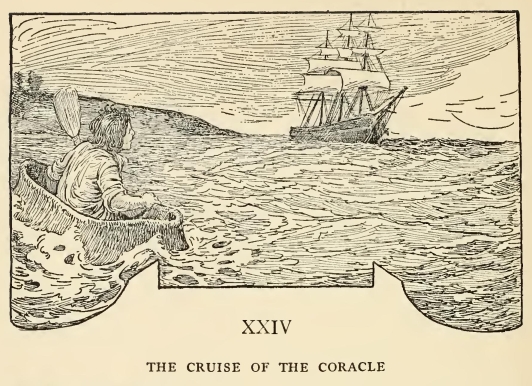
It was broad day when I awoke and found myself tossing at the south-west end of Treasure Island. The sun was up but was still hid from me behind the great bulk of the Spy-glass, which on this side descended almost to the sea in formidable cliffs.
It was full daylight when I woke and found myself tossing at the southwest end of Treasure Island. The sun was up, but the great bulk of the Spy-glass still hid it from me. On this side, the Spy-glass dropped almost to the sea in towering cliffs.
Haulbowline Head and Mizzenmast Hill were at my elbow, the hill bare and dark, the head bound with cliffs forty or fifty feet high and fringed with great masses of fallen rock. I was scarce a quarter of a mile to seaward, and it was my first thought to paddle in and land.
Haulbowline Head and Mizzenmast Hill were close beside me. The hill was bare and dark. The headland was lined with cliffs forty or fifty feet high, with great masses of fallen rock at their base. I was less than a quarter of a mile offshore, and my first thought was to paddle in and land.
That notion was soon given over. Among the fallen rocks the breakers spouted and bellowed; loud reverberations, heavy sprays flying and falling, succeeded one another from second to second; and I saw myself, if I ventured nearer, dashed to death upon the rough shore or spending my strength in vain to scale the beetling crags.
I soon gave up that idea. Among the fallen rocks, the breaking waves spouted and roared. Loud echoes and heavy sprays of water followed one another from second to second. I saw that if I ventured closer, I would be dashed to death on the rough shore. Or I would waste my strength trying to climb the overhanging cliffs.
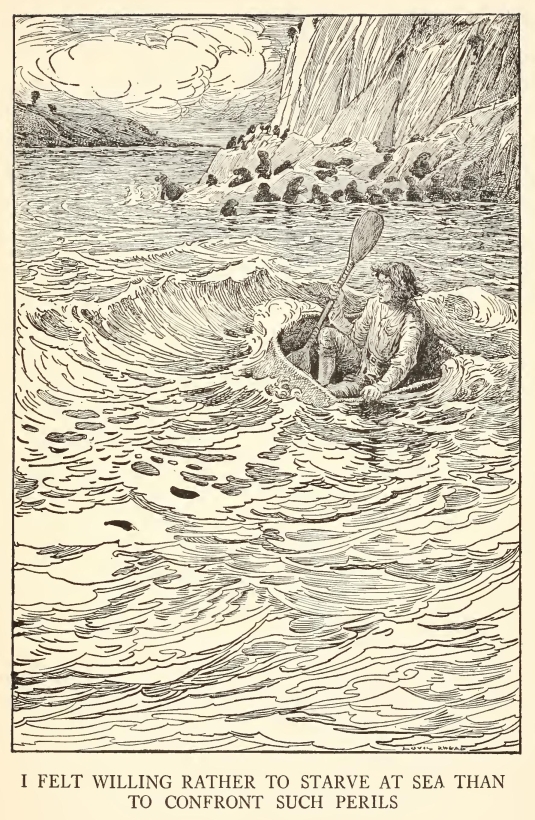
Nor was that all, for crawling together on flat tables of rock or letting themselves drop into the sea with loud reports I beheld huge slimy monsters—soft snails, as it were, of incredible bigness—two or three score of them together, making the rocks to echo with their barkings.
Nor was that all. I saw huge, slimy monsters crawling together on flat shelves of rock or dropping into the sea with loud splashes. They were like soft snails of incredible size. There were forty to sixty of them together, and their barking echoed off the rocks.
I have understood since that they were sea lions, and entirely harmless. But the look of them, added to the difficulty of the shore and the high running of the surf, was more than enough to disgust me of that landing-place. I felt willing rather to starve at sea than to confront such perils.
I later learned that they were sea lions and completely harmless. But their appearance, the difficult shore, and the high surf were more than enough to put me off landing there. I would rather have starved at sea than face such dangers.
In the meantime I had a better chance, as I supposed, before me. North of Haulbowline Head, the land runs in a long way, leaving at low tide a long stretch of yellow sand. To the north of that, again, there comes another cape—Cape of the Woods, as it was marked upon the chart—buried in tall green pines, which descended to the margin of the sea.
Meanwhile, I thought I had a better chance ahead. North of Haulbowline Head, the land curves far inland, leaving a long stretch of yellow sand at low tide. Farther north is another cape, marked on the chart as Cape of the Woods. It is covered in tall green pines that reach down to the edge of the sea.
I remembered what Silver had said about the current that sets northward along the whole west coast of Treasure Island, and seeing from my position that I was already under its influence, I preferred to leave Haulbowline Head behind me and reserve my strength for an attempt to land upon the kindlier-looking Cape of the Woods.
I remembered what Silver had said about the current flowing north along the entire west coast of Treasure Island. From where I was, I could see that the current was already carrying me. So I chose to leave Haulbowline Head behind and save my strength. I would try to land at the gentler-looking Cape of the Woods.
There was a great, smooth swell upon the sea. The wind blowing steady and gentle from the south, there was no contrariety between that and the current, and the billows rose and fell unbroken.
A great, smooth swell rolled across the sea. The wind blew steadily and gently from the south, in the same direction as the current. The waves rose and fell without breaking.
Had it been otherwise, I must long ago have perished; but as it was, it is surprising how easily and securely my little and light boat could ride. Often, as I still lay at the bottom and kept no more than an eye above the gunwale, I would see a big blue summit heaving close above me; yet the coracle would but bounce a little, dance as if on springs, and subside on the other side into the trough as lightly as a bird.
If things had been otherwise, I would have died long ago. But it was surprising how easily and safely my small, light boat rode the waves. I often lay on the bottom with only an eye above the boat’s edge. From there, I would see a huge blue wave rising close above me. Yet the coracle would only bounce a little, dance as if on springs, and settle into the hollow on the other side as lightly as a bird.
I began after a little to grow very bold and sat up to try my skill at paddling. But even a small change in the disposition of the weight will produce violent changes in the behaviour of a coracle. And I had hardly moved before the boat, giving up at once her gentle dancing movement, ran straight down a slope of water so steep that it made me giddy, and struck her nose, with a spout of spray, deep into the side of the next wave.
After a while, I grew quite bold and sat up to try paddling. But even a small shift in weight can make a coracle behave wildly. I had hardly moved when the boat stopped its gentle rocking and plunged straight down a slope of water. The slope was so steep that it made me dizzy. The boat drove its nose deep into the side of the next wave, sending up a spray of water.
I was drenched and terrified, and fell instantly back into my old position, whereupon the coracle seemed to find her head again and led me as softly as before among the billows. It was plain she was not to be interfered with, and at that rate, since I could in no way influence her course, what hope had I left of reaching land?
I was soaked and terrified, and immediately fell back into my old position. The coracle seemed to right itself and carried me as gently as before among the waves. Clearly, I could not interfere with the coracle. And since I could not control its course at all, what hope did I have of reaching land?
I began to be horribly frightened, but I kept my head, for all that. First, moving with all care, I gradually baled out the coracle with my sea-cap; then, getting my eye once more above the gunwale, I set myself to study how it was she managed to slip so quietly through the rollers.
I began to feel terribly frightened, but I kept my head. First, I carefully bailed water out of the coracle with my sea cap. Then I raised my eyes above the rim again. I began studying how the boat managed to slip so quietly through the rolling waves.
I found each wave, instead of the big, smooth glossy mountain it looks from shore or from a vessel’s deck, was for all the world like any range of hills on dry land, full of peaks and smooth places and valleys. The coracle, left to herself, turning from side to side, threaded, so to speak, her way through these lower parts and avoided the steep slopes and higher, toppling summits of the wave.
I found that each wave was just like a range of hills on land, full of peaks, smooth places, and valleys. From shore or a ship’s deck, a wave looks like a big, smooth, glossy mountain. Left to itself, the coracle turned from side to side and, so to speak, threaded its way through the lower parts. It avoided the steep slopes and the higher, toppling peaks of the wave.
“Well, now,” thought I to myself, “it is plain I must lie where I am and not disturb the balance; but it is plain also that I can put the paddle over the side and from time to time, in smooth places, give her a shove or two towards land.” No sooner thought upon than done. There I lay on my elbows in the most trying attitude, and every now and again gave a weak stroke or two to turn her head to shore.
“Well, now,” I thought, “I clearly have to stay where I am so I don’t upset the balance. But I can also put the paddle over the side. Now and then, in calm spots, I can give the boat a shove or two toward land.” As soon as I thought of it, I did it. I lay there propped on my elbows in a very uncomfortable position. Every now and then, I gave a weak stroke or two to turn the boat toward shore.
It was very tiring and slow work, yet I did visibly gain ground; and as we drew near the Cape of the Woods, though I saw I must infallibly miss that point, I had still made some hundred yards of easting. I was, indeed, close in. I could see the cool green tree-tops swaying together in the breeze, and I felt sure I should make the next promontory without fail.
The work was slow and exhausting, but I could see that I was making progress. As we neared the Cape of the Woods, I saw that I was bound to miss it. Even so, I had traveled some hundred yards east. I was close to shore. I could see the cool green treetops swaying together in the breeze, and I felt sure I would reach the next headland.
It was high time, for I now began to be tortured with thirst. The glow of the sun from above, its thousandfold reflection from the waves, the sea-water that fell and dried upon me, caking my very lips with salt, combined to make my throat burn and my brain ache. The sight of the trees so near at hand had almost made me sick with longing, but the current had soon carried me past the point, and as the next reach of sea opened out, I beheld a sight that changed the nature of my thoughts.
It was just in time, because I was beginning to suffer terribly from thirst. The sun blazed overhead, and its light reflected countless times off the waves. Seawater splashed over me and dried, coating even my lips with salt. All this made my throat burn and my head ache. The sight of the trees so close by had almost made me sick with longing. But the current soon carried me past the point. As the next stretch of sea came into view, I saw something that changed my thoughts.
Right in front of me, not half a mile away, I beheld the Hispaniola under sail. I made sure, of course, that I should be taken; but I was so distressed for want of water that I scarce knew whether to be glad or sorry at the thought, and long before I had come to a conclusion, surprise had taken entire possession of my mind and I could do nothing but stare and wonder.
Right in front of me, less than half a mile away, I saw the Hispaniola under sail. Of course, I was sure I would be captured. But I was so desperate for water that I hardly knew whether to be glad or sorry at the thought. Long before I could decide, I was completely taken by surprise. I could do nothing but stare and wonder.
The Hispaniola was under her main-sail and two jibs, and the beautiful white canvas shone in the sun like snow or silver. When I first sighted her, all her sails were drawing; she was lying a course about north-west, and I presumed the men on board were going round the island on their way back to the anchorage. Presently she began to fetch more and more to the westward, so that I thought they had sighted me and were going about in chase. At last, however, she fell right into the wind’s eye, was taken dead aback, and stood there awhile helpless, with her sails shivering.
The Hispaniola was sailing under her mainsail and two jibs. The beautiful white canvas shone in the sun like snow or silver. When I first saw her, all her sails were filled with wind. She was heading northwest, and I assumed the men aboard were sailing around the island back to the anchorage. Soon she began turning farther and farther west. I thought the men had seen me and were turning to chase me. But at last she turned directly into the wind, which blew against the front of her sails. She stayed there helpless for a while, her sails trembling.
“Clumsy fellows,” said I; “they must still be drunk as owls.” And I thought how Captain Smollett would have set them skipping.
“Clumsy fellows,” I said. “They must still be very drunk.” I thought how Captain Smollett would have made them move quickly.
Meanwhile the schooner gradually fell off and filled again upon another tack, sailed swiftly for a minute or so, and brought up once more dead in the wind’s eye. Again and again was this repeated. To and fro, up and down, north, south, east, and west, the Hispaniola sailed by swoops and dashes, and at each repetition ended as she had begun, with idly flapping canvas. It became plain to me that nobody was steering. And if so, where were the men? Either they were dead drunk or had deserted her, I thought, and perhaps if I could get on board I might return the vessel to her captain.
Meanwhile, the schooner gradually turned away from the wind, and her sails filled again on another tack. She sailed swiftly for a minute or so, then stopped again, facing directly into the wind. This happened again and again. The Hispaniola swept and darted back and forth, north, south, east, and west. Each time, she ended as she had begun, with her sails flapping uselessly. It became clear to me that nobody was steering. And if nobody was steering, where were the men? I thought they were either dead drunk or had abandoned her. Perhaps, if I could get on board, I could return the vessel to her captain.
The current was bearing coracle and schooner southward at an equal rate. As for the latter’s sailing, it was so wild and intermittent, and she hung each time so long in irons, that she certainly gained nothing, if she did not even lose. If only I dared to sit up and paddle, I made sure that I could overhaul her. The scheme had an air of adventure that inspired me, and the thought of the water breaker beside the fore companion doubled my growing courage.
The current was carrying the coracle and the schooner south at the same speed. The schooner sailed wildly and unevenly. Each time she turned into the wind, she stayed stuck there so long that she certainly gained no ground. She may even have lost some. If only I dared sit up and paddle, I was sure I could catch her. The plan had an adventurous appeal that inspired me. The thought of the water barrel beside the forward hatch made me twice as bold.
Up I got, was welcomed almost instantly by another cloud of spray, but this time stuck to my purpose and set myself, with all my strength and caution, to paddle after the unsteered Hispaniola. Once I shipped a sea so heavy that I had to stop and bail, with my heart fluttering like a bird, but gradually I got into the way of the thing and guided my coracle among the waves, with only now and then a blow upon her bows and a dash of foam in my face.
I got up and was almost instantly greeted by another cloud of spray. But this time I stuck to my purpose. Using all my strength and caution, I paddled after the unsteered Hispaniola. Once, a wave broke into the coracle so heavily that I had to stop and bail out the water. My heart fluttered like a bird. But gradually I got the hang of it and guided my coracle among the waves. Only now and then did a wave strike its bow and splash foam in my face.
I was now gaining rapidly on the schooner; I could see the brass glisten on the tiller as it banged about, and still no soul appeared upon her decks. I could not choose but suppose she was deserted. If not, the men were lying drunk below, where I might batten them down, perhaps, and do what I chose with the ship.
I was now catching up with the schooner quickly. I could see the brass gleaming on the tiller as it swung about. Still, no one appeared on deck. I could only assume the ship was deserted. If not, the men were lying drunk below. Perhaps I could lock them down there and do as I pleased with the ship.
For some time she had been doing the worse thing possible for me—standing still. She headed nearly due south, yawing, of course, all the time. Each time she fell off, her sails partly filled, and these brought her in a moment right to the wind again. I have said this was the worst thing possible for me, for helpless as she looked in this situation, with the canvas cracking like cannon and the blocks trundling and banging on the deck, she still continued to run away from me, not only with the speed of the current, but by the whole amount of her leeway, which was naturally great.
For some time, the ship had been doing the worst thing possible for me: standing still. She pointed almost due south, swinging from side to side all the while, of course. Each time she turned away from the wind, her sails partly filled. The sails then brought her back into the wind at once. I have said this was the worst thing possible for me. Though the ship looked helpless, she was still moving away from me. Her sails cracked like cannon fire, and the blocks rolled and banged on the deck. But she was drifting away not only at the speed of the current. She was also being pushed sideways by the wind, which naturally carried her a long way.
But now, at last, I had my chance. The breeze fell for some seconds, very low, and the current gradually turning her, the Hispaniola revolved slowly round her centre and at last presented me her stern, with the cabin window still gaping open and the lamp over the table still burning on into the day. The main-sail hung drooped like a banner. She was stock-still but for the current.
But now, at last, I had my chance. The breeze died down for a few seconds, and the current gradually turned the Hispaniola. The ship slowly swung around its center until its stern faced me. The cabin window was still wide open, and the lamp over the table was still burning in the daylight. The mainsail hung limp like a banner. The ship was completely still except for the movement of the current.
For the last little while I had even lost, but now redoubling my efforts, I began once more to overhaul the chase.
For a little while, I had even lost ground. But now I tried harder and began to gain on what I was chasing again.
I was not a hundred yards from her when the wind came again in a clap; she filled on the port tack and was off again, stooping and skimming like a swallow.
I was less than a hundred yards from the ship when the wind suddenly returned. Her sails filled on the port tack, and she was off again, dipping and skimming like a swallow.
My first impulse was one of despair, but my second was towards joy. Round she came, till she was broadside on to me—round still till she had covered a half and then two thirds and then three quarters of the distance that separated us. I could see the waves boiling white under her forefoot. Immensely tall she looked to me from my low station in the coracle.
My first impulse was despair, but then I felt joy. The ship swung around until her side faced me. She kept turning, covering half the distance between us, then two thirds, then three quarters. I could see the waves boiling white beneath her bow. From my low position in the coracle, she looked immensely tall.
And then, of a sudden, I began to comprehend. I had scarce time to think—scarce time to act and save myself. I was on the summit of one swell when the schooner came stooping over the next. The bowsprit was over my head. I sprang to my feet and leaped, stamping the coracle under water. With one hand I caught the jib-boom, while my foot was lodged between the stay and the brace; and as I still clung there panting, a dull blow told me that the schooner had charged down upon and struck the coracle and that I was left without retreat on the Hispaniola.
Then, suddenly, I began to understand. I barely had time to think, barely time to act and save myself. I was on top of one wave when the schooner came pitching over the next. The bowsprit was over my head. I sprang to my feet and leaped, pushing the coracle underwater. With one hand, I caught the jib-boom, and my foot lodged between the stay and the brace. As I clung there, panting, a dull blow told me the schooner had struck the coracle. I was left on the Hispaniola with no way back.