Part 5, Chapter 23
The Tide Flows Out
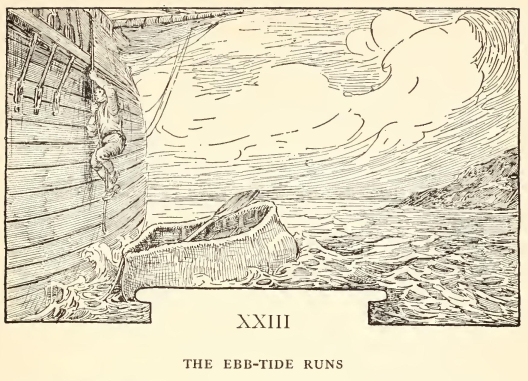
The coracle—as I had ample reason to know before I was done with her—was a very safe boat for a person of my height and weight, both buoyant and clever in a seaway; but she was the most cross-grained, lop-sided craft to manage. Do as you pleased, she always made more leeway than anything else, and turning round and round was the manoeuvre she was best at. Even Ben Gunn himself has admitted that she was “queer to handle till you knew her way.”
The coracle was a very safe boat for someone of my height and weight. I had plenty of reason to learn that before I was done with her. She stayed afloat well and handled rough water skillfully, but she was an awkward, lopsided craft to manage. Whatever you did, she drifted sideways more than anything else. Spinning round and round was what she did best. Even Ben Gunn himself admitted that she was “strange to handle until you got to know her ways.”
Certainly I did not know her way. She turned in every direction but the one I was bound to go; the most part of the time we were broadside on, and I am very sure I never should have made the ship at all but for the tide. By good fortune, paddle as I pleased, the tide was still sweeping me down; and there lay the Hispaniola right in the fairway, hardly to be missed.
I certainly did not know how to steer her. She turned in every direction except the one I needed to go. Most of the time, we were drifting sideways, and I am very sure I would never have reached the ship without the tide. Luckily, no matter how I paddled, the tide kept carrying me along. And there lay the Hispaniola right in the channel, hardly possible to miss.
First she loomed before me like a blot of something yet blacker than darkness, then her spars and hull began to take shape, and the next moment, as it seemed (for, the farther I went, the brisker grew the current of the ebb), I was alongside of her hawser and had laid hold.
At first, the ship loomed before me like a blot even blacker than the darkness. Then her masts, spars, and hull began to take shape. The farther I went, the faster the outgoing tide carried me. And so, it seemed, I was beside her mooring rope and had grabbed hold of it the next moment.
The hawser was as taut as a bowstring, and the current so strong she pulled upon her anchor. All round the hull, in the blackness, the rippling current bubbled and chattered like a little mountain stream. One cut with my sea-gully and the Hispaniola would go humming down the tide.
The thick rope was as tight as a bowstring, and the current was so strong that the ship pulled against her anchor. In the darkness, the rippling current bubbled and chattered all around the hull like a little mountain stream. One cut with my sailor’s knife and the Hispaniola would go humming down with the tide.
So far so good, but it next occurred to my recollection that a taut hawser, suddenly cut, is a thing as dangerous as a kicking horse. Ten to one, if I were so foolhardy as to cut the Hispaniola from her anchor, I and the coracle would be knocked clean out of the water.
So far, so good. But then I remembered that a taut rope, suddenly cut, is as dangerous as a kicking horse. If I were foolish enough to cut the Hispaniola free from her anchor, the odds were ten to one that the rope would knock me and the coracle right out of the water.
This brought me to a full stop, and if fortune had not again particularly favoured me, I should have had to abandon my design. But the light airs which had begun blowing from the south-east and south had hauled round after nightfall into the south-west. Just while I was meditating, a puff came, caught the Hispaniola, and forced her up into the current; and to my great joy, I felt the hawser slacken in my grasp, and the hand by which I held it dip for a second under water.
This brought me to a complete stop. If luck had not especially favored me again, I would have had to give up my plan. But the light winds that had begun blowing from the southeast and south had shifted to the southwest after nightfall. Just as I was thinking, a gust caught the Hispaniola and pushed her into the current. To my great joy, I felt the hawser go slack in my grasp. The hand holding it dipped underwater for a second.
With that I made my mind up, took out my gully, opened it with my teeth, and cut one strand after another, till the vessel swung only by two. Then I lay quiet, waiting to sever these last when the strain should be once more lightened by a breath of wind.
With that, I made up my mind. I took out my knife, opened it with my teeth, and cut the strands one by one. Soon the vessel swung from only two strands. Then I lay still, waiting for a breath of wind to ease the strain again so I could cut them.
All this time I had heard the sound of loud voices from the cabin, but to say truth, my mind had been so entirely taken up with other thoughts that I had scarcely given ear. Now, however, when I had nothing else to do, I began to pay more heed.
All this time, I had heard loud voices coming from the cabin. But to tell the truth, I had been so absorbed in other thoughts that I had barely listened. Now, however, I had nothing else to do, so I began to pay more attention.
One I recognized for the coxswain’s, Israel Hands, that had been Flint’s gunner in former days. The other was, of course, my friend of the red night-cap. Both men were plainly the worse of drink, and they were still drinking, for even while I was listening, one of them, with a drunken cry, opened the stern window and threw out something, which I divined to be an empty bottle. But they were not only tipsy; it was plain that they were furiously angry. Oaths flew like hailstones, and every now and then there came forth such an explosion as I thought was sure to end in blows. But each time the quarrel passed off and the voices grumbled lower for a while, until the next crisis came and in its turn passed away without result.
I recognized one voice as the coxswain’s, Israel Hands, who had been Flint’s gunner in the old days. The other voice was, of course, my friend’s, the man in the red night-cap. Both men were clearly drunk, and they were still drinking. As I listened, one of them gave a drunken cry, opened the stern window, and threw something out. I guessed it was an empty bottle. But they were not just drunk. They were clearly furious. Curses flew like hailstones, and every now and then their anger erupted so violently that I thought they would surely fight. But each time the quarrel died down, and their voices fell to a grumble for a while. Then another outburst would come and pass in turn, without anything happening.
On shore, I could see the glow of the great camp-fire burning warmly through the shore-side trees. Someone was singing, a dull, old, droning sailor’s song, with a droop and a quaver at the end of every verse, and seemingly no end to it at all but the patience of the singer. I had heard it on the voyage more than once and remembered these words:
On shore, I could see the warm glow of the great campfire through the trees along the shore. Someone was singing a dull, old sailor’s song in a droning voice. At the end of every verse, the singer’s voice sank and trembled. The song seemed to have no end, except when the singer ran out of patience. I had heard the song more than once on the voyage and remembered these words:
“But one man of her crew alive, What put to sea with seventy-five.”
“Only one man of her crew was alive, From the ship that set sail with seventy-five.”
And I thought it was a ditty rather too dolefully appropriate for a company that had met such cruel losses in the morning. But, indeed, from what I saw, all these buccaneers were as callous as the sea they sailed on.
I thought the song was sadly fitting for a group that had suffered such cruel losses that morning. But from what I saw, all these pirates were as heartless as the sea they sailed on.
At last the breeze came; the schooner sidled and drew nearer in the dark; I felt the hawser slacken once more, and with a good, tough effort, cut the last fibres through.
At last the breeze came. The schooner drifted sideways and drew closer in the dark. I felt the heavy rope slacken again, and with one strong effort, I cut through the last fibers.
The breeze had but little action on the coracle, and I was almost instantly swept against the bows of the Hispaniola. At the same time, the schooner began to turn upon her heel, spinning slowly, end for end, across the current.
The breeze had little effect on the coracle, and I was swept almost immediately against the bow of the Hispaniola. At the same time, the schooner began to turn, slowly spinning end for end across the current.
I wrought like a fiend, for I expected every moment to be swamped; and since I found I could not push the coracle directly off, I now shoved straight astern. At length I was clear of my dangerous neighbour, and just as I gave the last impulsion, my hands came across a light cord that was trailing overboard across the stern bulwarks. Instantly I grasped it.
I worked like mad, expecting to be swamped at any moment. Since I couldn’t push the coracle directly away, I pushed it straight back instead. At last I was clear of my dangerous neighbor. Just as I gave the final push, my hands touched a thin cord trailing overboard across the stern railing. I grabbed it at once.
Why I should have done so I can hardly say. It was at first mere instinct, but once I had it in my hands and found it fast, curiosity began to get the upper hand, and I determined I should have one look through the cabin window.
I can hardly say why I did it. At first, it was just instinct. But once I had it in my hands and found it secure, curiosity took over. I decided to take one look through the cabin window.
I pulled in hand over hand on the cord, and when I judged myself near enough, rose at infinite risk to about half my height and thus commanded the roof and a slice of the interior of the cabin.
I pulled on the cord hand over hand. When I thought I was close enough, I rose halfway up, at great risk. From there, I could see the roof and part of the cabin’s interior.
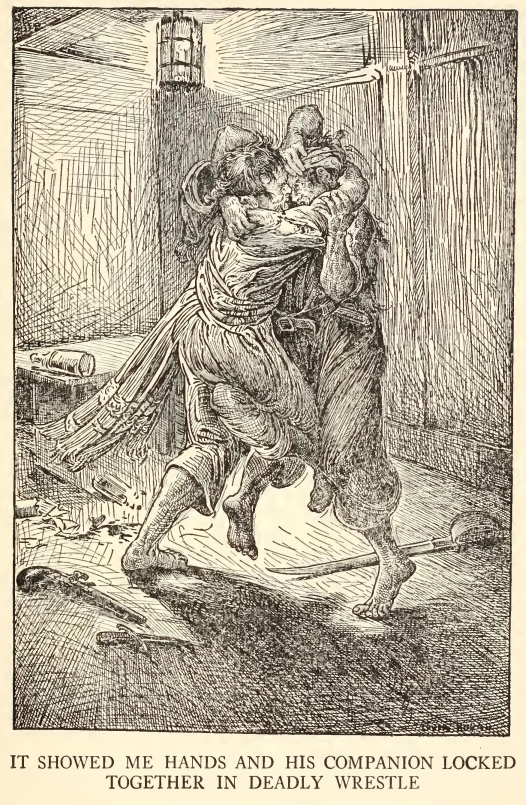
By this time the schooner and her little consort were gliding pretty swiftly through the water; indeed, we had already fetched up level with the camp-fire. The ship was talking, as sailors say, loudly, treading the innumerable ripples with an incessant weltering splash; and until I got my eye above the window-sill I could not comprehend why the watchmen had taken no alarm. One glance, however, was sufficient; and it was only one glance that I durst take from that unsteady skiff. It showed me Hands and his companion locked together in deadly wrestle, each with a hand upon the other’s throat.
By now, the schooner and the little boat alongside her were gliding fairly swiftly through the water. In fact, we had already come level with the campfire. The ship was talking loudly, as sailors say, moving through countless ripples with a constant, churning splash. I could not understand why the watchmen had not been alarmed until I raised my eyes above the windowsill. One glance was enough, though, and it was all I dared take from the unsteady skiff. I saw Hands and his companion locked in a deadly struggle, each with a hand around the other’s throat.
I dropped upon the thwart again, none too soon, for I was near overboard. I could see nothing for the moment but these two furious, encrimsoned faces swaying together under the smoky lamp, and I shut my eyes to let them grow once more familiar with the darkness.
I dropped back onto the boat’s bench just in time, because I was nearly overboard. For a moment, all I could see were two furious, blood-red faces swaying together beneath the smoky lamp. I closed my eyes to let them adjust to the darkness again.
The endless ballad had come to an end at last, and the whole diminished company about the camp-fire had broken into the chorus I had heard so often:
The endless ballad had finally ended, and everyone left around the campfire broke into the chorus I had heard so often:
“Fifteen men on the dead man’s chest— Yo-ho-ho, and a bottle of rum! Drink and the devil had done for the rest— Yo-ho-ho, and a bottle of rum!”
“Fifteen men on the dead man’s chest, Yo-ho-ho, and a bottle of rum! Drink and the devil had killed the rest, Yo-ho-ho, and a bottle of rum!”
I was just thinking how busy drink and the devil were at that very moment in the cabin of the Hispaniola, when I was surprised by a sudden lurch of the coracle. At the same moment, she yawed sharply and seemed to change her course. The speed in the meantime had strangely increased.
I was just thinking how busy drink and the devil were in the cabin of the Hispaniola at that moment when the coracle suddenly lurched, surprising me. At the same moment, it turned sharply and seemed to change course. Meanwhile, its speed had strangely increased.
I opened my eyes at once. All round me were little ripples, combing over with a sharp, bristling sound and slightly phosphorescent. The Hispaniola herself, a few yards in whose wake I was still being whirled along, seemed to stagger in her course, and I saw her spars toss a little against the blackness of the night; nay, as I looked longer, I made sure she also was wheeling to the southward.
I opened my eyes at once. All around me, small ripples broke with a sharp, bristling sound and glowed faintly. I was still being swept along in the wake of the Hispaniola, just a few yards behind her. The ship seemed to stagger off course, and I saw her spars sway against the black night. As I watched longer, I became sure she too was turning south.
I glanced over my shoulder, and my heart jumped against my ribs. There, right behind me, was the glow of the camp-fire. The current had turned at right angles, sweeping round along with it the tall schooner and the little dancing coracle; ever quickening, ever bubbling higher, ever muttering louder, it went spinning through the narrows for the open sea.
I glanced over my shoulder, and my heart leaped against my ribs. Right behind me was the glow of the campfire. The current had turned at a right angle, sweeping the tall schooner and the little bobbing coracle along with it. The current spun through the narrow passage toward the open sea, moving faster, bubbling higher, and rumbling louder.
Suddenly the schooner in front of me gave a violent yaw, turning, perhaps, through twenty degrees; and almost at the same moment one shout followed another from on board; I could hear feet pounding on the companion ladder and I knew that the two drunkards had at last been interrupted in their quarrel and awakened to a sense of their disaster.
Suddenly, the schooner in front of me swerved violently, turning perhaps twenty degrees. Almost at the same moment, one shout after another came from aboard. I could hear feet pounding on the companion ladder. I knew the two drunkards had finally stopped quarreling and realized the disaster they were in.
I lay down flat in the bottom of that wretched skiff and devoutly recommended my spirit to its Maker. At the end of the straits, I made sure we must fall into some bar of raging breakers, where all my troubles would be ended speedily; and though I could, perhaps, bear to die, I could not bear to look upon my fate as it approached.
I lay flat in the bottom of that miserable little boat and prayed, entrusting my spirit to its Maker. At the end of the straits, I was sure we would hit a stretch of raging breakers. There, all my troubles would quickly end. Though I could perhaps bear to die, I could not bear to watch my fate approach.
So I must have lain for hours, continually beaten to and fro upon the billows, now and again wetted with flying sprays, and never ceasing to expect death at the next plunge. Gradually weariness grew upon me; a numbness, an occasional stupor, fell upon my mind even in the midst of my terrors, until sleep at last supervened and in my sea-tossed coracle I lay and dreamed of home and the old Admiral Benbow.
I must have lain there for hours, constantly tossed back and forth by the waves and occasionally drenched by flying spray. I never stopped expecting to die with the next plunge. Gradually, I grew weary. Even amid my terror, my mind grew numb, and I sometimes fell into a stupor. At last I fell asleep in my sea-tossed coracle and dreamed of home and the old Admiral Benbow.