Part 5, Chapter 22
How My Sea Adventure Began
There was no return of the mutineers—not so much as another shot out of the woods. They had “got their rations for that day,” as the captain put it, and we had the place to ourselves and a quiet time to overhaul the wounded and get dinner. Squire and I cooked outside in spite of the danger, and even outside we could hardly tell what we were at, for horror of the loud groans that reached us from the doctor’s patients.
The mutineers did not return. There was not even another shot from the woods. They had “got their rations for that day,” as the captain put it. We had the place to ourselves and some quiet time to check on the wounded and make dinner. The squire and I cooked outside despite the danger. Even there, we could hardly tell what we were doing. We were horrified by the loud groans coming from the doctor’s patients.
Out of the eight men who had fallen in the action, only three still breathed—that one of the pirates who had been shot at the loophole, Hunter, and Captain Smollett; and of these, the first two were as good as dead; the mutineer indeed died under the doctor’s knife, and Hunter, do what we could, never recovered consciousness in this world. He lingered all day, breathing loudly like the old buccaneer at home in his apoplectic fit, but the bones of his chest had been crushed by the blow and his skull fractured in falling, and some time in the following night, without sign or sound, he went to his Maker.
Of the eight men who had fallen in the fight, only three were still breathing. They were the pirate shot at the loophole, Hunter, and Captain Smollett. The first two were as good as dead. The mutineer died while the doctor was operating on him. And despite everything we did, Hunter never regained consciousness in this world. He lingered all day, breathing loudly like the old buccaneer back home during his stroke. But the blow had crushed the bones in his chest, and his skull had fractured when he fell. Sometime the following night, without a sign or a sound, he went to his Maker.
As for the captain, his wounds were grievous indeed, but not dangerous. No organ was fatally injured. Anderson’s ball—for it was Job that shot him first—had broken his shoulder-blade and touched the lung, not badly; the second had only torn and displaced some muscles in the calf. He was sure to recover, the doctor said, but in the meantime, and for weeks to come, he must not walk nor move his arm, nor so much as speak when he could help it.
The captain’s wounds were serious, but not dangerous. No organ had been fatally injured. Job Anderson had shot him first. His bullet had broken the captain’s shoulder blade and slightly injured his lung. The second bullet had only torn and displaced some muscles in his calf. The doctor said the captain would surely recover. But for the next few weeks, he must not walk or move his arm. He must not even speak if he could help it.
My own accidental cut across the knuckles was a flea-bite. Doctor Livesey patched it up with plaster and pulled my ears for me into the bargain.
The accidental cut across my knuckles was just a scratch. Doctor Livesey patched it up with a bandage and pulled my ears for good measure.
After dinner the squire and the doctor sat by the captain’s side awhile in consultation; and when they had talked to their hearts’ content, it being then a little past noon, the doctor took up his hat and pistols, girt on a cutlass, put the chart in his pocket, and with a musket over his shoulder crossed the palisade on the north side and set off briskly through the trees.
After dinner, the squire and the doctor sat beside the captain for a while, discussing matters. When they had talked as long as they wished, it was a little past noon. The doctor picked up his hat and pistols, strapped on a cutlass, and put the chart in his pocket. With a musket over his shoulder, he crossed the palisade on the north side and set off briskly through the trees.
Gray and I were sitting together at the far end of the block house, to be out of earshot of our officers consulting; and Gray took his pipe out of his mouth and fairly forgot to put it back again, so thunder-struck he was at this occurrence.
Gray and I sat together at the far end of the blockhouse, out of earshot of our officers as they discussed matters. Gray took his pipe out of his mouth and forgot to put it back. He was that stunned by what had happened.
“Why, in the name of Davy Jones,” said he, “is Dr. Livesey mad?”
“For Davy Jones’s sake,” he said, “is Dr. Livesey crazy?”
“Why no,” says I. “He’s about the last of this crew for that, I take it.”
“Why, no,” I said. “I’d say he’s one of the last people in this crew to do that.”
“Well, shipmate,” said Gray, “mad he may not be; but if he’s not, you mark my words, I am.”
“Well, shipmate,” said Gray, “he may not be crazy. But if he’s not, mark my words, I am.”
“I take it,” replied I, “the doctor has his idea; and if I am right, he’s going now to see Ben Gunn.”
“I think the doctor has a plan,” I replied. “And if I’m right, he’s going to see Ben Gunn now.”
I was right, as appeared later; but in the meantime, the house being stifling hot and the little patch of sand inside the palisade ablaze with midday sun, I began to get another thought into my head, which was not by any means so right. What I began to do was to envy the doctor walking in the cool shadow of the woods with the birds about him and the pleasant smell of the pines, while I sat grilling, with my clothes stuck to the hot resin, and so much blood about me and so many poor dead bodies lying all around that I took a disgust of the place that was almost as strong as fear.
I was right, as I later discovered. But meanwhile, the house was stiflingly hot, and the small patch of sand inside the palisade blazed in the midday sun. I began to have another thought, one that was not nearly so right. I began to envy the doctor, walking in the cool shade of the woods, with birds around him and the pleasant smell of pines. Meanwhile, I sat roasting, my clothes stuck to the hot resin. There was so much blood around me and so many poor dead bodies lying everywhere that I grew disgusted with the place. My disgust was almost as strong as my fear.
All the time I was washing out the block house, and then washing up the things from dinner, this disgust and envy kept growing stronger and stronger, till at last, being near a bread-bag, and no one then observing me, I took the first step towards my escapade and filled both pockets of my coat with biscuit.
As I washed out the blockhouse and cleaned up after dinner, my disgust and envy kept growing stronger. Finally, I was near a bread bag, and no one was watching me. So I took the first step toward my escapade and filled both coat pockets with biscuits.
I was a fool, if you like, and certainly I was going to do a foolish, over-bold act; but I was determined to do it with all the precautions in my power. These biscuits, should anything befall me, would keep me, at least, from starving till far on in the next day.
I was a fool, if you like, and I was certainly about to do something foolish and reckless. But I was determined to take every precaution I could. If anything happened to me, these biscuits would at least keep me from starving until well into the next day.
The next thing I laid hold of was a brace of pistols, and as I already had a powder-horn and bullets, I felt myself well supplied with arms.
Next, I picked up a pair of pistols. Since I already had a powder horn and bullets, I felt well armed.
As for the scheme I had in my head, it was not a bad one in itself. I was to go down the sandy spit that divides the anchorage on the east from the open sea, find the white rock I had observed last evening, and ascertain whether it was there or not that Ben Gunn had hidden his boat, a thing quite worth doing, as I still believe. But as I was certain I should not be allowed to leave the enclosure, my only plan was to take French leave and slip out when nobody was watching, and that was so bad a way of doing it as made the thing itself wrong. But I was only a boy, and I had made my mind up.
As for the plan I had in mind, it was not a bad one in itself. I would go down the sandy spit that separates the eastern anchorage from the open sea. There, I would find the white rock I had noticed the evening before. I would check whether Ben Gunn had hidden his boat there. I still believe that was well worth doing. But I was sure I would not be allowed to leave the enclosure. My only option was to slip out without permission when nobody was watching. That was such a bad way to go about it that it made the plan itself wrong. But I was only a boy, and I had made up my mind.
Well, as things at last fell out, I found an admirable opportunity. The squire and Gray were busy helping the captain with his bandages, the coast was clear, I made a bolt for it over the stockade and into the thickest of the trees, and before my absence was observed I was out of cry of my companions.
Well, as things turned out, I found an excellent opportunity. The squire and Gray were busy helping the captain with his bandages. The coast was clear, so I dashed over the stockade and into the thickest part of the woods. Before my companions noticed I was gone, I was out of earshot.
This was my second folly, far worse than the first, as I left but two sound men to guard the house; but like the first, it was a help towards saving all of us.
This was my second mistake, far worse than the first, because I left only two able-bodied men to guard the house. But like the first mistake, it helped save all of us.
I took my way straight for the east coast of the island, for I was determined to go down the sea side of the spit to avoid all chance of observation from the anchorage. It was already late in the afternoon, although still warm and sunny. As I continued to thread the tall woods, I could hear from far before me not only the continuous thunder of the surf, but a certain tossing of foliage and grinding of boughs which showed me the sea breeze had set in higher than usual. Soon cool draughts of air began to reach me, and a few steps farther I came forth into the open borders of the grove, and saw the sea lying blue and sunny to the horizon and the surf tumbling and tossing its foam along the beach.
I headed straight for the island’s east coast. I was determined to follow the sea side of the spit to avoid any chance of being seen from the anchorage. It was already late afternoon, though still warm and sunny. As I made my way through the tall woods, I could hear the constant thunder of the surf far ahead. I could also hear leaves tossing and branches grinding together, showing that the sea breeze was stronger than usual. Soon I began to feel cool currents of air. A few steps farther on, I emerged at the open edge of the grove. I saw the blue sea, bright with sunlight, stretching to the horizon. Along the beach, the surf tumbled and tossed its foam.
I have never seen the sea quiet round Treasure Island. The sun might blaze overhead, the air be without a breath, the surface smooth and blue, but still these great rollers would be running along all the external coast, thundering and thundering by day and night; and I scarce believe there is one spot in the island where a man would be out of earshot of their noise.
I have never seen the sea calm around Treasure Island. The sun might blaze overhead, the air might be still, and the water smooth and blue. But even then, great waves would roll along the entire outer coast, thundering day and night. I hardly believe there is a single spot on the island where anyone could escape their sound.
I walked along beside the surf with great enjoyment, till, thinking I was now got far enough to the south, I took the cover of some thick bushes and crept warily up to the ridge of the spit.
I enjoyed walking along beside the surf. When I thought I had gone far enough south, I took cover in some thick bushes and carefully crept up to the ridge of the spit.
Behind me was the sea, in front the anchorage. The sea breeze, as though it had the sooner blown itself out by its unusual violence, was already at an end; it had been succeeded by light, variable airs from the south and south-east, carrying great banks of fog; and the anchorage, under lee of Skeleton Island, lay still and leaden as when first we entered it. The Hispaniola, in that unbroken mirror, was exactly portrayed from the truck to the waterline, the Jolly Roger hanging from her peak.
The sea was behind me, and the anchorage was in front. The sea breeze had already died down, as though its unusual force had worn it out sooner. Light, shifting winds from the south and southeast had taken its place, bringing great banks of fog. The anchorage, sheltered by Skeleton Island, lay still and leaden, just as it had when we first entered it. The Hispaniola was perfectly reflected in that unbroken mirror, from the top of her mast to the waterline. The Jolly Roger hung from her peak.
Alongside lay one of the gigs, Silver in the stern-sheets—him I could always recognize—while a couple of men were leaning over the stern bulwarks, one of them with a red cap—the very rogue that I had seen some hours before stride-legs upon the palisade. Apparently they were talking and laughing, though at that distance—upwards of a mile—I could, of course, hear no word of what was said. All at once there began the most horrid, unearthly screaming, which at first startled me badly, though I had soon remembered the voice of Captain Flint and even thought I could make out the bird by her bright plumage as she sat perched upon her master’s wrist.
One of the small boats lay alongside, with Silver sitting in the stern. I could always recognize him. A couple of men were leaning over the ship’s stern rail. One wore a red cap. He was the very rogue I had seen straddling the palisade a few hours before. They seemed to be talking and laughing, though at over a mile away, I could, of course, hear nothing they said. Suddenly, a horrible, unearthly scream rang out. It startled me badly at first, though I soon remembered Captain Flint’s voice. I even thought I could make out the bird by her bright feathers, perched on her master’s wrist.
Soon after, the jolly-boat shoved off and pulled for shore, and the man with the red cap and his comrade went below by the cabin companion.
Soon after, the small boat set off and was rowed toward shore. The man in the red cap and his companion went below through the cabin entrance.
Just about the same time, the sun had gone down behind the Spy-glass, and as the fog was collecting rapidly, it began to grow dark in earnest. I saw I must lose no time if I were to find the boat that evening.
Around the same time, the sun had gone down behind the Spy-glass. Fog was gathering quickly, and it was getting properly dark. I knew I had to waste no time if I was to find the boat that evening.
The white rock, visible enough above the brush, was still some eighth of a mile further down the spit, and it took me a goodish while to get up with it, crawling, often on all fours, among the scrub. Night had almost come when I laid my hand on its rough sides. Right below it there was an exceedingly small hollow of green turf, hidden by banks and a thick underwood about knee-deep, that grew there very plentifully; and in the centre of the dell, sure enough, a little tent of goat-skins, like what the gipsies carry about with them in England.
The white rock was easy enough to see above the brush. But it was still about an eighth of a mile farther down the spit. It took me quite a while to reach it, crawling through the scrub, often on all fours. Night had almost fallen when I placed my hand on its rough side. Directly below the rock was a very small hollow of green turf. Banks and thick, knee-high undergrowth hid it from view. Sure enough, in the center of the hollow stood a small tent made of goatskins, like those the gypsies carry around in England.
I dropped into the hollow, lifted the side of the tent, and there was Ben Gunn’s boat—home-made if ever anything was home-made; a rude, lop-sided framework of tough wood, and stretched upon that a covering of goat-skin, with the hair inside. The thing was extremely small, even for me, and I can hardly imagine that it could have floated with a full-sized man. There was one thwart set as low as possible, a kind of stretcher in the bows, and a double paddle for propulsion.
I dropped into the hollow and lifted the side of the tent. There was Ben Gunn’s boat. If ever a boat was homemade, this was it. It had a rough, lopsided frame of tough wood, covered with goatskin, with the hair on the inside. The boat was extremely small, even for me. I can hardly imagine it could have floated with a full-sized man in it. It had one seat set as low as possible, a kind of footrest in the bow, and a double paddle to move it.
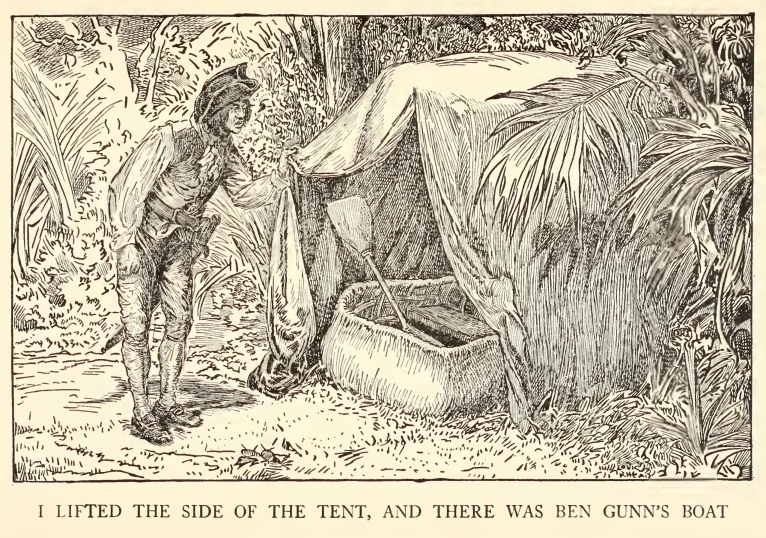
I had not then seen a coracle, such as the ancient Britons made, but I have seen one since, and I can give you no fairer idea of Ben Gunn’s boat than by saying it was like the first and the worst coracle ever made by man. But the great advantage of the coracle it certainly possessed, for it was exceedingly light and portable.
I had not yet seen a coracle, a kind of boat made by the ancient Britons. But I have seen one since. The best way to describe Ben Gunn’s boat is to say it looked like the first and worst coracle ever made. But it certainly had the great advantage of a coracle. It was extremely light and easy to carry.
Well, now that I had found the boat, you would have thought I had had enough of truantry for once, but in the meantime I had taken another notion and become so obstinately fond of it that I would have carried it out, I believe, in the teeth of Captain Smollett himself. This was to slip out under cover of the night, cut the Hispaniola adrift, and let her go ashore where she fancied. I had quite made up my mind that the mutineers, after their repulse of the morning, had nothing nearer their hearts than to up anchor and away to sea; this, I thought, it would be a fine thing to prevent, and now that I had seen how they left their watchmen unprovided with a boat, I thought it might be done with little risk.
Well, now that I had found the boat, you might have thought I had had enough mischief for once. But meanwhile, I had come up with another idea and grown stubbornly attached to it. I believe I would have carried it out even against Captain Smollett himself. My plan was to slip out under cover of night, cut the Hispaniola loose, and let her drift ashore wherever she pleased. I was quite sure that, after their defeat that morning, the mutineers wanted nothing more than to raise anchor and sail away. I thought it would be a fine thing to stop them. And now that I had seen how they had left their watchmen without a boat, I thought I could do it with little risk.
Down I sat to wait for darkness, and made a hearty meal of biscuit. It was a night out of ten thousand for my purpose. The fog had now buried all heaven. As the last rays of daylight dwindled and disappeared, absolute blackness settled down on Treasure Island. And when, at last, I shouldered the coracle and groped my way stumblingly out of the hollow where I had supped, there were but two points visible on the whole anchorage.
I sat down to wait for darkness and ate a hearty meal of biscuit. The night was one in ten thousand for my purpose. Fog now covered the entire sky. As the last rays of daylight faded away, complete darkness settled over Treasure Island. At last, I lifted the coracle onto my shoulder. I felt my way out of the hollow where I had eaten, stumbling as I went. Only two points of light were visible in the whole anchorage.
One was the great fire on shore, by which the defeated pirates lay carousing in the swamp. The other, a mere blur of light upon the darkness, indicated the position of the anchored ship. She had swung round to the ebb—her bow was now towards me—the only lights on board were in the cabin, and what I saw was merely a reflection on the fog of the strong rays that flowed from the stern window.
One was the great fire on shore, beside which the defeated pirates lay drinking and celebrating in the swamp. The other was just a blur of light in the darkness, marking the position of the anchored ship. The ship had swung around with the outgoing tide, so its bow now faced me. The only lights on board were in the cabin. What I saw was only the reflection on the fog of the strong light streaming from the stern window.
The ebb had already run some time, and I had to wade through a long belt of swampy sand, where I sank several times above the ankle, before I came to the edge of the retreating water, and wading a little way in, with some strength and dexterity, set my coracle, keel downwards, on the surface.
The tide had been going out for some time. I had to wade across a long stretch of swampy sand, sinking above my ankles several times, before I reached the water’s edge. I waded a little way into the water and, with some strength and skill, set my coracle on the surface, keel down.