Toomai and the Elephants
I will remember what I was, I am sick of rope and chain— I will remember my old strength and all my forest affairs. I will not sell my back to man for a bundle of sugar-cane: I will go out to my own kind, and the wood-folk in their lairs. I will go out until the day, until the morning break— Out to the wind’s untainted kiss, the water’s clean caress; I will forget my ankle-ring and snap my picket stake. I will revisit my lost loves, and playmates masterless!
I will remember what I was. I am sick of ropes and chains. I will remember my old strength and everything I did in the forest. I will not let humans ride me in exchange for a bundle of sugarcane. I will go out to my own kind and the forest creatures in their dens. I will keep going until day comes, until morning breaks. I will go out to the wind’s pure kiss and the water’s clean caress. I will forget the ring around my ankle and snap the stake that ties me down. I will visit those I once loved and my playmates who have no masters!
Kala Nag, which means Black Snake, had served the Indian Government in every way that an elephant could serve it for forty-seven years, and as he was fully twenty years old when he was caught, that makes him nearly seventy—a ripe age for an elephant. He remembered pushing, with a big leather pad on his forehead, at a gun stuck in deep mud, and that was before the Afghan War of 1842, and he had not then come to his full strength.
Kala Nag, whose name means Black Snake, had served the Indian Government in every way an elephant could for forty-seven years. He was already twenty when he was caught, so he was nearly seventy, a ripe old age for an elephant. He remembered pushing a gun stuck in deep mud, with a large leather pad on his forehead. That was before the Afghan War of 1842, when he had not yet reached his full strength.
His mother Radha Pyari,—Radha the darling,—who had been caught in the same drive with Kala Nag, told him, before his little milk tusks had dropped out, that elephants who were afraid always got hurt. Kala Nag knew that that advice was good, for the first time that he saw a shell burst he backed, screaming, into a stand of piled rifles, and the bayonets pricked him in all his softest places. So, before he was twenty-five, he gave up being afraid, and so he was the best-loved and the best-looked-after elephant in the service of the Government of India. He had carried tents, twelve hundred pounds’ weight of tents, on the march in Upper India. He had been hoisted into a ship at the end of a steam crane and taken for days across the water, and made to carry a mortar on his back in a strange and rocky country very far from India, and had seen the Emperor Theodore lying dead in Magdala, and had come back again in the steamer entitled, so the soldiers said, to the Abyssinian War medal. He had seen his fellow elephants die of cold and epilepsy and starvation and sunstroke up at a place called Ali Musjid, ten years later; and afterward he had been sent down thousands of miles south to haul and pile big balks of teak in the timberyards at Moulmein. There he had half killed an insubordinate young elephant who was shirking his fair share of work.
His mother, Radha Pyari, or Radha the darling, had been caught in the same drive as Kala Nag. Before his little milk tusks had fallen out, she told him that elephants who were afraid always got hurt. Kala Nag knew her advice was good. The first time he saw a shell burst, he backed screaming into a stack of rifles. The bayonets pricked him in all his softest places. So, before he was twenty-five, he gave up being afraid. As a result, he was the best-loved and best-cared-for elephant in the service of the Government of India. He had carried tents weighing twelve hundred pounds while marching through Upper India. He had been lifted onto a ship by a steam crane and taken across the water for several days. In a strange, rocky country far from India, he had been made to carry a mortar on his back. He had seen the Emperor Theodore lying dead in Magdala. Then he had returned on the steamer, entitled, so the soldiers said, to the Abyssinian War medal. Ten years later, at a place called Ali Musjid, he had seen his fellow elephants die of cold, epilepsy, starvation, and sunstroke. Afterward, he had been sent thousands of miles south to haul and stack big timbers of teak in the timberyards at Moulmein. There he had half killed a disobedient young elephant who was avoiding his fair share of the work.
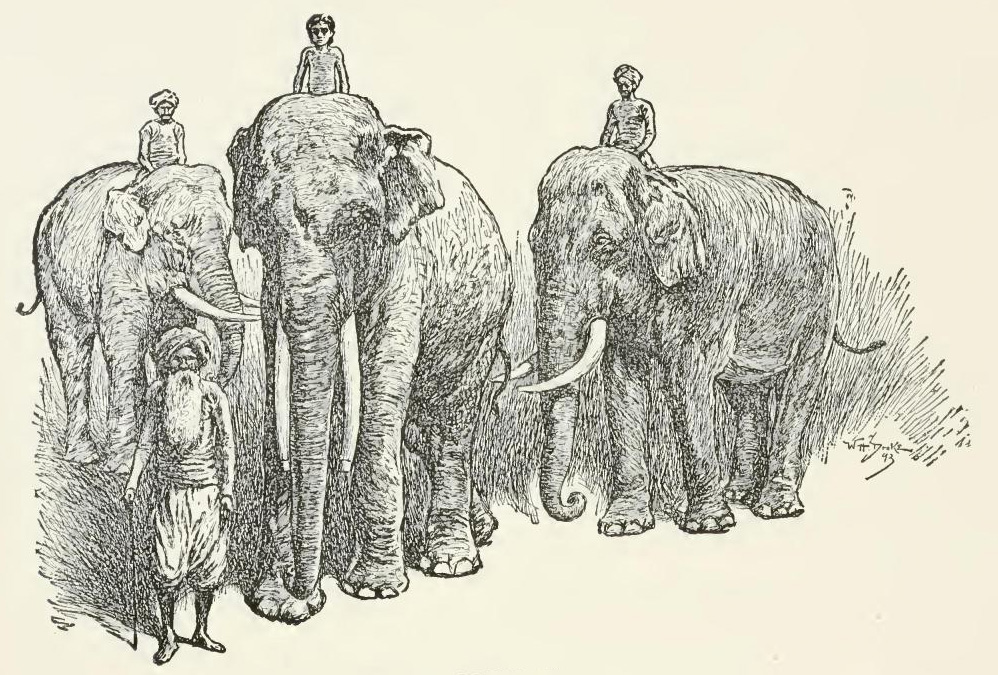
After that he was taken off timber-hauling, and employed, with a few score other elephants who were trained to the business, in helping to catch wild elephants among the Garo hills. Elephants are very strictly preserved by the Indian Government. There is one whole department which does nothing else but hunt them, and catch them, and break them in, and send them up and down the country as they are needed for work.
After that, he was taken off timber hauling and put to work catching wild elephants in the Garo hills. He worked with a few dozen other elephants trained for the job. The Indian Government strictly protects elephants. One whole department does nothing but hunt, catch, and train elephants, then send them around the country wherever they are needed for work.
Kala Nag stood ten fair feet at the shoulders, and his tusks had been cut off short at five feet, and bound round the ends, to prevent them splitting, with bands of copper; but he could do more with those stumps than any untrained elephant could do with the real sharpened ones. When, after weeks and weeks of cautious driving of scattered elephants across the hills, the forty or fifty wild monsters were driven into the last stockade, and the big drop gate, made of tree trunks lashed together, jarred down behind them, Kala Nag, at the word of command, would go into that flaring, trumpeting pandemonium (generally at night, when the flicker of the torches made it difficult to judge distances), and, picking out the biggest and wildest tusker of the mob, would hammer him and hustle him into quiet while the men on the backs of the other elephants roped and tied the smaller ones.
Kala Nag stood a full ten feet tall at the shoulders. His tusks had been cut short at five feet, and copper bands were fitted around the ends to prevent splitting. But he could do more with those stumps than any untrained elephant could do with full, sharp tusks. For weeks on end, men cautiously drove scattered elephants across the hills. At last, forty or fifty wild monsters were driven into the final stockade. Then a large gate, made of tree trunks lashed together, dropped shut behind them with a jarring crash. At a word of command, Kala Nag would enter the torchlit, trumpeting chaos. This usually happened at night, when the flickering torches made it hard to judge distances. He would pick out the biggest, wildest tusker in the herd, then beat and push him until he grew quiet. Meanwhile, men on the backs of the other elephants roped and tied the smaller ones.
There was nothing in the way of fighting that Kala Nag, the old wise Black Snake, did not know, for he had stood up more than once in his time to the charge of the wounded tiger, and, curling up his soft trunk to be out of harm’s way, had knocked the springing brute sideways in mid-air with a quick sickle cut of his head, that he had invented all by himself; had knocked him over, and kneeled upon him with his huge knees till the life went out with a gasp and a howl, and there was only a fluffy striped thing on the ground for Kala Nag to pull by the tail.
Kala Nag, the wise old Black Snake, knew everything there was to know about fighting. More than once, he had stood his ground against a charging wounded tiger. He would curl his soft trunk out of harm’s way and strike with a quick, sickle-shaped swing of his head. He had invented the move himself. The blow knocked the leaping beast sideways in midair and sent him tumbling to the ground. Then Kala Nag would kneel on him with his huge knees until the tiger died with a gasp and a howl. All that remained was a fluffy, striped thing on the ground for Kala Nag to pull by the tail.
“Yes,” said Big Toomai, his driver, the son of Black Toomai who had taken him to Abyssinia, and grandson of Toomai of the Elephants who had seen him caught, “there is nothing that the Black Snake fears except me. He has seen three generations of us feed him and groom him, and he will live to see four.”
“Yes,” said his driver, Big Toomai. He was the son of Black Toomai, who had taken the elephant to Abyssinia. He was also the grandson of Toomai of the Elephants, who had seen the elephant caught. “The Black Snake fears nothing except me. He has seen three generations of us feed and groom him, and he will live to see four.”
“He is afraid of me also,” said Little Toomai, standing up to his full height of four feet, with only one rag upon him. He was ten years old, the eldest son of Big Toomai, and, according to custom, he would take his father’s place on Kala Nag’s neck when he grew up, and would handle the heavy iron ankus, the elephant goad, that had been worn smooth by his father, and his grandfather, and his great-grandfather.
“He is afraid of me too,” said Little Toomai. He stood up to his full height of four feet, wearing only a rag. He was ten years old and the eldest son of Big Toomai. As custom required, he would take his father’s place on Kala Nag’s neck when he grew up. He would handle the heavy iron ankus, an elephant goad worn smooth by his father, grandfather, and great-grandfather.
He knew what he was talking of; for he had been born under Kala Nag’s shadow, had played with the end of his trunk before he could walk, had taken him down to water as soon as he could walk, and Kala Nag would no more have dreamed of disobeying his shrill little orders than he would have dreamed of killing him on that day when Big Toomai carried the little brown baby under Kala Nag’s tusks, and told him to salute his master that was to be.
He knew what he was talking about because he had been born under Kala Nag’s shadow. Before he could walk, he had played with the end of Kala Nag’s trunk. As soon as he could walk, he had taken Kala Nag down to the water. Kala Nag would no more have dreamed of disobeying the boy’s shrill little orders than of killing him that day. That was the day Big Toomai carried the little brown baby under Kala Nag’s tusks and told Kala Nag to salute the child who would be his master.
“Yes,” said Little Toomai, “he is afraid of me,” and he took long strides up to Kala Nag, called him a fat old pig, and made him lift up his feet one after the other.
“Yes,” said Little Toomai, “he is afraid of me.” He strode up to Kala Nag and called him a fat old pig. Then he made him lift his feet one after the other.
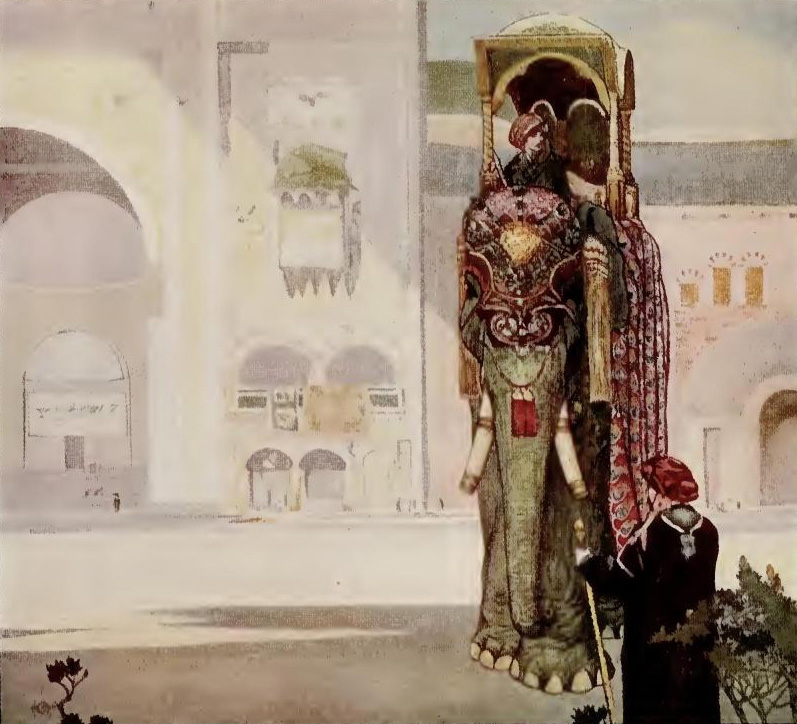
“Wah!” said Little Toomai, “thou art a big elephant,” and he wagged his fluffy head, quoting his father. “The Government may pay for elephants, but they belong to us mahouts. When thou art old, Kala Nag, there will come some rich rajah, and he will buy thee from the Government, on account of thy size and thy manners, and then thou wilt have nothing to do but to carry gold earrings in thy ears, and a gold howdah on thy back, and a red cloth covered with gold on thy sides, and walk at the head of the processions of the King. Then I shall sit on thy neck, O Kala Nag, with a silver ankus, and men will run before us with golden sticks, crying, `Room for the King’s elephant!’ That will be good, Kala Nag, but not so good as this hunting in the jungles.”
“Wah!” said Little Toomai, “you are a big elephant.” He wagged his fluffy head and repeated his father’s words. “The Government may pay for elephants, but they belong to us mahouts. When you are old, Kala Nag, some rich rajah will come and buy you from the Government. He will buy you because of your size and your manners. Then you will have nothing to do but wear gold earrings and a gold howdah on your back. You will wear a red cloth covered with gold on your sides. You will walk at the head of the King’s processions. Then I shall sit on your neck, O Kala Nag, with a silver ankus. Men will run before us with golden sticks, crying, ‘Room for the King’s elephant!’ That will be good, Kala Nag, but not as good as hunting in the jungles.”
“Umph!” said Big Toomai. “Thou art a boy, and as wild as a buffalo-calf. This running up and down among the hills is not the best Government service. I am getting old, and I do not love wild elephants. Give me brick elephant lines, one stall to each elephant, and big stumps to tie them to safely, and flat, broad roads to exercise upon, instead of this come-and-go camping. Aha, the Cawnpore barracks were good. There was a bazaar close by, and only three hours’ work a day.”
“Umph!” said Big Toomai. “You are a boy, and as wild as a buffalo calf. Running up and down the hills is not the best way to serve the Government. I am getting old, and I do not like wild elephants. Give me brick elephant quarters, with one stall for each elephant and big stumps to tie them to safely. Give me flat, broad roads to exercise them on, instead of moving from camp to camp. Ah, the Cawnpore barracks were good. There was a bazaar close by, and only three hours of work a day.”
Little Toomai remembered the Cawnpore elephant-lines and said nothing. He very much preferred the camp life, and hated those broad, flat roads, with the daily grubbing for grass in the forage reserve, and the long hours when there was nothing to do except to watch Kala Nag fidgeting in his pickets.
Little Toomai remembered the elephant lines at Cawnpore and said nothing. He much preferred life in camp. He hated those broad, flat roads and the daily search for grass in the forage reserve. He also hated the long hours when there was nothing to do but watch Kala Nag fidget while tethered.
What Little Toomai liked was to scramble up bridle paths that only an elephant could take; the dip into the valley below; the glimpses of the wild elephants browsing miles away; the rush of the frightened pig and peacock under Kala Nag’s feet; the blinding warm rains, when all the hills and valleys smoked; the beautiful misty mornings when nobody knew where they would camp that night; the steady, cautious drive of the wild elephants, and the mad rush and blaze and hullabaloo of the last night’s drive, when the elephants poured into the stockade like boulders in a landslide, found that they could not get out, and flung themselves at the heavy posts only to be driven back by yells and flaring torches and volleys of blank cartridge.
Little Toomai liked scrambling up trails that only an elephant could travel, then dipping into the valley below. He liked glimpsing wild elephants feeding miles away, and seeing frightened pigs and peacocks rush from under Kala Nag’s feet. He liked the blinding warm rains, when all the hills and valleys seemed to smoke. He liked the beautiful misty mornings when nobody knew where they would camp that night. He liked the steady, cautious drive of the wild elephants. And he liked the mad rush, the blaze and the uproar of the final night’s drive. The elephants poured into the stockade like boulders in a landslide. When they found they could not get out, they hurled themselves at the heavy posts. Yells, blazing torches and volleys of blank cartridges drove them back.
Even a little boy could be of use there, and Toomai was as useful as three boys. He would get his torch and wave it, and yell with the best. But the really good time came when the driving out began, and the Keddah—that is, the stockade—looked like a picture of the end of the world, and men had to make signs to one another, because they could not hear themselves speak. Then Little Toomai would climb up to the top of one of the quivering stockade posts, his sun-bleached brown hair flying loose all over his shoulders, and he looking like a goblin in the torch-light. And as soon as there was a lull you could hear his high-pitched yells of encouragement to Kala Nag, above the trumpeting and crashing, and snapping of ropes, and groans of the tethered elephants. “Mael, mael, Kala Nag! (Go on, go on, Black Snake!) Dant do! (Give him the tusk!) Somalo! Somalo! (Careful, careful!) Maro! Mar! (Hit him, hit him!) Mind the post! Arre! Arre! Hai! Yai! Kya-a-ah!” he would shout, and the big fight between Kala Nag and the wild elephant would sway to and fro across the Keddah, and the old elephant catchers would wipe the sweat out of their eyes, and find time to nod to Little Toomai wriggling with joy on the top of the posts.
Even a little boy could be useful there, and Toomai was as useful as three boys. He would get his torch, wave it, and yell as loudly as anyone. But the real fun began when the driving out started. The Keddah, or stockade, looked like a picture of the end of the world. The men had to use signs because they could not hear themselves speak. Little Toomai would climb to the top of one of the trembling stockade posts. His sun-bleached brown hair flew loose over his shoulders, and he looked like a goblin in the torchlight. Whenever the noise died down, you could hear his high-pitched yells encouraging Kala Nag. They rose above the trumpeting, crashing, snapping ropes, and groans of the tethered elephants. “Mael, mael, Kala Nag! (Go on, go on, Black Snake!) Dant do! (Give him the tusk!) Somalo! Somalo! (Careful, careful!) Maro! Mar! (Hit him, hit him!) Mind the post! Arre! Arre! Hai! Yai! Kya-a-ah!” he would shout. The great fight between Kala Nag and the wild elephant swayed back and forth across the Keddah. The old elephant catchers would wipe the sweat from their eyes. They even found time to nod to Little Toomai, who wriggled with joy atop the posts.
He did more than wriggle. One night he slid down from the post and slipped in between the elephants and threw up the loose end of a rope, which had dropped, to a driver who was trying to get a purchase on the leg of a kicking young calf (calves always give more trouble than full-grown animals). Kala Nag saw him, caught him in his trunk, and handed him up to Big Toomai, who slapped him then and there, and put him back on the post.
He did more than wriggle. One night he slid down from the post and slipped in among the elephants. He threw the loose end of a fallen rope up to a driver. The driver was trying to get a grip on the leg of a kicking young calf. (Calves always give more trouble than full-grown animals.) Kala Nag saw him, picked him up with his trunk, and handed him to Big Toomai. Big Toomai slapped him then and there and put him back on the post.
Next morning he gave him a scolding and said, “Are not good brick elephant lines and a little tent carrying enough, that thou must needs go elephant catching on thy own account, little worthless? Now those foolish hunters, whose pay is less than my pay, have spoken to Petersen Sahib of the matter.” Little Toomai was frightened. He did not know much of white men, but Petersen Sahib was the greatest white man in the world to him. He was the head of all the Keddah operations—the man who caught all the elephants for the Government of India, and who knew more about the ways of elephants than any living man.
The next morning, he scolded him. “Aren’t good brick elephant quarters and a little tent carrying enough for you? Must you go catching elephants on your own, you little good-for-nothing? Now those foolish hunters, who are paid less than I am, have told Petersen Sahib about it.” Little Toomai was frightened. He did not know much about white men, but to him, Petersen Sahib was the greatest white man in the world. Petersen Sahib was in charge of all the Keddah operations. He caught all the elephants for the Government of India and knew more about their ways than any living man.
“What—what will happen?” said Little Toomai.
“What, what will happen?” said Little Toomai.
“Happen! The worst that can happen. Petersen Sahib is a madman. Else why should he go hunting these wild devils? He may even require thee to be an elephant catcher, to sleep anywhere in these fever-filled jungles, and at last to be trampled to death in the Keddah. It is well that this nonsense ends safely. Next week the catching is over, and we of the plains are sent back to our stations. Then we will march on smooth roads, and forget all this hunting. But, son, I am angry that thou shouldst meddle in the business that belongs to these dirty Assamese jungle folk. Kala Nag will obey none but me, so I must go with him into the Keddah, but he is only a fighting elephant, and he does not help to rope them. So I sit at my ease, as befits a mahout,—not a mere hunter,—a mahout, I say, and a man who gets a pension at the end of his service. Is the family of Toomai of the Elephants to be trodden underfoot in the dirt of a Keddah? Bad one! Wicked one! Worthless son! Go and wash Kala Nag and attend to his ears, and see that there are no thorns in his feet. Or else Petersen Sahib will surely catch thee and make thee a wild hunter—a follower of elephant’s foot tracks, a jungle bear. Bah! Shame! Go!”
“ Happen? The worst thing possible! Petersen Sahib is a madman. Why else would he hunt these wild devils? He may even make you become an elephant catcher. You would have to sleep anywhere in these fever-ridden jungles and finally be trampled to death in the Keddah. It is good that this nonsense is ending safely. Next week the catching will be over, and we from the plains will be sent back to our stations. Then we will march on smooth roads and forget all this hunting. But, son, I am angry that you meddle in work that belongs to these dirty Assamese jungle folk. Kala Nag obeys no one but me, so I must go with him into the Keddah. But he is only a fighting elephant, and he does not help rope the wild ones. So I sit comfortably, as a mahout should. I am not a mere hunter. I am a mahout, I tell you, and a man who gets a pension when his service ends. Is the family of Toomai of the Elephants to be trampled in the dirt of a Keddah? Bad boy! Wicked boy! Worthless son! Go and wash Kala Nag and tend to his ears. Make sure there are no thorns in his feet. Otherwise Petersen Sahib will surely catch you and make you a wild hunter, a follower of elephant tracks, a jungle bear. Bah! Shame! Go!”
Little Toomai went off without saying a word, but he told Kala Nag all his grievances while he was examining his feet. “No matter,” said Little Toomai, turning up the fringe of Kala Nag’s huge right ear. “They have said my name to Petersen Sahib, and perhaps—and perhaps—and perhaps—who knows? Hai! That is a big thorn that I have pulled out!”
Little Toomai went away without saying a word. But as he examined Kala Nag’s feet, he told him all his complaints. “Never mind,” said Little Toomai, turning up the edge of Kala Nag’s huge right ear. “They have mentioned my name to Petersen Sahib. And perhaps, and perhaps, and perhaps, who knows? Hai! That is a big thorn I’ve pulled out!”
The next few days were spent in getting the elephants together, in walking the newly caught wild elephants up and down between a couple of tame ones to prevent them giving too much trouble on the downward march to the plains, and in taking stock of the blankets and ropes and things that had been worn out or lost in the forest.
Over the next few days, they gathered the elephants together. They walked the newly caught wild elephants back and forth between pairs of tame ones. This was to keep the wild elephants from causing too much trouble on the march down to the plains. They also checked which blankets, ropes, and other things had been worn out or lost in the forest.
Petersen Sahib came in on his clever she-elephant Pudmini; he had been paying off other camps among the hills, for the season was coming to an end, and there was a native clerk sitting at a table under a tree, to pay the drivers their wages. As each man was paid he went back to his elephant, and joined the line that stood ready to start. The catchers, and hunters, and beaters, the men of the regular Keddah, who stayed in the jungle year in and year out, sat on the backs of the elephants that belonged to Petersen Sahib’s permanent force, or leaned against the trees with their guns across their arms, and made fun of the drivers who were going away, and laughed when the newly caught elephants broke the line and ran about.
Petersen Sahib arrived on his clever female elephant, Pudmini. He had been paying workers at other camps in the hills because the season was coming to an end. A local clerk sat at a table under a tree, paying the drivers their wages. As each man was paid, he returned to his elephant and joined the line waiting to leave. The catchers, hunters, and beaters belonged to the regular Keddah and stayed in the jungle year after year. Some sat on elephants belonging to Petersen Sahib’s permanent force. Others leaned against trees with their guns across their arms. They made fun of the drivers who were leaving. They also laughed when the newly caught elephants broke out of the line and ran about.
Big Toomai went up to the clerk with Little Toomai behind him, and Machua Appa, the head tracker, said in an undertone to a friend of his, “There goes one piece of good elephant stuff at least. ’Tis a pity to send that young jungle-cock to molt in the plains.”
Big Toomai went up to the clerk, with Little Toomai behind him. Machua Appa, the head tracker, said quietly to a friend, “There goes someone who knows elephants, at least. It’s a pity to send that young jungle-cock to molt in the plains.”
Now Petersen Sahib had ears all over him, as a man must have who listens to the most silent of all living things—the wild elephant. He turned where he was lying all along on Pudmini’s back and said, “What is that? I did not know of a man among the plains-drivers who had wit enough to rope even a dead elephant.”
Now Petersen Sahib had ears everywhere, as a man must who listens to the wild elephant, the most silent of all living things. He turned as he lay stretched out on Pudmini’s back and said, “What is that? I didn’t know any of the plains-drivers were clever enough to rope even a dead elephant.”
“This is not a man, but a boy. He went into the Keddah at the last drive, and threw Barmao there the rope, when we were trying to get that young calf with the blotch on his shoulder away from his mother.”
“This is not a man, but a boy. He went into the Keddah during the last drive and threw Barmao the rope. We were trying to separate a young calf with a blotch on his shoulder from his mother.”
Machua Appa pointed at Little Toomai, and Petersen Sahib looked, and Little Toomai bowed to the earth.
Machua Appa pointed at Little Toomai, and Petersen Sahib looked. Little Toomai bowed to the ground.
“He throw a rope? He is smaller than a picket-pin. Little one, what is thy name?” said Petersen Sahib.
“Can he throw a rope? He’s smaller than a tent peg. Little one, what’s your name?” said Petersen Sahib.
Little Toomai was too frightened to speak, but Kala Nag was behind him, and Toomai made a sign with his hand, and the elephant caught him up in his trunk and held him level with Pudmini’s forehead, in front of the great Petersen Sahib. Then Little Toomai covered his face with his hands, for he was only a child, and except where elephants were concerned, he was just as bashful as a child could be.
Little Toomai was too frightened to speak. But Kala Nag was behind him, and Toomai gave him a hand signal. The elephant lifted him with his trunk and held him level with Pudmini’s forehead, in front of the great Petersen Sahib. Then Little Toomai covered his face with his hands. He was only a child, and except when it came to elephants, he was as shy as any child could be.
“Oho!” said Petersen Sahib, smiling underneath his mustache, “and why didst thou teach thy elephant that trick? Was it to help thee steal green corn from the roofs of the houses when the ears are put out to dry?”
“Oh!” said Petersen Sahib, smiling beneath his mustache. “Why did you teach your elephant that trick? Was it to help you steal green corn from the roofs of houses when the ears were put out to dry?”
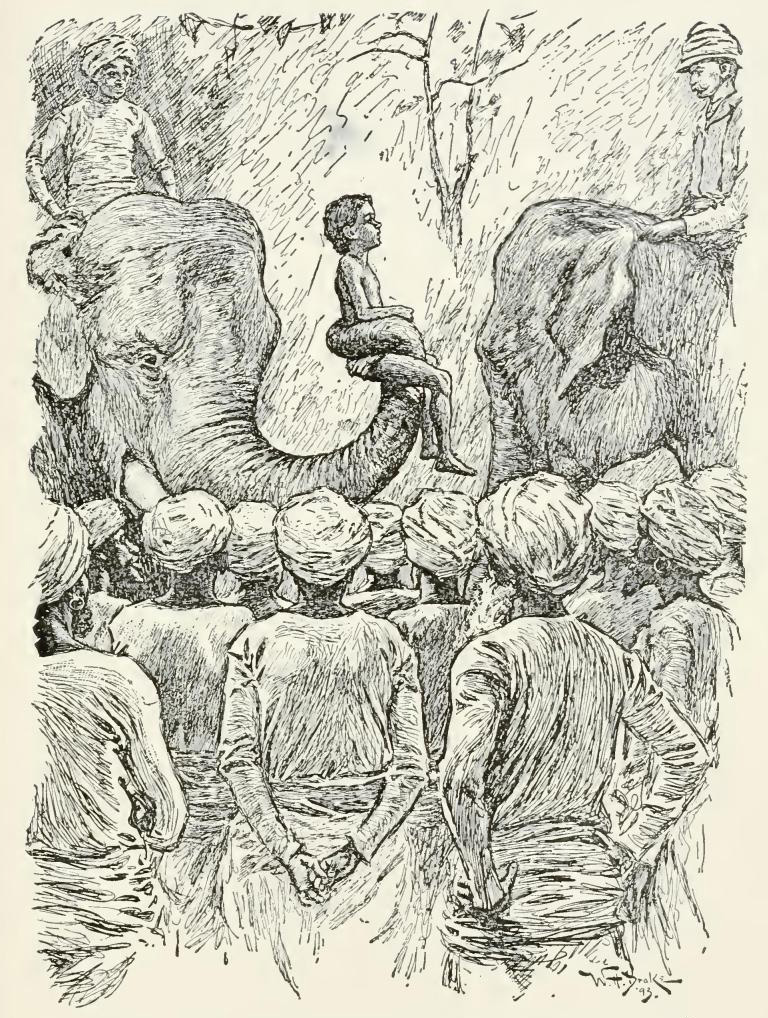
“Not green corn, Protector of the Poor,—melons,” said Little Toomai, and all the men sitting about broke into a roar of laughter. Most of them had taught their elephants that trick when they were boys. Little Toomai was hanging eight feet up in the air, and he wished very much that he were eight feet underground.
“Not green corn, Protector of the Poor, melons,” said Little Toomai. All the men sitting nearby burst out laughing. Most of them had taught their elephants that trick when they were boys. Little Toomai was hanging eight feet in the air, and he wished he were eight feet underground.
“He is Toomai, my son, Sahib,” said Big Toomai, scowling. “He is a very bad boy, and he will end in a jail, Sahib.”
“He is Toomai, my son, Sahib,” said Big Toomai, scowling. “He is a very bad boy, and he will end up in jail, Sahib.”
“Of that I have my doubts,” said Petersen Sahib. “A boy who can face a full Keddah at his age does not end in jails. See, little one, here are four annas to spend in sweetmeats because thou hast a little head under that great thatch of hair. In time thou mayest become a hunter too.” Big Toomai scowled more than ever. “Remember, though, that Keddahs are not good for children to play in,” Petersen Sahib went on.
“I doubt that,” said Petersen Sahib. “A boy who can face a full Keddah at his age does not end up in jail. Here, little one, are four annas to spend on sweets. You’ve got a little brain under all that hair. In time, you may become a hunter too.” Big Toomai scowled even more. “Remember, though, Keddahs are not good places for children to play,” Petersen Sahib went on.
“Must I never go there, Sahib?” asked Little Toomai with a big gasp.
“Can I never go there, Sahib?” asked Little Toomai, gasping.
“Yes.” Petersen Sahib smiled again. “When thou hast seen the elephants dance. That is the proper time. Come to me when thou hast seen the elephants dance, and then I will let thee go into all the Keddahs.”
“Yes.” Petersen Sahib smiled again. “When you have seen the elephants dance. That is the right time. Come to me when you have seen the elephants dance, and then I will let you go into all the Keddahs.”
There was another roar of laughter, for that is an old joke among elephant-catchers, and it means just never. There are great cleared flat places hidden away in the forests that are called elephants’ ball-rooms, but even these are only found by accident, and no man has ever seen the elephants dance. When a driver boasts of his skill and bravery the other drivers say, “And when didst thou see the elephants dance?”
There was another roar of laughter, because this was an old joke among elephant-catchers. It meant simply never. Great, clear, flat places called elephants’ ball-rooms are hidden in the forests. But even these are found only by accident, and no one has ever seen the elephants dance. When a driver boasts of his skill and courage, the other drivers say, “And when did you see the elephants dance?”
Kala Nag put Little Toomai down, and he bowed to the earth again and went away with his father, and gave the silver four-anna piece to his mother, who was nursing his baby brother, and they all were put up on Kala Nag’s back, and the line of grunting, squealing elephants rolled down the hill path to the plains. It was a very lively march on account of the new elephants, who gave trouble at every ford, and needed coaxing or beating every other minute.
Kala Nag put Little Toomai down. Little Toomai bowed to the ground again and went away with his father. He gave the silver four-anna coin to his mother, who was nursing his baby brother. They were all lifted onto Kala Nag’s back, and the line of grunting, squealing elephants made its way down the hill path to the plains. It was a very lively march because of the new elephants. They caused trouble at every river crossing and needed coaxing or beating every other minute.
Big Toomai prodded Kala Nag spitefully, for he was very angry, but Little Toomai was too happy to speak. Petersen Sahib had noticed him, and given him money, so he felt as a private soldier would feel if he had been called out of the ranks and praised by his commander-in-chief.
Big Toomai spitefully prodded Kala Nag because he was very angry, but Little Toomai was too happy to speak. Petersen Sahib had noticed Little Toomai and given him money. So Little Toomai felt like a private soldier called out of the ranks and praised by his commander-in-chief.
“What did Petersen Sahib mean by the elephant dance?” he said, at last, softly to his mother.
“What did Petersen Sahib mean by the elephant dance?” he finally asked his mother softly.
Big Toomai heard him and grunted. “That thou shouldst never be one of these hill buffaloes of trackers. That was what he meant. Oh, you in front, what is blocking the way?”
Big Toomai heard him and grunted. “He meant that you should never become one of those trackers, those hill buffaloes. Hey, you up front, what’s blocking the way?”
An Assamese driver, two or three elephants ahead, turned round angrily, crying: “Bring up Kala Nag, and knock this youngster of mine into good behavior. Why should Petersen Sahib have chosen me to go down with you donkeys of the rice fields? Lay your beast alongside, Toomai, and let him prod with his tusks. By all the Gods of the Hills, these new elephants are possessed, or else they can smell their companions in the jungle.” Kala Nag hit the new elephant in the ribs and knocked the wind out of him, as Big Toomai said, “We have swept the hills of wild elephants at the last catch. It is only your carelessness in driving. Must I keep order along the whole line?”
An Assamese driver, two or three elephants ahead, turned around angrily and shouted: “Bring up Kala Nag and knock my youngster into good behavior. Why did Petersen Sahib choose me to go down with you donkeys from the rice fields? Bring your beast alongside, Toomai, and let him poke mine with his tusks. By all the Gods of the Hills, these new elephants are possessed. Or else they can smell their companions in the jungle.” Kala Nag hit the new elephant in the ribs and knocked the wind out of him. Big Toomai said, “We cleared the hills of wild elephants in the last catch. The trouble is only your careless driving. Must I keep order along the whole line?”
“Hear him!” said the other driver. “We have swept the hills! Ho! Ho! You are very wise, you plains people. Anyone but a mud-head who never saw the jungle would know that they know that the drives are ended for the season. Therefore all the wild elephants to-night will—but why should I waste wisdom on a river-turtle?”
“Listen to him!” said the other driver. “‘We have swept the hills!’ Ha! Ha! You plains people are very wise. Anyone but a mud-head who has never seen the jungle would know that the wild elephants know the drives are over for the season. So tonight all the wild elephants will... But why should I waste wisdom on a river-turtle?”
“What will they do?” Little Toomai called out.
“What will they do?” Little Toomai called out.
“Ohe, little one. Art thou there? Well, I will tell thee, for thou hast a cool head. They will dance, and it behooves thy father, who has swept all the hills of all the elephants, to double-chain his pickets to-night.”
“Hello, little one. Are you there? Well, I will tell you, because you have a cool head. They will dance. Your father has cleared all the hills of all the elephants, so he should double-chain his pickets tonight.”
“What talk is this?” said Big Toomai. “For forty years, father and son, we have tended elephants, and we have never heard such moonshine about dances.”
“What are you talking about?” said Big Toomai. “For forty years, my father and I have tended elephants. We have never heard such nonsense about dances.”
“Yes; but a plainsman who lives in a hut knows only the four walls of his hut. Well, leave thy elephants unshackled tonight and see what comes. As for their dancing, I have seen the place where—Bapree-bap! How many windings has the Dihang River? Here is another ford, and we must swim the calves. Stop still, you behind there.”
“Yes, but a plainsman who lives in a hut knows only the four walls of his hut. Well, leave your elephants unshackled tonight and see what happens. As for their dancing, I have seen the place where they dance. Bapree-bap! How many bends does the Dihang River have? Here is another ford, and we must swim the calves across. Stop there, you in the back.”
And in this way, talking and wrangling and splashing through the rivers, they made their first march to a sort of receiving camp for the new elephants. But they lost their tempers long before they got there.
And so, talking, arguing, and splashing through rivers, they marched to a kind of reception camp for new elephants. But they lost their tempers long before they got there.
Then the elephants were chained by their hind legs to their big stumps of pickets, and extra ropes were fitted to the new elephants, and the fodder was piled before them, and the hill drivers went back to Petersen Sahib through the afternoon light, telling the plains drivers to be extra careful that night, and laughing when the plains drivers asked the reason.
Then the elephants were chained by their hind legs to large wooden stakes. The new elephants were secured with extra ropes, and fodder was piled in front of them. The hill drivers went back to Petersen Sahib through the afternoon light. They told the plains drivers to be extra careful that night and laughed when they asked why.
Little Toomai attended to Kala Nag’s supper, and as evening fell, wandered through the camp, unspeakably happy, in search of a tom-tom. When an Indian child’s heart is full, he does not run about and make a noise in an irregular fashion. He sits down to a sort of revel all by himself. And Little Toomai had been spoken to by Petersen Sahib! If he had not found what he wanted, I believe he would have been ill. But the sweetmeat seller in the camp lent him a little tom-tom—a drum beaten with the flat of the hand—and he sat down, cross-legged, before Kala Nag as the stars began to come out, the tom-tom in his lap, and he thumped and he thumped and he thumped, and the more he thought of the great honor that had been done to him, the more he thumped, all alone among the elephant fodder. There was no tune and no words, but the thumping made him happy.
Little Toomai took care of Kala Nag’s supper. As evening fell, he wandered through the camp, looking for a tom-tom. He was happier than words could say. When an Indian child’s heart is full, he does not run around making noise without any order. He sits down and celebrates all by himself. And Petersen Sahib had spoken to Little Toomai! If he had not found what he wanted, I believe he would have been ill. But the camp’s sweet seller lent him a small tom-tom, a drum played with the flat of the hand. As the stars began to appear, he sat cross-legged in front of Kala Nag, with the tom-tom in his lap. He thumped and thumped and thumped, all alone among the elephants’ food. The more he thought about the great honor he had received, the more he thumped. There was no tune and no words, but the thumping made him happy.
The new elephants strained at their ropes, and squealed and trumpeted from time to time, and he could hear his mother in the camp hut putting his small brother to sleep with an old, old song about the great God Shiv, who once told all the animals what they should eat. It is a very soothing lullaby, and the first verse says:
The new elephants strained against their ropes and occasionally squealed and trumpeted. He could hear his mother in the camp hut, singing his little brother to sleep. She sang a very old song about the great God Shiv, who once told all the animals what they should eat. The lullaby is very soothing, and the first verse says:
Shiv, who poured the harvest and made the winds to blow, Sitting at the doorways of a day of long ago, Gave to each his portion, food and toil and fate, From the King upon the guddee to the Beggar at the gate. All things made he—Shiva the Preserver. Mahadeo! Mahadeo! He made all— Thorn for the camel, fodder for the kine, And mother’s heart for sleepy head, O little son of mine!
Shiv, who brought the harvest and made the winds blow, Sat at the doorways one day long ago. He gave each one a share of food, work, and fate, From the King on the guddee to the Beggar at the gate. He made all things, Shiva the Preserver. Mahadeo! Mahadeo! He made all: Thorns for the camel, fodder for the cattle, And a mother’s heart for a sleepy head, my little son!
Little Toomai came in with a joyous tunk-a-tunk at the end of each verse, till he felt sleepy and stretched himself on the fodder at Kala Nag’s side. At last the elephants began to lie down one after another as is their custom, till only Kala Nag at the right of the line was left standing up; and he rocked slowly from side to side, his ears put forward to listen to the night wind as it blew very slowly across the hills. The air was full of all the night noises that, taken together, make one big silence—the click of one bamboo stem against the other, the rustle of something alive in the undergrowth, the scratch and squawk of a half-waked bird (birds are awake in the night much more often than we imagine), and the fall of water ever so far away. Little Toomai slept for some time, and when he waked it was brilliant moonlight, and Kala Nag was still standing up with his ears cocked. Little Toomai turned, rustling in the fodder, and watched the curve of his big back against half the stars in heaven, and while he watched he heard, so far away that it sounded no more than a pinhole of noise pricked through the stillness, the “hoot-toot” of a wild elephant.
Little Toomai joined in with a joyful tunk-a-tunk at the end of each verse. Then he grew sleepy and stretched out on the fodder beside Kala Nag. At last the elephants began to lie down one by one, as they usually did. Only Kala Nag, at the right end of the line, remained standing. He rocked slowly from side to side, his ears forward, listening to the night wind blowing gently across the hills. The air was full of night sounds that, together, made one great silence. Bamboo stems clicked against each other, and something alive rustled in the undergrowth. A half-awake bird scratched and squawked. (Birds are awake at night much more often than we imagine.) Water fell somewhere far away. Little Toomai slept for a while. When he woke, the moonlight was brilliant, and Kala Nag was still standing with his ears raised. Little Toomai turned, rustling the fodder, and watched the curve of Kala Nag’s great back against half the stars in the sky. As he watched, he heard the “hoot-toot” of a wild elephant. It was so far away that the sound seemed no more than a pinhole of noise pierced through the stillness.
All the elephants in the lines jumped up as if they had been shot, and their grunts at last waked the sleeping mahouts, and they came out and drove in the picket pegs with big mallets, and tightened this rope and knotted that till all was quiet. One new elephant had nearly grubbed up his picket, and Big Toomai took off Kala Nag’s leg chain and shackled that elephant fore-foot to hind-foot, but slipped a loop of grass string round Kala Nag’s leg, and told him to remember that he was tied fast. He knew that he and his father and his grandfather had done the very same thing hundreds of times before. Kala Nag did not answer to the order by gurgling, as he usually did. He stood still, looking out across the moonlight, his head a little raised and his ears spread like fans, up to the great folds of the Garo hills.
All the elephants in the lines jumped up as if they had been shot. Their grunts finally woke the sleeping mahouts, who came out and hammered the tethering pegs into the ground with big mallets. They tightened one rope and knotted another until all was quiet. One new elephant had nearly dug up his peg. Big Toomai took off Kala Nag’s leg chain and used it to shackle that elephant’s front foot to his hind foot. But he slipped a loop of grass string around Kala Nag’s leg and told him to remember that he was tied fast. Big Toomai knew that he, his father, and his grandfather had done the very same thing hundreds of times before. Kala Nag did not answer the order with a gurgle, as he usually did. He stood still, looking across the moonlit ground toward the great folds of the Garo hills. His head was raised a little, and his ears were spread like fans.
“Tend to him if he grows restless in the night,” said Big Toomai to Little Toomai, and he went into the hut and slept. Little Toomai was just going to sleep, too, when he heard the coir string snap with a little “tang,” and Kala Nag rolled out of his pickets as slowly and as silently as a cloud rolls out of the mouth of a valley. Little Toomai pattered after him, barefooted, down the road in the moonlight, calling under his breath, “Kala Nag! Kala Nag! Take me with you, O Kala Nag!” The elephant turned, without a sound, took three strides back to the boy in the moonlight, put down his trunk, swung him up to his neck, and almost before Little Toomai had settled his knees, slipped into the forest.
“Look after him if he gets restless during the night,” Big Toomai said to Little Toomai. Then he went into the hut and slept. Little Toomai was just going to sleep, too, when he heard the coconut fiber rope snap with a little “tang.” Kala Nag moved out of his tethering stakes, as slowly and silently as a cloud rolling out of a valley. Little Toomai pattered after him, barefoot, down the moonlit road. He called softly, “Kala Nag! Kala Nag! Take me with you, O Kala Nag!” The elephant turned without a sound and took three strides back to the boy in the moonlight. He lowered his trunk and swung the boy up onto his neck. Then, almost before Little Toomai had settled his knees, Kala Nag slipped into the forest.
There was one blast of furious trumpeting from the lines, and then the silence shut down on everything, and Kala Nag began to move. Sometimes a tuft of high grass washed along his sides as a wave washes along the sides of a ship, and sometimes a cluster of wild-pepper vines would scrape along his back, or a bamboo would creak where his shoulder touched it. But between those times he moved absolutely without any sound, drifting through the thick Garo forest as though it had been smoke. He was going uphill, but though Little Toomai watched the stars in the rifts of the trees, he could not tell in what direction.
A furious blast of trumpeting came from the lines. Then silence fell over everything, and Kala Nag began to move. Sometimes a tuft of tall grass brushed his sides, like a wave washing against a ship. Sometimes wild-pepper vines scraped his back, or a bamboo stalk creaked as his shoulder touched it. But between those moments, he moved without a sound. He drifted through the thick Garo forest as though it were smoke. He was going uphill, but Little Toomai could not tell which direction he was going. Even watching the stars through gaps in the trees did not help him tell.
Then Kala Nag reached the crest of the ascent and stopped for a minute, and Little Toomai could see the tops of the trees lying all speckled and furry under the moonlight for miles and miles, and the blue-white mist over the river in the hollow. Toomai leaned forward and looked, and he felt that the forest was awake below him—awake and alive and crowded. A big brown fruit-eating bat brushed past his ear; a porcupine’s quills rattled in the thicket; and in the darkness between the tree stems he heard a hog-bear digging hard in the moist warm earth, and snuffing as it digged.
Then Kala Nag reached the top of the slope and stopped for a minute. Little Toomai could see the treetops stretching for miles, speckled and furry in the moonlight. Blue-white mist lay over the river in the hollow. Toomai leaned forward and looked. He felt that the forest below him was awake, alive, and crowded. A large brown fruit bat brushed past his ear. A porcupine’s quills rattled in the bushes. In the darkness between the tree trunks, he heard a hog-bear digging hard in the warm, damp earth. The hog-bear snuffled as it dug.
Then the branches closed over his head again, and Kala Nag began to go down into the valley—not quietly this time, but as a runaway gun goes down a steep bank—in one rush. The huge limbs moved as steadily as pistons, eight feet to each stride, and the wrinkled skin of the elbow points rustled. The undergrowth on either side of him ripped with a noise like torn canvas, and the saplings that he heaved away right and left with his shoulders sprang back again and banged him on the flank, and great trails of creepers, all matted together, hung from his tusks as he threw his head from side to side and plowed out his pathway. Then Little Toomai laid himself down close to the great neck lest a swinging bough should sweep him to the ground, and he wished that he were back in the lines again.
Then the branches closed over his head again, and Kala Nag began to go down into the valley. This time he did not go quietly. He rushed down like a runaway cannon rolling down a steep bank. His huge legs moved as steadily as pistons, covering eight feet with each stride. The wrinkled skin around his elbows rustled. The undergrowth on either side ripped apart with a sound like tearing canvas. He shoved saplings aside with his shoulders, and they sprang back and struck his flanks. As he tossed his head from side to side and forced a path through, long, tangled vines hung from his tusks. Then Little Toomai lay flat against the great neck so that a swinging branch would not sweep him to the ground. He wished he were back in the camp lines.
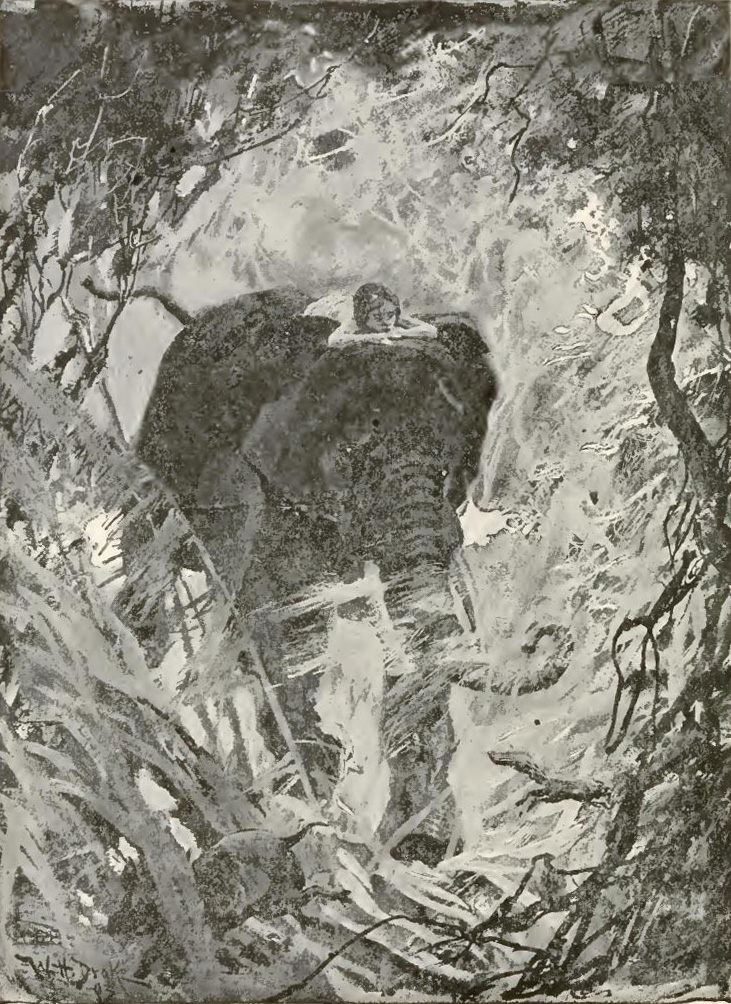
The grass began to get squashy, and Kala Nag’s feet sucked and squelched as he put them down, and the night mist at the bottom of the valley chilled Little Toomai. There was a splash and a trample, and the rush of running water, and Kala Nag strode through the bed of a river, feeling his way at each step. Above the noise of the water, as it swirled round the elephant’s legs, Little Toomai could hear more splashing and some trumpeting both upstream and down—great grunts and angry snortings, and all the mist about him seemed to be full of rolling, wavy shadows.
The grass grew soggy, and Kala Nag’s feet sucked and squelched with each step. The night mist at the bottom of the valley chilled Little Toomai. There was splashing and trampling, and the rush of running water. Kala Nag strode through the riverbed, feeling his way with each step. Water swirled around the elephant’s legs. Above its noise, Little Toomai could hear more splashing and some trumpeting both upstream and downstream. He heard great grunts and angry snorts, and all the mist around him seemed full of rolling, wavering shadows.
“Ai!” he said, half aloud, his teeth chattering. “The elephant-folk are out tonight. It is the dance, then!”
“Ai!” he said quietly, his teeth chattering. “The elephant-folk are out tonight. So it is the dance!”
Kala Nag swashed out of the water, blew his trunk clear, and began another climb. But this time he was not alone, and he had not to make his path. That was made already, six feet wide, in front of him, where the bent jungle-grass was trying to recover itself and stand up. Many elephants must have gone that way only a few minutes before. Little Toomai looked back, and behind him a great wild tusker with his little pig’s eyes glowing like hot coals was just lifting himself out of the misty river. Then the trees closed up again, and they went on and up, with trumpetings and crashings, and the sound of breaking branches on every side of them.
Kala Nag splashed out of the water, blew the water from his trunk, and began climbing again. But this time he was not alone, and he did not have to make his own path. A path six feet wide already lay ahead of him. The bent jungle grass along it was trying to spring back up. Many elephants must have gone that way only a few minutes earlier. Little Toomai looked back. Behind him, a huge wild tusker was just lifting himself out of the misty river. His small, piglike eyes glowed like hot coals. Then the trees closed in again, and they continued up the slope. Trumpeting, crashing, and the sound of breaking branches came from every side.
At last Kala Nag stood still between two tree-trunks at the very top of the hill. They were part of a circle of trees that grew round an irregular space of some three or four acres, and in all that space, as Little Toomai could see, the ground had been trampled down as hard as a brick floor. Some trees grew in the center of the clearing, but their bark was rubbed away, and the white wood beneath showed all shiny and polished in the patches of moonlight. There were creepers hanging from the upper branches, and the bells of the flowers of the creepers, great waxy white things like convolvuluses, hung down fast asleep. But within the limits of the clearing there was not a single blade of green—nothing but the trampled earth.
At last Kala Nag stood still between two tree trunks at the very top of the hill. The trees formed a circle around an uneven clearing of about three or four acres. Little Toomai could see that the ground throughout the clearing had been trampled as hard as a brick floor. Some trees grew in the center, but their bark had been rubbed away. The white wood underneath looked shiny and polished in the patches of moonlight. Vines hung from the upper branches. Their flowers hung down, fast asleep, like great waxy white bells, like morning glories. But within the clearing there was not a single blade of green, only the trampled earth.
The moonlight showed it all iron gray, except where some elephants stood upon it, and their shadows were inky black. Little Toomai looked, holding his breath, with his eyes starting out of his head, and as he looked, more and more and more elephants swung out into the open from between the tree trunks. Little Toomai could only count up to ten, and he counted again and again on his fingers till he lost count of the tens, and his head began to swim. Outside the clearing he could hear them crashing in the undergrowth as they worked their way up the hillside, but as soon as they were within the circle of the tree trunks they moved like ghosts.
In the moonlight, it all looked iron gray, except where some elephants stood. Their shadows were inky black. Little Toomai watched, holding his breath, his eyes wide. As he watched, more and more elephants came swinging out from between the tree trunks into the open. Little Toomai could only count to ten. He counted on his fingers again and again until he lost track of the tens and his head began to spin. Outside the clearing, he could hear the elephants crashing through the undergrowth as they climbed the hillside. But as soon as they entered the circle of tree trunks, they moved like ghosts.
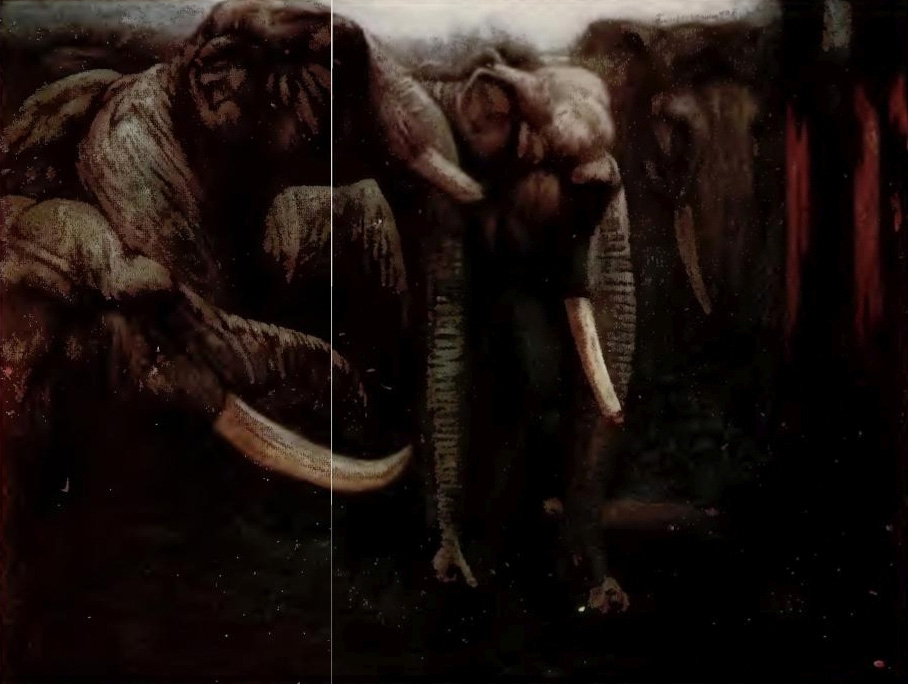
There were white-tusked wild males, with fallen leaves and nuts and twigs lying in the wrinkles of their necks and the folds of their ears; fat, slow-footed she-elephants, with restless, little pinky black calves only three or four feet high running under their stomachs; young elephants with their tusks just beginning to show, and very proud of them; lanky, scraggy old-maid elephants, with their hollow anxious faces, and trunks like rough bark; savage old bull elephants, scarred from shoulder to flank with great weals and cuts of bygone fights, and the caked dirt of their solitary mud baths dropping from their shoulders; and there was one with a broken tusk and the marks of the full-stroke, the terrible drawing scrape, of a tiger’s claws on his side.
There were wild males with white tusks. Fallen leaves, nuts, and twigs lay in their neck wrinkles and ear folds. There were fat, slow-moving females, with restless little pinkish-black calves running beneath their bellies. The calves were only three or four feet tall. There were young elephants whose tusks were just beginning to show, and they were very proud of them. There were lanky, scrawny old maid elephants, with hollow, anxious faces and trunks like rough bark. There were fierce old bulls, scarred from shoulder to flank with great welts and cuts from past fights. Caked dirt from their solitary mud baths fell from their shoulders. One elephant had a broken tusk. On his side were the marks of a tiger’s claws, a terrible long scrape made in a full stroke.
They were standing head to head, or walking to and fro across the ground in couples, or rocking and swaying all by themselves—scores and scores of elephants.
The elephants stood head to head, walked back and forth in pairs, or rocked and swayed alone. There were dozens and dozens of them.
Toomai knew that so long as he lay still on Kala Nag’s neck nothing would happen to him, for even in the rush and scramble of a Keddah drive a wild elephant does not reach up with his trunk and drag a man off the neck of a tame elephant. And these elephants were not thinking of men that night. Once they started and put their ears forward when they heard the chinking of a leg iron in the forest, but it was Pudmini, Petersen Sahib’s pet elephant, her chain snapped short off, grunting, snuffling up the hillside. She must have broken her pickets and come straight from Petersen Sahib’s camp; and Little Toomai saw another elephant, one that he did not know, with deep rope galls on his back and breast. He, too, must have run away from some camp in the hills about.
Toomai knew that as long as he lay still on Kala Nag’s neck, nothing would happen to him. Even in the rush and scramble of a Keddah drive, a wild elephant does not reach up with its trunk and pull a man off a tame elephant’s neck. And the elephants were not thinking about men that night. Once, they startled and pointed their ears forward at the sound of a leg iron clinking in the forest. But it was Pudmini, Petersen Sahib’s pet elephant. Her chain had snapped, and she was grunting and snuffling her way up the hillside. She must have broken free from her stakes and come straight from Petersen Sahib’s camp. Little Toomai saw another elephant, one he did not know, with deep rope sores on his back and chest. He, too, must have run away from a camp somewhere in the nearby hills.
At last there was no sound of any more elephants moving in the forest, and Kala Nag rolled out from his station between the trees and went into the middle of the crowd, clucking and gurgling, and all the elephants began to talk in their own tongue, and to move about.
At last, there was no sound of any more elephants moving through the forest. Kala Nag lumbered out from his place between the trees and into the middle of the crowd, clucking and gurgling. All the elephants began to speak in their own language and move about.
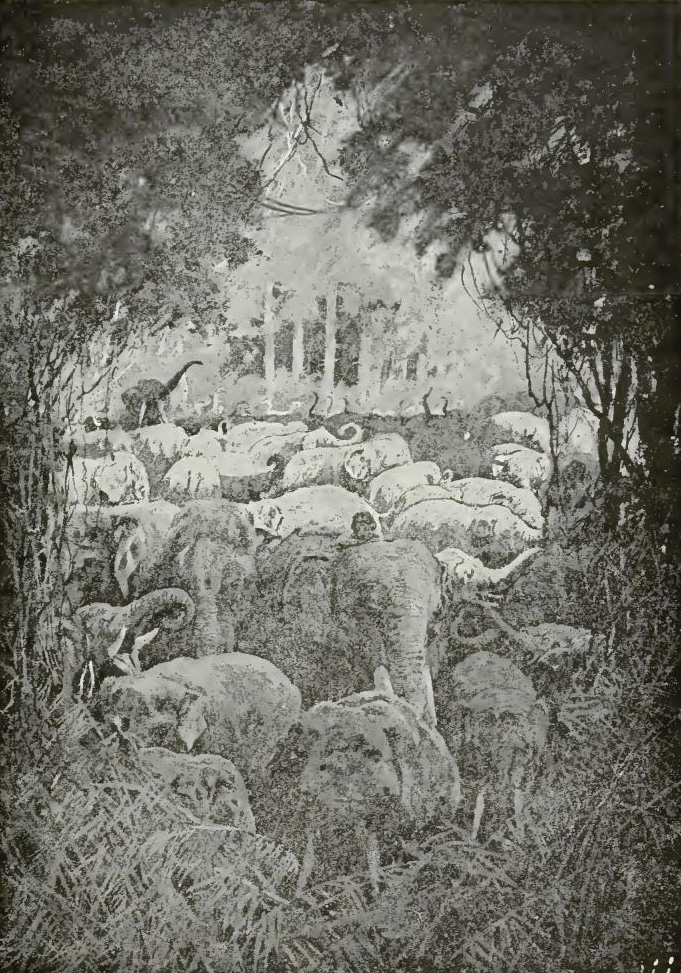
Still lying down, Little Toomai looked down upon scores and scores of broad backs, and wagging ears, and tossing trunks, and little rolling eyes. He heard the click of tusks as they crossed other tusks by accident, and the dry rustle of trunks twined together, and the chafing of enormous sides and shoulders in the crowd, and the incessant flick and hissh of the great tails. Then a cloud came over the moon, and he sat in black darkness. But the quiet, steady hustling and pushing and gurgling went on just the same. He knew that there were elephants all round Kala Nag, and that there was no chance of backing him out of the assembly; so he set his teeth and shivered. In a Keddah at least there was torchlight and shouting, but here he was all alone in the dark, and once a trunk came up and touched him on the knee.
Still lying down, Little Toomai looked down at the broad backs, flapping ears, tossing trunks, and small rolling eyes of countless elephants. He heard tusks click as they accidentally crossed. He heard the dry rustle of trunks twined together and the rubbing of enormous sides and shoulders in the crowd. The great tails flicked and hissed without stopping. Then a cloud passed over the moon, and he sat in complete darkness. But the quiet, steady pushing, shoving, and gurgling went on just the same. He knew elephants surrounded Kala Nag, and there was no chance of backing him out of the gathering. So he clenched his teeth and shivered. In a Keddah, at least there was torchlight and shouting. But here he was all alone in the dark, and once a trunk reached up and touched his knee.
Then an elephant trumpeted, and they all took it up for five or ten terrible seconds. The dew from the trees above spattered down like rain on the unseen backs, and a dull booming noise began, not very loud at first, and Little Toomai could not tell what it was. But it grew and grew, and Kala Nag lifted up one forefoot and then the other, and brought them down on the ground—one-two, one-two, as steadily as trip-hammers. The elephants were stamping all together now, and it sounded like a war drum beaten at the mouth of a cave. The dew fell from the trees till there was no more left to fall, and the booming went on, and the ground rocked and shivered, and Little Toomai put his hands up to his ears to shut out the sound. But it was all one gigantic jar that ran through him—this stamp of hundreds of heavy feet on the raw earth. Once or twice he could feel Kala Nag and all the others surge forward a few strides, and the thumping would change to the crushing sound of juicy green things being bruised, but in a minute or two the boom of feet on hard earth began again. A tree was creaking and groaning somewhere near him. He put out his arm and felt the bark, but Kala Nag moved forward, still tramping, and he could not tell where he was in the clearing. There was no sound from the elephants, except once, when two or three little calves squeaked together. Then he heard a thump and a shuffle, and the booming went on. It must have lasted fully two hours, and Little Toomai ached in every nerve, but he knew by the smell of the night air that the dawn was coming.
Then an elephant trumpeted, and they all joined in for five or ten terrible seconds. Dew from the trees above splattered like rain onto their unseen backs. A dull booming began, not very loud at first, and Little Toomai could not tell what it was. But it grew louder and louder. Kala Nag lifted one front foot, then the other, and brought them down on the ground. One, two, one, two, as steadily as heavy hammers. All the elephants were stamping now. It sounded like a war drum being beaten at the mouth of a cave. Dew fell from the trees until there was none left. The booming went on, and the ground rocked and shook. Little Toomai raised his hands to his ears to block out the sound. But the stamping of hundreds of heavy feet on bare earth was one enormous vibration that ran through him. Once or twice, he felt Kala Nag and all the others surge forward a few steps. The thumping changed to the crushing sound of juicy green plants being trampled. But after a minute or two, the feet began booming on hard earth again. A tree was creaking and groaning somewhere nearby. Little Toomai reached out and felt its bark. But Kala Nag moved forward, still stamping, and Little Toomai could not tell where he was in the clearing. The elephants made no sound, except once, when two or three little calves squeaked together. Then he heard a thump and a shuffle, and the booming went on. It must have lasted a full two hours, and Little Toomai ached in every nerve. But he knew from the smell of the night air that dawn was coming.
The morning broke in one sheet of pale yellow behind the green hills, and the booming stopped with the first ray, as though the light had been an order. Before Little Toomai had got the ringing out of his head, before even he had shifted his position, there was not an elephant in sight except Kala Nag, Pudmini, and the elephant with the rope-galls, and there was neither sign nor rustle nor whisper down the hillsides to show where the others had gone.
Morning spread in a sheet of pale yellow behind the green hills. The booming stopped with the first ray of light, as though the light had given an order. Before Little Toomai could shake the ringing from his head or even move, the other elephants had vanished. Only Kala Nag, Pudmini, and the elephant with the rope sores remained. There was no sign, rustle, or whisper on the hillsides to show where the others had gone.
Little Toomai stared again and again. The clearing, as he remembered it, had grown in the night. More trees stood in the middle of it, but the undergrowth and the jungle grass at the sides had been rolled back. Little Toomai stared once more. Now he understood the trampling. The elephants had stamped out more room—had stamped the thick grass and juicy cane to trash, the trash into slivers, the slivers into tiny fibers, and the fibers into hard earth.
Little Toomai stared again and again. The clearing was bigger than he remembered. It had grown during the night. More trees stood in the middle, but the undergrowth and jungle grass at the edges had been pushed back. Little Toomai stared once more. Now he understood the trampling. The elephants had stomped out more room. They had crushed the thick grass and juicy cane into scraps, the scraps into slivers, the slivers into tiny fibers, and the fibers into hard earth.
“Wah!” said Little Toomai, and his eyes were very heavy. “Kala Nag, my lord, let us keep by Pudmini and go to Petersen Sahib’s camp, or I shall drop from thy neck.”
“Wah!” said Little Toomai, his eyes very heavy. “Kala Nag, my lord, let us stay close to Pudmini and go to Petersen Sahib’s camp. Otherwise, I’ll fall from your neck.”
The third elephant watched the two go away, snorted, wheeled round, and took his own path. He may have belonged to some little native king’s establishment, fifty or sixty or a hundred miles away.
The third elephant watched the two leave, snorted, turned around, and went his own way. He may have belonged to the household of some minor local king, fifty, sixty, or a hundred miles away.
Two hours later, as Petersen Sahib was eating early breakfast, his elephants, who had been double chained that night, began to trumpet, and Pudmini, mired to the shoulders, with Kala Nag, very footsore, shambled into the camp. Little Toomai’s face was gray and pinched, and his hair was full of leaves and drenched with dew, but he tried to salute Petersen Sahib, and cried faintly: “The dance—the elephant dance! I have seen it, and—I die!” As Kala Nag sat down, he slid off his neck in a dead faint.
Two hours later, Petersen Sahib was eating an early breakfast when his elephants began to trumpet. They had been chained twice over that night. Pudmini came into the camp covered in mud up to her shoulders, with Kala Nag shuffling beside her, his feet very sore. Little Toomai’s face was gray and drawn, and his hair was full of leaves and wet with dew. But he tried to salute Petersen Sahib and cried weakly: “The dance, the elephant dance! I have seen it, and I am dying!” As Kala Nag sat down, Little Toomai slid off his neck, completely unconscious.
But, since native children have no nerves worth speaking of, in two hours he was lying very contentedly in Petersen Sahib’s hammock with Petersen Sahib’s shooting-coat under his head, and a glass of warm milk, a little brandy, with a dash of quinine, inside of him, and while the old hairy, scarred hunters of the jungles sat three deep before him, looking at him as though he were a spirit, he told his tale in short words, as a child will, and wound up with:
But native children have hardly any nerves to speak of. So, two hours later, he was lying quite contentedly in Petersen Sahib’s hammock, with Petersen Sahib’s shooting coat under his head. He had drunk a glass of warm milk, a little brandy, and a dash of quinine. The old, hairy, scarred jungle hunters sat three deep before him, looking at him as if he were a spirit. As they watched, he told his story in short words, as a child does, and ended with:
“Now, if I lie in one word, send men to see, and they will find that the elephant folk have trampled down more room in their dance-room, and they will find ten and ten, and many times ten, tracks leading to that dance-room. They made more room with their feet. I have seen it. Kala Nag took me, and I saw. Also Kala Nag is very leg-weary!”
“Now, if I am lying about a single word, send men to see. They will find that the elephant folk have trampled down more space in their dance-room. They will also find tens and tens, and many times ten, tracks leading to the dance-room. The elephants made more room with their feet. I have seen it. Kala Nag took me, and I saw it. Also, Kala Nag’s legs are very tired!”
Little Toomai lay back and slept all through the long afternoon and into the twilight, and while he slept Petersen Sahib and Machua Appa followed the track of the two elephants for fifteen miles across the hills. Petersen Sahib had spent eighteen years in catching elephants, and he had only once before found such a dance-place. Machua Appa had no need to look twice at the clearing to see what had been done there, or to scratch with his toe in the packed, rammed earth.
Little Toomai lay back and slept all through the long afternoon and into the evening. While he slept, Petersen Sahib and Machua Appa followed the tracks of the two elephants for fifteen miles across the hills. Petersen Sahib had spent eighteen years catching elephants, and he had found such a dance-place only once before. Machua Appa needed only one look at the clearing to see what had happened there. He did not need to scrape the tightly packed earth with his toe.
“The child speaks truth,” said he. “All this was done last night, and I have counted seventy tracks crossing the river. See, Sahib, where Pudmini’s leg-iron cut the bark of that tree! Yes; she was there too.”
“The child is telling the truth,” he said. “All this happened last night, and I counted seventy tracks crossing the river. Look, Sahib, where Pudmini’s leg-iron cut the bark of that tree! Yes, she was there too.”
They looked at one another and up and down, and they wondered. For the ways of elephants are beyond the wit of any man, black or white, to fathom.
They looked at one another, then up and down, and wondered. For no man, black or white, can understand the ways of elephants.
“Forty years and five,” said Machua Appa, “have I followed my lord, the elephant, but never have I heard that any child of man had seen what this child has seen. By all the Gods of the Hills, it is—what can we say?” and he shook his head.
“For forty-five years,” said Machua Appa, “I have followed my lord, the elephant. But I have never heard of any human child seeing what this child has seen. By all the Gods of the Hills, it is... what can we say?” He shook his head.
When they got back to camp it was time for the evening meal. Petersen Sahib ate alone in his tent, but he gave orders that the camp should have two sheep and some fowls, as well as a double ration of flour and rice and salt, for he knew that there would be a feast.
When they got back to camp, it was time for dinner. Petersen Sahib ate alone in his tent. But he knew there would be a feast, so he ordered two sheep and some chickens for the camp. He also ordered a double ration of flour, rice, and salt.
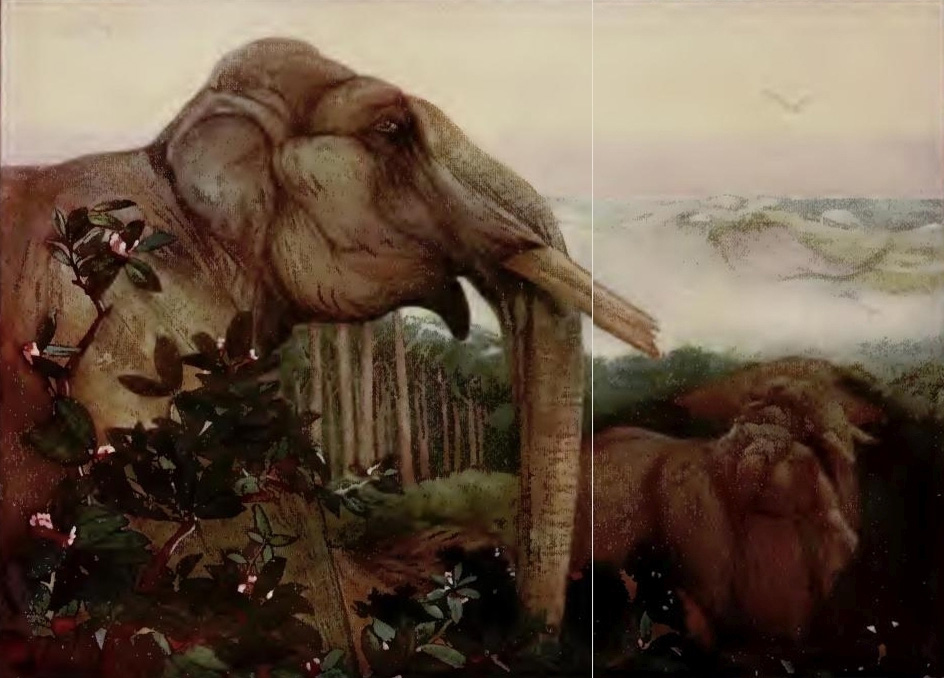
Big Toomai had come up hotfoot from the camp in the plains to search for his son and his elephant, and now that he had found them he looked at them as though he were afraid of them both. And there was a feast by the blazing campfires in front of the lines of picketed elephants, and Little Toomai was the hero of it all. And the big brown elephant catchers, the trackers and drivers and ropers, and the men who know all the secrets of breaking the wildest elephants, passed him from one to the other, and they marked his forehead with blood from the breast of a newly killed jungle-cock, to show that he was a forester, initiated and free of all the jungles.
Big Toomai had rushed up from the camp on the plains to search for his son and his elephant. Now that he had found them, he looked at them as if he were afraid of them both. A feast was held by blazing campfires in front of the rows of tethered elephants. Little Toomai was the hero of the feast. The big brown elephant catchers passed him from one to another. They were trackers, drivers, ropers, and men who knew all the secrets of taming the wildest elephants. They marked his forehead with blood from the breast of a freshly killed jungle rooster. This showed that he was a forester, initiated and free to go anywhere in the jungles.
And at last, when the flames died down, and the red light of the logs made the elephants look as though they had been dipped in blood too, Machua Appa, the head of all the drivers of all the Keddahs—Machua Appa, Petersen Sahib’s other self, who had never seen a made road in forty years: Machua Appa, who was so great that he had no other name than Machua Appa,—leaped to his feet, with Little Toomai held high in the air above his head, and shouted: “Listen, my brothers. Listen, too, you my lords in the lines there, for I, Machua Appa, am speaking! This little one shall no more be called Little Toomai, but Toomai of the Elephants, as his great-grandfather was called before him. What never man has seen he has seen through the long night, and the favor of the elephant-folk and of the Gods of the Jungles is with him. He shall become a great tracker. He shall become greater than I, even I, Machua Appa! He shall follow the new trail, and the stale trail, and the mixed trail, with a clear eye! He shall take no harm in the Keddah when he runs under their bellies to rope the wild tuskers; and if he slips before the feet of the charging bull elephant, the bull elephant shall know who he is and shall not crush him. Aihai! my lords in the chains,”—he whirled up the line of pickets—“here is the little one that has seen your dances in your hidden places,—the sight that never man saw! Give him honor, my lords! Salaam karo, my children. Make your salute to Toomai of the Elephants! Gunga Pershad, ahaa! Hira Guj, Birchi Guj, Kuttar Guj, ahaa! Pudmini,—thou hast seen him at the dance, and thou too, Kala Nag, my pearl among elephants!—ahaa! Together! To Toomai of the Elephants. Barrao!”
At last, the flames died down. The red glow of the logs made the elephants look as if they too had been dipped in blood. Then Machua Appa leaped to his feet, holding Little Toomai high above his head. Machua Appa was the chief of all the drivers at all the Keddahs. He was Petersen Sahib’s right-hand man, and he had not seen a paved road in forty years. He was so great that he had no other name than Machua Appa. He shouted: “Listen, my brothers. Listen too, my lords in the lines there, for I, Machua Appa, am speaking! This little one shall no longer be called Little Toomai. He shall be called Toomai of the Elephants, as his great-grandfather was before him. During the long night, he saw what no man has ever seen. The elephant-folk and the Gods of the Jungles look on him with favor. He shall become a great tracker. He shall become greater than I, even I, Machua Appa! With a clear eye, he shall follow new trails, old trails, and mixed trails! He shall come to no harm in the Keddah when he runs under the elephants’ bellies to rope the wild tuskers. And if he slips in front of a charging bull elephant, the bull shall recognize him and not crush him. “Aihai! My lords in chains,” he cried, turning toward the line of tethered elephants, “here is the little one who has seen you dance in your hidden places. No man has ever seen that sight! Give him honor, my lords! Salaam karo, my children. Salute Toomai of the Elephants! Gunga Pershad, ahaa! Hira Guj, Birchi Guj, Kuttar Guj, ahaa! Pudmini, you saw him at the dance. And you did too, Kala Nag, my pearl among elephants! Ahaa! Together! To Toomai of the Elephants. Barrao!”
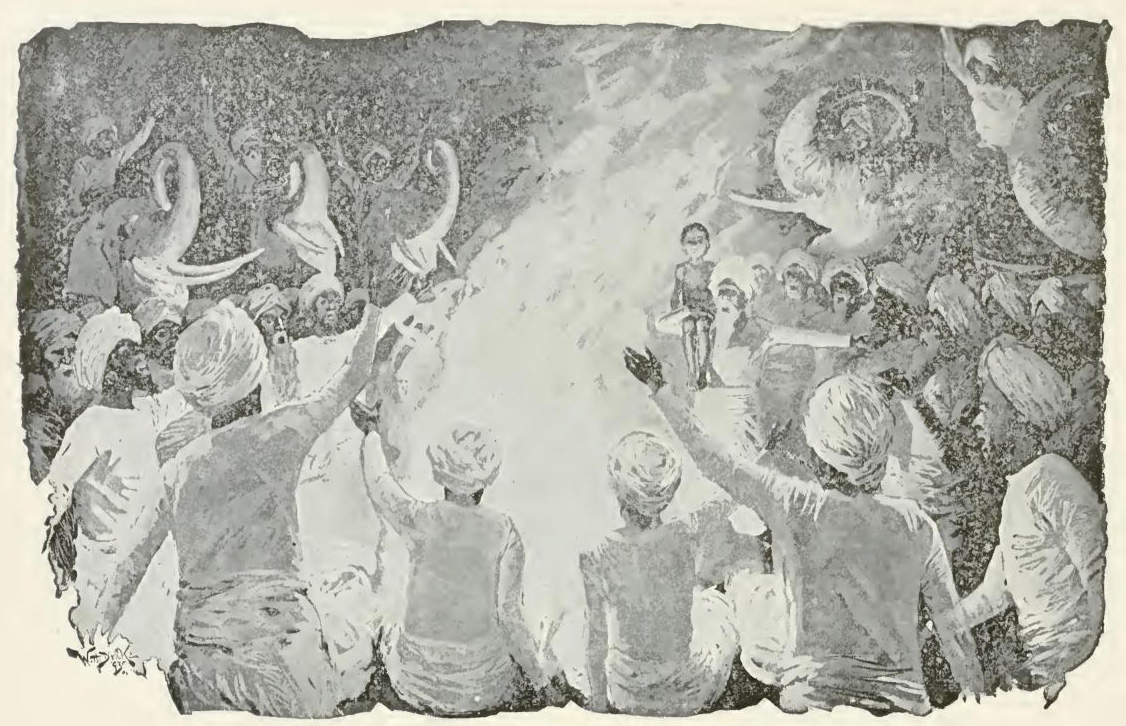
And at that last wild yell the whole line flung up their trunks till the tips touched their foreheads, and broke out into the full salute—the crashing trumpet-peal that only the Viceroy of India hears, the Salaamut of the Keddah.
At that last wild yell, the whole line raised their trunks until the tips touched their foreheads. Then they gave the full salute, the Salaamut of the Keddah. It was the crashing trumpet blast that only the Viceroy of India hears.
But it was all for the sake of Little Toomai, who had seen what never man had seen before—the dance of the elephants at night and alone in the heart of the Garo hills!
But it was all for Little Toomai, who had seen what no one had ever seen before. Alone at night, deep in the Garo hills, he had seen the elephants dance!
Shiv and the Grasshopper
Shiv and the Grasshopper
(The song that Toomai’s mother sang to the baby)
(The song Toomai’s mother sang to the baby)
Shiv, who poured the harvest and made the winds to blow, Sitting at the doorways of a day of long ago, Gave to each his portion, food and toil and fate, From the King upon the guddee to the Beggar at the gate. All things made he—Shiva the Preserver. Mahadeo! Mahadeo! He made all,— Thorn for the camel, fodder for the kine, And mother’s heart for sleepy head, O little son of mine! Wheat he gave to rich folk, millet to the poor, Broken scraps for holy men that beg from door to door; Battle to the tiger, carrion to the kite, And rags and bones to wicked wolves without the wall at night. Naught he found too lofty, none he saw too low— Parbati beside him watched them come and go; Thought to cheat her husband, turning Shiv to jest— Stole the little grasshopper and hid it in her breast. So she tricked him, Shiva the Preserver. Mahadeo! Mahadeo! Turn and see. Tall are the camels, heavy are the kine, But this was Least of Little Things, O little son of mine! When the dole was ended, laughingly she said, “Master, of a million mouths, is not one unfed?” Laughing, Shiv made answer, “All have had their part, Even he, the little one, hidden ’neath thy heart.” From her breast she plucked it, Parbati the thief, Saw the Least of Little Things gnawed a new-grown leaf! Saw and feared and wondered, making prayer to Shiv, Who hath surely given meat to all that live. All things made he—Shiva the Preserver. Mahadeo! Mahadeo! He made all,— Thorn for the camel, fodder for the kine, And mother’s heart for sleepy head, O little son of mine!
Shiv, who gave the harvest and made the winds blow, Sat at the doorways of a day long ago. He gave each one a share of food, work, and fate, From the King on the guddee to the Beggar at the gate. He made all things, Shiva the Preserver. Mahadeo! Mahadeo! He made all, Thorns for the camel, feed for the cattle, And a mother’s heart for a sleepy head, O little son of mine! He gave wheat to the rich, millet to the poor, And scraps to holy men who beg from door to door. He gave the tiger battle, and dead flesh to the kite, And rags and bones to wicked wolves outside the wall at night. He found nothing too high, and saw no one too low. Parbati watched beside him as they came and went. She thought to fool her husband and make a joke of Shiv. She stole the little grasshopper and hid it against her breast. So she tricked him, Shiva the Preserver. Mahadeo! Mahadeo! Turn and see. The camels are tall, the cattle are heavy, But this was the Least of Little Things, O little son of mine! When he had finished giving, she said with a laugh, “Master, among a million mouths, has not one gone unfed?” Shiv laughed and answered, “All have had their share, Even the little one hidden beneath your heart.” Parbati the thief pulled the grasshopper from her breast. She saw the Least of Little Things had chewed a new leaf! She saw, feared, and wondered, and prayed to Shiv, Who has surely given food to all living things. He made all things, Shiva the Preserver. Mahadeo! Mahadeo! He made all, Thorns for the camel, feed for the cattle, And a mother’s heart for a sleepy head, O little son of mine!