These stories and poems follow Mowgli, a boy raised by wolves, and other animal characters. In one story, the mongoose Rikki-tikki-tavi defends a family's home against cobras.
190 pages 3h 41m reading time
One of the best-loved classics of children's literature, still read around the world more than a century later.
Imagines a jungle run by its own Law, a code of rules that the animals must follow to live together and survive.
Explores the question of belonging through Mowgli, a boy who is never fully at home among wolves or among people.
Robert Baden-Powell built the Wolf Cubs, the youngest branch of the Scouting movement, around its characters and the Law of the Jungle, and Cub Scouts still use names like Akela today.
It inspired many films, most famously Disney's 1967 animated version, which made Mowgli, Baloo, and Bagheera familiar to generations of children.
Written in snowy Vermont
Kipling wrote these Indian jungle tales while living in Vermont, in the United States, with his American wife.
Sparked by another novel
Kipling said a story about a boy and wolves in H. Rider Haggard's novel "Nada the Lily" gave him the idea.
First told in magazines
Most of the stories appeared in magazines, one at a time, before they were gathered into this book.
Drawn partly by his father
Kipling's father, an artist who had worked in India, made some of the pictures for the first edition.
A sequel came quickly
Readers wanted more, and "The Second Jungle Book" followed the next year with new Mowgli stories.
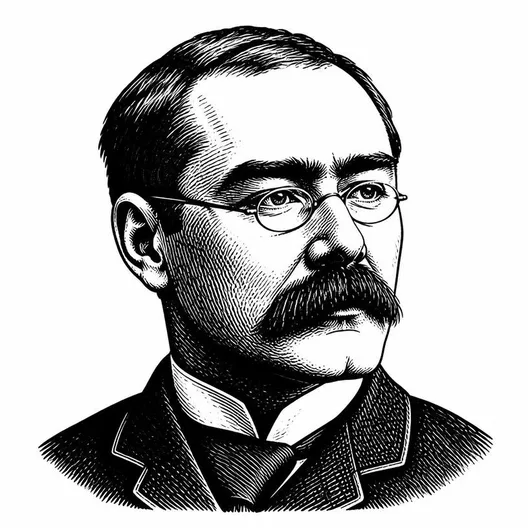 Rudyard Kipling 1894

