The Queen's Servants
You can work it out by Fractions or by simple Rule of Three, But the way of Tweedle-dum is not the way of Tweedle-dee. You can twist it, you can turn it, you can plait it till you drop, But the way of Pilly Winky’s not the way of Winkie Pop!
You can work it out with fractions or a simple proportion, But Tweedle-dum’s way is not Tweedle-dee’s way. You can twist it, turn it, or braid it until you drop, But Pilly Winky’s way is not Winkie Pop’s way!
It had been raining heavily for one whole month—raining on a camp of thirty thousand men and thousands of camels, elephants, horses, bullocks, and mules all gathered together at a place called Rawal Pindi, to be reviewed by the Viceroy of India. He was receiving a visit from the Amir of Afghanistan—a wild king of a very wild country. The Amir had brought with him for a bodyguard eight hundred men and horses who had never seen a camp or a locomotive before in their lives—savage men and savage horses from somewhere at the back of Central Asia. Every night a mob of these horses would be sure to break their heel ropes and stampede up and down the camp through the mud in the dark, or the camels would break loose and run about and fall over the ropes of the tents, and you can imagine how pleasant that was for men trying to go to sleep. My tent lay far away from the camel lines, and I thought it was safe. But one night a man popped his head in and shouted, “Get out, quick! They’re coming! My tent’s gone!”
It had rained heavily for a whole month. The rain fell on a camp of thirty thousand men and thousands of camels, elephants, horses, bullocks, and mules. They had all gathered at Rawal Pindi to be reviewed by the Viceroy of India. He was receiving a visit from the Amir of Afghanistan, a wild king from a very wild country. The Amir had brought eight hundred men and horses as his bodyguard. Neither the men nor the horses had ever seen a camp or a locomotive before. They were savage men and savage horses from somewhere in the remote parts of Central Asia. Every night, a group of these horses would be sure to break their heel ropes. They would stampede up and down the camp through the mud in the dark. Or the camels would break loose, run about, and fall over the tent ropes. You can imagine how pleasant that was for men trying to sleep. My tent was far from the camel lines, and I thought it was safe. But one night a man popped his head in and shouted, “Get out, quick! They’re coming! My tent’s gone!”
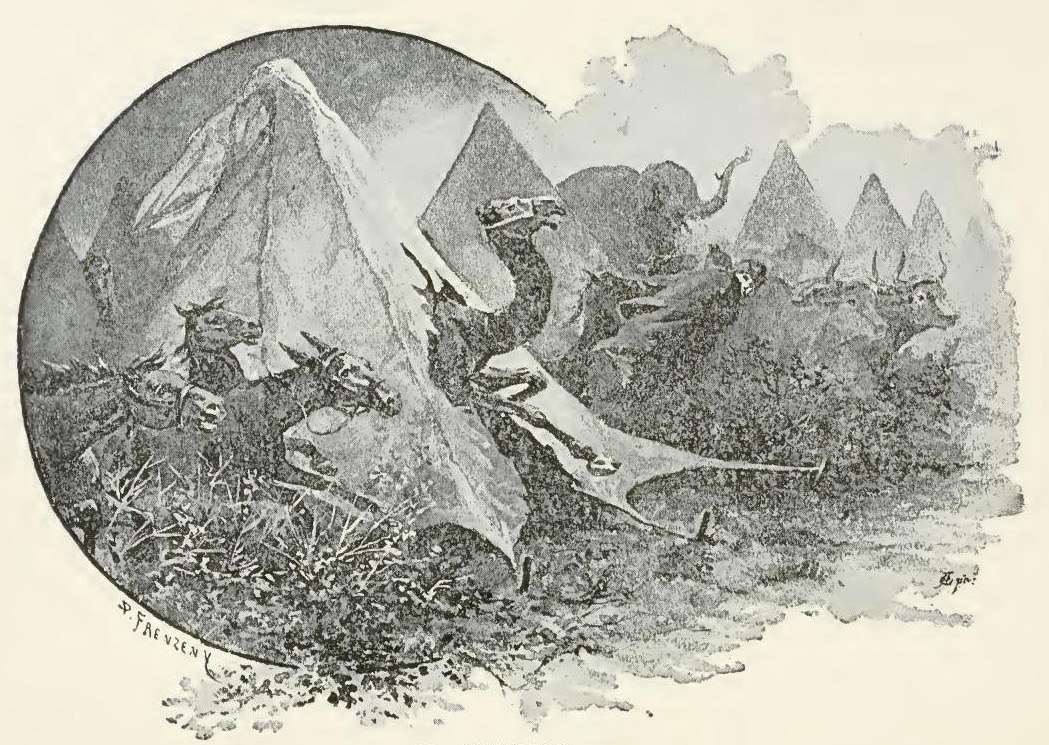
I knew who “they” were, so I put on my boots and waterproof and scuttled out into the slush. Little Vixen, my fox terrier, went out through the other side; and then there was a roaring and a grunting and bubbling, and I saw the tent cave in, as the pole snapped, and begin to dance about like a mad ghost. A camel had blundered into it, and wet and angry as I was, I could not help laughing. Then I ran on, because I did not know how many camels might have got loose, and before long I was out of sight of the camp, plowing my way through the mud.
I knew who “they” were, so I put on my boots and raincoat and hurried out into the slush. Little Vixen, my fox terrier, went out the other side. Then there was roaring, grunting, and bubbling. I saw the tent collapse as the pole snapped, and it began to dance around like a mad ghost. A camel had blundered into the tent. Though I was wet and angry, I could not help laughing. Then I ran on because I did not know how many camels might have gotten loose. Before long, the camp was out of sight, and I was plowing my way through the mud.
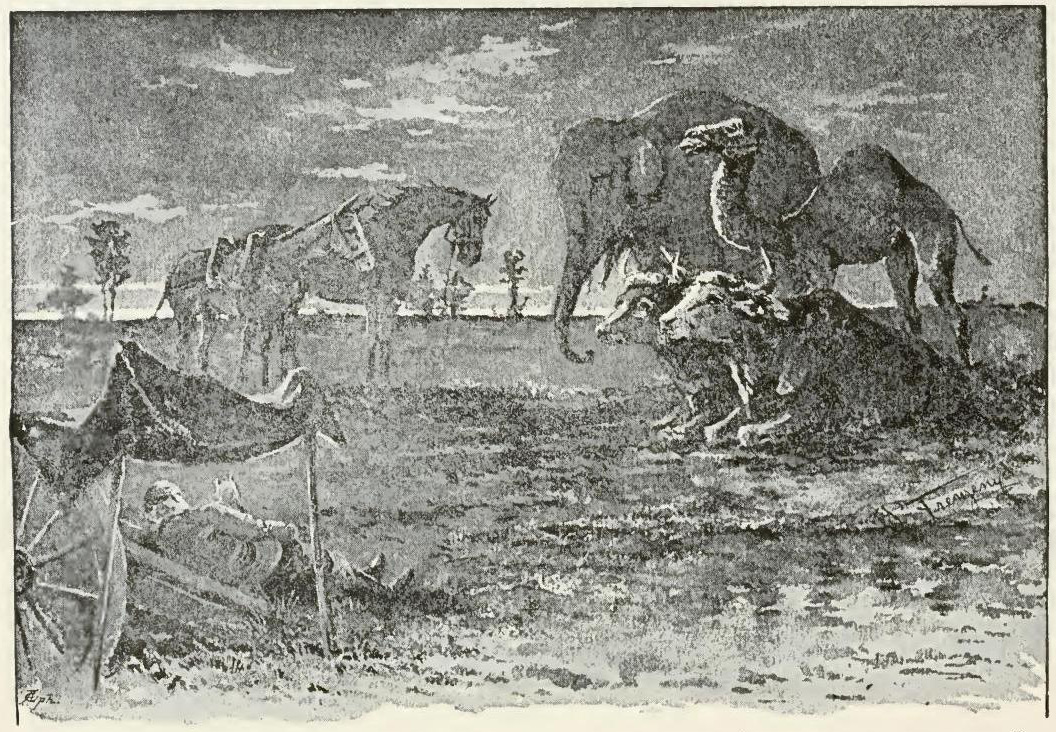
At last I fell over the tail-end of a gun, and by that knew I was somewhere near the artillery lines where the cannon were stacked at night. As I did not want to plowter about any more in the drizzle and the dark, I put my waterproof over the muzzle of one gun, and made a sort of wigwam with two or three rammers that I found, and lay along the tail of another gun, wondering where Vixen had got to, and where I might be.
At last I tripped over the rear end of a cannon. I knew then that I was near the artillery lines, where the cannons were stored at night. I did not want to keep stumbling around in the drizzle and darkness. So I put my waterproof coat over the muzzle of one cannon. Then I used two or three rammers I found to make a sort of tent. I lay along the rear end of another cannon, wondering where Vixen had gone and where I might be.
Just as I was getting ready to go to sleep I heard a jingle of harness and a grunt, and a mule passed me shaking his wet ears. He belonged to a screw-gun battery, for I could hear the rattle of the straps and rings and chains and things on his saddle pad. The screw-guns are tiny little cannon made in two pieces, that are screwed together when the time comes to use them. They are taken up mountains, anywhere that a mule can find a road, and they are very useful for fighting in rocky country.
Just as I was getting ready to sleep, I heard a jingle of harness and a grunt. A mule passed me, shaking his wet ears. He belonged to a screw-gun battery. I could hear the straps, rings, chains, and other things rattling on his saddle pad. Screw-guns are tiny cannons made in two pieces. The pieces are screwed together when it is time to use the guns. Mules carry them up mountains, anywhere a mule can find a road. They are very useful for fighting in rocky country.
Behind the mule there was a camel, with his big soft feet squelching and slipping in the mud, and his neck bobbing to and fro like a strayed hen’s. Luckily, I knew enough of beast language—not wild-beast language, but camp-beast language, of course—from the natives to know what he was saying.
Behind the mule was a camel. His big, soft feet squelched and slipped in the mud, and his neck bobbed back and forth like a wandering hen’s. Luckily, I had learned enough of the animals’ language from the local people to understand what he was saying. Camp animal language, of course, not wild animal language.
He must have been the one that flopped into my tent, for he called to the mule, “What shall I do? Where shall I go? I have fought with a white thing that waved, and it took a stick and hit me on the neck.” (That was my broken tent pole, and I was very glad to know it.) “Shall we run on?”
He must have been the one who flopped into my tent, because he called to the mule, “What should I do? Where should I go? I fought with a white thing that waved, and it picked up a stick and hit me on the neck.” (That was my broken tent pole, and I was very glad to know it.) “Should we keep running?”
“Oh, it was you,” said the mule, “you and your friends, that have been disturbing the camp? All right. You’ll be beaten for this in the morning. But I may as well give you something on account now.”
“Oh, it was you and your friends disturbing the camp?” said the mule. “All right. You’ll be beaten for this in the morning. But I may as well give you a bit of your beating now.”
I heard the harness jingle as the mule backed and caught the camel two kicks in the ribs that rang like a drum. “Another time,” he said, “you’ll know better than to run through a mule battery at night, shouting `Thieves and fire!’ Sit down, and keep your silly neck quiet.”
I heard the harness jingle as the mule backed up and kicked the camel twice in the ribs. The kicks rang out like a drum. “Next time,” he said, “you’ll know better than to run through a mule battery at night, shouting ‘Thieves and fire!’ Sit down, and keep your silly neck still.”
The camel doubled up camel-fashion, like a two-foot rule, and sat down whimpering. There was a regular beat of hoofs in the darkness, and a big troop-horse cantered up as steadily as though he were on parade, jumped a gun tail, and landed close to the mule.
The camel folded up in the way camels do, like a folding ruler, and sat down whimpering. Hooves beat steadily in the darkness. A large cavalry horse cantered up as steadily as if he were on parade. He jumped over the trail of a gun and landed close to the mule.
“It’s disgraceful,” he said, blowing out his nostrils. “Those camels have racketed through our lines again—the third time this week. How’s a horse to keep his condition if he isn’t allowed to sleep. Who’s here?”
“It’s disgraceful,” he said, blowing through his nostrils. “Those camels have clattered through our lines again. That’s the third time this week. How can a horse stay in good shape if he isn’t allowed to sleep? Who’s here?”
“I’m the breech-piece mule of number two gun of the First Screw Battery,” said the mule, “and the other’s one of your friends. He’s waked me up too. Who are you?”
“I’m the breech-piece mule for gun number two of the First Screw Battery,” said the mule. “The other one is a friend of yours. He woke me up too. Who are you?”
“Number Fifteen, E troop, Ninth Lancers—Dick Cunliffe’s horse. Stand over a little, there.”
“Number Fifteen, E troop, Ninth Lancers, Dick Cunliffe’s horse. Move over a little, there.”
“Oh, beg your pardon,” said the mule. “It’s too dark to see much. Aren’t these camels too sickening for anything? I walked out of my lines to get a little peace and quiet here.”
“Oh, sorry,” said the mule. “It’s too dark to see much. Aren’t these camels just unbearable? I left the camp lines to get a little peace and quiet here.”
“My lords,” said the camel humbly, “we dreamed bad dreams in the night, and we were very much afraid. I am only a baggage camel of the 39th Native Infantry, and I am not as brave as you are, my lords.”
“My lords,” the camel said humbly, “we had bad dreams last night, and we were very afraid. I am only a baggage camel of the 39th Native Infantry. I am not as brave as you are, my lords.”
“Then why didn’t you stay and carry baggage for the 39th Native Infantry, instead of running all round the camp?” said the mule.
“Then why didn’t you stay and carry baggage for the 39th Native Infantry instead of running around the camp?” said the mule.
“They were such very bad dreams,” said the camel. “I am sorry. Listen! What is that? Shall we run on again?”
“They were such terrible dreams,” said the camel. “I’m sorry. Listen! What’s that? Should we run again?”
“Sit down,” said the mule, “or you’ll snap your long stick-legs between the guns.” He cocked one ear and listened. “Bullocks!” he said. “Gun bullocks. On my word, you and your friends have waked the camp very thoroughly. It takes a good deal of prodding to put up a gun-bullock.”
“Sit down,” said the mule, “or you’ll break your long stick-legs between the guns.” He raised one ear and listened. “Oxen!” he said. “Gun oxen. My word, you and your friends have really woken up the camp. It takes a lot of prodding to get a gun ox on its feet.”
I heard a chain dragging along the ground, and a yoke of the great sulky white bullocks that drag the heavy siege guns when the elephants won’t go any nearer to the firing, came shouldering along together. And almost stepping on the chain was another battery mule, calling wildly for “Billy.”
I heard a chain dragging along the ground. A pair of huge, sulky white oxen came along, yoked together. They pulled the heavy siege guns when the elephants refused to go any closer to the gunfire. Another battery mule followed, almost stepping on the chain and calling wildly for “Billy.”
“That’s one of our recruits,” said the old mule to the troop horse. “He’s calling for me. Here, youngster, stop squealing. The dark never hurt anybody yet.”
“That’s one of our new recruits,” said the old mule to the troop horse. “He’s calling for me. Hey, kid, stop squealing. The dark has never hurt anyone.”
The gun-bullocks lay down together and began chewing the cud, but the young mule huddled close to Billy.
The oxen that pulled the guns lay down together and began chewing their cud. But the young mule huddled close to Billy.
“Things!” he said. “Fearful and horrible, Billy! They came into our lines while we were asleep. D’you think they’ll kill us?”
“Things!” he said. “Terrible, horrible things, Billy! They came into our lines while we were asleep. Do you think they’ll kill us?”
“I’ve a very great mind to give you a number-one kicking,” said Billy. “The idea of a fourteen-hand mule with your training disgracing the battery before this gentleman!”
“I’m very tempted to give you a really good kicking,” said Billy. “A fourteen-hand mule with your training, disgracing the battery in front of this gentleman!”
“Gently, gently!” said the troop-horse. “Remember they are always like this to begin with. The first time I ever saw a man (it was in Australia when I was a three-year-old) I ran for half a day, and if I’d seen a camel, I should have been running still.”
“Easy, easy!” said the troop-horse. “Remember, they are always like this at first. I first saw a man in Australia when I was three years old. I ran for half a day. And if I’d seen a camel, I’d still be running.”
Nearly all our horses for the English cavalry are brought to India from Australia, and are broken in by the troopers themselves.
Nearly all our horses for the English cavalry are brought to India from Australia. The soldiers train the horses themselves.
“True enough,” said Billy. “Stop shaking, youngster. The first time they put the full harness with all its chains on my back I stood on my forelegs and kicked every bit of it off. I hadn’t learned the real science of kicking then, but the battery said they had never seen anything like it.”
“That’s true,” said Billy. “Stop shaking, kid. The first time they put the full harness and all its chains on my back, I stood on my front legs and kicked it all off. I hadn’t learned the real science of kicking yet, but the battery said they had never seen anything like it.”
“But this wasn’t harness or anything that jingled,” said the young mule. “You know I don’t mind that now, Billy. It was Things like trees, and they fell up and down the lines and bubbled; and my head-rope broke, and I couldn’t find my driver, and I couldn’t find you, Billy, so I ran off with—with these gentlemen.”
“But it wasn’t harness or anything that jingled,” said the young mule. “You know I don’t mind that now, Billy. They were things like trees, and they fell up and down the lines and bubbled. My head-rope broke, and I couldn’t find my driver. I couldn’t find you either, Billy, so I ran off with, with these gentlemen.”
“H’m!” said Billy. “As soon as I heard the camels were loose I came away on my own account. When a battery—a screw-gun mule calls gun-bullocks gentlemen, he must be very badly shaken up. Who are you fellows on the ground there?”
“Hm!” said Billy. “As soon as I heard the camels were loose, I left on my own. When a battery, a screw-gun mule, calls gun-bullocks gentlemen, he must be badly shaken up. Who are you fellows down there on the ground?”
The gun bullocks rolled their cuds, and answered both together: “The seventh yoke of the first gun of the Big Gun Battery. We were asleep when the camels came, but when we were trampled on we got up and walked away. It is better to lie quiet in the mud than to be disturbed on good bedding. We told your friend here that there was nothing to be afraid of, but he knew so much that he thought otherwise. Wah!”
The gun bullocks chewed their cud and answered together: “We are the seventh yoke of the first gun of the Big Gun Battery. We were asleep when the camels came. But when they trampled us, we got up and walked away. It is better to lie quietly in the mud than to be disturbed on good bedding. We told your friend here there was nothing to fear. But he knew so much that he thought otherwise. Wah!”
They went on chewing.
They kept chewing.
“That comes of being afraid,” said Billy. “You get laughed at by gun-bullocks. I hope you like it, young un.”
“That’s what happens when you’re afraid,” said Billy. “The gun-bullocks laugh at you. I hope you like being laughed at, kid.”
The young mule’s teeth snapped, and I heard him say something about not being afraid of any beefy old bullock in the world. But the bullocks only clicked their horns together and went on chewing.
The young mule snapped his teeth. I heard him say he wasn’t afraid of any big old bullock in the world. But the bullocks just clicked their horns together and kept chewing.
“Now, don’t be angry after you’ve been afraid. That’s the worst kind of cowardice,” said the troop-horse. “Anybody can be forgiven for being scared in the night, I think, if they see things they don’t understand. We’ve broken out of our pickets, again and again, four hundred and fifty of us, just because a new recruit got to telling tales of whip snakes at home in Australia till we were scared to death of the loose ends of our head-ropes.”
“Now, don’t get angry after you’ve been afraid. That’s the worst kind of cowardice,” said the troop-horse. “I think anyone can be forgiven for being scared at night if they see things they don’t understand. All four hundred and fifty of us have broken loose from our tethers again and again. It happened just because a new recruit told stories about whip snakes back home in Australia. He scared us to death of the loose ends of the ropes on our heads.”
“That’s all very well in camp,” said Billy. “I’m not above stampeding myself, for the fun of the thing, when I haven’t been out for a day or two. But what do you do on active service?”
“That’s fine in camp,” said Billy. “I’m happy to stampede myself for fun when I haven’t been out for a day or two. But what do you do in active service?”
“Oh, that’s quite another set of new shoes,” said the troop horse. “Dick Cunliffe’s on my back then, and drives his knees into me, and all I have to do is to watch where I am putting my feet, and to keep my hind legs well under me, and be bridle-wise.”
“Oh, that’s a whole different matter,” said the troop horse. “Then Dick Cunliffe is on my back, pressing his knees into me. All I have to do is watch where I put my feet, keep my hind legs well under me, and respond to the bridle.”
“What’s bridle-wise?” said the young mule.
“What does it mean to be trained to respond to a bridle?” said the young mule.
“By the Blue Gums of the Back Blocks,” snorted the troop-horse, “do you mean to say that you aren’t taught to be bridle-wise in your business? How can you do anything, unless you can spin round at once when the rein is pressed on your neck? It means life or death to your man, and of course that’s life and death to you. Get round with your hind legs under you the instant you feel the rein on your neck. If you haven’t room to swing round, rear up a little and come round on your hind legs. That’s being bridle-wise.”
“By the Blue Gums of the Back Blocks,” snorted the troop-horse, “do you mean you aren’t taught to be bridle-wise in your work? How can you do anything unless you can turn at once when the rein presses against your neck? Your rider’s life depends on it, and of course that means your life depends on it too. The moment you feel the rein on your neck, turn with your hind legs under you. If you don’t have room to turn, rear up a little and turn on your hind legs. That’s being bridle-wise.”
“We aren’t taught that way,” said Billy the mule stiffly. “We’re taught to obey the man at our head: step off when he says so, and step in when he says so. I suppose it comes to the same thing. Now, with all this fine fancy business and rearing, which must be very bad for your hocks, what do you do?”
“We aren’t trained that way,” said Billy the mule stiffly. “We’re taught to obey the man at our head. We move off when he says to and step into line when he says to. I suppose it amounts to the same thing. Now, what do you do with all that fancy work and rearing? It must be very bad for your hocks.”
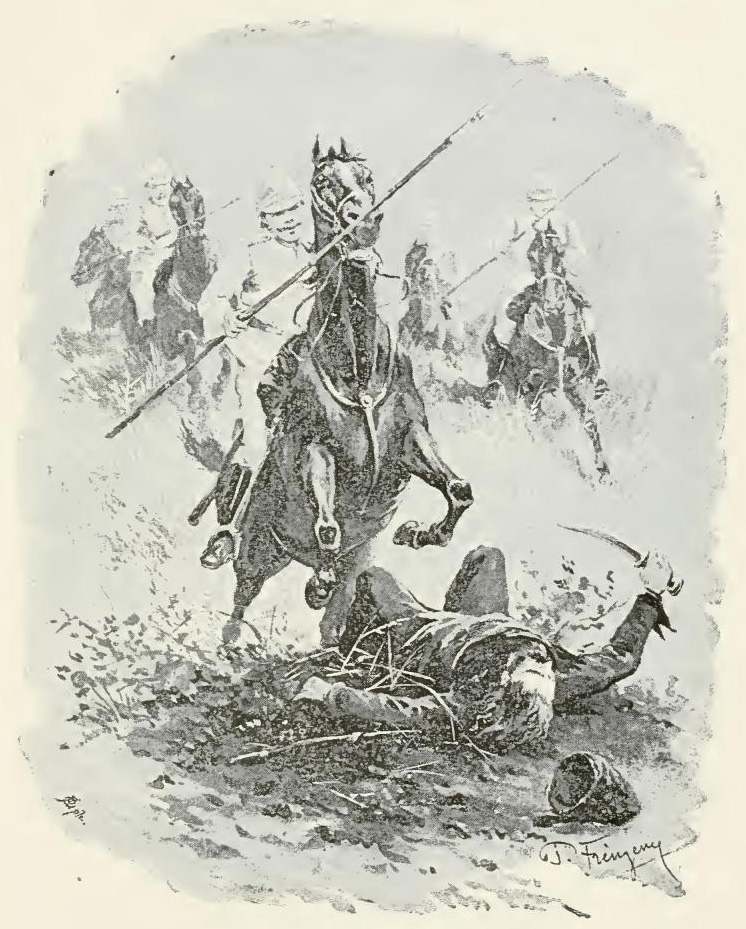
“That depends,” said the troop-horse. “Generally I have to go in among a lot of yelling, hairy men with knives—long shiny knives, worse than the farrier’s knives—and I have to take care that Dick’s boot is just touching the next man’s boot without crushing it. I can see Dick’s lance to the right of my right eye, and I know I’m safe. I shouldn’t care to be the man or horse that stood up to Dick and me when we’re in a hurry.”
“That depends,” said the troop-horse. “Usually, I have to go in among a lot of yelling, hairy men with knives. They have long, shiny knives, worse than the farrier’s knives. I have to make sure Dick’s boot just touches the next man’s boot without crushing it. I can see Dick’s lance just to the right of my right eye, and I know I’m safe. I wouldn’t want to be the man or horse that stood in our way when Dick and I are in a hurry.”
“Don’t the knives hurt?” said the young mule.
“Don’t the knives hurt?” asked the young mule.
“Well, I got one cut across the chest once, but that wasn’t Dick’s fault—”
“Well, I was cut across the chest once, but that wasn’t Dick’s fault.”
“A lot I should have cared whose fault it was, if it hurt!” said the young mule.
“As if I would have cared whose fault it was, if it hurt!” said the young mule.
“You must,” said the troop horse. “If you don’t trust your man, you may as well run away at once. That’s what some of our horses do, and I don’t blame them. As I was saying, it wasn’t Dick’s fault. The man was lying on the ground, and I stretched myself not to tread on him, and he slashed up at me. Next time I have to go over a man lying down I shall step on him—hard.”
“You must,” said the troop horse. “If you don’t trust your man, you might as well run away at once. Some of our horses do run away, and I don’t blame them. As I was saying, it wasn’t Dick’s fault. The man was lying on the ground, and I stretched to avoid stepping on him. But he slashed upward at me. Next time I have to go over a man lying down, I’ll step on him. Hard.”
“H’m!” said Billy. “It sounds very foolish. Knives are dirty things at any time. The proper thing to do is to climb up a mountain with a well-balanced saddle, hang on by all four feet and your ears too, and creep and crawl and wriggle along, till you come out hundreds of feet above anyone else on a ledge where there’s just room enough for your hoofs. Then you stand still and keep quiet—never ask a man to hold your head, young un—keep quiet while the guns are being put together, and then you watch the little poppy shells drop down into the tree-tops ever so far below.”
“Hmm!” said Billy. “That sounds very foolish. Knives are always dirty things. The proper thing to do is climb a mountain with a well-balanced saddle. Hang on with all four feet and your ears too. Creep and crawl and wriggle along until you reach a ledge hundreds of feet above everyone else. There’s just enough room on the ledge for your hoofs. Then stand still and keep quiet. Never ask a man to hold your head, youngster. Keep quiet while the guns are being put together. Then watch the little poppy shells drop into the treetops far below.”
“Don’t you ever trip?” said the troop-horse.
“Don’t you ever trip?” asked the troop-horse.
“They say that when a mule trips you can split a hen’s ear,” said Billy. “Now and again perhaps a badly packed saddle will upset a mule, but it’s very seldom. I wish I could show you our business. It’s beautiful. Why, it took me three years to find out what the men were driving at. The science of the thing is never to show up against the sky line, because, if you do, you may get fired at. Remember that, young un. Always keep hidden as much as possible, even if you have to go a mile out of your way. I lead the battery when it comes to that sort of climbing.”
“They say a mule trips so rarely that you could split a hen’s ear when it happens,” said Billy. “Once in a while, perhaps a badly packed saddle will make a mule fall, but that’s very rare. I wish I could show you our work. It’s beautiful. Why, it took me three years to figure out what the men were trying to do. The trick is never to stand out against the skyline, because you may get shot at if you do. Remember that, youngster. Always stay hidden as much as possible, even if you have to go a mile out of your way. I lead the battery when it comes to that kind of climbing.”
“Fired at without the chance of running into the people who are firing!” said the troop-horse, thinking hard. “I couldn’t stand that. I should want to charge—with Dick.”
“Being shot at without a chance to charge the people shooting at you!” said the troop-horse, thinking hard. “I couldn’t stand that. I’d want to charge with Dick.”
“Oh, no, you wouldn’t. You know that as soon as the guns are in position they’ll do all the charging. That’s scientific and neat. But knives—pah!”
“Oh, no, you wouldn’t. You know that once the guns are in position, they’ll do all the charging. That’s scientific and neat. But knives, pah!”
The baggage-camel had been bobbing his head to and fro for some time past, anxious to get a word in edgewise. Then I heard him say, as he cleared his throat, nervously:
The baggage camel had been bobbing his head back and forth for a while, eager to get a word in. Then he nervously cleared his throat, and I heard him say:
“I—I—I have fought a little, but not in that climbing way or that running way.”
“I, I, I have fought a little, but not while climbing or running.”
“No. Now you mention it,” said Billy, “you don’t look as though you were made for climbing or running—much. Well, how was it, old Hay-bales?”
“No. Now that you mention it,” said Billy, “you don’t look as if you were built for much climbing or running. Well, how was it, old Hay-bales?”
“The proper way,” said the camel. “We all sat down—”
“The right way,” said the camel. “We all sat down...”
“Oh, my crupper and breastplate!” said the troop-horse under his breath. “Sat down!”
“Oh, my crupper and breastplate!” the troop horse muttered. “Sat down!”
“We sat down—a hundred of us,” the camel went on, “in a big square, and the men piled our packs and saddles, outside the square, and they fired over our backs, the men did, on all sides of the square.”
“We sat down in a big square, a hundred of us,” the camel went on. “The men piled our packs and saddles outside the square. Then the men fired over our backs on all sides of the square.”
“What sort of men? Any men that came along?” said the troop-horse. “They teach us in riding school to lie down and let our masters fire across us, but Dick Cunliffe is the only man I’d trust to do that. It tickles my girths, and, besides, I can’t see with my head on the ground.”
“What kind of men? Any men who came along?” said the troop-horse. “At riding school, they teach us to lie down and let our masters fire over us. But Dick Cunliffe is the only man I’d trust to do that. The firing tickles my girths, and besides, I can’t see with my head on the ground.”
“What does it matter who fires across you?” said the camel. “There are plenty of men and plenty of other camels close by, and a great many clouds of smoke. I am not frightened then. I sit still and wait.”
“What does it matter who fires across you?” said the camel. “There are plenty of men and other camels nearby, and a lot of smoke. I’m not afraid then. I sit still and wait.”
“And yet,” said Billy, “you dream bad dreams and upset the camp at night. Well, well! Before I’d lie down, not to speak of sitting down, and let a man fire across me, my heels and his head would have something to say to each other. Did you ever hear anything so awful as that?”
“And yet,” said Billy, “you have bad dreams and disturb the camp at night. Well, well! I wouldn’t even sit down and let a man fire a gun across me, let alone lie down. I’d kick him in the head first. Did you ever hear anything so awful as that?”
There was a long silence, and then one of the gun bullocks lifted up his big head and said, “This is very foolish indeed. There is only one way of fighting.”
There was a long silence. Then one of the gun bullocks raised his big head and said, “This is very foolish. There is only one way to fight.”
“Oh, go on,” said Billy. “Please don’t mind me. I suppose you fellows fight standing on your tails?”
“Oh, go on,” said Billy. “Please don’t mind me. I suppose you guys fight while standing on your tails?”
“Only one way,” said the two together. (They must have been twins.) “This is that way. To put all twenty yoke of us to the big gun as soon as Two Tails trumpets.” (“Two Tails” is camp slang for the elephant.)
“Only one way,” they both said at once. (They must have been twins.) “The way is to harness all twenty yoke of us to the big gun as soon as Two Tails trumpets.” (“Two Tails” is camp slang for the elephant.)
“What does Two Tails trumpet for?” said the young mule.
“Why does Two Tails trumpet?” asked the young mule.
“To show that he is not going any nearer to the smoke on the other side. Two Tails is a great coward. Then we tug the big gun all together—Heya—Hullah! Heeyah! Hullah! We do not climb like cats nor run like calves. We go across the level plain, twenty yoke of us, till we are unyoked again, and we graze while the big guns talk across the plain to some town with mud walls, and pieces of the wall fall out, and the dust goes up as though many cattle were coming home.”
“To show that he will not go any closer to the smoke on the other side. Two Tails is a great coward. Then we all pull the big gun together. Heya! Hullah! Heeyah! Hullah! We do not climb like cats or run like calves. Twenty yoke of us cross the flat plain until we are unyoked again. Then we graze while the big guns talk across the plain to a town with mud walls. Pieces of the wall fall out, and dust rises as if many cattle were coming home.”
“Oh! And you choose that time for grazing?” said the young mule.
“Oh! And you choose that time to graze?” said the young mule.
“That time or any other. Eating is always good. We eat till we are yoked up again and tug the gun back to where Two Tails is waiting for it. Sometimes there are big guns in the city that speak back, and some of us are killed, and then there is all the more grazing for those that are left. This is Fate. None the less, Two Tails is a great coward. That is the proper way to fight. We are brothers from Hapur. Our father was a sacred bull of Shiva. We have spoken.”
“That time or any other time. Eating is always good. We eat until we are yoked up again. Then we pull the gun back to where Two Tails is waiting for it. Sometimes the big guns in the city fire back, and some of us are killed. Then there is even more grazing for those who are left. This is Fate. Even so, Two Tails is a great coward. That is the proper way to fight. We are brothers from Hapur. Our father was a sacred bull of Shiva. We have spoken.”
“Well, I’ve certainly learned something tonight,” said the troop-horse. “Do you gentlemen of the screw-gun battery feel inclined to eat when you are being fired at with big guns, and Two Tails is behind you?”
“Well, I’ve certainly learned something tonight,” said the troop-horse. “You gentlemen in the screw-gun battery, do you feel like eating when big guns are firing at you and Two Tails is behind you?”
“About as much as we feel inclined to sit down and let men sprawl all over us, or run into people with knives. I never heard such stuff. A mountain ledge, a well-balanced load, a driver you can trust to let you pick your own way, and I’m your mule. But—the other things—no!” said Billy, with a stamp of his foot.
“About as much as we want to sit down and let men sprawl all over us, or run into people carrying knives. I’ve never heard such nonsense. Give me a mountain ledge, a well-balanced load, and a driver I can trust to let me choose my own way, and I’m your mule. But the other things? No!” said Billy, stamping his foot.
“Of course,” said the troop horse, “everyone is not made in the same way, and I can quite see that your family, on your father’s side, would fail to understand a great many things.”
“Of course,” said the troop horse, “not everyone is made the same way. And I can see why your father’s side of the family would not understand a great many things.”
“Never you mind my family on my father’s side,” said Billy angrily, for every mule hates to be reminded that his father was a donkey. “My father was a Southern gentleman, and he could pull down and bite and kick into rags every horse he came across. Remember that, you big brown Brumby!”
“Leave my father’s family out of this,” said Billy angrily. Every mule hates being reminded that his father was a donkey. “My father was a Southern gentleman. He could pull down, bite, and kick every horse he met to pieces. Remember that, you big brown Brumby!”
Brumby means wild horse without any breeding. Imagine the feelings of Sunol if a car-horse called her a “skate,” and you can imagine how the Australian horse felt. I saw the white of his eye glitter in the dark.
Brumby means a wild horse with no pedigree. Imagine how Sunol would feel if a cart horse called her a “skate.” That was how the Australian horse felt. I saw the white of his eye gleam in the dark.
“See here, you son of an imported Malaga jackass,” he said between his teeth, “I’d have you know that I’m related on my mother’s side to Carbine, winner of the Melbourne Cup, and where I come from we aren’t accustomed to being ridden over roughshod by any parrot-mouthed, pig-headed mule in a pop-gun pea-shooter battery. Are you ready?”
“Listen here, you son of an imported Malaga jackass,” he said through clenched teeth. “On my mother’s side, I’m related to Carbine, winner of the Melbourne Cup. Where I come from, we don’t let any parrot-mouthed, pig-headed mule in a pop-gun artillery battery push us around. Are you ready?”
“On your hind legs!” squealed Billy. They both reared up facing each other, and I was expecting a furious fight, when a gurgly, rumbly voice, called out of the darkness to the right—“Children, what are you fighting about there? Be quiet.”
“On your hind legs!” squealed Billy. They both stood up on their hind legs, facing each other. I expected a furious fight. But then a gurgling, rumbling voice called from the darkness to the right: “Children, what are you fighting about? Be quiet.”
Both beasts dropped down with a snort of disgust, for neither horse nor mule can bear to listen to an elephant’s voice.
Both animals dropped down with a snort of disgust. Neither horses nor mules can stand listening to an elephant’s voice.
“It’s Two Tails!” said the troop-horse. “I can’t stand him. A tail at each end isn’t fair!”
“It’s Two Tails!” said the troop-horse. “I can’t stand him. A tail at each end isn’t fair!”
“My feelings exactly,” said Billy, crowding into the troop-horse for company. “We’re very alike in some things.”
“I feel exactly the same,” said Billy, moving close to the troop-horse for company. “We’re very alike in some ways.”
“I suppose we’ve inherited them from our mothers,” said the troop horse. “It’s not worth quarreling about. Hi! Two Tails, are you tied up?”
“I suppose we got them from our mothers,” said the troop horse. “It’s not worth arguing about. Hey! Two Tails, are you tied up?”
“Yes,” said Two Tails, with a laugh all up his trunk. “I’m picketed for the night. I’ve heard what you fellows have been saying. But don’t be afraid. I’m not coming over.”
“Yes,” said Two Tails, laughing all the way up his trunk. “I’m tethered for the night. I’ve heard what you fellows have been saying. But don’t be afraid. I’m not coming over.”
The bullocks and the camel said, half aloud, “Afraid of Two Tails—what nonsense!” And the bullocks went on, “We are sorry that you heard, but it is true. Two Tails, why are you afraid of the guns when they fire?”
The bullocks and the camel said quietly, “Afraid of Two Tails? What nonsense!” The bullocks continued, “We're sorry you heard, but it's true. Two Tails, why are you afraid when the guns fire?”
“Well,” said Two Tails, rubbing one hind leg against the other, exactly like a little boy saying a poem, “I don’t quite know whether you’d understand.”
“Well,” said Two Tails. He rubbed one hind leg against the other, just like a little boy reciting a poem. “I’m not quite sure you’d understand.”
“We don’t, but we have to pull the guns,” said the bullocks.
“We don’t, but we have to pull the guns,” said the oxen.
“I know it, and I know you are a good deal braver than you think you are. But it’s different with me. My battery captain called me a Pachydermatous Anachronism the other day.”
“I know, and I know you’re much braver than you think. But it’s different for me. The other day, my battery captain called me a Pachydermatous Anachronism.”
“That’s another way of fighting, I suppose?” said Billy, who was recovering his spirits.
“That’s another way of fighting, I guess?” said Billy, who was starting to feel better.
“You don’t know what that means, of course, but I do. It means betwixt and between, and that is just where I am. I can see inside my head what will happen when a shell bursts, and you bullocks can’t.”
“You don’t know what that means, of course, but I do. It means in between, and that’s exactly where I am. I can picture what will happen when a shell explodes, and you bullocks can’t.”
“I can,” said the troop-horse. “At least a little bit. I try not to think about it.”
“I can,” said the troop-horse. “At least, a little. I try not to think about it.”
“I can see more than you, and I do think about it. I know there’s a great deal of me to take care of, and I know that nobody knows how to cure me when I’m sick. All they can do is to stop my driver’s pay till I get well, and I can’t trust my driver.”
“I can see more than you, and I do think about it. I know there’s a lot of me to take care of. I also know that nobody knows how to cure me when I’m sick. All they can do is stop paying my driver until I get well. And I can’t trust my driver.”
“Ah!” said the troop horse. “That explains it. I can trust Dick.”
“Ah!” said the troop horse. “That explains it. I can trust Dick.”
“You could put a whole regiment of Dicks on my back without making me feel any better. I know just enough to be uncomfortable, and not enough to go on in spite of it.”
“You could put a whole regiment of Dicks on my back, and I still wouldn't feel any better. I know just enough to feel uncomfortable, but not enough to keep going despite it.”
“We do not understand,” said the bullocks.
“We don’t understand,” said the bullocks.
“I know you don’t. I’m not talking to you. You don’t know what blood is.”
“I know you don’t. I’m not talking to you. You don’t know what blood is.”
“We do,” said the bullocks. “It is red stuff that soaks into the ground and smells.”
“We do,” said the oxen. “It is red stuff that soaks into the ground and smells.”
The troop-horse gave a kick and a bound and a snort.
The troop horse kicked, leaped, and snorted.
“Don’t talk of it,” he said. “I can smell it now, just thinking of it. It makes me want to run—when I haven’t Dick on my back.”
“Don’t talk about it,” he said. “I can smell it now, just thinking about it. It makes me want to run when Dick isn’t on my back.”
“But it is not here,” said the camel and the bullocks. “Why are you so stupid?”
“But it isn’t here,” said the camel and the oxen. “Why are you so stupid?”
“It’s vile stuff,” said Billy. “I don’t want to run, but I don’t want to talk about it.”
“It’s awful stuff,” said Billy. “I don’t want to run, but I don’t want to talk about it.”
“There you are!” said Two Tails, waving his tail to explain.
“There you are!” said Two Tails, waving his tail to explain.
“Surely. Yes, we have been here all night,” said the bullocks.
“Of course. Yes, we’ve been here all night,” said the oxen.
Two Tails stamped his foot till the iron ring on it jingled. “Oh, I’m not talking to you. You can’t see inside your heads.”
Two Tails stamped his foot until the iron ring on it jingled. “Oh, I’m not talking to you. You can’t see inside your heads.”
“No. We see out of our four eyes,” said the bullocks. “We see straight in front of us.”
“No. We see with our four eyes,” said the bullocks. “We see straight ahead.”
“If I could do that and nothing else, you wouldn’t be needed to pull the big guns at all. If I was like my captain—he can see things inside his head before the firing begins, and he shakes all over, but he knows too much to run away—if I was like him I could pull the guns. But if I were as wise as all that I should never be here. I should be a king in the forest, as I used to be, sleeping half the day and bathing when I liked. I haven’t had a good bath for a month.”
“If I could do that and nothing else, you wouldn’t be needed to pull the big guns at all. If I were like my captain, I could pull the guns. He can see things in his mind before the firing starts, and he shakes all over. But he knows too much to run away. If I were that wise, though, I would never be here. I would be a king in the forest, as I used to be, sleeping half the day and bathing whenever I liked. I haven’t had a good bath in a month.”
“That’s all very fine,” said Billy. “But giving a thing a long name doesn’t make it any better.”
“That’s all well and good,” said Billy. “But giving something a long name doesn’t make it any better.”
“H’sh!” said the troop horse. “I think I understand what Two Tails means.”
“Shh!” said the troop horse. “I think I understand what Two Tails means.”
“You’ll understand better in a minute,” said Two Tails angrily. “Now you just explain to me why you don’t like this!”
“You’ll understand better in a minute,” Two Tails said angrily. “Now, explain to me why you don’t like this!”
He began trumpeting furiously at the top of his trumpet.
He began trumpeting furiously as loudly as he could.
“Stop that!” said Billy and the troop horse together, and I could hear them stamp and shiver. An elephant’s trumpeting is always nasty, especially on a dark night.
“Stop that!” Billy and the troop horse said together. I could hear them stamping and shivering. An elephant’s trumpet is always unpleasant, especially on a dark night.
“I shan’t stop,” said Two Tails. “Won’t you explain that, please? Hhrrmph! Rrrt! Rrrmph! Rrrhha!” Then he stopped suddenly, and I heard a little whimper in the dark, and knew that Vixen had found me at last. She knew as well as I did that if there is one thing in the world the elephant is more afraid of than another it is a little barking dog. So she stopped to bully Two Tails in his pickets, and yapped round his big feet. Two Tails shuffled and squeaked. “Go away, little dog!” he said. “Don’t snuff at my ankles, or I’ll kick at you. Good little dog—nice little doggie, then! Go home, you yelping little beast! Oh, why doesn’t someone take her away? She’ll bite me in a minute.”
“I won’t stop,” said Two Tails. “Won’t you explain that, please? Hhrrmph! Rrrt! Rrrmph! Rrrhha!” Then he stopped suddenly, and I heard a little whimper in the dark. I knew that Vixen had found me at last. She knew as well as I did that elephants fear little barking dogs more than anything else. So she stopped to bully Two Tails where he was tethered and yapped around his big feet. Two Tails shuffled and squeaked. “Go away, little dog!” he said. “Don’t sniff at my ankles, or I’ll kick you. Good little dog, nice little doggie! Go home, you yelping little beast! Oh, why doesn’t someone take her away? She’ll bite me in a minute.”
“Seems to me,” said Billy to the troop horse, “that our friend Two Tails is afraid of most things. Now, if I had a full meal for every dog I’ve kicked across the parade-ground I should be as fat as Two Tails nearly.”
“It seems to me,” Billy said to the troop horse, “that our friend Two Tails is afraid of most things. If I had a full meal for every dog I’ve kicked across the parade ground, I’d be almost as fat as Two Tails.”
I whistled, and Vixen ran up to me, muddy all over, and licked my nose, and told me a long tale about hunting for me all through the camp. I never let her know that I understood beast talk, or she would have taken all sorts of liberties. So I buttoned her into the breast of my overcoat, and Two Tails shuffled and stamped and growled to himself.
I whistled, and Vixen ran up to me, covered in mud, and licked my nose. She told me a long story about looking for me all over the camp. I never let her know I understood animal speech, or she would have taken all sorts of liberties. So I buttoned her inside the chest of my overcoat. Meanwhile, Two Tails shuffled, stamped, and growled to himself.
“Extraordinary! Most extraordinary!” he said. “It runs in our family. Now, where has that nasty little beast gone to?”
“Amazing! Truly amazing!” he said. “It runs in our family. Now, where has that nasty little beast gone?”
I heard him feeling about with his trunk.
I heard him searching around with his trunk.
“We all seem to be affected in various ways,” he went on, blowing his nose. “Now, you gentlemen were alarmed, I believe, when I trumpeted.”
“We all seem to be affected in different ways,” he went on, blowing his nose. “I believe you gentlemen were frightened when I trumpeted.”
“Not alarmed, exactly,” said the troop-horse, “but it made me feel as though I had hornets where my saddle ought to be. Don’t begin again.”
“Not exactly alarmed,” said the troop-horse, “but it felt as if I had hornets where my saddle should be. Don’t start again.”
“I’m frightened of a little dog, and the camel here is frightened by bad dreams in the night.”
“I’m afraid of a little dog, and this camel is afraid of bad dreams at night.”
“It is very lucky for us that we haven’t all got to fight in the same way,” said the troop-horse.
“We’re very lucky that we don’t all have to fight in the same way,” said the troop-horse.
“What I want to know,” said the young mule, who had been quiet for a long time—“what I want to know is, why we have to fight at all.”
“What I want to know,” said the young mule, who had been quiet for a long time, “is why we have to fight at all.”
“Because we’re told to,” said the troop-horse, with a snort of contempt.
“Because we’re told to,” said the troop-horse, snorting scornfully.
“Orders,” said Billy the mule, and his teeth snapped.
“Orders,” said Billy the mule, and his teeth snapped.
“Hukm hai!” (It is an order!), said the camel with a gurgle, and Two Tails and the bullocks repeated, “Hukm hai!”
“Hukm hai!” (It is an order!), the camel gurgled. Two Tails and the bullocks repeated, “Hukm hai!”
“Yes, but who gives the orders?” said the recruit-mule.
“Yes, but who gives the orders?” said the new recruit mule.
“The man who walks at your head—Or sits on your back—Or holds the nose rope—Or twists your tail,” said Billy and the troop-horse and the camel and the bullocks one after the other.
“The man who walks in front of you, or sits on your back, or holds your nose rope, or twists your tail,” said Billy, the troop-horse, the camel, and the bullocks, one after another.
“But who gives them the orders?”
“But who gives them the orders?”
“Now you want to know too much, young un,” said Billy, “and that is one way of getting kicked. All you have to do is to obey the man at your head and ask no questions.”
“You want to know too much, youngster,” said Billy, “and asking too many questions is one way to get kicked. All you have to do is obey the man at your head and ask no questions.”
“He’s quite right,” said Two Tails. “I can’t always obey, because I’m betwixt and between. But Billy’s right. Obey the man next to you who gives the order, or you’ll stop all the battery, besides getting a thrashing.”
“He’s quite right,” said Two Tails. “I can’t always obey because I’m caught in the middle. But Billy’s right. Obey the man next to you who gives the order. Otherwise, you’ll stop the whole battery and get a beating too.”
The gun-bullocks got up to go. “Morning is coming,” they said. “We will go back to our lines. It is true that we only see out of our eyes, and we are not very clever. But still, we are the only people to-night who have not been afraid. Good-night, you brave people.”
The gun-bullocks got up to leave. “Morning is coming,” they said. “We will go back to our lines. It is true that we only see through our eyes, and we are not very clever. But we are still the only ones here tonight who have not been afraid. Good night, you brave people.”
Nobody answered, and the troop-horse said, to change the conversation, “Where’s that little dog? A dog means a man somewhere about.”
Nobody answered. To change the subject, the troop horse said, “Where’s that little dog? If there’s a dog, there’s a man somewhere nearby.”
“Here I am,” yapped Vixen, “under the gun tail with my man. You big, blundering beast of a camel you, you upset our tent. My man’s very angry.”
“Here I am,” yapped Vixen, “under the gun’s tail with my man. You big, clumsy camel, you knocked over our tent. My man is very angry.”
“Phew!” said the bullocks. “He must be white!”
“Phew!” said the oxen. “He must be white!”
“Of course he is,” said Vixen. “Do you suppose I’m looked after by a black bullock-driver?”
“Of course he is,” said Vixen. “Do you think a black bullock driver takes care of me?”
“Huah! Ouach! Ugh!” said the bullocks. “Let us get away quickly.”
“Huah! Ouach! Ugh!” said the oxen. “Let’s get away quickly.”
They plunged forward in the mud, and managed somehow to run their yoke on the pole of an ammunition wagon, where it jammed.
They plunged forward through the mud and somehow got their yoke caught on the pole of an ammunition wagon. The yoke jammed there.
“Now you have done it,” said Billy calmly. “Don’t struggle. You’re hung up till daylight. What on earth’s the matter?”
“Now you’ve done it,” Billy said calmly. “Don’t struggle. You’ll be hanging there until daylight. What on earth is the matter?”
The bullocks went off into the long hissing snorts that Indian cattle give, and pushed and crowded and slued and stamped and slipped and nearly fell down in the mud, grunting savagely.
The bullocks let out the long, hissing snorts typical of Indian cattle. Grunting savagely, they pushed, crowded, turned, stamped, and slipped, nearly falling in the mud.
“You’ll break your necks in a minute,” said the troop-horse. “What’s the matter with white men? I live with ’em.”
“You’ll break your necks in a minute,” said the troop-horse. “What’s wrong with white men? I live with them.”
“They—eat—us! Pull!” said the near bullock. The yoke snapped with a twang, and they lumbered off together.
“They eat us! Pull!” said the bullock on the near side. The yoke snapped with a twang. The two bullocks lumbered off together.
I never knew before what made Indian cattle so scared of Englishmen. We eat beef—a thing that no cattle-driver touches—and of course the cattle do not like it.
I never knew before why Indian cattle were so scared of Englishmen. We eat beef, but cattle drivers never touch it. Of course, the cattle do not like us eating beef.
“May I be flogged with my own pad-chains! Who’d have thought of two big lumps like those losing their heads?” said Billy.
“May I be whipped with my own pad-chains! Who would have thought two big lumps like those would lose their heads?” said Billy.
“Never mind. I’m going to look at this man. Most of the white men, I know, have things in their pockets,” said the troop-horse.
“Never mind. I’m going to look at this man. I know most white men have things in their pockets,” said the troop-horse.
“I’ll leave you, then. I can’t say I’m over-fond of ’em myself. Besides, white men who haven’t a place to sleep in are more than likely to be thieves, and I’ve a good deal of Government property on my back. Come along, young un, and we’ll go back to our lines. Good-night, Australia! See you on parade to-morrow, I suppose. Good-night, old Hay-bale!—try to control your feelings, won’t you? Good-night, Two Tails! If you pass us on the ground tomorrow, don’t trumpet. It spoils our formation.”
“I’ll leave you, then. I can’t say I’m very fond of them myself. Besides, white men with nowhere to sleep are very likely to be thieves. And I have a lot of Government property on my back. Come on, youngster, we’ll go back to our lines. Good night, Australia! I suppose I’ll see you on parade tomorrow. Good night, old Hay-bale! Try to control your feelings, won’t you? Good night, Two Tails! If you pass us on the ground tomorrow, don’t trumpet. It spoils our formation.”
Billy the Mule stumped off with the swaggering limp of an old campaigner, as the troop-horse’s head came nuzzling into my breast, and I gave him biscuits, while Vixen, who is a most conceited little dog, told him fibs about the scores of horses that she and I kept.
Billy the Mule limped off with the swagger of an old soldier. As he went, the troop horse nuzzled his head against my chest, and I gave him biscuits. Meanwhile, Vixen, a very conceited little dog, told him lies about the scores of horses she and I kept.
“I’m coming to the parade to-morrow in my dog-cart,” she said. “Where will you be?”
“I’m coming to the parade tomorrow in my horse-drawn cart,” she said. “Where will you be?”
“On the left hand of the second squadron. I set the time for all my troop, little lady,” he said politely. “Now I must go back to Dick. My tail’s all muddy, and he’ll have two hours’ hard work dressing me for parade.”
“On the left side of the second squadron. I set the pace for all my troop, little lady,” he said politely. “Now I have to go back to Dick. My tail is all muddy, and he’ll have to work hard for two hours to get me ready for parade.”
The big parade of all the thirty thousand men was held that afternoon, and Vixen and I had a good place close to the Viceroy and the Amir of Afghanistan, with high, big black hat of astrakhan wool and the great diamond star in the center. The first part of the review was all sunshine, and the regiments went by in wave upon wave of legs all moving together, and guns all in a line, till our eyes grew dizzy. Then the cavalry came up, to the beautiful cavalry canter of “Bonnie Dundee,” and Vixen cocked her ear where she sat on the dog-cart. The second squadron of the Lancers shot by, and there was the troop-horse, with his tail like spun silk, his head pulled into his breast, one ear forward and one back, setting the time for all his squadron, his legs going as smoothly as waltz music. Then the big guns came by, and I saw Two Tails and two other elephants harnessed in line to a forty-pounder siege gun, while twenty yoke of oxen walked behind. The seventh pair had a new yoke, and they looked rather stiff and tired. Last came the screw guns, and Billy the mule carried himself as though he commanded all the troops, and his harness was oiled and polished till it winked. I gave a cheer all by myself for Billy the mule, but he never looked right or left.
The grand parade of all thirty thousand men took place that afternoon. Vixen and I had a good spot near the Viceroy and the Amir of Afghanistan. The Amir wore a tall, large black hat made of astrakhan wool, with a huge diamond star in the center. The first part of the review was all sunshine. The regiments marched past in wave after wave, their legs moving together and their guns all in a line. Our eyes grew dizzy watching them. Then the cavalry came up, cantering to the beautiful cavalry tune “Bonnie Dundee.” Vixen pricked up an ear as she sat on the dog-cart. The second squadron of the Lancers shot past. There was the troop-horse, his tail like spun silk and his head pulled down to his chest. With one ear forward and one back, he set the pace for his whole squadron. His legs moved as smoothly as waltz music. Then the big guns came past. I saw Two Tails and two other elephants harnessed in a line to a forty-pounder siege gun. Twenty pairs of oxen walked behind them. The seventh pair had a new yoke, and the oxen looked rather stiff and tired. Last came the screw guns. Billy the mule carried himself as though he commanded all the troops. His harness had been oiled and polished until it gleamed. I cheered for Billy the mule all by myself, but he never looked right or left.
The rain began to fall again, and for a while it was too misty to see what the troops were doing. They had made a big half circle across the plain, and were spreading out into a line. That line grew and grew and grew till it was three-quarters of a mile long from wing to wing—one solid wall of men, horses, and guns. Then it came on straight toward the Viceroy and the Amir, and as it got nearer the ground began to shake, like the deck of a steamer when the engines are going fast.
The rain began to fall again, and for a while the mist was too thick to see what the troops were doing. They had formed a big half circle across the plain and were spreading out into a line. The line grew and grew and grew until it stretched three-quarters of a mile from one end to the other. It was a solid wall of men, horses, and guns. Then the line came straight toward the Viceroy and the Amir. As it drew nearer, the ground began to shake, like the deck of a steamer when its engines are running fast.
Unless you have been there you cannot imagine what a frightening effect this steady come-down of troops has on the spectators, even when they know it is only a review. I looked at the Amir. Up till then he had not shown the shadow of a sign of astonishment or anything else. But now his eyes began to get bigger and bigger, and he picked up the reins on his horse’s neck and looked behind him. For a minute it seemed as though he were going to draw his sword and slash his way out through the English men and women in the carriages at the back. Then the advance stopped dead, the ground stood still, the whole line saluted, and thirty bands began to play all together. That was the end of the review, and the regiments went off to their camps in the rain, and an infantry band struck up with—
Unless you have been there, you cannot imagine how frightening that steady advance of troops is to spectators. It is frightening even when they know it is only a review. I looked at the Amir. Until then, he had shown no sign of astonishment or any other feeling. But now his eyes grew wider and wider. He picked up the reins from his horse’s neck and looked behind him. For a minute, he seemed ready to draw his sword and slash his way out. The English men and women in carriages were behind him. Then the advance stopped dead, and the ground stood still. The whole line saluted, and thirty bands began to play at once. That was the end of the review. The regiments went back to their camps in the rain, and an infantry band began to play:
The animals went in two by two, Hurrah! The animals went in two by two, The elephant and the battery mul’, and they all got into the Ark For to get out of the rain!
The animals went in two by two, Hurrah! The animals went in two by two, The elephant and the artillery mule, and they all got into the Ark To get out of the rain!
Then I heard an old grizzled, long-haired Central Asian chief, who had come down with the Amir, asking questions of a native officer.
Then I heard an old Central Asian chief with long, gray hair asking a local officer questions. The chief had come down with the Amir.
“Now,” said he, “in what manner was this wonderful thing done?”
“Now,” he said, “how was this wonderful thing done?”
And the officer answered, “An order was given, and they obeyed.”
The officer replied, “An order was given, and they obeyed.”
“But are the beasts as wise as the men?” said the chief.
“But are the animals as wise as the men?” asked the chief.
“They obey, as the men do. Mule, horse, elephant, or bullock, he obeys his driver, and the driver his sergeant, and the sergeant his lieutenant, and the lieutenant his captain, and the captain his major, and the major his colonel, and the colonel his brigadier commanding three regiments, and the brigadier the general, who obeys the Viceroy, who is the servant of the Empress. Thus it is done.”
“They obey, just as the men do. Whether a mule, horse, elephant, or bullock, each animal obeys its driver. The driver obeys his sergeant, and the sergeant obeys his lieutenant. The lieutenant obeys his captain, and the captain obeys his major. The major obeys his colonel, and the colonel obeys his brigadier, who commands three regiments. The brigadier obeys the general, who obeys the Viceroy, who serves the Empress. That is how it is done.”
“Would it were so in Afghanistan!” said the chief, “for there we obey only our own wills.”
“I wish that were true in Afghanistan!” said the chief. “There, we obey only our own wishes.”
“And for that reason,” said the native officer, twirling his mustache, “your Amir whom you do not obey must come here and take orders from our Viceroy.”
“And that's why,” said the native officer, twirling his mustache, “your Amir, whom you don't obey, must come here and take orders from our Viceroy.”
Parade Song of the Camp Animals
Parade Song of the Camp Animals
ELEPHANTS OF THE GUN TEAMS
ELEPHANTS IN THE GUN TEAMS
We lent to Alexander the strength of Hercules, The wisdom of our foreheads, the cunning of our knees; We bowed our necks to service: they ne’er were loosed again,— Make way there—way for the ten-foot teams Of the Forty-Pounder train!
We gave Alexander the strength of Hercules, The wisdom of our foreheads, the cunning of our knees. We bowed our necks to serve, and our necks were never freed again. Make way, make way for the ten-foot teams Of the Forty-Pounder train!
GUN BULLOCKS
OXEN THAT PULL GUNS
Those heroes in their harnesses avoid a cannon-ball, And what they know of powder upsets them one and all; Then we come into action and tug the guns again— Make way there—way for the twenty yoke Of the Forty-Pounder train!
Those heroes in their harnesses dodge cannonballs, And what they know of gunpowder upsets every one of them. Then we go into action and pull the guns again. Make way, make way for the twenty yoke Of the Forty-Pounder train!
CAVALRY HORSES
CAVALRY HORSES
By the brand on my shoulder, the finest of tunes Is played by the Lancers, Hussars, and Dragoons, And it’s sweeter than “Stables” or “Water” to me— The Cavalry Canter of “Bonnie Dundee”! Then feed us and break us and handle and groom, And give us good riders and plenty of room, And launch us in column of squadron and see The way of the war-horse to “Bonnie Dundee”!
By the brand on my shoulder, the finest tune Is played by the Lancers, Hussars, and Dragoons. It’s sweeter to me than “Stables” or “Water”: The Cavalry Canter of “Bonnie Dundee”! So feed us, train us, handle us, and groom us. Give us good riders and plenty of room. Send us out in a column of squadrons, and see How war-horses move to “Bonnie Dundee”!
SCREW-GUN MULES
SCREW-GUN MULES
As me and my companions were scrambling up a hill, The path was lost in rolling stones, but we went forward still; For we can wriggle and climb, my lads, and turn up everywhere, Oh, it’s our delight on a mountain height, with a leg or two to spare! Good luck to every sergeant, then, that lets us pick our road; Bad luck to all the driver-men that cannot pack a load: For we can wriggle and climb, my lads, and turn up everywhere, Oh, it’s our delight on a mountain height, with a leg or two to spare!
My companions and I were scrambling up a hill. Rolling stones hid the path, but we kept going. For we can wriggle and climb, my lads, and turn up everywhere. Oh, we love the mountain heights, with a leg or two to spare! Good luck to every sergeant who lets us choose our own path. Bad luck to all the drivers who cannot pack a load. For we can wriggle and climb, my lads, and turn up everywhere. Oh, we love the mountain heights, with a leg or two to spare!
COMMISSARIAT CAMELS
SUPPLY CAMELS
We haven’t a camelty tune of our own To help us trollop along, But every neck is a hair trombone (Rtt-ta-ta-ta! is a hair trombone!) And this our marching-song: Can’t! Don’t! Sha’n’t! Won’t! Pass it along the line! Somebody’s pack has slid from his back, Wish it were only mine! Somebody’s load has tipped off in the road— Cheer for a halt and a row! Urrr! Yarrh! Grr! Arrh! Somebody’s catching it now!
We don’t have a camelty tune of our own To help us trudge along, But every neck is a hair trombone (Rtt-ta-ta-ta! is a hair trombone!) And this is our marching song: Can’t! Don’t! Shan’t! Won’t! Pass it along the line! Somebody’s pack has slipped off his back, I wish it were only mine! Somebody’s load has tipped off in the road, Cheer for a halt and a commotion! Urrr! Yarrh! Grr! Arrh! Somebody’s getting punished now!
ALL THE BEASTS TOGETHER
ALL THE ANIMALS TOGETHER
Children of the Camp are we, Serving each in his degree; Children of the yoke and goad, Pack and harness, pad and load. See our line across the plain, Like a heel-rope bent again, Reaching, writhing, rolling far, Sweeping all away to war! While the men that walk beside, Dusty, silent, heavy-eyed, Cannot tell why we or they March and suffer day by day. Children of the Camp are we, Serving each in his degree; Children of the yoke and goad, Pack and harness, pad and load!
We are children of the camp, Each serving in our own way. Children of the yoke and the goad, Of packs and harnesses, pads and loads. See our line stretch across the plain, Like a heel rope bent back on itself, Stretching, twisting, rolling far, Sweeping everything away to war! The men who walk beside us, Dusty, silent, and heavy-eyed, Cannot tell why we or they March and suffer day after day. We are children of the camp, Each serving in our own way. Children of the yoke and the goad, Of packs and harnesses, pads and loads!
The end