A boy narrates his journey down the Mississippi River with Jim, a man escaping slavery. Two con men posing as a duke and a king draw them into a series of river-town scams.
424 pages 8h 14m reading time
Often called the Great American Novel, and one of the most important books in American literature.
Shows a boy deciding to help his friend escape slavery even though everything he has been taught says it is wrong, so that his own good heart wins out over the rules of his society.
Argues through humor and satire that the respectable people of the American South, with their churches, family feuds, and slavery, were often cruel and foolish.
Proved that a great novel could be told in the everyday speech of ordinary Americans, a style that shaped writers like Ernest Hemingway, who said all modern American literature comes from this book.
Banned by a library
Soon after it came out, the public library in Concord, Massachusetts, banned it as crude and fit only for slums.
Put aside for years
Twain started writing it, stopped partway for several years, and needed about seven years to finish it.
A secret rude drawing
Someone secretly altered one printed picture into a rude joke, delaying the American release while it was fixed.
Lost pages in an attic
The first half of Twain's handwritten draft went missing for about a century, then turned up in a Los Angeles attic.
American humorist and novelist whose Tom Sawyer and Huckleberry Finn drew on his Mississippi River boyhood
The original uses words for races and peoples that are now dated or offensive, including slurs, which are covered. The modernized text uses today’s words, keeping slurs only where people in the book say them. Why


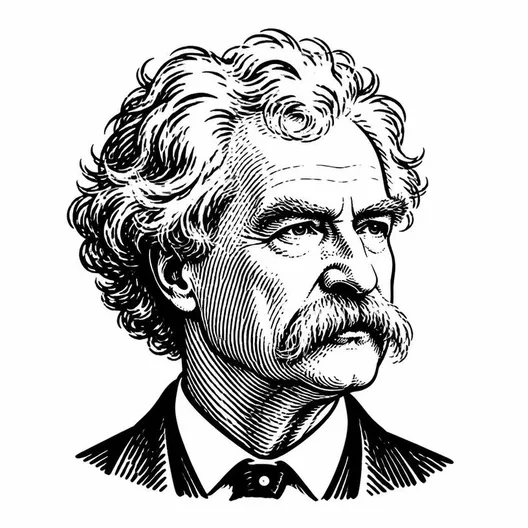 Mark Twain 1884