Part 2, Chapter 11
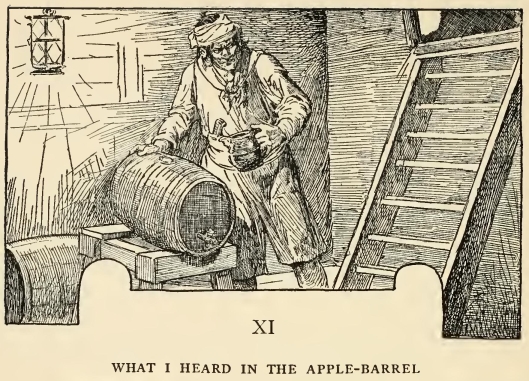
What I Heard in the Apple Barrel
No, not I,” said Silver. “Flint was cap’n; I was quartermaster, along of my timber leg. The same broadside I lost my leg, old Pew lost his deadlights. It was a master surgeon, him that ampytated me—out of college and all—Latin by the bucket, and what not; but he was hanged like a dog, and sun-dried like the rest, at Corso Castle. That was Roberts’ men, that was, and comed of changing names to their ships—Royal Fortune and so on. Now, what a ship was christened, so let her stay, I says. So it was with the Cassandra, as brought us all safe home from Malabar, after England took the Viceroy of the Indies; so it was with the old Walrus, Flint’s old ship, as I’ve seen amuck with the red blood and fit to sink with gold.”
“No, not me,” said Silver. “Flint was captain. I was quartermaster, on account of my wooden leg. I lost my leg in the same broadside that cost old Pew his eyes. The man who amputated my leg was a master surgeon, college-trained and all, with Latin by the bucket and whatnot. But he was hanged like a dog and left to dry in the sun like the rest, at Corso Castle. Those were Roberts’ men, they were. It came from changing their ships’ names, Royal Fortune and so on. Now, I say a ship should keep the name she was christened with. That was the way with the Cassandra, which brought us all safely home from Malabar, after England captured the Viceroy of the Indies. And so it was with the old Walrus, Flint’s old ship. I’ve seen her awash with red blood and so loaded with gold she was fit to sink.”
“Ah!” cried another voice, that of the youngest hand on board, and evidently full of admiration. “He was the flower of the flock, was Flint!”
“Ah!” cried another voice. It was the youngest sailor on board, and he sounded full of admiration. “Flint was the best of the lot!”
“Davis was a man too, by all accounts,” said Silver. “I never sailed along of him; first with England, then with Flint, that’s my story; and now here on my own account, in a manner of speaking. I laid by nine hundred safe, from England, and two thousand after Flint. That ain’t bad for a man before the mast—all safe in bank. ’Tain’t earning now, it’s saving does it, you may lay to that. Where’s all England’s men now? I dunno. Where’s Flint’s? Why, most on ’em aboard here, and glad to get the duff—been begging before that, some on ’em. Old Pew, as had lost his sight, and might have thought shame, spends twelve hundred pound in a year, like a lord in Parliament. Where is he now? Well, he’s dead now and under hatches; but for two year before that, shiver my timbers, the man was starving! He begged, and he stole, and he cut throats, and starved at that, by the powers!”
“Davis was a fine man too, by all accounts,” said Silver. “I never sailed with him. I sailed first with England, then with Flint. And now I’m here on my own account, in a manner of speaking. I saved nine hundred pounds from sailing with England, and two thousand after Flint. That’s not bad for an ordinary sailor, and it’s all safe in the bank. It’s not earning money that counts, it’s saving it. You can be sure of that. Where are all England’s men now? I don’t know. Where are Flint’s? Well, most of them are aboard this ship, glad to get a bit of pudding. Some of them had been begging before this. Old Pew lost his sight, and you’d think he might have been ashamed. But he spent twelve hundred pounds in a year, like a lord in Parliament. Where is he now? Well, he’s dead and buried. But for two years before that, shiver my timbers, the man was starving! He begged, and he stole, and he cut throats, and still he starved, by the powers!”
“Well, it ain’t much use, after all,” said the young seaman.
“Well, it’s not much use after all,” said the young sailor.
“’Tain’t much use for fools, you may lay to it—that, nor nothing,” cried Silver. “But now, you look here: you’re young, you are, but you’re as smart as paint. I see that when I set my eyes on you, and I’ll talk to you like a man.”
“You can be sure that’s no use to fools, and neither is anything else,” cried Silver. “But now, look here. You’re young, but you’re as sharp as they come. I saw that the moment I laid eyes on you, and I’ll talk to you like a man.”
You may imagine how I felt when I heard this abominable old rogue addressing another in the very same words of flattery as he had used to myself. I think, if I had been able, that I would have killed him through the barrel. Meantime, he ran on, little supposing he was overheard.
You can imagine how I felt when I heard that horrible old scoundrel flattering someone else in the very same words he had used on me. I think I would have killed him through the barrel if I could have. Meanwhile, he kept talking, never imagining that anyone was listening.
“Here it is about gentlemen of fortune. They lives rough, and they risk swinging, but they eat and drink like fighting-cocks, and when a cruise is done, why, it’s hundreds of pounds instead of hundreds of farthings in their pockets. Now, the most goes for rum and a good fling, and to sea again in their shirts. But that’s not the course I lay. I puts it all away, some here, some there, and none too much anywheres, by reason of suspicion. I’m fifty, mark you; once back from this cruise, I set up gentleman in earnest. Time enough too, says you. Ah, but I’ve lived easy in the meantime, never denied myself o’ nothing heart desires, and slep’ soft and ate dainty all my days but when at sea. And how did I begin? Before the mast, like you!”
“Here’s the thing about gentlemen of fortune. They live rough and risk being hanged, but they eat and drink like fighting cocks. When a voyage is over, they have hundreds of pounds in their pockets instead of hundreds of farthings. Now, most spend it on rum and a good time, then go back to sea in their shirts. But that’s not my way. I save it all, some here, some there, and never too much in one place, so nobody gets suspicious. I’m fifty, mind you. Once I’m back from this voyage, I’ll settle down as a real gentleman. About time, you say. Ah, but I’ve lived easy all along. I’ve never denied myself anything my heart desires. Except when I’ve been at sea, I’ve slept in comfort and eaten fine food all my life. And how did I start? Before the mast, as an ordinary sailor, just like you!”
“Well,” said the other, “but all the other money’s gone now, ain’t it? You daren’t show face in Bristol after this.”
“Well,” said the other, “but all the other money is gone now, isn’t it? You wouldn’t dare show your face in Bristol after this.”
“Why, where might you suppose it was?” asked Silver derisively.
“Where do you think it was?” Silver asked mockingly.
“At Bristol, in banks and places,” answered his companion.
“In Bristol, in banks and other places,” his companion replied.
“It were,” said the cook; “it were when we weighed anchor. But my old missis has it all by now. And the Spy-glass is sold, lease and goodwill and rigging; and the old girl’s off to meet me. I would tell you where, for I trust you, but it’d make jealousy among the mates.”
“It was,” said the cook. “It was when we set sail. But my wife has it all by now. And the Spy-glass is sold, lease, goodwill, and fittings. My wife is off to meet me. I trust you, so I would tell you where, but it would make the other mates jealous.”
“And can you trust your missis?” asked the other.
“And can you trust your wife?” asked the other.
“Gentlemen of fortune,” returned the cook, “usually trusts little among themselves, and right they are, you may lay to it. But I have a way with me, I have. When a mate brings a slip on his cable—one as knows me, I mean—it won’t be in the same world with old John. There was some that was feared of Pew, and some that was feared of Flint; but Flint his own self was feared of me. Feared he was, and proud. They was the roughest crew afloat, was Flint’s; the devil himself would have been feared to go to sea with them. Well now, I tell you, I’m not a boasting man, and you seen yourself how easy I keep company, but when I was quartermaster, lambs wasn’t the word for Flint’s old buccaneers. Ah, you may be sure of yourself in old John’s ship.”
“Gentlemen of fortune,” the cook replied, “usually don’t trust each other much, and you can be sure they’re right not to. But I have a way about me, I do. When a mate dies, I mean one who knows me, he won’t be in the same world as old John. Some were afraid of Pew, and some were afraid of Flint. But Flint himself was afraid of me. He was afraid, and proud too. Flint’s crew was the roughest afloat. The devil himself would have been afraid to go to sea with them. Now, I’m not a man to boast, and you’ve seen for yourself how easygoing I am. But when I was quartermaster, lambs wasn’t the word for Flint’s old pirates. Ah, you can be sure of yourself on old John’s ship.”
“Well, I tell you now,” replied the lad, “I didn’t half a quarter like the job till I had this talk with you, John; but there’s my hand on it now.”
“Well, I’ll tell you,” the boy replied, “I didn’t like the job one bit until I talked with you, John. But you have my word now.”
“And a brave lad you were, and smart too,” answered Silver, shaking hands so heartily that all the barrel shook, “and a finer figurehead for a gentleman of fortune I never clapped my eyes on.”
“You were a brave lad, and smart too,” Silver replied. He shook hands so heartily that the whole barrel shook. “I’ve never seen a finer figurehead for a pirate.”
By this time I had begun to understand the meaning of their terms. By a “gentleman of fortune” they plainly meant neither more nor less than a common pirate, and the little scene that I had overheard was the last act in the corruption of one of the honest hands—perhaps of the last one left aboard. But on this point I was soon to be relieved, for Silver giving a little whistle, a third man strolled up and sat down by the party.
By then I had begun to understand what their terms meant. By a “gentleman of fortune” they plainly meant nothing more or less than a common pirate. The scene I had overheard was the final step in turning one of the honest crew members into a pirate. Perhaps he was the last honest man left aboard. But I would soon have my doubts on that point relieved. Silver gave a little whistle, and a third man strolled over and sat down with the others.
“Dick’s square,” said Silver.
“Dick is with us,” said Silver.
“Oh, I know’d Dick was square,” returned the voice of the coxswain, Israel Hands. “He’s no fool, is Dick.” And he turned his quid and spat. “But look here,” he went on, “here’s what I want to know, Barbecue: how long are we a-going to stand off and on like a blessed bumboat? I’ve had a’most enough o’ Cap’n Smollett; he’s hazed me long enough, by thunder! I want to go into that cabin, I do. I want their pickles and wines, and that.”
“Oh, I knew Dick was loyal,” said the coxswain, Israel Hands. “Dick’s no fool.” He turned the plug of tobacco in his mouth and spat. “But look here,” he went on, “here’s what I want to know, Barbecue: how long are we going to hang around like a blasted bumboat? I’ve almost had enough of Captain Smollett. He’s pushed me around long enough, by thunder! I want to go into that cabin. I want their pickles and wines and the rest.”
“Israel,” said Silver, “your head ain’t much account, nor ever was. But you’re able to hear, I reckon; leastways, your ears is big enough. Now, here’s what I say: you’ll berth forward, and you’ll live hard, and you’ll speak soft, and you’ll keep sober till I give the word; and you may lay to that, my son.”
“Israel,” said Silver, “you’re not very bright, and you never were. But I reckon you can hear. At least your ears are big enough. Now, here’s what I say: you’ll sleep at the front of the ship and live on basic rations. You’ll speak quietly and stay sober until I say otherwise. And you can count on that, my son.”
“Well, I don’t say no, do I?” growled the coxswain. “What I say is, when? That’s what I say.”
“Well, I’m not saying no, am I?” growled the coxswain. “What I’m asking is, when? That’s what I’m asking.”
“When! By the powers!” cried Silver. “Well now, if you want to know, I’ll tell you when. The last moment I can manage, and that’s when. Here’s a first-rate seaman, Cap’n Smollett, sails the blessed ship for us. Here’s this squire and doctor with a map and such—I don’t know where it is, do I? No more do you, says you. Well then, I mean this squire and doctor shall find the stuff, and help us to get it aboard, by the powers. Then we’ll see. If I was sure of you all, sons of double Dutchmen, I’d have Cap’n Smollett navigate us half-way back again before I struck.”
“When! By the powers!” cried Silver. “Well, if you want to know, I’ll tell you when. At the very last moment I can manage, that’s when. Captain Smollett is a first-rate sailor, and he’s sailing the blessed ship for us. The squire and the doctor have a map and such. I don’t know where the map is, do I? And you say you don’t either. So I mean to have the squire and the doctor find the treasure and help us get it aboard. By the powers, then we’ll see. If I could trust all of you, you sons of double Dutchmen, I’d have Captain Smollett sail us halfway back before I made my move.”
“Why, we’re all seamen aboard here, I should think,” said the lad Dick.
“Why, I’d think we’re all sailors on board,” said the young man Dick.
“We’re all forecastle hands, you mean,” snapped Silver. “We can steer a course, but who’s to set one? That’s what all you gentlemen split on, first and last. If I had my way, I’d have Cap’n Smollett work us back into the trades at least; then we’d have no blessed miscalculations and a spoonful of water a day. But I know the sort you are. I’ll finish with ’em at the island, as soon’s the blunt’s on board, and a pity it is. But you’re never happy till you’re drunk. Split my sides, I’ve a sick heart to sail with the likes of you!”
“We’re all ordinary sailors, you mean,” snapped Silver. “We can steer a ship, but who can plot a course? That’s where all you gentlemen go wrong, every time. If I had my way, I’d have Captain Smollett take us back to the trade winds, at least. Then we wouldn’t end up making damned mistakes and living on a spoonful of water a day. But I know what you’re like. I’ll finish them off at the island, as soon as the money is on board. And that’s a shame. But you’re never happy until you’re drunk. I swear, it makes me sick to sail with the likes of you!”
“Easy all, Long John,” cried Israel. “Who’s a-crossin’ of you?”
“Take it easy, Long John,” cried Israel. “Who’s opposing you?”
“Why, how many tall ships, think ye, now, have I seen laid aboard? And how many brisk lads drying in the sun at Execution Dock?” cried Silver. “And all for this same hurry and hurry and hurry. You hear me? I seen a thing or two at sea, I have. If you would on’y lay your course, and a p’int to windward, you would ride in carriages, you would. But not you! I know you. You’ll have your mouthful of rum tomorrow, and go hang.”
“How many tall ships do you think I’ve seen boarded? And how many lively young men have I seen hanging in the sun at Execution Dock?” cried Silver. “And all because of this rushing and rushing and rushing. Do you hear me? I’ve seen a thing or two at sea. If you’d only plan your course and allow for the wind, you’d ride in carriages. But not you! I know you. You’ll have your mouthful of rum tomorrow, and then you’ll hang.”
“Everybody knowed you was a kind of a chapling, John; but there’s others as could hand and steer as well as you,” said Israel. “They liked a bit o’ fun, they did. They wasn’t so high and dry, nohow, but took their fling, like jolly companions every one.”
“Everybody knew you were a sort of chaplain, John. But others could handle the sails and steer as well as you,” said Israel. “They liked a bit of fun. They weren’t so stiff and proper. They enjoyed themselves, every one of them, like good companions.”
“So?” says Silver. “Well, and where are they now? Pew was that sort, and he died a beggar-man. Flint was, and he died of rum at Savannah. Ah, they was a sweet crew, they was! On’y, where are they?”
“So?” says Silver. “Well, where are they now? Pew was like that, and he died a beggar. Flint was too, and he died from drinking rum in Savannah. Ah, they were a fine crew, they were! But where are they now?”
“But,” asked Dick, “when we do lay ’em athwart, what are we to do with ’em, anyhow?”
“But,” asked Dick, “when we do overpower them, what are we going to do with them, anyway?”
“There’s the man for me!” cried the cook admiringly. “That’s what I call business. Well, what would you think? Put ’em ashore like maroons? That would have been England’s way. Or cut ’em down like that much pork? That would have been Flint’s, or Billy Bones’s.”
“There’s the man for me!” cried the cook admiringly. “That’s what I call getting things done. Well, what do you think? Leave them stranded ashore? That would have been England’s way. Or cut them down like so much pork? That would have been Flint’s way, or Billy Bones’s.”
“Billy was the man for that,” said Israel. “‘Dead men don’t bite,’ says he. Well, he’s dead now hisself; he knows the long and short on it now; and if ever a rough hand come to port, it was Billy.”
“Billy was the man for that,” said Israel. “‘Dead men don’t bite,’ he used to say. Well, he’s dead himself now. He knows all about it now. And if ever a rough sailor came to port, it was Billy.”
“Right you are,” said Silver; “rough and ready. But mark you here, I’m an easy man—I’m quite the gentleman, says you; but this time it’s serious. Dooty is dooty, mates. I give my vote—death. When I’m in Parlyment and riding in my coach, I don’t want none of these sea-lawyers in the cabin a-coming home, unlooked for, like the devil at prayers. Wait is what I say; but when the time comes, why, let her rip!”
“Right you are,” said Silver. “Rough and ready. But listen here, I’m an easy man, quite the gentleman, you might say. This time it’s serious, though. Duty is duty, mates. I vote for death. When I’m in Parliament and riding in my coach, I don’t want any of these sea-lawyers coming home unexpectedly. They’d be like the devil showing up at prayers. I say we wait, but when the time comes, let her rip!”
“John,” cries the coxswain, “you’re a man!”
“John,” the coxswain cries, “you’re a man!”
“You’ll say so, Israel when you see,” said Silver. “Only one thing I claim—I claim Trelawney. I’ll wring his calf’s head off his body with these hands, Dick!” he added, breaking off. “You just jump up, like a sweet lad, and get me an apple, to wet my pipe like.”
“You’ll agree when you see, Israel,” said Silver. “I only claim one thing. I claim Trelawney. I’ll twist his stupid head off his body with these hands. Dick!” he added, changing the subject. “Be a good lad and jump up and get me an apple to wet my throat.”
You may fancy the terror I was in! I should have leaped out and run for it if I had found the strength, but my limbs and heart alike misgave me. I heard Dick begin to rise, and then someone seemingly stopped him, and the voice of Hands exclaimed, “Oh, stow that! Don’t you get sucking of that bilge, John. Let’s have a go of the rum.”
You can imagine how terrified I was! I would have jumped out and run away if I had been strong enough. But my legs and my courage failed me. I heard Dick start to get up, but someone seemed to stop him. Then Hands cried out, “Oh, stop that! Don’t drink that swill, John. Let’s have some rum.”
“Dick,” said Silver, “I trust you. I’ve a gauge on the keg, mind. There’s the key; you fill a pannikin and bring it up.”
“Dick,” said Silver, “I trust you. But mind, I know how much is in the keg. Here’s the key. Fill a cup and bring it up.”
Terrified as I was, I could not help thinking to myself that this must have been how Mr. Arrow got the strong waters that destroyed him.
Terrified as I was, I could not help thinking that this must have been how Mr. Arrow got the liquor that destroyed him.
Dick was gone but a little while, and during his absence Israel spoke straight on in the cook’s ear. It was but a word or two that I could catch, and yet I gathered some important news, for besides other scraps that tended to the same purpose, this whole clause was audible: “Not another man of them’ll jine.” Hence there were still faithful men on board.
Dick was gone only a short while. During his absence, Israel spoke steadily into the cook’s ear. I could catch only a word or two, but I gathered some important news. I heard a few scraps that pointed to the same thing, and I could hear this whole phrase: “Not another man of them will join.” So there were still loyal men on board.
When Dick returned, one after another of the trio took the pannikin and drank—one “To luck,” another with a “Here’s to old Flint,” and Silver himself saying, in a kind of song, “Here’s to ourselves, and hold your luff, plenty of prizes and plenty of duff.”
When Dick returned, the three men took turns drinking from the cup. One said, “To luck,” and another said, “Here’s to old Flint.” Silver himself sang out, “Here’s to ourselves, and hold your luff, plenty of prizes and plenty of duff.”
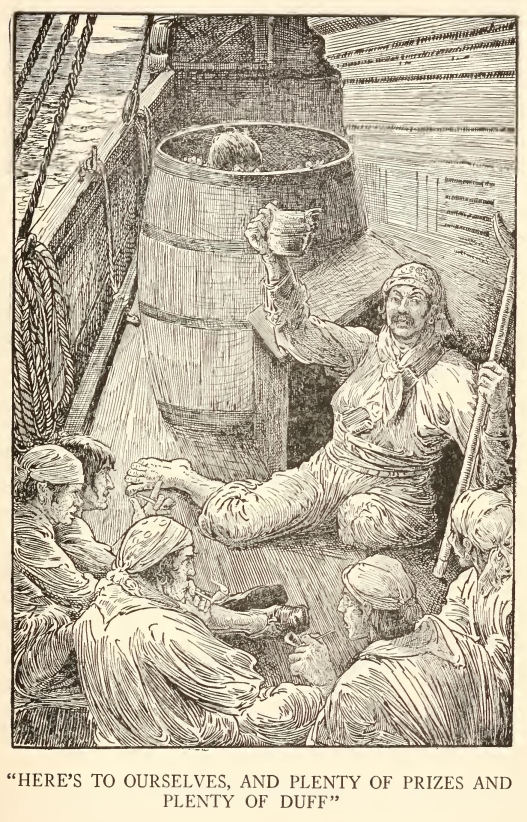
Just then a sort of brightness fell upon me in the barrel, and looking up, I found the moon had risen and was silvering the mizzen-top and shining white on the luff of the fore-sail; and almost at the same time the voice of the lookout shouted, “Land ho!”
Just then, a kind of brightness fell on me in the barrel. I looked up and saw that the moon had risen. It turned the mizzen-top silver and shone white on the front edge of the foresail. Almost at the same time, the lookout shouted, “Land ho!”