Part 3, Chapter 13
How My Shore Adventure Began
The appearance of the island when I came on deck next morning was altogether changed. Although the breeze had now utterly ceased, we had made a great deal of way during the night and were now lying becalmed about half a mile to the south-east of the low eastern coast. Grey-coloured woods covered a large part of the surface. This even tint was indeed broken up by streaks of yellow sand-break in the lower lands, and by many tall trees of the pine family, out-topping the others—some singly, some in clumps; but the general colouring was uniform and sad. The hills ran up clear above the vegetation in spires of naked rock. All were strangely shaped, and the Spy-glass, which was by three or four hundred feet the tallest on the island, was likewise the strangest in configuration, running up sheer from almost every side and then suddenly cut off at the top like a pedestal to put a statue on.
When I came on deck the next morning, the island looked completely different. Although the breeze had died away, we had made a lot of progress during the night. We now lay becalmed about half a mile southeast of the low eastern coast. Gray woods covered much of the island. Streaks of yellow sand broke up the gray in the lowlands. Many tall pine trees also rose above the others, some alone and some in groups. But the overall color was uniform and gloomy. The hills rose above the vegetation in spires of bare rock. All were strangely shaped, but the Spy-glass was the strangest of all. It was three or four hundred feet taller than any other hill on the island. It rose steeply on almost every side, then ended abruptly in a flat top, like a pedestal for a statue.
The Hispaniola was rolling scuppers under in the ocean swell. The booms were tearing at the blocks, the rudder was banging to and fro, and the whole ship creaking, groaning, and jumping like a manufactory. I had to cling tight to the backstay, and the world turned giddily before my eyes, for though I was a good enough sailor when there was way on, this standing still and being rolled about like a bottle was a thing I never learned to stand without a qualm or so, above all in the morning, on an empty stomach.
The Hispaniola rolled so far in the ocean swell that her scuppers dipped underwater. The booms pulled hard at their blocks, and the rudder banged back and forth. The whole ship creaked, groaned, and jumped like a factory. I had to hold tight to the backstay, and the world spun before my eyes. I was a good enough sailor when the ship was moving. But I never learned to endure being rolled about like a bottle while the ship stood still without feeling a little sick. It was worst in the morning, on an empty stomach.
Perhaps it was this—perhaps it was the look of the island, with its grey, melancholy woods, and wild stone spires, and the surf that we could both see and hear foaming and thundering on the steep beach—at least, although the sun shone bright and hot, and the shore birds were fishing and crying all around us, and you would have thought anyone would have been glad to get to land after being so long at sea, my heart sank, as the saying is, into my boots; and from the first look onward, I hated the very thought of Treasure Island.
Perhaps it was this. Or perhaps it was the sight of the island, with its gray, gloomy woods and wild stone spires. We could see and hear the surf foaming and thundering on the steep beach. The sun shone bright and hot, and shore birds were fishing and crying all around us. After so long at sea, you would have thought anyone would be glad to reach land. Even so, my heart sank into my boots, as the saying goes. From that first look, I hated the very thought of Treasure Island.
We had a dreary morning’s work before us, for there was no sign of any wind, and the boats had to be got out and manned, and the ship warped three or four miles round the corner of the island and up the narrow passage to the haven behind Skeleton Island. I volunteered for one of the boats, where I had, of course, no business. The heat was sweltering, and the men grumbled fiercely over their work. Anderson was in command of my boat, and instead of keeping the crew in order, he grumbled as loud as the worst.
We had a dreary morning’s work ahead of us because there was no sign of wind. We had to get the boats out and crew them. Then we had to pull the ship with ropes three or four miles around the corner of the island. From there, we had to pull her up the narrow passage to the haven behind Skeleton Island. I volunteered for one of the boats, though I had no business being there, of course. The heat was sweltering, and the men grumbled fiercely as they worked. Anderson was in command of my boat. Instead of keeping the crew in order, he grumbled as loudly as the worst of them.
“Well,” he said with an oath, “it’s not forever.”
“Well,” he said with a curse, “it’s not forever.”
I thought this was a very bad sign, for up to that day the men had gone briskly and willingly about their business; but the very sight of the island had relaxed the cords of discipline.
I thought this was a very bad sign. Until that day, the men had worked quickly and willingly. But just seeing the island had weakened their discipline.
All the way in, Long John stood by the steersman and conned the ship. He knew the passage like the palm of his hand, and though the man in the chains got everywhere more water than was down in the chart, John never hesitated once.
All the way in, Long John stood beside the helmsman and directed the ship. He knew the passage like the palm of his hand. The man measuring the depth found more water everywhere than the chart showed, but John never hesitated once.
“There’s a strong scour with the ebb,” he said, “and this here passage has been dug out, in a manner of speaking, with a spade.”
“There’s a strong current when the tide goes out,” he said, “and this passage has been dug out with a spade, so to speak.”
We brought up just where the anchor was in the chart, about a third of a mile from each shore, the mainland on one side and Skeleton Island on the other. The bottom was clean sand. The plunge of our anchor sent up clouds of birds wheeling and crying over the woods, but in less than a minute they were down again and all was once more silent.
We anchored right where the chart showed, about a third of a mile from each shore. The mainland was on one side and Skeleton Island on the other. The bottom was clean sand. As our anchor plunged into the water, clouds of birds rose, circling and crying over the woods. But in less than a minute, the birds settled down again, and all was silent once more.
The place was entirely land-locked, buried in woods, the trees coming right down to high-water mark, the shores mostly flat, and the hilltops standing round at a distance in a sort of amphitheatre, one here, one there. Two little rivers, or rather two swamps, emptied out into this pond, as you might call it; and the foliage round that part of the shore had a kind of poisonous brightness. From the ship we could see nothing of the house or stockade, for they were quite buried among trees; and if it had not been for the chart on the companion, we might have been the first that had ever anchored there since the island arose out of the seas.
The place was completely enclosed by land and buried in woods. The trees came right down to the high-water mark, and the shores were mostly flat. In the distance, hilltops stood here and there in a kind of amphitheater. Two little rivers, or rather two swamps, emptied into what you might call this pond. The foliage along that part of the shore had a kind of poisonous brightness. From the ship, we could see nothing of the house or stockade, because they were completely hidden among the trees. If it had not been for the chart on the companionway, we might have been the first ever to anchor there since the island rose from the sea.
There was not a breath of air moving, nor a sound but that of the surf booming half a mile away along the beaches and against the rocks outside. A peculiar stagnant smell hung over the anchorage—a smell of sodden leaves and rotting tree trunks. I observed the doctor sniffing and sniffing, like someone tasting a bad egg.
Not a breath of air moved. The only sound was the surf booming half a mile away along the beaches and against the rocks beyond. A strange, stale smell hung over the anchorage, the smell of soaked leaves and rotting tree trunks. I watched the doctor sniffing again and again, like someone tasting a bad egg.
“I don’t know about treasure,” he said, “but I’ll stake my wig there’s fever here.”
“I don’t know about treasure,” he said, “but I’d bet anything there’s fever here.”
If the conduct of the men had been alarming in the boat, it became truly threatening when they had come aboard. They lay about the deck growling together in talk. The slightest order was received with a black look and grudgingly and carelessly obeyed. Even the honest hands must have caught the infection, for there was not one man aboard to mend another. Mutiny, it was plain, hung over us like a thunder-cloud.
If the men’s behavior in the boat had been alarming, it became truly threatening once they came aboard. They lounged on the deck, talking together in low, growling voices. They scowled at the slightest order and obeyed it reluctantly and carelessly. Even the loyal sailors must have caught the mood, for not one man aboard was any better than another. Clearly, mutiny hung over us like a thundercloud.
And it was not only we of the cabin party who perceived the danger. Long John was hard at work going from group to group, spending himself in good advice, and as for example no man could have shown a better. He fairly outstripped himself in willingness and civility; he was all smiles to everyone. If an order were given, John would be on his crutch in an instant, with the cheeriest “Aye, aye, sir!” in the world; and when there was nothing else to do, he kept up one song after another, as if to conceal the discontent of the rest.
And we in the cabin party were not the only ones who saw the danger. Long John was working hard, going from group to group and giving plenty of good advice. No one could have set a better example. He outdid himself in willingness and politeness, and he smiled at everyone. If someone gave an order, John would be up on his crutch in an instant, with the cheeriest “Aye, aye, sir!” imaginable. When there was nothing else to do, he sang one song after another, as if to hide the others’ discontent.
Of all the gloomy features of that gloomy afternoon, this obvious anxiety on the part of Long John appeared the worst.
Of all the gloomy things about that afternoon, Long John’s obvious anxiety seemed the worst.
We held a council in the cabin.
We held a meeting in the cabin.
“Sir,” said the captain, “if I risk another order, the whole ship’ll come about our ears by the run. You see, sir, here it is. I get a rough answer, do I not? Well, if I speak back, pikes will be going in two shakes; if I don’t, Silver will see there’s something under that, and the game’s up. Now, we’ve only one man to rely on.”
“Sir,” said the captain, “if I risk giving another order, the whole ship will be in an uproar. You see, sir, here’s the problem. I get a rude answer, don’t I? Well, if I answer back, the pikes will be out in no time. If I don’t, Silver will see that something’s behind it, and the game’s up. Now, we have only one man we can rely on.”
“And who is that?” asked the squire.
“And who is that?” asked the squire.
“Silver, sir,” returned the captain; “he’s as anxious as you and I to smother things up. This is a tiff; he’d soon talk ’em out of it if he had the chance, and what I propose to do is to give him the chance. Let’s allow the men an afternoon ashore. If they all go, why we’ll fight the ship. If they none of them go, well then, we hold the cabin, and God defend the right. If some go, you mark my words, sir, Silver’ll bring ’em aboard again as mild as lambs.”
“Silver, sir,” replied the captain. “He’s as eager as you and I are to smooth things over. This is a quarrel. He’d soon talk the men out of it if he had the chance. I propose we give him that chance. Let’s let the men spend the afternoon ashore. If they all go, we’ll fight to keep the ship. If none of them go, we’ll hold the cabin, and God defend the right. If some go, mark my words, sir, Silver will bring them back aboard as gentle as lambs.”
It was so decided; loaded pistols were served out to all the sure men; Hunter, Joyce, and Redruth were taken into our confidence and received the news with less surprise and a better spirit than we had looked for, and then the captain went on deck and addressed the crew.
So it was decided. Loaded pistols were given to all the men we could trust. We told Hunter, Joyce, and Redruth the news. They were less surprised and took it better than we had expected. Then the captain went on deck and spoke to the crew.
“My lads,” said he, “we’ve had a hot day and are all tired and out of sorts. A turn ashore’ll hurt nobody—the boats are still in the water; you can take the gigs, and as many as please may go ashore for the afternoon. I’ll fire a gun half an hour before sundown.”
“My lads,” he said, “we’ve had a hot day, and we’re all tired and in bad moods. A trip ashore won’t hurt anyone. The boats are still in the water, so you can take the gigs. Anyone who wants to may go ashore for the afternoon. I’ll fire a gun half an hour before sunset.”
I believe the silly fellows must have thought they would break their shins over treasure as soon as they were landed, for they all came out of their sulks in a moment and gave a cheer that started the echo in a faraway hill and sent the birds once more flying and squalling round the anchorage.
I believe the foolish fellows must have thought they would stumble over treasure as soon as they landed. They all stopped sulking at once and gave a cheer. It echoed from a distant hill and sent the birds flying and squawking around the anchorage again.
The captain was too bright to be in the way. He whipped out of sight in a moment, leaving Silver to arrange the party, and I fancy it was as well he did so. Had he been on deck, he could no longer so much as have pretended not to understand the situation. It was as plain as day. Silver was the captain, and a mighty rebellious crew he had of it. The honest hands—and I was soon to see it proved that there were such on board—must have been very stupid fellows. Or rather, I suppose the truth was this, that all hands were disaffected by the example of the ringleaders—only some more, some less; and a few, being good fellows in the main, could neither be led nor driven any further. It is one thing to be idle and skulk and quite another to take a ship and murder a number of innocent men.
The captain was too smart to get in the way. He disappeared in a moment, leaving Silver to organize the party. I think it was just as well he did. If he had been on deck, he could no longer have pretended not to understand the situation. It was as clear as day. Silver was the captain, and he had a very rebellious crew. The honest sailors must have been very foolish. I was soon to see proof that there were honest sailors on board. Or rather, I suppose the truth was that all the sailors had been led astray by the ringleaders' example. Some were more disaffected than others. A few were good fellows at heart and could not be persuaded or forced to go any further. It is one thing to be lazy and shirk your work, and quite another to seize a ship and murder innocent men.
At last, however, the party was made up. Six fellows were to stay on board, and the remaining thirteen, including Silver, began to embark.
At last, however, the group was chosen. Six men were to stay on board. The remaining thirteen, including Silver, began to board the boats.
Then it was that there came into my head the first of the mad notions that contributed so much to save our lives. If six men were left by Silver, it was plain our party could not take and fight the ship; and since only six were left, it was equally plain that the cabin party had no present need of my assistance. It occurred to me at once to go ashore. In a jiffy I had slipped over the side and curled up in the fore-sheets of the nearest boat, and almost at the same moment she shoved off.
That was when I had the first of the wild ideas that did so much to save our lives. If Silver left six men aboard, our party clearly could not take the ship and fight it. And since only six were left, the group in the cabin clearly had no immediate need of my help. I immediately thought of going ashore. In a moment, I had slipped over the side and curled up in the bow of the nearest boat. Almost at the same moment, the boat pushed off.
No one took notice of me, only the bow oar saying, “Is that you, Jim? Keep your head down.” But Silver, from the other boat, looked sharply over and called out to know if that were me; and from that moment I began to regret what I had done.
No one paid attention to me, except the man rowing at the bow. He said, “Is that you, Jim? Keep your head down.” But Silver looked sharply over from the other boat and called out to ask if it was me. From that moment, I began to regret what I had done.
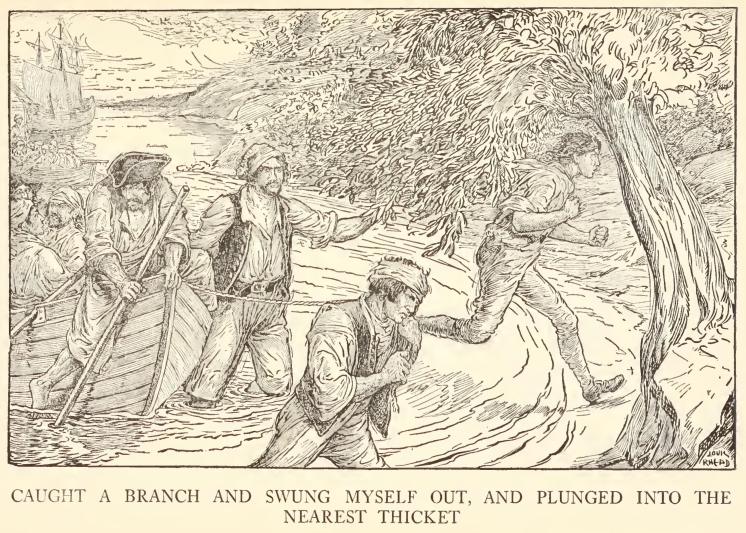
The crews raced for the beach, but the boat I was in, having some start and being at once the lighter and the better manned, shot far ahead of her consort, and the bow had struck among the shore-side trees and I had caught a branch and swung myself out and plunged into the nearest thicket while Silver and the rest were still a hundred yards behind.
The crews raced for the beach, but my boat had a head start. It was also lighter and had a stronger crew, so it sped far ahead of the other boat. The bow struck the trees along the shore. I grabbed a branch, swung myself out, and plunged into the nearest thicket. Silver and the rest were still a hundred yards behind.
“Jim, Jim!” I heard him shouting.
“Jim, Jim!” I heard him shout.
But you may suppose I paid no heed; jumping, ducking, and breaking through, I ran straight before my nose till I could run no longer.
But you can imagine I paid no attention. Jumping, ducking, and pushing through, I ran straight ahead until I could run no farther.