Part 6, Chapter 34
And Last
The next morning we fell early to work, for the transportation of this great mass of gold near a mile by land to the beach, and thence three miles by boat to the Hispaniola, was a considerable task for so small a number of workmen. The three fellows still abroad upon the island did not greatly trouble us; a single sentry on the shoulder of the hill was sufficient to ensure us against any sudden onslaught, and we thought, besides, they had had more than enough of fighting.
The next morning, we started work early. Moving the great mass of gold nearly a mile over land to the beach was a big job. Then we had to carry it three miles by boat to the Hispaniola. It was a considerable task for so few workers. The three men still at large on the island did not worry us much. One guard on the hillside was enough to protect us against a sudden attack. Besides, we thought the three men had had more than enough fighting.
Therefore the work was pushed on briskly. Gray and Ben Gunn came and went with the boat, while the rest during their absences piled treasure on the beach. Two of the bars, slung in a rope’s end, made a good load for a grown man—one that he was glad to walk slowly with. For my part, as I was not much use at carrying, I was kept busy all day in the cave packing the minted money into bread-bags.
So the work went ahead quickly. Gray and Ben Gunn went back and forth in the boat. While they were away, the rest piled treasure on the beach. Two bars tied to the end of a rope were a heavy load for a grown man. He was glad to walk slowly while carrying them. As for me, I was not much use carrying things, so I spent all day in the cave packing the coins into bread bags.
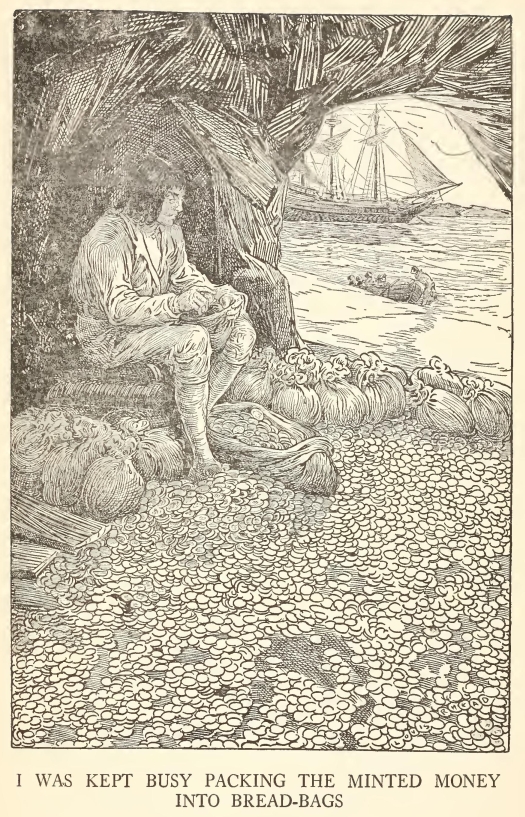
It was a strange collection, like Billy Bones’s hoard for the diversity of coinage, but so much larger and so much more varied that I think I never had more pleasure than in sorting them. English, French, Spanish, Portuguese, Georges, and Louises, doubloons and double guineas and moidores and sequins, the pictures of all the kings of Europe for the last hundred years, strange Oriental pieces stamped with what looked like wisps of string or bits of spider’s web, round pieces and square pieces, and pieces bored through the middle, as if to wear them round your neck—nearly every variety of money in the world must, I think, have found a place in that collection; and for number, I am sure they were like autumn leaves, so that my back ached with stooping and my fingers with sorting them out.
It was a strange collection, with as many kinds of coins as Billy Bones’s hoard. But it was much larger and more varied, and I don’t think I ever enjoyed anything more than sorting the coins. There were English, French, Spanish, and Portuguese coins: Georges and Louises, doubloons and double guineas, moidores and sequins. There were coins bearing the faces of all the kings of Europe from the last hundred years. There were strange Oriental coins stamped with what looked like wisps of string or bits of spiderweb. Some coins were round, some square, and some had holes in the middle, as if to wear around your neck. I think the collection must have contained nearly every kind of money in the world. And I’m sure the coins were as numerous as autumn leaves. My back ached from bending over them, and my fingers ached from sorting them.
Day after day this work went on; by every evening a fortune had been stowed aboard, but there was another fortune waiting for the morrow; and all this time we heard nothing of the three surviving mutineers.
Day after day, the work went on. By evening, we had loaded a fortune aboard, but another fortune waited for the next day. All this time, we heard nothing of the three surviving mutineers.
At last—I think it was on the third night—the doctor and I were strolling on the shoulder of the hill where it overlooks the lowlands of the isle, when, from out the thick darkness below, the wind brought us a noise between shrieking and singing. It was only a snatch that reached our ears, followed by the former silence.
At last, I think it was on the third night, the doctor and I were walking along the hillside. From there, we could see the island’s lowlands. The wind brought us a sound from the deep darkness below, somewhere between shrieking and singing. We heard only a short burst before the silence returned.
“Heaven forgive them,” said the doctor; “’tis the mutineers!”
“Heaven forgive them,” said the doctor. “It’s the mutineers!”
“All drunk, sir,” struck in the voice of Silver from behind us.
“All drunk, sir,” Silver interrupted from behind us.
Silver, I should say, was allowed his entire liberty, and in spite of daily rebuffs, seemed to regard himself once more as quite a privileged and friendly dependent. Indeed, it was remarkable how well he bore these slights and with what unwearying politeness he kept on trying to ingratiate himself with all. Yet, I think, none treated him better than a dog, unless it was Ben Gunn, who was still terribly afraid of his old quartermaster, or myself, who had really something to thank him for; although for that matter, I suppose, I had reason to think even worse of him than anybody else, for I had seen him meditating a fresh treachery upon the plateau. Accordingly, it was pretty gruffly that the doctor answered him.
I should say that Silver was allowed complete freedom. Despite being rebuffed every day, he seemed to consider himself once again a favored and friendly dependent. It was remarkable how well he took these insults. He also never tired of trying, with great politeness, to win everyone over. Yet I think no one treated him better than a dog, except perhaps Ben Gunn and me. Ben Gunn was still terribly afraid of his old quartermaster, and I really did have something to thank Silver for. Although, for that matter, I suppose I had reason to think even worse of him than anyone else. I had seen him plotting another betrayal on the plateau. So the doctor answered him rather gruffly.
“Drunk or raving,” said he.
“Drunk or delirious,” he said.
“Right you were, sir,” replied Silver; “and precious little odds which, to you and me.”
“You were right, sir,” replied Silver. “And it makes very little difference to you and me which it was.”
“I suppose you would hardly ask me to call you a humane man,” returned the doctor with a sneer, “and so my feelings may surprise you, Master Silver. But if I were sure they were raving—as I am morally certain one, at least, of them is down with fever—I should leave this camp, and at whatever risk to my own carcass, take them the assistance of my skill.”
“I suppose you would hardly ask me to call you a humane man,” the doctor replied with a sneer. “So my feelings may surprise you, Master Silver. I am practically certain that at least one of them is down with fever. But if I were sure they were delirious, I would leave this camp and give them my medical help, whatever the risk to my own life.”
“Ask your pardon, sir, you would be very wrong,” quoth Silver. “You would lose your precious life, and you may lay to that. I’m on your side now, hand and glove; and I shouldn’t wish for to see the party weakened, let alone yourself, seeing as I know what I owes you. But these men down there, they couldn’t keep their word—no, not supposing they wished to; and what’s more, they couldn’t believe as you could.”
“Begging your pardon, sir, you would be very wrong,” said Silver. “You would lose your precious life, and you can count on that. I’m completely on your side now. I wouldn’t want to see the party weakened, let alone see you harmed, knowing what I owe you. But those men down there couldn’t keep their word, even if they wanted to. And what’s more, they couldn’t believe that you could keep yours.”
“No,” said the doctor. “You’re the man to keep your word, we know that.”
“No,” said the doctor. “You’re a man who keeps his word. We know that.”
Well, that was about the last news we had of the three pirates. Only once we heard a gunshot a great way off and supposed them to be hunting. A council was held, and it was decided that we must desert them on the island—to the huge glee, I must say, of Ben Gunn, and with the strong approval of Gray. We left a good stock of powder and shot, the bulk of the salt goat, a few medicines, and some other necessaries, tools, clothing, a spare sail, a fathom or two of rope, and by the particular desire of the doctor, a handsome present of tobacco.
Well, that was about the last news we had of the three pirates. Only once, we heard a gunshot a long way off and assumed the pirates were hunting. We held a council and decided to leave them on the island. I must say, Ben Gunn was delighted, and Gray strongly approved. We left a good supply of gunpowder and shot, most of the salted goat meat, and a few medicines. We also left other necessities, including tools, clothing, a spare sail, and six to twelve feet of rope. At the doctor’s particular request, we also left a generous gift of tobacco.
That was about our last doing on the island. Before that, we had got the treasure stowed and had shipped enough water and the remainder of the goat meat in case of any distress; and at last, one fine morning, we weighed anchor, which was about all that we could manage, and stood out of North Inlet, the same colours flying that the captain had flown and fought under at the palisade.
That was about the last thing we did on the island. Before that, we had stowed the treasure and loaded enough water and the rest of the goat meat in case of trouble. At last, one fine morning, we raised the anchor, which was about all we could manage. Then we sailed out of North Inlet, flying the same flag the captain had flown and fought under at the palisade.
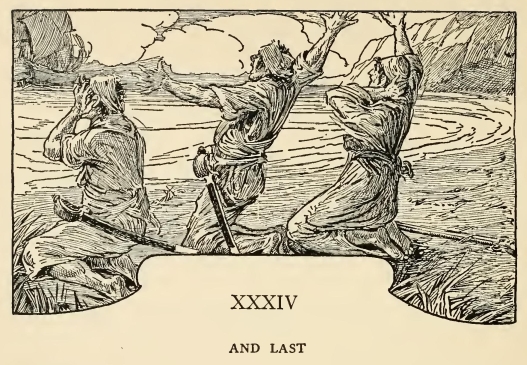
The three fellows must have been watching us closer than we thought for, as we soon had proved. For coming through the narrows, we had to lie very near the southern point, and there we saw all three of them kneeling together on a spit of sand, with their arms raised in supplication. It went to all our hearts, I think, to leave them in that wretched state; but we could not risk another mutiny; and to take them home for the gibbet would have been a cruel sort of kindness. The doctor hailed them and told them of the stores we had left, and where they were to find them. But they continued to call us by name and appeal to us, for God’s sake, to be merciful and not leave them to die in such a place.
The three men must have been watching us more closely than we thought, as we soon discovered. As we sailed through the narrow passage, we had to stay close to the southern point. There we saw all three men kneeling together on a strip of sand, with their arms raised in a plea. I think it pained all of us to leave them in such a miserable state. But we could not risk another mutiny. And taking them home to be hanged would have been a cruel kind of kindness. The doctor called out to them about the supplies we had left and where to find them. But they kept calling us by name. They begged us, for God’s sake, to show mercy and not leave them to die in such a place.
At last, seeing the ship still bore on her course and was now swiftly drawing out of earshot, one of them—I know not which it was—leapt to his feet with a hoarse cry, whipped his musket to his shoulder, and sent a shot whistling over Silver’s head and through the main-sail.
At last, they saw that the ship was still on course and quickly moving out of earshot. One of them leapt to his feet with a hoarse cry. I don't know which one. He raised his musket to his shoulder and fired. The shot whistled over Silver’s head and through the main sail.
After that, we kept under cover of the bulwarks, and when next I looked out they had disappeared from the spit, and the spit itself had almost melted out of sight in the growing distance. That was, at least, the end of that; and before noon, to my inexpressible joy, the highest rock of Treasure Island had sunk into the blue round of sea.
After that, we stayed behind the ship’s bulwarks. When I looked out again, they had disappeared from the spit of land. The spit itself had almost vanished as we sailed farther away. At least that was the end of that. Before noon, to my indescribable joy, even the highest rock on Treasure Island had disappeared below the blue horizon.
We were so short of men that everyone on board had to bear a hand—only the captain lying on a mattress in the stern and giving his orders, for though greatly recovered he was still in want of quiet. We laid her head for the nearest port in Spanish America, for we could not risk the voyage home without fresh hands; and as it was, what with baffling winds and a couple of fresh gales, we were all worn out before we reached it.
We were so short of men that everyone on board had to help. Only the captain lay on a mattress at the stern, giving orders. Though he had recovered greatly, he still needed rest. We headed for the nearest port in Spanish America because we could not risk sailing home without more crew. Even so, the shifting winds and a couple of strong storms wore us all out before we reached port.
It was just at sundown when we cast anchor in a most beautiful land-locked gulf, and were immediately surrounded by shore boats full of Negroes and Mexican Indians and half-bloods selling fruits and vegetables and offering to dive for bits of money. The sight of so many good-humoured faces (especially the blacks), the taste of the tropical fruits, and above all the lights that began to shine in the town made a most charming contrast to our dark and bloody sojourn on the island; and the doctor and the squire, taking me along with them, went ashore to pass the early part of the night. Here they met the captain of an English man-of-war, fell in talk with him, went on board his ship, and, in short, had so agreeable a time that day was breaking when we came alongside the Hispaniola.
Just at sunset, we anchored in a beautiful, sheltered gulf. Boats from shore immediately surrounded us. They were full of Black people, Mexican Indians, and people of mixed ancestry. They sold fruit and vegetables and offered to dive for coins. Their good-humored faces, especially those of the Black people, made a charming contrast to our dark and bloody stay on the island. So did the taste of tropical fruit and, above all, the lights beginning to shine in the town. The doctor and the squire took me ashore with them to spend the early part of the night. There they met the captain of a British warship and began talking with him. We went aboard his ship and had such a pleasant time that day was breaking when we came alongside the Hispaniola.
Ben Gunn was on deck alone, and as soon as we came on board he began, with wonderful contortions, to make us a confession. Silver was gone. The maroon had connived at his escape in a shore boat some hours ago, and he now assured us he had only done so to preserve our lives, which would certainly have been forfeit if “that man with the one leg had stayed aboard.” But this was not all. The sea-cook had not gone empty-handed. He had cut through a bulkhead unobserved and had removed one of the sacks of coin, worth perhaps three or four hundred guineas, to help him on his further wanderings.
Ben Gunn was alone on deck. As soon as we came aboard, he began to confess, twisting his body in all sorts of ways. Silver was gone. Ben, the marooned man, had helped him escape in a shore boat a few hours earlier. He now assured us he had only done it to save our lives. We would certainly have been killed if “that man with the one leg had stayed aboard.” But that was not all. The sea cook had not left empty-handed. He had cut through a partition without being noticed and taken one of the sacks of coins. It was worth perhaps three or four hundred guineas, and would help him on his further travels.
I think we were all pleased to be so cheaply quit of him.
I think we were all glad to be rid of him at so little cost.
Well, to make a long story short, we got a few hands on board, made a good cruise home, and the Hispaniola reached Bristol just as Mr. Blandly was beginning to think of fitting out her consort. Five men only of those who had sailed returned with her. “Drink and the devil had done for the rest,” with a vengeance, although, to be sure, we were not quite in so bad a case as that other ship they sang about:
Well, to make a long story short, we took a few crew members aboard and had a good voyage home. The Hispaniola reached Bristol just as Mr. Blandly was beginning to think of preparing another ship to accompany her. Only five of the men who had sailed returned with her. “Drink and the devil had done for the rest,” and then some. Although, to be sure, we were not quite as badly off as the people on that other ship in the song:
With one man of her crew alive, What put to sea with seventy-five.
With one member of her crew alive, Though she sailed with seventy-five.
All of us had an ample share of the treasure and used it wisely or foolishly, according to our natures. Captain Smollett is now retired from the sea. Gray not only saved his money, but being suddenly smit with the desire to rise, also studied his profession, and he is now mate and part owner of a fine full-rigged ship, married besides, and the father of a family. As for Ben Gunn, he got a thousand pounds, which he spent or lost in three weeks, or to be more exact, in nineteen days, for he was back begging on the twentieth. Then he was given a lodge to keep, exactly as he had feared upon the island; and he still lives, a great favourite, though something of a butt, with the country boys, and a notable singer in church on Sundays and saints’ days.
All of us received a generous share of the treasure. We used it wisely or foolishly, according to our natures. Captain Smollett has now retired from the sea. Gray not only saved his money but also developed a sudden desire to get ahead. He studied his profession and is now first mate and part owner of a fine, fully rigged ship. He is also married and has a family. As for Ben Gunn, he received a thousand pounds, which he spent or lost in three weeks. To be exact, it took him nineteen days, for he was back begging on the twentieth. Then he was given a lodge to look after, just as he had feared on the island. He still lives there and is a great favorite with the local boys, though they also make fun of him. He is also a notable singer in church on Sundays and saints’ days.
Of Silver we have heard no more. That formidable seafaring man with one leg has at last gone clean out of my life; but I dare say he met his old Negress, and perhaps still lives in comfort with her and Captain Flint. It is to be hoped so, I suppose, for his chances of comfort in another world are very small.
We have heard nothing more of Silver. That fearsome one-legged sailor has finally disappeared from my life. But I expect he found his old Black woman, and perhaps he still lives comfortably with her and Captain Flint. I suppose we should hope so, since his chances of comfort in the next world are very small.
The bar silver and the arms still lie, for all that I know, where Flint buried them; and certainly they shall lie there for me. Oxen and wain-ropes would not bring me back again to that accursed island; and the worst dreams that ever I have are when I hear the surf booming about its coasts or start upright in bed with the sharp voice of Captain Flint still ringing in my ears: “Pieces of eight! Pieces of eight!”
As far as I know, the silver bars and weapons still lie where Flint buried them. And they will certainly stay there as far as I am concerned. Even oxen and cart ropes could not drag me back to that cursed island. My worst dreams are the ones where I hear the surf booming along its shores. Or I sit bolt upright in bed, Captain Flint’s sharp voice still ringing in my ears: “Pieces of eight! Pieces of eight!”
The end