The White Seal
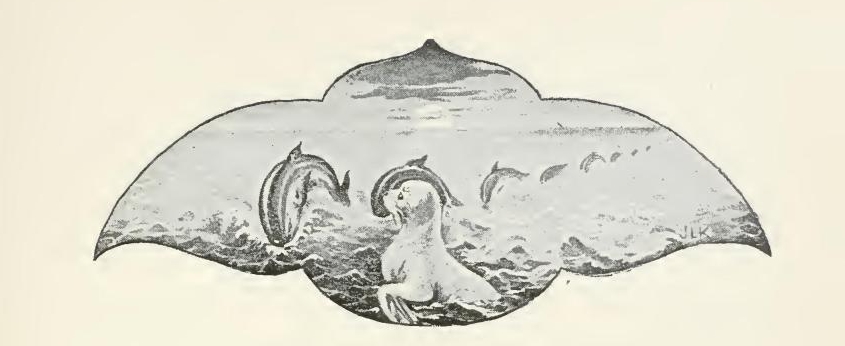
Oh! hush thee, my baby, the night is behind us, And black are the waters that sparkled so green. The moon, o’er the combers, looks downward to find us At rest in the hollows that rustle between. Where billow meets billow, then soft be thy pillow, Ah, weary wee flipperling, curl at thy ease! The storm shall not wake thee, nor shark overtake thee, Asleep in the arms of the slow-swinging seas! Seal Lullaby
Oh, hush, my baby, the night is behind us, And the waters that sparkled green are black. The moon looks down over the breaking waves to find us Resting in the rustling hollows between them. Where wave meets wave, may your pillow be soft. Ah, tired little flipperling, curl up and rest! The storm will not wake you, and no shark will catch you, As you sleep in the arms of the slowly swaying seas! Seal Lullaby
All these things happened several years ago at a place called Novastoshnah, or North East Point, on the Island of St. Paul, away and away in the Bering Sea. Limmershin, the Winter Wren, told me the tale when he was blown on to the rigging of a steamer going to Japan, and I took him down into my cabin and warmed and fed him for a couple of days till he was fit to fly back to St. Paul’s again. Limmershin is a very quaint little bird, but he knows how to tell the truth.
All these things happened several years ago at Novastoshnah, also called North East Point, on the Island of St. Paul. The island lies far away in the Bering Sea. Limmershin, the Winter Wren, told me the tale after he was blown onto the rigging of a steamer bound for Japan. I took him down to my cabin, where I warmed and fed him for a couple of days. Then he was fit to fly back to St. Paul’s. Limmershin is a very curious little bird, but he knows how to tell the truth.
Nobody comes to Novastoshnah except on business, and the only people who have regular business there are the seals. They come in the summer months by hundreds and hundreds of thousands out of the cold gray sea. For Novastoshnah Beach has the finest accommodation for seals of any place in all the world.
Nobody comes to Novastoshnah except on business, and only the seals have regular business there. In summer, they come out of the cold gray sea by the hundreds of thousands. For Novastoshnah Beach offers seals the best place to stay in all the world.
Sea Catch knew that, and every spring would swim from whatever place he happened to be in—would swim like a torpedo-boat straight for Novastoshnah and spend a month fighting with his companions for a good place on the rocks, as close to the sea as possible. Sea Catch was fifteen years old, a huge gray fur seal with almost a mane on his shoulders, and long, wicked dog teeth. When he heaved himself up on his front flippers he stood more than four feet clear of the ground, and his weight, if anyone had been bold enough to weigh him, was nearly seven hundred pounds. He was scarred all over with the marks of savage fights, but he was always ready for just one fight more. He would put his head on one side, as though he were afraid to look his enemy in the face; then he would shoot it out like lightning, and when the big teeth were firmly fixed on the other seal’s neck, the other seal might get away if he could, but Sea Catch would not help him.
Sea Catch knew that. Every spring, wherever he happened to be, he would swim straight to Novastoshnah like a torpedo boat. There he would spend a month fighting other seals for a good spot on the rocks, as close to the sea as possible. Sea Catch was fifteen years old, a huge gray fur seal with an almost mane-like growth on his shoulders and long, wicked dog teeth. When he pushed himself up on his front flippers, he stood more than four feet above the ground. If anyone had been bold enough to weigh him, they would have found he weighed nearly seven hundred pounds. He was covered in scars from savage fights, but he was always ready for one more. He would tilt his head to one side, as if he were afraid to face his enemy. Then he would thrust it forward like lightning and clamp his big teeth onto the other seal’s neck. The other seal might get away if he could, but Sea Catch would not help him.
Yet Sea Catch never chased a beaten seal, for that was against the Rules of the Beach. He only wanted room by the sea for his nursery. But as there were forty or fifty thousand other seals hunting for the same thing each spring, the whistling, bellowing, roaring, and blowing on the beach was something frightful.
Yet Sea Catch never chased a defeated seal, because that was against the Rules of the Beach. He only wanted space by the sea for his nursery. But every spring, forty or fifty thousand other seals wanted the same thing. So the whistling, bellowing, roaring, and blowing on the beach were frightful.
From a little hill called Hutchinson’s Hill, you could look over three and a half miles of ground covered with fighting seals; and the surf was dotted all over with the heads of seals hurrying to land and begin their share of the fighting. They fought in the breakers, they fought in the sand, and they fought on the smooth-worn basalt rocks of the nurseries, for they were just as stupid and unaccommodating as men. Their wives never came to the island until late in May or early in June, for they did not care to be torn to pieces; and the young two-, three-, and four-year-old seals who had not begun housekeeping went inland about half a mile through the ranks of the fighters and played about on the sand dunes in droves and legions, and rubbed off every single green thing that grew. They were called the holluschickie—the bachelors—and there were perhaps two or three hundred thousand of them at Novastoshnah alone.
From a small hill called Hutchinson’s Hill, you could look out over three and a half miles of fighting seals. The surf was dotted with seal heads as more seals hurried ashore to join the fight. They fought in the breakers, on the sand, and on the smooth basalt rocks of the nurseries. They were just as stupid and unwilling to make room for others as men. Their wives never came to the island until late May or early June, because they did not want to be torn to pieces. The young seals, two, three, and four years old, had not yet started families. They made their way through the ranks of fighting seals and went about half a mile inland. There they played on the sand dunes in huge crowds and rubbed away every single green thing that grew. They were called the holluschickie, the bachelors. There were perhaps two or three hundred thousand of them at Novastoshnah alone.
Sea Catch had just finished his forty-fifth fight one spring when Matkah, his soft, sleek, gentle-eyed wife, came up out of the sea, and he caught her by the scruff of the neck and dumped her down on his reservation, saying gruffly: “Late as usual. Where have you been?”
One spring, Sea Catch had just finished his forty-fifth fight when Matkah came up out of the sea. She was his soft, sleek wife with gentle eyes. He grabbed her by the scruff of the neck and dumped her on his reserved ground. “Late as usual,” he said gruffly. “Where have you been?”
It was not the fashion for Sea Catch to eat anything during the four months he stayed on the beaches, and so his temper was generally bad. Matkah knew better than to answer back. She looked round and cooed: “How thoughtful of you. You’ve taken the old place again.”
Sea Catch never ate during the four months he spent on the beaches, so he was usually bad-tempered. Matkah knew better than to talk back. She looked around and cooed: “How thoughtful of you. You’ve taken the old spot again.”
“I should think I had,” said Sea Catch. “Look at me!”
“I certainly have,” said Sea Catch. “Look at me!”
He was scratched and bleeding in twenty places; one eye was almost out, and his sides were torn to ribbons.
He was scratched and bleeding in twenty places. One eye was almost out, and his sides were torn to shreds.
“Oh, you men, you men!” Matkah said, fanning herself with her hind flipper. “Why can’t you be sensible and settle your places quietly? You look as though you had been fighting with the Killer Whale.”
“Oh, you men, you men!” Matkah said, fanning herself with her hind flipper. “Why can’t you be sensible and settle your places peacefully? You look as if you’ve been fighting with the Killer Whale.”
“I haven’t been doing anything but fight since the middle of May. The beach is disgracefully crowded this season. I’ve met at least a hundred seals from Lukannon Beach, house hunting. Why can’t people stay where they belong?”
“I’ve done nothing but fight since the middle of May. The beach is terribly crowded this season. I’ve met at least a hundred seals from Lukannon Beach looking for homes. Why can’t people stay where they belong?”
“I’ve often thought we should be much happier if we hauled out at Otter Island instead of this crowded place,” said Matkah.
“I’ve often thought we’d be much happier if we came ashore at Otter Island instead of this crowded place,” said Matkah.
“Bah! Only the holluschickie go to Otter Island. If we went there they would say we were afraid. We must preserve appearances, my dear.”
“Bah! Only the holluschickie go to Otter Island. If we went there, they would say we were afraid. We have to keep up appearances, my dear.”
Sea Catch sunk his head proudly between his fat shoulders and pretended to go to sleep for a few minutes, but all the time he was keeping a sharp lookout for a fight. Now that all the seals and their wives were on the land, you could hear their clamor miles out to sea above the loudest gales. At the lowest counting there were over a million seals on the beach—old seals, mother seals, tiny babies, and holluschickie, fighting, scuffling, bleating, crawling, and playing together—going down to the sea and coming up from it in gangs and regiments, lying over every foot of ground as far as the eye could reach, and skirmishing about in brigades through the fog. It is nearly always foggy at Novastoshnah, except when the sun comes out and makes everything look all pearly and rainbow-colored for a little while.
Sea Catch proudly lowered his head between his fat shoulders and pretended to sleep for a few minutes. But all the while, he was watching closely for a fight. Now that all the seals and their wives were on land, their noise carried miles out to sea. You could hear it above even the loudest gales. By the lowest count, there were over a million seals on the beach. There were old seals, mother seals, tiny babies, and holluschickie. They fought, scuffled, bleated, crawled, and played together. They went down to the sea and came back up in gangs and regiments. They covered every foot of ground as far as the eye could see. Through the fog, they skirmished in brigades. It is nearly always foggy at Novastoshnah. But sometimes the sun comes out and makes everything look pearly and rainbow-colored for a little while.
Kotick, Matkah’s baby, was born in the middle of that confusion, and he was all head and shoulders, with pale, watery blue eyes, as tiny seals must be, but there was something about his coat that made his mother look at him very closely.
Kotick, Matkah’s baby, was born in the middle of that confusion. Like all baby seals, he was all head and shoulders, with pale, watery blue eyes. But something about his coat made his mother look at him very closely.
“Sea Catch,” she said, at last, “our baby’s going to be white!”
“Sea Catch,” she finally said, “our baby’s going to be white!”
“Empty clam-shells and dry seaweed!” snorted Sea Catch. “There never has been such a thing in the world as a white seal.”
“Empty clam shells and dry seaweed!” snorted Sea Catch. “There has never been a white seal anywhere in the world.”
“I can’t help that,” said Matkah; “there’s going to be now.” And she sang the low, crooning seal song that all the mother seals sing to their babies:
“I can’t help that,” said Matkah. “There’s going to be now.” And she sang the soft, soothing seal song that all mother seals sing to their babies:
You mustn’t swim till you’re six weeks old, Or your head will be sunk by your heels; And summer gales and Killer Whales Are bad for baby seals. Are bad for baby seals, dear rat, As bad as bad can be; But splash and grow strong, And you can’t be wrong. Child of the Open Sea!
You must not swim until you are six weeks old, Or your heels will pull your head underwater. And summer storms and Killer Whales Are bad for baby seals. Bad for baby seals, dear rat, As bad as can be. But splash and grow strong, And you cannot go wrong, Child of the Open Sea!
Of course the little fellow did not understand the words at first. He paddled and scrambled about by his mother’s side, and learned to scuffle out of the way when his father was fighting with another seal, and the two rolled and roared up and down the slippery rocks. Matkah used to go to sea to get things to eat, and the baby was fed only once in two days, but then he ate all he could and throve upon it.
Of course, the little fellow did not understand the words at first. He paddled and scrambled around beside his mother. He learned to scramble out of the way when his father fought another seal. The two seals rolled and roared up and down the slippery rocks. Matkah used to go out to sea to find food, and the baby was fed only once every two days. But then he ate all he could and thrived on it.
The first thing he did was to crawl inland, and there he met tens of thousands of babies of his own age, and they played together like puppies, went to sleep on the clean sand, and played again. The old people in the nurseries took no notice of them, and the holluschickie kept to their own grounds, and the babies had a beautiful playtime.
The first thing he did was crawl inland. There he met tens of thousands of babies his own age. They played together like puppies, slept on the clean sand, and played again. The older seals in the nurseries paid no attention to them, and the holluschickie stayed on their own grounds. The babies had a wonderful time playing.
When Matkah came back from her deep-sea fishing she would go straight to their playground and call as a sheep calls for a lamb, and wait until she heard Kotick bleat. Then she would take the straightest of straight lines in his direction, striking out with her fore flippers and knocking the youngsters head over heels right and left. There were always a few hundred mothers hunting for their children through the playgrounds, and the babies were kept lively. But, as Matkah told Kotick, “So long as you don’t lie in muddy water and get mange, or rub the hard sand into a cut or scratch, and so long as you never go swimming when there is a heavy sea, nothing will hurt you here.”
When Matkah returned from fishing in the deep sea, she went straight to the playground. She called like a sheep calling for a lamb and waited until she heard Kotick bleat. Then she headed straight toward him, striking out with her front flippers and knocking youngsters head over heels on both sides. A few hundred mothers were always searching the playgrounds for their children, and the babies were kept lively. But, as Matkah told Kotick, “As long as you don’t lie in muddy water and get mange, or rub hard sand into a cut or scratch, nothing will hurt you here. You must also never go swimming when the sea is rough.”
Little seals can no more swim than little children, but they are unhappy till they learn. The first time that Kotick went down to the sea a wave carried him out beyond his depth, and his big head sank and his little hind flippers flew up exactly as his mother had told him in the song, and if the next wave had not thrown him back again he would have drowned.
Baby seals cannot swim any more than young children can, but they are unhappy until they learn. The first time Kotick went down to the sea, a wave carried him out into water too deep for him. His big head sank, and his little hind flippers flew up, exactly as his mother had told him in the song. If the next wave had not thrown him back, he would have drowned.
After that, he learned to lie in a beach pool and let the wash of the waves just cover him and lift him up while he paddled, but he always kept his eye open for big waves that might hurt. He was two weeks learning to use his flippers; and all that while he floundered in and out of the water, and coughed and grunted and crawled up the beach and took catnaps on the sand, and went back again, until at last he found that he truly belonged to the water.
After that, he learned to lie in a pool on the beach and paddle as the waves washed over him and lifted him up. But he always watched for big waves that might hurt him. It took him two weeks to learn to use his flippers. All that time, he floundered in and out of the water, coughing and grunting. He crawled up the beach, took short naps on the sand, and went back into the water. At last, he found that he truly belonged in the water.
Then you can imagine the times that he had with his companions, ducking under the rollers; or coming in on top of a comber and landing with a swash and a splutter as the big wave went whirling far up the beach; or standing up on his tail and scratching his head as the old people did; or playing “I’m the King of the Castle” on slippery, weedy rocks that just stuck out of the wash. Now and then he would see a thin fin, like a big shark’s fin, drifting along close to shore, and he knew that that was the Killer Whale, the Grampus, who eats young seals when he can get them; and Kotick would head for the beach like an arrow, and the fin would jig off slowly, as if it were looking for nothing at all.
You can imagine the fun Kotick had with his companions. They ducked under the rolling waves or rode in on top of a breaker. They landed with a splash and a splutter as the big wave swept far up the beach. They stood on their tails and scratched their heads, as the older seals did. They played “I’m the King of the Castle” on slippery, weedy rocks that just stuck out of the water. Now and then Kotick saw a thin fin drifting close to shore. It looked like a big shark’s fin, and he knew it belonged to the Killer Whale, the Grampus, who eats young seals when he can catch them. Kotick would head for the beach like an arrow, and the fin would drift slowly away, as if it were looking for nothing at all.
Late in October the seals began to leave St. Paul’s for the deep sea, by families and tribes, and there was no more fighting over the nurseries, and the holluschickie played anywhere they liked. “Next year,” said Matkah to Kotick, “you will be a holluschickie; but this year you must learn how to catch fish.”
Late in October, the seals began leaving St. Paul’s for the deep sea, traveling in families and tribes. There was no more fighting over the nurseries, and the holluschickie played wherever they liked. “Next year,” Matkah said to Kotick, “you will be a holluschickie. But this year you must learn how to catch fish.”
They set out together across the Pacific, and Matkah showed Kotick how to sleep on his back with his flippers tucked down by his side and his little nose just out of the water. No cradle is so comfortable as the long, rocking swell of the Pacific. When Kotick felt his skin tingle all over, Matkah told him he was learning the “feel of the water,” and that tingly, prickly feelings meant bad weather coming, and he must swim hard and get away.
They set out together across the Pacific. Matkah showed Kotick how to sleep on his back, with his flippers tucked against his sides and his little nose just above the water. No cradle is as comfortable as the long, rocking swell of the Pacific. When Kotick felt his skin tingle all over, Matkah told him he was learning the “feel of the water.” She said those tingly, prickly feelings meant bad weather was coming, and he must swim hard to get away.
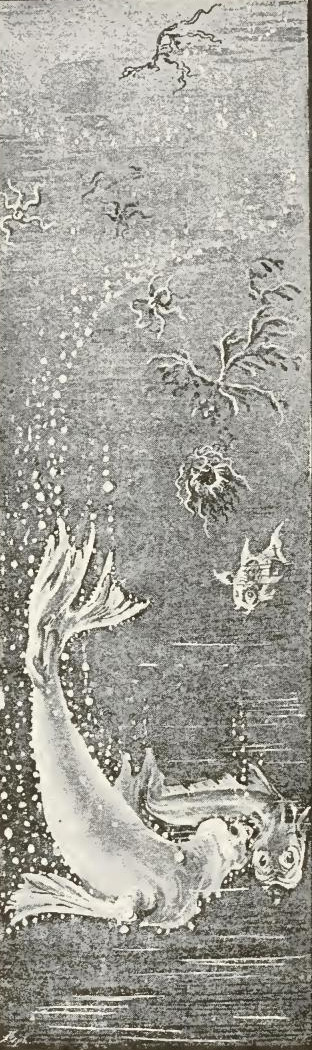
“In a little time,” she said, “you’ll know where to swim to, but just now we’ll follow Sea Pig, the Porpoise, for he is very wise.” A school of porpoises were ducking and tearing through the water, and little Kotick followed them as fast as he could. “How do you know where to go to?” he panted. The leader of the school rolled his white eye and ducked under. “My tail tingles, youngster,” he said. “That means there’s a gale behind me. Come along! When you’re south of the Sticky Water [he meant the Equator] and your tail tingles, that means there’s a gale in front of you and you must head north. Come along! The water feels bad here.”
“Soon,” she said, “you’ll know where to swim. But for now, we’ll follow Sea Pig, the Porpoise, because he’s very wise.” A school of porpoises was diving and racing through the water. Little Kotick followed them as fast as he could. “How do you know where to go?” he panted. The leader of the school rolled his white eye and dived under. “My tail tingles, youngster,” he said. “That means there’s a storm behind me. Come along! When you’re south of the Sticky Water [he meant the Equator] and your tail tingles, there’s a storm ahead. Then you must head north. Come along! The water feels bad here.”
This was one of very many things that Kotick learned, and he was always learning. Matkah taught him to follow the cod and the halibut along the under-sea banks and wrench the rockling out of his hole among the weeds; how to skirt the wrecks lying a hundred fathoms below water and dart like a rifle bullet in at one porthole and out at another as the fishes ran; how to dance on the top of the waves when the lightning was racing all over the sky, and wave his flipper politely to the stumpy-tailed Albatross and the Man-of-war Hawk as they went down the wind; how to jump three or four feet clear of the water like a dolphin, flippers close to the side and tail curved; to leave the flying fish alone because they are all bony; to take the shoulder-piece out of a cod at full speed ten fathoms deep, and never to stop and look at a boat or a ship, but particularly a row-boat. At the end of six months what Kotick did not know about deep-sea fishing was not worth the knowing. And all that time he never set flipper on dry ground.
This was one of many things Kotick learned, and he was always learning. Matkah taught him to follow cod and halibut along the underwater banks and pull rockling from their holes among the weeds. She taught him to swim around wrecks lying a hundred fathoms underwater. As fish swam through them, he would shoot in one porthole and out another, fast as a rifle bullet. She taught him to dance on the waves while lightning raced across the sky. He learned to wave his flipper politely to the short-tailed Albatross and the Man-of-war Hawk as they flew downwind. He learned to leap three or four feet out of the water like a dolphin, flippers against his sides and tail curved. He learned to leave flying fish alone because they are all bony. He learned to take the shoulder piece out of a cod at full speed, ten fathoms underwater. He also learned never to stop and look at a boat or ship, especially a rowboat. After six months, anything Kotick did not know about deep-sea fishing was not worth knowing. And all that time he never set a flipper on dry ground.
One day, however, as he was lying half asleep in the warm water somewhere off the Island of Juan Fernandez, he felt faint and lazy all over, just as human people do when the spring is in their legs, and he remembered the good firm beaches of Novastoshnah seven thousand miles away, the games his companions played, the smell of the seaweed, the seal roar, and the fighting. That very minute he turned north, swimming steadily, and as he went on he met scores of his mates, all bound for the same place, and they said: “Greeting, Kotick! This year we are all holluschickie, and we can dance the Fire-dance in the breakers off Lukannon and play on the new grass. But where did you get that coat?”
One day, however, he was lying half asleep in the warm water somewhere off the Island of Juan Fernandez. He felt weak and lazy all over, just as people do when spring is in their legs. He remembered the good, firm beaches of Novastoshnah, seven thousand miles away. He remembered the games his companions played, the smell of the seaweed, the roar of the seals, and the fighting. That very minute, he turned north and swam steadily on. Along the way, he met scores of his mates, all heading for the same place. They said: “Greetings, Kotick! This year we are all holluschickie. We can dance the Fire-dance in the breakers off Lukannon and play on the new grass. But where did you get that coat?”
Kotick’s fur was almost pure white now, and though he felt very proud of it, he only said, “Swim quickly! My bones are aching for the land.” And so they all came to the beaches where they had been born, and heard the old seals, their fathers, fighting in the rolling mist.
Kotick’s fur was almost pure white now. Though he was very proud of it, he only said, “Swim quickly! My bones ache for land.” So they all came to the beaches where they had been born. There, they heard the old seals, their fathers, fighting in the rolling mist.
That night Kotick danced the Fire-dance with the yearling seals. The sea is full of fire on summer nights all the way down from Novastoshnah to Lukannon, and each seal leaves a wake like burning oil behind him and a flaming flash when he jumps, and the waves break in great phosphorescent streaks and swirls. Then they went inland to the holluschickie grounds and rolled up and down in the new wild wheat and told stories of what they had done while they had been at sea. They talked about the Pacific as boys would talk about a wood that they had been nutting in, and if anyone had understood them he could have gone away and made such a chart of that ocean as never was. The three- and four-year-old holluschickie romped down from Hutchinson’s Hill crying: “Out of the way, youngsters! The sea is deep and you don’t know all that’s in it yet. Wait till you’ve rounded the Horn. Hi, you yearling, where did you get that white coat?”
That night Kotick danced the Fire-dance with the yearling seals. On summer nights, the sea is full of fire all the way from Novastoshnah to Lukannon. Each seal leaves a wake like burning oil and a flash of flame when he jumps. The waves break in great glowing streaks and swirls. Then the seals went inland to the holluschickie grounds. They rolled up and down in the fresh wild wheat and told stories about their time at sea. They talked about the Pacific as boys might talk about a wood where they had gathered nuts. If anyone had understood them, they could have made a map of that ocean unlike any ever made. The three- and four-year-old holluschickie came romping down from Hutchinson’s Hill, shouting: “Out of the way, youngsters! The sea is deep, and you don’t know everything in it yet. Wait until you’ve rounded the Horn. Hey, you yearling, where did you get that white coat?”
“I didn’t get it,” said Kotick. “It grew.” And just as he was going to roll the speaker over, a couple of black-haired men with flat red faces came from behind a sand dune, and Kotick, who had never seen a man before, coughed and lowered his head. The holluschickie just bundled off a few yards and sat staring stupidly. The men were no less than Kerick Booterin, the chief of the seal-hunters on the island, and Patalamon, his son. They came from the little village not half a mile from the sea nurseries, and they were deciding what seals they would drive up to the killing pens—for the seals were driven just like sheep—to be turned into seal-skin jackets later on.
“I didn’t get it,” said Kotick. “It grew.” Just as he was about to roll the speaker over, two black-haired men with flat red faces came from behind a sand dune. Kotick had never seen a man before, so he coughed and lowered his head. The holluschickie simply shuffled a few yards away and sat staring stupidly. The men were Kerick Booterin, the island’s chief seal hunter, and his son Patalamon. They came from the little village less than half a mile from the sea nurseries. They were deciding which seals to drive up to the killing pens. The seals were driven just like sheep, so they could later be made into sealskin jackets.
“Ho!” said Patalamon. “Look! There’s a white seal!”
“Hey!” said Patalamon. “Look! There’s a white seal!”
Kerick Booterin turned nearly white under his oil and smoke, for he was an Aleut, and Aleuts are not clean people. Then he began to mutter a prayer. “Don’t touch him, Patalamon. There has never been a white seal since—since I was born. Perhaps it is old Zaharrof’s ghost. He was lost last year in the big gale.”
Kerick Booterin turned nearly white beneath the oil and soot on his skin. He was an Aleut, and Aleuts are not clean people. Then he began to mutter a prayer. “Don’t touch him, Patalamon. There has never been a white seal since, since I was born. Perhaps he is old Zaharrof’s ghost. Zaharrof was lost in the big storm last year.”
“I’m not going near him,” said Patalamon. “He’s unlucky. Do you really think he is old Zaharrof come back? I owe him for some gulls’ eggs.”
“I’m not going near him,” said Patalamon. “He’s unlucky. Do you really think he’s old Zaharrof come back? I owe him for some gulls’ eggs.”
“Don’t look at him,” said Kerick. “Head off that drove of four-year-olds. The men ought to skin two hundred to-day, but it’s the beginning of the season and they are new to the work. A hundred will do. Quick!”
“Don’t look at him,” said Kerick. “Cut off that group of four-year-olds. The men should skin two hundred today. But it’s the beginning of the season, and they’re new to the work. A hundred will do. Quick!”
Patalamon rattled a pair of seal’s shoulder bones in front of a herd of holluschickie and they stopped dead, puffing and blowing. Then he stepped near and the seals began to move, and Kerick headed them inland, and they never tried to get back to their companions. Hundreds and hundreds of thousands of seals watched them being driven, but they went on playing just the same. Kotick was the only one who asked questions, and none of his companions could tell him anything, except that the men always drove seals in that way for six weeks or two months of every year.
Patalamon rattled two seal shoulder bones in front of a herd of holluschickie. The seals stopped in their tracks, puffing and blowing. Then Patalamon stepped closer, and the seals began to move. Kerick drove them inland, and they never tried to return to their companions. Hundreds of thousands of seals watched them being driven away, but kept playing just the same. Kotick was the only one who asked questions. None of his companions could tell him anything, except that the men drove seals this way for six weeks or two months every year.
“I am going to follow,” he said, and his eyes nearly popped out of his head as he shuffled along in the wake of the herd.
“I’m going to follow,” he said. His eyes nearly popped out of his head as he shuffled along behind the herd.
“The white seal is coming after us,” cried Patalamon. “That’s the first time a seal has ever come to the killing-grounds alone.”
“The white seal is following us,” cried Patalamon. “That’s the first time a seal has ever come to the killing grounds alone.”
“Hsh! Don’t look behind you,” said Kerick. “It is Zaharrof’s ghost! I must speak to the priest about this.”
“Shh! Don’t look behind you,” said Kerick. “It’s Zaharrof’s ghost! I need to speak to the priest about this.”
The distance to the killing-grounds was only half a mile, but it took an hour to cover, because if the seals went too fast Kerick knew that they would get heated and then their fur would come off in patches when they were skinned. So they went on very slowly, past Sea Lion’s Neck, past Webster House, till they came to the Salt House just beyond the sight of the seals on the beach. Kotick followed, panting and wondering. He thought that he was at the world’s end, but the roar of the seal nurseries behind him sounded as loud as the roar of a train in a tunnel. Then Kerick sat down on the moss and pulled out a heavy pewter watch and let the drove cool off for thirty minutes, and Kotick could hear the fog-dew dripping off the brim of his cap. Then ten or twelve men, each with an iron-bound club three or four feet long, came up, and Kerick pointed out one or two of the drove that were bitten by their companions or too hot, and the men kicked those aside with their heavy boots made of the skin of a walrus’s throat, and then Kerick said, “Let go!” and then the men clubbed the seals on the head as fast as they could.
The killing grounds were only half a mile away, but the journey took an hour. Kerick knew that if the seals went too fast, they would overheat. Then their fur would come off in patches when they were skinned. So they moved very slowly, past Sea Lion’s Neck and Webster House, until they reached the Salt House. It was just out of sight of the seals on the beach. Kotick followed, panting and wondering. He thought he was at the end of the world. But behind him, the roar of the seal nurseries sounded as loud as a train in a tunnel. Then Kerick sat down on the moss, pulled out a heavy pewter watch, and let the herd cool off for thirty minutes. Kotick could hear the fog dripping from the brim of Kerick’s cap. Then ten or twelve men came up, each carrying an iron-bound club three or four feet long. Kerick pointed out one or two seals in the herd that had been bitten by the others or were too hot. The men kicked them aside with heavy boots made from the skin of a walrus’s throat. Then Kerick said, “Let go!” and the men clubbed the seals on the head as fast as they could.
Ten minutes later little Kotick did not recognize his friends any more, for their skins were ripped off from the nose to the hind flippers, whipped off and thrown down on the ground in a pile. That was enough for Kotick. He turned and galloped (a seal can gallop very swiftly for a short time) back to the sea; his little new mustache bristling with horror. At Sea Lion’s Neck, where the great sea lions sit on the edge of the surf, he flung himself flipper-overhead into the cool water and rocked there, gasping miserably. “What’s here?” said a sea lion gruffly, for as a rule the sea lions keep themselves to themselves.
Ten minutes later, little Kotick no longer recognized his friends. Their skins had been ripped off from their noses to their hind flippers and thrown into a pile on the ground. That was enough for Kotick. He turned and galloped back to the sea, his little new mustache bristling with horror. (A seal can gallop very quickly for a short time.) At Sea Lion’s Neck, where the great sea lions sit at the edge of the surf, he flung himself head over flippers into the cool water. He rocked there, gasping miserably. “What’s this?” said a sea lion gruffly, for sea lions usually keep to themselves.
“Scoochnie! Ochen scoochnie!” (“I’m lonesome, very lonesome!”) said Kotick. “They’re killing all the holluschickie on all the beaches!”
“Scoochnie! Ochen scoochnie!” (“I’m lonely, very lonely!”) said Kotick. “They’re killing all the holluschickie on all the beaches!”
The Sea Lion turned his head inshore. “Nonsense!” he said. “Your friends are making as much noise as ever. You must have seen old Kerick polishing off a drove. He’s done that for thirty years.”
The Sea Lion turned his head toward the shore. “Nonsense!” he said. “Your friends are making as much noise as ever. You must have seen old Kerick killing a group of them. He’s been doing that for thirty years.”
“It’s horrible,” said Kotick, backing water as a wave went over him, and steadying himself with a screw stroke of his flippers that brought him all standing within three inches of a jagged edge of rock.
“It’s horrible,” said Kotick, paddling backward as a wave washed over him. He steadied himself with a twisting stroke of his flippers, coming to a complete stop three inches from a jagged rock.
“Well done for a yearling!” said the Sea Lion, who could appreciate good swimming. “I suppose it is rather awful from your way of looking at it, but if you seals will come here year after year, of course the men get to know of it, and unless you can find an island where no men ever come you will always be driven.”
“Well done for a yearling!” said the Sea Lion, who could appreciate good swimming. “I suppose it is pretty awful from your point of view. But if you seals keep coming here year after year, of course the men will find out. And unless you can find an island where no men ever come, you will always be driven.”
“Isn’t there any such island?” began Kotick.
“Is there no such island?” Kotick began.
“I’ve followed the poltoos [the halibut] for twenty years, and I can’t say I’ve found it yet. But look here—you seem to have a fondness for talking to your betters—suppose you go to Walrus Islet and talk to Sea Vitch. He may know something. Don’t flounce off like that. It’s a six-mile swim, and if I were you I should haul out and take a nap first, little one.”
“I’ve followed the poltoos [the halibut] for twenty years, and I can’t say I’ve found it yet. But look here, you seem to like talking to your betters. Why don’t you go to Walrus Islet and talk to Sea Vitch? He may know something. Don’t rush off like that. It’s a six-mile swim, and if I were you, I’d come ashore and take a nap first, little one.”
Kotick thought that that was good advice, so he swam round to his own beach, hauled out, and slept for half an hour, twitching all over, as seals will. Then he headed straight for Walrus Islet, a little low sheet of rocky island almost due northeast from Novastoshnah, all ledges and rock and gulls’ nests, where the walrus herded by themselves.
Kotick thought this was good advice, so he swam back to his own beach and climbed out. He slept for half an hour, twitching all over, as seals do. Then he headed straight for Walrus Islet. This small, low, rocky island lay almost due northeast of Novastoshnah. It was covered in ledges, rocks, and gulls’ nests, and the walruses gathered there by themselves.
He landed close to old Sea Vitch—the big, ugly, bloated, pimpled, fat-necked, long-tusked walrus of the North Pacific, who has no manners except when he is asleep—as he was then, with his hind flippers half in and half out of the surf.
He landed close to old Sea Vitch, a North Pacific walrus. Sea Vitch was big, ugly, bloated, and covered in pimples, with a fat neck and long tusks. He had no manners except when he was asleep. He was asleep then, with his hind flippers half in and half out of the surf.
“Wake up!” barked Kotick, for the gulls were making a great noise.
“Wake up!” barked Kotick, because the gulls were making a lot of noise.
“Hah! Ho! Hmph! What’s that?” said Sea Vitch, and he struck the next walrus a blow with his tusks and waked him up, and the next struck the next, and so on till they were all awake and staring in every direction but the right one.
“Hah! Ho! Hmph! What’s that?” said Sea Vitch. He hit the next walrus with his tusks, waking him up. That walrus hit the next, and so on, until they were all awake. They stared in every direction except the right one.
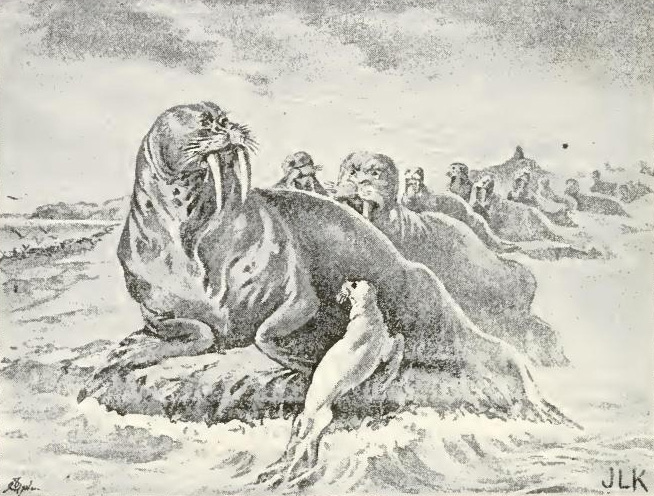
“Hi! It’s me,” said Kotick, bobbing in the surf and looking like a little white slug.
“Hi! It’s me,” said Kotick, bobbing in the surf and looking like a little white slug.
“Well! May I be—skinned!” said Sea Vitch, and they all looked at Kotick as you can fancy a club full of drowsy old gentlemen would look at a little boy. Kotick did not care to hear any more about skinning just then; he had seen enough of it. So he called out: “Isn’t there any place for seals to go where men don’t ever come?”
“Well! May I be skinned!” said Sea Vitch. They all looked at Kotick like a club full of sleepy old gentlemen looking at a little boy. Kotick did not want to hear any more about skinning just then. He had seen enough of it. So he called out: “Isn’t there anywhere seals can go where men never come?”
“Go and find out,” said Sea Vitch, shutting his eyes. “Run away. We’re busy here.”
“Go and find out,” said Sea Vitch, closing his eyes. “Go away. We’re busy here.”
Kotick made his dolphin-jump in the air and shouted as loud as he could: “Clam-eater! Clam-eater!” He knew that Sea Vitch never caught a fish in his life but always rooted for clams and seaweed; though he pretended to be a very terrible person. Naturally the Chickies and the Gooverooskies and the Epatkas—the Burgomaster Gulls and the Kittiwakes and the Puffins, who are always looking for a chance to be rude, took up the cry, and—so Limmershin told me—for nearly five minutes you could not have heard a gun fired on Walrus Islet. All the population was yelling and screaming “Clam-eater! Stareek [old man]!” while Sea Vitch rolled from side to side grunting and coughing.
Kotick leaped into the air like a dolphin and shouted as loudly as he could: “Clam-eater! Clam-eater!” He knew that Sea Vitch had never caught a fish in his life. Sea Vitch always searched for clams and seaweed, though he pretended to be very fierce. Naturally, the Chickies, Gooverooskies, and Epatkas took up the cry. These were the Burgomaster Gulls, Kittiwakes, and Puffins, who were always looking for a chance to be rude. Limmershin told me that for nearly five minutes, you could not have heard a gun fired on Walrus Islet. The whole population was yelling and screaming “Clam-eater! Stareek [old man]!” while Sea Vitch rolled from side to side, grunting and coughing.
“Now will you tell?” said Kotick, all out of breath.
“Will you tell me now?” said Kotick, out of breath.
“Go and ask Sea Cow,” said Sea Vitch. “If he is living still, he’ll be able to tell you.”
“Go and ask Sea Cow,” said Sea Vitch. “If he’s still alive, he’ll be able to tell you.”
“How shall I know Sea Cow when I meet him?” said Kotick, sheering off.
“How will I recognize Sea Cow when I meet him?” said Kotick, swimming away.
“He’s the only thing in the sea uglier than Sea Vitch,” screamed a Burgomaster gull, wheeling under Sea Vitch’s nose. “Uglier, and with worse manners! Stareek!”
“He’s the only creature in the sea uglier than Sea Vitch,” screamed a Burgomaster gull, circling under Sea Vitch’s nose. “Uglier, and with worse manners! Stareek!”
Kotick swam back to Novastoshnah, leaving the gulls to scream. There he found that no one sympathized with him in his little attempt to discover a quiet place for the seals. They told him that men had always driven the holluschickie—it was part of the day’s work—and that if he did not like to see ugly things he should not have gone to the killing grounds. But none of the other seals had seen the killing, and that made the difference between him and his friends. Besides, Kotick was a white seal.
Kotick swam back to Novastoshnah, leaving the gulls screaming behind him. There he found that no one sympathized with his small effort to find a quiet place for the seals. The other seals told him that men had always driven the holluschickie. It was part of the day’s work. They said that if he did not like seeing ugly things, he should not have gone to the killing grounds. But none of the other seals had seen the killing, and that made him different from his friends. Besides, Kotick was a white seal.
“What you must do,” said old Sea Catch, after he had heard his son’s adventures, “is to grow up and be a big seal like your father, and have a nursery on the beach, and then they will leave you alone. In another five years you ought to be able to fight for yourself.” Even gentle Matkah, his mother, said: “You will never be able to stop the killing. Go and play in the sea, Kotick.” And Kotick went off and danced the Fire-dance with a very heavy little heart.
After old Sea Catch heard about his son’s adventures, he said, “You must grow up to be a big seal like your father. Then you must have a nursery on the beach, and they will leave you alone. In another five years, you should be able to fight for yourself.” Even his gentle mother, Matkah, said: “You will never be able to stop the killing. Go and play in the sea, Kotick.” And Kotick went off and danced the Fire-dance with a very heavy little heart.
That autumn he left the beach as soon as he could, and set off alone because of a notion in his bullet-head. He was going to find Sea Cow, if there was such a person in the sea, and he was going to find a quiet island with good firm beaches for seals to live on, where men could not get at them. So he explored and explored by himself from the North to the South Pacific, swimming as much as three hundred miles in a day and a night. He met with more adventures than can be told, and narrowly escaped being caught by the Basking Shark, and the Spotted Shark, and the Hammerhead, and he met all the untrustworthy ruffians that loaf up and down the seas, and the heavy polite fish, and the scarlet spotted scallops that are moored in one place for hundreds of years, and grow very proud of it; but he never met Sea Cow, and he never found an island that he could fancy.
That autumn, he left the beach as soon as he could. He set off alone because of an idea in his round head. He was going to find Sea Cow, if there was such a creature in the sea. He was also going to find a quiet island with good, firm beaches where seals could live beyond the reach of men. So he explored on his own from the North to the South Pacific, swimming as much as three hundred miles in a day and a night. He had more adventures than can be told. He narrowly escaped being caught by the Basking Shark, the Spotted Shark, and the Hammerhead. He met all the untrustworthy ruffians that hang around the seas, as well as the heavy, polite fish. He also met the scarlet spotted scallops, which stay anchored in one place for hundreds of years and grow very proud of it. But he never met Sea Cow, and he never found an island he liked.
If the beach was good and hard, with a slope behind it for seals to play on, there was always the smoke of a whaler on the horizon, boiling down blubber, and Kotick knew what that meant. Or else he could see that seals had once visited the island and been killed off, and Kotick knew that where men had come once they would come again.
If a beach was good and firm, with a slope behind it for seals to play on, there was always a whaling ship on the horizon. Its smoke came from boiling down blubber, and Kotick knew what that meant. Or he could see that seals had once visited the island and been killed off. Kotick knew that wherever men had come once, they would come again.
He picked up with an old stumpy-tailed albatross, who told him that Kerguelen Island was the very place for peace and quiet, and when Kotick went down there he was all but smashed to pieces against some wicked black cliffs in a heavy sleet-storm with lightning and thunder. Yet as he pulled out against the gale he could see that even there had once been a seal nursery. And it was so in all the other islands that he visited.
He met an old albatross with a short, stubby tail. The albatross told him that Kerguelen Island was the perfect place for peace and quiet. But when Kotick went there, he was almost smashed to pieces against some dangerous black cliffs. He had been caught in a fierce sleet storm with thunder and lightning. Yet as he struggled away from the cliffs against the gale, he could see that seals had once raised their young there. The same was true of all the other islands he visited.
Limmershin gave a long list of them, for he said that Kotick spent five seasons exploring, with a four months’ rest each year at Novastoshnah, when the holluschickie used to make fun of him and his imaginary islands. He went to the Gallapagos, a horrid dry place on the Equator, where he was nearly baked to death; he went to the Georgia Islands, the Orkneys, Emerald Island, Little Nightingale Island, Gough’s Island, Bouvet’s Island, the Crossets, and even to a little speck of an island south of the Cape of Good Hope. But everywhere the People of the Sea told him the same things. Seals had come to those islands once upon a time, but men had killed them all off. Even when he swam thousands of miles out of the Pacific and got to a place called Cape Corrientes (that was when he was coming back from Gough’s Island), he found a few hundred mangy seals on a rock and they told him that men came there too.
Limmershin listed many islands. He said Kotick spent five seasons exploring, resting for four months each year at Novastoshnah. During those rests, the holluschickie made fun of him and his imaginary islands. He went to the Gallapagos, a horrible dry place on the Equator, where he nearly baked to death. He went to the Georgia Islands, the Orkneys, Emerald Island, Little Nightingale Island, Gough’s Island, Bouvet’s Island, the Crossets, and even a tiny speck of an island south of the Cape of Good Hope. But everywhere, the People of the Sea told him the same thing. Seals had once lived on those islands, but men had killed them all. On his way back from Gough’s Island, he swam thousands of miles out of the Pacific to a place called Cape Corrientes. Even there, he found a few hundred mangy seals on a rock. They told him that men came there too.
That nearly broke his heart, and he headed round the Horn back to his own beaches; and on his way north he hauled out on an island full of green trees, where he found an old, old seal who was dying, and Kotick caught fish for him and told him all his sorrows. “Now,” said Kotick, “I am going back to Novastoshnah, and if I am driven to the killing-pens with the holluschickie I shall not care.”
That nearly broke his heart, so he headed around the Horn and back to his own beaches. On his way north, he came ashore on an island full of green trees. There he found a very old seal who was dying. Kotick caught fish for him and told him all his troubles. “Now,” said Kotick, “I am going back to Novastoshnah. If I am driven to the killing pens with the holluschickie, I won’t care.”
The old seal said, “Try once more. I am the last of the Lost Rookery of Masafuera, and in the days when men killed us by the hundred thousand there was a story on the beaches that some day a white seal would come out of the North and lead the seal people to a quiet place. I am old, and I shall never live to see that day, but others will. Try once more.”
The old seal said, “Try once more. I am the last of the Lost Rookery of Masafuera. In the days when men killed us by the hundred thousand, a story spread along the beaches. It said that one day a white seal would come from the North and lead the seal people to a quiet place. I am old, and I will never live to see that day, but others will. Try once more.”
And Kotick curled up his mustache (it was a beauty) and said, “I am the only white seal that has ever been born on the beaches, and I am the only seal, black or white, who ever thought of looking for new islands.”
And Kotick curled up his mustache. It was a beauty. He said, “I am the only white seal ever born on the beaches. And I am the only seal, black or white, who ever thought of looking for new islands.”
This cheered him immensely; and when he came back to Novastoshnah that summer, Matkah, his mother, begged him to marry and settle down, for he was no longer a holluschick but a full-grown sea-catch, with a curly white mane on his shoulders, as heavy, as big, and as fierce as his father. “Give me another season,” he said. “Remember, Mother, it is always the seventh wave that goes farthest up the beach.”
This cheered him up immensely. When he returned to Novastoshnah that summer, his mother, Matkah, begged him to marry and settle down. He was no longer a holluschick but a full-grown sea-catch. He had a curly white mane on his shoulders and was as heavy, big, and fierce as his father. “Give me another season,” he said. “Remember, Mother, the seventh wave always goes farthest up the beach.”
Curiously enough, there was another seal who thought that she would put off marrying till the next year, and Kotick danced the Fire-dance with her all down Lukannon Beach the night before he set off on his last exploration. This time he went westward, because he had fallen on the trail of a great shoal of halibut, and he needed at least one hundred pounds of fish a day to keep him in good condition. He chased them till he was tired, and then he curled himself up and went to sleep on the hollows of the ground swell that sets in to Copper Island. He knew the coast perfectly well, so about midnight, when he felt himself gently bumped on a weed-bed, he said, “Hm, tide’s running strong tonight,” and turning over under water opened his eyes slowly and stretched. Then he jumped like a cat, for he saw huge things nosing about in the shoal water and browsing on the heavy fringes of the weeds.
Strangely enough, another seal had decided to put off marrying until the next year. Kotick danced the Fire-dance with her all along Lukannon Beach the night before he set off on his last exploration. This time he went west because he had found the trail of a huge school of halibut. He needed at least one hundred pounds of fish a day to stay in good condition. He chased the halibut until he was tired. Then he curled up and fell asleep in the hollows of the ocean swells rolling toward Copper Island. He knew the coast perfectly well. So, around midnight, when he felt himself gently bump against a bed of seaweed, he said, “Hm, the tide’s running strong tonight.” He turned over underwater, slowly opened his eyes, and stretched. Then he jumped like a cat. He saw huge creatures nosing around in the shallow water and feeding on the thick fringes of seaweed.
“By the Great Combers of Magellan!” he said, beneath his mustache. “Who in the Deep Sea are these people?”
“By the Great Combers of Magellan!” he muttered. “Who in the Deep Sea are these people?”
They were like no walrus, sea lion, seal, bear, whale, shark, fish, squid, or scallop that Kotick had ever seen before. They were between twenty and thirty feet long, and they had no hind flippers, but a shovel-like tail that looked as if it had been whittled out of wet leather. Their heads were the most foolish-looking things you ever saw, and they balanced on the ends of their tails in deep water when they weren’t grazing, bowing solemnly to each other and waving their front flippers as a fat man waves his arm.
They were unlike any walrus, sea lion, seal, bear, whale, shark, fish, squid, or scallop Kotick had ever seen. They were twenty to thirty feet long and had no hind flippers. Instead, they had a shovel-shaped tail that looked as if it had been carved from wet leather. Their heads were the silliest-looking things you ever saw. When they weren’t grazing, they balanced on the ends of their tails in deep water. They bowed solemnly to each other and waved their front flippers like a fat man waving his arm.
“Ahem!” said Kotick. “Good sport, gentlemen?” The big things answered by bowing and waving their flippers like the Frog Footman. When they began feeding again Kotick saw that their upper lip was split into two pieces that they could twitch apart about a foot and bring together again with a whole bushel of seaweed between the splits. They tucked the stuff into their mouths and chumped solemnly.
“Ahem!” said Kotick. “Good sport, gentlemen?” The big creatures answered by bowing and waving their flippers like the Frog Footman. When they began feeding again, Kotick saw that their upper lips were split in two. They could twitch the two halves about a foot apart, then bring them together around a whole bushel of seaweed. They tucked the seaweed into their mouths and chewed solemnly.
“Messy style of feeding, that,” said Kotick. They bowed again, and Kotick began to lose his temper. “Very good,” he said. “If you do happen to have an extra joint in your front flipper you needn’t show off so. I see you bow gracefully, but I should like to know your names.” The split lips moved and twitched; and the glassy green eyes stared, but they did not speak.
“That’s a messy way to eat,” said Kotick. They bowed again, and Kotick began to lose his temper. “Fine,” he said. “If you happen to have an extra joint in your front flipper, you don’t need to show off. I can see you bow gracefully, but I’d like to know your names.” Their split lips moved and twitched, and their glassy green eyes stared, but they did not speak.
“Well!” said Kotick. “You’re the only people I’ve ever met uglier than Sea Vitch—and with worse manners.”
“Well!” said Kotick. “You’re the only people I’ve ever met who are uglier than Sea Vitch and have worse manners.”
Then he remembered in a flash what the Burgomaster gull had screamed to him when he was a little yearling at Walrus Islet, and he tumbled backward in the water, for he knew that he had found Sea Cow at last.
Then he suddenly remembered what the Burgomaster gull had screamed to him when he was a yearling at Walrus Islet. He tumbled backward into the water because he knew he had found Sea Cow at last.
The sea cows went on schlooping and grazing and chumping in the weed, and Kotick asked them questions in every language that he had picked up in his travels; and the Sea People talk nearly as many languages as human beings. But the sea cows did not answer because Sea Cow cannot talk. He has only six bones in his neck where he ought to have seven, and they say under the sea that that prevents him from speaking even to his companions. But, as you know, he has an extra joint in his foreflipper, and by waving it up and down and about he makes what answers to a sort of clumsy telegraphic code.
The sea cows kept schlooping, grazing, and chumping in the weed. Kotick asked them questions in every language he had picked up on his travels. And the Sea People speak nearly as many languages as humans do. But the sea cows did not answer because Sea Cow cannot talk. He has only six bones in his neck, where he ought to have seven. Under the sea, they say this keeps him from speaking even to his companions. But, as you know, he has an extra joint in his foreflipper. By waving it up and down and around, he communicates in a kind of clumsy telegraphic code.
By daylight Kotick’s mane was standing on end and his temper was gone where the dead crabs go. Then the Sea Cow began to travel northward very slowly, stopping to hold absurd bowing councils from time to time, and Kotick followed them, saying to himself, “People who are such idiots as these are would have been killed long ago if they hadn’t found out some safe island. And what is good enough for the Sea Cow is good enough for the Sea Catch. All the same, I wish they’d hurry.”
By daylight, Kotick’s mane was standing on end, and his temper had gone where the dead crabs go. Then the Sea Cow began moving north very slowly. From time to time, they stopped for absurd meetings where they bowed to one another. Kotick followed them, saying to himself, “Idiots like these would have been killed long ago if they hadn’t found a safe island. And what’s good enough for the Sea Cow is good enough for the Sea Catch. Still, I wish they’d hurry.”
It was weary work for Kotick. The herd never went more than forty or fifty miles a day, and stopped to feed at night, and kept close to the shore all the time; while Kotick swam round them, and over them, and under them, but he could not hurry them up one-half mile. As they went farther north they held a bowing council every few hours, and Kotick nearly bit off his mustache with impatience till he saw that they were following up a warm current of water, and then he respected them more.
It was tiring work for Kotick. The herd never traveled more than forty or fifty miles a day. They stopped to feed at night and stayed close to shore the whole time. Kotick swam around them, over them, and under them, but he could not make them go even half a mile faster. As they traveled farther north, they held a bowing council every few hours. Kotick nearly bit off his mustache with impatience. Then he saw that they were following a warm current of water, and he respected them more.
One night they sank through the shiny water—sank like stones—and for the first time since he had known them began to swim quickly. Kotick followed, and the pace astonished him, for he never dreamed that Sea Cow was anything of a swimmer. They headed for a cliff by the shore—a cliff that ran down into deep water, and plunged into a dark hole at the foot of it, twenty fathoms under the sea. It was a long, long swim, and Kotick badly wanted fresh air before he was out of the dark tunnel they led him through.
One night they sank like stones through the shining water. For the first time since Kotick had known them, they began to swim quickly. Kotick followed, astonished by their speed. He had never imagined that Sea Cow could swim so well. They headed for a cliff on the shore that dropped into deep water. Then they plunged into a dark hole at its base, twenty fathoms underwater. It was a long, long swim. Kotick badly needed fresh air before he emerged from the dark tunnel they led him through.
“My wig!” he said, when he rose, gasping and puffing, into open water at the farther end. “It was a long dive, but it was worth it.”
“Wow!” he said as he surfaced in open water at the far end, gasping and puffing. “That was a long dive, but it was worth it.”
The sea cows had separated and were browsing lazily along the edges of the finest beaches that Kotick had ever seen. There were long stretches of smooth-worn rock running for miles, exactly fitted to make seal-nurseries, and there were play-grounds of hard sand sloping inland behind them, and there were rollers for seals to dance in, and long grass to roll in, and sand dunes to climb up and down, and, best of all, Kotick knew by the feel of the water, which never deceives a true sea catch, that no men had ever come there.
The sea cows had spread out and were feeding lazily along the edges of the finest beaches Kotick had ever seen. Smooth, worn rock stretched for miles, perfectly suited for seal nurseries. Behind the rocks were play areas of hard sand that sloped inland. There were rolling waves for seals to dance in, long grass to roll in, and sand dunes to climb up and down. Best of all, Kotick could tell from the feel of the water that no men had ever come there. The feel of the water never deceives a true sea catch.
The first thing he did was to assure himself that the fishing was good, and then he swam along the beaches and counted up the delightful low sandy islands half hidden in the beautiful rolling fog. Away to the northward, out to sea, ran a line of bars and shoals and rocks that would never let a ship come within six miles of the beach, and between the islands and the mainland was a stretch of deep water that ran up to the perpendicular cliffs, and somewhere below the cliffs was the mouth of the tunnel.
First, he made sure the fishing was good. Then he swam along the beaches, counting the delightful low, sandy islands half hidden in the beautiful rolling fog. Far to the north, a line of sandbars, shoals, and rocks stretched out to sea. They would keep any ship at least six miles from the beach. Between the islands and the mainland, a stretch of deep water ran up to the sheer cliffs. Somewhere below the cliffs was the entrance to the tunnel.
“It’s Novastoshnah over again, but ten times better,” said Kotick. “Sea Cow must be wiser than I thought. Men can’t come down the cliffs, even if there were any men; and the shoals to seaward would knock a ship to splinters. If any place in the sea is safe, this is it.”
“It’s like Novastoshnah all over again, but ten times better,” said Kotick. “Sea Cow must be wiser than I thought. Men can’t get down the cliffs, even if there were any men. And the shallow waters out at sea would smash a ship to pieces. If any place in the sea is safe, this is it.”
He began to think of the seal he had left behind him, but though he was in a hurry to go back to Novastoshnah, he thoroughly explored the new country, so that he would be able to answer all questions.
He began to think about the seal he had left behind. Though he was eager to return to Novastoshnah, he explored the new land thoroughly so he could answer all questions.
Then he dived and made sure of the mouth of the tunnel, and raced through to the southward. No one but a sea cow or a seal would have dreamed of there being such a place, and when he looked back at the cliffs even Kotick could hardly believe that he had been under them.
Then he dived, found the tunnel entrance, and raced through it toward the south. Only a sea cow or a seal would have imagined such a place existed. And when Kotick looked back at the cliffs, even he could hardly believe he had been under them.
He was six days going home, though he was not swimming slowly; and when he hauled out just above Sea Lion’s Neck the first person he met was the seal who had been waiting for him, and she saw by the look in his eyes that he had found his island at last.
It took him six days to get home, though he was not swimming slowly. He came ashore just above Sea Lion’s Neck. The first seal he met had been waiting for him. She could see in his eyes that he had finally found his island.
But the holluschickie and Sea Catch, his father, and all the other seals laughed at him when he told them what he had discovered, and a young seal about his own age said, “This is all very well, Kotick, but you can’t come from no one knows where and order us off like this. Remember we’ve been fighting for our nurseries, and that’s a thing you never did. You preferred prowling about in the sea.”
But when Kotick told them what he had discovered, the holluschickie, his father Sea Catch, and all the other seals laughed at him. A young seal about his own age said, “That’s all very well, Kotick. But you can’t come from who knows where and order us away like this. Remember, we’ve been fighting for our nurseries, and you never did that. You preferred to roam around in the sea.”
The other seals laughed at this, and the young seal began twisting his head from side to side. He had just married that year, and was making a great fuss about it.
The other seals laughed at this, and the young seal began turning his head from side to side. He had just married that year and was making a big fuss about it.
“I’ve no nursery to fight for,” said Kotick. “I only want to show you all a place where you will be safe. What’s the use of fighting?”
“I don’t have a nursery to fight for,” said Kotick. “I just want to show you all a place where you’ll be safe. Why fight?”
“Oh, if you’re trying to back out, of course I’ve no more to say,” said the young seal with an ugly chuckle.
“Oh, if you’re trying to back out, of course I have nothing more to say,” said the young seal with a nasty chuckle.
“Will you come with me if I win?” said Kotick. And a green light came into his eye, for he was very angry at having to fight at all.
“Will you come with me if I win?” Kotick said. A green light came into his eye because he was very angry that he had to fight at all.
“Very good,” said the young seal carelessly. “If you win, I’ll come.”
“Okay,” said the young seal casually. “If you win, I’ll come.”
He had no time to change his mind, for Kotick’s head was out and his teeth sunk in the blubber of the young seal’s neck. Then he threw himself back on his haunches and hauled his enemy down the beach, shook him, and knocked him over. Then Kotick roared to the seals: “I’ve done my best for you these five seasons past. I’ve found you the island where you’ll be safe, but unless your heads are dragged off your silly necks you won’t believe. I’m going to teach you now. Look out for yourselves!”
He had no time to change his mind. Kotick lunged and sank his teeth into the blubber on the young seal’s neck. Then he threw himself back on his haunches and dragged his enemy down the beach. He shook him and knocked him over. Then Kotick roared to the seals: “I’ve done my best for you for the past five seasons. I’ve found you an island where you’ll be safe. But you won’t believe me unless your heads are dragged off your silly necks. I’m going to teach you now. Look out for yourselves!”
Limmershin told me that never in his life—and Limmershin sees ten thousand big seals fighting every year—never in all his little life did he see anything like Kotick’s charge into the nurseries. He flung himself at the biggest sea catch he could find, caught him by the throat, choked him and bumped him and banged him till he grunted for mercy, and then threw him aside and attacked the next. You see, Kotick had never fasted for four months as the big seals did every year, and his deep-sea swimming trips kept him in perfect condition, and, best of all, he had never fought before. His curly white mane stood up with rage, and his eyes flamed, and his big dog teeth glistened, and he was splendid to look at. Old Sea Catch, his father, saw him tearing past, hauling the grizzled old seals about as though they had been halibut, and upsetting the young bachelors in all directions; and Sea Catch gave a roar and shouted: “He may be a fool, but he is the best fighter on the beaches! Don’t tackle your father, my son! He’s with you!”
Limmershin told me he had never seen anything like Kotick’s charge into the nurseries in his whole little life. And Limmershin sees ten thousand big seals fighting every year. Kotick threw himself at the biggest sea catch he could find and grabbed him by the throat. He choked him, knocked him around, and banged him about until he grunted for mercy. Then Kotick threw him aside and attacked the next one. You see, Kotick had never gone without food for four months, as the big seals did every year. His deep-sea swimming trips kept him in perfect condition. And best of all, he had never fought before. His curly white mane stood up with rage, his eyes blazed, and his big canine teeth gleamed. He was magnificent to see. His father, old Sea Catch, saw him tearing past. Kotick was dragging the gray-haired old seals around as if they were halibut and knocking the young bachelors in every direction. Sea Catch roared and shouted: “He may be a fool, but he is the best fighter on the beaches! Don’t attack your father, my son! He’s with you!”
Kotick roared in answer, and old Sea Catch waddled in with his mustache on end, blowing like a locomotive, while Matkah and the seal that was going to marry Kotick cowered down and admired their men-folk. It was a gorgeous fight, for the two fought as long as there was a seal that dared lift up his head, and when there were none they paraded grandly up and down the beach side by side, bellowing.
Kotick roared in answer, and old Sea Catch waddled in, his whiskers bristling and his breath blowing like a locomotive. Matkah and the seal who was going to marry Kotick cowered and admired their men. It was a magnificent fight. The two fought as long as any seal dared to lift his head. When none did, they marched grandly up and down the beach side by side, bellowing.
At night, just as the Northern Lights were winking and flashing through the fog, Kotick climbed a bare rock and looked down on the scattered nurseries and the torn and bleeding seals. “Now,” he said, “I’ve taught you your lesson.”
At night, just as the Northern Lights flickered and flashed through the fog, Kotick climbed onto a bare rock. He looked down at the scattered nurseries and the torn and bleeding seals. “Now,” he said, “I’ve taught you your lesson.”
“My wig!” said old Sea Catch, boosting himself up stiffly, for he was fearfully mauled. “The Killer Whale himself could not have cut them up worse. Son, I’m proud of you, and what’s more, I’ll come with you to your island—if there is such a place.”
“Good grief!” said old Sea Catch, pushing himself up stiffly because he was badly mauled. “The Killer Whale himself couldn’t have hurt them worse. Son, I’m proud of you. What’s more, I’ll come with you to your island, if there is such a place.”
“Hear you, fat pigs of the sea. Who comes with me to the Sea Cow’s tunnel? Answer, or I shall teach you again,” roared Kotick.
“Listen, you fat pigs of the sea. Who will come with me to the Sea Cow’s tunnel? Answer, or I’ll teach you another lesson,” roared Kotick.
There was a murmur like the ripple of the tide all up and down the beaches. “We will come,” said thousands of tired voices. “We will follow Kotick, the White Seal.”
A murmur spread along all the beaches, like the ripple of the tide. “We will come,” said thousands of tired voices. “We will follow Kotick, the White Seal.”
Then Kotick dropped his head between his shoulders and shut his eyes proudly. He was not a white seal any more, but red from head to tail. All the same he would have scorned to look at or touch one of his wounds.
Then Kotick lowered his head between his shoulders and proudly closed his eyes. He was no longer a white seal, but red from head to tail. Even so, he would have considered it beneath him to look at or touch any of his wounds.
A week later he and his army (nearly ten thousand holluschickie and old seals) went away north to the Sea Cow’s tunnel, Kotick leading them, and the seals that stayed at Novastoshnah called them idiots. But next spring, when they all met off the fishing banks of the Pacific, Kotick’s seals told such tales of the new beaches beyond Sea Cow’s tunnel that more and more seals left Novastoshnah. Of course it was not all done at once, for the seals are not very clever, and they need a long time to turn things over in their minds, but year after year more seals went away from Novastoshnah, and Lukannon, and the other nurseries, to the quiet, sheltered beaches where Kotick sits all the summer through, getting bigger and fatter and stronger each year, while the holluschickie play around him, in that sea where no man comes.
A week later, Kotick led his army north to the Sea Cow’s tunnel. It included nearly ten thousand holluschickie and old seals. The seals that stayed at Novastoshnah called them idiots. But the next spring, all the seals met off the fishing banks of the Pacific. Kotick’s seals told such stories about the new beaches beyond Sea Cow’s tunnel that more and more seals left Novastoshnah. Of course, this did not all happen at once. Seals are not very clever, and they need a long time to think things over. But year after year, more seals left Novastoshnah, Lukannon, and the other nurseries. They went to the quiet, sheltered beaches where Kotick spends the whole summer. He grows bigger, fatter, and stronger each year, while the holluschickie play around him in that sea where no man comes.
Lukannon
Lukannon
This is the great deep-sea song that all the St. Paul seals sing when they are heading back to their beaches in the summer. It is a sort of very sad seal National Anthem.
This is the great deep-sea song that all the St. Paul seals sing when they return to their beaches each summer. It is a sort of very sad national anthem for seals.
I met my mates in the morning (and, oh, but I am old!) Where roaring on the ledges the summer ground-swell rolled; I heard them lift the chorus that drowned the breakers’ song— The Beaches of Lukannon—two million voices strong. The song of pleasant stations beside the salt lagoons, The song of blowing squadrons that shuffled down the dunes, The song of midnight dances that churned the sea to flame— The Beaches of Lukannon—before the sealers came! I met my mates in the morning (I’ll never meet them more!); They came and went in legions that darkened all the shore. And o’er the foam-flecked offing as far as voice could reach We hailed the landing-parties and we sang them up the beach. The Beaches of Lukannon—the winter wheat so tall— The dripping, crinkled lichens, and the sea-fog drenching all! The platforms of our playground, all shining smooth and worn! The Beaches of Lukannon—the home where we were born! I met my mates in the morning, a broken, scattered band. Men shoot us in the water and club us on the land; Men drive us to the Salt House like silly sheep and tame, And still we sing Lukannon—before the sealers came. Wheel down, wheel down to southward; oh, Gooverooska, go! And tell the Deep-Sea Viceroys the story of our woe; Ere, empty as the shark’s egg the tempest flings ashore, The Beaches of Lukannon shall know their sons no more!
I met my companions in the morning (and, oh, how old I am!). The summer swells rolled in and roared against the ledges. I heard my companions raise a chorus that drowned out the breaking waves. It was the song of the Beaches of Lukannon, sung by two million voices. The song of pleasant resting places beside the salt lagoons, The song of blowing groups of seals that shuffled down the dunes, The song of midnight dances that churned the sea into flame. The Beaches of Lukannon, before the sealers came! I met my companions in the morning (I will never meet them again!). They came and went in great numbers that darkened the whole shore. Across the foaming water, as far as our voices could reach, We greeted the groups coming ashore and sang as they climbed the beach. The Beaches of Lukannon, where the winter wheat grew so tall! The dripping, wrinkled lichens, and the sea fog soaking everything! The flat rocks of our playground, worn smooth and shining! The Beaches of Lukannon, the home where we were born! I met my companions in the morning, a broken, scattered group. Men shoot us in the water and club us on the land. Men drive us to the Salt House like foolish, tame sheep. And still we sing of Lukannon, before the sealers came. Wheel south, wheel south. Oh, Gooverooska, go! Tell the Deep-Sea Viceroys the story of our sorrow. Go before the Beaches of Lukannon lose all their sons, And lie as empty as a shark's egg thrown ashore by a storm!