Chapter 17
But there was no hilarity in the little town that same tranquil Saturday afternoon. The Harpers, and Aunt Polly’s family, were being put into mourning, with great grief and many tears. An unusual quiet possessed the village, although it was ordinarily quiet enough, in all conscience. The villagers conducted their concerns with an absent air, and talked little; but they sighed often. The Saturday holiday seemed a burden to the children. They had no heart in their sports, and gradually gave them up.
But there was no laughter in the little town that same peaceful Saturday afternoon. The Harpers and Aunt Polly’s family were being dressed in mourning clothes, with deep grief and many tears. An unusual silence settled over the village, although it was certainly quiet enough even on ordinary days. The villagers went about their business distractedly and said little, but they sighed often. The Saturday holiday seemed like a burden to the children. Their hearts were not in their games, and they gradually stopped playing.
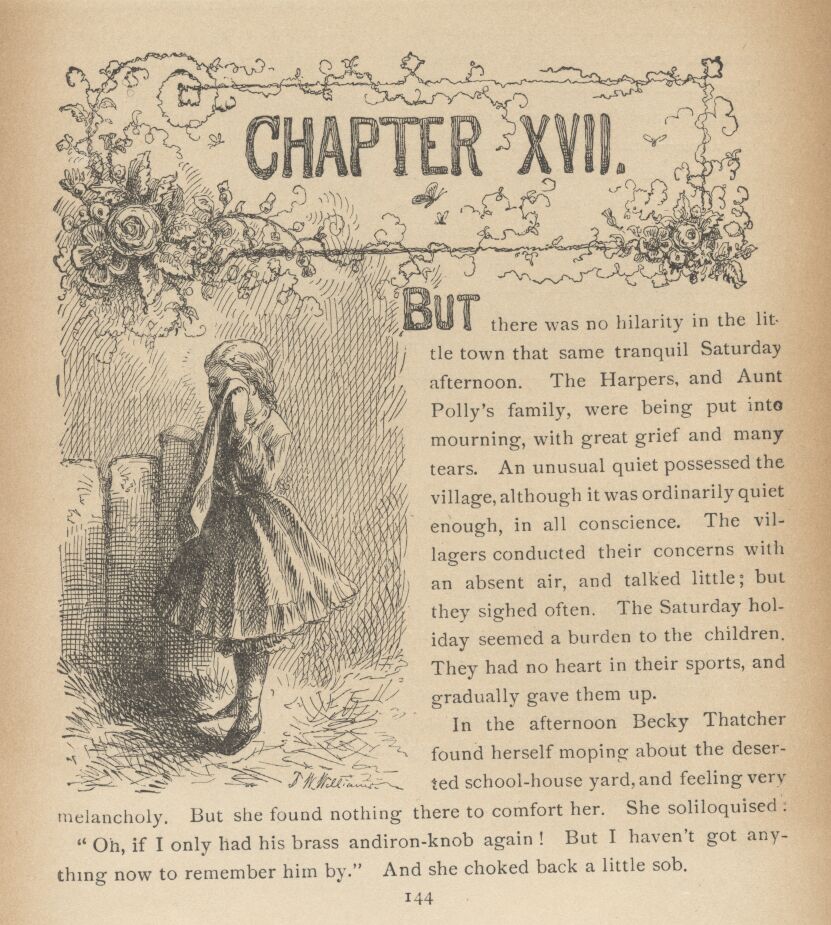
In the afternoon Becky Thatcher found herself moping about the deserted schoolhouse yard, and feeling very melancholy. But she found nothing there to comfort her. She soliloquized:
That afternoon, Becky Thatcher found herself wandering gloomily around the deserted schoolyard, feeling very sad. But she found nothing there to comfort her. She said to herself:
“Oh, if I only had a brass andiron-knob again! But I haven’t got anything now to remember him by.” And she choked back a little sob.
“Oh, if only I had a brass knob from a fireplace log holder again! But now I have nothing to remember him by.” And she held back a little sob.
Presently she stopped, and said to herself:
After a while, she stopped and said to herself:
“It was right here. Oh, if it was to do over again, I wouldn’t say that—I wouldn’t say it for the whole world. But he’s gone now; I’ll never, never, never see him any more.”
“It was right here. Oh, if I could do it over again, I wouldn’t say that. I wouldn’t say it for the whole world. But he’s gone now. I’ll never, never, never see him again.”
This thought broke her down, and she wandered away, with tears rolling down her cheeks. Then quite a group of boys and girls—playmates of Tom’s and Joe’s—came by, and stood looking over the paling fence and talking in reverent tones of how Tom did so-and-so the last time they saw him, and how Joe said this and that small trifle (pregnant with awful prophecy, as they could easily see now!)—and each speaker pointed out the exact spot where the lost lads stood at the time, and then added something like “and I was a-standing just so—just as I am now, and as if you was him—I was as close as that—and he smiled, just this way—and then something seemed to go all over me, like—awful, you know—and I never thought what it meant, of course, but I can see now!”
The thought overwhelmed her, and she wandered away with tears rolling down her cheeks. Then quite a group of boys and girls, Tom’s and Joe’s playmates, came by. They stood looking over the picket fence, talking in hushed, respectful tones. They recalled how Tom did this or that the last time they saw him. They remembered the little things Joe had said (full of terrible warnings, as they could easily see now!). Each speaker pointed out the exact spot where the lost boys had stood. Then each added something like “and I was standing just so, just as I am now. And as if you was him, I was as close as that. And he smiled, just this way. And then something seemed to go all over me, like, awful, you know. And I never thought what it meant, of course, but I can see now!”
Then there was a dispute about who saw the dead boys last in life, and many claimed that dismal distinction, and offered evidences, more or less tampered with by the witness; and when it was ultimately decided who did see the departed last, and exchanged the last words with them, the lucky parties took upon themselves a sort of sacred importance, and were gaped at and envied by all the rest. One poor chap, who had no other grandeur to offer, said with tolerably manifest pride in the remembrance:
Then an argument broke out over who had last seen the dead boys alive. Many claimed that grim honor and offered evidence they had more or less altered themselves. Finally, it was settled who did see the boys last and exchange the last words with them. The lucky ones took on an almost sacred importance, and everyone else stared at them in awe and envy. One poor fellow, who had nothing else to boast about, recalled his moment with fairly obvious pride and said:
“Well, Tom Sawyer he licked me once.”
“Well, Tom Sawyer he beat me up once.”
But that bid for glory was a failure. Most of the boys could say that, and so that cheapened the distinction too much. The group loitered away, still recalling memories of the lost heroes, in awed voices.
But that attempt at glory failed. Most of the boys could say the same thing, so it wasn't special enough. The group slowly wandered away, still sharing memories of the lost heroes in voices filled with awe.
When the Sunday-school hour was finished, the next morning, the bell began to toll, instead of ringing in the usual way. It was a very still Sabbath, and the mournful sound seemed in keeping with the musing hush that lay upon nature. The villagers began to gather, loitering a moment in the vestibule to converse in whispers about the sad event. But there was no whispering in the house; only the funereal rustling of dresses as the women gathered to their seats disturbed the silence there. None could remember when the little church had been so full before. There was finally a waiting pause, an expectant dumbness, and then Aunt Polly entered, followed by Sid and Mary, and they by the Harper family, all in deep black, and the whole congregation, the old minister as well, rose reverently and stood until the mourners were seated in the front pew. There was another communing silence, broken at intervals by muffled sobs, and then the minister spread his hands abroad and prayed. A moving hymn was sung, and the text followed: “I am the Resurrection and the Life.”
When Sunday school ended the next morning, the bell began to toll instead of ringing as usual. It was a very quiet Sunday. The mournful sound seemed to suit the thoughtful silence that lay over nature. The villagers began to gather, pausing in the entrance hall to whisper about the sad event. But there was no whispering inside the church. Only the somber rustling of the women’s dresses as they took their seats disturbed the silence. No one could remember the little church ever being so full. At last, everyone waited in expectant silence. Then Aunt Polly entered, followed by Sid and Mary, and then the Harper family, all dressed in deep black. The whole congregation, including the old minister, rose respectfully and stood until the mourners sat in the front pew. Another shared silence followed, broken now and then by muffled sobs. Then the minister stretched out his hands and prayed. A moving hymn was sung, followed by the passage for the sermon: “I am the Resurrection and the Life.”
As the service proceeded, the clergyman drew such pictures of the graces, the winning ways, and the rare promise of the lost lads that every soul there, thinking he recognized these pictures, felt a pang in remembering that he had persistently blinded himself to them always before, and had as persistently seen only faults and flaws in the poor boys. The minister related many a touching incident in the lives of the departed, too, which illustrated their sweet, generous natures, and the people could easily see, now, how noble and beautiful those episodes were, and remembered with grief that at the time they occurred they had seemed rank rascalities, well deserving of the cowhide. The congregation became more and more moved, as the pathetic tale went on, till at last the whole company broke down and joined the weeping mourners in a chorus of anguished sobs, the preacher himself giving way to his feelings, and crying in the pulpit.
As the service went on, the minister described the lost boys’ good qualities, charming ways, and exceptional promise. Everyone there thought they recognized the boys in these descriptions. Each felt a pang, remembering how they had always refused to see those qualities before. Instead, they had just as stubbornly seen only faults and flaws in the poor boys. The minister also told many touching stories from the boys’ lives that showed their kind, generous natures. Now the people could easily see how noble and beautiful those deeds were. They remembered with sorrow that, at the time, those same deeds had seemed like outright mischief, well worth a whipping. The congregation grew more and more moved as the sorrowful story continued. At last, everyone broke down and joined the grieving mourners in a chorus of anguished sobs. The preacher himself gave way to his feelings and cried in the pulpit.
There was a rustle in the gallery, which nobody noticed; a moment later the church door creaked; the minister raised his streaming eyes above his handkerchief, and stood transfixed! First one and then another pair of eyes followed the minister’s, and then almost with one impulse the congregation rose and stared while the three dead boys came marching up the aisle, Tom in the lead, Joe next, and Huck, a ruin of drooping rags, sneaking sheepishly in the rear! They had been hid in the unused gallery listening to their own funeral sermon!
There was a rustle in the gallery, but nobody noticed. A moment later, the church door creaked. The minister lifted his tear-filled eyes above his handkerchief and froze! One pair of eyes followed his gaze, then another. Then, almost as one, the congregation stood and stared as the three dead boys marched up the aisle. Tom led the way, with Joe next. Huck, covered in sagging rags, trailed behind, looking sheepish! They had been hiding in the unused gallery, listening to their own funeral sermon!
Aunt Polly, Mary, and the Harpers threw themselves upon their restored ones, smothered them with kisses and poured out thanksgivings, while poor Huck stood abashed and uncomfortable, not knowing exactly what to do or where to hide from so many unwelcoming eyes. He wavered, and started to slink away, but Tom seized him and said:
Aunt Polly, Mary, and the Harpers rushed to embrace their loved ones, now back with them. They smothered them with kisses and poured out their thanks, while poor Huck stood embarrassed and uncomfortable. He didn't know what to do or where to hide from so many unwelcoming eyes. He hesitated and started to sneak away, but Tom grabbed him and said:
“Aunt Polly, it ain’t fair. Somebody’s got to be glad to see Huck.”
“Aunt Polly, it ain’t fair. Somebody’s got to be glad to see Huck.”
“And so they shall. I’m glad to see him, poor motherless thing!” And the loving attentions Aunt Polly lavished upon him were the one thing capable of making him more uncomfortable than he was before.
“And so they will. I’m glad to see him, poor motherless child!” Aunt Polly showered him with affection. It was the only thing that could make him even more uncomfortable than he already was.
Suddenly the minister shouted at the top of his voice: “Praise God from whom all blessings flow—sing!—and put your hearts in it!”
Suddenly the minister shouted at the top of his voice: “Praise God from whom all blessings flow. Sing! And put your hearts in it!”
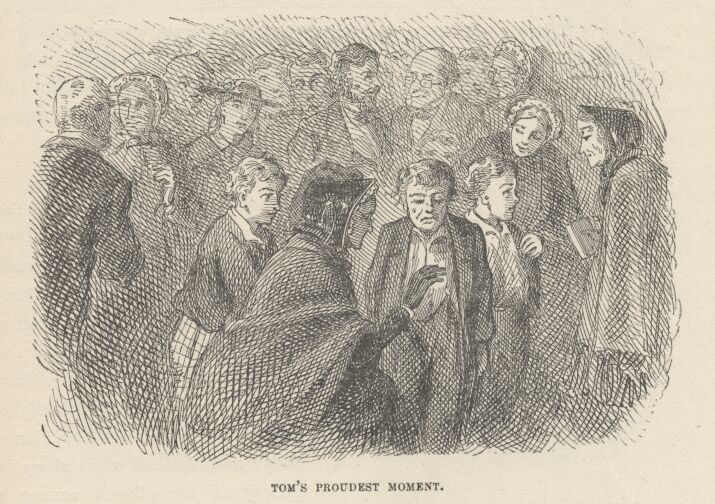
And they did. Old Hundred swelled up with a triumphant burst, and while it shook the rafters Tom Sawyer the Pirate looked around upon the envying juveniles about him and confessed in his heart that this was the proudest moment of his life.
And they did. Old Hundred rose in a triumphant burst. As the music shook the rafters, Tom Sawyer the Pirate looked around at the other children, who envied him. He admitted to himself that this was the proudest moment of his life.
As the “sold” congregation trooped out they said they would almost be willing to be made ridiculous again to hear Old Hundred sung like that once more.
The “fooled” congregation filed out. They said they would almost be willing to look foolish again to hear Old Hundred sung like that once more.
Tom got more cuffs and kisses that day—according to Aunt Polly’s varying moods—than he had earned before in a year; and he hardly knew which expressed the most gratefulness to God and affection for himself.
Tom got more slaps and kisses that day than he had earned in a whole year before. Whether he got slaps or kisses depended on Aunt Polly’s mood. He could hardly tell which showed more gratitude to God and affection for him.