Chapter 16
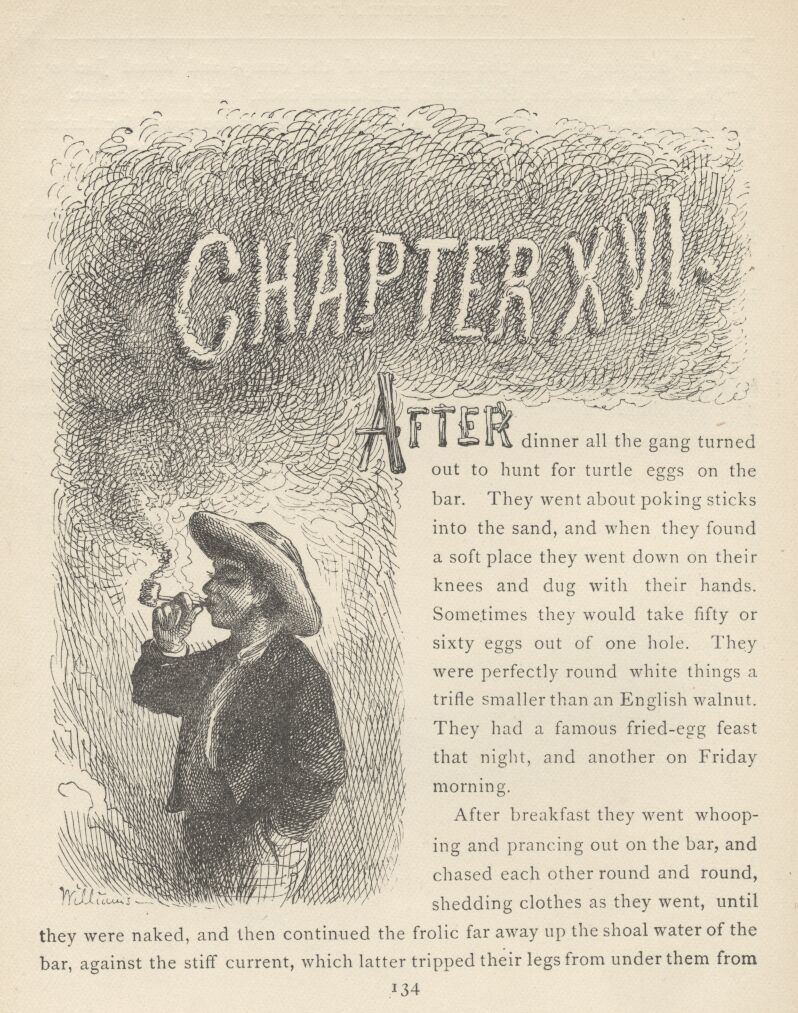
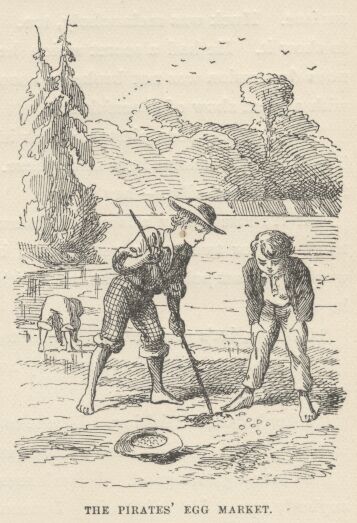
After dinner all the gang turned out to hunt for turtle eggs on the bar. They went about poking sticks into the sand, and when they found a soft place they went down on their knees and dug with their hands. Sometimes they would take fifty or sixty eggs out of one hole. They were perfectly round white things a trifle smaller than an English walnut. They had a famous fried-egg feast that night, and another on Friday morning.
After dinner, the whole gang went out to hunt for turtle eggs on the sandbar. They poked sticks into the sand. When they found a soft spot, they got down on their knees and dug with their hands. Sometimes they took fifty or sixty eggs out of a single hole. The eggs were perfectly round and white, a little smaller than an English walnut. They had a wonderful feast of fried eggs that night, and another on Friday morning.
After breakfast they went whooping and prancing out on the bar, and chased each other round and round, shedding clothes as they went, until they were naked, and then continued the frolic far away up the shoal water of the bar, against the stiff current, which latter tripped their legs from under them from time to time and greatly increased the fun. And now and then they stooped in a group and splashed water in each other’s faces with their palms, gradually approaching each other, with averted faces to avoid the strangling sprays, and finally gripping and struggling till the best man ducked his neighbor, and then they all went under in a tangle of white legs and arms and came up blowing, sputtering, laughing, and gasping for breath at one and the same time.
After breakfast they ran onto the sandbar, whooping and jumping. They chased each other around and around, pulling off their clothes until they were naked. Then they kept playing far up the sandbar’s shallow water, pushing against the strong current. Now and then the current knocked their legs out from under them, making it all even more fun. Sometimes they crouched together and splashed water into each other’s faces with their palms. They gradually moved closer, turning their faces away to avoid choking on the spray. Finally they grabbed each other and wrestled until the strongest dunked the boy beside him. Then they all went under in a tangle of white arms and legs. They came up blowing, sputtering, laughing, and gasping for breath, all at once.
When they were well exhausted, they would run out and sprawl on the dry, hot sand, and lie there and cover themselves up with it, and by and by break for the water again and go through the original performance once more. Finally it occurred to them that their naked skin represented flesh-colored “tights” very fairly; so they drew a ring in the sand and had a circus—with three clowns in it, for none would yield this proudest post to his neighbor.
When they were worn out, they would run out and sprawl on the dry, hot sand. They would lie there and cover themselves with sand. After a while, they would race back into the water and do it all over again. Finally, they realized that their bare skin looked quite a bit like flesh-colored “tights”. So they drew a ring in the sand and put on a circus with three clowns. None of them would let another have the honor of being the clown.
Next they got their marbles and played “knucks” and “ringtaw” and “keeps” till that amusement grew stale. Then Joe and Huck had another swim, but Tom would not venture, because he found that in kicking off his trousers he had kicked his string of rattlesnake rattles off his ankle, and he wondered how he had escaped cramp so long without the protection of this mysterious charm. He did not venture again until he had found it, and by that time the other boys were tired and ready to rest. They gradually wandered apart, dropped into the “dumps,” and fell to gazing longingly across the wide river to where the village lay drowsing in the sun. Tom found himself writing “BECKY” in the sand with his big toe; he scratched it out, and was angry with himself for his weakness. But he wrote it again, nevertheless; he could not help it. He erased it once more and then took himself out of temptation by driving the other boys together and joining them.
Next they got their marbles and played “knucks” and “ringtaw” and “keeps” until they grew bored with those games. Then Joe and Huck went swimming again, but Tom would not risk it. He discovered that, while kicking off his pants, he had kicked the string of rattlesnake rattles off his ankle. He wondered how he had avoided cramps so long without the protection of this mysterious charm. He would not swim again until he found it. By then, the other boys were tired and ready to rest. They gradually wandered apart, grew gloomy, and gazed longingly across the wide river toward the village dozing in the sun. Tom found himself writing “BECKY” in the sand with his big toe. He scratched out the name and was angry with himself for his weakness. But he wrote it again anyway. He could not help it. He erased it once more, then removed the temptation by rounding up the other boys and joining them.
But Joe’s spirits had gone down almost beyond resurrection. He was so homesick that he could hardly endure the misery of it. The tears lay very near the surface. Huck was melancholy, too. Tom was downhearted, but tried hard not to show it. He had a secret which he was not ready to tell, yet, but if this mutinous depression was not broken up soon, he would have to bring it out. He said, with a great show of cheerfulness:
But Joe’s spirits had sunk so low they could hardly be lifted again. He was so homesick he could hardly stand the misery. He was close to tears. Huck was gloomy, too. Tom felt low but tried hard not to show it. He had a secret he wasn’t ready to tell yet. But if this rebellious gloom didn’t lift soon, he would have to reveal his secret. He said, putting on a great show of cheerfulness:
“I bet there’s been pirates on this island before, boys. We’ll explore it again. They’ve hid treasures here somewhere. How’d you feel to light on a rotten chest full of gold and silver—hey?”
“I bet there’s been pirates on this island before, boys. We’ll explore it again. They’ve hid treasure here somewhere. How’d you feel to stumble across a rotten chest full of gold and silver, huh?”
But it roused only faint enthusiasm, which faded out, with no reply. Tom tried one or two other seductions; but they failed, too. It was discouraging work. Joe sat poking up the sand with a stick and looking very gloomy. Finally he said:
But it stirred only a little enthusiasm, which faded without a reply. Tom tried one or two other ways to tempt him, but those failed too. It was discouraging work. Joe sat poking at the sand with a stick and looking very gloomy. Finally he said:
“Oh, boys, let’s give it up. I want to go home. It’s so lonesome.”
“Oh, boys, let’s give up. I want to go home. It’s so lonely.”
“Oh no, Joe, you’ll feel better by and by,” said Tom. “Just think of the fishing that’s here.”
“Oh no, Joe, you’ll feel better soon,” said Tom. “Just think of all the fishing you can do here.”
“I don’t care for fishing. I want to go home.”
“I don’t like fishing. I want to go home.”
“But, Joe, there ain’t such another swimming-place anywhere.”
“But, Joe, there ain’t another swimming spot like this anywhere.”
“Swimming’s no good. I don’t seem to care for it, somehow, when there ain’t anybody to say I sha’n’t go in. I mean to go home.”
“Swimming’s no good. Somehow, I don’t seem to enjoy it when there ain’t anybody to say I can’t go in. I plan to go home.”
“Oh, shucks! Baby! You want to see your mother, I reckon.”
“Oh, shucks! Baby! You want to see your mother, I reckon.”
“Yes, I do want to see my mother—and you would, too, if you had one. I ain’t any more baby than you are.” And Joe snuffled a little.
“Yes, I do want to see my mother. And you would, too, if you had one. I ain’t any more baby than you are.” And Joe sniffled a little.
“Well, we’ll let the crybaby go home to his mother, won’t we, Huck? Poor thing—does it want to see its mother? And so it shall. You like it here, don’t you, Huck? We’ll stay, won’t we?”
“Well, we’ll let the crybaby go home to his mother, won’t we, Huck? Poor thing. Does it want to see its mother? Then it can. You like it here, don’t you, Huck? We’ll stay, won’t we?”
Huck said, “Y-e-s”—without any heart in it.
Huck said, “Y-e-s,” without any enthusiasm.
“I’ll never speak to you again as long as I live,” said Joe, rising. “There now!” And he moved moodily away and began to dress himself.
“I’ll never speak to you again as long as I live,” Joe said, standing up. “There now!” He walked away in a bad mood and started getting dressed.
“Who cares!” said Tom. “Nobody wants you to. Go ’long home and get laughed at. Oh, you’re a nice pirate. Huck and me ain’t crybabies. We’ll stay, won’t we, Huck? Let him go if he wants to. I reckon we can get along without him, per’aps.”
“Who cares!” said Tom. “Nobody wants you to. Go along home and get laughed at. Oh, you’re a fine pirate. Huck and me ain’t crybabies. We’ll stay, won’t we, Huck? Let him go if he wants to. I reckon we can get along without him, perhaps.”
But Tom was uneasy, nevertheless, and was alarmed to see Joe go sullenly on with his dressing. And then it was discomforting to see Huck eying Joe’s preparations so wistfully, and keeping up such an ominous silence. Presently, without a parting word, Joe began to wade off toward the Illinois shore. Tom’s heart began to sink. He glanced at Huck. Huck could not bear the look, and dropped his eyes. Then he said:
But Tom was still uneasy, and he grew alarmed as Joe sullenly continued getting dressed. And it troubled him to see Huck watching Joe’s preparations so longingly and staying so ominously silent. Soon, without a word of goodbye, Joe began wading toward the Illinois shore. Tom’s heart began to sink. He glanced at Huck. Huck could not bear Tom’s look and lowered his eyes. Then he said:
“I want to go, too, Tom. It was getting so lonesome anyway, and now it’ll be worse. Let’s us go, too, Tom.”
“I want to go, too, Tom. It was getting so lonesome anyway, and now it’ll be worse. Let’s us go, too, Tom.”
“I won’t! You can all go, if you want to. I mean to stay.”
“I won’t! You can all go if you want to. I’m staying.”
“Tom, I better go.”
“Tom, I better go.”
“Well, go ’long—who’s hendering you.”
“Well, go along. Who’s hindering you?”
Huck began to pick up his scattered clothes. He said:
Huck started picking up his scattered clothes. He said:
“Tom, I wisht you’d come, too. Now you think it over. We’ll wait for you when we get to shore.”
“Tom, I wish you’d come, too. Now you think it over. We’ll wait for you when we get to shore.”
“Well, you’ll wait a blame long time, that’s all.”
“Well, you’ll wait a blame long time, that’s all.”
Huck started sorrowfully away, and Tom stood looking after him, with a strong desire tugging at his heart to yield his pride and go along too. He hoped the boys would stop, but they still waded slowly on. It suddenly dawned on Tom that it was become very lonely and still. He made one final struggle with his pride, and then darted after his comrades, yelling:
Huck started walking sadly away, and Tom stood watching him go. Tom felt a strong urge to swallow his pride and go along too. He hoped the boys would stop, but they kept slowly wading on. Suddenly, Tom realized how lonely and quiet it had become. He struggled with his pride one last time, then dashed after his friends, yelling:
“Wait! Wait! I want to tell you something!”
“Wait! Wait! I want to tell you something!”
They presently stopped and turned around. When he got to where they were, he began unfolding his secret, and they listened moodily till at last they saw the “point” he was driving at, and then they set up a warwhoop of applause and said it was “splendid!” and said if he had told them at first, they wouldn’t have started away. He made a plausible excuse; but his real reason had been the fear that not even the secret would keep them with him any very great length of time, and so he had meant to hold it in reserve as a last seduction.
They soon stopped and turned around. When he caught up with them, he began explaining his secret. They listened gloomily until they finally saw the “point” he was getting at. Then they let out a wild cheer and said it was “splendid!” They said if he had told them at first, they wouldn’t have started to leave. He gave a believable excuse, but his real reason was fear. He had worried that even the secret wouldn’t keep them with him for very long. So he had planned to save it as one last way to tempt them to stay.
The lads came gayly back and went at their sports again with a will, chattering all the time about Tom’s stupendous plan and admiring the genius of it. After a dainty egg and fish dinner, Tom said he wanted to learn to smoke, now. Joe caught at the idea and said he would like to try, too. So Huck made pipes and filled them. These novices had never smoked anything before but cigars made of grapevine, and they “bit” the tongue, and were not considered manly anyway.
The boys came back cheerfully and eagerly returned to their games. All the while, they chatted about Tom’s amazing plan and admired how clever it was. After a delicious dinner of eggs and fish, Tom said he wanted to learn to smoke now. Joe jumped at the idea and said he wanted to try, too. So Huck made pipes and filled them. The two beginners had never smoked anything except cigars made of grapevine. Those cigars “bit” the tongue and weren’t considered manly anyway.
Now they stretched themselves out on their elbows and began to puff, charily, and with slender confidence. The smoke had an unpleasant taste, and they gagged a little, but Tom said:
Now they stretched out, propped themselves on their elbows, and began to puff cautiously, with little confidence. The smoke tasted unpleasant, and they gagged a little, but Tom said:
“Why, it’s just as easy! If I’d a knowed this was all, I’d a learnt long ago.”
“Why, it’s just as easy! If I’d have knowed this was all, I’d have learnt long ago.”
“So would I,” said Joe. “It’s just nothing.”
“So would I,” said Joe. “It’s nothing at all.”
“Why, many a time I’ve looked at people smoking, and thought well I wish I could do that; but I never thought I could,” said Tom.
“Well, lots of times I’ve watched people smoking and thought, I wish I could do that. But I never thought I could,” said Tom.
“That’s just the way with me, hain’t it, Huck? You’ve heard me talk just that way—haven’t you, Huck? I’ll leave it to Huck if I haven’t.”
“That’s just the way with me, ain’t it, Huck? You’ve heard me talk just that way, haven’t you, Huck? I’ll leave it to Huck to say if I haven’t.”
“Yes—heaps of times,” said Huck.
“Yes, heaps of times,” said Huck.
“Well, I have too,” said Tom; “oh, hundreds of times. Once down by the slaughter-house. Don’t you remember, Huck? Bob Tanner was there, and Johnny Miller, and Jeff Thatcher, when I said it. Don’t you remember, Huck, ’bout me saying that?”
“Well, I have too,” said Tom. “Oh, hundreds of times. Once down by the slaughterhouse. Don’t you remember, Huck? Bob Tanner was there, and Johnny Miller, and Jeff Thatcher, when I said it. Don’t you remember, Huck, about me saying that?”
“Yes, that’s so,” said Huck. “That was the day after I lost a white alley. No, ’twas the day before.”
“Yes, that’s so,” said Huck. “That was the day after I lost a white marble. No, it was the day before.”
“There—I told you so,” said Tom. “Huck recollects it.”
“There, I told you so,” said Tom. “Huck remembers it.”
“I bleeve I could smoke this pipe all day,” said Joe. “I don’t feel sick.”
“I believe I could smoke this pipe all day,” said Joe. “I don’t feel sick.”
“Neither do I,” said Tom. “I could smoke it all day. But I bet you Jeff Thatcher couldn’t.”
“Neither do I,” said Tom. “I could smoke it all day. But I bet Jeff Thatcher couldn’t.”
“Jeff Thatcher! Why, he’d keel over just with two draws. Just let him try it once. He’d see!”
“Jeff Thatcher! Why, he’d fall over after just two puffs. Just let him try it once. He’d see!”
“I bet he would. And Johnny Miller—I wish could see Johnny Miller tackle it once.”
“I bet he would. And Johnny Miller? I wish I could see Johnny Miller tackle it once.”
“Oh, don’t I!” said Joe. “Why, I bet you Johnny Miller couldn’t any more do this than nothing. Just one little snifter would fetch him.”
“Oh, don’t I!” said Joe. “Why, I bet you Johnny Miller couldn’t do this at all. Just one little puff would finish him.”
“’Deed it would, Joe. Say—I wish the boys could see us now.”
“Indeed it would, Joe. Say, I wish the boys could see us now.”
“So do I.”
“So do I.”
“Say—boys, don’t say anything about it, and some time when they’re around, I’ll come up to you and say, ‘Joe, got a pipe? I want a smoke.’ And you’ll say, kind of careless like, as if it warn’t anything, you’ll say, ‘Yes, I got my old pipe, and another one, but my tobacker ain’t very good.’ And I’ll say, ‘Oh, that’s all right, if it’s strong enough.’ And then you’ll out with the pipes, and we’ll light up just as ca’m, and then just see ’em look!”
“Say, boys, don’t say anything about it. Sometime when they’re around, I’ll come up to you and say, ‘Joe, got a pipe? I want a smoke.’ And you’ll say, kind of careless like, as if it wasn’t anything, ‘Yes, I got my old pipe, and another one, but my tobacco ain’t very good.’ And I’ll say, ‘Oh, that’s all right, if it’s strong enough.’ And then you’ll pull out the pipes, and we’ll light up just as calm. And then just see ’em look!”
“By jings, that’ll be gay, Tom! I wish it was now!”
“Gosh, that’ll be fun, Tom! I wish it was now!”
“So do I! And when we tell ’em we learned when we was off pirating, won’t they wish they’d been along?”
“So do I! And when we tell them we learned while we was off pirating, won’t they wish they’d been along?”
“Oh, I reckon not! I’ll just bet they will!”
“Oh, I don’t think so! I’ll just bet they will!”
So the talk ran on. But presently it began to flag a trifle, and grow disjointed. The silences widened; the expectoration marvellously increased. Every pore inside the boys’ cheeks became a spouting fountain; they could scarcely bail out the cellars under their tongues fast enough to prevent an inundation; little overflowings down their throats occurred in spite of all they could do, and sudden retchings followed every time. Both boys were looking very pale and miserable, now. Joe’s pipe dropped from his nerveless fingers. Tom’s followed. Both fountains were going furiously and both pumps bailing with might and main. Joe said feebly:
So the talk went on. But soon it began to slow a little and grow scattered. The silences grew longer, and the boys spat more and more. Every pore inside their cheeks became a gushing fountain. They could barely empty the pools under their tongues fast enough to prevent a flood. Despite all their efforts, a little saliva kept spilling down their throats, making them gag suddenly every time. Both boys looked very pale and miserable now. Joe’s pipe dropped from his limp fingers. Tom’s followed. Both fountains were gushing furiously, and both pumps were working as hard as they could. Joe said weakly:
“I’ve lost my knife. I reckon I better go and find it.”
“I’ve lost my knife. I reckon I better go and find it.”
Tom said, with quivering lips and halting utterance:
Tom said, his lips trembling and his words coming out slowly and unevenly:
“I’ll help you. You go over that way and I’ll hunt around by the spring. No, you needn’t come, Huck—we can find it.”
“I’ll help you. You go that way, and I’ll look around by the spring. No, you don’t need to come, Huck. We can find it.”
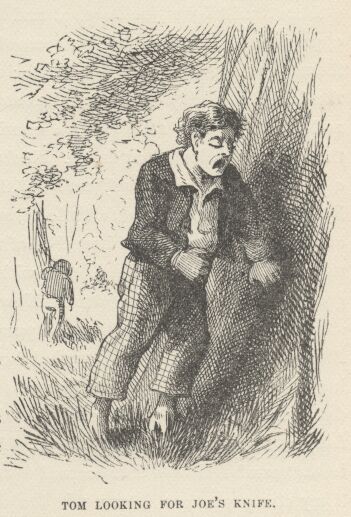
So Huck sat down again, and waited an hour. Then he found it lonesome, and went to find his comrades. They were wide apart in the woods, both very pale, both fast asleep. But something informed him that if they had had any trouble they had got rid of it.
So Huck sat down again and waited an hour. Then he felt lonely and went to find his friends. They were far apart in the woods, both very pale and fast asleep. But something told him that if they had had any trouble, they had gotten rid of it.
They were not talkative at supper that night. They had a humble look, and when Huck prepared his pipe after the meal and was going to prepare theirs, they said no, they were not feeling very well—something they ate at dinner had disagreed with them.
They didn't talk much at supper that night. They looked humbled. After the meal, Huck got his pipe ready and was about to get theirs ready too. But they said no, they weren't feeling very well. Something they had eaten at dinner had upset their stomachs.
About midnight Joe awoke, and called the boys. There was a brooding oppressiveness in the air that seemed to bode something. The boys huddled themselves together and sought the friendly companionship of the fire, though the dull dead heat of the breathless atmosphere was stifling. They sat still, intent and waiting. The solemn hush continued. Beyond the light of the fire everything was swallowed up in the blackness of darkness. Presently there came a quivering glow that vaguely revealed the foliage for a moment and then vanished. By and by another came, a little stronger. Then another. Then a faint moan came sighing through the branches of the forest and the boys felt a fleeting breath upon their cheeks, and shuddered with the fancy that the Spirit of the Night had gone by. There was a pause. Now a weird flash turned night into day and showed every little grassblade, separate and distinct, that grew about their feet. And it showed three white, startled faces, too. A deep peal of thunder went rolling and tumbling down the heavens and lost itself in sullen rumblings in the distance. A sweep of chilly air passed by, rustling all the leaves and snowing the flaky ashes broadcast about the fire. Another fierce glare lit up the forest and an instant crash followed that seemed to rend the treetops right over the boys’ heads. They clung together in terror, in the thick gloom that followed. A few big raindrops fell pattering upon the leaves.
Around midnight Joe woke up and called to the boys. A heavy, threatening feeling hung in the air, as if something were about to happen. The boys huddled together and turned to the fire for comfort, though the still air was already stiflingly hot. They sat motionless, alert and waiting. The deep silence continued. Beyond the firelight, everything disappeared into total darkness. Soon a flickering glow faintly revealed the leaves for a moment, then vanished. After a while another glow came, a little brighter. Then another. Then a faint moan sighed through the forest branches, and the boys felt a brief breath against their cheeks. They shuddered, imagining that the Spirit of the Night had passed by. There was a pause. Then an eerie flash turned night into day, revealing every blade of grass around their feet, separate and clear. It also revealed three pale, startled faces. A deep thunderclap rolled and tumbled across the sky, fading into low, angry rumbles in the distance. A rush of chilly air swept past, rustling all the leaves and scattering flaky ashes like snow around the fire. Another fierce flash lit up the forest. A crash followed instantly, seeming to split the treetops directly above the boys’ heads. They clung together in terror in the deep darkness that followed. A few large raindrops pattered on the leaves.
“Quick! boys, go for the tent!” exclaimed Tom.
“Quick, boys! Head for the tent!” Tom shouted.
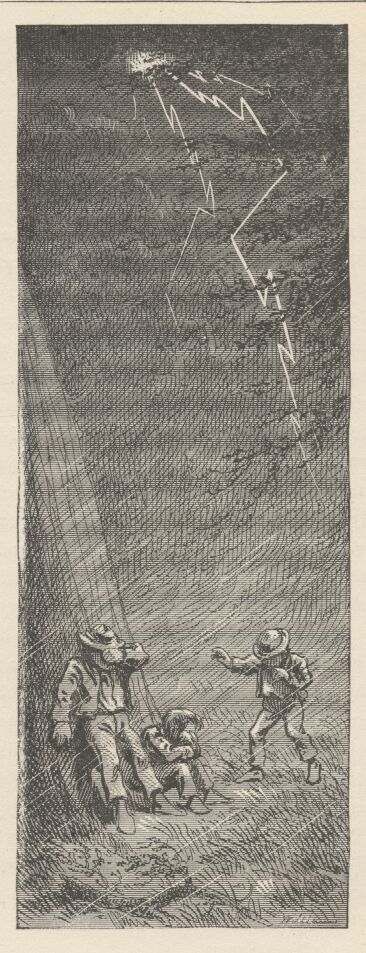
They sprang away, stumbling over roots and among vines in the dark, no two plunging in the same direction. A furious blast roared through the trees, making everything sing as it went. One blinding flash after another came, and peal on peal of deafening thunder. And now a drenching rain poured down and the rising hurricane drove it in sheets along the ground. The boys cried out to each other, but the roaring wind and the booming thunderblasts drowned their voices utterly. However, one by one they straggled in at last and took shelter under the tent, cold, scared, and streaming with water; but to have company in misery seemed something to be grateful for. They could not talk, the old sail flapped so furiously, even if the other noises would have allowed them. The tempest rose higher and higher, and presently the sail tore loose from its fastenings and went winging away on the blast. The boys seized each others’ hands and fled, with many tumblings and bruises, to the shelter of a great oak that stood upon the riverbank. Now the battle was at its highest. Under the ceaseless conflagration of lightning that flamed in the skies, everything below stood out in cleancut and shadowless distinctness: the bending trees, the billowy river, white with foam, the driving spray of spumeflakes, the dim outlines of the high bluffs on the other side, glimpsed through the drifting cloudrack and the slanting veil of rain. Every little while some giant tree yielded the fight and fell crashing through the younger growth; and the unflagging thunderpeals came now in ear-splitting explosive bursts, keen and sharp, and unspeakably appalling. The storm culminated in one matchless effort that seemed likely to tear the island to pieces, burn it up, drown it to the treetops, blow it away, and deafen every creature in it, all at one and the same moment. It was a wild night for homeless young heads to be out in.
They sprang away, stumbling over roots and through vines in the dark, each running in a different direction. A fierce gust roared through the trees, making everything sing as it passed. Blinding flashes came one after another, followed by deafening crashes of thunder. Now heavy rain poured down, and the growing hurricane drove it in sheets along the ground. The boys shouted to each other, but the roaring wind and booming thunder drowned out their voices completely. At last, they stumbled back one by one and took shelter under the tent, cold, frightened, and dripping wet. But having company in their misery seemed like something to be grateful for. They could not talk over the furious flapping of the old sail, even if the other noises had allowed it. The storm grew stronger and stronger. Soon the sail tore loose from its ropes and flew away on the wind. The boys grabbed each other’s hands and fled, falling and bruising themselves along the way. They took shelter beneath a huge oak on the riverbank. Now the battle was at its fiercest. Lightning blazed endlessly across the sky, making everything below stand out sharply, without shadows. They could see the bending trees and the rolling river, white with foam, with flecks of foam blowing through the air. Across the river, the high bluffs were faintly visible through drifting clouds and slanting curtains of rain. Every little while, some giant tree lost the fight and crashed down through the younger trees. The thunder never let up, exploding in ear-splitting bursts, sharp and unimaginably terrifying. The storm reached its peak in one tremendous burst. It seemed likely to tear the island apart, burn it up, and drown it to the treetops. It seemed likely to blow the island away and deafen every creature on it, all at the very same moment. It was a wild night for young boys without a home to be out in.
But at last the battle was done, and the forces retired with weaker and weaker threatenings and grumblings, and peace resumed her sway. The boys went back to camp, a good deal awed; but they found there was still something to be thankful for, because the great sycamore, the shelter of their beds, was a ruin, now, blasted by the lightnings, and they were not under it when the catastrophe happened.
But at last the battle was over, and the forces retreated, their threats and grumbling growing fainter and fainter. Peace ruled again. The boys went back to camp, still shaken. But they found they still had something to be thankful for. The great sycamore that had sheltered their beds was now a ruin, shattered by lightning. They were thankful because they had not been under the tree when it was struck.
Everything in camp was drenched, the campfire as well; for they were but heedless lads, like their generation, and had made no provision against rain. Here was matter for dismay, for they were soaked through and chilled. They were eloquent in their distress; but they presently discovered that the fire had eaten so far up under the great log it had been built against (where it curved upward and separated itself from the ground), that a handbreadth or so of it had escaped wetting; so they patiently wrought until, with shreds and bark gathered from the under sides of sheltered logs, they coaxed the fire to burn again. Then they piled on great dead boughs till they had a roaring furnace, and were gladhearted once more. They dried their boiled ham and had a feast, and after that they sat by the fire and expanded and glorified their midnight adventure until morning, for there was not a dry spot to sleep on, anywhere around.
Everything in camp was drenched, including the campfire. Like other boys of their generation, they were careless and had made no preparations for rain. This was cause for dismay, since they were soaked through and chilled. They had plenty to say about their misery. But soon they discovered that the fire had burned far under the great log they had built it against. The log curved upward there, away from the ground, sheltering a patch of fire about a hand’s width across. That patch had stayed dry. So they worked patiently, gathering wood scraps and bark from the undersides of sheltered logs. With these, they coaxed the fire into burning again. Then they piled on big dead branches until the fire roared like a furnace, and they were cheerful again. They dried their boiled ham and had a feast. Afterward, they sat by the fire until morning, making their midnight adventure sound bigger and grander with every telling. There was nowhere dry to sleep.
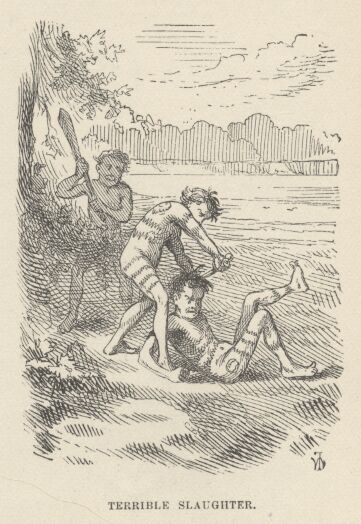
As the sun began to steal in upon the boys, drowsiness came over them, and they went out on the sandbar and lay down to sleep. They got scorched out by and by, and drearily set about getting breakfast. After the meal they felt rusty, and stiff-jointed, and a little homesick once more. Tom saw the signs, and fell to cheering up the pirates as well as he could. But they cared nothing for marbles, or circus, or swimming, or anything. He reminded them of the imposing secret, and raised a ray of cheer. While it lasted, he got them interested in a new device. This was to knock off being pirates, for a while, and be Indians for a change. They were attracted by this idea; so it was not long before they were stripped, and striped from head to heel with black mud, like so many zebras—all of them chiefs, of course—and then they went tearing through the woods to attack an English settlement.
As the sun began to creep over the boys, they grew drowsy. They went out onto the sandbar and lay down to sleep. Before long, the sun grew too hot for them, and they wearily set about making breakfast. After the meal, they felt sluggish, stiff, and a little homesick again. Tom noticed the signs and did his best to cheer up the pirates. But they had no interest in marbles, the circus, swimming, or anything else. He reminded them of the grand secret, and that cheered them up a little. While their spirits were lifted, he got them interested in a new idea. They would stop being pirates for a while and play Indians for a change. They liked the idea. Soon they had stripped and painted themselves with stripes of black mud from head to toe, like zebras. All of them were chiefs, of course. Then they went charging through the woods to attack an English settlement.
By and by they separated into three hostile tribes, and darted upon each other from ambush with dreadful warwhoops, and killed and scalped each other by thousands. It was a gory day. Consequently it was an extremely satisfactory one.
Soon they split into three enemy tribes. They sprang from hiding to attack each other with terrifying war cries, killing and scalping each other by the thousands. It was a bloody day. So it was an extremely satisfying one.
They assembled in camp toward suppertime, hungry and happy; but now a difficulty arose—hostile Indians could not break the bread of hospitality together without first making peace, and this was a simple impossibility without smoking a pipe of peace. There was no other process that ever they had heard of. Two of the savages almost wished they had remained pirates. However, there was no other way; so with such show of cheerfulness as they could muster they called for the pipe and took their whiff as it passed, in due form.
They gathered at camp around suppertime, hungry and happy. But now a problem arose. Hostile Indians could not share a meal as guests without first making peace. And making peace was simply impossible without smoking a peace pipe. They had never heard of any other way. Two of the savages almost wished they had stayed pirates. Still, there was no other way. So, looking as cheerful as they could, they called for the pipe. Each took a puff as it passed, following the proper ceremony.
And behold, they were glad they had gone into savagery, for they had gained something; they found that they could now smoke a little without having to go and hunt for a lost knife; they did not get sick enough to be seriously uncomfortable. They were not likely to fool away this high promise for lack of effort. No, they practised cautiously, after supper, with right fair success, and so they spent a jubilant evening. They were prouder and happier in their new acquirement than they would have been in the scalping and skinning of the Six Nations. We will leave them to smoke and chatter and brag, since we have no further use for them at present.
And behold, they were glad they had gone into savagery, because they had gained something. They found that they could now smoke a little without having to go and hunt for a lost knife. They did not get sick enough to be seriously uncomfortable. They were not likely to throw away this high promise for lack of effort. No, they practiced cautiously after supper, with pretty fair success, and so they spent a jubilant evening. They were prouder and happier in their new skill than they would have been in scalping and skinning the Six Nations. We will leave them to smoke and chatter and brag, since we have no further use for them at present.