Chapter 15
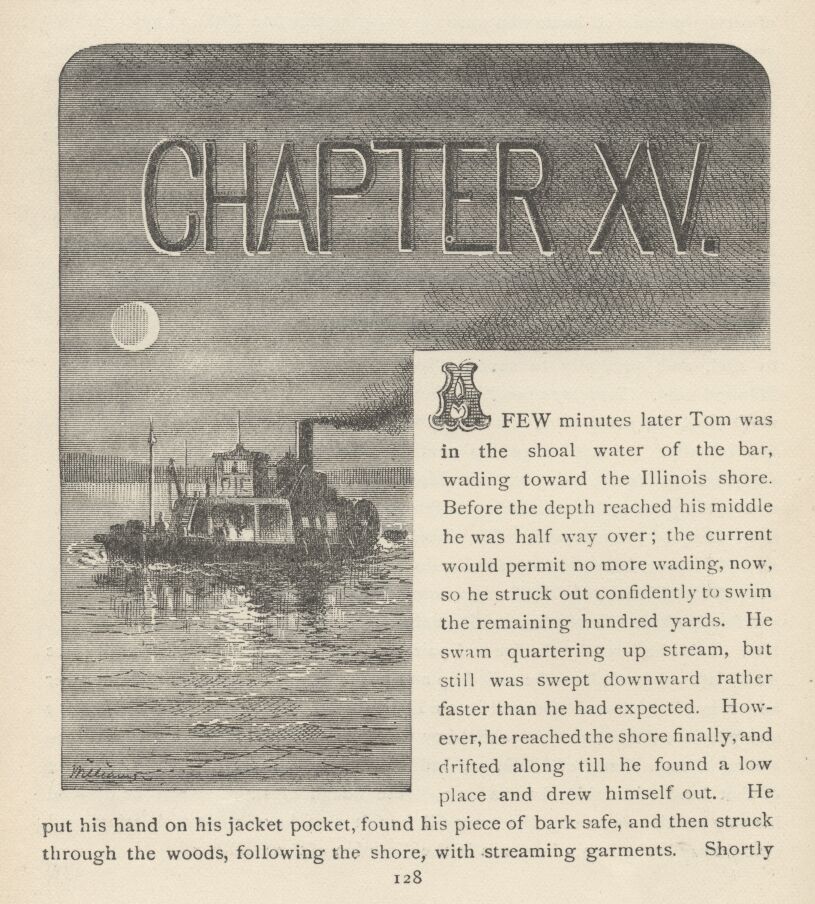
A few minutes later Tom was in the shoal water of the bar, wading toward the Illinois shore. Before the depth reached his middle he was halfway over; the current would permit no more wading, now, so he struck out confidently to swim the remaining hundred yards. He swam quartering upstream, but still was swept downward rather faster than he had expected. However, he reached the shore finally, and drifted along till he found a low place and drew himself out. He put his hand on his jacket pocket, found his piece of bark safe, and then struck through the woods, following the shore, with streaming garments. Shortly before ten o’clock he came out into an open place opposite the village, and saw the ferryboat lying in the shadow of the trees and the high bank. Everything was quiet under the blinking stars. He crept down the bank, watching with all his eyes, slipped into the water, swam three or four strokes and climbed into the skiff that did “yawl” duty at the boat’s stern. He laid himself down under the thwarts and waited, panting.
A few minutes later, Tom was wading through the shallow water over the sandbar toward the Illinois shore. He was halfway across before the water reached his waist. The current was now too strong for wading, so he confidently began swimming the remaining hundred yards. He swam at an angle upstream, but the current still swept him downstream rather faster than he had expected. However, he finally reached the shore and drifted along until he found a low spot and pulled himself out. He felt his jacket pocket and found his piece of bark safe inside. Then he headed through the woods along the shore, his clothes dripping. Shortly before ten o’clock, he reached a clearing across from the village. He saw the ferryboat resting in the shadow of the trees and the high bank. Everything was quiet under the twinkling stars. He crept down the bank, watching intently, and slipped into the water. After three or four swimming strokes, he climbed into the small boat serving as a “yawl” at the ferryboat’s stern. He lay down beneath the seats and waited, panting.
Presently the cracked bell tapped and a voice gave the order to “cast off.” A minute or two later the skiff’s head was standing high up, against the boat’s swell, and the voyage was begun. Tom felt happy in his success, for he knew it was the boat’s last trip for the night. At the end of a long twelve or fifteen minutes the wheels stopped, and Tom slipped overboard and swam ashore in the dusk, landing fifty yards downstream, out of danger of possible stragglers.
Soon the cracked bell tapped, and a voice gave the order to “cast off.” A minute or two later the skiff’s bow was standing high up against the swell from the boat, and the voyage had begun. Tom felt happy in his success, because he knew it was the boat’s last trip for the night. At the end of a long twelve or fifteen minutes the wheels stopped. Tom slipped overboard and swam ashore in the dark, landing fifty yards downstream, safe from any stragglers who might be about.
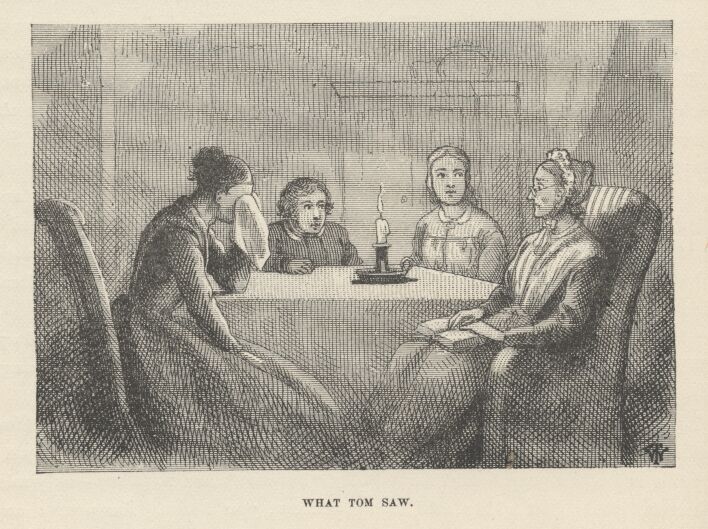
He flew along unfrequented alleys, and shortly found himself at his aunt’s back fence. He climbed over, approached the “ell,” and looked in at the sitting-room window, for a light was burning there. There sat Aunt Polly, Sid, Mary, and Joe Harper’s mother, grouped together, talking. They were by the bed, and the bed was between them and the door. Tom went to the door and began to softly lift the latch; then he pressed gently and the door yielded a crack; he continued pushing cautiously, and quaking every time it creaked, till he judged he might squeeze through on his knees; so he put his head through and began, warily.
He raced through little-used alleys and soon reached his aunt’s back fence. He climbed over and approached the “wing” of the house. He looked through the sitting-room window because a light was burning inside. Aunt Polly, Sid, Mary, and Joe Harper’s mother sat together, talking. They were beside the bed, which stood between them and the door. Tom went to the door and slowly began lifting the latch. Then he pushed gently, and the door opened a crack. He kept pushing carefully, trembling every time the door creaked, until he thought he could squeeze through on his knees. So he slipped his head through and cautiously began crawling inside.
“What makes the candle blow so?” said Aunt Polly. Tom hurried up. “Why, that door’s open, I believe. Why, of course it is. No end of strange things now. Go ’long and shut it, Sid.”
“What makes the candle flicker like that?” said Aunt Polly. Tom hurried up. “Why, that door’s open, I believe. Why, of course it is. There’s no end to strange things now. Go along and shut it, Sid.”
Tom disappeared under the bed just in time. He lay and “breathed” himself for a time, and then crept to where he could almost touch his aunt’s foot.
Tom slipped under the bed just in time. He lay there and “caught his breath” for a while. Then he crept close enough to almost touch his aunt’s foot.
“But as I was saying,” said Aunt Polly, “he warn’t bad, so to say—only misch_ee_vous. Only just giddy, and harum-scarum, you know. He warn’t any more responsible than a colt. He never meant any harm, and he was the best-hearted boy that ever was”—and she began to cry.
“But as I was saying,” said Aunt Polly, “he wasn’t bad, so to speak. Only misch_ie_vous. Only just silly and reckless, you know. He wasn’t any more responsible than a colt. He never meant any harm, and he was the kindest boy there ever was.” And she began to cry.
“It was just so with my Joe—always full of his devilment, and up to every kind of mischief, but he was just as unselfish and kind as he could be—and laws bless me, to think I went and whipped him for taking that cream, never once recollecting that I throwed it out myself because it was sour, and I never to see him again in this world, never, never, never, poor abused boy!” And Mrs. Harper sobbed as if her heart would break.
“It was just the same with my Joe. He was always full of his devilment and up to every kind of mischief. But he was as unselfish and kind as he could be. And laws bless me, to think I went and whipped him for taking that cream! I never once remembered that I throwed it out myself because it was sour. And I never to see him again in this world, never, never, never, poor mistreated boy!” And Mrs. Harper sobbed as if her heart would break.
“I hope Tom’s better off where he is,” said Sid, “but if he’d been better in some ways—”
“I hope Tom’s better off where he is,” said Sid. “But if he’d behaved better in some ways...”
“Sid!” Tom felt the glare of the old lady’s eye, though he could not see it. “Not a word against my Tom, now that he’s gone! God’ll take care of him—never you trouble _your_self, sir! Oh, Mrs. Harper, I don’t know how to give him up! I don’t know how to give him up! He was such a comfort to me, although he tormented my old heart out of me, ’most.”
“Sid!” Tom felt the old lady’s glare, though he could not see it. “Not a word against my Tom, now that he’s gone! God’ll take care of him. Don’t you worry _your_self, sir! Oh, Mrs. Harper, I don’t know how to let him go! I don’t know how to let him go! He was such a comfort to me, although he almost tormented my poor old heart out of me.”
“The Lord giveth and the Lord hath taken away—Blessed be the name of the Lord! But it’s so hard—Oh, it’s so hard! Only last Saturday my Joe busted a firecracker right under my nose and I knocked him sprawling. Little did I know then, how soon—Oh, if it was to do over again I’d hug him and bless him for it.”
“The Lord gives and the Lord has taken away. Praise the name of the Lord! But it’s so hard. Oh, it’s so hard! Only last Saturday my Joe busted a firecracker right under my nose, and I knocked him flat. I had no idea then how soon... Oh, if it was to do over again, I’d hug him and bless him for it.”
“Yes, yes, yes, I know just how you feel, Mrs. Harper, I know just exactly how you feel. No longer ago than yesterday noon, my Tom took and filled the cat full of Pain-killer, and I did think the cretur would tear the house down. And God forgive me, I cracked Tom’s head with my thimble, poor boy, poor dead boy. But he’s out of all his troubles now. And the last words I ever heard him say was to reproach—”
“Yes, yes, yes, I know just how you feel, Mrs. Harper. I know just exactly how you feel. Just yesterday at noon, my Tom took and filled the cat full of Pain-killer. And I did think the creature would tear the house down. And God forgive me, I hit Tom on the head with my thimble. Poor boy, poor dead boy. But he’s out of all his troubles now. And the last words I ever heard him say was to criticize...”
But this memory was too much for the old lady, and she broke entirely down. Tom was snuffling, now, himself—and more in pity of himself than anybody else. He could hear Mary crying, and putting in a kindly word for him from time to time. He began to have a nobler opinion of himself than ever before. Still, he was sufficiently touched by his aunt’s grief to long to rush out from under the bed and overwhelm her with joy—and the theatrical gorgeousness of the thing appealed strongly to his nature, too, but he resisted and lay still.
But this memory was too much for the old lady, and she broke down completely. Tom was sniffling now, too, more out of pity for himself than for anyone else. He could hear Mary crying and saying a kind word for him now and then. He began to think more highly of himself than ever before. Still, his aunt’s grief touched him enough to make him want to rush out from under the bed. He wanted to overwhelm her with joy. The chance to make such a grand, dramatic entrance also appealed strongly to him. But he resisted and lay still.
He went on listening, and gathered by odds and ends that it was conjectured at first that the boys had got drowned while taking a swim; then the small raft had been missed; next, certain boys said the missing lads had promised that the village should “hear something” soon; the wise-heads had “put this and that together” and decided that the lads had gone off on that raft and would turn up at the next town below, presently; but toward noon the raft had been found, lodged against the Missouri shore some five or six miles below the village—and then hope perished; they must be drowned, else hunger would have driven them home by nightfall if not sooner. It was believed that the search for the bodies had been a fruitless effort merely because the drowning must have occurred in mid-channel, since the boys, being good swimmers, would otherwise have escaped to shore. This was Wednesday night. If the bodies continued missing until Sunday, all hope would be given over, and the funerals would be preached on that morning. Tom shuddered.
He kept listening and pieced together the story from bits and pieces. At first, people had guessed that the boys had drowned while swimming. Then someone noticed that the small raft was missing. Next, some boys said the missing boys had promised that the village would “hear something” soon. The wise heads had “put this and that together” and decided the boys had left on the raft. They would soon turn up at the next town downriver. But around noon, the raft had been found against the Missouri shore, five or six miles below the village. Then all hope died. The boys must have drowned. Otherwise, hunger would have driven them home by nightfall, if not sooner. People believed the search for the bodies had failed only because the boys must have drowned in mid-channel. Since the boys were good swimmers, they would otherwise have made it to shore. This was Wednesday night. If the bodies were still missing on Sunday, everyone would give up all hope. Funeral sermons would be preached that morning. Tom shuddered.
Mrs. Harper gave a sobbing goodnight and turned to go. Then with a mutual impulse the two bereaved women flung themselves into each other’s arms and had a good, consoling cry, and then parted. Aunt Polly was tender far beyond her wont, in her goodnight to Sid and Mary. Sid snuffled a bit and Mary went off crying with all her heart.
Mrs. Harper sobbed as she said goodnight and turned to go. Then, moved by the same impulse, the two grieving women threw their arms around each other. They had a good, comforting cry and then parted. Aunt Polly was much more tender than usual when she said goodnight to Sid and Mary. Sid sniffled a little, and Mary went off crying with all her heart.
Aunt Polly knelt down and prayed for Tom so touchingly, so appealingly, and with such measureless love in her words and her old trembling voice, that he was weltering in tears again, long before she was through.
Aunt Polly knelt down and prayed for Tom with deeply moving pleas. Her words and her old, trembling voice were filled with endless love. So Tom was crying hard again long before she finished.
He had to keep still long after she went to bed, for she kept making broken-hearted ejaculations from time to time, tossing unrestfully, and turning over. But at last she was still, only moaning a little in her sleep. Now the boy stole out, rose gradually by the bedside, shaded the candle-light with his hand, and stood regarding her. His heart was full of pity for her. He took out his sycamore scroll and placed it by the candle. But something occurred to him, and he lingered considering. His face lighted with a happy solution of his thought; he put the bark hastily in his pocket. Then he bent over and kissed the faded lips, and straightway made his stealthy exit, latching the door behind him.
He had to stay still long after she went to bed. She kept crying out in heartbreak now and then, tossing restlessly and turning over. But at last she lay still, only moaning a little in her sleep. Now the boy crept out and slowly stood up beside the bed. He shielded the candlelight with his hand and stood looking at her. His heart was full of pity for her. He took out his roll of sycamore bark and placed it beside the candle. But something occurred to him, and he paused to think. His face lit up as he happily worked out what to do. He quickly put the bark in his pocket. Then he bent over and kissed her faded lips. At once, he slipped quietly out, latching the door behind him.
He threaded his way back to the ferry landing, found nobody at large there, and walked boldly on board the boat, for he knew she was tenantless except that there was a watchman, who always turned in and slept like a graven image. He untied the skiff at the stern, slipped into it, and was soon rowing cautiously upstream. When he had pulled a mile above the village, he started quartering across and bent himself stoutly to his work. He hit the landing on the other side neatly, for this was a familiar bit of work to him. He was moved to capture the skiff, arguing that it might be considered a ship and therefore legitimate prey for a pirate, but he knew a thorough search would be made for it and that might end in revelations. So he stepped ashore and entered the woods.
He made his way back to the ferry landing and found no one out and about. He walked boldly aboard the boat because he knew only a watchman was there. The watchman always went to bed and slept as still as a carved statue. He untied the skiff at the stern, slipped into it, and soon was rowing cautiously upstream. After rowing a mile above the village, he headed diagonally across the river and put his strength into rowing. He reached the landing on the other side neatly, because he had done this often before. He was tempted to steal the skiff. He reasoned that the skiff might count as a ship and therefore be fair game for a pirate. But he knew people would search thoroughly for the skiff, and the search might give his secrets away. So he stepped ashore and entered the woods.
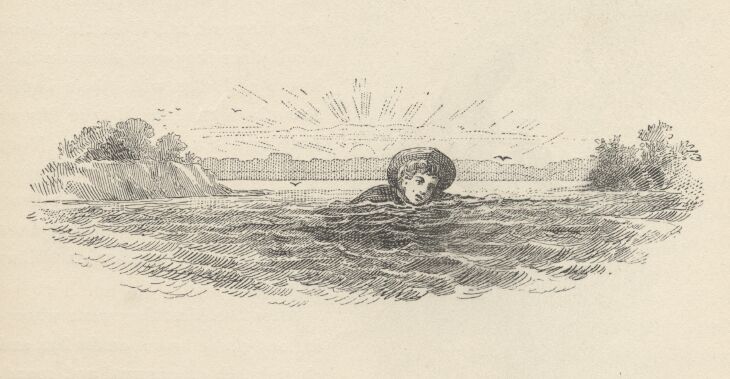
He sat down and took a long rest, torturing himself meanwhile to keep awake, and then started warily down the home-stretch. The night was far spent. It was broad daylight before he found himself fairly abreast the island bar. He rested again until the sun was well up and gilding the great river with its splendor, and then he plunged into the stream. A little later he paused, dripping, upon the threshold of the camp, and heard Joe say:
He sat down for a long rest, struggling painfully to stay awake. Then he cautiously began the last stretch home. The night was nearly over. It was broad daylight before he reached a point level with the island’s sandbar. He rested again until the sun was high, covering the great river in golden light. Then he plunged into the river. A little later, he stopped at the entrance to the camp, dripping wet, and heard Joe say:
“No, Tom’s true-blue, Huck, and he’ll come back. He won’t desert. He knows that would be a disgrace to a pirate, and Tom’s too proud for that sort of thing. He’s up to something or other. Now I wonder what?”
“No, Tom’s loyal, Huck, and he’ll come back. He won’t abandon us. He knows abandoning us would disgrace a pirate, and Tom’s too proud for that. He’s up to something. Now I wonder what?”
“Well, the things is ours, anyway, ain’t they?”
“Well, the things is ours, anyway, ain’t they?”
“Pretty near, but not yet, Huck. The writing says they are if he ain’t back here to breakfast.”
“Pretty near, but not yet, Huck. The writing says they are if he ain’t back here for breakfast.”
“Which he is!” exclaimed Tom, with fine dramatic effect, stepping grandly into camp.
“Which he is!” Tom exclaimed with great dramatic flair as he strode grandly into camp.
A sumptuous breakfast of bacon and fish was shortly provided, and as the boys set to work upon it, Tom recounted (and adorned) his adventures. They were a vain and boastful company of heroes when the tale was done. Then Tom hid himself away in a shady nook to sleep till noon, and the other pirates got ready to fish and explore.
A rich breakfast of bacon and fish was soon ready. As the boys dug in, Tom told his adventures and added a few flourishes. By the end of the story, they were a proud, boastful band of heroes. Then Tom hid away in a shady spot to sleep until noon. The other pirates got ready to fish and explore.