Chapter 11
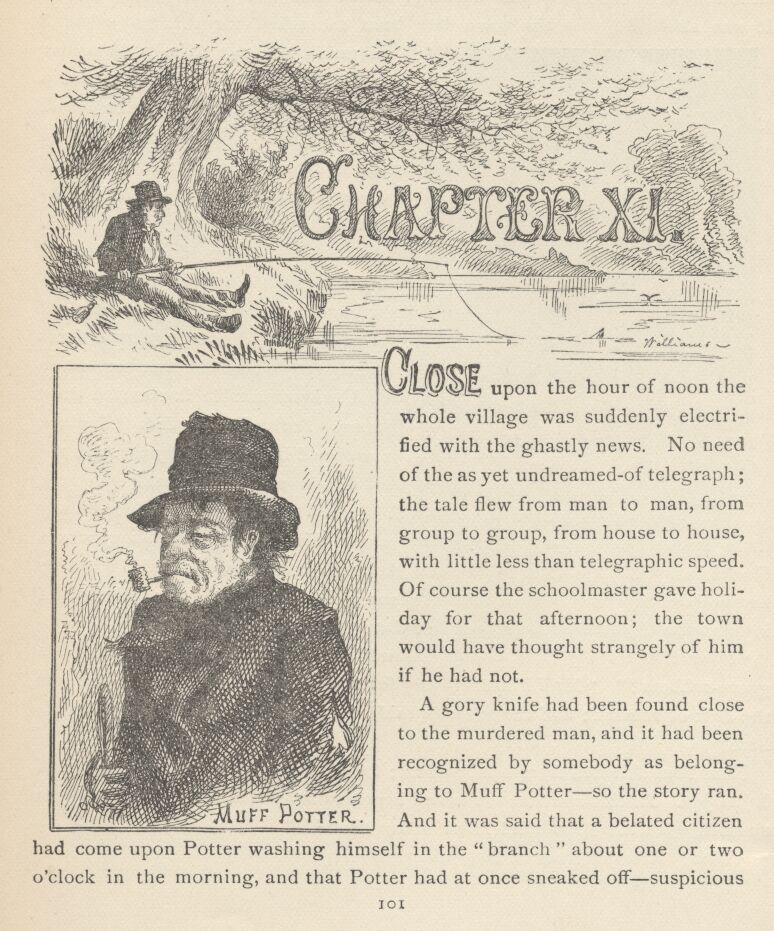
Close upon the hour of noon the whole village was suddenly electrified with the ghastly news. No need of the as yet un-dreamed-of telegraph; the tale flew from man to man, from group to group, from house to house, with little less than telegraphic speed. Of course the schoolmaster gave holiday for that afternoon; the town would have thought strangely of him if he had not.
Just before noon, the whole village was suddenly jolted by the horrifying news. There was no need for the telegraph, which no one had even dreamed of yet. The story flew from person to person, group to group, and house to house, almost as fast as a telegraph. Of course, the schoolmaster gave everyone that afternoon off. The town would have thought it strange if he hadn't.
A gory knife had been found close to the murdered man, and it had been recognized by somebody as belonging to Muff Potter—so the story ran. And it was said that a belated citizen had come upon Potter washing himself in the “branch” about one or two o’clock in the morning, and that Potter had at once sneaked off—suspicious circumstances, especially the washing which was not a habit with Potter. It was also said that the town had been ransacked for this “murderer” (the public are not slow in the matter of sifting evidence and arriving at a verdict), but that he could not be found. Horsemen had departed down all the roads in every direction, and the Sheriff “was confident” that he would be captured before night.
A bloody knife had been found near the murdered man. Someone had identified it as Muff Potter’s, or so the story went. People also said a townsman out late had found Potter washing himself in the “creek” around one or two that morning. Potter had immediately sneaked away. These were suspicious circumstances, especially the washing, since Potter was not in the habit of washing himself. People also said the town had been searched from top to bottom for this “murderer”. (The public wastes no time weighing evidence and reaching a verdict.) But Potter could not be found. Men on horseback had ridden off along all the roads in every direction. The Sheriff “was confident” that Potter would be caught before nightfall.
All the town was drifting toward the graveyard. Tom’s heartbreak vanished and he joined the procession, not because he would not a thousand times rather go anywhere else, but because an awful, unaccountable fascination drew him on. Arrived at the dreadful place, he wormed his small body through the crowd and saw the dismal spectacle. It seemed to him an age since he was there before. Somebody pinched his arm. He turned, and his eyes met Huckleberry’s. Then both looked elsewhere at once, and wondered if anybody had noticed anything in their mutual glance. But everybody was talking, and intent upon the grisly spectacle before them.
The whole town was making its way toward the graveyard. Tom’s heartbreak vanished, and he joined the procession. He would have preferred a thousand times over to go anywhere else, but a terrible, unexplained fascination drew him on. When he reached the dreadful place, he squeezed his small body through the crowd and saw the grim scene. It felt like ages since he had last been there. Someone pinched his arm. He turned and met Huckleberry’s eyes. Then both immediately looked away, each wondering if anyone had noticed anything in the glance they had exchanged. But everyone was talking, focused on the gruesome sight before them.
“Poor fellow!” “Poor young fellow!” “This ought to be a lesson to grave robbers!” “Muff Potter’ll hang for this if they catch him!” This was the drift of remark; and the minister said, “It was a judgment; His hand is here.”
“Poor fellow!” “Poor young fellow!” “This should be a lesson to grave robbers!” “Muff Potter will hang for this if they catch him!” These were the kinds of comments people made. And the minister said, “It was God’s punishment. His hand is at work here.”
Now Tom shivered from head to heel; for his eye fell upon the stolid face of Injun Joe. At this moment the crowd began to sway and struggle, and voices shouted, “It’s him! it’s him! he’s coming himself!”
Now Tom shivered from head to toe because he caught sight of Injun Joe’s expressionless face. At that moment, the crowd began to sway and push, and voices shouted, “It’s him! It’s him! He’s coming himself!”
“Who? Who?” from twenty voices.
“Who? Who?” twenty voices called out.
“Muff Potter!”
“Muff Potter!”
“Hallo, he’s stopped!—Look out, he’s turning! Don’t let him get away!”
“Hey, he’s stopped! Look out, he’s turning! Don’t let him get away!”
People in the branches of the trees over Tom’s head said he wasn’t trying to get away—he only looked doubtful and perplexed.
People in the tree branches above Tom’s head said he wasn’t trying to get away. He just looked unsure and confused.
“Infernal impudence!” said a bystander; “wanted to come and take a quiet look at his work, I reckon—didn’t expect any company.”
“Infernal impudence!” said a bystander. “Wanted to come and take a quiet look at his work, I reckon. Didn’t expect any company.”
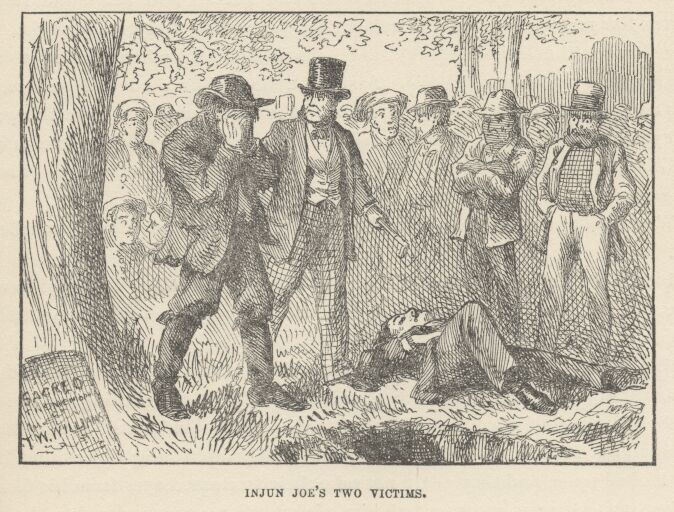
The crowd fell apart, now, and the Sheriff came through, ostentatiously leading Potter by the arm. The poor fellow’s face was haggard, and his eyes showed the fear that was upon him. When he stood before the murdered man, he shook as with a palsy, and he put his face in his hands and burst into tears.
The crowd parted now, and the Sheriff came through, making a show of leading Potter by the arm. The poor man’s face looked worn and drawn, and his eyes showed his fear. When he stood before the murdered man, he trembled as if he had a shaking disorder. He buried his face in his hands and burst into tears.
“I didn’t do it, friends,” he sobbed; “’pon my word and honor I never done it.”
“I didn’t do it, friends,” he sobbed. “On my word and honor, I never done it.”
“Who’s accused you?” shouted a voice.
“Who accused you?” a voice shouted.
This shot seemed to carry home. Potter lifted his face and looked around him with a pathetic hopelessness in his eyes. He saw Injun Joe, and exclaimed:
This remark seemed to hit home. Potter raised his head and looked around with a pitiful look of hopelessness in his eyes. He saw Injun Joe and cried out:
“Oh, Injun Joe, you promised me you’d never—”
“Oh, Injun Joe, you promised me you’d never...”
“Is that your knife?” and it was thrust before him by the Sheriff.
“Is that your knife?” The sheriff thrust the knife in front of him.
Potter would have fallen if they had not caught him and eased him to the ground. Then he said:
Potter would have fallen if they hadn't caught him and gently lowered him to the ground. Then he said:
“Something told me ’t if I didn’t come back and get—” He shuddered; then waved his nerveless hand with a vanquished gesture and said, “Tell ’em, Joe, tell ’em—it ain’t any use any more.”
“Something told me that if I didn’t come back and get...” He shuddered. Then he weakly waved his hand in defeat and said, “Tell them, Joe, tell them. It ain’t any use anymore.”
Then Huckleberry and Tom stood dumb and staring, and heard the stony-hearted liar reel off his serene statement, they expecting every moment that the clear sky would deliver God’s lightnings upon his head, and wondering to see how long the stroke was delayed. And when he had finished and still stood alive and whole, their wavering impulse to break their oath and save the poor betrayed prisoner’s life faded and vanished away, for plainly this miscreant had sold himself to Satan and it would be fatal to meddle with the property of such a power as that.
Then Huckleberry and Tom stood speechless and staring as they heard the heartless liar calmly tell his story. Every moment, they expected God’s lightning to strike him from the clear sky. They wondered why the blow was taking so long. But he finished and still stood alive and unharmed. Their wavering urge to break their oath and save the poor, betrayed prisoner’s life faded and disappeared. For clearly this villain had sold himself to Satan. Interfering with the property of such a powerful being would be fatal.
“Why didn’t you leave? What did you want to come here for?” somebody said.
“Why didn’t you leave? Why did you want to come here?” someone said.
“I couldn’t help it—I couldn’t help it,” Potter moaned. “I wanted to run away, but I couldn’t seem to come anywhere but here.” And he fell to sobbing again.
“I couldn’t help it. I couldn’t help it,” Potter moaned. “I wanted to run away, but I couldn’t seem to go anywhere but here.” And he started sobbing again.
Injun Joe repeated his statement, just as calmly, a few minutes afterward on the inquest, under oath; and the boys, seeing that the lightnings were still withheld, were confirmed in their belief that Joe had sold himself to the devil. He was now become, to them, the most balefully interesting object they had ever looked upon, and they could not take their fascinated eyes from his face.
A few minutes later, Injun Joe repeated his statement under oath at the inquest, just as calmly as before. The boys saw that lightning still had not struck him. This confirmed their belief that Joe had sold himself to the devil. To them, he was now the most frighteningly fascinating person they had ever seen. They could not take their eyes off his face.
They inwardly resolved to watch him nights, when opportunity should offer, in the hope of getting a glimpse of his dread master.
They secretly decided to watch him at night whenever they had the chance. They hoped to catch a glimpse of his terrifying master.
Injun Joe helped to raise the body of the murdered man and put it in a wagon for removal; and it was whispered through the shuddering crowd that the wound bled a little! The boys thought that this happy circumstance would turn suspicion in the right direction; but they were disappointed, for more than one villager remarked:
Injun Joe helped lift the murdered man's body and put it in a wagon to be taken away. Whispers spread through the shuddering crowd that the wound had bled a little! The boys thought this lucky development would turn suspicion in the right direction. But they were disappointed, because more than one villager remarked:
“It was within three feet of Muff Potter when it done it.”
“It was within three feet of Muff Potter when it done it.”
Tom’s fearful secret and gnawing conscience disturbed his sleep for as much as a week after this; and at breakfast one morning Sid said:
Tom’s frightening secret and nagging guilt disturbed his sleep for up to a week afterward. And one morning at breakfast, Sid said:
“Tom, you pitch around and talk in your sleep so much that you keep me awake half the time.”
“Tom, you toss around and talk in your sleep so much that you keep me awake half the time.”
Tom blanched and dropped his eyes.
Tom turned pale and looked down.
“It’s a bad sign,” said Aunt Polly, gravely. “What you got on your mind, Tom?”
“It’s a bad sign,” said Aunt Polly, seriously. “What you got on your mind, Tom?”
“Nothing. Nothing ’t I know of.” But the boy’s hand shook so that he spilled his coffee.
“Nothing. Nothing that I know of.” But the boy’s hand shook so much that he spilled his coffee.
“And you do talk such stuff,” Sid said. “Last night you said, ‘It’s blood, it’s blood, that’s what it is!’ You said that over and over. And you said, ‘Don’t torment me so—I’ll tell!’ Tell what? What is it you’ll tell?”
“And you do say such nonsense,” Sid said. “Last night you said, ‘It’s blood, it’s blood, that’s what it is!’ You said that over and over. And you said, ‘Stop tormenting me like this. I’ll tell!’ Tell what? What will you tell?”
Everything was swimming before Tom. There is no telling what might have happened, now, but luckily the concern passed out of Aunt Polly’s face and she came to Tom’s relief without knowing it. She said:
Everything seemed to spin in front of Tom. There’s no telling what might have happened next. But luckily, the worried look left Aunt Polly’s face, and she came to Tom’s rescue without realizing it. She said:
“Sho! It’s that dreadful murder. I dream about it most every night myself. Sometimes I dream it’s me that done it.”
“Oh! It’s that terrible murder. I dream about it most every night myself. Sometimes I dream it’s me that done it.”
Mary said she had been affected much the same way. Sid seemed satisfied. Tom got out of the presence as quick as he plausibly could, and after that he complained of toothache for a week, and tied up his jaws every night. He never knew that Sid lay nightly watching, and frequently slipped the bandage free and then leaned on his elbow listening a good while at a time, and afterward slipped the bandage back to its place again. Tom’s distress of mind wore off gradually and the toothache grew irksome and was discarded. If Sid really managed to make anything out of Tom’s disjointed mutterings, he kept it to himself.
Mary said she had felt much the same way. Sid seemed satisfied. Tom left their company as quickly as he could without raising suspicion. After that, he complained of a toothache for a week and wrapped a bandage around his jaws every night. He never knew that Sid lay watching him each night. Sid often slipped the bandage off, then propped himself on one elbow and listened for quite a while. Afterward, he slipped the bandage back into place. Tom’s worry gradually faded, and keeping up the toothache became a nuisance, so he gave it up. If Sid really managed to learn anything from Tom’s disconnected mutterings, he kept it to himself.
It seemed to Tom that his schoolmates never would get done holding inquests on dead cats, and thus keeping his trouble present to his mind. Sid noticed that Tom never was coroner at one of these inquiries, though it had been his habit to take the lead in all new enterprises; he noticed, too, that Tom never acted as a witness—and that was strange; and Sid did not overlook the fact that Tom even showed a marked aversion to these inquests, and always avoided them when he could. Sid marvelled, but said nothing. However, even inquests went out of vogue at last, and ceased to torture Tom’s conscience.
Tom felt his schoolmates would never stop holding inquests into the deaths of cats. These investigations kept reminding him of his trouble. Sid noticed that Tom never played the coroner, though he usually took the lead in all new activities. He also noticed that Tom never acted as a witness, which was strange. And Sid did not miss Tom’s obvious dislike of these inquests or how he avoided them whenever he could. Sid wondered about it but said nothing. Eventually, though, even inquests went out of fashion and stopped tormenting Tom’s conscience.
Every day or two, during this time of sorrow, Tom watched his opportunity and went to the little grated jail-window and smuggled such small comforts through to the “murderer” as he could get hold of. The jail was a trifling little brick den that stood in a marsh at the edge of the village, and no guards were afforded for it; indeed, it was seldom occupied. These offerings greatly helped to ease Tom’s conscience.
Every day or two during this time of sorrow, Tom waited for a chance to visit the jail’s little barred window. He smuggled whatever small comforts he could find through the window to the “murderer”. The jail was a tiny brick hole in a marsh at the edge of the village. It had no guards and was rarely occupied anyway. These gifts did a great deal to ease Tom’s conscience.
The villagers had a strong desire to tar-and-feather Injun Joe and ride him on a rail, for body-snatching, but so formidable was his character that nobody could be found who was willing to take the lead in the matter, so it was dropped. He had been careful to begin both of his inquest-statements with the fight, without confessing the grave-robbery that preceded it; therefore it was deemed wisest not to try the case in the courts at present.
The villagers were eager to tar and feather Injun Joe and carry him through town on a rail for stealing bodies. But he was so fearsome that no one was willing to take the lead, so they dropped the plan. He had carefully begun both his statements at the inquest with the fight, without admitting to the grave robbery before it. So it seemed wisest not to bring the case to court for now.