Chapter 10
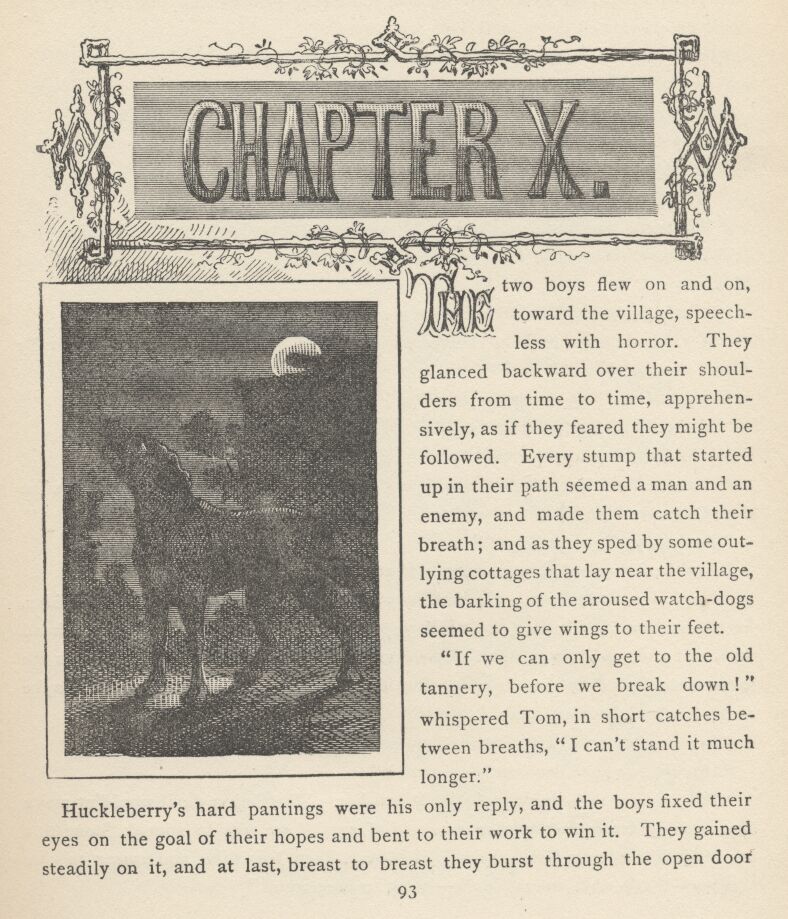
The two boys flew on and on, toward the village, speechless with horror. They glanced backward over their shoulders from time to time, apprehensively, as if they feared they might be followed. Every stump that started up in their path seemed a man and an enemy, and made them catch their breath; and as they sped by some outlying cottages that lay near the village, the barking of the aroused watch-dogs seemed to give wings to their feet.
The two boys raced on and on toward the village, too horrified to speak. From time to time, they glanced nervously over their shoulders, as if afraid someone might be following them. Every stump that loomed in their path looked like a man and an enemy, making them catch their breath. As they raced past some cottages on the village outskirts, they woke the watchdogs. The dogs’ barking seemed to give wings to their feet.
“If we can only get to the old tannery before we break down!” whispered Tom, in short catches between breaths. “I can’t stand it much longer.”
“If we can just reach the old tannery before we collapse!” Tom whispered between gasps for breath. “I can’t take much more.”
Huckleberry’s hard pantings were his only reply, and the boys fixed their eyes on the goal of their hopes and bent to their work to win it. They gained steadily on it, and at last, breast to breast, they burst through the open door and fell grateful and exhausted in the sheltering shadows beyond. By and by their pulses slowed down, and Tom whispered:
Huckleberry’s only reply was heavy panting. The boys kept their eyes on the place they hoped to reach and pushed themselves to get there. They drew steadily closer, and at last, side by side, they burst through the open door. They collapsed in the sheltering shadows beyond, grateful and exhausted. After a while, their hearts stopped racing, and Tom whispered:
“Huckleberry, what do you reckon’ll come of this?”
“Huckleberry, what do you reckon will happen because of this?”
“If Doctor Robinson dies, I reckon hanging’ll come of it.”
“If Doctor Robinson dies, I reckon someone will get hanged for it.”
“Do you though?”
“Do you really?”
“Why, I know it, Tom.”
“Well, I know it, Tom.”
Tom thought a while, then he said:
Tom thought for a while, then said:
“Who’ll tell? We?”
“Who’s going to tell? Us?”
“What are you talking about? S’pose something happened and Injun Joe didn’t hang? Why, he’d kill us some time or other, just as dead sure as we’re a laying here.”
“What are you talking about? Suppose something happened and Injun Joe didn’t hang? Why, he’d kill us some time or other, just as dead sure as we’re a laying here.”
“That’s just what I was thinking to myself, Huck.”
“That’s exactly what I was thinking, Huck.”
“If anybody tells, let Muff Potter do it, if he’s fool enough. He’s generally drunk enough.”
“If anybody tells, let Muff Potter do it, if he’s fool enough. He’s usually drunk enough.”
Tom said nothing—went on thinking. Presently he whispered:
Tom said nothing and kept thinking. After a while, he whispered:
“Huck, Muff Potter don’t know it. How can he tell?”
“Huck, Muff Potter don’t know it. How can he tell?”
“What’s the reason he don’t know it?”
“Why don’t he know it?”
“Because he’d just got that whack when Injun Joe done it. D’you reckon he could see anything? D’you reckon he knowed anything?”
“Because he’d just got that whack when Injun Joe done it. Do you reckon he could see anything? Do you reckon he knowed anything?”
“By hokey, that’s so, Tom!”
“Gosh, that’s right, Tom!”
“And besides, look-a-here—maybe that whack done for him!”
“And besides, look here, maybe that whack killed him!”
“No, ’taint likely, Tom. He had liquor in him; I could see that; and besides, he always has. Well, when pap’s full, you might take and belt him over the head with a church and you couldn’t phase him. He says so, his own self. So it’s the same with Muff Potter, of course. But if a man was dead sober, I reckon maybe that whack might fetch him; I dono.”
“No, it ain't likely, Tom. He had liquor in him. I could see that, and besides, he always has. Well, when pap's drunk, you could hit him over the head with a church and you couldn't faze him. He says so, his own self. So it's the same with Muff Potter, of course. But if a man was completely sober, I reckon maybe that blow might finish him off. I don't know.”
After another reflective silence, Tom said:
After another thoughtful pause, Tom said:
“Hucky, you sure you can keep mum?”
“Hucky, you sure you can keep a secret?”
“Tom, we got to keep mum. You know that. That Injun devil wouldn’t make any more of drownding us than a couple of cats, if we was to squeak ’bout this and they didn’t hang him. Now, look-a-here, Tom, less take and swear to one another—that’s what we got to do—swear to keep mum.”
“Tom, we got to keep mum. You know that. That Injun devil wouldn’t think any more of drowning us than a couple of cats, if we was to squeal about this and they didn’t hang him. Now, look here, Tom, let’s take and swear to one another. That’s what we got to do, swear to keep mum.”
“I’m agreed. It’s the best thing. Would you just hold hands and swear that we—”
“I agree. It’s the best thing to do. Would you just hold hands and swear that we...”
“Oh no, that wouldn’t do for this. That’s good enough for little rubbishy common things—specially with gals, cuz they go back on you anyway, and blab if they get in a huff—but there orter be writing ’bout a big thing like this. And blood.”
“Oh no, that wouldn’t do for this. That’s good enough for little rubbishy common things, especially with gals. Because they go back on you anyway, and blab if they get in a huff. But there ought to be something in writing for a big thing like this. And blood.”
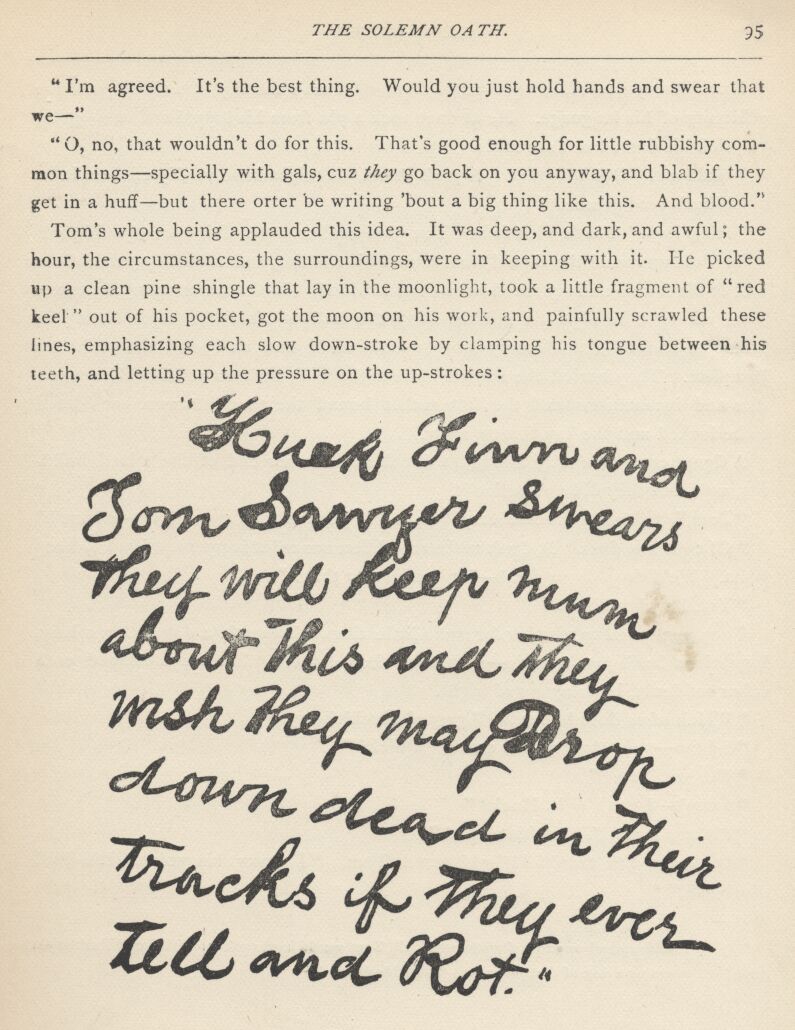
Tom’s whole being applauded this idea. It was deep, and dark, and awful; the hour, the circumstances, the surroundings, were in keeping with it. He picked up a clean pine shingle that lay in the moon-light, took a little fragment of “red keel” out of his pocket, got the moon on his work, and painfully scrawled these lines, emphasizing each slow down-stroke by clamping his tongue between his teeth, and letting up the pressure on the up-strokes.
Tom loved the idea with his whole being. It was deep, dark, and dreadful. The hour, the circumstances, and the surroundings all suited it. He picked up a clean pine shingle lying in the moonlight. He took a small piece of “red keel” from his pocket and positioned the shingle in the moonlight. Then he slowly and painstakingly scrawled these lines. With each slow downward stroke, he pressed his tongue between his teeth, easing the pressure on the upward strokes.
“Huck Finn and Tom Sawyer swears they will keep mum about This and They wish They may Drop down dead in Their Tracks if They ever Tell and Rot.”
“Huck Finn and Tom Sawyer swears they will keep mum about This and They wish They may Drop down dead in Their Tracks if They ever Tell and Rot.”
Huckleberry was filled with admiration of Tom’s facility in writing, and the sublimity of his language. He at once took a pin from his lapel and was going to prick his flesh, but Tom said:
Huckleberry greatly admired how easily Tom wrote and how grand his language was. He immediately took a pin from his lapel and was about to prick his skin, but Tom said:
“Hold on! Don’t do that. A pin’s brass. It might have verdigrease on it.”
“Hold on! Don’t do that. A pin’s brass. It might have verdigrease on it.”
“What’s verdigrease?”
“What’s verdigris?”
“It’s p’ison. That’s what it is. You just swaller some of it once—you’ll see.”
“It’s poison. That’s what it is. You just swallow some of it once. You’ll see.”
So Tom unwound the thread from one of his needles, and each boy pricked the ball of his thumb and squeezed out a drop of blood. In time, after many squeezes, Tom managed to sign his initials, using the ball of his little finger for a pen. Then he showed Huckleberry how to make an H and an F, and the oath was complete. They buried the shingle close to the wall, with some dismal ceremonies and incantations, and the fetters that bound their tongues were considered to be locked and the key thrown away.
So Tom unwound the thread from one of his needles. Each boy pricked the pad of his thumb and squeezed out a drop of blood. After much squeezing, Tom finally managed to sign his initials, using the pad of his little finger as a pen. Then he showed Huckleberry how to make an H and an F, and the oath was complete. They buried the shingle close to the wall, with some gloomy rituals and chants. They now considered the chains that kept their tongues silent locked, with the key thrown away.
A figure crept stealthily through a break in the other end of the ruined building, now, but they did not notice it.
A figure now crept quietly through a gap at the other end of the ruined building. But they did not notice the figure.
“Tom,” whispered Huckleberry, “does this keep us from ever telling—always?”
“Tom,” whispered Huckleberry, “does this mean we can’t ever tell, always?”
“Of course it does. It don’t make any difference what happens, we got to keep mum. We’d drop down dead—don’t you know that?”
“Of course it does. It don’t make any difference what happens, we got to keep mum. We’d drop down dead. Don’t you know that?”
“Yes, I reckon that’s so.”
“Yes, I reckon that’s so.”
They continued to whisper for some little time. Presently a dog set up a long, lugubrious howl just outside—within ten feet of them. The boys clasped each other suddenly, in an agony of fright.
They kept whispering for a little while. Then a dog let out a long, mournful howl just outside, within ten feet of them. The boys suddenly grabbed each other in terror.
“Which of us does he mean?” gasped Huckleberry.
“Which one of us does he mean?” Huckleberry gasped.
“I dono—peep through the crack. Quick!”
“I don't know. Peek through the crack. Quick!”
“No, you, Tom!”
“No, you, Tom!”
“I can’t—I can’t do it, Huck!”
“I can’t, I can’t do it, Huck!”
“Please, Tom. There ’tis again!”
“Please, Tom. There it is again!”
“Oh, lordy, I’m thankful!” whispered Tom. “I know his voice. It’s Bull Harbison.”
“Oh, lordy, I’m thankful!” whispered Tom. “I recognize his voice. It’s Bull Harbison.”
If Mr. Harbison owned a slave named Bull, Tom would have called him “Harbison’s Bull.” But a son or dog named Bull would have been “Bull Harbison.”
“Oh, that’s good—I tell you, Tom, I was most scared to death; I’d a bet anything it was a stray dog.”
“Oh, that’s good. I tell you, Tom, I was most scared to death. I’d have bet anything it was a stray dog.”
The dog howled again. The boys’ hearts sank once more.
The dog howled again. The boys’ hearts sank again.
“Oh, my! that ain’t no Bull Harbison!” whispered Huckleberry. “Do, Tom!”
“Oh, my! That ain’t no Bull Harbison!” whispered Huckleberry. “Do, Tom!”
Tom, quaking with fear, yielded, and put his eye to the crack. His whisper was hardly audible when he said:
Tom, shaking with fear, gave in and put his eye to the crack. His whisper was barely audible as he said:
“Oh, Huck, it’s a stray dog!”
“Oh, Huck, it’s a stray dog!”
“Quick, Tom, quick! Who does he mean?”
“Quick, Tom, quick! Who is he talking about?”
“Huck, he must mean us both—we’re right together.”
“Huck, he must mean both of us. We’re right together.”
“Oh, Tom, I reckon we’re goners. I reckon there ain’t no mistake ’bout where I’ll go to. I been so wicked.”
“Oh, Tom, I reckon we’re goners. I reckon there ain’t no mistake about where I’ll go to. I been so wicked.”
“Dad fetch it! This comes of playing hookey and doing everything a feller’s told not to do. I might a been good, like Sid, if I’d a tried—but no, I wouldn’t, of course. But if ever I get off this time, I lay I’ll just waller in Sunday-schools!” And Tom began to snuffle a little.
“Darn it! This comes of skipping school and doing everything a fellow’s told not to do. I might have been good, like Sid, if I’d have tried. But no, I wouldn’t, of course. But if ever I get out of this, I bet I’ll just wallow in Sunday schools!” And Tom began to sniffle a little.
“You bad!” and Huckleberry began to snuffle too. “Consound it, Tom Sawyer, you’re just old pie, ’long-side o’ what I am. Oh, lordy, lordy, lordy, I wisht I only had half your chance.”
“You bad!” and Huckleberry began to sniffle too. “Confound it, Tom Sawyer, you’re downright good compared to what I am. Oh, lordy, lordy, lordy, I wish I only had half your chance.”
Tom choked off and whispered:
Tom cut himself off and whispered:
“Look, Hucky, look! He’s got his back to us!”
“Look, Hucky, look! He’s got his back to us!”
Hucky looked, with joy in his heart.
Hucky looked on, filled with joy.
“Well, he has, by jingoes! Did he before?”
“Well, he has, by gosh! Did he before?”
“Yes, he did. But I, like a fool, never thought. Oh, this is bully, you know. Now who can he mean?”
“Yes, he did. But like a fool, I never thought of it. Oh, this is great, you know. Now who could he mean?”
The howling stopped. Tom pricked up his ears.
The howling stopped. Tom listened closely.
“Sh! What’s that?” he whispered.
“Shh! What’s that?” he whispered.
“Sounds like—like hogs grunting. No—it’s somebody snoring, Tom.”
“Sounds like, like pigs grunting. No, it’s somebody snoring, Tom.”
“That is it! Where ’bouts is it, Huck?”
“That is it! Whereabouts is it, Huck?”
“I bleeve it’s down at ’tother end. Sounds so, anyway. Pap used to sleep there, sometimes, ’long with the hogs, but laws bless you, he just lifts things when he snores. Besides, I reckon he ain’t ever coming back to this town any more.”
“I believe it’s down at the other end. Sounds so, anyway. Pap used to sleep there sometimes, along with the hogs. But bless you, he really shakes things up when he snores. Besides, I reckon he ain’t ever coming back to this town any more.”
The spirit of adventure rose in the boys’ souls once more.
The boys felt their sense of adventure stir once again.
“Hucky, do you das’t to go if I lead?”
“Hucky, do you dare to go if I lead?”
“I don’t like to, much. Tom, s’pose it’s Injun Joe!”
“I don’t like to, much. Tom, suppose it’s Injun Joe!”
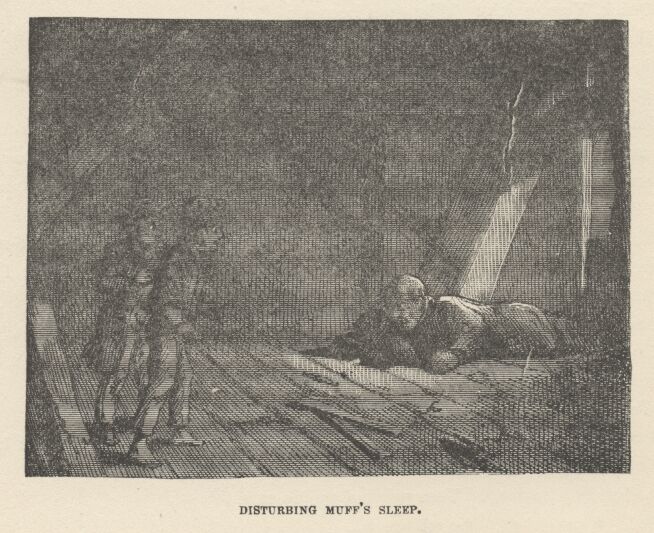
Tom quailed. But presently the temptation rose up strong again and the boys agreed to try, with the understanding that they would take to their heels if the snoring stopped. So they went tiptoeing stealthily down, the one behind the other. When they had got to within five steps of the snorer, Tom stepped on a stick, and it broke with a sharp snap. The man moaned, writhed a little, and his face came into the moonlight. It was Muff Potter. The boys’ hearts had stood still, and their hopes too, when the man moved, but their fears passed away now. They tip-toed out, through the broken weather-boarding, and stopped at a little distance to exchange a parting word. That long, lugubrious howl rose on the night air again! They turned and saw the strange dog standing within a few feet of where Potter was lying, and facing Potter, with his nose pointing heavenward.
Tom lost his nerve. But soon the temptation grew strong again, and the boys agreed to try. They would run for it if the snoring stopped. So they tiptoed quietly down, one behind the other. When they were within five steps of the snoring man, Tom stepped on a stick. It broke with a sharp snap. The man moaned and twisted a little, and his face came into the moonlight. It was Muff Potter. The boys’ hearts had stopped, and so had their hopes, when the man moved. But now their fears faded. They tiptoed out through the broken wooden siding and stopped a short distance away to say goodbye. That long, mournful howl rose into the night air again! They turned and saw the strange dog standing within a few feet of where Potter lay. The dog was facing Potter, with his nose pointed toward heaven.
“Oh, geeminy, it’s him!” exclaimed both boys, in a breath.
“Oh, gosh, it’s him!” both boys exclaimed at once.
“Say, Tom—they say a stray dog come howling around Johnny Miller’s house, ’bout midnight, as much as two weeks ago; and a whippoorwill come in and lit on the banisters and sung, the very same evening; and there ain’t anybody dead there yet.”
“Say, Tom, they say a stray dog come howling around Johnny Miller’s house about midnight. That was as much as two weeks ago. And a whippoorwill come in and landed on the railing and sung that very same evening. And there ain’t anybody dead there yet.”
“Well, I know that. And suppose there ain’t. Didn’t Gracie Miller fall in the kitchen fire and burn herself terrible the very next Saturday?”
“Well, I know that. And suppose there ain’t. Didn’t Gracie Miller fall into the kitchen fire and burn herself terrible the very next Saturday?”
“Yes, but she ain’t dead. And what’s more, she’s getting better, too.”
“Yes, but she ain’t dead. And what’s more, she’s getting better, too.”
“All right, you wait and see. She’s a goner, just as dead sure as Muff Potter’s a goner. That’s what the say, and they know all about these kind of things, Huck.”
“All right, you wait and see. She’s a goner, just as sure as Muff Potter’s a goner. That’s what the say, and they know all about these kind of things, Huck.”
Then they separated, cogitating. When Tom crept in at his bedroom window the night was almost spent. He undressed with excessive caution, and fell asleep congratulating himself that nobody knew of his escapade. He was not aware that the gently-snoring Sid was awake, and had been so for an hour.
Then they went their separate ways, deep in thought. It was almost dawn when Tom crept in through his bedroom window. He undressed with extreme care and fell asleep, congratulating himself that nobody knew about his adventure. He had no idea that Sid, who was snoring softly, was awake and had been for an hour.
When Tom awoke, Sid was dressed and gone. There was a late look in the light, a late sense in the atmosphere. He was startled. Why had he not been called—persecuted till he was up, as usual? The thought filled him with bodings. Within five minutes he was dressed and down-stairs, feeling sore and drowsy. The family were still at table, but they had finished breakfast. There was no voice of rebuke; but there were averted eyes; there was a silence and an air of solemnity that struck a chill to the culprit’s heart. He sat down and tried to seem gay, but it was up-hill work; it roused no smile, no response, and he lapsed into silence and let his heart sink down to the depths.
When Tom woke up, Sid was already dressed and gone. The light looked late, and the air felt late too. Tom was startled. Why hadn’t anyone called him and pestered him until he got up, as usual? The thought filled him with dread. Within five minutes, he was dressed and downstairs, feeling sore and sleepy. The family was still at the table, but they had finished breakfast. No one scolded him, but they looked away. Their silence and solemn mood sent a chill through his guilty heart. He sat down and tried to act cheerful, but it was hard work. His efforts brought no smiles or answers, so he fell silent and let his heart sink to the depths.
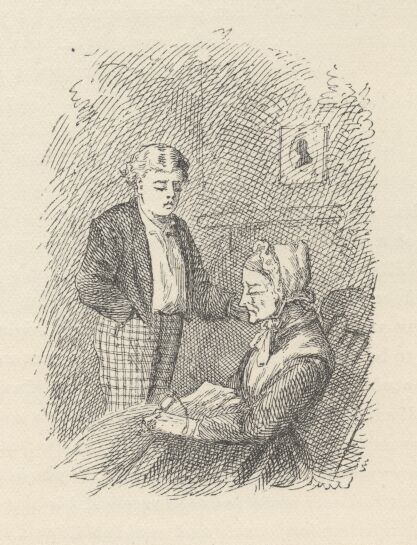
After breakfast his aunt took him aside, and Tom almost brightened in the hope that he was going to be flogged; but it was not so. His aunt wept over him and asked him how he could go and break her old heart so; and finally told him to go on, and ruin himself and bring her gray hairs with sorrow to the grave, for it was no use for her to try any more. This was worse than a thousand whippings, and Tom’s heart was sorer now than his body. He cried, he pleaded for forgiveness, promised to reform over and over again, and then received his dismissal, feeling that he had won but an imperfect forgiveness and established but a feeble confidence.
After breakfast his aunt took him aside. Tom almost cheered up, hoping she was going to whip him. But she didn’t. His aunt cried over him and asked how he could break her old heart like this. Finally, she told him to go ahead and ruin himself and send her to her grave, gray-haired and heartbroken. There was no use in her trying anymore. Her words were worse than a thousand whippings, and Tom’s heart now hurt more than his body. He cried and begged for forgiveness, promising over and over to change his ways. Then she sent him away. He felt she had only partly forgiven him and had little faith in him.
He left the presence too miserable to even feel revengeful toward Sid; and so the latter’s prompt retreat through the back gate was unnecessary. He moped to school gloomy and sad, and took his flogging, along with Joe Harper, for playing hookey the day before, with the air of one whose heart was busy with heavier woes and wholly dead to trifles. Then he betook himself to his seat, rested his elbows on his desk and his jaws in his hands, and stared at the wall with the stony stare of suffering that has reached the limit and can no further go. His elbow was pressing against some hard substance. After a long time he slowly and sadly changed his position, and took up this object with a sigh. It was in a paper. He unrolled it. A long, lingering, colossal sigh followed, and his heart broke. It was his brass andiron knob!
He left too miserable even to feel like getting revenge on Sid. So Sid’s quick escape through the back gate was unnecessary. He trudged to school, gloomy and sad. Along with Joe Harper, he took his whipping for skipping school the day before. He acted like someone whose heart was weighed down by deeper sorrows, leaving him numb to such little troubles. Then he went to his seat, rested his elbows on his desk, and cupped his jaw in his hands. He stared at the wall with the blank, fixed gaze of someone whose suffering could go no further. His elbow was pressing against something hard. After a long time, he slowly and sadly shifted his position and picked up the object with a sigh. It was wrapped in paper. He unwrapped it. A long, lingering, enormous sigh followed, and his heart broke. It was his brass knob from a fireplace andiron!
This final feather broke the camel’s back.
This was the last straw.