Chapter 8
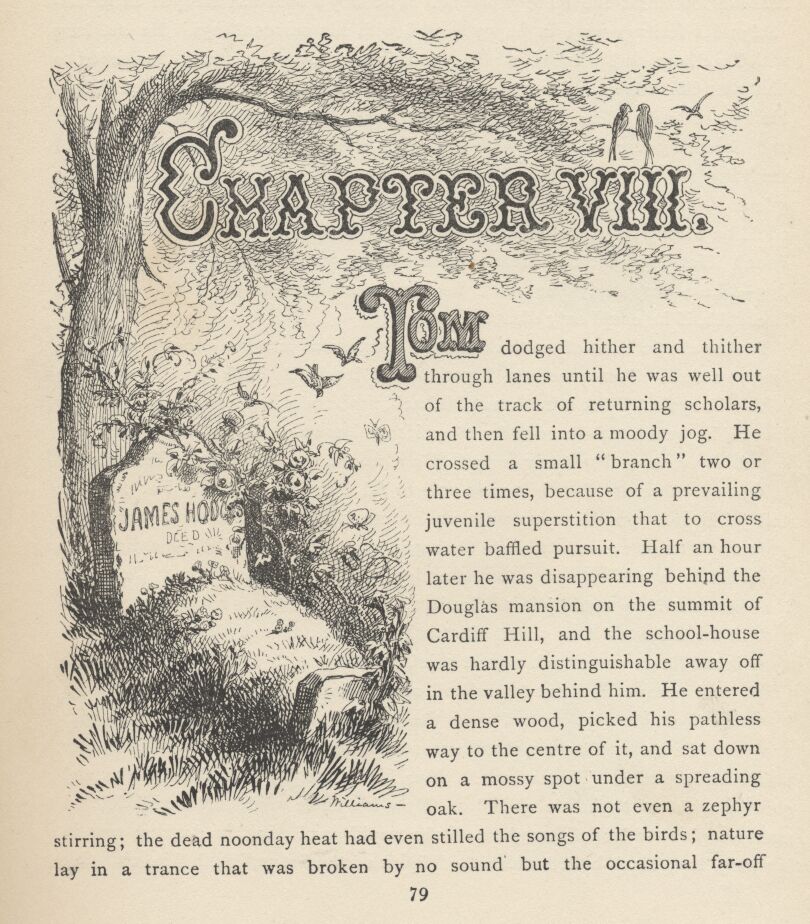
Tom dodged hither and thither through lanes until he was well out of the track of returning scholars, and then fell into a moody jog. He crossed a small “branch” two or three times, because of a prevailing juvenile superstition that to cross water baffled pursuit. Half an hour later he was disappearing behind the Douglas mansion on the summit of Cardiff Hill, and the school-house was hardly distinguishable away off in the valley behind him. He entered a dense wood, picked his pathless way to the centre of it, and sat down on a mossy spot under a spreading oak. There was not even a zephyr stirring; the dead noonday heat had even stilled the songs of the birds; nature lay in a trance that was broken by no sound but the occasional far-off hammering of a wood-pecker, and this seemed to render the pervading silence and sense of loneliness the more profound. The boy’s soul was steeped in melancholy; his feelings were in happy accord with his surroundings. He sat long with his elbows on his knees and his chin in his hands, meditating. It seemed to him that life was but a trouble, at best, and he more than half envied Jimmy Hodges, so lately released; it must be very peaceful, he thought, to lie and slumber and dream forever and ever, with the wind whispering through the trees and caressing the grass and the flowers over the grave, and nothing to bother and grieve about, ever any more. If he only had a clean Sunday-school record he could be willing to go, and be done with it all. Now as to this girl. What had he done? Nothing. He had meant the best in the world, and been treated like a dog—like a very dog. She would be sorry some day—maybe when it was too late. Ah, if he could only die temporarily!
Tom darted back and forth through lanes until he was well away from the students returning from school. Then he settled into a gloomy jog. He crossed a small “stream” two or three times because children commonly believed crossing water threw off anyone following them. Half an hour later, he was disappearing behind the Douglas mansion at the top of Cardiff Hill. The schoolhouse was barely visible far below in the valley behind him. He entered a thick wood, made his way to its center without a path, and sat beneath a spreading oak. The ground beneath him was covered in moss. Not even the faintest breeze stirred. The heavy midday heat had even silenced the birds. Nature lay in a trance, broken only by the occasional distant tapping of a woodpecker. That sound seemed to make the surrounding silence and loneliness even deeper. The boy’s soul was soaked in sadness. His feelings were in perfect harmony with his surroundings. He sat for a long time, elbows on his knees and chin in his hands, lost in thought. Life seemed nothing but trouble, even at its best. He more than half envied Jimmy Hodges, who had so recently been freed from it. It must be very peaceful, he thought, to lie asleep and dream forever and ever. The wind would whisper through the trees and gently stroke the grass and flowers over his grave. There would never be anything to worry or grieve about again. If only his Sunday-school record were spotless, he could be willing to die and be done with it all. Now, about this girl. What had he done? Nothing. He had meant nothing but the best, and she had treated him like a dog. Like an absolute dog. She would be sorry someday, maybe when it was too late. Ah, if only he could die temporarily!
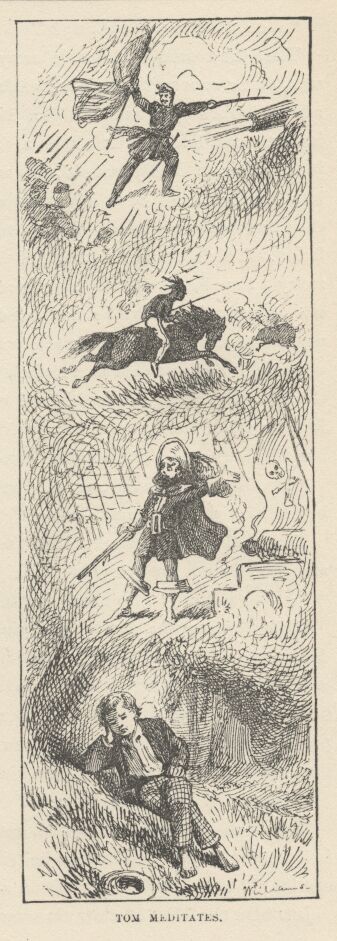
But the elastic heart of youth cannot be compressed into one constrained shape long at a time. Tom presently began to drift insensibly back into the concerns of this life again. What if he turned his back, now, and disappeared mysteriously? What if he went away—ever so far away, into unknown countries beyond the seas—and never came back any more! How would she feel then! The idea of being a clown recurred to him now, only to fill him with disgust. For frivolity and jokes and spotted tights were an offense, when they intruded themselves upon a spirit that was exalted into the vague august realm of the romantic. No, he would be a soldier, and return after long years, all war-worn and illustrious. No—better still, he would join the Indians, and hunt buffaloes and go on the warpath in the mountain ranges and the trackless great plains of the Far West, and away in the future come back a great chief, bristling with feathers, hideous with paint, and prance into Sunday-school, some drowsy summer morning, with a blood-curdling war-whoop, and sear the eyeballs of all his companions with unappeasable envy. But no, there was something gaudier even than this. He would be a pirate! That was it! now his future lay plain before him, and glowing with unimaginable splendor. How his name would fill the world, and make people shudder! How gloriously he would go plowing the dancing seas, in his long, low, black-hulled racer, the Spirit of the Storm, with his grisly flag flying at the fore! And at the zenith of his fame, how he would suddenly appear at the old village and stalk into church, brown and weather-beaten, in his black velvet doublet and trunks, his great jack-boots, his crimson sash, his belt bristling with horse-pistols, his crime-rusted cutlass at his side, his slouch hat with waving plumes, his black flag unfurled, with the skull and crossbones on it, and hear with swelling ecstasy the whisperings, “It’s Tom Sawyer the Pirate!—the Black Avenger of the Spanish Main!”
But the flexible heart of youth cannot stay squeezed into one narrow shape for long. Before long, Tom began drifting back to the concerns of this world without noticing it. What if he turned his back now and mysteriously disappeared? What if he went far, far away, to unknown countries across the seas, and never came back! How would she feel then! He thought again of becoming a clown, but now the idea disgusted him. Silliness, jokes, and spotted tights were offensive when they intruded on a soul lifted into the grand, hazy world of romance. No, he would be a soldier and return after many years, battle-worn and famous. No, better still, he would join the Indians. He would hunt buffalo and go on the warpath through the mountains and vast, uncharted plains of the Far West. Then, far in the future, he would return as a great chief, covered in feathers and terrifying in war paint. He would prance into Sunday school one sleepy summer morning with a bloodcurdling war cry. The sight would burn his companions’ eyes with envy that nothing could satisfy. But no, there was something even more dazzling. He would be a pirate! That was it! Now his future stretched clearly before him, glowing with unimaginable splendor. How his name would spread around the world and make people shudder! How gloriously he would plow through the dancing seas in his long, low, black-hulled racing ship, the Spirit of the Storm! His terrifying flag would fly at the front! And at the height of his fame, how suddenly he would appear in the old village and stride into church! He would be tanned and weather-beaten, wearing a black velvet doublet and short, full breeches, tall riding boots, and a crimson sash. His belt would bristle with large pistols, and his cutlass, rusted through a life of crime, would hang at his side. Feathers would wave from his soft, wide-brimmed hat. His black flag would fly open, showing its skull and crossbones. And how his joy would swell as he heard the whispers: “It’s Tom Sawyer the Pirate! The Black Avenger of the Spanish Main!”
Yes, it was settled; his career was determined. He would run away from home and enter upon it. He would start the very next morning. Therefore he must now begin to get ready. He would collect his resources together. He went to a rotten log near at hand and began to dig under one end of it with his Barlow knife. He soon struck wood that sounded hollow. He put his hand there and uttered this incantation impressively:
Yes, it was settled. He had decided on his future. He would run away from home and begin his new life. He would leave the very next morning. So he had to start getting ready now. He would gather his supplies. He went to a nearby rotten log and began digging under one end with his Barlow knife. Soon he struck a piece of wood that sounded hollow. He put his hand there and recited this magic spell with great ceremony:
“What hasn’t come here, come! What’s here, stay here!”
“Whatever hasn’t come here, come here! Whatever’s here, stay here!”
Then he scraped away the dirt, and exposed a pine shingle. He took it up and disclosed a shapely little treasure-house whose bottom and sides were of shingles. In it lay a marble. Tom’s astonishment was boundless! He scratched his head with a perplexed air, and said:
Then he scraped away the dirt and uncovered a pine shingle. He lifted it and revealed a neatly shaped little treasure chamber with a bottom and sides made of shingles. Inside lay a marble. Tom’s amazement knew no bounds! He scratched his head, looking puzzled, and said:
“Well, that beats anything!”
“Well, that’s more surprising than anything!”
Then he tossed the marble away pettishly, and stood cogitating. The truth was, that a superstition of his had failed, here, which he and all his comrades had always looked upon as infallible. If you buried a marble with certain necessary incantations, and left it alone a fortnight, and then opened the place with the incantation he had just used, you would find that all the marbles you had ever lost had gathered themselves together there, meantime, no matter how widely they had been separated. But now, this thing had actually and unquestionably failed. Tom’s whole structure of faith was shaken to its foundations. He had many a time heard of this thing succeeding but never of its failing before. It did not occur to him that he had tried it several times before, himself, but could never find the hiding-places afterward. He puzzled over the matter some time, and finally decided that some witch had interfered and broken the charm. He thought he would satisfy himself on that point; so he searched around till he found a small sandy spot with a little funnel-shaped depression in it. He laid himself down and put his mouth close to this depression and called—
Then he tossed the marble away in annoyance and stood thinking. The truth was that one of his superstitions had failed him. He and all his friends had always believed it could never fail. If you buried a marble with certain necessary magic words, you had to leave it alone for two weeks. Then you had to dig it up using the magic words he had just spoken. You would find that all the marbles you had ever lost had gathered there in the meantime. It did not matter how far apart they had been. But now the magic had actually failed, beyond any doubt. Tom’s whole system of beliefs was shaken to its foundations. He had often heard of this magic working, but never of it failing. He never thought about the several times he had tried it himself but could not find the hiding places afterward. He puzzled over the problem for some time. Finally, he decided that some witch had interfered and broken the spell. He thought he would make sure of that. So he searched until he found a small sandy spot with a little funnel-shaped hollow in it. He lay down, put his mouth close to the hollow, and called:
“Doodle-bug, doodle-bug, tell me what I want to know! Doodle-bug, doodle-bug, tell me what I want to know!”
“Doodle-bug, doodle-bug, tell me what I want to know! Doodle-bug, doodle-bug, tell me what I want to know!”
The sand began to work, and presently a small black bug appeared for a second and then darted under again in a fright.
The sand began to shift, and soon a small black bug appeared for a second. Then it darted back under the sand in fright.
“He dasn’t tell! So it was a witch that done it. I just knowed it.”
“He doesn't dare tell! So it was a witch that done it. I just knowed it.”
He well knew the futility of trying to contend against witches, so he gave up discouraged. But it occurred to him that he might as well have the marble he had just thrown away, and therefore he went and made a patient search for it. But he could not find it. Now he went back to his treasure-house and carefully placed himself just as he had been standing when he tossed the marble away; then he took another marble from his pocket and tossed it in the same way, saying:
He knew very well that fighting witches was useless, so he gave up, discouraged. But then he thought he might as well get back the marble he had just thrown away. So he went and searched patiently for it. But he could not find it. Then he returned to his treasure room and carefully stood exactly as he had when he threw the marble away. He took another marble from his pocket and threw it the same way, saying:
“Brother, go find your brother!”
“Brother, go find your brother!”
He watched where it stopped, and went there and looked. But it must have fallen short or gone too far; so he tried twice more. The last repetition was successful. The two marbles lay within a foot of each other.
He watched where it stopped, then went there and looked. But it must have landed short or gone too far, so he tried twice more. The last try worked. The two marbles lay within a foot of each other.
Just here the blast of a toy tin trumpet came faintly down the green aisles of the forest. Tom flung off his jacket and trousers, turned a suspender into a belt, raked away some brush behind the rotten log, disclosing a rude bow and arrow, a lath sword and a tin trumpet, and in a moment had seized these things and bounded away, barelegged, with fluttering shirt. He presently halted under a great elm, blew an answering blast, and then began to tiptoe and look warily out, this way and that. He said cautiously—to an imaginary company:
Just then, the faint blast of a toy tin trumpet sounded through the forest’s green passageways. Tom threw off his jacket and trousers and used a suspender as a belt. He cleared some brush from behind the rotten log, revealing a crudely made bow and arrow, a wooden-strip sword, and a tin trumpet. In a moment, he grabbed these things and bounded away, his legs bare and his shirt fluttering. Soon he stopped under a large elm and blew a blast in reply. Then he began to tiptoe, looking cautiously this way and that. He spoke carefully to an imaginary group:
“Hold, my merry men! Keep hid till I blow.”
“Wait, my merry men! Stay hidden until I blow.”
Now appeared Joe Harper, as airily clad and elaborately armed as Tom. Tom called:
Then Joe Harper appeared, as lightly dressed and as elaborately armed as Tom. Tom called out:
“Hold! Who comes here into Sherwood Forest without my pass?”
“Stop! Who’s entering Sherwood Forest without my permission?”
“Guy of Guisborne wants no man’s pass. Who art thou that—that—”
“Guy of Guisborne wants no man’s pass. Who art thou that... that...”
“Dares to hold such language,” said Tom, prompting—for they talked “by the book,” from memory.
“Dares to talk like that,” Tom prompted, because they were reciting “by the book” from memory.
“Who art thou that dares to hold such language?”
“Who art thou that dares to hold such language?”
“I, indeed! I am Robin Hood, as thy caitiff carcase soon shall know.”
“I, indeed! I am Robin Hood, as thy caitiff carcase soon shall know.”
“Then art thou indeed that famous outlaw? Right gladly will I dispute with thee the passes of the merry wood. Have at thee!”
“Then art thou indeed that famous outlaw? Right gladly will I dispute with thee the passes of the merry wood. Have at thee!”
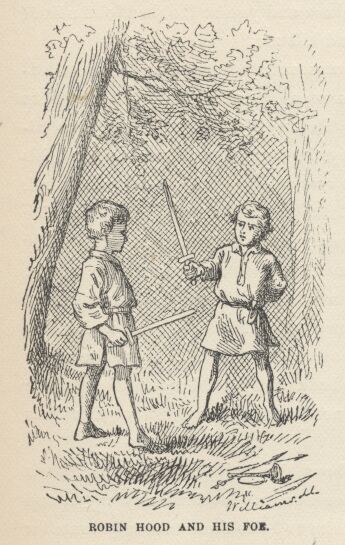
They took their lath swords, dumped their other traps on the ground, struck a fencing attitude, foot to foot, and began a grave, careful combat, “two up and two down.” Presently Tom said:
They took their thin wooden swords and dumped their other gear on the ground. They took fencing positions, foot to foot, and began a serious, careful fight, “two up and two down.” Soon Tom said:
“Now, if you’ve got the hang, go it lively!”
“Now, if you’ve got the hang of it, get moving!”
So they “went it lively,” panting and perspiring with the work. By and by Tom shouted:
So they “worked away energetically,” panting and sweating from the effort. After a while, Tom shouted:
“Fall! fall! Why don’t you fall?”
“Fall! Fall! Why don’t you fall?”
“I sha’n’t! Why don’t you fall yourself? You’re getting the worst of it.”
“I won’t! Why don’t you fall yourself? You’re getting the worst of it.”
“Why, that ain’t anything. I can’t fall; that ain’t the way it is in the book. The book says, ‘Then with one back-handed stroke he slew poor Guy of Guisborne.’ You’re to turn around and let me hit you in the back.”
“Why, that ain’t anything. I can’t fall. That ain’t how it happens in the book. The book says, ‘Then with one backhanded blow he killed poor Guy of Guisborne.’ You’re supposed to turn around and let me hit you in the back.”
There was no getting around the authorities, so Joe turned, received the whack and fell.
There was no way around the authorities. So Joe turned, took the hit, and fell.
“Now,” said Joe, getting up, “you got to let me kill you. That’s fair.”
“Now,” said Joe, getting up, “you got to let me kill you. That’s fair.”
“Why, I can’t do that, it ain’t in the book.”
“Why, I can’t do that. It ain’t in the book.”
“Well, it’s blamed mean—that’s all.”
“Well, it’s blamed mean. That’s all.”
“Well, say, Joe, you can be Friar Tuck or Much the miller’s son, and lam me with a quarter-staff; or I’ll be the Sheriff of Nottingham and you be Robin Hood a little while and kill me.”
“Well, say, Joe, you can be Friar Tuck or Much the miller’s son. You can beat me with a quarterstaff. Or I’ll be the Sheriff of Nottingham, and you be Robin Hood for a little while and kill me.”
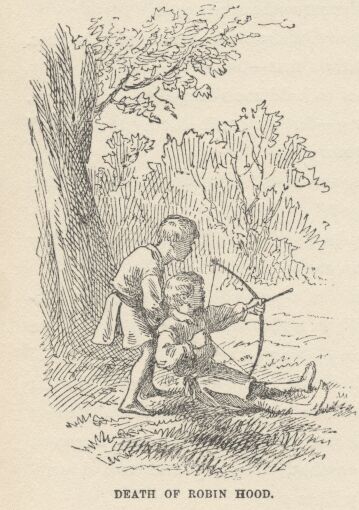
This was satisfactory, and so these adventures were carried out. Then Tom became Robin Hood again, and was allowed by the treacherous nun to bleed his strength away through his neglected wound. And at last Joe, representing a whole tribe of weeping outlaws, dragged him sadly forth, gave his bow into his feeble hands, and Tom said, “Where this arrow falls, there bury poor Robin Hood under the greenwood tree.” Then he shot the arrow and fell back and would have died, but he lit on a nettle and sprang up too gaily for a corpse.
This pleased them, so they acted out these adventures. Then Tom became Robin Hood again. The treacherous nun let him bleed away his strength through his untended wound. At last Joe, playing a whole band of weeping outlaws, sadly dragged him out. He put Tom’s bow into his weak hands, and Tom said, “Where this arrow lands, bury poor Robin Hood under the greenwood tree.” Then he shot the arrow and fell back. He would have died, but he landed on a nettle and jumped up far too cheerfully for a corpse.
The boys dressed themselves, hid their accoutrements, and went off grieving that there were no outlaws any more, and wondering what modern civilization could claim to have done to compensate for their loss. They said they would rather be outlaws a year in Sherwood Forest than President of the United States forever.
The boys got dressed, hid their gear, and went off, sad that there were no outlaws anymore. They wondered what modern civilization could claim to have done to make up for the loss of outlaws. They said they would rather spend a year as outlaws in Sherwood Forest than be President of the United States forever.