Chapter 7
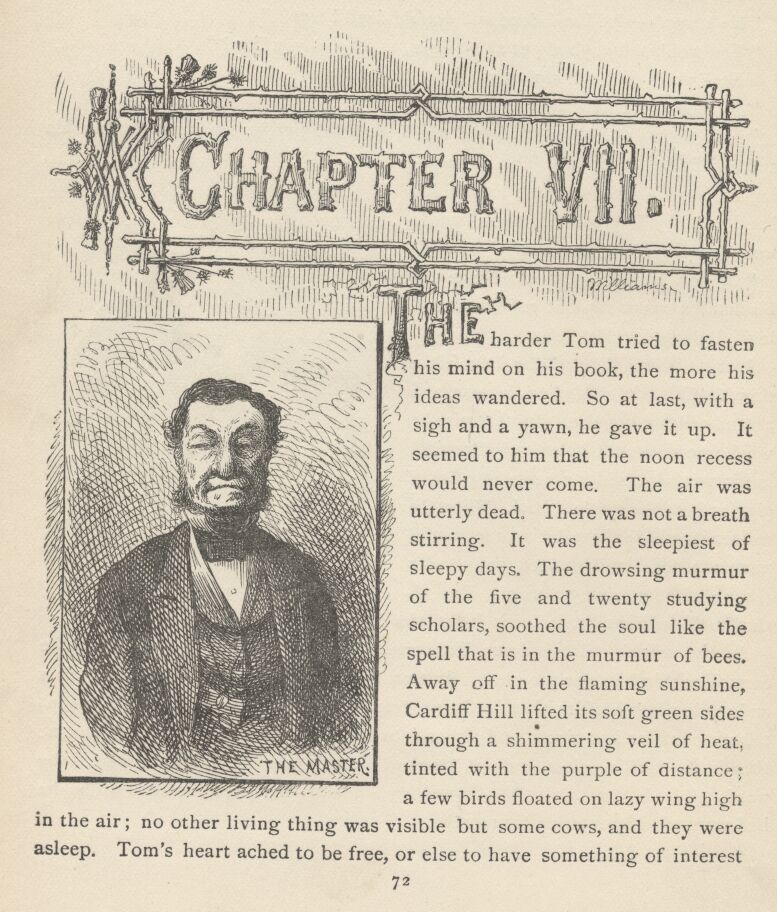
The harder Tom tried to fasten his mind on his book, the more his ideas wandered. So at last, with a sigh and a yawn, he gave it up. It seemed to him that the noon recess would never come. The air was utterly dead. There was not a breath stirring. It was the sleepiest of sleepy days. The drowsing murmur of the five and twenty studying scholars soothed the soul like the spell that is in the murmur of bees. Away off in the flaming sunshine, Cardiff Hill lifted its soft green sides through a shimmering veil of heat, tinted with the purple of distance; a few birds floated on lazy wing high in the air; no other living thing was visible but some cows, and they were asleep. Tom’s heart ached to be free, or else to have something of interest to do to pass the dreary time. His hand wandered into his pocket and his face lit up with a glow of gratitude that was prayer, though he did not know it. Then furtively the percussion-cap box came out. He released the tick and put him on the long flat desk. The creature probably glowed with a gratitude that amounted to prayer, too, at this moment, but it was premature: for when he started thankfully to travel off, Tom turned him aside with a pin and made him take a new direction.
The harder Tom tried to focus on his book, the more his thoughts wandered. So at last, with a sigh and a yawn, he gave up. It seemed to him that the lunch break would never come. The air was completely still. Not a breath of wind stirred. It was the sleepiest of sleepy days. The sleepy murmur of the twenty-five students studying soothed the soul like the spell cast by the buzzing of bees. Far away in the blazing sunshine, Cardiff Hill rose through a shimmering veil of heat. Its gently sloping green sides looked purple in the distance. A few birds floated lazily high in the air. The only other living things in sight were some cows, and they were asleep. Tom’s heart ached to be free, or at least to have something interesting to do to pass the dreary time. His hand wandered into his pocket, and his face lit up with gratitude that was a prayer, though he didn’t know it. Then he secretly took out the percussion-cap box. He released the tick and put him on the long, flat desk. The creature probably glowed with gratitude that amounted to a prayer, too, at that moment. But his gratitude came too soon. When he started to crawl thankfully away, Tom steered him aside with a pin and made him change direction.
Tom’s bosom friend sat next him, suffering just as Tom had been, and now he was deeply and gratefully interested in this entertainment in an instant. This bosom friend was Joe Harper. The two boys were sworn friends all the week, and embattled enemies on Saturdays. Joe took a pin out of his lapel and began to assist in exercising the prisoner. The sport grew in interest momently. Soon Tom said that they were interfering with each other, and neither getting the fullest benefit of the tick. So he put Joe’s slate on the desk and drew a line down the middle of it from top to bottom.
Tom’s closest friend sat next to him, suffering just as Tom had been. Now he instantly took a deep and grateful interest in the entertainment. This friend was Joe Harper. The two boys were sworn friends all week and fierce enemies on Saturdays. Joe took a pin from his lapel and began helping to put the prisoner through its paces. The game grew more interesting by the moment. Soon Tom said they were getting in each other’s way, and neither was getting the most fun from the tick. So he put Joe’s slate on the desk and drew a line down the middle from top to bottom.
“Now,” said he, “as long as he is on your side you can stir him up and I’ll let him alone; but if you let him get away and get on my side, you’re to leave him alone as long as I can keep him from crossing over.”
“Now,” he said, “as long as he’s on your side, you can stir him up. I’ll leave him alone while he’s there. But if you let him get away onto my side, you have to leave him alone as long as I can keep him from crossing back.”
“All right, go ahead; start him up.”
“All right, go ahead. Get him started.”
The tick escaped from Tom, presently, and crossed the equator. Joe harassed him awhile, and then he got away and crossed back again. This change of base occurred often. While one boy was worrying the tick with absorbing interest, the other would look on with interest as strong, the two heads bowed together over the slate, and the two souls dead to all things else. At last luck seemed to settle and abide with Joe. The tick tried this, that, and the other course, and got as excited and as anxious as the boys themselves, but time and again just as he would have victory in his very grasp, so to speak, and Tom’s fingers would be twitching to begin, Joe’s pin would deftly head him off, and keep possession. At last Tom could stand it no longer. The temptation was too strong. So he reached out and lent a hand with his pin. Joe was angry in a moment. Said he:
Soon the tick escaped from Tom and crossed the equator. Joe pestered him for a while, but then he escaped and crossed back again. The tick switched sides often. While one boy poked at the tick with intense interest, the other watched just as closely. Their heads bent together over the slate, and both boys were oblivious to everything else. At last, luck seemed to settle firmly on Joe’s side. The tick tried one route after another, growing as excited and anxious as the boys themselves. But time and again, just as the tick seemed about to win, Joe’s pin skillfully blocked his way. Tom’s fingers would be twitching, ready to start, but Joe kept control. At last Tom could stand it no longer. The temptation was too strong. So he reached over and helped with his own pin. Joe was instantly angry. He said:
“Tom, you let him alone.”
“Tom, you leave him alone.”
“I only just want to stir him up a little, Joe.”
“I just want to stir him up a little, Joe.”
“No, sir, it ain’t fair; you just let him alone.”
“No, sir, it ain’t fair. You just let him alone.”
“Blame it, I ain’t going to stir him much.”
“Blame it, I ain’t going to bother him much.”
“Let him alone, I tell you.”
“Leave him alone, I’m telling you.”
“I won’t!”
“I won’t!”
“You shall—he’s on my side of the line.”
“You will. He’s on my side of the line.”
“Look here, Joe Harper, whose is that tick?”
“Hey, Joe Harper, who owns that tick?”
“I don’t care whose tick he is—he’s on my side of the line, and you sha’n’t touch him.”
“I don’t care whose tick he is. He’s on my side of the line, and you can’t touch him.”
“Well, I’ll just bet I will, though. He’s my tick and I’ll do what I blame please with him, or die!”
“Well, I bet I will, though. He’s my tick, and I’ll do what I blame please with him, or die!”
A tremendous whack came down on Tom’s shoulders, and its duplicate on Joe’s; and for the space of two minutes the dust continued to fly from the two jackets and the whole school to enjoy it. The boys had been too absorbed to notice the hush that had stolen upon the school awhile before when the master came tiptoeing down the room and stood over them. He had contemplated a good part of the performance before he contributed his bit of variety to it.
A tremendous whack landed on Tom’s shoulders, and another just like it landed on Joe’s. For two minutes, dust kept flying from their jackets, and the whole school enjoyed the beating. The boys had been too absorbed to notice the school fall silent a little earlier. The teacher had tiptoed down the room and stood over them. He had watched a good part of their performance before adding a little variety of his own.
When school broke up at noon, Tom flew to Becky Thatcher, and whispered in her ear:
When school let out at noon, Tom rushed over to Becky Thatcher and whispered in her ear:
“Put on your bonnet and let on you’re going home; and when you get to the corner, give the rest of ’em the slip, and turn down through the lane and come back. I’ll go the other way and come it over ’em the same way.”
“Put on your hat and pretend you’re going home. When you get to the corner, give the rest of them the slip. Then turn down the lane and come back. I’ll go the other way and fool them the same way.”
So the one went off with one group of scholars, and the other with another. In a little while the two met at the bottom of the lane, and when they reached the school they had it all to themselves. Then they sat together, with a slate before them, and Tom gave Becky the pencil and held her hand in his, guiding it, and so created another surprising house. When the interest in art began to wane, the two fell to talking. Tom was swimming in bliss. He said:
So one went off with one group of students, and the other with another. Soon the two met at the bottom of the lane. When they reached the school, they had it all to themselves. Then they sat together with a slate in front of them. Tom gave Becky the pencil and held her hand in his, guiding it to draw another surprising house. When their interest in drawing began to fade, the two started talking. Tom was full of joy. He said:
“Do you love rats?”
“Do you love rats?”
“No! I hate them!”
“No! I hate them!”
“Well, I do, too—live ones. But I mean dead ones, to swing round your head with a string.”
“Well, I do, too, live ones. But I mean dead ones, to swing around your head on a string.”
“No, I don’t care for rats much, anyway. What I like is chewing-gum.”
“No, I don’t like rats much, anyway. What I like is chewing gum.”
“Oh, I should say so! I wish I had some now.”
“Oh, absolutely! I wish I had some now.”
“Do you? I’ve got some. I’ll let you chew it awhile, but you must give it back to me.”
“Do you? I’ve got some. I’ll let you chew it for a while, but you must give it back to me.”
That was agreeable, so they chewed it turn about, and dangled their legs against the bench in excess of contentment.
That suited them, so they took turns chewing it. They swung their legs against the bench, completely content.
“Was you ever at a circus?” said Tom.
“Was you ever at a circus?” said Tom.
“Yes, and my pa’s going to take me again some time, if I’m good.”
“Yes, and my dad’s going to take me again sometime, if I’m good.”
“I been to the circus three or four times—lots of times. Church ain’t shucks to a circus. There’s things going on at a circus all the time. I’m going to be a clown in a circus when I grow up.”
“I been to the circus three or four times, lots of times. Church ain’t nothing compared to a circus. There’s things going on at a circus all the time. I’m going to be a clown in a circus when I grow up.”
“Oh, are you! That will be nice. They’re so lovely, all spotted up.”
“Oh, are you! That’ll be nice. They’re so lovely with all those spots.”
“Yes, that’s so. And they get slathers of money—most a dollar a day, Ben Rogers says. Say, Becky, was you ever engaged?”
“Yes, that’s so. And they get loads of money, almost a dollar a day, Ben Rogers says. Say, Becky, was you ever engaged?”
“What’s that?”
“What’s that?”
“Why, engaged to be married.”
“Well, engaged to be married.”
“No.”
“No.”
“Would you like to?”
“Would you like to?”
“I reckon so. I don’t know. What is it like?”
“I reckon so. I don’t know. What is it like?”
“Like? Why it ain’t like anything. You only just tell a boy you won’t ever have anybody but him, ever ever ever, and then you kiss and that’s all. Anybody can do it.”
“Like? Why, it ain’t like anything. You only just tell a boy you won’t ever have anybody but him, ever, ever, ever. And then you kiss, and that’s all. Anybody can do it.”
“Kiss? What do you kiss for?”
“Kiss? Why do you kiss?”
“Why, that, you know, is to—well, they always do that.”
“Well, that, you know, is to... well, they always do that.”
“Everybody?”
“Everybody?”
“Why, yes, everybody that’s in love with each other. Do you remember what I wrote on the slate?”
“Well, yes, everyone who’s in love with each other. Do you remember what I wrote on the slate?”
“Ye—yes.”
“Ye... yes.”
“What was it?”
“What was it?”
“I sha’n’t tell you.”
“I won’t tell you.”
“Shall I tell you?”
“Should I tell you?”
“Ye—yes—but some other time.”
“Yes... yes, but some other time.”
“No, now.”
“No, now.”
“No, not now—to-morrow.”
“No, not now. Tomorrow.”
“Oh, no, now. Please, Becky—I’ll whisper it, I’ll whisper it ever so easy.”
“Oh, no, now. Please, Becky. I’ll whisper it. I’ll whisper it very softly.”
Becky hesitating, Tom took silence for consent, and passed his arm about her waist and whispered the tale ever so softly, with his mouth close to her ear. And then he added:
Becky hesitated, and Tom took her silence as consent. He put his arm around her waist and whispered the story very softly, with his mouth close to her ear. And then he added:
“Now you whisper it to me—just the same.”
“Now whisper it to me, just the same.”
She resisted, for a while, and then said:
She resisted for a while, then said:
“You turn your face away so you can’t see, and then I will. But you mustn’t ever tell anybody—will you, Tom? Now you won’t, will you?”
“Turn your face away so you can’t see, and then I will. But you must never tell anybody. Will you, Tom? Now you won’t, will you?”
“No, indeed, indeed I won’t. Now, Becky.”
“No, I really, really won’t. Now, Becky.”
He turned his face away. She bent timidly around till her breath stirred his curls and whispered, “I—love—you!”
He turned his face away. She shyly leaned around until her breath stirred his curls and whispered, “I, love, you!”
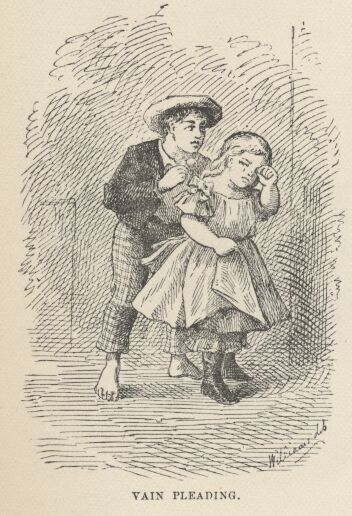
Then she sprang away and ran around and around the desks and benches, with Tom after her, and took refuge in a corner at last, with her little white apron to her face. Tom clasped her about her neck and pleaded:
Then she darted away and ran around and around the desks and benches, with Tom chasing her. At last, she hid in a corner, holding her little white apron to her face. Tom put his arms around her neck and pleaded:
“Now, Becky, it’s all done—all over but the kiss. Don’t you be afraid of that—it ain’t anything at all. Please, Becky.” And he tugged at her apron and the hands.
“Now, Becky, it’s all done. All that’s left is the kiss. Don’t you be afraid of that. It ain’t anything at all. Please, Becky.” And he tugged at her apron and her hands.
By and by she gave up, and let her hands drop; her face, all glowing with the struggle, came up and submitted. Tom kissed the red lips and said:
Eventually she gave up and let her hands drop. Her face, flushed from the struggle, lifted as she gave in. Tom kissed her red lips and said:
“Now it’s all done, Becky. And always after this, you know, you ain’t ever to love anybody but me, and you ain’t ever to marry anybody but me, ever never and forever. Will you?”
“Now it’s all done, Becky. And from now on, you know, you ain’t ever to love anybody but me. And you ain’t ever to marry anybody but me, ever never and forever. Will you?”
“No, I’ll never love anybody but you, Tom, and I’ll never marry anybody but you—and you ain’t to ever marry anybody but me, either.”
“No, I’ll never love anybody but you, Tom. And I’ll never marry anybody but you. And you ain’t to ever marry anybody but me, either.”
“Certainly. Of course. That’s part of it. And always coming to school or when we’re going home, you’re to walk with me, when there ain’t anybody looking—and you choose me and I choose you at parties, because that’s the way you do when you’re engaged.”
“Certainly. Of course. That’s part of it. And you’re always to walk with me to school or back home, when there ain’t anybody looking. And you choose me and I choose you at parties, because that’s what you do when you’re engaged.”
“It’s so nice. I never heard of it before.”
“It’s so nice. I never heard of it before.”
“Oh, it’s ever so gay! Why, me and Amy Lawrence—”
“Oh, it’s so much fun! Why, me and Amy Lawrence...”
The big eyes told Tom his blunder and he stopped, confused.
The wide eyes made Tom realize his mistake, and he stopped, confused.
“Oh, Tom! Then I ain’t the first you’ve ever been engaged to!”
“Oh, Tom! Then I ain’t the first you’ve ever been engaged to!”
The child began to cry. Tom said:
The child started to cry. Tom said:
“Oh, don’t cry, Becky, I don’t care for her any more.”
“Oh, don’t cry, Becky. I don’t like her anymore.”
“Yes, you do, Tom—you know you do.”
“Yes, you do, Tom. You know you do.”
Tom tried to put his arm about her neck, but she pushed him away and turned her face to the wall, and went on crying. Tom tried again, with soothing words in his mouth, and was repulsed again. Then his pride was up, and he strode away and went outside. He stood about, restless and uneasy, for a while, glancing at the door, every now and then, hoping she would repent and come to find him. But she did not. Then he began to feel badly and fear that he was in the wrong. It was a hard struggle with him to make new advances, now, but he nerved himself to it and entered. She was still standing back there in the corner, sobbing, with her face to the wall. Tom’s heart smote him. He went to her and stood a moment, not knowing exactly how to proceed. Then he said hesitatingly:
Tom tried to put his arm around her neck, but she pushed him away. She turned her face to the wall and kept crying. Tom tried again, speaking gently, but she pushed him away again. Then his pride took over, and he strode away and went outside. He stood around for a while, restless and uneasy, glancing at the door now and then. He hoped she would change her mind and come looking for him. But she did not. Then he began to feel bad and worry that he was in the wrong. Trying to approach her again was hard, but he gathered his courage and went inside. She was still standing in the back corner, sobbing with her face to the wall. Tom felt a pang of guilt. He went to her and stood for a moment, not knowing quite what to do. Then he said hesitantly:
“Becky, I—I don’t care for anybody but you.”
“Becky, I, I don’t care about anyone but you.”
No reply—but sobs.
No reply, only sobs.
“Becky”—pleadingly. “Becky, won’t you say something?”
“Becky,” he pleaded. “Becky, won’t you say something?”
More sobs.
More sobs.
Tom got out his chiefest jewel, a brass knob from the top of an andiron, and passed it around her so that she could see it, and said:
Tom took out his greatest treasure, a brass knob from the top of a fireplace log holder. He moved it around her so she could see it, and said:
“Please, Becky, won’t you take it?”
“Please, Becky, won’t you take it?”
She struck it to the floor. Then Tom marched out of the house and over the hills and far away, to return to school no more that day. Presently Becky began to suspect. She ran to the door; he was not in sight; she flew around to the play-yard; he was not there. Then she called:
She knocked it to the floor. Then Tom marched out of the house, over the hills, and far away. He would not return to school that day. Soon Becky began to suspect something. She ran to the door, but he was nowhere in sight. She rushed around to the schoolyard, but he was not there. Then she called:
“Tom! Come back, Tom!”
“Tom! Come back, Tom!”
She listened intently, but there was no answer. She had no companions but silence and loneliness. So she sat down to cry again and upbraid herself; and by this time the scholars began to gather again, and she had to hide her griefs and still her broken heart and take up the cross of a long, dreary, aching afternoon, with none among the strangers about her to exchange sorrows with.
She listened closely, but there was no answer. Silence and loneliness were her only companions. So she sat down to cry again and blame herself. By now, the students were beginning to gather again. She had to hide her sorrow, quiet her broken heart, and bear the burden of a long, dreary, painful afternoon. There was no one among the strangers around her with whom she could share her sorrows.