Chapter 6
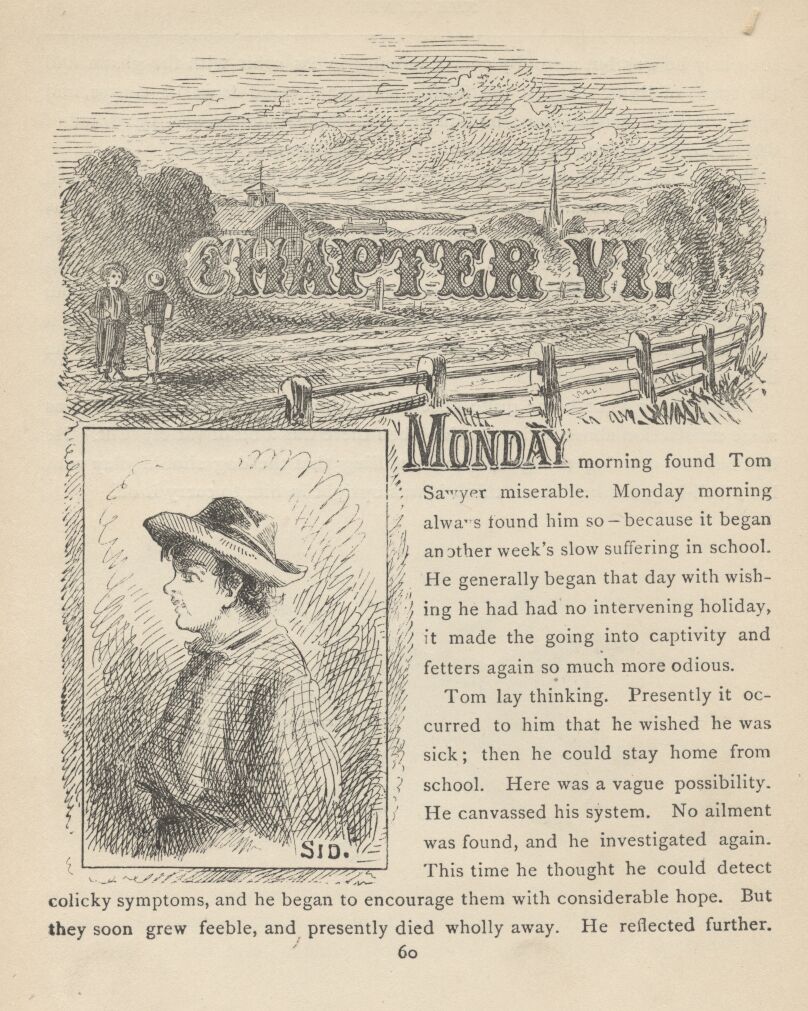
Monday morning found Tom Sawyer miserable. Monday morning always found him so—because it began another week’s slow suffering in school. He generally began that day with wishing he had had no intervening holiday, it made the going into captivity and fetters again so much more odious.
Tom Sawyer felt miserable on Monday morning. He always felt that way on Mondays because they began another week of slow suffering at school. He usually started the day wishing he hadn't had a holiday between school weeks. The break made going back to captivity and chains so much more hateful.
Tom lay thinking. Presently it occurred to him that he wished he was sick; then he could stay home from school. Here was a vague possibility. He canvassed his system. No ailment was found, and he investigated again. This time he thought he could detect colicky symptoms, and he began to encourage them with considerable hope. But they soon grew feeble, and presently died wholly away. He reflected further. Suddenly he discovered something. One of his upper front teeth was loose. This was lucky; he was about to begin to groan, as a “starter,” as he called it, when it occurred to him that if he came into court with that argument, his aunt would pull it out, and that would hurt. So he thought he would hold the tooth in reserve for the present, and seek further. Nothing offered for some little time, and then he remembered hearing the doctor tell about a certain thing that laid up a patient for two or three weeks and threatened to make him lose a finger. So the boy eagerly drew his sore toe from under the sheet and held it up for inspection. But now he did not know the necessary symptoms. However, it seemed well worth while to chance it, so he fell to groaning with considerable spirit.
Tom lay thinking. Soon he found himself wishing he were sick. Then he could stay home from school. There was a chance that might work. He checked his body for signs of illness. He found nothing wrong, so he checked again. This time he thought he felt stomach cramps, and he began encouraging them with considerable hope. But the cramps soon weakened, then disappeared completely. He thought some more. Suddenly he discovered something. One of his upper front teeth was loose. This was lucky. He was about to start groaning as a “starter,” as he called it. Then he realized that if he presented that argument, his aunt would pull the tooth out, and that would hurt. So he decided to save the tooth for later and look for something else. For a little while, he could think of nothing. Then he remembered hearing the doctor describe a condition that kept a patient in bed for two or three weeks. The condition also threatened to cost the patient a finger. So Tom eagerly pulled his sore toe out from under the sheet and held it up to examine it. But now he did not know what symptoms he needed to have. Still, it seemed well worth taking a chance, so he began groaning with considerable enthusiasm.
But Sid slept on unconscious.
But Sid kept sleeping, unaware.
Tom groaned louder, and fancied that he began to feel pain in the toe.
Tom groaned louder and imagined he was starting to feel pain in his toe.
No result from Sid.
No response from Sid.
Tom was panting with his exertions by this time. He took a rest and then swelled himself up and fetched a succession of admirable groans.
By now, Tom was panting from his efforts. He rested, then puffed himself up and let out a series of impressive groans.
Sid snored on.
Sid kept snoring.
Tom was aggravated. He said, “Sid, Sid!” and shook him. This course worked well, and Tom began to groan again. Sid yawned, stretched, then brought himself up on his elbow with a snort, and began to stare at Tom. Tom went on groaning. Sid said:
Tom was annoyed. He said, “Sid, Sid!” and shook him. Shaking Sid worked well, and Tom began to groan again. Sid yawned and stretched. Then he snorted, propped himself up on one elbow, and began to stare at Tom. Tom kept groaning. Sid said:
“Tom! Say, Tom!” [No response.] “Here, Tom! TOM! What is the matter, Tom?” And he shook him and looked in his face anxiously.
“Tom! Hey, Tom!” [No response.] “Hey, Tom! TOM! What’s wrong, Tom?” And he shook him and looked anxiously at his face.
Tom moaned out:
Tom moaned:
“Oh, don’t, Sid. Don’t joggle me.”
“Oh, don’t, Sid. Don’t shake me.”
“Why, what’s the matter, Tom? I must call auntie.”
“Why, what’s wrong, Tom? I need to call auntie.”
“No—never mind. It’ll be over by and by, maybe. Don’t call anybody.”
“No, never mind. Maybe it’ll be over soon. Don’t call anybody.”
“But I must! Don’t groan so, Tom, it’s awful. How long you been this way?”
“But I must! Don’t groan like that, Tom. It’s awful. How long you been this way?”
“Hours. Ouch! Oh, don’t stir so, Sid, you’ll kill me.”
“Hours. Ouch! Oh, don’t move around so much, Sid. You’ll kill me.”
“Tom, why didn’t you wake me sooner? Oh, Tom, don’t! It makes my flesh crawl to hear you. Tom, what is the matter?”
“Tom, why didn’t you wake me sooner? Oh, Tom, don’t! Hearing you makes my skin crawl. Tom, what’s wrong?”
“I forgive you everything, Sid. [Groan.] Everything you’ve ever done to me. When I’m gone—”
“I forgive you for everything, Sid. [Groan.] Everything you’ve ever done to me. When I’m gone...”
“Oh, Tom, you ain’t dying, are you? Don’t, Tom—oh, don’t. Maybe—”
“Oh, Tom, you ain’t dying, are you? Don’t, Tom. Oh, don’t. Maybe...”
“I forgive everybody, Sid. [Groan.] Tell ’em so, Sid. And Sid, you give my window-sash and my cat with one eye to that new girl that’s come to town, and tell her—”
“I forgive everybody, Sid. [Groan.] Tell them so, Sid. And Sid, you give my window sash and my one-eyed cat to that new girl who’s come to town. And tell her...”
But Sid had snatched his clothes and gone. Tom was suffering in reality, now, so handsomely was his imagination working, and so his groans had gathered quite a genuine tone.
But Sid had grabbed his clothes and left. Tom was really suffering now, because his imagination was working so well. So his groans had begun to sound quite genuine.
Sid flew downstairs and said:
Sid rushed downstairs and said:
“Oh, Aunt Polly, come! Tom’s dying!”
“Oh, Aunt Polly, come here! Tom’s dying!”
“Dying!”
“Dying!”
“Yes’m. Don’t wait—come quick!”
“Yes, ma’am. Don’t wait. Come quick!”
“Rubbage! I don’t believe it!”
“Rubbish! I don’t believe it!”
But she fled upstairs, nevertheless, with Sid and Mary at her heels. And her face grew white, too, and her lip trembled. When she reached the bedside she gasped out:
But she still rushed upstairs, with Sid and Mary right behind her. And her face turned pale, too, and her lip trembled. When she reached the bedside, she gasped out:
“You, Tom! Tom, what’s the matter with you?”
“Hey, Tom! Tom, what’s the matter with you?”
“Oh, auntie, I’m—”
“Oh, auntie, I’m...”
“What’s the matter with you—what is the matter with you, child?”
“What’s wrong with you? What’s wrong with you, child?”
“Oh, auntie, my sore toe’s mortified!”
“Oh, auntie, my sore toe’s rotting!”
The old lady sank down into a chair and laughed a little, then cried a little, then did both together. This restored her and she said:
The old lady sank into a chair and laughed a little, then cried a little. Then she laughed and cried at the same time. After laughing and crying, she felt better and said:
“Tom, what a turn you did give me. Now you shut up that nonsense and climb out of this.”
“Tom, you really gave me a scare. Now stop that nonsense and climb out of here.”
The groans ceased and the pain vanished from the toe. The boy felt a little foolish, and he said:
The groans stopped, and the pain in his toe disappeared. The boy felt a little foolish, and he said:
“Aunt Polly, it seemed mortified, and it hurt so I never minded my tooth at all.”
“Aunt Polly, it seemed to be rotting. And it hurt so much I didn't notice my tooth at all.”
“Your tooth, indeed! What’s the matter with your tooth?”
“Your tooth, really? What’s wrong with your tooth?”
“One of them’s loose, and it aches perfectly awful.”
“One of them’s loose, and it aches perfectly awful.”
“There, there, now, don’t begin that groaning again. Open your mouth. Well—your tooth is loose, but you’re not going to die about that. Mary, get me a silk thread, and a chunk of fire out of the kitchen.”
“There, there, now, don’t start groaning again. Open your mouth. Well, your tooth is loose, but you’re not going to die from that. Mary, get me some silk thread and a burning coal from the kitchen.”
Tom said:
Tom said:
“Oh, please, auntie, don’t pull it out. It don’t hurt any more. I wish I may never stir if it does. Please don’t, auntie. I don’t want to stay home from school.”
“Oh, please, auntie, don’t pull it out. It don’t hurt anymore. May I never move again if it does. Please don’t, auntie. I don’t want to stay home from school.”
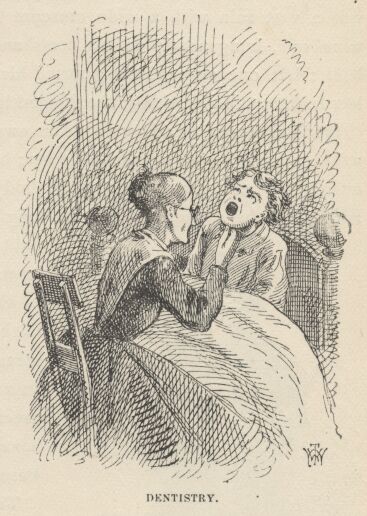
“Oh, you don’t, don’t you? So all this row was because you thought you’d get to stay home from school and go a-fishing? Tom, Tom, I love you so, and you seem to try every way you can to break my old heart with your outrageousness.” By this time the dental instruments were ready. The old lady made one end of the silk thread fast to Tom’s tooth with a loop and tied the other to the bedpost. Then she seized the chunk of fire and suddenly thrust it almost into the boy’s face. The tooth hung dangling by the bedpost, now.
“Oh, you don’t, don’t you? So all this fuss was because you thought you’d get to stay home from school and go fishing? Tom, Tom, I love you so much. And you seem to try every way you can to break my old heart with your outrageous behavior.” By now, the dental tools were ready. The old lady looped one end of the silk thread around Tom’s tooth and tied the other to the bedpost. Then she grabbed the burning chunk of wood and suddenly thrust it almost into the boy’s face. Now the tooth hung dangling from the bedpost.
But all trials bring their compensations. As Tom wended to school after breakfast, he was the envy of every boy he met because the gap in his upper row of teeth enabled him to expectorate in a new and admirable way. He gathered quite a following of lads interested in the exhibition; and one that had cut his finger and had been a centre of fascination and homage up to this time, now found himself suddenly without an adherent, and shorn of his glory. His heart was heavy, and he said with a disdain which he did not feel that it wasn’t anything to spit like Tom Sawyer; but another boy said, “Sour grapes!” and he wandered away a dismantled hero.
But all troubles have their rewards. As Tom walked to school after breakfast, every boy he met envied him. The gap in his upper teeth let him spit in a new and impressive way. He gathered quite a crowd of boys eager to watch. One boy had cut his finger and, until then, had been the center of attention and admiration. Now he suddenly found himself without a single follower, stripped of his glory. He was miserable, but pretended to be scornful as he said spitting like Tom Sawyer was nothing special. But another boy said, “Sour grapes!” and he wandered away, a fallen hero.
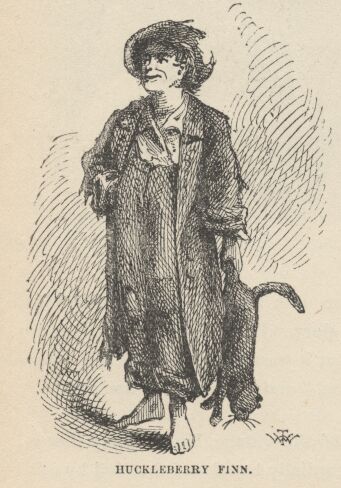
Shortly Tom came upon the juvenile pariah of the village, Huckleberry Finn, son of the town drunkard. Huckleberry was cordially hated and dreaded by all the mothers of the town, because he was idle and lawless and vulgar and bad—and because all their children admired him so, and delighted in his forbidden society, and wished they dared to be like him. Tom was like the rest of the respectable boys, in that he envied Huckleberry his gaudy outcast condition, and was under strict orders not to play with him. So he played with him every time he got a chance. Huckleberry was always dressed in the cast-off clothes of full-grown men, and they were in perennial bloom and fluttering with rags. His hat was a vast ruin with a wide crescent lopped out of its brim; his coat, when he wore one, hung nearly to his heels and had the rearward buttons far down the back; but one suspender supported his trousers; the seat of the trousers bagged low and contained nothing, the fringed legs dragged in the dirt when not rolled up.
Soon Tom came upon the village’s young outcast, Huckleberry Finn, son of the town drunkard. All the mothers in town heartily hated and feared Huckleberry because he was lazy, lawless, vulgar, and bad. They also hated him because all their children admired him, loved his forbidden company, and wished they dared to be like him. Like the other respectable boys, Tom envied Huckleberry’s flashy life as an outcast. Tom had strict orders not to play with him. So he played with him every chance he got. Huckleberry always wore grown men’s cast-off clothes, which were forever sprouting and fluttering with rags. His hat was an enormous wreck, with a wide crescent-shaped chunk missing from the brim. His coat, when he wore one, hung almost to his heels, with its back buttons far down his back. Only one suspender held up his trousers. The seat sagged low, with nothing inside it. The ragged trouser legs dragged in the dirt when they weren’t rolled up.
Huckleberry came and went, at his own free will. He slept on doorsteps in fine weather and in empty hogsheads in wet; he did not have to go to school or to church, or call any being master or obey anybody; he could go fishing or swimming when and where he chose, and stay as long as it suited him; nobody forbade him to fight; he could sit up as late as he pleased; he was always the first boy that went barefoot in the spring and the last to resume leather in the fall; he never had to wash, nor put on clean clothes; he could swear wonderfully. In a word, everything that goes to make life precious that boy had. So thought every harassed, hampered, respectable boy in St. Petersburg.
Huckleberry came and went whenever he pleased. He slept on doorsteps in good weather and in empty barrels when it rained. He didn't have to go to school or church, call anyone master, or obey anybody. He could go fishing or swimming whenever and wherever he chose, and stay as long as he liked. Nobody forbade him to fight. He could stay up as late as he pleased. He was always the first boy to go barefoot in spring and the last to put shoes on in fall. He never had to wash or put on clean clothes. He could swear wonderfully. In short, that boy had everything that made life worth living. So thought every respectable boy in St. Petersburg, constantly bothered and held back by rules.
Tom hailed the romantic outcast:
Tom called out to the romantic outcast:
“Hello, Huckleberry!”
“Hello, Huckleberry!”
“Hello yourself, and see how you like it.”
“Hello to you too, and see how you like it.”
“What’s that you got?”
“What’s that you got?”
“Dead cat.”
“Dead cat.”
“Lemme see him, Huck. My, he’s pretty stiff. Where’d you get him?”
“Let me see him, Huck. My, he’s pretty stiff. Where did you get him?”
“Bought him off’n a boy.”
“Bought him off of a boy.”
“What did you give?”
“What did you give?”
“I give a blue ticket and a bladder that I got at the slaughter-house.”
“I give a blue ticket and a bladder that I got at the slaughterhouse.”
“Where’d you get the blue ticket?”
“Where did you get the blue ticket?”
“Bought it off’n Ben Rogers two weeks ago for a hoop-stick.”
“Bought it off of Ben Rogers two weeks ago for a hoop-stick.”
“Say—what is dead cats good for, Huck?”
“Say, what is dead cats good for, Huck?”
“Good for? Cure warts with.”
“Good for? Cure warts with.”
“No! Is that so? I know something that’s better.”
“No! Really? I know something better.”
“I bet you don’t. What is it?”
“I bet you don’t. What is it?”
“Why, spunk-water.”
“Why, spunk-water.”
“Spunk-water! I wouldn’t give a dern for spunk-water.”
“Spunk-water! I wouldn’t give a darn for spunk-water.”
“You wouldn’t, wouldn’t you? D’you ever try it?”
“You wouldn’t, wouldn’t you? Did you ever try it?”
“No, I hain’t. But Bob Tanner did.”
“No, I ain't. But Bob Tanner did.”
“Who told you so!”
“Who told you that!”
“Why, he told Jeff Thatcher, and Jeff told Johnny Baker, and Johnny told Jim Hollis, and Jim told Ben Rogers, and Ben told a , and the told me. There now!”
“Why, he told Jeff Thatcher, and Jeff told Johnny Baker. And Johnny told Jim Hollis, and Jim told Ben Rogers. And Ben told a , and the told me. There now!”
“Well, what of it? They’ll all lie. Leastways all but the . I don’t know him. But I never see a that wouldn’t lie. Shucks! Now you tell me how Bob Tanner done it, Huck.”
“Well, so what? They’ll all lie. Leastways, all but the . I don’t know him. But I never see a that wouldn’t lie. Shucks! Now you tell me how Bob Tanner done it, Huck.”
“Why, he took and dipped his hand in a rotten stump where the rain-water was.”
“Why, he took and dipped his hand into a rotten stump that had rainwater in it.”
“In the daytime?”
“During the day?”
“Certainly.”
“Of course.”
“With his face to the stump?”
“With his face toward the stump?”
“Yes. Least I reckon so.”
“Yes. Least I reckon so.”
“Did he say anything?”
“Did he say anything?”
“I don’t reckon he did. I don’t know.”
“I don’t reckon he did. I don’t know.”
“Aha! Talk about trying to cure warts with spunk-water such a blame fool way as that! Why, that ain’t a-going to do any good. You got to go all by yourself, to the middle of the woods, where you know there’s a spunk-water stump, and just as it’s midnight you back up against the stump and jam your hand in and say:
“Aha! Talk about trying to cure warts with spunk-water in such a blame fool way! Why, that ain't going to do any good. You got to go all by yourself to the middle of the woods, where you know there's a spunk-water stump. And right at midnight, you back up against the stump, jam your hand in, and say:
‘Barley-corn, barley-corn, injun-meal shorts, Spunk-water, spunk-water, swaller these warts,’
‘Barleycorn, barleycorn, injun-meal shorts, Spunk-water, spunk-water, swallow these warts,’
and then walk away quick, eleven steps, with your eyes shut, and then turn around three times and walk home without speaking to anybody. Because if you speak the charm’s busted.”
and then walk away quick, eleven steps, with your eyes shut. Then turn around three times and walk home without speaking to anybody. Because if you speak, the charm’s busted.”
“Well, that sounds like a good way; but that ain’t the way Bob Tanner done.”
“Well, that sounds like a good way. But that ain’t the way Bob Tanner done.”
“No, sir, you can bet he didn’t, becuz he’s the wartiest boy in this town; and he wouldn’t have a wart on him if he’d knowed how to work spunk-water. I’ve took off thousands of warts off of my hands that way, Huck. I play with frogs so much that I’ve always got considerable many warts. Sometimes I take ’em off with a bean.”
“No, sir, you can bet he didn’t, because he’s the wartiest boy in this town. And he wouldn’t have a wart on him if he’d knowed how to work spunk-water. I’ve took off thousands of warts off of my hands that way, Huck. I play with frogs so much that I’ve always got considerable many warts. Sometimes I take them off with a bean.”
“Yes, bean’s good. I’ve done that.”
“Yes, bean’s good. I’ve done that.”
“Have you? What’s your way?”
“Have you? How do you do it?”
“You take and split the bean, and cut the wart so as to get some blood, and then you put the blood on one piece of the bean and take and dig a hole and bury it ’bout midnight at the crossroads in the dark of the moon, and then you burn up the rest of the bean. You see that piece that’s got the blood on it will keep drawing and drawing, trying to fetch the other piece to it, and so that helps the blood to draw the wart, and pretty soon off she comes.”
“You take and split the bean, and cut the wart to get some blood. Then you put the blood on one piece of the bean and take and dig a hole. Bury that piece about midnight at the crossroads, when there’s no moon. Then you burn up the rest of the bean. You see, the piece with the blood on it will keep pulling and pulling, trying to draw the other piece to it. So that helps the blood pull the wart off, and pretty soon off she comes.”
“Yes, that’s it, Huck—that’s it; though when you’re burying it if you say ‘Down bean; off wart; come no more to bother me!’ it’s better. That’s the way Joe Harper does, and he’s been nearly to Coonville and most everywheres. But say—how do you cure ’em with dead cats?”
“Yes, that’s it, Huck, that’s it. Though it’s better if, when you’re burying it, you say, ‘Down, bean. Off, wart. Come no more to bother me!’ That’s the way Joe Harper does it, and he’s been nearly to Coonville and most everywhere. But say, how do you cure warts with dead cats?”
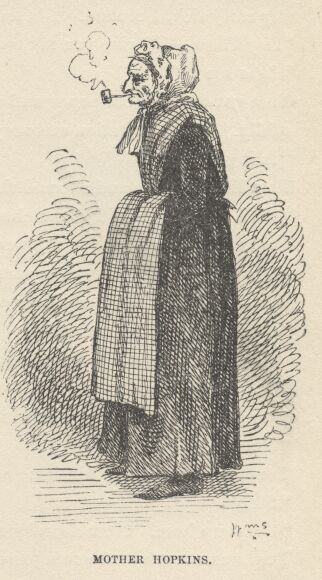
“Why, you take your cat and go and get in the grave-yard ’long about midnight when somebody that was wicked has been buried; and when it’s midnight a devil will come, or maybe two or three, but you can’t see ’em, you can only hear something like the wind, or maybe hear ’em talk; and when they’re taking that feller away, you heave your cat after ’em and say, ‘Devil follow corpse, cat follow devil, warts follow cat, I’m done with ye!’ That’ll fetch any wart.”
“Why, you take your cat and go to the graveyard around midnight, when somebody wicked has been buried. And at midnight a devil will come, or maybe two or three, but you can’t see them. You can only hear something like the wind, or maybe hear them talk. And when they’re taking that fellow away, you heave your cat after them and say, ‘Devil follow corpse, cat follow devil, warts follow cat, I’m done with you!’ That’ll get rid of any wart.”
“Sounds right. D’you ever try it, Huck?”
“Sounds right. Did you ever try it, Huck?”
“No, but old Mother Hopkins told me.”
“No, but old Mother Hopkins told me.”
“Well, I reckon it’s so, then. Becuz they say she’s a witch.”
“Well, I reckon it’s so, then. Because they say she’s a witch.”
“Say! Why, Tom, I know she is. She witched pap. Pap says so his own self. He come along one day, and he see she was a-witching him, so he took up a rock, and if she hadn’t dodged, he’d a got her. Well, that very night he rolled off’n a shed wher’ he was a layin drunk, and broke his arm.”
“Say! Why, Tom, I know she is. She witched pap. Pap says so his own self. He come along one day, and he see she was a-witching him. So he took up a rock, and if she hadn’t dodged, he’d have got her. Well, that very night he rolled off of a shed where he was a-laying drunk, and broke his arm.”
“Why, that’s awful. How did he know she was a-witching him?”
“Why, that’s awful. How did he know she was casting a spell on him?”
“Lord, pap can tell, easy. Pap says when they keep looking at you right stiddy, they’re a-witching you. Specially if they mumble. Becuz when they mumble they’re saying the Lord’s Prayer backards.”
“Lord, pap can tell, easy. Pap says when they keep looking at you right steady, they’re bewitching you. Especially if they mumble. Because when they mumble they’re saying the Lord’s Prayer backwards.”
“Say, Hucky, when you going to try the cat?”
“Say, Hucky, when you going to try the cat?”
“To-night. I reckon they’ll come after old Hoss Williams to-night.”
“Tonight. I reckon they’ll come after old Hoss Williams tonight.”
“But they buried him Saturday. Didn’t they get him Saturday night?”
“But they buried him on Saturday. Didn’t they get him Saturday night?”
“Why, how you talk! How could their charms work till midnight?—and then it’s Sunday. Devils don’t slosh around much of a Sunday, I don’t reckon.”
“Why, listen to you! How could their charms work before midnight? And then it’s Sunday. Devils don’t roam around much on Sundays, I don’t reckon.”
“I never thought of that. That’s so. Lemme go with you?”
“I never thought of that. That’s true. Let me go with you?”
“Of course—if you ain’t afeard.”
“Of course, if you ain’t afraid.”
“Afeard! ’Tain’t likely. Will you meow?”
“Afraid! It ain’t likely. Will you meow?”
“Yes—and you meow back, if you get a chance. Last time, you kep’ me a-meowing around till old Hays went to throwing rocks at me and says ‘Dern that cat!’ and so I hove a brick through his window—but don’t you tell.”
“Yes, and you meow back, if you get a chance. Last time, you kept me meowing around till old Hays went to throwing rocks at me. And he says, ‘Dern that cat!’ So I threw a brick through his window. But don’t you tell.”
“I won’t. I couldn’t meow that night, becuz auntie was watching me, but I’ll meow this time. Say—what’s that?”
“I won’t. I couldn’t meow that night because auntie was watching me. But I’ll meow this time. Say, what’s that?”
“Nothing but a tick.”
“Just a tick.”
“Where’d you get him?”
“Where did you get him?”
“Out in the woods.”
“Out in the woods.”
“What’ll you take for him?”
“What will you take for him?”
“I don’t know. I don’t want to sell him.”
“I don’t know. I don’t want to sell him.”
“All right. It’s a mighty small tick, anyway.”
“All right. It’s a really small tick, anyway.”
“Oh, anybody can run a tick down that don’t belong to them. I’m satisfied with it. It’s a good enough tick for me.”
“Oh, anybody can find fault with a tick that don’t belong to them. I’m happy with it. It’s a good enough tick for me.”
“Sho, there’s ticks a plenty. I could have a thousand of ’em if I wanted to.”
“Oh, there’s plenty of ticks. I could have a thousand of them if I wanted to.”
“Well, why don’t you? Becuz you know mighty well you can’t. This is a pretty early tick, I reckon. It’s the first one I’ve seen this year.”
“Well, why don’t you? Because you know mighty well you can’t. This tick showed up pretty early, I reckon. It’s the first one I’ve seen this year.”
“Say, Huck—I’ll give you my tooth for him.”
“Hey, Huck, I’ll give you my tooth for him.”
“Less see it.”
“Let’s see it.”
Tom got out a bit of paper and carefully unrolled it. Huckleberry viewed it wistfully. The temptation was very strong. At last he said:
Tom took out a small piece of paper and carefully unrolled it. Huckleberry looked at it longingly. The temptation was very strong. Finally, he said:
“Is it genuwyne?”
“Is it genuine?”
Tom lifted his lip and showed the vacancy.
Tom lifted his lip and showed the gap where his tooth had been.
“Well, all right,” said Huckleberry, “it’s a trade.”
“Well, all right,” said Huckleberry, “it’s a deal.”
Tom enclosed the tick in the percussion-cap box that had lately been the pinchbug’s prison, and the boys separated, each feeling wealthier than before.
Tom shut the tick inside the percussion-cap box that had recently been the pinchbug’s prison. The boys went their separate ways, each feeling richer than before.
When Tom reached the little isolated frame school-house, he strode in briskly, with the manner of one who had come with all honest speed. He hung his hat on a peg and flung himself into his seat with business-like alacrity. The master, throned on high in his great splint-bottom arm-chair, was dozing, lulled by the drowsy hum of study. The interruption roused him.
When Tom reached the small, isolated wooden schoolhouse, he strode in briskly, as if he had hurried there without wasting time. He hung his hat on a peg and threw himself into his seat with businesslike energy. The teacher sat high above the room, like a king on a throne, in his large armchair with its woven wooden seat. He was dozing, lulled by the sleepy hum of students studying. Tom’s arrival woke him.
“Thomas Sawyer!”
“Thomas Sawyer!”
Tom knew that when his name was pronounced in full, it meant trouble.
Tom knew that when someone used his full name, he was in trouble.
“Sir!”
“Sir!”
“Come up here. Now, sir, why are you late again, as usual?”
“Come up here. Now, sir, why are you late again, as usual?”
Tom was about to take refuge in a lie, when he saw two long tails of yellow hair hanging down a back that he recognized by the electric sympathy of love; and by that form was the only vacant place on the girls’ side of the school-house. He instantly said:
Tom was about to hide behind a lie when he saw two long blond pigtails hanging down a back. With love’s electric instinct, he recognized that back. And beside the girl was the only empty seat on the girls’ side of the schoolhouse. He immediately said:
“I stopped to talk with Huckleberry Finn!”
“I stopped to talk with Huckleberry Finn!”
The master’s pulse stood still, and he stared helplessly. The buzz of study ceased. The pupils wondered if this foolhardy boy had lost his mind. The master said:
The teacher’s heart stopped, and he stared helplessly. The hum of students studying fell silent. The students wondered if this reckless boy had lost his mind. The teacher said:
“You—you did what?”
“You, you did what?”
“Stopped to talk with Huckleberry Finn.”
“Stopped to talk with Huckleberry Finn.”
There was no mistaking the words.
The words were unmistakable.
“Thomas Sawyer, this is the most astounding confession I have ever listened to. No mere ferule will answer for this offence. Take off your jacket.”
“Thomas Sawyer, this is the most shocking confession I have ever heard. Just hitting you with a ruler won't be enough punishment for this offense. Take off your jacket.”
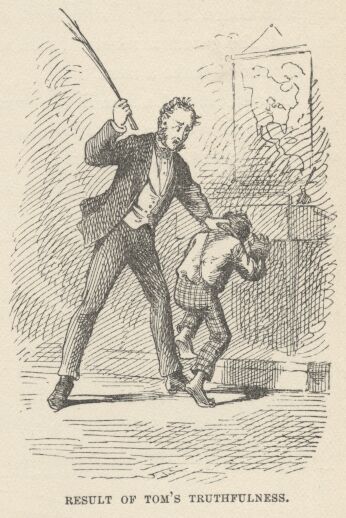
The master’s arm performed until it was tired and the stock of switches notably diminished. Then the order followed:
The teacher kept swinging his arm until it grew tired and his supply of whipping sticks had shrunk considerably. Then came the order:
“Now, sir, go and sit with the girls! And let this be a warning to you.”
“Now, sir, go sit with the girls! And take this as a warning.”
The titter that rippled around the room appeared to abash the boy, but in reality that result was caused rather more by his worshipful awe of his unknown idol and the dread pleasure that lay in his high good fortune. He sat down upon the end of the pine bench and the girl hitched herself away from him with a toss of her head. Nudges and winks and whispers traversed the room, but Tom sat still, with his arms upon the long, low desk before him, and seemed to study his book.
The giggles that spread around the room seemed to embarrass the boy. But his embarrassment came more from his worshipful awe of the girl he adored but didn't know. His wonderful luck also filled him with a frightening pleasure. He sat down at the end of the pine bench, and the girl scooted away, tossing her head. Nudges, winks, and whispers passed around the room, but Tom sat still. He rested his arms on the long, low desk in front of him and seemed to study his book.
By and by attention ceased from him, and the accustomed school murmur rose upon the dull air once more. Presently the boy began to steal furtive glances at the girl. She observed it, “made a mouth” at him and gave him the back of her head for the space of a minute. When she cautiously faced around again, a peach lay before her. She thrust it away. Tom gently put it back. She thrust it away again, but with less animosity. Tom patiently returned it to its place. Then she let it remain. Tom scrawled on his slate, “Please take it—I got more.” The girl glanced at the words, but made no sign. Now the boy began to draw something on the slate, hiding his work with his left hand. For a time the girl refused to notice; but her human curiosity presently began to manifest itself by hardly perceptible signs. The boy worked on, apparently unconscious. The girl made a sort of non-committal attempt to see, but the boy did not betray that he was aware of it. At last she gave in and hesitatingly whispered:
After a while, everyone stopped paying attention to him, and the usual classroom murmur filled the dull air again. Soon the boy began sneaking glances at the girl. She noticed, “made a face” at him, and turned her back on him for a minute. When she cautiously turned around again, a peach lay in front of her. She pushed it away. Tom gently put it back. She pushed it away again, but less angrily. Tom patiently put it back in its place. Then she let it stay. Tom scribbled on his slate, “Please take it. I got more.” The girl glanced at the words but gave no response. Now the boy began drawing something on the slate, hiding his work with his left hand. For a while, the girl refused to look. But soon her natural curiosity began to show in barely noticeable ways. The boy kept working, seeming not to notice. The girl tried to peek without showing too much interest, but the boy gave no sign that he noticed. At last she gave in and hesitantly whispered:
“Let me see it.”
“Let me see it.”
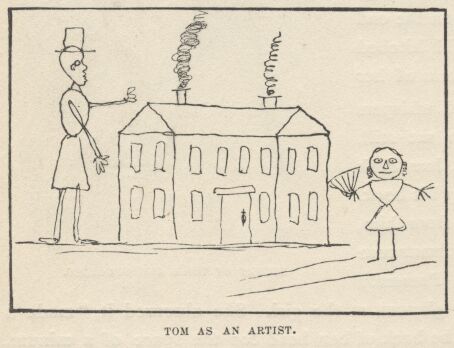
Tom partly uncovered a dismal caricature of a house with two gable ends to it and a corkscrew of smoke issuing from the chimney. Then the girl’s interest began to fasten itself upon the work and she forgot everything else. When it was finished, she gazed a moment, then whispered:
Tom partly uncovered a crude, miserable-looking drawing of a house with two gabled ends. A corkscrew of smoke rose from the chimney. Then the girl began to take an interest in the drawing, and she forgot everything else. When the drawing was finished, she gazed at it for a moment, then whispered:
“It’s nice—make a man.”
“It’s nice. Make a man.”
The artist erected a man in the front yard, that resembled a derrick. He could have stepped over the house; but the girl was not hypercritical; she was satisfied with the monster, and whispered:
The artist drew a man in the front yard who looked like a construction crane. He could have stepped over the house. But the girl wasn't too picky. She was satisfied with the monster and whispered:
“It’s a beautiful man—now make me coming along.”
“It’s a beautiful man. Now make me coming along.”
Tom drew an hour-glass with a full moon and straw limbs to it and armed the spreading fingers with a portentous fan. The girl said:
Tom drew an hourglass with a full-moon head and straw-like arms and legs. He put an imposing fan in its spread-out fingers. The girl said:
“It’s ever so nice—I wish I could draw.”
“It’s so nice. I wish I could draw.”
“It’s easy,” whispered Tom, “I’ll learn you.”
“It’s easy,” whispered Tom. “I’ll learn you.”
“Oh, will you? When?”
“Oh, will you? When?”
“At noon. Do you go home to dinner?”
“At noon. Do you go home for lunch?”
“I’ll stay if you will.”
“I’ll stay if you do.”
“Good—that’s a whack. What’s your name?”
“Good, that’s a deal. What’s your name?”
“Becky Thatcher. What’s yours? Oh, I know. It’s Thomas Sawyer.”
“Becky Thatcher. What’s your name? Oh, I know. It’s Thomas Sawyer.”
“That’s the name they lick me by. I’m Tom when I’m good. You call me Tom, will you?”
“That’s the name they use when they whip me. I’m Tom when I’m good. You call me Tom, will you?”
“Yes.”
“Yes.”
Now Tom began to scrawl something on the slate, hiding the words from the girl. But she was not backward this time. She begged to see. Tom said:
Now Tom began scribbling something on the slate, hiding the words from the girl. But she wasn't shy this time. She begged to see what he had written. Tom said:
“Oh, it ain’t anything.”
“Oh, it ain’t anything.”
“Yes it is.”
“Yes, it is.”
“No it ain’t. You don’t want to see.”
“No, it ain’t. You don’t want to see.”
“Yes I do, indeed I do. Please let me.”
“Yes, I do, I really do. Please let me.”
“You’ll tell.”
“You’ll tell.”
“No I won’t—deed and deed and double deed won’t.”
“No, I won’t. I really, really, really won’t.”
“You won’t tell anybody at all? Ever, as long as you live?”
“You won’t tell anyone at all? Ever, as long as you live?”
“No, I won’t ever tell _any_body. Now let me.”
“No, I won’t ever tell _any_body. Now let me.”
“Oh, you don’t want to see!”
“Oh, you don’t want to see!”
“Now that you treat me so, I will see.” And she put her small hand upon his and a little scuffle ensued, Tom pretending to resist in earnest but letting his hand slip by degrees till these words were revealed: “I love you.”
“Now that you’re treating me this way, I will see.” She put her small hand on his, and they struggled a little. Tom pretended to resist for real, but slowly let his hand slip aside until these words appeared: “I love you.”
“Oh, you bad thing!” And she hit his hand a smart rap, but reddened and looked pleased, nevertheless.
“Oh, you bad thing!” She gave his hand a sharp slap, but she blushed and looked pleased anyway.
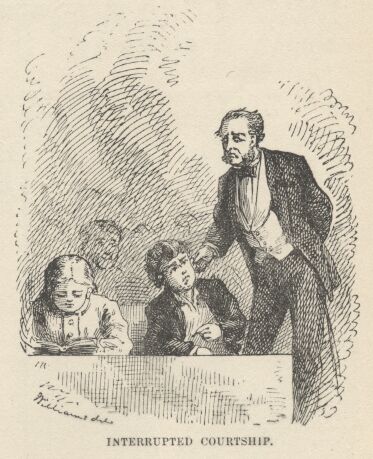
Just at this juncture the boy felt a slow, fateful grip closing on his ear, and a steady lifting impulse. In that wise he was borne across the house and deposited in his own seat, under a peppering fire of giggles from the whole school. Then the master stood over him during a few awful moments, and finally moved away to his throne without saying a word. But although Tom’s ear tingled, his heart was jubilant.
Just then, the boy felt a slow, ominous grip tighten around his ear and steadily lift him up. He was carried across the schoolroom by his ear and set down in his own seat. The whole school showered him with giggles. Then the teacher stood over him for a few terrible moments. Finally, he returned to his throne without saying a word. But although Tom’s ear tingled, his heart was full of joy.
As the school quieted down Tom made an honest effort to study, but the turmoil within him was too great. In turn he took his place in the reading class and made a botch of it; then in the geography class and turned lakes into mountains, mountains into rivers, and rivers into continents, till chaos was come again; then in the spelling class, and got “turned down,” by a succession of mere baby words, till he brought up at the foot and yielded up the pewter medal which he had worn with ostentation for months.
As the school quieted down, Tom made an honest effort to study, but the turmoil inside him was too great. In turn he took his place in the reading class and made a botch of it. Then, in the geography class, he turned lakes into mountains, mountains into rivers, and rivers into continents, till chaos was come again. Then, in the spelling class, he got “turned down” by a string of mere baby words, till he ended up at the foot of the class and gave up the pewter medal he had worn and shown off for months.