Chapter 1
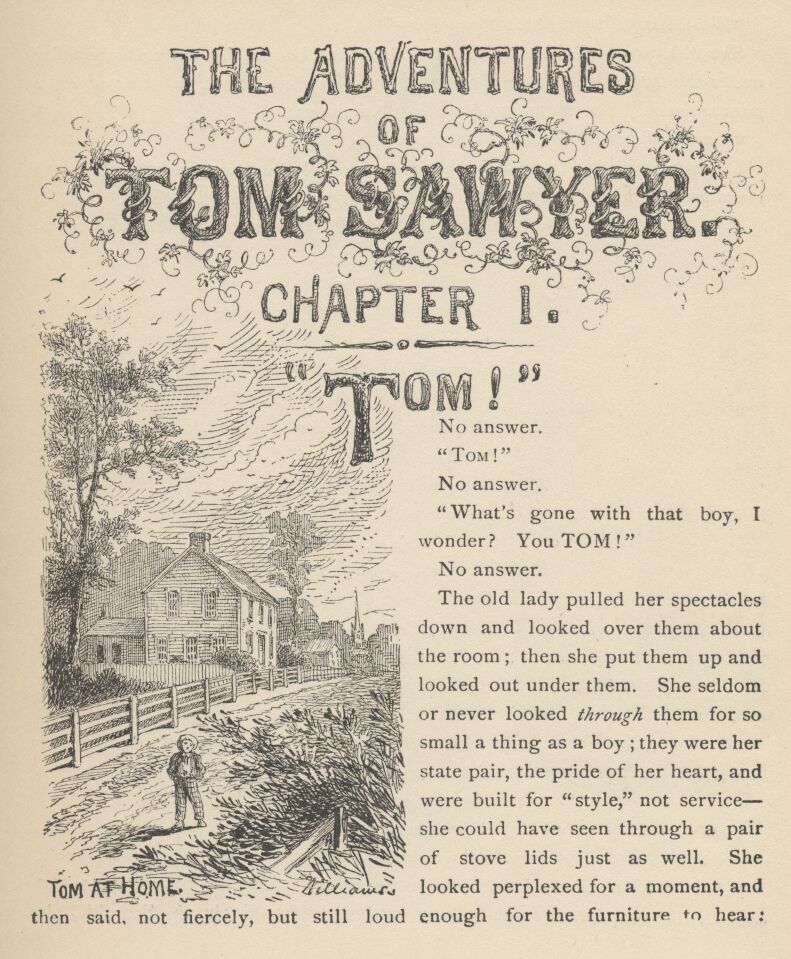
“Tom!”
“Tom!”
No answer.
No answer.
“TOM!”
“TOM!”
No answer.
No answer.
“What’s gone with that boy, I wonder? You TOM!”
“Where has that boy gone, I wonder? You TOM!”
No answer.
No answer.
The old lady pulled her spectacles down and looked over them about the room; then she put them up and looked out under them. She seldom or never looked through them for so small a thing as a boy; they were her state pair, the pride of her heart, and were built for “style,” not service—she could have seen through a pair of stove-lids just as well. She looked perplexed for a moment, and then said, not fiercely, but still loud enough for the furniture to hear:
The old lady lowered her glasses and looked over them around the room. Then she pushed them up and looked out from under them. She rarely, if ever, looked through them for anything as unimportant as a boy. They were her best pair, the pride of her heart, and were made for “style,” not use. She could have seen just as well through a pair of stove lids. She looked puzzled for a moment. Then she spoke, not harshly, but still loud enough for the furniture to hear:
“Well, I lay if I get hold of you I’ll—”
“Well, I bet if I get hold of you, I’ll...”
She did not finish, for by this time she was bending down and punching under the bed with the broom, and so she needed breath to punctuate the punches with. She resurrected nothing but the cat.
She did not finish, because by then she was bending down and jabbing under the bed with the broom. She needed her breath for the grunts that went with each jab. All she brought out was the cat.
“I never did see the beat of that boy!”
“I never did see anyone like that boy!”
She went to the open door and stood in it and looked out among the tomato vines and “jimpson” weeds that constituted the garden. No Tom. So she lifted up her voice at an angle calculated for distance and shouted:
She went to the open door and stood there, looking out among the tomato vines and “jimpson” weeds. That was the garden. No Tom. So she raised her voice, aiming it to carry as far as possible, and shouted:
“Y-o-u-u TOM!”
“You, TOM!”
There was a slight noise behind her and she turned just in time to seize a small boy by the slack of his roundabout and arrest his flight.
There was a faint noise behind her. She turned just in time to grab a small boy by his loose jacket and stop him from escaping.
“There! I might ’a’ thought of that closet. What you been doing in there?”
“There! I might have thought of that closet. What you been doing in there?”
“Nothing.”
“Nothing.”
“Nothing! Look at your hands. And look at your mouth. What is that truck?”
“Nothing! Look at your hands. And look at your mouth. What is that stuff?”
“I don’t know, aunt.”
“I don’t know, aunt.”
“Well, I know. It’s jam—that’s what it is. Forty times I’ve said if you didn’t let that jam alone I’d skin you. Hand me that switch.”
“Well, I know. It’s jam, that’s what it is. I’ve told you forty times that if you didn’t leave that jam alone, I’d skin you. Hand me that switch.”
The switch hovered in the air—the peril was desperate—
The stick hovered in the air. The danger was extreme.
“My! Look behind you, aunt!”
“Wow! Look behind you, Aunt!”
The old lady whirled round, and snatched her skirts out of danger. The lad fled on the instant, scrambled up the high board-fence, and disappeared over it.
The old lady spun around and snatched her skirts out of danger. The boy fled at once, scrambled up the tall wooden fence, and disappeared over it.
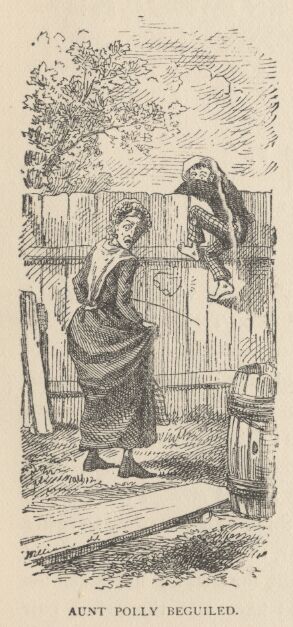
His aunt Polly stood surprised a moment, and then broke into a gentle laugh.
His aunt Polly stood in surprise for a moment. Then she let out a gentle laugh.
“Hang the boy, can’t I never learn anything? Ain’t he played me tricks enough like that for me to be looking out for him by this time? But old fools is the biggest fools there is. Can’t learn an old dog new tricks, as the saying is. But my goodness, he never plays them alike, two days, and how is a body to know what’s coming? He ’pears to know just how long he can torment me before I get my dander up, and he knows if he can make out to put me off for a minute or make me laugh, it’s all down again and I can’t hit him a lick. I ain’t doing my duty by that boy, and that’s the Lord’s truth, goodness knows. Spare the rod and spile the child, as the Good Book says. I’m a laying up sin and suffering for us both, I know. He’s full of the Old Scratch, but laws-a-me! he’s my own dead sister’s boy, poor thing, and I ain’t got the heart to lash him, somehow. Every time I let him off, my conscience does hurt me so, and every time I hit him my old heart most breaks. Well-a-well, man that is born of woman is of few days and full of trouble, as the Scripture says, and I reckon it’s so. He’ll play hookey this evening, and I’ll just be obleeged to make him work, tomorrow, to punish him. It’s mighty hard to make him work Saturdays, when all the boys is having holiday, but he hates work more than he hates anything else, and I’ve got to do some of my duty by him, or I’ll be the ruination of the child.”
“Hang the boy, can’t I never learn anything? Ain’t he played me tricks enough like that for me to be looking out for him by this time? But old fools is the biggest fools there is. Can’t learn an old dog new tricks, as the saying is. But my goodness, he never plays them alike two days in a row, and how is a body to know what’s coming? He appears to know just how long he can torment me before I get my dander up. And he knows if he can make out to put me off for a minute or make me laugh, it’s all down again and I can’t hit him a lick. I ain’t doing my duty by that boy, and that’s the Lord’s truth, goodness knows. Spare the rod and spoil the child, as the Good Book says. I’m a laying up sin and suffering for us both, I know. He’s full of the Old Scratch, but laws-a-me! he’s my own dead sister’s boy, poor thing, and I ain’t got the heart to lash him, somehow. Every time I let him off, my conscience does hurt me so, and every time I hit him my old heart most breaks. Well-a-well, man that is born of woman is of few days and full of trouble, as the Scripture says, and I reckon it’s so. He’ll play hooky this evening, and I’ll just be obliged to make him work tomorrow, to punish him. It’s mighty hard to make him work Saturdays, when all the boys is having holiday. But he hates work more than he hates anything else, and I’ve got to do some of my duty by him, or I’ll be the ruination of the child.”
Southwestern dialect for “afternoon”
Tom did play hookey, and he had a very good time. He got back home barely in season to help Jim, the small colored boy, saw next-day’s wood and split the kindlings before supper—at least he was there in time to tell his adventures to Jim while Jim did three-fourths of the work. Tom’s younger brother (or rather half-brother) Sid was already through with his part of the work (picking up chips), for he was a quiet boy, and had no adventurous, trouble-some ways.
Tom did skip school, and he had a very good time. He got home just in time to help Jim, the little Black boy, with the wood before supper. They had to saw the next day’s firewood and split the kindling. At least, Tom was there in time to tell Jim about his adventures while Jim did three-fourths of the work. Tom’s younger brother Sid (actually his half-brother) had already finished his share of the work, picking up wood chips. He was a quiet boy, with none of Tom’s adventurous, troublesome ways.
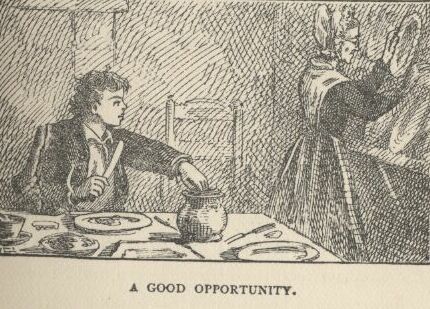
While Tom was eating his supper, and stealing sugar as opportunity offered, Aunt Polly asked him questions that were full of guile, and very deep—for she wanted to trap him into damaging revealments. Like many other simple-hearted souls, it was her pet vanity to believe she was endowed with a talent for dark and mysterious diplomacy, and she loved to contemplate her most transparent devices as marvels of low cunning. Said she:
While Tom ate his supper and stole sugar whenever he got the chance, Aunt Polly asked him sly, probing questions. She wanted to trick him into revealing something that would get him into trouble. Like many other trusting souls, she took special pride in believing she had a gift for secret, mysterious diplomacy. She loved to admire her most obvious tricks as masterpieces of sly cunning. She said:
“Tom, it was middling warm in school, warn’t it?”
“Tom, it was pretty warm in school, wasn’t it?”
“Yes’m.”
“Yes, ma’am.”
“Powerful warm, warn’t it?”
“Powerful warm, wasn't it?”
“Yes’m.”
“Yes, ma’am.”
“Didn’t you want to go in a-swimming, Tom?”
“Didn’t you want to go swimming, Tom?”
A bit of a scare shot through Tom—a touch of uncomfortable suspicion. He searched Aunt Polly’s face, but it told him nothing. So he said:
Tom felt a flash of fear, a hint of uneasy suspicion. He searched Aunt Polly’s face, but her expression told him nothing. So he said:
“No’m—well, not very much.”
“No, ma’am, well, not very much.”
The old lady reached out her hand and felt Tom’s shirt, and said:
The old woman reached out, felt Tom’s shirt, and said:
“But you ain’t too warm now, though.” And it flattered her to reflect that she had discovered that the shirt was dry without anybody knowing that that was what she had in her mind. But in spite of her, Tom knew where the wind lay, now. So he forestalled what might be the next move:
“But you ain’t too warm now, though.” And she felt pleased with herself for finding out that the shirt was dry. Nobody knew she had been trying to check it. But despite her efforts, Tom now knew what she was up to. So he acted before she could make her next move:
“Some of us pumped on our heads—mine’s damp yet. See?”
“Some of us pumped water over our heads. Mine’s still damp. See?”
Aunt Polly was vexed to think she had overlooked that bit of circumstantial evidence, and missed a trick. Then she had a new inspiration:
Aunt Polly was annoyed with herself for overlooking that clue and missing a chance to catch him. Then she had a new idea:
“Tom, you didn’t have to undo your shirt collar where I sewed it, to pump on your head, did you? Unbutton your jacket!”
“Tom, you didn’t have to undo the collar I sewed shut to pump water over your head, did you? Unbutton your jacket!”
The trouble vanished out of Tom’s face. He opened his jacket. His shirt collar was securely sewed.
The worry disappeared from Tom’s face. He opened his jacket. His shirt collar was sewn securely shut.
“Bother! Well, go ’long with you. I’d made sure you’d played hookey and been a-swimming. But I forgive ye, Tom. I reckon you’re a kind of a singed cat, as the saying is—better’n you look. This time.”
“Bother! Well, go along with you. I was sure you’d played hooky and been swimming. But I forgive you, Tom. I reckon you’re a kind of a singed cat, as the saying goes. Better than you look. This time.”
She was half sorry her sagacity had miscarried, and half glad that Tom had stumbled into obedient conduct for once.
She was half sorry her cleverness had failed her. But she was half glad Tom had accidentally obeyed for once.
But Sidney said:
But Sidney said:
“Well, now, if I didn’t think you sewed his collar with white thread, but it’s black.”
“Well, now, I thought you sewed his collar with white thread. But the thread is black.”
“Why, I did sew it with white! Tom!”
“Wait, I did sew it with white thread! Tom!”
But Tom did not wait for the rest. As he went out at the door he said:
But Tom didn't wait for the rest. As he walked out the door, he said:
“Siddy, I’ll lick you for that.”
“Siddy, I’ll beat you up for that.”
In a safe place Tom examined two large needles which were thrust into the lapels of his jacket, and had thread bound about them—one needle carried white thread and the other black. He said:
In a safe place, Tom examined two large needles stuck into the lapels of his jacket. Each had thread wrapped around it, one with white thread and the other with black. He said:
“She’d never noticed if it hadn’t been for Sid. Confound it! sometimes she sews it with white, and sometimes she sews it with black. I wish to gee-miny she’d stick to one or t’other—I can’t keep the run of ’em. But I bet you I’ll lam Sid for that. I’ll learn him!”
“She’d never noticed if it hadn’t been for Sid. Confound it! Sometimes she sews it with white, and sometimes she sews it with black. I wish to jiminy she’d stick to one or the other. I can’t keep track of them. But I bet you I’ll lam Sid for that. I’ll learn him!”
He was not the Model Boy of the village. He knew the model boy very well though—and loathed him.
He was not the village’s best-behaved boy. He knew that boy very well, though, and hated him.
Within two minutes, or even less, he had forgotten all his troubles. Not because his troubles were one whit less heavy and bitter to him than a man’s are to a man, but because a new and powerful interest bore them down and drove them out of his mind for the time—just as men’s misfortunes are forgotten in the excitement of new enterprises. This new interest was a valued novelty in whistling, which he had just acquired from a negro, and he was suffering to practise it undisturbed. It consisted in a peculiar bird-like turn, a sort of liquid warble, produced by touching the tongue to the roof of the mouth at short intervals in the midst of the music—the reader probably remembers how to do it, if he has ever been a boy. Diligence and attention soon gave him the knack of it, and he strode down the street with his mouth full of harmony and his soul full of gratitude. He felt much as an astronomer feels who has discovered a new planet—no doubt, as far as strong, deep, unalloyed pleasure is concerned, the advantage was with the boy, not the astronomer.
Within two minutes, or even less, he had forgotten all his troubles. Not because his troubles felt any less heavy and bitter than a grown man’s troubles feel to him. Instead, a powerful new interest pushed them aside and drove them from his mind for a while. Just so, men forget their misfortunes in the excitement of new projects. This new interest was a prized whistling trick he had just learned from a Black person. He was desperate to practice it without being disturbed. The trick was a special birdlike sound, a sort of flowing warble. He made it by briefly touching his tongue to the roof of his mouth at intervals while whistling. The reader probably remembers how to do it, if he has ever been a boy. With practice and concentration, he soon got the knack. He strode down the street with his mouth full of music and his soul full of gratitude. He felt much like an astronomer who has discovered a new planet. No doubt, when it came to strong, deep, pure pleasure, the boy had the advantage over the astronomer.
The summer evenings were long. It was not dark, yet. Presently Tom checked his whistle. A stranger was before him—a boy a shade larger than himself. A new-comer of any age or either sex was an impressive curiosity in the poor little shabby village of St. Petersburg. This boy was well dressed, too—well dressed on a week-day. This was simply astounding. His cap was a dainty thing, his close-buttoned blue cloth roundabout was new and natty, and so were his pantaloons. He had shoes on—and it was only Friday. He even wore a necktie, a bright bit of ribbon. He had a citified air about him that ate into Tom’s vitals. The more Tom stared at the splendid marvel, the higher he turned up his nose at his finery and the shabbier and shabbier his own outfit seemed to him to grow. Neither boy spoke. If one moved, the other moved—but only sidewise, in a circle; they kept face to face and eye to eye all the time. Finally Tom said:
The summer evenings were long. It was not dark yet. Soon Tom stopped whistling. A stranger stood before him, a boy slightly bigger than himself. A newcomer of any age, boy or girl, man or woman, was a fascinating sight in the poor, shabby little village of St. Petersburg. This boy was well dressed, too, and on a weekday. That was simply astounding. His cap was a fancy little thing. His blue cloth jacket, buttoned all the way up, was new and stylish, and so were his trousers. He had shoes on, and it was only Friday. He even wore a necktie, a bright piece of ribbon. He had a city look about him that Tom found deeply irritating. The more Tom stared at this splendid sight, the more he turned up his nose at the boy’s fancy clothes. And the shabbier his own outfit seemed to grow. Neither boy spoke. If one moved, the other moved, but only sideways, in a circle. They stayed face to face and kept their eyes locked the whole time. Finally Tom said:
“I can lick you!”
“I can beat you up!”
“I’d like to see you try it.”
“I’d like to see you try it.”
“Well, I can do it.”
“Well, I can do it.”
“No you can’t, either.”
“No, you can’t, either.”
“Yes I can.”
“Yes, I can.”
“No you can’t.”
“No, you can’t.”
“I can.”
“I can.”
“You can’t.”
“You can’t.”
“Can!”
“Can!”
“Can’t!”
“Can’t!”
An uncomfortable pause. Then Tom said:
There was an awkward pause. Then Tom said:
“What’s your name?”
“What’s your name?”
“’Tisn’t any of your business, maybe.”
“It isn’t any of your business, maybe.”
“Well I ’low I’ll make it my business.”
“Well, I suppose I’ll make it my business.”
“Well why don’t you?”
“Well, why don’t you?”
“If you say much, I will.”
“If you say much more, I will.”
“Much—much—much. There now.”
“Much, much, much. There now.”
“Oh, you think you’re mighty smart, don’t you? I could lick you with one hand tied behind me, if I wanted to.”
“Oh, you think you’re so smart, don’t you? I could beat you up with one hand tied behind my back, if I wanted to.”
“Well why don’t you do it? You say you can do it.”
“Well, why don’t you do it? You say you can do it.”
“Well I will, if you fool with me.”
“Well, I will, if you mess with me.”
“Oh yes—I’ve seen whole families in the same fix.”
“Oh yes, I’ve seen whole families in the same fix.”
“Smarty! You think you’re some, now, don’t you? Oh, what a hat!”
“Show-off! You think you’re something special now, don’t you? Oh, what a hat!”
“You can lump that hat if you don’t like it. I dare you to knock it off—and anybody that’ll take a dare will suck eggs.”
“You can put up with that hat if you don’t like it. I dare you to knock it off. And anybody who backs down from a dare will suck eggs.”
“You’re a liar!”
“You’re a liar!”
“You’re another.”
“You are too.”
“You’re a fighting liar and dasn’t take it up.”
“You’re a liar, and you don’t dare fight me.”
“Aw—take a walk!”
“Aw, get lost!”
“Say—if you give me much more of your sass I’ll take and bounce a rock off’n your head.”
“Say, if you give me much more of your sass, I’ll take and bounce a rock off your head.”
“Oh, of course you will.”
“Oh, of course you will.”
“Well I will.”
“Well, I will.”
“Well why don’t you do it then? What do you keep saying you will for? Why don’t you do it? It’s because you’re afraid.”
“Well, why don’t you do it then? Why do you keep saying you will? Why don’t you do it? It’s because you’re afraid.”
“I ain’t afraid.”
“I ain’t afraid.”
“You are.”
“You are.”
“I ain’t.”
“I ain’t.”
“You are.”
“You are.”
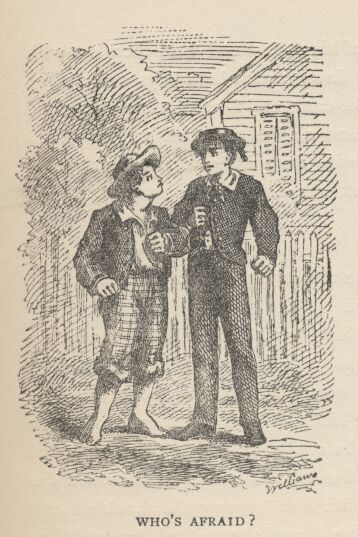
Another pause, and more eying and sidling around each other. Presently they were shoulder to shoulder. Tom said:
Another pause, and more watching each other and circling sideways. Soon they stood shoulder to shoulder. Tom said:
“Get away from here!”
“Get away from here!”
“Go away yourself!”
“You go away!”
“I won’t.”
“I won’t.”
“I won’t either.”
“I won’t either.”
So they stood, each with a foot placed at an angle as a brace, and both shoving with might and main, and glowering at each other with hate. But neither could get an advantage. After struggling till both were hot and flushed, each relaxed his strain with watchful caution, and Tom said:
So they stood, each bracing himself with one foot set at an angle. Both pushed with all their strength and glared at each other with hatred. But neither could gain an advantage. After struggling until both were hot and red-faced, each cautiously eased off while keeping a close watch on the other. Then Tom said:
“You’re a coward and a pup. I’ll tell my big brother on you, and he can thrash you with his little finger, and I’ll make him do it, too.”
“You’re a coward and a pup. I’ll tell my big brother on you. And he can beat you up with his little finger. And I’ll make him do it, too.”
“What do I care for your big brother? I’ve got a brother that’s bigger than he is—and what’s more, he can throw him over that fence, too.” [Both brothers were imaginary.]
“What do I care about your big brother? I’ve got a brother who’s bigger than yours. And what’s more, my brother can throw yours over that fence, too.” [Both brothers were imaginary.]
“That’s a lie.”
“That’s a lie.”
“Your saying so don’t make it so.”
“Your saying so don’t make it so.”
Tom drew a line in the dust with his big toe, and said:
Tom drew a line in the dust with his big toe and said:
“I dare you to step over that, and I’ll lick you till you can’t stand up. Anybody that’ll take a dare will steal sheep.”
“I dare you to step over that. If you do, I’ll beat you until you can’t stand up. Anybody who backs down from a dare will steal sheep.”
The new boy stepped over promptly, and said:
The new boy stepped over right away and said:
“Now you said you’d do it, now let’s see you do it.”
“Now you said you’d do it. Now let’s see you do it.”
“Don’t you crowd me now; you better look out.”
“Don’t you crowd me now. You better watch out.”
“Well, you said you’d do it—why don’t you do it?”
“Well, you said you’d do it. Why don’t you do it?”
“By jingo! for two cents I will do it.”
“Gosh! For two cents, I will do it.”
The new boy took two broad coppers out of his pocket and held them out with derision. Tom struck them to the ground. In an instant both boys were rolling and tumbling in the dirt, gripped together like cats; and for the space of a minute they tugged and tore at each other’s hair and clothes, punched and scratched each other’s nose, and covered themselves with dust and glory. Presently the confusion took form, and through the fog of battle Tom appeared, seated astride the new boy, and pounding him with his fists. “Holler ’nuff!” said he.
The new boy took two large copper coins from his pocket and held them out mockingly. Tom knocked them to the ground. In an instant, both boys were rolling and tumbling in the dirt, locked together like cats. For a minute, they pulled at each other’s hair and clothes, punched and scratched each other’s noses, and covered themselves with dust and glory. Soon the chaos cleared, and through the fog of battle, Tom appeared, sitting astride the new boy and punching him. “Holler enough!” he said.
The boy only struggled to free himself. He was crying—mainly from rage.
The boy only struggled to break free. He was crying, mostly out of rage.
“Holler ’nuff!”—and the pounding went on.
“Holler enough!” And the pounding went on.
At last the stranger got out a smothered “’Nuff!” and Tom let him up and said:
At last the stranger managed a muffled “Enough!” Tom let him get up and said:
“Now that’ll learn you. Better look out who you’re fooling with next time.”
“Now that’ll learn you. Better look out who you’re fooling with next time.”
The new boy went off brushing the dust from his clothes, sobbing, snuffling, and occasionally looking back and shaking his head and threatening what he would do to Tom the “next time he caught him out.” To which Tom responded with jeers, and started off in high feather, and as soon as his back was turned the new boy snatched up a stone, threw it and hit him between the shoulders and then turned tail and ran like an antelope. Tom chased the traitor home, and thus found out where he lived. He then held a position at the gate for some time, daring the enemy to come outside, but the enemy only made faces at him through the window and declined. At last the enemy’s mother appeared, and called Tom a bad, vicious, vulgar child, and ordered him away. So he went away; but he said he “’lowed” to “lay” for that boy.
The new boy walked away, brushing dust from his clothes, sobbing and sniffling. Every so often, he looked back, shook his head, and threatened what he would do to Tom the “next time he caught him out.” Tom answered with jeers and headed off in high spirits. As soon as Tom turned his back, the new boy grabbed a stone and threw it. It hit Tom between the shoulders, and the boy turned and ran like an antelope. Tom chased the traitor home and so found out where he lived. Then he stood guard at the gate for a while, daring the enemy to come outside. But the enemy only made faces at him through the window and refused to come out. At last, the enemy’s mother appeared and called Tom a bad, vicious, rude child. She ordered him to leave. So he left, but he said he “allowed” to “lay” for that boy.
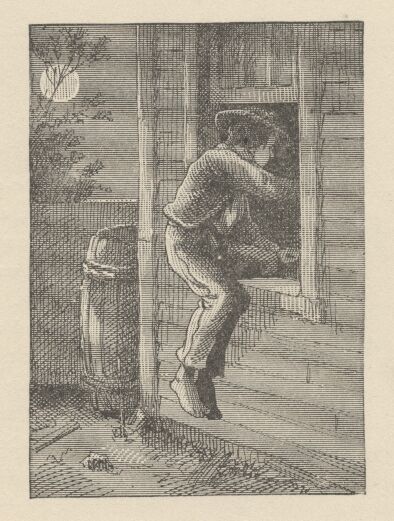
He got home pretty late that night, and when he climbed cautiously in at the window, he uncovered an ambuscade, in the person of his aunt; and when she saw the state his clothes were in her resolution to turn his Saturday holiday into captivity at hard labor became adamantine in its firmness.
He got home pretty late that night. When he cautiously climbed in through the window, he found his aunt waiting in ambush. When she saw the state of his clothes, nothing could shake her resolve. She would turn his Saturday holiday into a day of confinement and hard labor.