Chapter 15
Setting Up the Supply Depots
Mackintosh’s account of the depot-laying journeys undertaken by his parties in the summer of 1915–16 unfortunately is not available. The leader of the parties kept a diary, but he had the book with him when he was lost on the sea-ice in the following winter. The narrative of the journeys has been compiled from the notes kept by Joyce, Richards, and other members of the parties, and I may say here that it is a record of dogged endeavour in the face of great difficulties and serious dangers. It is always easy to be wise after the event, and one may realize now that the use of the dogs, untrained and soft from shipboard inactivity, on the comparatively short journey undertaken immediately after the landing in 1915 was a mistake. The result was the loss of nearly all the dogs before the longer and more important journeys of 1915–16 were undertaken. The men were sledging almost continuously during a period of six months; they suffered from frost-bite, scurvy, snow-blindness, and the utter weariness of overtaxed bodies. But the they placed the depots in the required positions, and if the Weddell Sea party had been able to make the crossing of the Antarctic continent, the stores and fuel would have been waiting for us where we expected to find them.
Unfortunately, Mackintosh’s account of the depot-laying journeys his parties made in the summer of 1915–16 is unavailable. He kept a diary, but he had it with him when he was lost on the sea ice the following winter. The account of the journeys has been compiled from notes kept by Joyce, Richards, and other members of the parties. I may say here that it is a record of determined effort in the face of great difficulties and serious dangers. It is always easy to be wise after the event. We can now see that using the dogs on the relatively short journey immediately after the landing in 1915 was a mistake. They were untrained and out of condition from inactivity aboard the ship. As a result, nearly all the dogs were lost before the longer and more important journeys of 1915–16 began. The men hauled sledges almost continuously for six months. They suffered from frostbite, scurvy, snow blindness, and the utter exhaustion of overworked bodies. But they placed the depots in the required positions. If the Weddell Sea party had been able to cross the Antarctic continent, the stores and fuel would have been waiting for us where we expected to find them.
The position on October 9 was that the nine men at Hut Point had with them the stores required for the depots and for their own maintenance throughout the summer. The remaining dogs were at Cape Evans with Gaze, who had a sore heel and had been replaced temporarily by Stevens in the sledging party. A small quantity of stores had been conveyed already to Safety Camp on the edge of the Barrier beyond Hut Point. Mackintosh intended to form a large depot off Minna Bluff, seventy miles out from Hut Point. This would necessitate several trips with heavy loads. Then he would use the Bluff depot as a base for the journey to Mount Hope, at the foot of the Beardmore Glacier, where the final depot was to be laid.
On October 9, the nine men at Hut Point had the supplies needed for the depots and for their own needs throughout the summer. The remaining dogs were at Cape Evans with Gaze. He had a sore heel, so Stevens had temporarily replaced him in the sledging party. A small amount of supplies had already been taken to Safety Camp, on the edge of the Barrier beyond Hut Point. Mackintosh planned to establish a large depot off Minna Bluff, seventy miles from Hut Point. This would require several trips with heavy loads. He would then use the Bluff depot as a base for the journey to Mount Hope, at the foot of the Beardmore Glacier. The final depot was to be established there.
The party left Hut Point on the morning of October 9, the nine men hauling on one rope and trailing three loaded sledges. They reached Safety Camp in the early afternoon, and, after repacking the sledges with a load of about 2000 lbs., they began the journey over the Barrier. The pulling proved exceedingly heavy, and they camped at the end of half a mile. It was decided next day to separate the sledges, three men to haul each sledge. Mackintosh hoped that better progress could be made in this way. The distance for the day was only four miles, and the next day’s journey was no better. Joyce mentions that he had never done harder pulling, the surface being soft, and the load amounting to 220 lbs. per man. The new arrangement was not a success, owing to differences in hauling capacity and inequalities in the loading of the sledges; and on the morning of the 12th, Mackintosh, after consultation, decided to push forward with Wild and Spencer-Smith, hauling one sledge and a relatively light load, and leave Joyce and the remaining five men to bring two sledges and the rest of the stores at their best pace. This arrangement was maintained on the later journeys. The temperatures were falling below –30° Fahr. at some hours, and, as the men perspired freely while hauling their heavy loads in the sun, they suffered a great deal of discomfort in the damp and freezing clothes at night. Joyce cut down his load on the 13th by depot-ing some rations and spare clothing, and made better progress. He was building snow-cairns as guide-posts for use on the return journey. He mentions passing some large crevasses during succeeding days. Persistent head winds with occasional drift made the conditions unpleasant and caused many frost-bites. When the surface was hard, and the pulling comparatively easy, the men slipped and fell continually, “looking much like classical dancers.”
The party left Hut Point on the morning of October 9. The nine men pulled on one rope, towing three loaded sledges. They reached Safety Camp early that afternoon and repacked the sledges with about 2,000 pounds of supplies. Then they began their journey over the Barrier. The pulling was extremely hard, and they camped after half a mile. The next day, they decided to separate the sledges, with three men pulling each one. Mackintosh hoped this would help them make better progress. They covered only four miles that day, and the next day’s journey was no better. Joyce said he had never pulled so hard. The surface was soft, and the load amounted to 220 pounds per man. The new arrangement failed because the men had different pulling abilities and the sledges were unevenly loaded. On the morning of the 12th, Mackintosh discussed the problem with the others and decided to push ahead with Wild and Spencer-Smith. They would pull one sledge with a relatively light load. Joyce and the remaining five men would bring the other two sledges and the rest of the supplies at their best pace. They kept to this arrangement on their later journeys. Temperatures fell below minus 30 degrees Fahrenheit at certain hours. The men sweated heavily as they pulled their loads in the sun. At night, they suffered great discomfort in their damp, freezing clothes. On the 13th, Joyce reduced his load by storing some rations and spare clothing at a depot, and made better progress. He was building snow cairns as guideposts for the return journey. He mentioned passing some large crevasses in the following days. Persistent headwinds, with occasional drifting snow, made conditions unpleasant and caused many cases of frostbite. When the surface was hard and pulling was comparatively easy, the men kept slipping and falling, “looking much like classical dancers.”
On the 20th a northerly wind made possible the use of a sail, and Joyce’s party made rapid progress. Jack sighted a bamboo pole during the afternoon; and Joyce found that marked a depot he had laid for my own “Farthest South” party in 1908. He dug down in the hope of finding some stores, but the depot had been cleared. The party reached the Bluff depot on the evening of the 21st and found that Mackintosh had been there on the 19th. Mackintosh had left 178 lbs. of provisions, and Joyce left one sledge and 273 lbs. of stores. The most interesting incident of the return journey was the discovery of a note left by Mr. Cherry Garrard for Captain Scott on March 19, 1912, only a few days before the latter perished at his camp farther south. An upturned sledge at this point was found to mark a depot of dog-biscuit and motor-oil, laid by one of Captain Scott’s parties. Joyce reached Safety Camp on the afternoon of the 27th, and, after dumping all spare gear, pushed on to Hut Point in a blizzard. The sledges nearly went over a big drop at the edge of the Barrier, and a few moments later Stevens dropped down a crevasse to the length of his harness.
On the 20th, a northerly wind allowed Joyce’s party to use a sail, and they made rapid progress. That afternoon, Jack spotted a bamboo pole. Joyce found that it marked a depot he had laid for my own “Farthest South” party in 1908. He dug down, hoping to find some supplies, but the depot had been cleared. The party reached the Bluff depot on the evening of the 21st. They found that Mackintosh had been there on the 19th. Mackintosh had left 178 lbs. of provisions, and Joyce left one sledge and 273 lbs. of supplies. The most interesting incident of the return journey was the discovery of a note Mr. Cherry Garrard had left for Captain Scott. It was dated March 19, 1912, only a few days before Scott died at his camp farther south. An overturned sledge at the site marked a depot of dog biscuits and motor oil, laid by one of Captain Scott’s parties. Joyce reached Safety Camp on the afternoon of the 27th. After leaving all spare gear there, he pushed on to Hut Point in a blizzard. The sledges nearly went over a big drop at the edge of the Barrier. A few moments later, Stevens fell into a crevasse as far as his harness allowed.
“Had a tough job getting him up, as we had no alpine rope and had to use harness,” wrote Joyce. “Got over all right and had a very hard pull against wind and snow, my face getting frost-bitten as I had to keep looking up to steer. We arrived at the hut about 7.30 p.m. after a very hard struggle. We found the Captain and his party there. They had been in for three days. Gaze was also there with the dogs. We soon had a good feed and forgot our hard day’s work.”
“We had a tough job getting him up because we had no climbing rope and had to use harness,” wrote Joyce. “We got over all right, but then had a very hard pull against the wind and snow. My face got frostbitten because I had to keep looking up to steer. We reached the hut around 7:30 p.m. after a very hard struggle. We found the Captain and his party there. They had been at the hut for three days. Gaze was also there with the dogs. We soon had a good meal and forgot our hard day’s work.”
Mackintosh decided to make use of the dogs on the second journey to the Bluff depot. He thought that with the aid of the dogs heavier loads might be hauled. This plan involved the dispatch of a party to Cape Evans to get dog-pemmican. Mackintosh himself, with Wild and Spencer-Smith, started south again on October 29. Their sledge overturned on the slope down to the sea-ice, and the rim of their tent-spread was broken. The damage did not appear serious, and the party soon disappeared round Cape Armitage. Joyce remained in charge at Hut Point, with instructions to get dog food from Cape Evans and make a start south as soon as possible. He sent Stevens, Hayward, and Cope to Cape Evans the next day, and busied himself with the repair of sledging-gear. Cope, Hayward, and Gaze arrived back from Cape Evans on November 1, Stevens having stayed at the base. A blizzard delayed the start southward, and the party did not get away until November 5. The men pulled in harness with the four dogs, and, as the surface was soft and the loads on the two sledges were heavy, the advance was slow. The party covered 5 miles 700 yards on the 6th, 4 miles 300 yards on the 7th, and 8 miles 1800 yards on the 9th, with the aid of a light northerly wind. They passed on the 9th a huge bergstrom, with a drop of about 70 feet from the flat surface of the Barrier. Joyce thought that a big crevasse had caved in. “We took some photographs,” wrote Joyce. “It is a really extraordinary fill-in of ice, with cliffs of blue ice about 70 feet high, and heavily crevassed, with overhanging snow-curtains. One could easily walk over the edge coming from the north in thick weather.” Another bergstrom, with crevassed ice around it, was encountered on the 11th. Joyce reached the Bluff depot on the evening of the 14th and found that he could leave 624 lbs. of provisions. Mackintosh had been there several days earlier and had left 188 lbs. of stores.
Mackintosh decided to use the dogs on the second journey to the Bluff depot. He thought the dogs might help haul heavier loads. The plan required a party to go to Cape Evans for dog-pemmican. Mackintosh himself set out south again with Wild and Spencer-Smith on October 29. Their sledge overturned on the slope down to the sea ice, breaking the rim of their tent-spread. The damage did not seem serious, and the party soon disappeared around Cape Armitage. Joyce remained in charge at Hut Point. He was instructed to get dog food from Cape Evans and head south as soon as possible. The next day, he sent Stevens, Hayward, and Cope to Cape Evans. He stayed busy repairing sledging gear. Cope, Hayward, and Gaze returned from Cape Evans on November 1. Stevens had stayed at the base. A blizzard delayed the journey south, and the party did not leave until November 5. The men pulled in harness alongside the four dogs. Progress was slow because the surface was soft and the loads on the two sledges were heavy. The party covered 5 miles 700 yards on the 6th and 4 miles 300 yards on the 7th. With the help of a light northerly wind, they covered 8 miles 1800 yards on the 9th. On the 9th, they passed a huge bergstrom, with a drop of about 70 feet from the Barrier's flat surface. Joyce thought a large crevasse had caved in. “We took some photographs,” wrote Joyce. “It is a truly extraordinary area of ice that has filled in, with cliffs of blue ice about 70 feet high. The ice is heavily crevassed, with overhanging curtains of snow. Coming from the north in thick weather, one could easily walk over the edge.” On the 11th, they encountered another bergstrom, with crevassed ice around it. Joyce reached the Bluff depot on the evening of the 14th and found that he could leave 624 lbs. of provisions. Mackintosh had been there several days earlier and had left 188 lbs. of stores.
Joyce made Hut Point again on November 20 after an adventurous day. The surface was good in the morning and he pushed forward rapidly. About 10.30 a.m. the party encountered heavy pressure-ice with crevasses, and had many narrow escapes. “After lunch we came on four crevasses quite suddenly. Jack fell through. We could not alter course, or else we should have been steering among them, so galloped right across. We were going so fast that the dogs that went through were jerked out. It came on very thick at 2 p.m. Every bit of land was obscured, and it was hard to steer. Decided to make for Hut Point, and arrived at 6.30 p.m., after doing twenty-two miles, a very good performance. I had a bad attack of snow-blindness and had to use cocaine. Hayward also had a bad time. I was laid up and had to keep my eyes bandaged for three days. Hayward, too.” The two men were about again on November 24, and the party started south on its third journey to the Bluff on the 25th. Mackintosh was some distance ahead, but the two parties met on the 28th and had some discussion as to plans. Mackintosh was proceeding to the Bluff depot with the intention of taking a load of stores to the depot placed on lat. 80° S. in the first season’s sledging. Joyce, after depositing his third load at the Bluff, would return to Hut Point for a fourth and last load, and the parties would then join forces for the journey southward to Mount Hope.
Joyce reached Hut Point again on November 20 after an eventful day. The surface was good in the morning, and he made rapid progress. Around 10:30 a.m., the party encountered heavy pressure-ice with crevasses and had many narrow escapes. “After lunch we suddenly came upon four crevasses. Jack fell through. We could not change course, because we would have been steering among the crevasses, so we galloped straight across them. We were going so fast that the dogs that fell through were jerked out. The weather turned very thick at 2 p.m. All the land was hidden, and it was hard to steer. We decided to head for Hut Point and arrived at 6:30 p.m. We had covered twenty-two miles, a very good performance. I had a bad attack of snow-blindness and had to use cocaine. Hayward also had a bad time. I was laid up and had to keep my eyes bandaged for three days. Hayward did too.” The two men were up and about again on November 24. On the 25th, the party set out south on its third journey to the Bluff. Mackintosh was some distance ahead, but the two parties met on the 28th and discussed their plans. Mackintosh was going to the Bluff depot. He intended to take a load of stores to the depot placed at latitude 80° S. during the first season’s sledging. After leaving his third load at the Bluff, Joyce would return to Hut Point for a fourth and final load. The parties would then join forces for the journey south to Mount Hope.
Joyce left 729 lbs. at the Bluff depot on December 2, reached Hut Point on December 7, and, after allowing dogs and men a good rest, he moved southward again on December 13. This proved to be the worst journey the party had made. The men had much trouble with crevasses, and they were held up by blizzards on December 16, 18, 19, 22, 23, 26, and 27. They spent Christmas Day struggling through soft snow against an icy wind and drift. The party reached the Bluff depot on December 28, and found that Mackintosh, who had been much delayed by the bad weather, had gone south two days earlier on his way to the 80° S. depot. He had not made much progress and his camp was in sight. He had left instructions for Joyce to follow him. The Bluff depot was now well stocked. Between 2800 and 2900 lbs. of provisions had been dragged to the depot for the use of parties working to the south of this point. This quantity was in addition to stores placed there earlier in the year.
Joyce left 729 lbs. at the Bluff depot on December 2 and reached Hut Point on December 7. After giving the dogs and men a good rest, he headed south again on December 13. This proved to be the party’s worst journey yet. The men had a great deal of trouble with crevasses. Blizzards held them up on December 16, 18, 19, 22, 23, 26, and 27. They spent Christmas Day struggling through soft snow against an icy wind and drifting snow. The party reached the Bluff depot on December 28. They found that Mackintosh had left two days earlier, heading south toward the 80° S. depot. Bad weather had delayed him considerably. He had not made much progress, and his camp was in sight. He had left instructions for Joyce to follow him. The Bluff depot was now well stocked. Between 2,800 and 2,900 lbs. of provisions had been dragged there for parties working farther south. These provisions were in addition to the stores placed there earlier in the year.
Joyce left the Bluff depot on December 29, and the parties were together two days later. Mackintosh handed Joyce instructions to proceed with his party to lat. 81° S and place a depot there. He was then to send three men back to Hut Point and proceed to lat. 82° S., where he would lay another depot. Then if provisions permitted he would push south as far as lat. 83°. Mackintosh himself was reinforcing the depot at lat. 80° S. and would then carry on southward. Apparently his instructions to Joyce were intended to guard against the contingency of the parties failing to meet. The dogs were hauling well, and though their number was small they were of very great assistance. The parties were now ninety days out from Cape Evans, and “all hands were feeling fit.”
Joyce left the Bluff depot on December 29, and the parties met two days later. Mackintosh instructed Joyce to take his party to latitude 81° S and establish a depot there. Joyce was then to send three men back to Hut Point and continue to latitude 82° S. There he would establish another depot. Then, if supplies allowed, he would push south as far as latitude 83° S. Mackintosh himself was adding supplies to the depot at latitude 80° S and would then continue south. Apparently, his instructions to Joyce were meant to prepare for the possibility that the parties might not meet. The dogs were hauling well. Though there were few of them, they were a great help. The parties had now been away from Cape Evans for ninety days, and “all hands were feeling fit.”
The next incident of importance was the appearance of a defect in one of the two Primus lamps used by Joyce’s party. The lamps had all seen service with one or other of Captain Scott’s parties, and they had not been in first-class condition when the sledging commenced. The threatened failure of a lamp was a matter of grave moment, since a party could not travel without the means of melting snow and preparing hot food. If Joyce took a faulty lamp past the 80° S. depot, his whole party might have to turn back at lat. 81° S., and this would imperil the success of the season’s sledging. He decided, therefore, to send three men back from the 80° S. depot, which he reached on January 6, 1916. Cope, Gaze, and Jack were the men to return. They took the defective Primus and a light load, and by dint of hard travelling, without the aid of dogs, they reached Cape Evans on January 16.
The next important incident was a defect in one of the two Primus lamps used by Joyce’s party. All the lamps had been used by one or another of Captain Scott’s parties. None had been in first-class condition when the sledging began. The possible failure of a lamp was very serious. A party could not travel without a way to melt snow and prepare hot food. If Joyce took a faulty lamp beyond the 80° S. depot, his whole party might have to turn back at latitude 81° S. This would put the success of the season’s sledging at risk. He therefore decided to send three men back from the 80° S. depot, which he reached on January 6, 1916. The men chosen to return were Cope, Gaze, and Jack. They took the defective Primus and a light load. Traveling hard without the help of dogs, they reached Cape Evans on January 16.
Joyce, Richards, and Hayward went forward with a load of 1280 lbs., comprising twelve weeks’ sledging rations, dog food and depot supplies, in addition to the sledging-gear. They built cairns at short intervals as guides to the depots. Joyce was feeding the dogs well and giving them a hot hoosh every third night. “It is worth it for the wonderful amount of work they are doing. If we can keep them to 82° S. I can honestly say it is through their work we have got through.” On January 8 Mackintosh joined Joyce, and from that point the parties, six men strong, went forward together. They marched in thick weather during January 10, 11, and 12, keeping the course by means of cairns, with a scrap of black cloth on top of each one. It was possible, by keeping the cairns in line behind the sledges and building new ones as old ones disappeared, to march on an approximately straight line. On the evening of the 12th they reached lat. 81° S., and built a large cairn for the depot. The stores left here were three weeks’ rations for the ordinary sledging unit of three men. This quantity would provide five days’ rations for twelve men, half for the use of the overland party, and half for the depot party on its return journey.
Joyce, Richards, and Hayward went ahead with a load of 1,280 pounds. It included twelve weeks’ sledging rations, dog food, depot supplies, and sledging gear. They built cairns at short intervals to guide them to the depots. Joyce fed the dogs well and gave them a hot hoosh every third night. “It is worth it for the wonderful amount of work they are doing. If we can keep them going to 82° S., I can honestly say we have made it through because of their work.” On January 8, Mackintosh joined Joyce. From then on, the two parties, six men in all, went forward together. They marched through thick weather on January 10, 11, and 12. They kept to their course using the cairns, each topped with a scrap of black cloth. They kept the cairns in line behind the sledges and built new ones as the old ones disappeared. In this way, they could march in an approximately straight line. On the evening of the 12th, they reached 81° S. and built a large cairn for the depot. They left three weeks’ rations there for a standard sledging unit of three men. That amount would provide five days’ rations for twelve men. Half was for the overland party and half for the depot party on its return journey.
The party moved southwards again on January 13 in bad weather.
The group moved south again on January 13 in bad weather.
“After a little consultation we decided to get under way,” wrote Joyce. “Although the weather is thick, and snow is falling, it is worth while to make the effort. A little patience with the direction and the cairns, even if one has to put them up 200 yds. apart, enables us to advance, and it seems that this weather will never break. We have cut up an old pair of trousers belonging to Richards to place on the sides of the cairns, so as to make them more prominent. It was really surprising to find how we got on in spite of the snow and the pie-crust surface. We did 5 miles 75 yds. before lunch. The dogs are doing splendidly. I really don’t know how we should manage if it were not for them.... The distance for the day was 10 miles 720 yds., a splendid performance considering surface and weather.”
“After a short discussion, we decided to set off,” wrote Joyce. “Although visibility is poor and snow is falling, it is worth trying. With a little patience in following our direction and using the cairns, we can make progress. That is true even if we have to build the cairns 200 yards apart. And it seems this weather will never clear. We have cut up an old pair of Richards’s trousers and put pieces on the sides of the cairns. This makes them easier to see. It was surprising how well we got on despite the snow and the pie-crust surface. We covered 5 miles and 75 yards before lunch. The dogs are doing splendidly. I really don’t know how we would manage without them.... We covered 10 miles and 720 yards that day. It was a splendid performance, considering the surface and weather.”
The weather cleared on the 14th; and the men were able to get bearings from the mountains to the westward. They advanced fairly rapidly during succeeding days, the daily distances being from ten to twelve miles, and reached lat. 82° S. on the morning of January 18. The depot here, like the depot at 81° S., contained five days’ provisions for twelve men. Mackintosh was having trouble with the Primus lamp in his tent, and this made it inadvisable to divide the party again. It was decided, therefore, that all should proceed, and that the next and last depot should be placed on the base of Mount Hope, at the foot of the Beardmore Glacier, in lat. 83° 30´ S. The party proceeded at once and advanced five miles beyond the depot before camping on the evening of the 18th.
The weather cleared on the 14th, and the men were able to take bearings from the mountains to the west. They moved fairly quickly over the following days, covering ten to twelve miles a day. They reached latitude 82° S. on the morning of January 18. Like the depot at 81° S., the depot there held five days’ provisions for twelve men. Mackintosh was having trouble with the Primus lamp in his tent. Because of this, it was unwise to divide the party again. So they decided that everyone would continue together. The next and last depot would be placed at the base of Mount Hope, at the foot of the Beardmore Glacier, at latitude 83° 30´ S. The party set out at once and traveled five miles beyond the depot before camping on the evening of the 18th.
The sledge loads were now comparatively light, and on the 19th the party covered 13 miles 700 yds. A new trouble was developing, for Spencer-Smith was suffering from swollen and painful legs, and was unable to do much pulling. Joyce wrote on the 21st that Smith was worse, and that Mackintosh was showing signs of exhaustion. A mountain that he believed to be Mount Hope could be seen right ahead, over thirty miles away. Spencer-Smith, who had struggled forward gamely and made no unnecessary complaints, started with the party the next morning and kept going until shortly before noon. Then he reported his inability to proceed, and Mackintosh called a halt. Spencer-Smith suggested that he should be left with provisions and a tent while the other members of the party pushed on to Mount Hope, and pluckily assured Mackintosh that the rest would put him right and that he would be ready to march when they returned. The party agreed, after a brief consultation, to adopt this plan. Mackintosh felt that the depot must be laid, and that delay would be dangerous. Spencer-Smith was left with a tent, one sledge, and provisions, and told to expect the returning party in about a week. The tent was made as comfortable as possible inside, and food was placed within the sick man’s reach. Spencer-Smith bade his companions a cheery good-bye after lunch, and the party was six or seven miles away before evening. Five men had to squeeze into one tent that night, but with a minus temperature they did not object to being crowded.
The sledge loads were now relatively light, and on the 19th the party covered 13 miles and 700 yards. But a new problem was developing. Spencer-Smith’s legs were swollen and painful, and he could not do much pulling. On the 21st, Joyce wrote that Smith was worse and that Mackintosh was showing signs of exhaustion. Straight ahead, more than thirty miles away, Joyce could see a mountain he believed was Mount Hope. Spencer-Smith had struggled bravely onward without unnecessary complaints. He set out with the party the next morning and kept going until shortly before noon. Then he said he could go no farther, and Mackintosh called a halt. Spencer-Smith suggested that he be left with provisions and a tent while the others pushed on to Mount Hope. He bravely assured Mackintosh that the rest would restore him and that he would be ready to march when they returned. After a brief discussion, the party agreed to the plan. Mackintosh felt that the supply depot had to be laid and that delay would be dangerous. Spencer-Smith was left with a tent, one sledge, and provisions. He was told to expect the party back in about a week. The others made the tent as comfortable as possible and placed food within the sick man’s reach. After lunch, Spencer-Smith said a cheerful goodbye to his companions. By evening, the party was six or seven miles away. Five men had to squeeze into one tent that night, but with the temperature below zero, they did not mind the crowding.
On January 23 a thick fog obscured all landmarks, and as bearings of the mountains were now necessary the party had to camp at 11 a.m., after travelling only four miles. The thick weather continued over the 24th, and the men did not move again until the morning of the 25th. They did 17¾ miles that day, and camped at 6 p.m. on the edge of “the biggest ice-pressure” Joyce had ever seen. They were steering in towards the mountains and were encountering the tremendous congestion created by the flow of the Beardmore Glacier into the barrier ice.
On January 23, thick fog hid all landmarks. The party now needed to take bearings from the mountains, so they had to camp at 11 a.m. They had traveled only four miles. The poor visibility continued through January 24, and the men did not move again until the morning of January 25. They traveled 17¾ miles that day. At 6 p.m., they camped on the edge of “the biggest ice-pressure” Joyce had ever seen. They were heading toward the mountains and encountering the tremendous jumble of ice created where the Beardmore Glacier flowed into the barrier ice.
“We decided to keep the camp up,” ran Joyce’s account of the work done on January 26. “Skipper, Richards, and myself roped ourselves together, I taking the lead, to try and find a course through this pressure. We came across very wide crevasses, went down several, came on top of a very high ridge, and such a scene! Imagine thousands of tons of ice churned up to a depth of about 300 ft. We took a couple of photographs, then carried on to the east. At last we found a passage through, and carried on through smaller crevasses to Mount Hope, or we hoped it was the mountain by that name. We can see a great glacier ahead which we take for the Beardmore, which this mountain is on, but the position on the chart seems wrong. [It was not.—E.H.S.] We nearly arrived at the ice-foot when Richards saw something to the right, which turned out to be two of Captain Scott’s sledges, upright, but three-quarters buried in snow. Then we knew for certain this was the place we had struggled to get to. So we climbed the glacier on the slope and went up about one and a quarter miles, and saw the great Beardmore Glacier stretching to the south. It is about twenty-five miles wide—a most wonderful sight. Then we returned to our camp, which we found to be six miles away. We left at 8 a.m. and arrived back at 3 p.m., a good morning’s work. We then had lunch. About 4 p.m. we got under way and proceeded with the two sledges and camped about 7 o’clock. Wild, Hayward and myself then took the depot up the Glacier, a fortnight’s provisions. We left it lashed to a broken sledge and put up a large flag. I took two photographs of it. We did not arrive back until 10.30 p.m. It was rather a heavy pull up. I was very pleased to see our work completed at last.... Turned in 12 o’clock. The distance done during day 22 miles.”
“We decided to keep the camp up,” wrote Joyce in his account of the work done on January 26. “Skipper, Richards, and I roped ourselves together, with me in the lead. We set out to find a route through the pressure ice. We came across very wide crevasses and went down into several of them. Then we reached the top of a very high ridge, and what a scene! Imagine thousands of tons of ice churned up to a depth of about 300 feet. We took a couple of photographs, then continued east. At last we found a passage through. We carried on through smaller crevasses to Mount Hope, or what we hoped was the mountain by that name. We could see a great glacier ahead, which we took to be the Beardmore. Mount Hope is on the Beardmore, but its position on the chart seemed wrong. [It was not. E.H.S.] “We had almost reached the foot of the ice when Richards saw something to the right. It turned out to be two of Captain Scott’s sledges, standing upright but three-quarters buried in snow. Then we knew for certain that this was the place we had struggled to reach. So we climbed the sloping glacier for about one and a quarter miles. We saw the great Beardmore Glacier stretching south. It is about twenty-five miles wide, a most wonderful sight. Then we returned to our camp, which turned out to be six miles away. We had left at 8 a.m. and got back at 3 p.m., a good morning’s work. Then we had lunch. “About 4 p.m. we set out with the two sledges and camped around 7 o’clock. Wild, Hayward, and I then took the depot, a fortnight’s provisions, up the glacier. We left it tied to a broken sledge and put up a large flag. I took two photographs of it. We did not get back until 10:30 p.m. It was quite a hard pull up the glacier. I was very pleased to see our work completed at last.... I went to bed at 12 o’clock. We covered 22 miles during the day.”
The party remained in camp until 3.30 p.m. on the 27th, owing to a blizzard with heavy snow. Then they made a start in clearer weather and got through the crevassed area before camping at 7 p.m. Joyce was suffering from snow-blindness. They were now homeward bound, with 365 miles to go. They covered 16½ miles on the 28th, with Joyce absolutely blind and hanging to the harness for guidance, “but still pulling his whack.” They reached Spencer-Smith’s camp the next afternoon and found him in his sleeping-bag, quite unable to walk. Joyce’s diary of this date contains a rather gloomy reference to the outlook, since he guessed that Mackintosh also would be unable to make the homeward march. “The dogs are still keeping fit,” he added. “If they will only last to 80° S. we shall then have enough food to take them in, and then if the ship is in I guarantee they will live in comfort the remainder of their lives.”
The party stayed in camp until 3:30 p.m. on the 27th because a blizzard brought heavy snow. Then the weather cleared, and they set out. They crossed the area full of crevasses before camping at 7 p.m. Joyce was suffering from snow blindness. They were now on their way home, with 365 miles to go. They covered 16½ miles on the 28th. Joyce was completely blind and held on to the harness to guide himself, “but still pulling his share.” They reached Spencer-Smith’s camp the next afternoon. They found him in his sleeping bag, completely unable to walk. Joyce’s diary entry for that day took a rather gloomy view of their prospects. He guessed that Mackintosh, too, would be unable to make the journey home. “The dogs are still keeping fit,” he added. “If they can last as far as 80° S., we will have enough food to get them home. And then, if the ship is there, I guarantee they will live in comfort for the rest of their lives.”
No march could be made on the 30th, since a blizzard was raging. The party made 8 miles on the 31st, with Spencer-Smith on one of the sledges in his sleeping-bag. The sufferer was quite helpless, and had to be lifted and carried about, but his courage did not fail him. His words were cheerful even when his physical suffering and weakness were most pronounced. The distance for February 1 was 13 miles. The next morning the party abandoned one sledge in order to lighten the load, and proceeded with a single sledge, Spencer-Smith lying on top of the stores and gear. The distance for the day was 15½ miles. They picked up the 82° S. depot on February 3, and took one week’s provisions, leaving two weeks’ rations for the overland party. Joyce, Wild, Richards, and Hayward were feeling fit. Mackintosh was lame and weak; Spencer-Smith’s condition was alarming. The party was being helped by strong southerly winds, and the distances covered were decidedly good. The sledge-meter recorded 15 miles 1700 yds. on February 4, 17 miles 1400 yds. on the 5th, 18 miles 1200 yds. on the 6th, and 13 miles 1000 yds. on the 7th, when the 81° S. depot was picked up at 10.30 a.m., and one week’s stores taken, two weeks’ rations being left.
The party could not march on the 30th because a blizzard was raging. They covered 8 miles on the 31st, with Spencer-Smith in his sleeping bag on one of the sledges. He was completely helpless and had to be lifted and carried, but his courage did not fail him. He spoke cheerfully even when his pain and weakness were at their worst. On February 1, the party covered 13 miles. The next morning, they left one sledge behind to lighten the load. They continued with a single sledge, with Spencer-Smith lying on top of the supplies and gear. They covered 15½ miles that day. On February 3, they reached the depot at 82° S. They took one week’s provisions and left two weeks’ rations for the overland party. Joyce, Wild, Richards, and Hayward felt fit. Mackintosh was lame and weak, and Spencer-Smith’s condition was alarming. Strong southerly winds helped the party, and they covered very good distances. The sledge-meter recorded 15 miles 1,700 yards on February 4 and 17 miles 1,400 yards on the 5th. It recorded 18 miles 1,200 yards on the 6th and 13 miles 1,000 yards on the 7th. On the 7th, they reached the depot at 81° S. at 10:30 a.m. They took one week’s supplies and left two weeks’ rations.
The march to the next depot, at 80° S., was uneventful. The party made good marches in spite of bad surfaces and thick weather, and reached the depot late in the afternoon of February 12. The supply of stores at this depot was ample, and the men took a fortnight’s rations (calculated on a three-man basis), leaving nearly four weeks’ rations. Spencer-Smith seemed a little better, and all hands were cheered by the rapid advance. February 14, 15, and 16 were bad days, the soft surface allowing the men to sink to their knees at times. The dogs had a rough time, and the daily distances fell to about eight miles. Mackintosh’s weakness was increasing. Then on the 18th, when the party was within twelve miles of the Bluff depot, a furious blizzard made travelling impossible. This blizzard raged for five days. Rations were reduced on the second day, and the party went on half-rations the third day.
The march to the next depot, at 80° S., was uneventful. Despite poor surfaces and thick weather, the party made good progress. They reached the depot late in the afternoon of February 12. Supplies there were ample. The men took two weeks’ rations, calculated for three men, leaving nearly four weeks’ rations behind. Spencer-Smith seemed a little better, and the rapid progress lifted everyone’s spirits. February 14, 15, and 16 were bad days. The surface was soft, and the men sometimes sank to their knees. The dogs had a hard time, and the party’s daily distance fell to about eight miles. Mackintosh was growing weaker. Then, on the 18th, a fierce blizzard made travel impossible when the party was within twelve miles of the Bluff depot. The blizzard raged for five days. The party reduced rations on the second day and went on half-rations on the third day.
“Still blizzarding,” wrote Joyce on the 20th. “Things are serious, what with our patient and provisions running short. Dog provisions are nearly out, and we have to halve their rations. We are now on one cup of hoosh among the three of us, with one biscuit and six lumps of sugar. The most serious of calamities is that our oil is running out. We have plenty of tea, but no fuel to cook it with.” The men in Mackintosh’s tent were in no better plight. Mackintosh himself was in a bad way. He was uncertain about his ability to resume the march, but was determined to try.
“Still blizzarding,” Joyce wrote on the 20th. “Things are serious, with our patient and our supplies running short. Dog food is nearly gone, and we have to halve their rations. The three of us now share one cup of hoosh, one biscuit, and six lumps of sugar. Worst of all, our oil is running out. We have plenty of tea, but no fuel to make it with.” The men in Mackintosh’s tent were no better off. Mackintosh himself was in bad shape. He was unsure whether he could continue the march, but he was determined to try.
“Still blizzarding,” wrote Joyce again on the 21st. “We are lying in pools of water made by our bodies through staying in the same place for such a long time. I don’t know what we shall do if this does not ease. It has been blowing continuously without a lull. The food for to-day was one cup of pemmican amongst three of us, one biscuit each, and two cups of tea among the three.” The kerosene was exhausted, but Richards improvised a lamp by pouring some spirit (intended for priming the oil-lamp) into a mug, lighting it, and holding another mug over it. It took half an hour to heat a mug of melted snow in this way. “Same old thing, no ceasing of this blizzard,” was Joyce’s note twenty-four hours later. “Hardly any food left except tea and sugar. Richards, Hayward, and I, after a long talk, decided to get under way to-morrow in any case, or else we shall be sharing the fate of Captain Scott and his party. The other tent seems to be very quiet, but now and again we hear a burst of song from Wild, so they are in the land of the living. We gave the dogs the last of their food to-night, so we shall have to push, as a great deal depends on them.” Further quotations from Joyce’s diary tell their own story.
“Still blizzarding,” Joyce wrote again on the 21st. “We are lying in pools of water made by our bodies after staying in the same place so long. I don’t know what we shall do if the blizzard does not ease. The wind has been blowing continuously without a lull. Today’s food was one cup of pemmican shared among the three of us, one biscuit each, and two cups of tea shared among the three.” The kerosene had run out. But Richards made a makeshift lamp by pouring some spirit into a mug and lighting it. The spirit had been intended for priming the oil lamp. He held another mug over the flame. It took half an hour to heat a mug of melted snow this way. “Same old thing, no end to this blizzard,” Joyce wrote twenty-four hours later. “Hardly any food left except tea and sugar. After a long talk, Richards, Hayward, and I decided to set out tomorrow no matter what. Otherwise, we shall share the fate of Captain Scott and his party. The other tent seems very quiet, but now and then we hear Wild burst into song. So they are still alive. We gave the dogs the last of their food tonight, so we shall have to press on, as a great deal depends on them.” Further passages from Joyce’s diary tell their own story.
“February 23, Wednesday.—About 11 o’clock saw a break in the clouds and the sun showing. Decided to have the meal we kept for getting under way. Sang out to the Skipper’s party that we should shift as soon as we had a meal. I asked Wild, and found they had a bag of oatmeal, some Bovril cubes, one bag of chocolate, and eighteen biscuits, so they are much better off than we are. After we had our meal we started to dig out our sledge, which we found right under. It took us two hours, and one would hardly credit how weak we were. Two digs of the shovel and we were out of breath. This was caused through our lying up on practically no food. After getting sledge out we took it around to the Skipper’s tent on account of the heavy sastrugi, which was very high. Got under way about 2.20. Had to stop very often on account of sail, etc. About 3.20 the Skipper, who had tied himself to the rear of the sledge, found it impossible to proceed. So after a consultation with Wild and party, decided to pitch their tent, leaving Wild to look after the Skipper and Spencer-Smith, and make the best of our way to the depot, which is anything up to twelve miles away. So we made them comfortable and left them about 3.40. I told Wild I should leave as much as possible and get back 26th or 27th, weather permitting, but just as we left them it came on to snow pretty hard, sun going in, and we found even with the four dogs we could not make more than one-half to three-quarters of a mile an hour. The surface is so bad that sometimes you go in up to your waist; still in spite of all this we carried on until 6.35. Camped in a howling blizzard. I found my left foot badly frost-bitten. Now after this march we came into our banquet—one cup of tea and half a biscuit. Turned in at 9 o’clock. Situation does not look very cheerful. This is really the worst surface I have ever come across in all my journeys here.”
“February 23, Wednesday. About 11 o’clock, we saw a break in the clouds and the sun appeared. We decided to eat the meal we had saved for when we set off. I called out to the Skipper’s party that we would move as soon as we had eaten. I asked Wild about their supplies. They had a bag of oatmeal, some Bovril cubes, one bag of chocolate, and eighteen biscuits. So they were much better off than we were. After our meal, we started to dig out our sledge, which we found completely buried. It took us two hours, and you could hardly believe how weak we were. After two digs with the shovel, we were out of breath. We were weak because we had been lying up with practically no food. Once we had the sledge out, we took it around to the Skipper’s tent because the sastrugi, or ridges of hard snow, were so high. We set off about 2.20. We had to stop often because of the sail and other things. About 3.20, the Skipper, who had tied himself to the back of the sledge, found he could go no farther. After talking with Wild and his party, we decided to pitch their tent. We would leave Wild to look after the Skipper and Spencer-Smith, while we made our best way to the depot, which was up to twelve miles away. We made them comfortable and left them about 3.40. I told Wild I would leave as much as possible and get back on the 26th or 27th, weather permitting. But just as we left them, the sun disappeared and it began to snow hard. We found that even with four dogs, we could not make more than half to three-quarters of a mile an hour. The surface was so bad that sometimes you sank in up to your waist. Still, despite all this, we carried on until 6.35. We camped in a howling blizzard. I found that my left foot was badly frostbitten. Now, after this march, we came to our banquet: one cup of tea and half a biscuit. We turned in at 9 o’clock. The situation does not look very cheerful. This is really the worst surface I have ever come across in all my journeys here.”
Mackintosh had stayed on his feet as long as was humanly possible. The records of the outward journey show clearly that he was really unfit to continue beyond the 82° S. depot, and other members of the party would have liked him to have stayed with Spencer-Smith at lat. 83° S. But the responsibility for the work to be done was primarily his, and he would not give in. He had been suffering for several weeks from what he cheerfully called “a sprained leg,” owing to scurvy. He marched for half an hour on the 23rd before breaking down, but had to be supported partly by Richards. Spencer-Smith was sinking. Wild, who stayed in charge of the two invalids, was in fairly good condition. Joyce, Richards, and Hayward, who had undertaken the relief journey, were all showing symptoms of scurvy, though in varying degrees. Their legs were weak, their gums swollen. The decision that the invalids, with Wild, should stay in camp from February 24, while Joyce’s party pushed forward to Bluff depot, was justified fully by the circumstances. Joyce, Richards, and Hayward had difficulty in reaching the depot with a nearly empty sledge. An attempt to make their journey with two helpless men might have involved the loss of the whole party.
Mackintosh had stayed on his feet as long as humanly possible. The records of the outward journey clearly show that he was really unfit to continue beyond the 82° S. depot. Other members of the party would have preferred him to stay with Spencer-Smith at latitude 83° S. But Mackintosh bore primary responsibility for the work, and he would not give in. For several weeks he had suffered from what he cheerfully called “a sprained leg,” caused by scurvy. On the 23rd, he marched for half an hour before breaking down. Richards had to help support him. Spencer-Smith was growing weaker. Wild, who stayed in charge of the two sick men, was in fairly good condition. Joyce, Richards, and Hayward had undertaken the relief journey. All three showed symptoms of scurvy, though to varying degrees. Their legs were weak, and their gums were swollen. In these circumstances, the decision for the sick men to stay in camp with Wild from February 24 was fully justified. Meanwhile, Joyce’s party would push on to Bluff depot. Joyce, Richards, and Hayward had difficulty reaching the depot with a nearly empty sledge. If they had tried to make the journey with two helpless men, the whole party might have been lost.
“February 24, Thursday.—Up at 4:30; had one cup of tea, half biscuit; under way after 7. Weather, snowing and blowing like yesterday. Richards, laying the cairns had great trouble in getting the compass within 10° on account of wind. During the forenoon had to stop every quarter of an hour on account of our breath. Every time the sledge struck a drift she stuck in (although only 200 lbs.), and in spite of three men and four dogs we could only shift her with the 1—2—3 haul. I wonder if this weather will ever clear up. Camped in an exhausted condition about 12.10. Lunch, half cup of weak tea and quarter biscuit, which took over half an hour to make. Richards and Hayward went out of tent to prepare for getting under way, but the force of wind and snow drove them back. The force of wind is about seventy to eighty miles per hour. We decided to get the sleeping-bags in, which took some considerable time. The worst of camping is the poor dogs and our weak condition, which means we have to get out of our wet sleeping-bags and have another half cup of tea without working for it. With scrapings from dog-tank it is a very scanty meal. This is the second day the dogs have been without food, and if we cannot soon pick up depot and save the dogs it will be almost impossible to drag our two invalids back the one hundred miles which we have to go. The wind carried on with unabating fury until 7 o’clock, and then came a lull. We at once turned out, but found it snowing so thickly that it was impossible to proceed on account of our weakness. No chance must we miss. Turned in again. Wind sprang up again with heavy drift 8.30. In spite of everything my tent-mates are very cheerful and look on the bright side of everything. After a talk we decided to wait and turned in. It is really wonderful what dreams we have, especially of food. Trusting in Providence for fine weather to-morrow.
“February 24, Thursday. We were up at 4:30 and had one cup of tea and half a biscuit. We set out after 7. It was snowing and blowing, just like yesterday. Richards, who was placing the cairns, had great trouble getting the compass reading within 10° because of the wind. During the morning, we had to stop every fifteen minutes to catch our breath. Whenever the sledge hit a snowdrift, it got stuck, although it weighed only 200 lbs. Even with three men and four dogs, we could move it only by pulling together on a count of three. I wonder if this weather will ever clear up. We camped at about 12:10, exhausted. For lunch we had half a cup of weak tea and a quarter of a biscuit. Preparing it took over half an hour. Richards and Hayward went out of the tent to prepare to set off, but the wind and snow drove them back. The wind was blowing at about seventy to eighty miles per hour. We decided to bring in the sleeping bags, which took quite a while. The worst part of camping is the plight of the poor dogs and our own weakness. Because we are so weak, we have to get out of our wet sleeping bags and have another half cup of tea without working for it. With scrapings from the dog tank, it is a very scanty meal. The dogs have now gone two days without food. If we cannot soon find the depot and save them, it will be almost impossible to drag our two invalids the hundred miles back. The wind raged just as fiercely until 7 o’clock, then it eased. We went out at once, but the snow was falling so thickly that we were too weak to go on. We must not miss any chance. We went back to bed. At 8:30 the wind rose again, carrying heavy clouds of drifting snow. In spite of everything, my tent-mates are very cheerful and look on the bright side of everything. After talking it over, we decided to wait and went to bed. The dreams we have are really wonderful, especially the dreams of food. I trust Providence will bring fine weather tomorrow.”
“February 25, Friday.—Turned out 4.45. Richards prepared our usual banquet, half cup of tea, quarter biscuit, which we relished. Under way at 7, carried on, halting every ten minutes or quarter of an hour. Weather, snowing and blowing same as yesterday. We are in a very weak state, but we cannot give in. We often talk about poor Captain Scott and the blizzard that finished him and party. If we had stayed in our tent another day I don’t think we should have got under way at all, and we would have shared the same fate. But if the worst comes we have made up our minds to carry on and die in harness. If any one were to see us on trek they would be surprised, three men staggering on with four dogs, very weak; practically empty sledge with fair wind and just crawling along; our clothes are all worn out, finneskoe and sleeping bags torn. Tent is our worst point, all torn in front, and we are afraid to camp on account of it, as it is too cold to mend it. We camped for our grand lunch at noon. After five hours’ struggling I think we did about three miles. After lunch sat in our tent talking over the situation. Decided to get under way again as soon as there is any clearance. Snowing and blowing, force about fifty or sixty miles an hour.
“February 25, Friday. Got up at 4:45. Richards prepared our usual banquet: half a cup of tea and a quarter of a biscuit. We enjoyed it. We set off at 7 and kept going, stopping every ten or fifteen minutes. The weather was the same as yesterday, with snow and wind. We are very weak, but we cannot give in. We often talk about poor Captain Scott and the blizzard that killed him and his party. If we had stayed in our tent another day, I don’t think we would have set off at all. We would have shared the same fate. But if the worst comes, we have made up our minds to carry on and die working. Anyone who saw us traveling would be surprised. Three very weak men are staggering along with four dogs. The sledge is practically empty, and the wind is behind us, yet we are just crawling along. Our clothes are all worn out, and our finneskoe and sleeping bags are torn. The tent is our worst problem. It is all torn at the front, and we are afraid to camp because of it. It is too cold to mend the tent. We camped for our grand lunch at noon. After five hours of struggling, I think we had traveled about three miles. After lunch, we sat in our tent talking over the situation. We decided to set off again as soon as the weather clears at all. Snow is falling and the wind is blowing at about fifty or sixty miles an hour.
“February 26, Saturday.—Richards went out 1.10 a.m. and found it clearing a bit, so we got under way as soon as possible, which was 2.10 a.m. About 2.35 Richards sighted depot, which seemed to be right on top of us. I suppose we camped no more than three-quarters of a mile from it. The dogs sighted it, which seemed to electrify them. They had new life and started to run, but we were so weak that we could not go more than 200 yds. and then spell. I think another day would have seen us off. Arrived at depot 3.25; found it in a dilapidated condition, cases all about the place. I don’t suppose there has ever been a weaker party arrive at any depot, either north or south. After a hard struggle got our tent up and made camp. Then gave the dogs a good feed of pemmican. If ever dogs saved the lives of any one they have saved ours. Let us hope they will continue in good health, so that we can get out to our comrades. I started on our cooking. Not one of us had any appetite, although we were in the land of plenty, as we call this depot; plenty of biscuit, etc., but we could not eat. I think it is the reaction, not only in arriving here, but also finding no news of the ship, which was arranged before we left. We all think there has been a calamity there. Let us hope for the best. We decided to have rolled-oats and milk for a start, which went down very well, and then a cup of tea. How cheery the Primus sounds. It seems like coming out of a thick London fog into a drawing-room. After a consultation we decided to have a meal of pemmican in four hours, and so on, until our weakness was gone. Later.—Still the same weather. We shall get under way and make a forced march back as soon as possible. I think we shall get stronger travelling and feeding well. Later.—Weather will not permit us to travel yet. Mended our torn tent with food-bags. This took four hours. Feeding the dogs every four hours, and Richards and Hayward built up depot. It is really surprising to find it takes two men to lift a 50-lb. case; it only shows our weakness. Weather still the same; force of wind at times about seventy to ninety miles an hour; really surprising how this can keep on so long.
“February 26, Saturday. Richards went out at 1:10 a.m. and found the weather clearing a little. So we set out as soon as possible, at 2:10 a.m. Around 2:35, Richards spotted the depot, which seemed to be right on top of us. I suppose we had camped no more than three-quarters of a mile from it. When the dogs saw the depot, they seemed electrified. They had new life and started to run. But we were so weak that we could not go more than 200 yards without stopping to rest. I think another day would have finished us. We reached the depot at 3:25 and found it in poor condition, with cases scattered everywhere. I don’t suppose a weaker party has ever reached a depot, either north or south. After a hard struggle, we put up our tent and made camp. Then we gave the dogs a good feed of pemmican. If dogs have ever saved anyone’s life, they have saved ours. Let us hope they stay healthy, so that we can get out to our comrades. I started cooking. None of us had any appetite, although we were in what we call the land of plenty. The depot had plenty of biscuits and other food, but we could not eat. I think it was the reaction to reaching the depot and finding no news of the ship. News had been arranged for before we left. We all think there has been a disaster there. Let us hope for the best. We decided to start with rolled oats and milk, which went down very well, followed by a cup of tea. How cheerful the Primus sounds. It feels like coming out of a thick London fog into a drawing room. After talking it over, we decided to eat pemmican in four hours, and keep eating at four-hour intervals until we were no longer weak. Later. The weather is still the same. We shall set out and make a forced march back as soon as possible. I think we shall grow stronger as we travel and eat well. Later. The weather still won’t let us travel. We mended our torn tent with food bags. This took four hours. We are feeding the dogs every four hours, and Richards and Hayward rebuilt the depot. It is really surprising that it takes two men to lift a 50-pound case. It just shows how weak we are. The weather is still the same. At times the wind blows at about seventy to ninety miles an hour. It is really surprising that this can go on for so long.
“February 27, Sunday.—Wind continued with fury the whole night. Expecting every minute to have the tent blown off us. Up 5 o’clock; found it so thick one could not get out of the tent. We are still very weak, but think we can do the twelve miles to our comrades in one long march. If only it would clear up for just one day we would not mind. This is the longest continuous blizzard I have ever been in. We have not had a travelling day for eleven days, and the amount of snow that has fallen is astonishing. Later.—Had a meal 10.30 and decided to get under way in spite of the wind and snow. Under way 12 o’clock. We have three weeks’ food on sledge, about 160 lbs., and one week’s dog-food, 50 lbs. The whole weight, all told, about 600 lbs., and also taking an extra sledge to bring back Captain Mackintosh. To our surprise we could not shift the sledges. After half an hour we got about ten yards. We turned the sledge up and scraped runners; it went a little better after. I am afraid our weakness is much more than we think. Hayward is in rather a bad way about his knees, which are giving him trouble and are very painful; we will give him a good massage when we camp. The dogs have lost all heart in pulling; they seem to think that going south again is no good to them; they seem to just jog along, and one cannot do more. I don’t suppose our pace is more than one-half or three-quarters of a mile per hour. The surface is rotten, snow up to one’s knees, and what with wind and drift a very bad outlook. Lunched about 4.30. Carried on until 11.20, when we camped. It was very dark making our dinner, but soon got through the process. Then Richards spent an hour or so in rubbing Hayward with methylated spirits, which did him a world of good. If he were to break up now I should not know what to do. Turned in about 1.30. It is now calm, but overcast with light falling snow.
“February 27, Sunday. The wind continued to rage all night. We expected the tent to be blown off us at any minute. We got up at 5 o’clock and found the weather so thick we could not get out of the tent. We are still very weak, but think we can cover the twelve miles to our comrades in one long march. If only the weather would clear up for just one day, we would not mind. This is the longest continuous blizzard I have ever been in. We have not had a day fit for travel for eleven days. The amount of snow that has fallen is astonishing. Later. We ate at 10.30 and decided to set out despite the wind and snow. We set out at 12 o’clock. We have three weeks’ food on the sledge, about 160 lbs., and one week’s dog food, 50 lbs. The total weight is about 600 lbs. We are also taking an extra sledge to bring back Captain Mackintosh. To our surprise, we could not move the sledges. After half an hour, we had covered about ten yards. We turned the sledge over and scraped its runners. It moved a little better after that. I am afraid we are much weaker than we think. Hayward’s knees are giving him trouble and are very painful. We will give him a good massage when we camp. The dogs have lost all heart for pulling. They seem to think there is no point in going south again. They just seem to jog along, and we can do no more. I don’t suppose our pace is more than half or three-quarters of a mile per hour. The surface is rotten, with snow up to our knees. With the wind and drifting snow as well, the outlook is very bad. We had lunch about 4.30 and carried on until 11.20, when we camped. It was very dark while we made dinner, but we soon finished. Then Richards spent an hour or so rubbing Hayward with methylated spirits. It did him a world of good. If he were to break down now, I would not know what to do. We turned in about 1.30. It is calm now, but overcast, with light snow falling.
“February 28, Monday.—Up at 6 o’clock; can just see a little sky-line. Under way at 9 o’clock. The reason of delay, had to mend finneskoe, which are in a very dilapidated condition. I got my feet badly frost-bitten yesterday. About 11 o’clock came on to snow, everything overcast. We ought to reach our poor boys in three or four hours, but Fate wills otherwise, as it came on again to blizzard force about 11.45. Camped at noon. I think the party must be within a very short distance, but we cannot go on as we might pass them, and as we have not got any position to go on except compass. Later.—Kept on blizzarding all afternoon and night.
“February 28, Monday. Up at 6 o’clock. I can just make out a little of the skyline. We set off at 9 o’clock. We were delayed because we had to mend our finneskoe, which are in very poor condition. My feet were badly frostbitten yesterday. Around 11 o’clock, snow began to fall, and the sky was completely overcast. We ought to reach our poor boys in three or four hours, but Fate had other plans. The wind reached blizzard force again at about 11.45. We camped at noon. I think the party must be very close, but we cannot go on. We might pass them, since we have no position to guide us and only a compass. Later. The blizzard continued all afternoon and night.
“February 29, Tuesday.—Up at 5 o’clock; still very thick. It cleared up a little to the south about 8 o’clock, when Richards sighted something black to the north of us, but could not see properly what it was. After looking round sighted camp to the south, so we got under way as soon as possible. Got up to the camp about 12.45, when Wild came out to meet us. We gave him a cheer, as we fully expected to find all down. He said he had taken a little exercise every day; they had not any food left. The Skipper then came out of the tent, very weak and as much as he could do to walk. He said, ‘I want to thank you for saving our lives.’ I told Wild to go and give them a feed and not to eat too much at first in case of reaction, as I am going to get under way as soon as they have had a feed. So we had lunch, and the Skipper went ahead to get some exercise, and after an hour’s digging out got everything ready for leaving. When we lifted Smith we found he was in a great hole which he had melted through. This party had been in one camp for twelve days. We got under way and picked the Skipper up; he had fallen down, too weak to walk. We put him on the sledge we had brought out, and we camped about 8 o’clock. I think we did about three miles, rather good with two men on the sledges and Hayward in a very bad way. I don’t think there has been a party, either north or south, in such straits, three men down and three of us very weak; but the dogs seem to have new life since we turned north. I think they realize they are homeward bound. I am glad we kept them, even when we were starving. I knew they would have to come in at the finish. We have now to look forward to southerly winds for help, which I think we shall get at this time of year. Let us hope the temperature will keep up, as our sleeping-bags are wet through and worn out, and all our clothes full of holes, and finneskoe in a dilapidated condition; in fact, one would not be out on a cold day in civilization with the rotten clothes we have on. Turned in 11 o’clock, wet through, but in a better frame of mind. Hope to try and reach the depot to-morrow, even if we have to march overtime.
“February 29, Tuesday. We were up at 5 o’clock. It was still very foggy. Around 8 o’clock, the fog cleared a little to the south. Richards spotted something black to the north of us, but could not see clearly what it was. After looking around, we spotted the camp to the south, so we set off as soon as possible. We reached the camp around 12.45, and Wild came out to meet us. We cheered him, as we had fully expected to find everyone incapacitated. He said he had taken a little exercise every day. They had no food left. The Skipper then came out of the tent. He was very weak and could barely walk. He said, ‘I want to thank you for saving our lives.’ I told Wild to go and give them some food. I also told him they should not eat too much at first, in case it made them ill. I planned to set off as soon as they had eaten. So we had lunch, and the Skipper went ahead to get some exercise. After an hour of digging things out, we had everything ready for departure. When we lifted Smith, we found he was in a deep hole he had melted through the snow. His party had been in the same camp for twelve days. We set off and picked up the Skipper. He had fallen down, too weak to walk. We put him on the sledge we had brought out, and we made camp around 8 o’clock. I think we covered about three miles. That was rather good, with two men on the sledges and Hayward in a very bad way. I don’t think any party, either north or south, has been in such desperate straits. Three men were incapacitated, and three of us were very weak. But the dogs seem to have new life since we turned north. I think they realize they are heading home. I am glad we kept them, even when we were starving. I knew we would need them in the end. We must now look to southerly winds for help. I think we shall get them at this time of year. Let us hope the temperature stays up. Our sleeping bags are soaked through and worn out, our clothes are full of holes, and our finneskoe are falling apart. In fact, no one in civilization would go out on a cold day in the rotten clothes we have on. I went to bed at 11 o’clock, soaked through but in better spirits. I hope we can try to reach the depot tomorrow, even if we have to march longer than usual.
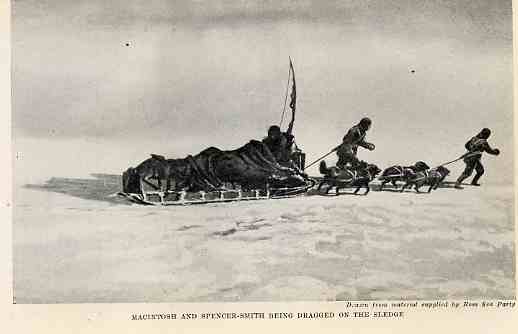
“March 1, Wednesday.—Turned out usual time; a good south wind, but, worse luck, heavy drift. Set sail; put the Skipper on rear sledge. The temperature has gone down and it is very cold. Bluff in sight. We are making good progress, doing a good mileage before lunch. After lunch a little stronger wind. Hayward still hanging on to sledge; Skipper fell off twice. Reached depot 5.45. When camping found we had dropped our tent-poles, so Richards went back a little way and spotted them through the binoculars about half a mile off, and brought them back. Hayward and I were very cold by that time, the drift very bad. Moral: See everything properly secured. We soon had our tent up, cooked our dinner in the dark, and turned in about 10 o’clock.
“March 1, Wednesday. We got up at the usual time. There was a good south wind, but, worse luck, heavy drifting snow. We set sail and put the Skipper on the rear sledge. The temperature has dropped, and it is very cold. Bluff is in sight. We are making good progress and cover a good distance before lunch. After lunch the wind is a little stronger. Hayward is still hanging on to the sledge. The Skipper fell off twice. We reached the depot at 5:45. When we camped, we found we had dropped our tent poles. Richards went back a little way and spotted them through the binoculars, about half a mile away. He brought them back. By then, Hayward and I were very cold, and the drifting snow was very bad. Moral: Make sure everything is properly secured. We soon had our tent up, cooked dinner in the dark, and turned in about 10 o’clock.
“March 2, Thursday.—Up as usual. Strong south-west wind with heavy drift. Took two weeks’ provisions from the depot. I think that will last us through, as there is another depot about fifty miles north from here; I am taking the outside course on account of the crevasses, and one cannot take too many chances with two men on sledges and one crippled. Under way about 10 o’clock; lunched noon in a heavy drift; took an hour to get the tents up, etc., the wind being so heavy. Found sledges buried under snow after lunch, took some time to get under way. Wind and drift very heavy; set half-sail on the first sledge and under way about 3.30. The going is perfect; sometimes sledges overtaking us. Carried on until 8 o’clock, doing an excellent journey for the day; distance about eleven or twelve miles. Gives one a bit of heart to carry on like this; only hope we can do this all the way. Had to cook our meals in the dark, but still we did not mind. Turned in about 11 o’clock, pleased with ourselves, although we were wet through with snow, as it got through all the holes in our clothes, and the sleeping-bags are worse than awful.
“March 2, Thursday. Got up as usual. A strong southwest wind was blowing, with heavy drifting snow. We took two weeks’ provisions from the depot. I think they will last us the rest of the way, since there is another depot about fifty miles north of here. I am taking the outer route because of the crevasses. One cannot take too many chances with two men on sledges and one of them crippled. We set off about 10 o’clock and stopped for lunch at noon in heavy drifting snow. The wind was so strong that it took an hour to put up the tents and do the other work. After lunch, we found the sledges buried under snow, and it took some time to get going again. The wind and drifting snow were very heavy. We set a half-sail on the first sledge and got under way about 3.30. The going is perfect. Sometimes the sledges overtake us. We carried on until 8 o’clock, having made excellent progress for the day. We covered about eleven or twelve miles. Traveling like this gives one a bit of heart to carry on. I only hope we can do it all the way. We had to cook our meals in the dark, but we did not mind. We turned in about 11 o’clock, pleased with ourselves. We were wet through because snow had got in through all the holes in our clothes, and the sleeping-bags are worse than awful.
“March 3, Friday.—Up the usual time. It has been blowing a raging blizzard all night. Found to our disgust utterly impossible to carry on. Another few hours of agony in these rotten bags. Later.—Blizzard much heavier. Amused myself mending finneskoe and Burberrys, mitts and socks. Had the Primus while this operation was in force. Hoping for a fine day to-morrow.
“March 3, Friday. Got up at the usual time. A fierce blizzard has been blowing all night. To our disgust, we found it was utterly impossible to carry on. Another few hours of agony in these rotten bags. Later. The blizzard is much worse. I kept myself busy mending finneskoe, Burberrys, mitts, and socks. I had the Primus stove while I worked. Hoping for a fine day tomorrow.
“March 4, Saturday.—Up 5.20. Still blizzarding, but have decided to get under way as we will have to try and travel through everything, as Hayward is getting worse, and one doesn’t know who is the next. No mistake it is scurvy, and the only possible cure is fresh food. I sincerely hope the ship is in; if not we shall get over the hills by Castle Rock, which is rather difficult and will delay another couple of days. Smith is still cheerful; he has hardly moved for weeks and he has to have everything done for him. Got under way 9.35. It took some two hours to dig out dogs and sledges, as they were completely buried. It is the same every morning now. Set sail, going along pretty fair. Hayward gets on sledge now and again. Lunched as usual; sledges got buried again at lunch-time. It takes some time to camp now, and in this drift it is awful. In the afternoon wind eased a bit and drift went down. Found it very hard pulling with the third man on sledge, as Hayward has been on all the afternoon. Wind veered two points to south, so we had a fair wind. An hour before we camped Erebus and Terror showing up, a welcome sight. Only hope wind will continue. Drift is worst thing to contend with as it gets into our clothes, which are wet through now. Camped 8 o’clock. Cooked in the dark, and turned in in our wet sleeping-bags about 10 o’clock. Distance about eight or nine miles.
“March 4, Saturday. Up at 5:20. The blizzard is still raging, but we have decided to set out. We will have to try to travel through anything, because Hayward is getting worse. We don’t know who will be next. There is no doubt it is scurvy, and the only possible cure is fresh food. I sincerely hope the ship is in. If not, we will have to cross the hills by Castle Rock. That route is rather difficult and will delay us another couple of days. Smith is still cheerful. He has hardly moved for weeks, and everything has to be done for him. We set out at 9:35. It took about two hours to dig out the dogs and sledges, as they were completely buried. It is the same every morning now. We set sail and made fairly good progress. Hayward rides on a sledge now and again. We stopped for lunch as usual, and the sledges were buried again during lunch. It takes some time to set up camp now, and in this drifting snow it is awful. In the afternoon, the wind eased a little and the drifting snow died down. Pulling was very hard with a third man on a sledge, as Hayward had been riding all afternoon. The wind shifted two points south, giving us a favorable wind. An hour before we camped, Erebus and Terror came into view, a welcome sight. I only hope the wind continues. The drifting snow is the worst thing to contend with. It gets into our clothes, which are now wet through. We camped at 8 o’clock, cooked in the dark, and turned in around 10 o’clock in our wet sleeping bags. We covered about eight or nine miles.
“March 5, Sunday.—Turned out 6.15. Overslept a little; very tired after yesterday. Sun shining brightly and no wind. It seemed strange last night, no flapping of tent in one’s ears. About 8.30 came on to drift again. Under way 9.20, both sails set. Sledge going hard, especially in soft places. If Hayward had not broken down we should not feel the weight so much. Lunch 12.45. Under way at 3. Wind and drift very heavy. A good job it is blowing some, or else we should have to relay. All land obscured. Distance about ten or eleven miles, a very good performance. Camped 7.10 in the dark. Patients not in the best of trim. I hope to get in, bar accidents, in four days.
“March 5, Sunday. Got up at 6.15. I overslept a little because I was very tired after yesterday. The sun was shining brightly and there was no wind. Last night felt strange without the tent flapping in my ears. Around 8.30 the snow began drifting again. We set off at 9.20 with both sails up. The sledge was hard to pull, especially through soft snow. If Hayward had not broken down, we would not feel the weight so much. We had lunch at 12.45. We set off again at 3. The wind and drifting snow were very heavy. It was a good thing the wind was blowing, or we would have had to move the load in stages. All the land was hidden from view. We covered about ten or eleven miles, a very good performance. We camped at 7.10 in the dark. The patients were not in the best condition. I hope to get in within four days, if there are no accidents.
“March 6, Monday.—Under way 9.20. Picked up thirty-two mile depot 11 o’clock. Going with a fair wind in the forenoon, which eased somewhat after lunch and so caused very heavy work in pulling. It seems to me we shall have to depot someone if the wind eases at all. Distance during day about eight miles.
“March 6, Monday. We got underway at 9:20 and picked up the thirty-two mile depot at 11 o’clock. We had a favorable wind in the morning, but it weakened somewhat after lunch. This made pulling very hard work. It seems to me that we shall have to leave someone at a depot if the wind eases at all. We covered about eight miles during the day.
“March 7, Tuesday.—Under way 9 o’clock. Although we turn out at 5 it seems a long time to get under way. There is double as much work to do now with our invalids. This is the calmest day we have had for weeks. The sun is shining and all land in sight. It is very hard going. Had a little breeze about 11 o’clock, set sail, but work still very, very heavy. Hayward and Skipper going on ahead with sticks, very slow pace, but it will buck them up and do them good. If one could only get some fresh food! About 11 o’clock decided to camp and overhaul sledges and depot all gear except what is actually required. Under way again at 2, but surface being so sticky did not make any difference. After a consultation the Skipper decided to stay behind in a tent with three weeks’ provisions whilst we pushed on with Smith and Hayward. It seems hard, only about thirty miles away, and yet cannot get any assistance. Our gear is absolutely rotten, no sleep last night, shivering all night in wet bags. I wonder what will be the outcome of it all after our struggle. Trust in Providence. Distance about three and a half miles.
“March 7, Tuesday. We set out at 9 o’clock. Although we get up at 5, it seems to take a long time to get going. With our sick men, there is twice as much work to do now. This is the calmest day we have had for weeks. The sun is shining, and all the land is in sight. The going is very hard. We had a little breeze at about 11 o’clock and set sail, but the work was still very, very hard. Hayward and Skipper went ahead with sticks at a very slow pace. But it will cheer them up and do them good. If only we could get some fresh food! At about 11 o’clock we decided to camp, check the sledges, and leave behind all gear except what we actually needed. We set out again at 2, but the surface was so sticky that it made no difference. After a discussion, the Skipper decided to stay behind in a tent with three weeks’ provisions. The rest of us would push on with Smith and Hayward. It seems hard to be only about thirty miles away and yet unable to get any help. Our gear is completely worn out. We got no sleep last night and shivered all night in wet sleeping bags. I wonder how it will all turn out after our struggle. Trust in Providence. Distance covered was about three and a half miles.”
“March 8, Wednesday.—Under way 9.20. Wished the Skipper good-bye; took Smith and Hayward on. Had a fair wind, going pretty good. Hope to arrive in Hut Point in four days. Lunched at No. 2 depot. Distance about four and a half miles. Under way as usual after lunch; head wind, going very heavy. Carried on until 6.30. Distance about eight or nine miles.
“March 8, Wednesday. Started out at 9.20. Said good-bye to the Skipper and took Smith and Hayward with me. We had a favorable wind and made pretty good progress. I hope to reach Hut Point in four days. We had lunch at No. 2 depot. The distance was about four and a half miles. We set out again after lunch as usual. The wind was against us, and progress was very difficult. We kept going until 6.30. The distance was about eight or nine miles.
“March 9, Thursday.—Had a very bad night, cold intense. Temperature down to —29° all night. At 4 a.m. Spencer-Smith called out that he was feeling queer. Wild spoke to him. Then at 5.45 Richards suddenly said, ‘I think he has gone.’ Poor Smith, for forty days in pain he had been dragged on the sledge, but never grumbled or complained. He had a strenuous time in his wet bag, and the jolting of the sledge on a very weak heart was not too good for him. Sometimes when we lifted him on the sledge he would nearly faint, but during the whole time he never complained. Wild looked after him from the start. We buried him in his bag at 9 o’clock at the following position: Ereb. 184°—Obs. Hill 149°. We made a cross of bamboos, and built a mound and cairn, with particulars. After that got under way with Hayward on sledge. Found going very hard, as we had a northerly wind in our faces, with a temperature below 20°. What with frost-bites, etc., we are all suffering. Even the dogs seem like giving in; they do not seem to take any interest in their work. We have been out much too long, and nothing ahead to cheer us up but a cold, cheerless hut. We did about two and a half miles in the forenoon; Hayward toddling ahead every time we had a spell. During lunch the wind veered to the south with drift, just right to set sail. We carried on with Hayward on sledge and camped in the dark about 8 o’clock. Turned in at 10, weary, worn, and sad. Hoping to reach depot to-morrow.
“March 9, Thursday. We had a very bad night. The cold was intense, with the temperature down to −29° all night. At 4 a.m. Spencer-Smith called out that he felt strange. Wild spoke to him. Then, at 5.45, Richards suddenly said, ‘I think he has gone.’ Poor Smith had been in pain for forty days while we dragged him on the sledge, but he never grumbled or complained. He had a hard time in his wet bag, and the jolting of the sledge was not good for his very weak heart. Sometimes, when we lifted him onto the sledge, he would nearly faint. But through it all, he never complained. Wild looked after him from the start. We buried him in his bag at 9 o’clock at the following position: Ereb. 184°, Obs. Hill 149°. We made a cross from bamboo poles and built a mound and cairn, with particulars. After that, we set off with Hayward on the sledge. The going was very hard because a north wind was blowing in our faces and the temperature was below 20°. With frostbite and everything else, we are all suffering. Even the dogs seem ready to give up. They do not seem interested in their work. We have been out much too long, and nothing ahead will cheer us up except a cold, cheerless hut. We covered about two and a half miles in the morning. Hayward walked slowly ahead whenever we stopped to rest. During lunch, the wind shifted to the south, bringing drifting snow. The wind was just right for setting sail. We carried on with Hayward on the sledge and camped in the dark at about 8 o’clock. We went to bed at 10, weary, worn out, and sad. We hope to reach the depot tomorrow.
“March 10, Friday.—Turned out as usual. Beam wind, going pretty fair, very cold. Came into very soft snow about 3; arrived at Safety Camp 5 o’clock. Got to edge of Ice Barrier; found passage over in a bay full of seals. Dogs got very excited; had a job to keep them away. By the glass it looked clear right to Cape Armitage, which is four and a half miles away. Arrived there 8 o’clock, very dark and bad light. Found open water. Turned to climb slopes against a strong north-easterly breeze with drift. Found a place about a mile away, but we were so done up that it took until 11.30 to get gear up. This slope was about 150 yds. up, and every three paces we had to stop and get breath. Eventually camped and turned in about 2 o’clock. I think this is the worst day I ever spent. What with the disappointment of not getting round the Point, and the long day and the thought of getting Hayward over the slopes, it is not very entertaining for sleep.
“March 10, Friday. We got up as usual. The wind was coming from the side, and we made fairly good progress. It was very cold. We came into very soft snow about 3 and reached Safety Camp at 5 o’clock. We got to the edge of the Ice Barrier and found a way across in a bay full of seals. The dogs got very excited, and we had a hard time keeping them away. Looking through the glass, the way seemed clear right to Cape Armitage, four and a half miles away. We arrived there at 8 o’clock. It was very dark, and the light was bad. We found open water. We turned to climb the slopes against a strong north-easterly wind and drifting snow. We found a place about a mile away, but we were so exhausted that it took until 11.30 to get the gear up. The slope was about 150 yards long, and we had to stop for breath every three paces. We eventually camped and turned in about 2 o’clock. I think this was the worst day I ever spent. I was disappointed that we had not got round the Point. After the long day, I was also thinking about getting Hayward over the slopes. These were not pleasant thoughts to go to sleep with.
“March 11, Saturday.—Up at 7 o’clock; took binoculars and went over the slope to look around the Cape. To my surprise found the open water and pack at the Cape only extended for about a mile. Came down and gave the boys the good news. I think it would take another two hard days to get over the hills, and we are too weak to do much of that, as I am afraid of another collapsing. Richards and Wild climbed up to look at the back of the bay and found the ice secure. Got under way 10.30, went round the Cape and found ice; very slushy, but continued on. No turning now; got into hard ice shortly after, eventually arriving at Hut Point about 3 o’clock. It seems strange after our adventures to arrive back at the old hut. This place has been standing since we built it in 1901, and has been the starting-point of a few expeditions since. When we were coming down the bay I could fancy the Discovery there when Scott arrived from his Farthest South in 1902, the ship decorated rainbow fashion, and Lieutenant Armitage giving out the news that Captain Scott had got to 82° 17´ S. We went wild that day. But now our homecoming is quite different. Hut half-full of snow through a window being left open and drift getting in; but we soon got it shipshape and Hayward in. I had the fire going and plenty of vegetables on, as there was a fair supply of dried vegetables. Then after we had had a feed, Richards and Wild went down the bay and killed a couple of seals. I gave a good menu of seal meat at night, and we turned in about 11 o’clock, full—too full, in fact. As there is no news here of the ship, and we cannot see her, we surmise she has gone down with all hands. I cannot see there is any chance of her being afloat or she would be here. I don’t know how the Skipper will take it.
“March 11, Saturday. We got up at 7 o’clock. I took the binoculars and went over the slope to look around the Cape. To my surprise, the open water and pack ice at the Cape extended only about a mile. I came down and gave the boys the good news. I think it would take another two hard days to cross the hills. We are too weak for much of that, and I am afraid another man might collapse. Richards and Wild climbed up to look at the back of the bay and found the ice secure. We set off at 10.30, went around the Cape, and found ice. It was very slushy, but we continued. There was no turning back now. Soon we reached hard ice, and we eventually arrived at Hut Point about 3 o’clock. After our adventures, it feels strange to be back at the old hut. It has stood here since we built it in 1901 and has been the starting point for a few expeditions since. As we came down the bay, I could imagine the Discovery there when Scott returned from his Farthest South in 1902. The ship was decorated in rainbow fashion. Lieutenant Armitage announced that Captain Scott had reached 82° 17´ S. We went wild that day. But our homecoming now is quite different. Someone had left a window open, and drifting snow had half filled the hut. But we soon got it in order and brought Hayward inside. I lit the fire and put plenty of vegetables on to cook. We had a fair supply of dried vegetables. After we had eaten, Richards and Wild went down the bay and killed a couple of seals. That night I served a good meal of seal meat. We turned in about 11 o’clock, full, too full, in fact. There is no news of the ship here, and we cannot see her. So we assume she has gone down with all hands. I cannot see any chance that she is still afloat, or she would be here. I don’t know how the Skipper will take it.
“March 12, Sunday.—Heard groans proceeding from the sleeping-bags all night; all hands suffering from over-eating. Hayward not very well. Turned out 8 o’clock. Good breakfast—porridge, seal, vegetables, and coffee; more like a banquet to us. After breakfast Richards and Wild killed a couple of seals whilst I made the hut a bit comfy. Hayward can hardly move. All of us in a very bad state, but we must keep up exercise. My ankles and knees badly swollen, gums prominent. Wild, very black around joints, and gums very black. Richards about the best off. After digging hut out I prepared food which I think will keep the scurvy down. The dogs have lost their lassitude and are quite frisky, except Oscar, who is suffering from over-feeding. After a strenuous day’s work turned in 10 o’clock.
“March 12, Sunday. Heard groans from the sleeping bags all night. Everyone was suffering from overeating. Hayward was not very well. Got up at 8 o’clock. We had a good breakfast of porridge, seal, vegetables, and coffee. It was more like a banquet to us. After breakfast, Richards and Wild killed a couple of seals while I made the hut a bit more comfortable. Hayward can hardly move. We are all in a very bad state, but we must keep exercising. My ankles and knees are badly swollen, and my gums are prominent. Wild is very black around his joints, and his gums are very black. Richards is about the best off. After digging out the hut, I prepared food that I think will keep the scurvy down. The dogs are no longer sluggish and are quite frisky, except for Oscar, who is suffering from overfeeding. After a strenuous day’s work, I went to bed at 10 o’clock.
“March 13, Monday.—Turned out 7 o’clock. Carried on much the same as yesterday, bringing in seal blubber and meat. Preparing for departure to-morrow; hope every one will be all right. Made new dog harness and prepared sledges. In afternoon cooked sufficient seal meat for our journey out and back, and same for dogs. Turned in 10 o’clock, feeling much better.
“March 13, Monday. Got up at 7 o’clock. We carried on much as we did yesterday, bringing in seal blubber and meat. We are preparing to leave tomorrow. I hope everyone will be all right. We made new dog harnesses and prepared the sledges. In the afternoon, we cooked enough seal meat for our journey out and back, and enough for the dogs. I went to bed at 10 o’clock, feeling much better.
“March 14, Tuesday.—A beautiful day. Under way after lunch. One would think, looking at our party, that we were the most ragged lot one could meet in a day’s march; all our clothes past mending, our faces as black as niggers’—a sort of crowd one would run away from. Going pretty good. As soon as we rounded Cape Armitage a dead head wind with a temperature of –18° Fahr., so we are not in for a pleasant time. Arrived at Safety Camp 6 o’clock, turned in 8.30, after getting everything ready.
“March 14, Tuesday. A beautiful day. We set off after lunch. Looking at our party, you might think we were the most ragged group you could meet in a day’s march. All our clothes were beyond mending, and our faces were black as those of the people called by a racial slur. We looked like the sort of crowd you would run away from. We were making pretty good progress. As soon as we rounded Cape Armitage, we faced a direct headwind and a temperature of −18° Fahrenheit. So we are not in for a pleasant time. We arrived at Safety Camp at 6 o’clock. After getting everything ready, we turned in at 8:30.”
“March 15, Wednesday.—Under way as usual. Nice calm day. Had a very cold night, temperature going down to –30° Fahr. Going along at a rattling good rate; in spite of our swollen limbs we did about fifteen miles. Very cold when we camped; temperature –20° Fahr. Turned in 9 o’clock.
“March 15, Wednesday. We set off as usual. A nice, calm day. The night had been very cold, with the temperature dropping to minus 30° Fahrenheit. We traveled at a great pace. Despite our swollen limbs, we covered about fifteen miles. It was very cold when we camped, with the temperature at minus 20° Fahrenheit. We went to bed at 9 o’clock.
“March 16, Thursday.—Up before the sun, 4.45 a.m. Had a very cold night, not much sleep. Under way early. Going good. Passed Smith’s grave 10.45 a.m. and had lunch at depot. Saw Skipper’s camp just after, and looking through glass found him outside tent, much to the joy of all hands, as we expected him to be down. Picked him up 4.15 p.m. Broke the news of Smith’s death and no ship. I gave him the date of the 17th to look out for our returning, so he had a surprise. We struck his camp and went north for about a mile and camped. We gave the Skipper a banquet of seal, vegetables, and black currant jam, the feed of his life. He seems in a bad way. I hope to get him in in three days, and I think fresh food will improve him. We turned in 8 o’clock. Distance done during day sixteen miles.
“March 16, Thursday. Up before sunrise, at 4.45 a.m. The night was very cold, and I slept little. We set off early and made good progress. We passed Smith’s grave at 10.45 a.m. and had lunch at the supply depot. Soon afterward, we saw Skipper’s camp. Looking through the telescope, we saw him outside his tent. Everyone was delighted, because we had expected him to be laid up. We picked him up at 4.15 p.m. and told him that Smith had died and there was no ship. I had told him to expect us back on the 17th, so he was surprised. We took down his camp, went north for about a mile, and made camp. We gave the Skipper a banquet of seal, vegetables, and black currant jam, the meal of his life. He seems to be in bad shape. I hope to get him back in three days, and I think fresh food will help him. We went to bed at 8 o’clock. We covered sixteen miles during the day.
“March 17, Friday.—Up at 5 o’clock. Under way 8 a.m. Skipper feeling much better after feeding him up. Lunched a few yards past Smith’s grave. Had a good afternoon, going fair. Distance about sixteen miles. Very cold night, temperature –30° Fahr. What with wet bags and clothes, rotten.
“March 17, Friday. Up at 5 o’clock. Set off at 8 a.m. The Skipper was feeling much better after we fed him up. We ate lunch a few yards past Smith’s grave. We had a good afternoon and made fair progress. Distance about sixteen miles. A very cold night, with the temperature at −30° Fahrenheit. With wet bags and clothes, it was miserable.
“March 18, Saturday.—Turned out 5 o’clock. Had rather a cold night. Temperature –29° Fahr. Surface very good. The Skipper walked for a little way, which did him good. Lunched as usual. Pace good. After lunch going good. Arrived at Safety Camp 4.10 p.m. To our delight found the sea-ice in the same condition and arrived at Hut Point at 7 o’clock. Found Hayward still about same. Set to, made a good dinner, and all hands seem in the best of spirits. Now we have arrived and got the party in, it remains to themselves to get better. Plenty of exercise and fresh food ought to do miracles. We have been out 160 days, and done a distance of 1561 miles, a good record. I think the irony of fate was poor Smith going under a day before we got in. I think we shall all soon be well. Turned in 10.30 p.m. Before turning in Skipper shook us by the hand with great emotion, thanking us for saving his life.”
“March 18, Saturday. Got up at 5 o’clock. We had a rather cold night. The temperature was minus 29° Fahrenheit. The surface was very good. The Skipper walked a little way, which did him good. We had lunch as usual. Our pace was good. The going was good after lunch. We arrived at Safety Camp at 4:10 p.m. To our delight, we found the sea ice in the same condition. We arrived at Hut Point at 7 o’clock. We found Hayward still about the same. We got to work and made a good dinner. Everyone seemed in the best of spirits. Now that we have arrived and brought the party in, it is up to them to get better. Plenty of exercise and fresh food ought to work miracles. We have been out for 160 days and covered 1,561 miles, a good record. I think it was an irony of fate that poor Smith died a day before we got in. I think we shall all soon be well. We went to bed at 10:30 p.m. Before going to bed, the Skipper shook our hands with great emotion, thanking us for saving his life.”
Richards, summarizing the work of the parties, says that the journeys made between September 1 and March 18, a period of 160 days, totalled 1561 miles. The main journey, from Hut Point to Mount Hope and return, was 830 miles.
Summarizing the parties' work, Richards says their journeys covered 1,561 miles between September 1 and March 18, a period of 160 days. The main journey, from Hut Point to Mount Hope and back, covered 830 miles.
“The equipment,” he adds, “was old at the commencement of the season, and this told severely at the later stages of the journey. Three Primus lamps gave out on the journeys, and the old tent brought back by one of the last parties showed rents several feet in length. This hampered the travelling in the long blizzards. Finneskoe were also in pieces at the end, and time had frequently to be lost through repairs to clothing becoming imperative. This account would not be complete without some mention of the unselfish service rendered by Wild to his two ill tent-mates. From the time he remained behind at the long blizzard till the death of Spencer-Smith he had two helpless men to attend to, and despite his own condition he was ever ready, night or day, to minister to their wants. This, in a temperature of –30° Fahr. at times, was no light task.
“The equipment,” he adds, “was already old at the start of the season. This caused serious problems in the later stages of the journey. Three Primus lamps broke down during the journeys. The old tent brought back by one of the last parties had tears several feet long. This made travel difficult during the long blizzards. The finneskoe were also in pieces by the end. Repairs to clothing were often unavoidable, and time was lost making them. This account would not be complete without mentioning Wild’s unselfish care for the two sick men sharing his tent. From the time he stayed behind during the long blizzard until Spencer-Smith’s death, he cared for two helpless men. Despite his own condition, he was always ready to attend to their needs, day or night. This was no easy task, especially when temperatures sometimes reached −30°F.
“Without the aid of four faithful friends, Oscar, Con, Gunner, and Towser, the party could never have arrived back. These dogs from November 5 accompanied the sledging parties, and, although the pace was often very slow, they adapted themselves well to it. Their endurance was fine. For three whole days at one time they had not a scrap of food, and this after a period on short rations. Though they were feeble towards the end of the trip, their condition usually was good, and those who returned with them will ever remember the remarkable service they rendered.
“Without the help of four faithful friends, Oscar, Con, Gunner, and Towser, the party could never have returned. From November 5, these dogs accompanied the sledging parties. Although the pace was often very slow, the dogs adapted well to it. Their endurance was remarkable. At one point, they went three whole days without a scrap of food, after a period on short rations. Though they were weak toward the end of the trip, their condition was usually good. Those who returned with them will always remember the remarkable service they gave.
“The first indication of anything wrong with the general health of the party occurred at about lat. 82° 30´ S., when Spencer-Smith complained of stiffness in the legs and discolouration. He attributed this to holes in his windproof clothing. At lat. 83° S., when he gave way, it was thought that the rest would do him good. About the end of January Captain Mackintosh showed very serious signs of lameness. At this time his party had been absent from Hut Point, and consequently from fresh food, about three months.
“The first sign that anything was wrong with the party’s general health came at about latitude 82° 30´ S. Spencer-Smith complained of stiffness and discoloration in his legs. He blamed holes in his windproof clothing. At latitude 83° S., when he gave way, the others thought the rest would do him good. Near the end of January, Captain Mackintosh showed very serious signs of lameness. By then, his party had been away from Hut Point, and therefore without fresh food, for about three months.
“On the journey back Spencer-Smith gradually became weaker, and for some time before the end was in a very weak condition indeed. Captain Mackintosh, by great efforts, managed to keep his feet until the long blizzard was encountered. Here it was that Hayward was first found to be affected with the scurvy, his knees being stiff. In his case the disease took him off his feet very suddenly, apparently causing the muscles of his legs to contract till they could be straightened hardly more than a right angle. He had slight touches in the joints of the arms. In the cases of Joyce, Wild, and Richards, joints became stiff and black in the rear, but general weakness was the worst symptom experienced. Captain Mackintosh’s legs looked the worst in the party.”
“On the journey back, Spencer-Smith gradually grew weaker. For some time before the end, he was in a very weak condition indeed. Captain Mackintosh made great efforts to stay on his feet until the long blizzard struck. During the blizzard, Hayward was first found to have scurvy. His knees were stiff. The disease suddenly left him unable to walk. It apparently caused his leg muscles to contract until he could hardly straighten his legs beyond a right angle. The joints in his arms were also slightly affected. Joyce, Wild, and Richards developed stiff joints that were black at the back, but general weakness was their worst symptom. Captain Mackintosh’s legs looked the worst in the party.”
The five men who were now at Hut Point found quickly that some of the winter months must be spent there. They had no news of the ship, and were justified in assuming that she had not returned to the Sound, since if she had some message would have been awaiting them at Hut Point, if not farther south. The sea-ice had broken and gone north within a mile of the point, and the party must wait until the new ice became firm as far as Cape Evans. Plenty of seal meat was available, as well as dried vegetables, and the fresh food improved the condition of the patients very rapidly. Richards massaged the swollen joints and found that this treatment helped a good deal. Before the end of March Mackintosh and Hayward, the worst sufferers, were able to take exercise. By the second week of April Mackintosh was free of pain, though the backs of his legs were still discoloured.
The five men at Hut Point soon realized they would have to spend some of the winter months there. They had no news of the ship and had good reason to assume she had not returned to the Sound. If she had, a message would have been waiting for them at Hut Point, if not farther south. The sea ice had broken up and drifted north, leaving open water within a mile of the point. The party had to wait until new ice was firm all the way to Cape Evans. There was plenty of seal meat, as well as dried vegetables, and the fresh food rapidly improved the patients' condition. Richards massaged their swollen joints and found that this helped a great deal. Before the end of March, Mackintosh and Hayward, the worst affected, were able to exercise. By the second week of April, Mackintosh was free of pain, though the backs of his legs were still discolored.
A tally of the stores at the hut showed that on a reasonable allowance the supply would last till the middle of June. Richards and Wild killed many seals, so that there was no scarcity of meat and blubber. A few penguins were also secured. The sole means of cooking food and heating the hut was an improvised stove of brick, covered with two sheets of iron. This had been used by the former Expedition. The stove emitted dense smoke and often made the hut very uncomfortable, while at the same time it covered the men and all their gear with clinging and penetrating soot. Cleanliness was out of the question, and this increased the desire of the men to get across to Cape Evans. During April the sea froze in calm weather, but winds took the ice out again. On April 23 Joyce walked four miles to the north, partly on young ice two inches thick, and he thought then that the party might be able to reach Cape Evans within a few days. But a prolonged blizzard took the ice out right up to the Point, so that the open water extended at the end of April right up to the foot of Vinie’s Hill. Then came a spell of calm weather, and during the first week of May the sea-ice formed rapidly. The men made several short trips over it to the north. The sun had disappeared below the horizon in the middle of April, and would not appear again for over four months.
A count of the supplies at the hut showed that, with reasonable rations, they would last until mid-June. Richards and Wild killed many seals, so there was no shortage of meat and blubber. They also caught a few penguins. The only way to cook food and heat the hut was with a makeshift brick stove covered with two sheets of iron. The former Expedition had used it. The stove gave off thick smoke and often made the hut very uncomfortable. It also covered the men and all their gear with soot that clung to and penetrated everything. Keeping clean was impossible, and this made the men even more eager to cross to Cape Evans. During April, the sea froze in calm weather, but winds carried the ice away again. On April 23, Joyce walked four miles north, partly over new ice two inches thick. He then thought the party might be able to reach Cape Evans within a few days. But a prolonged blizzard carried the ice away as far as the Point. By the end of April, open water stretched right up to the foot of Vinie’s Hill. Then came a spell of calm weather, and during the first week of May, sea ice formed rapidly. The men made several short trips north over the ice. The sun had disappeared below the horizon in mid-April and would not appear again for more than four months.
The disaster that followed is described by both Richards and Joyce. “And now a most regrettable incident occurred,” wrote Richards. “On the morning of May 8, before breakfast, Captain Mackintosh asked Joyce what he thought of his going to Cape Evans with Hayward. Captain Mackintosh considered the ice quite safe, and the fine morning no doubt tempted him to exchange the quarters at the hut for the greater comfort and better food at Cape Evans.” (Mackintosh naturally would be anxious to know if the men at Cape Evans were well and had any news of the ship.) “He was strongly urged at the time not to take the risk, as it was pointed out that the ice, although firm, was very young, and that a blizzard was almost sure to take part of it out to sea.”
Both Richards and Joyce described the disaster that followed. “And now a very regrettable incident occurred,” wrote Richards. “On the morning of May 8, before breakfast, Captain Mackintosh asked Joyce what he thought about Mackintosh going to Cape Evans with Hayward. Captain Mackintosh thought the ice was quite safe. The fine morning no doubt tempted him to leave the hut for the greater comfort and better food at Cape Evans.” (Mackintosh would naturally have been anxious to know whether the men at Cape Evans were well and had any news of the ship.) “He was strongly urged not to take the risk. It was pointed out that, although the ice was firm, it was very young. A blizzard was almost certain to carry some of it out to sea.”
However, at about 1 p.m., with the weather apparently changing for the worse, Mackintosh and Hayward left, after promising to turn back if the weather grew worse. The last sight the watching party on the hill gained of them was when they were about a mile away, close to the shore, but apparently making straight for Cape Evans. At 3 p.m. a moderate blizzard was raging, which later increased in fury, and the party in the hut had many misgivings for the safety of the absent men.
However, at about 1 p.m., the weather seemed to be getting worse. Mackintosh and Hayward left anyway, promising to turn back if it did get worse. The group watching from the hill last saw them about a mile away, close to the shore. They seemed to be heading straight for Cape Evans. By 3 p.m., a moderate blizzard was raging, and it later grew more violent. The group in the hut was deeply worried about the safety of the two men.
On May 10, the first day possible, the three men left behind walked over new ice to the north to try and discover some trace as to the fate of the others. The footmarks were seen clearly enough raised up on the ice, and the track was followed for about two miles in a direction leading to Cape Evans. Here they ended abruptly, and in the dim light a wide stretch of water, very lightly covered with ice, was seen as far as the eye could reach. It was at once evident that part of the ice over which they had travelled had gone out to sea.
On May 10, the first day it was possible, the three men left behind walked north over new ice. They hoped to find some trace of what had happened to the others. They could clearly see the footprints, raised on the ice, and followed the trail for about two miles toward Cape Evans. There the footprints stopped abruptly. In the dim light, they could see a wide stretch of water, lightly covered with ice, as far as the eye could see. It was immediately clear that part of the ice the others had traveled over had drifted out to sea.
The whole party had intended, if the weather had held good, to have attempted the passage across with the full moon about May 16. On the date on which Mackintosh and Hayward left it was impossible that a sledge should travel the distance over the sea-ice owing to the sticky nature of the surface. Hence their decision to go alone and leave the others to follow with the sledge and equipment when the surface should improve. That they had actually been lost was learned only on July 15, on which date the party from Hut Point arrived at Cape Evans.
The whole party had planned to attempt the crossing by the light of the full moon around May 16, if the weather stayed good. On the day Mackintosh and Hayward left, the sea-ice was too sticky for a sledge to travel the distance. So Mackintosh and Hayward decided to go alone. The others would follow with the sledge and equipment when the surface improved. Their loss became known only on July 15, when the party from Hut Point arrived at Cape Evans.
The entry in Joyce’s diary shows that he had very strong forebodings of disaster when Mackintosh and Hayward left. He warned them not to go, as the ice was still thin and the weather was uncertain. Mackintosh seems to have believed that he and Hayward, travelling light, could get across to Cape Evans quickly before the weather broke, and if the blizzard had come two or three hours later they probably would have been safe. The two men carried no sleeping-bags and only a small meal of chocolate and seal meat.
Joyce’s diary shows that he strongly feared disaster when Mackintosh and Hayward left. He warned them not to go because the ice was still thin and the weather was uncertain. Mackintosh seems to have believed that he and Hayward could travel light and reach Cape Evans quickly, before the weather turned bad. If the blizzard had come two or three hours later, they probably would have been safe. The two men carried no sleeping bags and only a small meal of chocolate and seal meat.
The weather during June was persistently bad. No move had been possible on May 16, the sea-ice being out, and Joyce decided to wait until the next full moon. When this came the weather was boisterous, and so it was not until the full moon of July that the journey to Cape Evans was made. During June and July seals got very scarce, and the supply of blubber ran short.
The weather was consistently bad throughout June. No move had been possible on May 16 because the sea ice was gone, so Joyce decided to wait until the next full moon. When it came, the weather was stormy. As a result, the journey to Cape Evans was not made until the full moon in July. During June and July, seals became very scarce, and the supply of blubber ran short.
Meals consisted of little but seal meat and porridge. The small stock of salt was exhausted, but the men procured two and a half pounds by boiling down snow taken from the bottom layer next to the sea-ice. The dogs recovered condition rapidly and did some hunting on their own account among the seals.
Meals consisted mostly of seal meat and porridge. The small supply of salt ran out. But the men obtained two and a half pounds by boiling down snow from the bottom layer next to the sea ice. The dogs quickly regained their strength and hunted some seals on their own.
The party started for Cape Evans on July 15. They had expected to take advantage of the full moon, but by a strange chance they had chosen the period of an eclipse, and the moon was shadowed most of the time they were crossing the sea-ice. The ice was firm, and the three men reached Cape Evans without difficulty. They found Stevens, Cope, Gaze, and Jack at the Cape Evans Hut, and learned that nothing had been seen of Captain Mackintosh and Hayward. The conclusion that these men had perished was accepted reluctantly. The party at the base consisted now of Stevens, Cope, Joyce, Richards, Gaze, Wild, and Jack.
The party set out for Cape Evans on July 15. They had expected to use the light of the full moon. But, by a strange chance, they had chosen a time when an eclipse occurred. The moon was in shadow for most of their crossing of the sea ice. The ice was firm, and the three men reached Cape Evans without difficulty. They found Stevens, Cope, Gaze, and Jack at the Cape Evans Hut. They learned that no one had seen Captain Mackintosh or Hayward. They reluctantly accepted the conclusion that both men had died. The party at the base now consisted of Stevens, Cope, Joyce, Richards, Gaze, Wild, and Jack.
The men settled down now to wait for relief. When opportunity offered Joyce led search-parties to look for the bodies or any trace of the missing men, and he subsequently handed me the following report:
The men settled down to wait for help. Whenever possible, Joyce led search parties to look for the bodies or any trace of the missing men. He later gave me the following report:
“I beg to report that the following steps were taken to try and discover the bodies of Captain Mackintosh and Mr. Hayward. After our party’s return to the hut at Cape Evans, July 15, 1916, it was learned that Captain Mackintosh and Mr. Hayward had not arrived; and, being aware of the conditions under which they were last seen, all the members of the wintering party were absolutely convinced that these two men were totally lost and dead—that they could not have lived for more than a few hours at the outside in the blizzard that they had encountered, they being entirely unprovided with equipment of any sort.
“I report the following steps taken to try to find the bodies of Captain Mackintosh and Mr. Hayward. After our party returned to the hut at Cape Evans on July 15, 1916, we learned that Captain Mackintosh and Mr. Hayward had not arrived. All members of the wintering party knew the conditions in which the two men were last seen. They were therefore absolutely convinced that both men were lost and dead. Captain Mackintosh and Mr. Hayward had no equipment of any kind. They could not have survived more than a few hours at most in the blizzard they encountered.
“There was the barest chance that after the return of the sun some trace of their bodies might be found, so during the spring—that is, August and September 1916—and in the summer—December and January 1916–17—the following searches were carried out:
“There was only the slightest chance that some trace of their bodies might be found after the sun returned. So the following searches were carried out during spring (August and September 1916) and summer (December 1916 and January 1917):
“(1) Wild and I thoroughly searched Inaccessible Island at the end of August 1916.
“(1) Wild and I thoroughly searched Inaccessible Island at the end of August 1916.
“(2) Various parties in September searched along the shore to the vicinity of Turk’s Head.
“(2) In September, various groups searched along the shore as far as the area near Turk’s Head.
“(3) In company with Messrs. Wild and Gaze I started from Hut Point, December 31, 1916, at 8 a.m., and a course was steered inshore as close as possible to the cliffs in order to search for any possible means of ascent. At a distance of half a mile from Hut Point we passed a snow slope which I had already ascended in June 1916; three and a half miles farther on was another snow slope, which ended in Blue Ice Glacier slope, which we found impossible to climb, snow slope being formed by heavy winter snowfall. These were the only two places accessible. Distance on this day, 10 miles 1710 yds covered. On January 1 search was continued round the south side of Glacier Tongue from the base towards the seaward end. There was much heavy pressure; it was impossible to reach the summit owing to the wide crack. Distance covered 4 miles 100 yds. On January 2 thick weather caused party to lay up. On 3rd, glacier was further examined, and several slopes formed by snow led to top of glacier, but crevasses between slope and the tongue prevented crossing. The party then proceeded round the Tongue to Tent Island, which was also searched, a complete tour of the island being made. It was decided to make for Cape Evans, as thick weather was approaching. We arrived at 8 p.m. Distance 8 miles 490 yds.
“(3) On December 31, 1916, at 8 a.m., I set out from Hut Point with Messrs. Wild and Gaze. We followed a course as close to the cliffs as possible, looking for any way to climb them. Half a mile from Hut Point, we passed a snow slope I had climbed in June 1916. Three and a half miles farther on, we found another snow slope, which ended at Blue Ice Glacier slope. We found the glacier slope impossible to climb. The snow slope had been formed by heavy winter snowfall. These were the only two accessible places. That day we covered 10 miles 1710 yards. On January 1, we continued searching around the south side of Glacier Tongue, from its base toward its seaward end. There was much heavy pressure, and a wide crack made it impossible to reach the summit. We covered 4 miles 100 yards. On January 2, thick weather forced the party to stop. On January 3, we examined the glacier further. Several snow slopes led to the top of the glacier, but crevasses between the slopes and the Tongue prevented us from crossing. The party then went around the Tongue to Tent Island. We searched Tent Island too, making a complete circuit of it. As thick weather was approaching, we decided to head for Cape Evans. We arrived at 8 p.m., having covered 8 miles 490 yards.
“I remain, etc., “ERNEST E. JOYCE.
“Sincerely, “ERNEST E. JOYCE.
“To Sir ERNEST SHACKLETON, C.V.O., “Commander, I.T.A.E.”
“To Sir Ernest Shackleton, C.V.O., “Commander, I.T.A.E.”
In September Richards was forced to lay up at the hut owing to a strained heart, due presumably to stress of work on the sledging journeys. Early in October a party consisting of Joyce, Gaze, and Wild spent several days at Cape Royds, where they skinned specimens. They sledged stores back to Cape Evans in case it should be found necessary to remain there over another winter. In September, Joyce, Gaze, and Wild went out to Spencer-Smith’s grave with a wooden cross, which they erected firmly. Relief arrived on January 10, 1917, but it is necessary now to turn back to the events of May 1915, when the Aurora was driven from her moorings off Cape Evans.
In September, Richards had to rest at the hut because of a strained heart, probably caused by the strain of the sledging journeys. Early in October, Joyce, Gaze, and Wild spent several days at Cape Royds, where they skinned specimens. They took supplies back to Cape Evans by sledge in case they had to stay there for another winter. In September, Joyce, Gaze, and Wild went to Spencer-Smith’s grave with a wooden cross, which they planted firmly. Relief arrived on January 10, 1917. But first, we must return to the events of May 1915, when the Aurora was driven from her moorings off Cape Evans.