Chapter 16
The Aurora’s Drift
After Mackintosh left the Aurora on January 25, 1915, Stenhouse kept the ship with difficulty off Tent Island. The ice-anchors would not hold, owing to the continual breaking away of the pack, and he found it necessary much of the time to steam slow ahead against the floes. The third sledging party, under Cope, left the ship on the afternoon of the 31st, with the motor-tractor towing two sledges, and disappeared towards Hut Point. Cope’s party returned to the ship on February 2 and left again on February 5, after a delay caused by the loose condition of the ice. Two days later, after more trouble with drifting floes, Stenhouse proceeded to Cape Evans, where he took a line of soundings for the winter quarters. During the next month the Aurora occupied various positions in the neighbourhood of Cape Evans. No secure moorings were available. The ship had to keep clear of threatening floes, dodge “growlers” and drifting bergs, and find shelter from the blizzards. A sudden shift of wind on February 24, when the ship was sheltering in the lee of Glacier Tongue, caused her to be jammed hard against the low ice off the glacier, but no damage was done. Early in March Stenhouse sent moorings ashore at Cape Evans, and on March 11 he proceeded to Hut Point, where he dropped anchor in Discovery Bay. Here he landed stores, amounting to about two months’ full rations for twelve men, and embarked Spencer-Smith, Stevens, Hook, Richards, Ninnis, and Gaze, with two dogs. He returned to Cape Evans that evening.
After Mackintosh left the Aurora on January 25, 1915, Stenhouse struggled to keep the ship off Tent Island. The ice-anchors would not hold because the pack ice kept breaking away. Much of the time, he had to steam slowly ahead against the floes. On the afternoon of the 31st, the third sledging party, led by Cope, left the ship. A motor-tractor towed two sledges, and the party disappeared towards Hut Point. Cope’s party returned to the ship on February 2. They left again on February 5, after being delayed by loose ice. Two days later, after more trouble with drifting floes, Stenhouse sailed to Cape Evans. There he took a line of depth measurements to find a place for the ship to spend the winter. Over the next month, the Aurora occupied various positions near Cape Evans. There were no secure moorings. The ship had to keep clear of threatening floes, dodge “growlers” and drifting bergs, and find shelter from blizzards. On February 24, the ship was sheltering in the lee of Glacier Tongue when the wind suddenly shifted. The ship was jammed hard against the low ice off the glacier, but suffered no damage. Early in March, Stenhouse sent moorings ashore at Cape Evans. On March 11, he sailed to Hut Point and dropped anchor in Discovery Bay. There he landed stores amounting to about two months’ full rations for twelve men. He also took aboard Spencer-Smith, Stevens, Hook, Richards, Ninnis, and Gaze, along with two dogs. He returned to Cape Evans that evening.
“We had a bad time when we were ‘sculling’ about the Sound, first endeavouring to make Hut Point to land provisions, and then looking for winter quarters in the neighbourhood of Glacier Tongue,” wrote Stenhouse afterwards. “The ice kept breaking away in small floes, and we were apparently no nearer to anywhere than when the sledges left; we were frustrated in every move. The ship broke away from the fast ice in blizzards, and then we went dodging about the Sound from the Ross Island side to the western pack, avoiding and clearing floes and growlers in heavy drift when we could see nothing, our compasses unreliable and the ship short-handed. In that homeless time I kept watch and watch with the second officer, and was hard pressed to know what to do. Was ever ship in such predicament? To the northward of Cape Royds was taboo, as also was the coast south of Glacier Tongue. In a small stretch of ice-bound coast we had to find winter quarters. The ice lingered on, and all this time we could find nowhere to drop anchor, but had to keep steam handy for emergencies. Once I tried the North Bay of Cape Evans, as it apparently was the only ice-free spot. I called all hands, and making up a boat’s crew with one of the firemen sent the whaler away with the second officer in charge to sound. No sooner had the boat left ship than the wind freshened from the northward, and large bergs and growlers, setting into the bay, made the place untenable. The anchorage I eventually selected seemed the best available—and here we are drifting, with all plans upset, when we ought to be lying in winter quarters.”
“We had a bad time when we were ‘sculling’ about the Sound,” Stenhouse wrote afterwards. “First we tried to reach Hut Point to land provisions. Then we looked for winter quarters near Glacier Tongue. The ice kept breaking away in small floes. We seemed no closer to getting anywhere than we had been when the sledges left. Every move we made was frustrated. “During blizzards, the ship broke away from the fast ice. Then we dodged about the Sound, from the Ross Island side to the western pack. We avoided floes and growlers and cleared them away in heavy drifting snow, when we could see nothing. Our compasses were unreliable, and the ship was short-handed. During that time without a home, the second officer and I stood watches in turn. I struggled to know what to do. Was any ship ever in such a predicament? “The coast north of Cape Royds was off-limits, as was the coast south of Glacier Tongue. We had to find winter quarters along a short stretch of ice-bound coast. The ice lingered on, and all this time we could find nowhere to anchor. We had to keep steam ready for emergencies. “Once I tried the North Bay of Cape Evans, because it seemed to be the only ice-free spot. I called all hands and included one of the firemen in a boat crew. Then I sent the whaler out to sound the depth, with the second officer in charge. No sooner had the boat left the ship than the north wind grew stronger. Large icebergs and growlers drifted into the bay, making it impossible to stay there. The anchorage I eventually chose seemed the best available. Yet here we are drifting, with all our plans upset, when we ought to be lying in winter quarters.”
A heavy gale came up on March 12, and the Aurora, then moored off Cape Evans, dragged her anchor and drifted out of the bay. She went northward past Cape Barne and Cape Royds in a driving mist, with a heavy storm-sea running. This gale was a particularly heavy one. The ship and gear were covered with ice, owing to the freezing of spray, and Stenhouse had anxious hours amid the heavy, ice-encumbered waters before the gale moderated. The young ice, which was continually forming in the very low temperature, helped to reduce the sea as soon as the gale moderated, and the Aurora got back to Cape Evans on the evening of the 13th. Ice was forming in the bay, and on the morning of the 14th Stenhouse took the ship into position for winter moorings. He got three steel hawsers out and made fast to the shore anchors. These hawsers were hove tight, and the Aurora rested then, with her stern to the shore, in seven fathoms. Two more wires were taken ashore the next day. Young ice was forming around the ship, and under the influence of wind and tide this ice began early to put severe strains upon the moorings. Stenhouse had the fires drawn and the boiler blown down on the 20th, and the engineer reported at that time that the bunkers contained still 118 tons of coal.
A powerful gale arose on March 12. The Aurora, then anchored off Cape Evans, dragged her anchor and drifted out of the bay. She drifted north past Cape Barne and Cape Royds through driving mist, as the storm raised heavy seas. The gale was especially fierce. Freezing spray covered the ship and her equipment with ice. Stenhouse spent anxious hours in the heavy, ice-filled seas before the gale eased. New ice was constantly forming in the extreme cold. As soon as the gale eased, the ice helped calm the sea. The Aurora returned to Cape Evans on the evening of the 13th. Ice was forming in the bay, and on the morning of the 14th Stenhouse positioned the ship for winter mooring. He ran three steel cables to the shore anchors and secured them. He tightened the cables, and the Aurora rested with her stern toward the shore in seven fathoms of water. Two more wires were taken ashore the next day. New ice was forming around the ship. Driven by wind and tide, the ice soon began putting severe strain on the moorings. On the 20th, Stenhouse had the fires put out and the boiler drained. The engineer reported that the bunkers still contained 118 tons of coal.
The ice broke away between Cape Evans and Cape Barne on the 23rd, and pressure around the ship shattered the bay ice and placed heavy strains on the stern moorings. The young ice, about four inches thick, went out eventually and left a lead along the shore. The ship had set in towards the shore, owing to the pressure, and the stern was now in four-and-a-half fathoms. Stenhouse tightened the moorings and ran out an extra wire to the shore anchor. The nature of the ice movements is illustrated by a few extracts from the log:
On the 23rd, the ice broke away between Cape Evans and Cape Barne. Pressure around the ship shattered the ice in the bay and put a heavy strain on the stern moorings. The young ice, about four inches thick, eventually drifted away, leaving a channel of open water along the shore. The pressure had pushed the ship toward the shore, and the stern was now in four and a half fathoms of water. Stenhouse tightened the moorings and ran an extra wire to the shore anchor. A few extracts from the log show how the ice moved:
“March 27, 5 p.m.—Ice broke away from shore and started to go out. 8 p.m.—Light southerly airs; fine; ice setting out to north-west; heavy pressure of ice on starboard side and great strain on moorings. 10 p.m.—Ice clear of ship.
“March 27, 5 p.m.: Ice broke away from the shore and began to drift out. 8 p.m.: Light winds from the south. Fine weather. The ice was drifting northwest. It pressed heavily against the ship’s starboard side and put great strain on the moorings. 10 p.m.: The ice was clear of the ship.
“March 28.—New ice forming over bay. 3 a.m.—Ice which went out last watch set in towards bay. 5 a.m.—Ice coming in and overriding newly formed bay-ice; heavy pressure on port side of ship; wires frozen into ice. 8 a.m.—Calm and fine; new ice setting out of bay. 5 p.m.—New ice formed since morning cleared from bay except area on port side of ship and stretching abeam and ahead for about 200 yds., which is held by bights of wire; new ice forming.
“March 28. New ice forming over the bay. 3 a.m. Ice that went out during the last watch drifted back towards the bay. 5 a.m. Ice coming in and riding over the newly formed ice in the bay. Heavy pressure on the port side of the ship. Wires frozen into the ice. 8 a.m. Calm and fine. New ice drifting out of the bay. 5 p.m. The ice that formed this morning has cleared from the bay, except for an area held by loops of wire. This area is on the port side of the ship and stretches about 200 yards alongside and ahead. New ice forming.
“March 29, 1.30 p.m.—New ice going out. 2 p.m.—Hands on floe on port quarter clearing wires; stern in three fathoms; hauled wires tight, bringing stern more to eastward and in four fathoms; hove in about one fathom of starboard cable, which had dragged during recent pressure.
“March 29, 1.30 p.m.: New ice moving out. 2 p.m.: Crew on the floe off the port quarter, clearing wires. The stern was in three fathoms of water. We pulled the wires tight, moving the stern farther east into four fathoms of water. We pulled in about one fathom of the starboard cable, which had dragged during the recent pressure.
“April 10, 1.30 p.m.—Ice breaking from shore under influence of south-east wind. Two starboard quarter wires parted; all bights of stern wires frozen in ice; chain taking weight. 2 p.m.—Ice opened, leaving ice in bay in line from Cape to landward of glacier. 8 p.m.—Fresh wind; ship holding ice in bay; ice in Sound wind-driven to north-west.
“April 10, 1.30 p.m.: Ice is breaking away from shore under the influence of a southeast wind. Two starboard quarter wires have snapped. All the loops of the stern wires are frozen in the ice. The chain is bearing the weight. 2 p.m.: The ice opened up, leaving ice in the bay along a line from Cape to the landward side of the glacier. 8 p.m.: A fresh wind is blowing. The ship is holding the ice in the bay. The wind is driving the ice in the Sound northwest.
“April 17, 1 am.—Pressure increased and wind shifted to north-west. Ice continued to override and press into shore until 5 o’clock; during this time pressure into bay was very heavy; movement of ice in straits causing noise like heavy surf. Ship took ground gently at rudder-post during pressure; bottom under stern shallows very quickly. 10 p.m.—Ice-moving out of bay to westward; heavy strain on after moorings and cables, which are cutting the floe.”
“April 17, 1 a.m.: Pressure increased, and the wind shifted to the northwest. Ice continued to pile up and press against the shore until 5 o’clock. During this time, the pressure into the bay was very heavy. Ice moving in the straits sounded like heavy surf. During the pressure, the ship gently touched bottom at the rudder-post. The water becomes shallow very quickly beneath the stern. 10 p.m.: Ice is moving out of the bay toward the west. The strain on the stern moorings and cables is heavy, and they are cutting into the ice floe.”
Stenhouse continued to nurse his moorings against the onslaughts of the ice during the rest of April and the early days of May. The break-away from the shore came suddenly and unexpectedly on the evening of May 6:
Stenhouse continued to tend his moorings against the pressure of the ice throughout the rest of April and early May. The break from the shore came suddenly and unexpectedly on the evening of May 6:
“May 6, 1915.—Fine morning with light breezes from east-south-east.... 3.30 p.m.—Ice nearly finished. Sent hands ashore for sledge-load. 4 p.m.—Wind freshening with blizzardy appearance of sky. 8 p.m.—. . . Heavy strain on after-moorings. 9.45 p.m.—The ice parted from the shore; all moorings parted. Most fascinating to listen to waves and chain breaking. In the thick haze I saw the ice astern breaking up and the shore receding. I called all hands and clapped relieving tackles (4-in. Manila luff tackles) on to the cables on the forepart of the windlass. The bos’n had rushed along with his hurricane lamp, and shouted, ‘She’s away wi’ it!’ He is a good fellow and very conscientious. I ordered steam on main engines, and the engine-room staff, with Hooke and Ninnis, turned to. Grady, fireman, was laid up with a broken rib. As the ship, in the solid floe, set to the north-west, the cables rattled and tore at the hawse-pipes; luckily the anchors, lying as they were on a strip-sloping bottom, came away easily, without damage to windlass or hawse-pipes. Slowly as we disappeared into Sound, the light in the hut died away. At 11.30 p.m. the ice around us started to break up, the floes playing tattoo on the ship’s sides. We were out in the Sound and catching the full force of the wind. The moon broke through the clouds after midnight and showed us the pack, stretching continuously to northward, and about one mile to the south. As the pack from the southward came up and closed in on the ship, the swell lessened and the banging of floes alongside eased a little.
“May 6, 1915. Fine morning with light breezes from the east-south-east.... 3.30 p.m. Ice nearly finished. Sent men ashore for a sledge-load. 4 p.m. Wind strengthening, with a blizzardy look to the sky. 8 p.m. . . . Heavy strain on the stern moorings. 9.45 p.m. The ice broke away from the shore, and all the moorings snapped. It was fascinating to listen to the waves and the chain breaking. Through the thick haze, I saw the ice behind the ship breaking up and the shore receding. I called all hands and fastened relieving tackles (4-inch Manila luff tackles) to the cables at the front of the windlass. The bos’n had rushed along with his hurricane lamp and shouted, ‘She’s away wi’ it!’ He is a good fellow and very conscientious. I ordered steam for the main engines. The engine-room staff, along with Hooke and Ninnis, set to work. Grady, the fireman, was laid up with a broken rib. As the ship drifted north-west in the solid floe, the cables rattled and tore at the hawse-pipes. Luckily, the anchors lay on a strip-sloping bottom and came away easily. Neither the windlass nor the hawse-pipes was damaged. As we slowly disappeared into the Sound, the light in the hut faded away. At 11.30 p.m. the ice around us began to break up, and the floes drummed against the ship’s sides. We were out in the Sound, exposed to the full force of the wind. After midnight, the moon broke through the clouds and revealed the pack. It stretched continuously northward and for about one mile to the south. As the pack from the south came up and closed in on the ship, the swell lessened. The floes also banged a little less against the ship’s sides.
“May 7, 8 a.m.—Wind east-south-east. Moderate gale with thick drift. The ice around ship is packing up and forming ridges about two feet high. The ship is lying with head to the eastward, Cape Bird showing to north-east. When steam is raised I have hopes of getting back to the fast ice near the Glacier Tongue. Since we have been in winter quarters the ice has formed and, held by the islands and land at Cape Evans, has remained north of the Tongue. If we can return we should be able now to moor to the fast ice. The engineers are having great difficulty with the sea connexions, which are frozen. The main bow-down cock, from which the boiler is ‘run up,’ has been tapped and a screw plug put into it to allow of a hot iron rod being inserted to thaw out the ice between the cock and the ship’s side—about two feet of hard ice. 4.30 p.m.—The hot iron has been successful. Donolly (second engineer) had the pleasure of stopping the first spurt of water through the pipe; he got it in the eye. Fires were lit in furnaces, and water commenced to blow in the boiler—the first blow in our defence against the terrific forces of Nature in the Antarctic. 8 p.m.—The gale has freshened, accompanied by thick drift.”
“May 7, 8 a.m. Wind east-south-east. A moderate gale with thick drifting snow. The ice around the ship is packing together and forming ridges about two feet high. The ship’s bow points east, with Cape Bird visible to the north-east. Once we have steam up, I hope to get back to the fast ice near the Glacier Tongue. Since we entered winter quarters, ice has formed north of the Tongue. Held in place by the islands and the land at Cape Evans, it has remained there. If we can return, we should now be able to moor to the fast ice. The engineers are having great difficulty with the frozen seawater connections. They have tapped the main bow-down cock, through which the boiler is filled, and fitted a screw plug. This allows them to insert a hot iron rod to thaw the ice between the cock and the ship’s side. There are about two feet of hard ice. 4.30 p.m. The hot iron has worked. Donolly (second engineer) had the pleasure of stopping the first spurt of water through the pipe. He got it in the eye. Fires were lit in the furnaces, and water began to blow into the boiler. This was the first blow in our defence against the terrific forces of Nature in the Antarctic. 8 p.m. The gale has grown stronger, with thick drifting snow.”
The Aurora drifted helplessly throughout May 7. On the morning of May 8 the weather cleared a little and the Western Mountains became indistinctly visible. Cape Bird could also be seen. The ship was moving northwards with the ice. The daylight was no more than a short twilight of about two hours’ duration. The boiler was being filled with ice, which had to be lifted aboard, broken up, passed through a small porthole to a man inside, and then carried to the manhole on top of the boiler. Stenhouse had the wireless aerial rigged during the afternoon, and at 5 p.m. was informed that the watering of the boiler was complete. The wind freshened to a moderate southerly gale, with thick drift, in the night, and this gale continued during the following day, the 9th. The engineer reported at noon that he had 40-lb. pressure in the boiler and was commencing the thawing of the auxiliary sea-connexion pump by means of a steam-pipe.
The Aurora drifted helplessly throughout May 7. On the morning of May 8, the weather cleared a little, and the Western Mountains came faintly into view. Cape Bird was also visible. The ship was moving north with the ice. There were only about two hours of daylight, and even that was little more than twilight. The crew were filling the boiler with ice. They had to lift the ice aboard, break it up, and pass it through a small porthole to a man inside. Then the ice was carried to the manhole on top of the boiler. During the afternoon, Stenhouse had the wireless aerial rigged. At 5 p.m., he was told that the boiler had been filled. During the night, the southerly wind strengthened to a moderate gale, with thick drifting snow. The gale continued through the following day, the 9th. At noon, the engineer reported that the boiler pressure had reached 40 pounds. He was beginning to thaw the auxiliary seawater connection pump using a steam pipe.
“Cape Bird is the only land visible, bearing north-east true about eight miles distant,” wrote, Stenhouse on the afternoon of the 9th. “So this is the end of our attempt to winter in McMurdo Sound. Hard luck after four months’ buffeting, for the last seven weeks of which we nursed our moorings. Our present situation calls for increasing vigilance. It is five weeks to the middle of winter. There is no sun, the light is little and uncertain, and we may expect many blizzards. We have no immediate water-supply, as only a small quantity of fresh ice was aboard when we broke drift.
“Cape Bird is the only land visible, about eight miles away to the true northeast,” Stenhouse wrote on the afternoon of the 9th. “So this is the end of our attempt to spend the winter in McMurdo Sound. It is hard luck after four months of being battered, especially after spending the last seven weeks carefully tending our moorings. Our present situation calls for greater vigilance. The middle of winter is five weeks away. There is no sun, the light is dim and uncertain, and we may expect many blizzards. We have no immediate water supply because we had only a small quantity of fresh ice aboard when we broke free and began to drift.
“The Aurora is fast in the pack and drifting God knows where. Well, there are prospects of a most interesting winter drift. We are all in good health, except Grady, whose rib is mending rapidly; we have good spirits and we will get through. But what of the poor beggars at Cape Evans, and the Southern Party? It is a dismal prospect for them. There are sufficient provisions at Cape Evans, Hut Point, and, I suppose, Cape Royds, but we have the remaining Burberrys, clothing, etc., for next year’s sledging still on board. I see little prospect of getting back to Cape Evans or anywhere in the Sound. We are short of coal and held firmly in the ice. I hope she drifts quickly to the north-east. Then we can endeavour to push through the pack and make for New Zealand, coal and return to the Barrier eastward of Cape Crozier. This could be done, I think, in the early spring, September. We must get back to aid the depot-laying next season.”
“The Aurora is trapped in the pack ice and drifting God knows where. Well, it looks as though we face a most interesting winter drift. We are all in good health, except Grady, whose rib is healing quickly. Our spirits are high, and we will get through. But what about the poor beggars at Cape Evans and the Southern Party? Their prospects are dismal. There are enough supplies at Cape Evans, Hut Point, and, I suppose, Cape Royds. But we still have the remaining Burberry garments, clothing, and other gear for next year’s sledging on board. I see little chance of getting back to Cape Evans or anywhere else in the Sound. We are short of coal and firmly trapped in the ice. I hope the Aurora drifts quickly to the north-east. Then we can try to push through the pack ice and head for New Zealand. There we can take on coal and return to the Barrier east of Cape Crozier. I think we could do this in early spring, in September. We must get back to help lay the depots next season.”
A violent blizzard raged on May 10 and 11. “I never remember such wind-force,” said Stenhouse. “It was difficult to get along the deck.” The weather moderated on the 12th, and a survey of the ship’s position was possible. “We are lying in a field of ice with our anchors and seventy-five fathoms of cable on each hanging at the bows. The after-moorings were frozen into the ice astern of us at Cape Evans. Previous to the date of our leaving our winter berth four small wires had parted. When we broke away the chain two of the heavy (4-in.) wires parted close to shore; the other wire went at the butts. The chain and two wires are still fast in the ice and will have to be dug out. This morning we cleared the ice around the cables, but had to abandon the heaving-in, as the steam-froze in the return pipes from the windlass exhaust, and the joints had to be broken and the pipe thawed out. Hooke was ‘listening in’ from 8.30 p.m. to 12.30 a.m. for the Macquarie Island wireless station (1340 miles away) or the Bluff (New Zealand) station (1860 miles away), but had no luck.”
A violent blizzard raged on May 10 and 11. “I don’t remember ever feeling such strong winds,” said Stenhouse. “It was difficult to move along the deck.” The weather eased on the 12th, and we were able to examine the ship’s position. “We are lying in a field of ice, with our anchors hanging at the bow. Each anchor has seventy-five fathoms of cable attached. The stern moorings were frozen into the ice behind us at Cape Evans. Before we left our winter berth, four small wires had broken. When we broke away the chain, two of the heavy (4-inch) wires broke close to shore. The other wire broke at the butts. The chain and two wires are still caught in the ice and will have to be dug out. “This morning we cleared the ice around the cables, but had to stop hauling them in. Steam froze in the return pipes from the windlass exhaust, so we had to take the joints apart and thaw the pipe. Hooke was ‘listening in’ from 8.30 p.m. to 12.30 a.m. He was trying to pick up the Macquarie Island wireless station (1340 miles away) or the Bluff (New Zealand) station (1860 miles away), but had no luck.”
The anchors were hove in by dint of much effort on the 13th and 14th, ice forming on the cable as it was hoisted through a hole cut in the floe. Both anchors had broken, so the Aurora had now one small kedge-anchor left aboard. The ship’s position on May 14 was approximately forty-five miles north, thirty-four west of Cape Evans. “In one week we have drifted forty-five miles (geographical). Most of this distance was covered during the first two days of the drift. We appear to be nearly stationary. What movement there is in the ice seems to be to the north-west towards the ice-bound coast. Hands who were after penguins yesterday reported much noise in the ice about one mile from the ship. I hope the floe around the ship is large enough to take its own pressure. We cannot expect much pressure from the south, as McMurdo Sound should soon be frozen over and the ice holding. North-east winds would drive the pack in from the Ross Sea. I hope for the best. Plans for future development are ready, but probably will be checkmated again.... I took the anchors aboard. They are of no further use as separate anchors, but they ornament the forecastle head, so we put them in their places.... The supply of fresh water is a problem. The engineer turned steam from the boiler into the main water-tank (starboard) through a pipe leading from the main winch-pipe to the tank top. The steam condenses before reaching the tank. I hope freezing does not burst the tank. A large tabular iceberg, calved from the Barrier, is silhouetted against the twilight glow in the sky about ten miles away. The sight of millions of tons of fresh ice is most tantalizing. It would be a week’s journey to the berg and back over pack and pressure, and probably we could bring enough ice to last two days.”
The anchors were hauled in with great effort on the 13th and 14th. Ice formed on the cables as they were raised through a hole cut in the floe. Both anchors had broken, so the Aurora now had only one small kedge-anchor left aboard. On May 14, the ship’s position was approximately forty-five miles north and thirty-four miles west of Cape Evans. “In one week we have drifted forty-five geographical miles. We covered most of that distance during the first two days of the drift. We seem to be almost stationary. What movement there is in the ice seems to be northwest, toward the ice-bound coast. Crew members who went after penguins yesterday reported a lot of noise in the ice about one mile from the ship. I hope the floe around the ship is large enough to withstand its own pressure. We cannot expect much pressure from the south. McMurdo Sound should soon be frozen over, with the ice holding firm. Northeast winds would drive the pack ice in from the Ross Sea. I hope for the best. Plans for what to do next are ready, but they will probably be thwarted again.... I brought the anchors aboard. They are no longer useful as separate anchors, but they decorate the forecastle head, so we put them in their places.... “The supply of fresh water is a problem. The engineer directed steam from the boiler into the main water tank on the starboard side. The steam passed through a pipe leading from the main winch pipe to the top of the tank. It condenses before reaching the tank. I hope freezing does not burst the tank. A large tabular iceberg, calved from the Barrier, is silhouetted against the twilight glow about ten miles away. The sight of millions of tons of fresh ice is extremely tantalizing. It would take a week to reach the berg and return across the pack ice and pressure ridges. And we could probably bring back enough ice to last two days.”
The record of the early months of the Aurora’s long drift in the Ross Sea is not eventful. The galley condenser was rigged, but the supply of fresh water remained a problem. The men collected fresh-fallen snow when possible and hoped to get within reach of fresh ice. Hooke and Ninnis worked hard at the wireless plant with the object of getting into touch with Macquarie Island, and possibly sending news of the ship’s movements to Cape Evans. They got the wireless motor running and made many adjustments of the instruments and aerials, but their efforts were not successful. Emperor penguins approached the ship occasionally, and the birds were captured whenever possible for the fresh meat they afforded. The Aurora was quite helpless in the grip of the ice, and after the engine-room bilges had been thawed and pumped out the boilers were blown down. The pressure had been raised to sixty pounds, but there was no chance of moving the ship, and the supply of coal was limited. The story of the Aurora’s drift during long months can be told briefly by means of extracts from Stenhouse’s log:
There was little to report from the early months of the Aurora’s long drift in the Ross Sea. The galley condenser was set up, but fresh water remained a problem. The men collected fresh snow when they could and hoped to get within reach of fresh ice. Hooke and Ninnis worked hard on the wireless equipment. They hoped to contact Macquarie Island and possibly send news of the ship’s movements to Cape Evans. They got the wireless motor running and made many adjustments to the instruments and aerials, but without success. Emperor penguins occasionally approached the ship. The men caught them whenever possible for their fresh meat. The Aurora was helpless in the grip of the ice. After the engine-room bilges had been thawed and pumped out, the boilers were drained. Steam pressure had been raised to sixty pounds, but there was no chance of moving the ship. The supply of coal was also limited. The story of the Aurora’s drift over many months can be told briefly through extracts from Stenhouse’s log:
“May 21.—Early this morning there appeared to be movements in the ice. The grating and grinding noise makes one feel the unimportance of man in circumstances like ours. Twilight towards noon showed several narrow, open leads about two cables from ship and in all directions. Unable to get bearing, but imagine that there is little or no alteration in ship’s position, as ship’s head is same, and Western Mountains appear the same.... Hope all is well at Cape Evans and that the other parties have returned safely. Wish we could relieve their anxiety.
“May 21. Early this morning, the ice seemed to be moving. The grating and grinding noise makes one feel how insignificant people are in circumstances like ours. Around noon, the twilight revealed several narrow channels of open water in all directions, about two cables from the ship. I cannot get a bearing, but I think the ship’s position has changed little or not at all. The ship is pointing in the same direction, and the Western Mountains look the same.... I hope all is well at Cape Evans and that the other parties have returned safely. I wish we could ease their anxiety.
“May 22.—Obtained good bearings of Beaufort Island, Cape Ross, and Dunlop Island, which put the ship in a position eighteen miles south 75° east (true) from Cape Ross. Since the 14th, when reliable bearings were last obtained, we have drifted north-west by north seven miles.
“May 22. We took good bearings on Beaufort Island, Cape Ross, and Dunlop Island. These placed the ship eighteen miles south 75° east (true) from Cape Ross. We last obtained reliable bearings on the 14th. Since then, we have drifted seven miles north-west by north.
“May 24.—Blizzard from south-south-east continued until 9 p.m., when it moderated, and at 11.45 p.m. wind shifted to north-west, light, with snow. Quite a lot of havoc has been caused during this blow, and the ship has made much northing. In the morning the crack south of the ship opened to about three feet. At 2 p.m. felt heavy shock and the ship heeled to port about 70°. Found ice had cracked from port gangway to north-west, and parted from ship from gangway along to stern. Crack extended from stern to south-east. 7.35 p.m.—Ice cracked from port fore chains, in line parallel to previous crack. The ice broke again between the cracks and drifted to north-west for about ten yards. The ice to southward then commenced to break up, causing heavy strain on ship, and setting apparently north in large broken fields. Ship badly jammed in. 9.15 p.m.—Ice closed in again around ship. Two heavy windsqualls with a short interval between followed by cessation of wind. We are in a labyrinth of large rectangular floes (some with their points pressing heavily against ship) and high pressure-ridges.
“May 24. The blizzard from the south-south-east continued until 9 p.m., when it eased. At 11.45 p.m. the wind shifted to the north-west and became light, with snow. The storm has caused a great deal of damage, and the ship has drifted far north. In the morning the crack south of the ship opened to about three feet. At 2 p.m. we felt a heavy shock, and the ship tilted about 70° to port. We found that the ice had cracked from the port gangway toward the north-west. It had also separated from the ship from the gangway to the stern. A crack extended from the stern to the south-east. 7.35 p.m. The ice cracked from the port fore chains, along a line parallel to the previous crack. The ice broke again between the cracks and drifted north-west for about ten yards. The ice to the south then began to break up, putting heavy strain on the ship. It appeared to be drifting north in large broken fields. The ship was badly jammed in. 9.15 p.m. The ice closed in around the ship again. Two heavy gusts of wind, with a short interval between them, were followed by calm. We are in a maze of large rectangular floes and high pressure-ridges. The points of some floes are pressing heavily against the ship.
“May 25.—In middle watch felt pressure occasionally. Twilight showed a scene of chaos all around; one floe about three feet in thickness had upended, driven under ship on port quarter. As far as can be seen there are heavy blocks of ice screwed up on end, and the scene is like a graveyard. I think swell must have come up under ice from seaward (north-east), McMurdo Sound, and broken the ice, which afterwards started to move under the influence of the blizzard. Hardly think swell came from the Sound, as the cracks were wending from north-west to south-east, and also as the Sound should be getting icebound by now. If swell came from north-east then there is open water not far away. I should like to know. I believe the Ross Sea is rarely entirely ice-covered. Have bright moonlight now, which accentuates everything—the beauty and loneliness of our surroundings, and uselessness of ourselves, while in this prison: so near to Cape Evans and yet we might as well be anywhere as here. Have made our sledging-ration scales, and crew are busy making harness and getting sledging equipment ready for emergencies. Temperature –30° Fahr.
“May 25. During the middle watch, we occasionally felt pressure. Twilight revealed chaos all around us. One floe, about three feet thick, had tipped up and been driven under the ship’s port quarter. As far as I can see, heavy blocks of ice have been forced up on end. The scene looks like a graveyard. I think a swell must have come under the ice from seaward (north-east), McMurdo Sound, and broken it. The ice then began to move under the force of the blizzard. I hardly think the swell came from the Sound. The cracks ran from north-west to south-east, and the Sound should be freezing over by now. If the swell came from the north-east, then there is open water not far away. I wish I knew. I believe the Ross Sea is rarely completely covered by ice. We have bright moonlight now, which makes everything stand out more clearly: the beauty and loneliness of our surroundings, and how useless we are in this prison. We are so near Cape Evans, and yet we might as well be anywhere else. We have worked out our sledging rations. The crew are busy making harnesses and preparing sledging equipment for emergencies. Temperature: −30° Fahrenheit.”
“May 26.—If the ship is nipped in the ice, the ship’s company (eighteen hands) will take to four sledges with one month’s rations and make for nearest land. Six men and one sledge will endeavour to make Cape Evans via the western land, Butler Point, Hut Point, etc. The remaining twelve will come along with all possible speed, but no forced marches, killing and depot-ing penguins and seals for emergency retreats. If the ship remains here and makes no further drift to the north, towards latter end of July light will be making. The sun returns August 23. The sea-ice should be fairly safe, and a party of three, with one month’s rations, will proceed to Cape Evans. If the ice sets north and takes the ship clear of land, we will proceed to New Zealand, bunker, get extra officer and four volunteers, provisions, etc., push south with all speed to the Barrier, put party on to the Barrier, about two miles east of Cape Crozier, and land all necessary stores and requirements. The ship will stand off until able to reach Cape Evans. If necessary, party will depot all stores possible at Corner Camp and go on to Cape Evans. If worst has happened my party will lay out the depot at the Beardmore for Shackleton. If the ship is released from the ice after September we must endeavour to reach Cape Evans before going north to bunker. We have not enough coal to hang about the Sound for many days.
“May 26. If the ship is crushed in the ice, the crew of eighteen will set out on four sledges. They will take one month’s rations and head for the nearest land. Six men with one sledge will try to reach Cape Evans by way of the western land, Butler Point, Hut Point, and so on. The remaining twelve will follow as quickly as possible, but without forced marches. They will kill penguins and seals and store their meat for use in an emergency retreat. If the ship remains here and drifts no farther north, daylight will begin to return toward the end of July. The sun returns on August 23. The sea ice should be fairly safe. A party of three, with one month’s rations, will then proceed to Cape Evans. If the ice moves north and carries the ship clear of land, we will proceed to New Zealand. We will take on coal, an extra officer, four volunteers, provisions, and other supplies. Then we will push south as quickly as possible to the Barrier. We will put a party ashore on the Barrier, about two miles east of Cape Crozier, with all necessary stores and supplies. The ship will remain offshore until it can reach Cape Evans. If necessary, the party will store as many supplies as possible at Corner Camp and go on to Cape Evans. If the worst has happened, my party will lay out the depot at the Beardmore for Shackleton. If the ship is released from the ice after September, we must try to reach Cape Evans before going north to take on coal. We do not have enough coal to linger in the Sound for many days.
“May 28.—By the position obtained by meridian altitude of stars and bearing of Mount Melbourne, we have drifted thirty-six miles north-east from last bearings taken on 23rd inst. The most of this must have been during the blizzard of the 24th. Mount Melbourne is one hundred and eleven miles due north of us, and there is some doubt in my mind as to whether the peak which we can see is this mountain. There may be a mirage.... In the evening had the football out on the ice by the light of a beautiful moon. The exercise and break from routine are a splendid tonic. Ice-noises sent all hands on board.
“May 28. Our position was calculated from the stars’ altitude at their highest point and the bearing of Mount Melbourne. It shows that we have drifted thirty-six miles northeast since the last bearings were taken on the 23rd. Most of this drift must have occurred during the blizzard on the 24th. Mount Melbourne is one hundred and eleven miles due north of us. I have some doubt whether the peak we can see is Mount Melbourne. There may be a mirage.... In the evening, we played football on the ice by the light of a beautiful moon. The exercise and break from routine are a splendid tonic. Noises from the ice sent everyone back on board.
“June 1.—Thick, hazy weather. In the afternoon a black streak appeared in the ice about a cable’s length to the westward and stretching north and south. 8 p.m.—The black line widened and showed long lane of open water. Apparently we are fast in a floe which has broken from the main field. With thick weather we are uncertain of our position and drift. It will be interesting to find out what this crack in the ice signifies. I am convinced that there is open water, not far distant, in the Ross Sea.... To-night Hooke is trying to call up Cape Evans. If the people at the hut have rigged the set which was left there, they will hear ‘All well’ from the Aurora. I hope they have. [The messages were not received.]
“June 1. Thick, hazy weather. In the afternoon, a black streak appeared in the ice about a cable’s length to the west. It ran north and south. 8 p.m. The black line widened and revealed a long stretch of open water. Apparently, we are trapped in a floe that has broken away from the main ice field. In the thick weather, we are uncertain of our position and direction of drift. It will be interesting to find out what this crack in the ice means. I am convinced that there is open water not far away in the Ross Sea.... Tonight Hooke is trying to call Cape Evans by radio. If the people at the hut have set up the radio left there, they will hear ‘All well’ from the Aurora. I hope they have. [The messages were not received.]
“June 8.—Made our latitude 75° 59´ S. by altitude of Sirius. This is a very monotonous life, but all hands appear to be happy and contented. Find that we are not too well off for meals and will have to cut rations a little. Grady is taking exercise now and should soon be well again. He seems very anxious to get to work again, and is a good man. No wireless calls to-night, as there is a temporary breakdown—condenser jar broken. There is a very faint display of aurora in northern sky. It comes and goes almost imperceptibly, a most fascinating sight. The temperature is –20° Fahr.; 52° of frost is much too cold to allow one to stand for long.
“June 8. We calculated our latitude as 75° 59´ S. from the altitude of Sirius. Life is very monotonous, but everyone seems happy and contented. We find that our food supply is not very good, so we will have to cut rations a little. Grady is taking exercise now and should soon be well again. He seems very eager to get back to work and is a good man. There are no wireless calls tonight because of a temporary breakdown. A condenser jar is broken. There is a very faint display of aurora in the northern sky. It comes and goes almost imperceptibly. It is a fascinating sight. The temperature is –20° Fahrenheit. At 52° below freezing, it is much too cold to stand outside for long.
“June 11.—Walked over to a very high pressure-ridge about a quarter of a mile north-north-west of the ship. In the dim light walking over the ice is far from being monotonous, as it is almost impossible to see obstacles, such as small, snowed-up ridges, which makes us wary and cautious. A dip in the sea would be the grand finale, but there is little risk of this as the water freezes as soon as a lane opens in the ice. The pressure-ridge is about fifteen to twenty feet high for several hundred feet, and the ice all about it is bent up in a most extraordinary manner. At 9 p.m. Hooke called Cape Evans, ‘All well—Aurora,’ etc.; 10 p.m., weather reports for 8 p.m. sent to Wellington, New Zealand, and Melbourne, via Macquarie Island. [The dispatch of messages from the Aurora was continued, but it was learned afterwards that none of them had been received by any station.]
“June 11. Walked to a very high pressure ridge about a quarter of a mile north-northwest of the ship. Walking over the ice in the dim light is far from monotonous. Obstacles, such as small ridges covered in snow, are almost impossible to see, so we must be wary and cautious. A dip in the sea would be the grand finale. But there is little risk of that, since the water freezes as soon as a lane opens in the ice. The pressure ridge is about fifteen to twenty feet high for several hundred feet. The ice all around it is bent upward in a most extraordinary way. At 9 p.m. Hooke called Cape Evans: ‘All well, Aurora,’ etc. At 10 p.m. weather reports for 8 p.m. were sent to Wellington, New Zealand, and Melbourne, via Macquarie Island. [Messages continued to be sent from the Aurora, but we learned afterward that none had been received by any station.]
“June 13.—The temperature in the chart-room ranges from zero to a little above freezing-point. This is a very disturbing factor in rates of the chronometers (five in number, 3 G.M.T. and 2 Sid.T.), which are kept in cases in a padded box, each case covered by a piece of blanket, and the box covered by a heavy coat. In any enclosed place where people pass their time, the niches and places where no heat penetrates are covered with frozen breath. There will be a big thaw-out when the temperature rises.
“June 13. The temperature in the chart-room ranges from zero to just above freezing. This variation greatly affects the rates of the five chronometers, three G.M.T. and two Sid.T. They are kept in cases inside a padded box. Each case is covered with a piece of blanket, and the box is covered with a heavy coat. In any enclosed space where people spend time, frozen breath covers the nooks and other places that heat cannot reach. There will be a big thaw when the temperature rises.
“June 14.—Mount Melbourne is bearing north 14° W (true). Our approximate position is forty miles east-north-east of Nordenskjold Ice Tongue. At 9 p.m. Hooke called Cape Evans and sent weather reports to Wellington and Melbourne via Macquarie Island. Hooke and Ninnis on several evenings at about 11 o’clock have heard what happened to be faint messages, but unreadable. He sent word to Macquarie Island of this in hopes that they would hear and increase the power.
“June 14. Mount Melbourne bears north 14° W (true). Our approximate position is forty miles east-north-east of Nordenskjold Ice Tongue. At 9 p.m. Hooke called Cape Evans. He also sent weather reports to Wellington and Melbourne via Macquarie Island. On several evenings at about 11 o’clock, Hooke and Ninnis have heard faint messages, but could not read them. Hooke told Macquarie Island about the messages, hoping they would hear and increase the power.
“June 20.—During this last blow with its accompanying drift-snow there has been much leakage of current from the aerial during the sending of reports. This is apparently due to induction caused by the snow accumulating on the insulators aloft, and thus rendering them useless, and probably to increased inductive force of the current in a body of snowdrift. Hooke appears to be somewhat downhearted over it, and, after discussing the matter, gave me a written report on the non-success (up to the present time) of his endeavours to establish communication. He thinks that the proximity of the Magnetic Pole and Aurora Australis might affect things. The radiation is good and sufficient for normal conditions. His suggestion to lead the down lead wires out to the ahead and astern would increase scope, but I cannot countenance it owing to unsettled state of ice and our too lofty poles.
“June 20. During this latest storm, much current has leaked from the aerial while reports were being sent. The storm has also brought drifting snow. The leakage is apparently due to induction caused by snow building up on the insulators high above and making them useless. It is probably also due to the increased inductive force of the current in a mass of drifting snow. Hooke seems somewhat discouraged by this. After we discussed the matter, he gave me a written report on his efforts to establish communication, which have not yet succeeded. He thinks the proximity of the Magnetic Pole and Aurora Australis might affect the results. The radiation is good and sufficient for normal conditions. He suggests running the down lead wires out ahead and astern, which would increase their reach. But I cannot approve this because the ice is unsettled and our poles are too tall.
“June 21.—Blowing gale from south-west throughout day, but for short spell of westerly breeze about 5 p.m. Light drift at frequent intervals, very hazy, and consequently no land in sight during short twilight. Very hard up for mitts and clothing. What little we have on board I have put to one side for the people at the hut. Have given Thompson instructions to turn crew to making pair mitts and helmet out of Jaeger fleece for all hands forward. With strict economy we should make things spin out; cannot help worrying over our people at the hut. Although worrying does no good, one cannot do otherwise in this present impotent state. 11 p.m.—Wind howling and whistling through rigging. Outside, in glare of moon, flying drift and expanse of ice-field. Desolation!
“June 21. A gale blew from the southwest throughout the day, except for a short westerly breeze around 5 p.m. Light snow drifted at frequent intervals. It was very hazy, so no land was visible during the short twilight. We are very short of mitts and clothing. I have set aside what little we have on board for the people at the hut. I have told Thompson to put the crew to work making a pair of mitts and a helmet from Jaeger fleece for everyone in the crew. With strict economy, we should make our supplies last. I cannot help worrying about our people at the hut. Although worrying does no good, I cannot help it while we are so helpless. 11 p.m. The wind is howling and whistling through the rigging. Outside, snow blows across the vast ice field in the glare of the moon. Desolation!
“June 22.—To-day the sun has reached the limit of his northern declination and now he will start to come south. Observed this day as holiday, and in the evening had hands aft to drink to the health of the King and the Expedition. All hands are happy, but miss the others at Cape Evans. I pray to God we may soon be clear of this prison and in a position to help them. We can live now for sunlight and activity.
“June 22. Today the sun has reached its northernmost point and will now begin to move south. We observed the day as a holiday. In the evening, we gathered the crew at the stern to drink to the health of the King and the Expedition. Everyone is happy, but we miss the others at Cape Evans. I pray to God that we may soon be free of this prison and able to help them. We can now look forward to sunlight and activity.
“July 1.—The 1st of July! Thank God. The days pass quickly. Through all my waking hours one long thought of the people at Cape Evans, but one must appear to be happy and take interest in the small happenings of shipboard.
“July 1. The 1st of July! Thank God. The days pass quickly. All my waking hours, I think constantly of the people at Cape Evans. But I must appear happy and take an interest in the small happenings on board.
“July 3.—Rather hazy with very little light. Moderate west-north-west to south-west winds until noon, when wind veered to south and freshened. No apparent change in ship’s position; the berg is on the same bearing (1 point on the port quarter) and apparently the same distance off. Mount Melbourne was hidden behind a bank of clouds. This is our only landmark now, as Franklin Island is towered in perpetual gloom. Although we have had the berg in sight during all the time of our drift from the entrance to McMurdo Sound, we have not yet seen it in a favourable light, and, were it not for its movement, we might mistake it for a tabular island. It will be interesting to view our companion in the returning light—unless we are too close to it!
“July 3. Rather hazy, with very little light. Moderate winds blew from west-northwest to southwest until noon. Then the wind shifted south and grew stronger. The ship’s position has not apparently changed. The berg is at the same bearing (one point off the port quarter) and apparently at the same distance. Mount Melbourne was hidden behind a bank of clouds. It is our only landmark now, as Franklin Island is shrouded in perpetual gloom. Although we have seen the berg throughout our drift from the entrance to McMurdo Sound, we have not yet seen it in good light. If it were not moving, we might mistake it for a flat-topped island. It will be interesting to see our companion when the light returns, unless we are too close to it!
“July 5.—Dull grey day (during twilight) with light, variable, westerly breezes. All around hangs a heavy curtain of haze, and, although very light snow is falling, overhead is black and clear with stars shining. As soon as the faint noon light fades away the heavy low haze intensifies the darkness and makes one thankful that one has a good firm ‘berth’ in the ice. I don’t care to contemplate the scene if the ice should break up at the present time.
“July 5. A dull grey day (during twilight), with light, shifting breezes from the west. A heavy curtain of haze hangs all around. Although very light snow is falling, the sky overhead is black and clear, with stars shining. As soon as the faint noon light fades, the heavy, low haze makes the darkness deeper. It makes me thankful to have a good, firm ‘berth’ in the ice. I don’t care to imagine the scene if the ice should break up now.
“July 6.—Last night I thought I saw open water in the shape of a long black lane to the southward of the ship and extending in an easterly and westerly direction, but owing to the haze and light snow I could not be sure; this morning the lane was distinctly visible and appeared to be two or three hundred yards wide and two miles long.... At 6 p.m. loud pressure-noises would be heard from the direction of the open lane and continued throughout the night. Shortly after 8 o’clock the grinding and hissing spread to our starboard bow (west-south-west), and the vibration caused by the pressure could be felt intermittently on board the ship.... The incessant grinding and grating of the ice to the southward, with seething noises, as of water rushing under the ship’s bottom, and ominous sounds, kept me on the qui vive all night, and the prospect of a break-up of the ice would have wracked my nerves had I not had them numbed by previous experiences.
“July 6. Last night I thought I saw open water south of the ship. It looked like a long black lane running east to west. But I could not be sure because of the haze and light snow. This morning the lane was clearly visible. It appeared to be two or three hundred yards wide and two miles long.... At 6 p.m. loud pressure noises could be heard from the direction of the open lane. They continued throughout the night. Shortly after 8 o’clock the grinding and hissing spread to our starboard bow (west-south-west). The vibrations from the pressure could be felt on board the ship from time to time.... The ice to the south ground and grated without stopping. There were seething noises, like water rushing under the ship’s bottom, and other ominous sounds. They kept me on the alert all night. The prospect of the ice breaking up would have shattered my nerves if previous experiences had not already numbed them.
“July 9.—At noon the sky to the northward had cleared sufficiently to allow of seeing Mount Melbourne, which appears now as a low peak to the north-west. Ship’s position is twenty-eight miles north-north-east of Franklin Island. On the port bow and ahead of the ship there are some enormous pressure-ridges; they seem to be the results of the recent and present ice-movements. Pressure heard from the southward all day.
“July 9. At noon, the sky to the north had cleared enough to reveal Mount Melbourne. It now appeared as a low peak to the northwest. The ship was twenty-eight miles north-northeast of Franklin Island. Some enormous pressure ridges lay ahead of the ship and off its port bow. The ridges seemed to be the result of recent and ongoing ice movements. We heard ice pressure from the south all day.
“July 13.—At 5 p.m. very heavy pressure was heard on the port beam and bow (south) and very close to the ship. This occurred again at irregular intervals. Quite close to the ship the ice could be seen bending upwards, and occasional jars were felt on board. I am inclined to think that we have set into a cul-de-sac and that we will now experience the full force of pressure from the south. We have prepared for the worst and can only hope for the best—a release from the ice with a seaworthy vessel under us.
“July 13. At 5 p.m. we heard very heavy ice pressure close to the ship, on the port side and bow (south). We heard it again at irregular intervals. We could see the ice bending upwards quite close to the ship, and occasionally felt jolts on board. I think we have drifted into a dead end and will now feel the full force of pressure from the south. We have prepared for the worst and can only hope for the best: that the ice will release us, leaving our ship seaworthy.
“July 18.—This has been a day of events. About 8 a.m. the horizon to the north became clear and, as the light grew, the more westerly land showed up. This is the first clear day that we have had since the 9th of the month, and we have set a considerable distance to the north-east in the meantime. By meridian altitudes of stars and bearings of the land, which proved to be Coulman Islands, Mount Murchison, and Mount Melbourne, our position shows seventy-eight miles (geographical) north-east by north of Franklin Island. During the last three days we have drifted forty miles (geographical), so there has been ample reason for all the grinding and growling of pressure lately. The ship endured some severe squeezes this day.
“July 18. This has been a day of events. Around 8 a.m., the northern horizon cleared. As the light grew, the land farther west came into view. This is the first clear day we have had since the 9th of the month. In the meantime, we have drifted a considerable distance northeast. We determined our position from the stars’ altitudes at the meridian and bearings of the land. The land proved to be Coulman Islands, Mount Murchison, and Mount Melbourne. Our position is seventy-eight geographical miles north-northeast of Franklin Island. During the last three days, we have drifted forty geographical miles. So there has been ample reason for all the grinding and growling of the ice pressure lately. The ship endured some severe squeezes today.
“July 20.—Shortly before breakfast the raucous voice of the emperor penguin was heard, and afterwards two were seen some distance from the ship.... The nearest mainland (in vicinity of Cape Washington) is ninety miles distant, as also is Coulman Island. Franklin Island is eighty miles south-east by south, and the pack is in motion. This is the emperor’s hatching season, and here we meet them out in the cheerless desert of ice.... 10.45 p.m.—Heavy pressure around ship, lanes opened and ship worked astern about twenty feet. The wires in the ice took the strain (lashings at mizzen chains carried away) and carried away fair-lead bollard on port side of forecastle head.
“July 20. Shortly before breakfast, we heard the harsh call of an emperor penguin. Later, we saw two penguins some distance from the ship.... The nearest mainland, near Cape Washington, is ninety miles away. Coulman Island is also ninety miles away. Franklin Island is eighty miles to the south-east by south, and the pack ice is moving. This is the emperor penguins’ hatching season, and here we find them in this bleak desert of ice.... 10.45 p.m. Heavy pressure from the ice surrounded the ship. Lanes opened in the ice, and the ship moved backward about twenty feet. The wires secured in the ice took the strain. The lashings at the mizzen chains gave way, and the wires tore away a fair-lead bollard on the port side of the forecastle head.
“July 21, 1 a.m.—Lanes opened to about 40 ft. wide. Ship in open pool about 100 ft. wide. Heavy pressure in vicinity of ship. Called all hands and cut wires at the forecastle head. [These wires had remained frozen in the ice after the ship broke away from her moorings, and they had served a useful purpose at some times by checking ice-movements close to the ship.] 2 a.m.—Ship swung athwart lane as the ice opened, and the floes on the port side pressed her stern round. 11.30 a.m.—Pack of killer whales came up in the lane around the ship. Some broke soft ice (about one inch thick) and pushed their heads through, rising to five or six feet perpendicularly out of the water. They were apparently having a look round. It is strange to see killers in this immense field of ice; open water must be near, I think. 5.15 p.m.—New ice of lanes cracked and opened. Floes on port side pushed stern on to ice (of floe); floes then closed in and nipped the ship fore and aft. The rudder was bent over to starboard and smashed. The solid oak and iron went like matchwood. 8 p.m.—Moderate south-south-west gale with drift. Much straining of timbers with pressure. 10 p.m.—Extra hard nip fore and aft; ship visibly hogged. Heavy pressure.
“July 21, 1 a.m.: Lanes in the ice opened to about 40 feet wide. The ship was in an open pool about 100 feet wide. There was heavy ice pressure near the ship. Called all hands and cut the wires at the bow. [These wires had remained frozen in the ice after the ship broke away from her moorings. At times, they had been useful in holding back ice movements close to the ship.] 2 a.m.: The ship swung across the lane as the ice opened. Floes on the port side pushed her stern around. 11.30 a.m.: A pack of killer whales came up in the lane around the ship. Some broke through soft ice about one inch thick and pushed their heads through. They rose vertically five or six feet out of the water. They were apparently looking around. It is strange to see killer whales in this immense field of ice. Open water must be near, I think. 5.15 p.m.: New ice in the lanes cracked and opened. Floes on the port side pushed the stern onto the ice of a floe. The floes then closed in and squeezed the ship at both ends. The rudder was bent over to starboard and smashed. The solid oak and iron broke like matchwood. 8 p.m.: Moderate south-southwest gale with drifting snow. The timbers strained heavily under the pressure. 10 p.m.: An especially hard squeeze at both ends. The ship visibly bent upward in the middle. Heavy pressure.”
“July 22.—Ship in bad position in newly frozen lane, with bow and stern jammed against heavy floes; heavy strain with much creaking and groaning. 8 a.m.—Called all hands to stations for sledges, and made final preparations for abandoning ship. Allotted special duties to several hands to facilitate quickness in getting clear should ship be crushed. Am afraid the ship’s back will be broken if the pressure continues, but cannot relieve her. 2 p.m.—Ship lying easier. Poured Sulphuric acid on the ice astern in hopes of rotting crack and relieving pressure on stern-post, but unsuccessfully. Very heavy pressure on and around ship (taking strain fore and aft and on starboard quarter). Ship, jumping and straining and listing badly. 10 p.m.—Ship has crushed her way into new ice on starboard side and slewed aslant lane with stern-post clear of land-ice. 12 p.m.—Ship is in safer position; lanes opening in every direction.
“July 22. The ship is in a bad position in a newly frozen lane, with its bow and stern jammed against heavy floes. It is under heavy strain, creaking and groaning loudly. 8 a.m. Called all hands to their sledge stations and made final preparations to abandon ship. Assigned special duties to several men so we could get clear quickly if the ship were crushed. I am afraid the ship’s back will break if the pressure continues, but I cannot relieve the pressure. 2 p.m. The ship is under less strain. We poured sulfuric acid on the ice astern, hoping to weaken a crack and relieve the pressure on the stern-post, but without success. The pressure on and around the ship is very heavy, with strain at the bow, stern, and starboard quarter. The ship is jumping, straining, and listing badly. 10 p.m. The ship has crushed its way into new ice on the starboard side and turned diagonally across the lane. Its stern-post is clear of the land-ice. 12 p.m. The ship is in a safer position. Lanes are opening in every direction.
“July 23.—Caught glimpse of Coulman Island through haze. Position of ship south 14° east (true), eighty miles off Coulman Island. Pressure continued intermittently throughout the day and night, with occasional very heavy squeezes to the ship which made timbers crack and groan. The ship’s stern is now in a more or less soft bed, formed of recently frozen ice of about one foot in thickness. I thank God that we have been spared through this fearful nightmare. I shall never forget the concertina motions of the ship during yesterday’s and Wednesday’s fore and aft nips.
“July 23. We caught a glimpse of Coulman Island through the haze. The ship was eighty miles from Coulman Island, bearing south 14° east (true). Pressure continued on and off throughout the day and night. At times, the ice squeezed the ship so hard that its timbers cracked and groaned. The ship’s stern is now in a more or less soft bed of recently frozen ice, about one foot thick. I thank God that we have been spared through this fearful nightmare. I shall never forget how the ship moved like a concertina during yesterday’s and Wednesday’s squeezes from bow to stern.
“July 24.—Compared with previous days this is a quiet one. The lanes have been opening and closing, and occasionally the ship gets a nasty squeeze against the solid floe on our starboard quarter. The more lanes that open the better, as they form ‘springs’ (when covered with thin ice, which makes to a thickness of three or four inches in a few hours) between the solid and heavier floes and fields. Surely we have been guided by the hands of Providence to have come in heavy grinding pack for over two hundred miles (geographical), skirting the ice-bound western shore, around and to the north of Franklin Island, and now into what appears a clear path to the open sea! In view of our precarious position and the lives of men in jeopardy, I sent this evening an aerogram to H. M. King George asking for a relief ship. I hope the wireless gets through. I have sent this message after much consideration, and know that in the event of our non-arrival in New Zealand on the specified date (November 1) a relief ship will be sent to aid the Southern Party.
“July 24. Compared with previous days, this is a quiet day. The lanes have been opening and closing. Occasionally the ship is squeezed badly against the solid floe off our starboard quarter. The more lanes that open, the better. When covered with thin ice, they form ‘springs’ between the solid, heavier floes and ice fields. This thin ice grows three or four inches thick in a few hours. Surely Providence has guided us through more than two hundred geographical miles of heavy, grinding pack ice! We have skirted the ice-bound western shore, passed around and north of Franklin Island, and now reached what appears to be a clear path to the open sea! Our position is precarious, and men’s lives are in danger. So this evening I sent a wireless message to H. M. King George, asking for a relief ship. I hope the message gets through. I sent the message after much thought. I know that if we do not reach New Zealand by the specified date, November 1, a relief ship will be sent to help the Southern Party.
“July 25.—Very heavy pressure about the ship. During the early hours a large field on the port quarter came charging up, and on meeting our floe tossed up a ridge from ten to fifteen feet high. The blocks of ice as they broke off crumbled and piled over each other to the accompaniment of a thunderous roar. Throughout the day the pressure continued, the floes alternately opening and closing, and the ship creaking and groaning during the nips between floes.
“July 25. There was very heavy pressure around the ship. In the early hours, a large field of ice came charging toward the ship’s port quarter. When it hit our floe, it threw up a ridge ten to fifteen feet high. Blocks of ice broke off, crumbled, and piled over one another with a thunderous roar. The pressure continued throughout the day. The floes opened and closed by turns, and the ship creaked and groaned whenever the floes squeezed it.
“August 4.—For nine days we have had southerly winds, and the last four we have experienced howling blizzards. I am sick of the sound of the infernal wind. Din! Din! Din! and darkness. We should have seen the sun to-day, but a bank of cumulus effectually hid him, although the daylight is a never-ending joy.
“August 4. We have had southerly winds for nine days. For the last four, we have endured howling blizzards. I am sick of the sound of the damned wind. Din! Din! Din! And darkness. We should have seen the sun today, but a bank of cumulus clouds completely hid it. Even so, the daylight is a never-ending joy.
“August 6.—The wind moderated towards 6 a.m., and about breakfast time, with a clear atmosphere, the land from near Cape Cotter to Cape Adare was visible. What a day of delights! After four days of thick weather we find ourselves in sight of Cape Adare in a position about forty-five miles east of Possession Isles; in this time we have been set one hundred miles. Good going. Mount Sabine, the first land seen by us when coming south, lies away to the westward, forming the highest peak (10,000 ft.) of a majestic range of mountains covered in eternal snow. Due west we can see the Possession Islands, lying under the stupendous bluff of Cape Downshire, which shows large patches of black rock. The land slopes down to the north-west of Cape Downshire, and rises again into the high peninsula about Cape Adore. We felt excited this morning in anticipation of seeing the sun, which rose about nine-thirty (local time). It was a glorious, joyful sight. We drank to something, and with very light hearts gave cheers for the sun.
“August 6. The wind eased around 6 a.m. By breakfast time, the air was clear. We could see the coast from near Cape Cotter to Cape Adare. What a wonderful day! After four days of poor visibility, we found ourselves in sight of Cape Adare, about forty-five miles east of Possession Isles. In that time, we had been carried one hundred miles. Good going. Mount Sabine, the first land we saw on our way south, lies to the west. It is the highest peak, at 10,000 feet, in a majestic range of mountains covered in eternal snow. Due west we can see the Possession Islands, lying beneath the immense bluff of Cape Downshire. Large patches of black rock show on the bluff. The land slopes down northwest of Cape Downshire, then rises again into the high peninsula around Cape Adore. This morning we were excited at the prospect of seeing the sun, which rose around nine-thirty local time. It was a glorious, joyful sight. We drank to something and, with very light hearts, cheered for the sun.
“August 9.—Donolly got to work on the rudder again. It is a long job cutting through the iron sheathing-plates of the rudder, and not too safe at present, as the ice is treacherous. Hooke says that the conditions are normal now. I wish for his sake that he could get through. He is a good sportsman and keeps on trying, although, I am convinced, he has little hope with this inadequate aerial.
“August 9. Donolly started work on the rudder again. Cutting through the rudder’s iron plates is a long job. It is not very safe right now, either, because the ice is treacherous. Hooke says conditions are normal now. I wish, for his sake, that he could get through. He is a good sport and keeps trying, although I am convinced he has little hope with this inadequate aerial.
“August 10.—The ship’s position is lat. 70° 40´ S., forty miles north 29° east of Cape Adare. The distance drifted from August 2 to 6 was one hundred miles, and from the 6th to the 10th eighty-eight miles.
“August 10. The ship is at latitude 70° 40´ S, forty miles from Cape Adare, bearing 29° east of north. From August 2 to 6, the ship drifted one hundred miles. From August 6 to 10, it drifted eighty-eight miles.
“August 12.—By observation and bearings of land we are forty-five miles north-east of Cape Adare, in lat. 70° 42´ S. This position is a little to the eastward of the position on the 10th. The bearings as laid off on a small scale chart of gnomonic projection are very inaccurate, and here we are handicapped, as our chronometers have lost all regularity. Donolly and Grade are having quite a job with the iron platings on the rudder, but should finish the cutting to-morrow. A jury-rudder is nearly completed. This afternoon we mixed some concrete for the lower part, and had to use boiling water, as the water froze in the mixing. The carpenter has made a good job of the rudder, although he has had to construct it on the quarterdeck in low temperatures and exposed to biting blasts.
“August 12. By observation and land bearings, we are forty-five miles northeast of Cape Adare, at latitude 70° 42´ S. This position is a little east of our position on the 10th. Bearings plotted on a small-scale gnomonic chart are very inaccurate. We are also at a disadvantage because our chronometers have lost all regularity. Donolly and Grade are having quite a job with the iron plating on the rudder, but should finish cutting it tomorrow. A makeshift rudder is nearly complete. This afternoon we mixed some concrete for its lower part. We had to use boiling water because the water froze as we mixed it. The carpenter has done a good job on the rudder. He has built it on the quarterdeck, despite the low temperatures and biting blasts.
“August 16.—We are ‘backing and filling’ about forty miles north-east of Cape Adare. This is where we expected to have made much mileage. However, we cannot grumble and must be patient. There was much mirage to the northward, and from the crow’s-nest a distinct appearance of open water could be seen stretching from north-north-west to north-east.
“August 16. We are ‘backing and filling’ about forty miles northeast of Cape Adare. We had expected to cover a lot of distance here. However, we cannot complain and must be patient. There was a lot of mirage to the north. From the crow’s-nest, we could clearly see what looked like open water stretching from north-northwest to northeast.
“August 17.—A glorious day! Land is distinctly visible, and to the northward the black fringe of water-sky over the horizon hangs continuously. Hooke heard Macquarie Island ‘speaking’ Hobart. The message heard was the finish of the weather reports. We have hopes now of news in the near future.
“August 17. A glorious day! Land is clearly visible. To the north, a continuous black band of water-sky hangs over the horizon. Hooke heard Macquarie Island ‘speaking’ to Hobart. He heard the end of the weather reports. We now hope to hear news soon.
“August 23.—Saw the land in the vicinity of Cape North. To the south-south-west the white cliffs and peaks of the inland ranges were very distinct, and away in the distance to the south-west could be seen a low stretch of undulating land. At times Mount Sabine was visible through the gloom. The latitude, is 69° 44½´ S. We are fifty-eight miles north, forty miles east of Cape North.
“August 23. Saw land near Cape North. To the south-southwest, the white cliffs and peaks of the inland ranges were very clear. Far away to the southwest, we could see a low stretch of rolling land. At times, Mount Sabine was visible through the gloom. Our latitude is 69° 44½´ S. We are fifty-eight miles north and forty miles east of Cape North.
“August 24.—We lifted the rudder out of the ice and placed it clear of the stern, athwart the fore-and-aft line of the ship. We had quite a job with it (weight, four and a half tons), using treble- and double-sheaved-blocks purchase, but with the endless-chain tackle from the engine-room, and plenty of ‘beef’ and leverage, we dragged it clear. All the pintles are gone at the fore part of the rudder; it is a clean break and bears witness to the terrific force exerted on the ship during the nip. I am glad to see the rudder upon the ice and clear of the propeller. The blade itself (which is solid oak and sheathed on two sides and after part half-way down, with three-quarter-inch iron plating) is undamaged, save for the broken pintles; the twisted portion is in the rudder trunk.
“August 24. We lifted the rudder out of the ice and laid it clear of the stern, across the ship’s length. It was quite a job. The rudder weighed four and a half tons, and we used pulley tackle with triple and double blocks. But with the endless-chain tackle from the engine room, plenty of ‘muscle’ and leverage, we dragged it clear. All the pintles at the front of the rudder have broken off. The break is clean and shows the tremendous force exerted on the ship when the ice squeezed it. I am glad to see the rudder on the ice, clear of the propeller. The blade itself is solid oak. Its two sides and rear edge are sheathed halfway down with three-quarter-inch iron plating. Apart from the broken pintles, it is undamaged. The twisted section is in the rudder trunk.
“August 25, 11 p.m.—Hooke has just been in with the good tidings that he has heard Macquarie and the Bluff (New Zealand) sending their weather reports and exchanging signals. Can this mean that they have heard our recent signals and are trying to get us now? Our motor has been out of order.
“August 25, 11 p.m. Hooke has just come in with good news. He has heard Macquarie and the Bluff (New Zealand) sending weather reports and exchanging signals. Could this mean they have heard our recent signals and are trying to reach us now? Our motor has been out of order.
“August 26.—The carpenter has finished the jury-rudder and is now at work on the lower end of the rudder truck, where the rudder burst into the stern timbers. We are lucky in having this opportunity to repair these minor damages, which might prove serious in a seaway.
“August 26. The carpenter has finished the temporary rudder. He is now working on the lower end of the rudder truck, where the rudder burst into the stern timbers. We are lucky to have this chance to repair the minor damage. It might prove serious in rough seas.
“August 31, 6.30 a.m.—Very loud pressure-noises to the south-east. I went aloft after breakfast and had the pleasure of seeing many open lanes in all directions. The lanes of yesterday are frozen over, showing what little chance there is of a general and continued break-up of the ice until the temperature rises. Land was visible, but far too distant for even approximate bearings. The berg still hangs to the north-west of the ship. We seem to have pivoted outwards from the land. We cannot get out of this too quickly, and although every one has plenty of work, and is cheerful, the uselessness of the ship in her present position palls.
“August 31, 6.30 a.m.: Very loud sounds of ice under pressure to the southeast. After breakfast, I climbed up and was pleased to see many open lanes in all directions. Yesterday’s lanes have frozen over. This shows how little chance there is of the ice breaking up widely and staying open until the temperature rises. Land was visible, but much too far away to take even approximate bearings. The iceberg is still northwest of the ship. We seem to have pivoted away from the land. We cannot get out of the ice too quickly. Everyone has plenty of work and is cheerful, but it is wearing to have the ship stuck and useless.
“September 5.—The mizzen wireless mast came down in a raging blizzard to-day. In the forenoon I managed to crawl to windward on the top of the bridge-house, and under the lee of the chart-house watched the mast bending over with the wind and swaying like the branch of a tree, but after the aerial had stood throughout the winter I hardly thought the mast would carry away. Luckily, as it is dangerous to life to be on deck in this weather (food is brought from the galley in relays through blinding drift and over big heaps of snow), no one was about when the mast carried away.
“September 5. The mizzen wireless mast came down today in a raging blizzard. In the morning, I managed to crawl across the top of the bridge-house toward the wind. Sheltered by the chart-house, I watched the mast bend and sway in the wind like a tree branch. But the aerial had survived the whole winter, so I hardly thought the mast would break. Luckily, no one was around when it came down. In this weather, being on deck is dangerous. Food is brought from the galley in relays through blinding, drifting snow and over large snowdrifts.
“September 8.—This is dull, miserable weather. Blow, snow, and calm for an hour or two. Sometimes it blows in this neighbourhood without snow and sometimes with—this seems to be the only difference. I have two patients now, Larkman and Mugridge. Larkman was frost-bitten on the great and second toes of the left foot some time ago, and has so far taken little notice of them. Now they are causing him some alarm as gangrene has set in. Mugridge is suffering from an intermittent rash, with red, inflamed skin and large, short-lived blisters. I don’t know what the deuce it is, but the nearest description to it in a ‘Materia Medica,’ etc., is pemphigus, so pemphigus it is, and he has been ‘tonic-ed’ and massaged.
“September 8. This is dull, miserable weather. There is wind and snow, then an hour or two of calm. Sometimes the wind blows here without snow, and sometimes with snow. That seems to be the only difference. I have two patients now, Larkman and Mugridge. Some time ago, Larkman suffered frostbite on the big and second toes of his left foot. Until now, he has paid little attention to them. Now he is worried because gangrene has set in. Mugridge has a rash that comes and goes, with red, inflamed skin and large blisters that quickly disappear. I don’t know what the deuce it is, but the closest description in a ‘Materia Medica,’ etc., is pemphigus. So pemphigus it is, and he has been given tonics and massaged.
“September 9.—This is the first day for a long time that we have registered a minimum temperature above zero for the twenty-four hours. It is pleasant to think that from noon to noon throughout the night the temperature never fell below +4° (28° frost), and with the increase of daylight it makes one feel that summer really is approaching.
“September 9. This is the first day in a long time when the minimum temperature has stayed above zero for 24 hours. It is pleasant to think that from noon to noon, including throughout the night, the temperature never fell below +4° (28° frost). That, along with the increasing daylight, makes one feel that summer really is approaching.
“September 13.—All around the northern horizon there is the appearance of an open water-sky, but around the ship the prospect is dreary. The sun rose at 6.20 a.m. and set at 5.25 p.m. Ship’s time eleven hours five minutes of sunlight and seventeen hours light. Three hours twilight morning and evening. The carpenter is dismantling the taffrail (to facilitate the landing and, if necessary, the boarding of the jury-rudder) and will construct a temporary, removable rail.
“September 13. All along the northern horizon, the sky suggests open water, but the view around the ship is dreary. The sun rose at 6:20 a.m. and set at 5:25 p.m., ship’s time. We had eleven hours and five minutes of sunlight and seventeen hours of light, with three hours of twilight in the morning and evening. The carpenter is taking apart the taffrail (the rail around the stern). This will make it easier to lower the jury-rudder and, if necessary, bring it aboard. He will build a temporary, removable rail.
“September 16.—There has been much mirage all around the horizon, and to the eastward through south to south-west heavy frost-smoke has been rising. Over the northern horizon a low bank of white fog hangs as though over the sea. I do not like these continued low temperatures. I am beginning to have doubts as to our release until the sun starts to rot the ice.
“September 16. There have been many mirages all around the horizon. Heavy frost-smoke has been rising from the east through the south to the southwest. A low bank of white fog hangs over the northern horizon, as though over the sea. I do not like these continued low temperatures. I am beginning to doubt that we will be released until the sun starts to weaken the ice.
“September 17.—This is the anniversary of our departure from London. There are only four of the original eleven on board—Larkman, Ninnis, Mauger, and I. Much has happened since Friday, September 18, 1914, and I can recall the scene as we passed down the Thames with submarines and cruisers, in commission and bent on business, crossing our course. I can also remember the regret at leaving it all and the consequent ‘fedupness.’
“September 17. Today is the anniversary of our departure from London. Only four of the original eleven are on board: Larkman, Ninnis, Mauger, and I. Much has happened since Friday, September 18, 1914. I remember the scene as we sailed down the Thames. Submarines and cruisers in active service crossed our course, going about their business. I also remember regretting that I was leaving it all behind, and the resulting feeling of being ‘fed up.’
“September 21.—The sun is making rapid progress south, and we have had to-day over seventeen hours’ light and twelve hours’ sunlight. Oh for a release! The monotony and worry of our helpless position is deadly. I suppose Shackleton and his party will have started depot-laying now and will be full of hopes for the future. I wonder whether the Endurance wintered in the ice or went north. I cannot help thinking that if she wintered in the Weddell Sea she will be worse off than the Aurora. What a lot we have to look for in the next six months—news of Shackleton and the Endurance, the party at Cape Evans, and the war.
“September 21. The sun is moving rapidly south, and today we had over seventeen hours of light and twelve hours of sunlight. Oh, to be free! The monotony and worry of being helpless are deadly. I suppose Shackleton and his party have started laying depots by now and are full of hope for the future. I wonder whether the Endurance spent the winter in the ice or went north. I cannot help thinking that if the Endurance spent the winter in the Weddell Sea, she will be worse off than the Aurora. So much to look for in the next six months: news of Shackleton and the Endurance, the party at Cape Evans, and the war.
“September 22.—Lat. 69° 12´ S.; long. 165° 00´ E. Sturge Island (Balleny Group) is bearing north (true) ninety miles distant. Light north-west airs with clear, fine weather. Sighted Sturge Island in the morning, bearing due north of us and appearing like a faint low shadow on the horizon. It is good to get a good landmark for fixing positions again, and it is good to see that we are making northerly progress, however small. Since breaking away from Cape Evans we have drifted roughly seven hundred and five miles around islands and past formidable obstacles, a wonderful drift! It is good to think that it has not been in vain, and that the knowledge of the set and drill of the pack will be a valuable addition to the sum of human knowledge. The distance from Cape Evans to our present position is seven hundred and five miles (geographical).
“September 22. Lat. 69° 12´ S., long. 165° 00´ E. Sturge Island (Balleny Group) is ninety miles to the north (true). Light breezes from the northwest, with clear, fine weather. We sighted Sturge Island in the morning, directly north of us. It looked like a faint, low shadow on the horizon. It is good to have a reliable landmark for fixing our position again. It is also good to see that we are making progress north, however little. Since breaking away from Cape Evans, we have drifted roughly seven hundred and five miles around islands and past formidable obstacles. What a wonderful drift! It is good to think that the drift has not been in vain. Our knowledge of the direction and movement of the pack ice will be a valuable addition to human knowledge. The distance from Cape Evans to our present position is seven hundred and five geographical miles.
“September 27.—The temperature in my room last night was round about zero, rather chilly, but warm enough under the blankets. Hooke has dismantled his wireless gear. He feels rather sick about not getting communication, although he does not show it.
“September 27. The temperature in my room last night was around zero. It was rather chilly, but warm enough under the blankets. Hooke has dismantled his radio equipment. He feels quite upset about not making contact, although he does not show it.
“September 30.—Ninnis has been busy now for the week on the construction of a new tractor. He is building the body and will assemble the motor in the fore ’tween decks, where it can be lashed securely when we are released from the ice. I can see leads of open water from the masthead, but we are still held firmly. How long?
“September 30. Ninnis has been busy building a new tractor for the past week. He is building the body and will assemble the motor in the forward space between decks. There, the motor can be tied down securely when we are free of the ice. From the masthead, I can see channels of open water, but we are still held firmly in the ice. How long?
“October 7.—As time wears on the possibility of getting back to the Barrier to land a party deserves consideration; if we do not get clear until late in the season we will have to turn south first, although we have no anchors and little moorings, no rudder and a short supply of coal. To leave a party on the Barrier would make us very short-handed; still, it can be done, and anything is preferable to the delay in assisting the people at Cape Evans. At 5 a.m. a beautiful parhelion formed around the sun. The sight so impressed the bos’n that he roused me out to see it.”
“October 7. As time passes, we must consider whether we can get back to the Barrier and land a party. If we do not get clear until late in the season, we will have to turn south first. This is despite having no anchors, little mooring equipment, no rudder, and a short supply of coal. Leaving a party on the Barrier would leave us very short-handed. Still, it can be done, and anything is better than delaying help for the people at Cape Evans. At 5 a.m., a beautiful parhelion formed around the sun. The sight so impressed the bos’n that he woke me to see it.”
During the month of October the Aurora drifted uneventfully. Stenhouse mentions that there was often an appearance of open water on the northern and eastern horizon. But anxious eyes were strained in vain for indications that the day of the ship’s release was near at hand. Hooke had the wireless plant running again and was trying daily to get into touch with Macquarie Island, now about eight hundred and fifty miles distant. The request for a relief ship was to be renewed if communication could be established, for by this time, if all had gone well with the Endurance, the overland party from the Weddell Sea would have been starting. There was considerable movement of the ice towards the end of the month, lanes opening and closing, but the floe, some acres in area, into which the Aurora was frozen, remained firm until the early days of November. The cracks appeared close to the ship, due apparently to heavy drift causing the floe to sink. The temperatures were higher now, under the influence of the sun, and the ice was softer. Thawing was causing discomfort in the quarters aboard. The position on November 12 was reckoned to be lat. 66° 49´ S., long. 155° 17´ 45´´ E. Stenhouse made a sounding on November 17, in lat. 66° 40´ S., long. 154° 45´ E., and found bottom at 194 fathoms. The bottom sample was mud and a few small stones. The sounding-line showed a fairly strong undercurrent to the north-west. “We panned out some of the mud,” says Stenhouse, “and in the remaining grit found several specks of gold.” Two days later the trend of the current was south-easterly. There was a pronounced thaw on the 22nd. The cabins were in a dripping state, and recently fallen snow was running off the ship in little streams. All hands were delighted, for the present discomfort offered promise of an early break-up of the pack.
During October, the Aurora drifted without incident. Stenhouse noted that there often appeared to be open water on the northern and eastern horizon. But anxious eyes searched in vain for signs that the ship would soon be free. Hooke had the wireless equipment working again. Every day he tried to contact Macquarie Island, now about eight hundred and fifty miles away. If contact could be made, they would renew their request for a relief ship. By this time, if all had gone well with the Endurance, the overland party from the Weddell Sea would have been setting out. Near the end of the month, the ice moved considerably, with lanes opening and closing. But the floe into which the Aurora was frozen covered several acres and remained firm until early November. Then cracks appeared close to the ship, apparently because heavy drifting was causing the floe to sink. The sun was raising the temperature now, and the ice was softer. The thaw was making conditions uncomfortable in the ship’s living quarters. On November 12, their estimated position was lat. 66° 49´ S., long. 155° 17´ 45´´ E. On November 17, Stenhouse took a depth sounding at lat. 66° 40´ S., long. 154° 45´ E. He found the bottom at 194 fathoms. The sample from the bottom contained mud and a few small stones. The sounding-line showed a fairly strong underwater current flowing northwest. “We panned out some of the mud,” says Stenhouse, “and in the remaining grit found several specks of gold.” Two days later, the current was flowing southeast. There was a marked thaw on the 22nd. The cabins were dripping, and recently fallen snow was running off the ship in little streams. All hands were delighted, because their present discomfort promised an early breakup of the pack ice.
“November 23.—At 3 a.m. Young Island, Balleny Group, was seen bearing north 54° east (true). The island, which showed up clearly on the horizon, under a heavy stratus-covered sky, appeared to be very far distant. By latitude at noon we are in 66° 26´ S. As this is the charted latitude of Peak Foreman, Young Island, the bearing does not agree. Land was seen at 8 a.m. bearing south 60° west (true). This, which would appear to be Cape Hudson, loomed up through the mists in the form of a high, bold headland, with low undulating land stretching away to the south-south-east and to the westward of it. The appearance of this headland has been foretold for the last two days, by masses of black fog, but it seems strange that land so high should not have been seen before, as there is little change in the atmospheric conditions.
“November 23. At 3 a.m. we saw Young Island, in the Balleny Group, bearing north 54° east (true). The island stood out clearly on the horizon beneath a sky covered by thick stratus clouds. It appeared to be very far away. At noon, our latitude was 66° 26´ S. This is the charted latitude of Peak Foreman, Young Island, so the bearing does not agree. At 8 a.m. we saw land bearing south 60° west (true). It appeared to be Cape Hudson, rising through the mist as a high, steep headland. Low, rolling land stretched away to the south-south-east and west of the headland. Masses of black fog had foretold the headland’s appearance for the past two days. But it seems strange that land so high had not been seen before, since atmospheric conditions have changed little.
“November 24.—Overcast and hazy during forenoon. Cloudy, clear, and fine in afternoon and evening. Not a vestige of land can be seen, so Cape Hudson is really ‘Cape Flyaway.’ This is most weird. All hands saw the headland to the south-west, and some of us sketched it. Now (afternoon), although the sky is beautifully clear to the south-west, nothing can be seen. We cannot have drifted far from yesterday’s position. No wonder Wilkes reported land. 9 p.m.—A low fringe of land appears on the horizon bearing south-west, but in no way resembles our Cape of yesterday. This afternoon we took a cast of the lead through the crack 200 yds. west of the ship, but found no bottom at 700 fathoms.”
“November 24. Overcast and hazy during the morning. Cloudy, clear, and fine in the afternoon and evening. Not a trace of land can be seen, so Cape Hudson really is ‘Cape Flyaway.’ This is very strange. All hands saw the headland to the south-west, and some of us sketched it. Now, in the afternoon, the sky is beautifully clear to the south-west, but nothing can be seen. We cannot have drifted far from yesterday’s position. No wonder Wilkes reported land. 9 p.m. A low strip of land appears on the horizon to the south-west, but it looks nothing like our Cape of yesterday. This afternoon we lowered a sounding lead through the crack 200 yards west of the ship, but found no bottom at 700 fathoms.”
An interesting incident on November 26 was the discovery of an emperor penguin rookery. Ninnis and Kavenagh took a long walk to the north-west, and found the deserted rookery. The depressions in the ice, made by the birds, were about eighteen inches long and contained a greyish residue. The rookery was in a hollow surrounded by pressure ridges six feet high. Apparently about twenty birds had been there. No pieces of egg-shell were seen, but the petrels and skuas had been there in force and probably would have taken all scraps of this kind. The floes were becoming soft and “rotten,” and walking was increasingly difficult. Deep pools of slush and water covered with thin snow made traps for the men. Stenhouse thought that a stiff blizzard would break up the pack. His anxiety was increasing with the advance of the season, and his log is a record of deep yearning to be free and active again. But the grip of the pack was inexorable. The hands had plenty of work on the Aurora, which was being made shipshape after the buffeting of the winter storms. Seals and penguins were seen frequently, and the supply of fresh meat was maintained. The jury-rudder was ready to be shipped when the ship was released, but in the meantime it was not being exposed to the attacks of the ice.
An interesting discovery on November 26 was an emperor penguin rookery. Ninnis and Kavenagh took a long walk to the north-west and found the deserted rookery. The hollows the birds had made in the ice were about eighteen inches long and contained a greyish residue. The rookery lay in a hollow surrounded by pressure ridges six feet high. Apparently, about twenty birds had been there. No pieces of eggshell were seen, but many petrels and skuas had been there. They probably would have taken all scraps of that kind. The ice floes were becoming soft and “rotten,” making walking increasingly difficult. Deep pools of slush and water lay beneath thin snow, forming traps for the men. Stenhouse thought that a strong blizzard would break up the pack ice. As the season advanced, he grew more anxious. His log records a deep longing to be free and active again. But the pack ice held the ship fast. The crew had plenty of work on the Aurora, getting her back in order after the battering of the winter storms. Seals and penguins were seen frequently, and the supply of fresh meat was maintained. The jury-rudder was ready to be fitted once the ship was free. In the meantime, it was kept out of reach of the ice.
“No appreciable change in our surroundings,” was the note for December 17. “Every day past now reduces our chance of getting out in time to go north for rudder, anchors, and coal. If we break out before January 15 we might get north to New Zealand and down to Cape Evans again in time to pick up the parties. After that date we can only attempt to go south in our crippled state, and short of fuel. With only nine days’ coal on board we would have little chance of working through any Ross Sea pack, or of getting south at all if we encountered many blizzards. Still there is a sporting chance and luck may be with us.... Shackleton may be past the Pole now. I wish our wireless calls had got through.”
“No noticeable change in our surroundings,” was the note for December 17. “Each day that passes reduces our chance of getting out in time to go north for a rudder, anchors, and coal. If we break free before January 15, we might reach New Zealand and return to Cape Evans in time to pick up the parties. After January 15, we can only try to go south with our ship damaged and short of fuel. We have only nine days’ worth of coal on board. That would give us little chance of getting through any Ross Sea pack ice. We would also have little chance of getting south at all if we encountered many blizzards. Still, there is a fair chance, and luck may be with us.... Shackleton may be past the Pole now. I wish our wireless calls had got through.”
Christmas Day, with its special dinner and mild festivities, came and passed, and still the ice remained firm. The men were finding some interest in watching the moulting of emperor penguins, who were stationed at various points in the neighbourhood of the ship. They had taken station to leeward of hummocks, and appeared to move only when the wind changed or the snow around them had become foul. They covered but a few yards on these journeys, and even then stumbled in their weakness. One emperor was brought on board alive, and the crew were greatly amused to see the bird balancing himself on heels and tail, with upturned toes, the position adopted when the egg is resting on the feet during the incubation period. The threat of a stiff “blow” aroused hopes of release several times, but the blizzard—probably the first Antarctic blizzard that was ever longed for—did not arrive. New Year’s Day found Stenhouse and other men just recovering from an attack of snow-blindness, contracted by making an excursion across the floes without snow-goggles.
Christmas Day came and went, with its special dinner and modest festivities, but the ice remained firm. The men found some interest in watching the emperor penguins moulting at various spots near the ship. The penguins had settled on the sheltered sides of ice hummocks. They seemed to move only when the wind changed or the snow around them became dirty. They traveled only a few yards on these journeys, and even then they stumbled from weakness. One emperor penguin was brought aboard alive. The crew were greatly amused to see the bird balancing on his heels and tail, with his toes pointing up. This is the position emperor penguins take when an egg rests on their feet during incubation. Several times, the threat of a strong “blow” raised hopes of release. But the blizzard did not arrive. It was probably the first Antarctic blizzard anyone had ever longed for. On New Year’s Day, Stenhouse and some other men were just recovering from snow blindness. They had gone across the ice floes without snow goggles.
At the end of the first week in January the ship was in lat. 65° 45´ S. The pack was well broken a mile from the ship, and the ice was rolling fast. Under the bows and stern the pools were growing and stretching away in long lanes to the west. A seal came up to blow under the stern on the 6th, proving that there was an opening in the sunken ice there. Stenhouse was economizing in food. No breakfast was served on the ship, and seal or penguin meat was used for at least one of the two meals later in the day. All hands were short of clothing, but Stenhouse was keeping intact the sledging gear intended for the use of the shore party. Strong, variable winds on the 9th raised hopes again, and on the morning of the 10th the ice appeared to be well broken from half a mile to a mile distant from the ship in all directions. “It seems extraordinary that the ship should be held in an almost unbroken floe of about a mile square, the more so as this patch was completely screwed and broken during the smash in July, and contains many faults. In almost any direction at a distance of half a mile from the ship there are pressure ridges of eight-inch ice piled twenty feet high. It was provident that although so near these ridges were escaped.”
At the end of the first week of January, the ship was at latitude 65° 45′ S. A mile from the ship, the pack ice was well broken up, and the ice was rolling fast. Beneath the bow and stern, pools of water were growing and stretching westward in long lanes. On the 6th, a seal surfaced beneath the stern to breathe, proving there was an opening in the submerged ice there. Stenhouse was conserving food. No breakfast was served aboard the ship. Seal or penguin meat was used for at least one of the two meals served later in the day. Everyone was short of clothing, but Stenhouse was keeping the sledging gear untouched for the shore party. Strong, shifting winds on the 9th raised hopes again. On the morning of the 10th, the ice appeared well broken up in all directions, from half a mile to a mile from the ship. “It seems extraordinary that the ship should be trapped in an almost unbroken floe about a mile square. It is even more extraordinary because this patch was completely crushed and broken during the smash in July. It also contains many cracks. In almost any direction, half a mile from the ship, pressure ridges of eight-inch ice are piled twenty feet high. It was fortunate that we escaped these ridges, although they were so close.”
The middle of January was passed and the Aurora lay still in the ice. The period of continuous day was drawing towards its close, and there was an appreciable twilight at midnight. A dark water-sky could be seen on the northern horizon. The latitude on January 24 was 65° 39½´ S. Towards the end of the month Stenhouse ordered a thorough overhaul of the stores and general preparations for a move. The supply of flour and butter was ample. Other stores were running low, and the crew lost no opportunity of capturing seals and penguins. Adelies were travelling to the east-south-east in considerable numbers, but they could not be taken unless they approached the ship closely, owing to the soft condition of the ice. The wireless plant, which had been idle during the months of daylight, had been rigged again, and Hooke resumed his calls to Macquarie Island on February 2. He listened in vain for any indication that he had been heard. The pack was showing much movement, but the large floe containing the ship remained firm.
Mid-January had passed, and the Aurora still lay in the ice. The period of continuous daylight was drawing to a close, and there was noticeable twilight at midnight. A dark water-sky could be seen on the northern horizon. On January 24, the latitude was 65° 39½´ S. Towards the end of the month, Stenhouse ordered a thorough check of the stores and general preparations for a move. There was plenty of flour and butter. Other supplies were running low, and the crew took every opportunity to catch seals and penguins. Adelies were travelling east-south-east in considerable numbers. But the ice was soft, so the crew could catch the penguins only if they came close to the ship. The wireless equipment had been unused during the months of daylight, but had now been set up again. On February 2, Hooke resumed his calls to Macquarie Island. He listened in vain for any sign that he had been heard. The pack ice was moving a great deal, but the large floe holding the ship remained firm.
The break-up of the floe came on February 12. Strong north-east to south-east winds put the ice in motion and brought a perceptible swell. The ship was making some water, a fore-taste of a trouble to come, and all hands spent the day at the pumps, reducing the water from three feet eight and a half inches in the well to twelve inches, in spite of frozen pipes and other difficulties. Work had just finished for the night when the ice broke astern and quickly split in all directions under the influence of the swell. The men managed to save some seal meat which had been cached in a drift near the gangway. They lost the flagstaff, which had been rigged as a wireless mast out on the floe, but drew in the aerial. The ship was floating now amid fragments of floe, and bumping considerably in the swell. A fresh southerly wind blew during the night, and the ship started to forge ahead gradually without sail. At 8.30 a.m. on the 13th Stenhouse set the foresail and foretopmast staysail, and the Aurora moved northward slowly, being brought up occasionally by large floes. Navigation under such conditions, without steam and without a rudder, was exceedingly difficult, but Stenhouse wished if possible to save his small remaining stock of coal until he cleared the pack, so that a quick run might be made to McMurdo Sound. The jury-rudder could not be rigged in the pack. The ship was making about three and a half feet of water in the twenty-four hours, a quantity easily kept in check by the pumps.
The floe broke up on February 12. Strong winds from the northeast to the southeast set the ice in motion and brought a noticeable swell. The ship was taking on some water, a sign of trouble to come. All hands spent the day at the pumps, despite frozen pipes and other difficulties. They reduced the water in the well from three feet eight and a half inches to twelve inches. Work had just finished for the night when the ice broke behind the ship. The swell quickly split the ice in all directions. The men managed to save some seal meat that had been stored in a snowdrift near the gangway. They lost the flagstaff, which had been set up on the floe as a wireless mast, but pulled in the aerial. The ship was now floating among fragments of the floe and bumping heavily in the swell. A fresh southerly wind blew during the night, and the ship gradually began to move forward without sail. At 8:30 a.m. on the 13th, Stenhouse set the foresail and foretopmast staysail. The Aurora moved slowly northward, occasionally being stopped by large floes. Navigation was extremely difficult in these conditions, without steam power or a rudder. But Stenhouse wanted to save his small remaining supply of coal until he cleared the pack, if possible. Then the ship could make a quick run to McMurdo Sound. The jury-rudder could not be rigged in the pack. The ship was taking on about three and a half feet of water every twenty-four hours. The pumps could easily keep that amount in check.
During the 14th the Aurora worked very slowly northward through heavy pack. Occasionally the yards were backed or an ice-anchor put into a floe to help her out of difficult places, but much of the time she steered herself. The jury-rudder boom was topped into position in the afternoon, but the rudder was not to be shipped until open pack or open water was reached. The ship was held up all day on the 15th in lat. 64° 38´ S. Heavy floes barred progress in every direction. Attempts were made to work the ship by trimming sails and warping with ice-anchors, but she could not be manœuvred smartly enough to take advantage of leads that opened and closed. This state of affairs continued throughout the 16th. That night a heavy swell was rolling under the ice and the ship had a rough time. One pointed floe ten or twelve feet thick was steadily battering, with a three-feet send, against the starboard side, and fenders only partially deadened the shock. “It is no use butting against this pack with steam-power,” wrote Stenhouse. “We would use all our meagre supply of coal in reaching the limit of the ice in sight, and then we would be in a hole, with neither ballast nor fuel.... But if this stagnation lasts another week we will have to raise steam and consume our coal in an endeavour to get into navigable waters. I am afraid our chances of getting south are very small now.”
On the 14th, the Aurora moved very slowly north through dense pack ice. At times, the crew backed the sails or placed an ice anchor in a floe to help the ship through difficult spots. But much of the time, she steered herself. That afternoon, the boom for the makeshift rudder was raised into position. But the rudder would not be fitted until the ship reached looser pack ice or open water. On the 15th, the ship was held up all day at latitude 64° 38´ S. Heavy floes blocked the way in every direction. The crew tried to move the ship by adjusting the sails and pulling her along with ice anchors. But they could not maneuver her quickly enough to use the channels that opened and closed in the ice. The same conditions continued throughout the 16th. That night, a heavy swell rolled beneath the ice, and the ship had a rough time. A pointed floe, ten or twelve feet thick, steadily battered the starboard side, surging three feet with each blow. Fenders only partly softened the impacts. “There is no use trying to force our way through this pack under steam,” wrote Stenhouse. “We would use all our meager supply of coal just reaching the edge of the ice we can see. Then we would be in trouble, with neither ballast nor fuel.... But if we remain stuck for another week, we will have to raise steam. We will have to use our coal in an attempt to reach navigable waters. I am afraid our chances of getting south are very small now.”
The pack remained close, and on the 21st a heavy swell made the situation dangerous. The ship bumped heavily that night and fenders were of little avail. With each “send” of the swell the ship would bang her bows on the floe ahead, then bounce back and smash into another floe across her stern-post. This floe, about six feet thick and 100 ft. across, was eventually split and smashed by the impacts. The pack was jammed close on the 23rd, when the noon latitude was 64° 36½´ S. The next change was for the worse. The pack loosened on the night of the 25th, and a heavy north-west swell caused the ship to bump heavily. This state of affairs recurred at intervals in succeeding days. “The battering and ramming of the floes increased in the early hours [of February 29] until it seemed as if some sharp floe or jagged underfoot must go through the ship’s hull. At 6 a.m. we converted a large coir-spring into a fender, and slipped it under the port quarter, where a pressured floe with twenty to thirty feet underfoot was threatening try knock the propeller and stern-post off altogether. At 9 a.m., after pumping ship, the engineer reported a leak in the way of the propeller-shaft aft near the stern-post on the port side. The carpenter cut part of the lining and filled the space between the timbers with Stockholm tar, cement, and oakum. He could not get at the actual leak, but his makeshift made a little difference. I am anxious about the propeller. This pack is a dangerous place for a ship now; it seems miraculous that the old Barky still floats.”
The pack ice remained tightly packed, and on the 21st a heavy swell made the situation dangerous. The ship was badly battered that night, and fenders did little to protect her. With each “send” of the swell, the ship banged her bows against the floe ahead. Then she bounced back and smashed into another floe across her stern-post. This floe, about six feet thick and 100 feet across, was eventually split and smashed by the impacts. The pack was tightly jammed on the 23rd, when the noon latitude was 64° 36½´ S. The next change was for the worse. The pack loosened on the night of the 25th, and a heavy northwest swell caused the ship to bump heavily. The same thing happened at intervals over the following days. “The floes battered and rammed the ship harder in the early hours [of February 29]. It seemed as if a sharp floe or a jagged edge beneath the water must go through the hull. At 6 a.m. we turned a large coir-spring into a fender and slipped it under the port quarter. There, a floe pressed against the ship, with twenty to thirty feet of ice extending beneath the water. It threatened to knock the propeller and stern-post off altogether. At 9 a.m., after pumping water out of the ship, the engineer reported a leak. It was near the propeller shaft, aft by the stern-post on the port side. The carpenter cut away part of the lining and filled the space between the timbers with Stockholm tar, cement, and oakum. He could not reach the actual leak, but his makeshift repair made a little difference. I am anxious about the propeller. This pack ice is a dangerous place for a ship now. It seems miraculous that the old Barky still floats.”
The ice opened out a little on March 1. It was imperative to get the ship out of her dangerous situation quickly; as winter was approaching, and Stenhouse therefore ordered steam to be raised. Next morning he had the spanker gaff rigged over the stern for use as a temporary rudder while in the heavy pack. Steam had been raised to working pressure at 5.15 p.m. on the 2nd, and the Aurora began to work ahead to the westward. Progress was very slow owing to heavy floes and deep underfoots, which necessitated frequent stoppages of the engines. Open water was in sight to the north and north-west the next morning, after a restless night spent among the rocking floes. But progress was very slow. The Aurora went to leeward under the influence of a west-south-west breeze, and steering by means of the yards and a warp-anchor was a ticklish business. The ship came to a full stop among heavy floes before noon on the 3rd, and three hours later, after vain attempts to warp ahead by means of ice-anchors, Stenhouse had the fires partially drawn (to save coal) and banked.
The ice opened up a little on March 1. Winter was approaching, so it was vital to get the ship out of danger quickly. Stenhouse therefore ordered the crew to raise steam. The next morning, he had the spanker gaff rigged over the stern to serve as a temporary rudder in the heavy pack ice. By 5.15 p.m. on March 2, steam had reached working pressure, and the Aurora began moving west. Progress was very slow because of heavy floes and deep ice projecting underwater. These forced the crew to stop the engines frequently. After a restless night among the rocking floes, the crew could see open water to the north and north-west the next morning. But progress remained very slow. A breeze from the west-south-west pushed the Aurora downwind, and steering with the yards and a warp-anchor was tricky. The ship came to a complete stop among heavy floes before noon on March 3. For three hours, the crew tried in vain to pull the ship forward using ice-anchors. Stenhouse then had some of the fires put out and the rest banked to save coal.
No advance was made on March 4 and 5. A moderate gale from the east-north-east closed the ice and set it in motion, and the Aurora, with banked fires, rolled and bumped, heavily. Seventeen bergs were in sight, and one of them was working southwards into the pack and threatening to approach the ship. During the night the engines were turned repeatedly by the action of ice on the propeller blades. “All theories about the swell being non-existent in the pack are false,” wrote the anxious master. “Here we are with a suggestion only of open water-sky, and the ship rolling her scuppers under and sitting down bodily on the floes.” The ice opened when the wind moderated, and on the afternoon of the 6th the Aurora moved northward again. “Without a rudder (no jury-rudder can yet be used amongst these swirling, rolling floes) the ship requires a lot of attention. Her head must be pointed between floes by means of ice-anchors and warps, or by mooring to a floe and steaming round it. We kept a fairly good course between two bergs to our northward and made about five miles northing till, darkness coming on, the men could no longer venture on the floes with safety to fix the anchors.”
No progress was made on March 4 and 5. A moderate gale from the east-north-east closed the ice and set it in motion. The Aurora, with her fires banked, rolled and bumped heavily. Seventeen icebergs were in sight. One was moving south into the pack ice and threatened to come close to the ship. During the night, ice pressing on the propeller blades repeatedly turned the engines. “All theories that there is no swell in the pack ice are false,” wrote the anxious master. “Here we have only a hint of open water on the horizon. Yet the ship is rolling until her scuppers are under water and settling heavily onto the ice floes.” The ice opened when the wind eased, and on the afternoon of the 6th the Aurora moved north again. “Without a rudder, the ship needs a lot of attention. A makeshift rudder cannot yet be used among these swirling, rolling floes. The ship’s bow must be pointed between the floes using ice anchors and ropes. Or we must moor to a floe and steam around it. We kept a fairly good course between two icebergs to the north and made about five miles northward. Then darkness fell, and the men could no longer safely venture onto the floes to fix the anchors.”
The next three days were full of anxiety. The Aurora was held by the ice, and subjected to severe buffeting, while two bergs approached from the north. On the morning of the 10th the nearest berg was within three cables of the ship. But the pack had opened and by 9.30 a.m. the ship was out of the danger zone and headed north-north-east. The pack continued to open during the afternoon, and the Aurora passed through wide stretches of small loose floes and brash. Progress was good until darkness made a stop necessary. The next morning the pack was denser. Stenhouse shipped a preventer jury-rudder (the weighted spanker gaff), but could not get steerage way. Broad leads were sighted to the north-west in the afternoon, and the ship got within a quarter of a mile of the nearest lead before being held up by heavy pack. She again bumped severely during the night, and the watch stood by with fenders to ease the more dangerous blows.
The next three days were full of anxiety. The Aurora was trapped in the ice and battered hard, while two icebergs approached from the north. On the morning of the 10th, the nearest iceberg was within three cable lengths of the ship. But the pack ice had opened up. By 9:30 a.m., the ship was out of danger and heading north-north-east. The pack continued to open during the afternoon. The Aurora passed through wide stretches of small, loose floes and broken ice. The ship made good progress until darkness forced it to stop. The next morning, the pack was denser. Stenhouse fitted a makeshift emergency rudder, using the weighted spanker gaff, but could not get enough movement to steer. That afternoon, broad channels of open water were sighted to the north-west. The ship came within a quarter of a mile of the nearest channel before heavy pack ice stopped it. The ship was badly battered again during the night. The watch stood ready with fenders to cushion the more dangerous blows.
Early next morning Stenhouse lowered a jury-rudder, with steering pennants to drag through the water, and moved north to north-west through heavy pack. He made sixteen miles that day on an erratic course, and then spent an anxious night with the ship setting back into the pack and being pounded heavily. Attempts to work forward to an open lead on the morning of the 13th were unsuccessful. Early in the afternoon a little progress was made, with all hands standing by to fend off high ice, and at 4.50 p.m. the Aurora cleared the main pack. An hour was spent shipping the jury-rudder under the counter, and then the ship moved slowly northward. There was pack still ahead, and the bergs and growlers were a constant menace in the hours of darkness. Some anxious work remained to be done, since bergs and scattered ice extended in all directions, but at 2 p.m. on March 14 the Aurora cleared the last belt of pack in lat. 62° 27.5´ S., long. 157° 32´ E. “We ‘spliced the main brace,’” says Stenhouse, “and blew three blasts of farewell to the pack with the whistle.”
Early the next morning, Stenhouse lowered a jury-rudder, with steering lines trailing through the water, and headed north to north-west through heavy pack ice. The ship followed an erratic course and made sixteen miles that day. Then came an anxious night as the ship drifted back into the pack and was heavily battered by ice. On the morning of the 13th, attempts to move forward to an open channel failed. Early in the afternoon, the ship made a little progress, with all hands ready to push away high ice. At 4.50 p.m., the Aurora cleared the main pack. The crew spent an hour fitting the jury-rudder beneath the stern, and then the ship moved slowly northward. Pack ice still lay ahead, and icebergs and growlers were a constant danger in the dark. There was still anxious work to do, as icebergs and scattered ice lay in all directions. But at 2 p.m. on March 14, the Aurora cleared the last belt of pack ice at latitude 62° 27.5´ S., longitude 157° 32´ E. “We ‘spliced the main brace,’” says Stenhouse, “and blew three blasts of farewell to the pack with the whistle.”
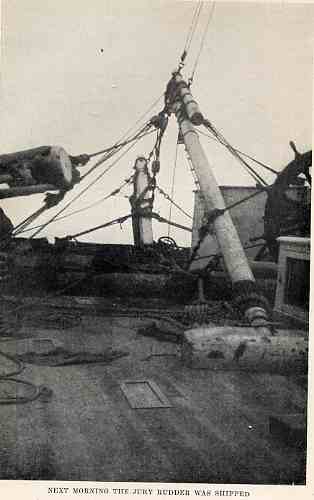
The Aurora was not at the end of her troubles, but the voyage up to New Zealand need not be described in detail. Any attempt to reach McMurdo Sound was now out of the question. Stenhouse had a battered, rudderless ship, with only a few tons of coal left in the bunkers, and he struggled northward in heavy weather against persistent adverse winds and head seas. The jury-rudder needed constant nursing, and the shortage of coal made it impossible to get the best service from the engines. There were times when the ship could make no progress and fell about helplessly in a confused swell or lay hove to amid mountainous seas. She was short-handed, and one or two of the men were creating additional difficulties. But Stenhouse displayed throughout fine seamanship and dogged perseverance. He accomplished successfully one of the most difficult voyages on record, in an ocean area notoriously stormy and treacherous. On March 23 he established wireless communication with Bluff Station, New Zealand, and the next day was in touch with Wellington and Hobart. The naval officer in New Zealand waters offered assistance, and eventually it was arranged that the Otago Harbour Board’s tug Plucky should meet the Aurora outside Port Chalmers. There were still bad days to be endured. The jury-rudder partially carried away and had to be unshipped in a heavy sea. Stenhouse carried on, and in the early morning of April 2 the Aurora picked up the tug and was taken in tow. She reached Port Chalmers the following morning, and was welcomed with the warm hospitality that New Zealand has always shown towards Antarctic explorers.
The Aurora’s troubles were not over, but there is no need to describe the voyage to New Zealand in detail. Any attempt to reach McMurdo Sound was now out of the question. Stenhouse had a battered ship without a rudder and only a few tons of coal left in the bunkers. He struggled northward through heavy weather, against persistent headwinds and oncoming seas. The jury-rudder needed constant attention, and the shortage of coal made it impossible to get the best performance from the engines. At times the ship could make no progress and tossed helplessly in a confused swell or lay hove to amid mountainous seas. She was short-handed, and one or two of the men were causing additional difficulties. But Stenhouse showed fine seamanship and determined perseverance throughout. He successfully completed one of the most difficult voyages on record, through a notoriously stormy and treacherous ocean. On March 23 he established wireless communication with Bluff Station, New Zealand. The next day he was in touch with Wellington and Hobart. The naval officer in New Zealand waters offered assistance. Eventually, it was arranged for the Otago Harbour Board’s tug Plucky to meet the Aurora outside Port Chalmers. There were still bad days to endure. The jury-rudder partly broke away and had to be removed in heavy seas. Stenhouse carried on, and early on April 2 the Aurora met the tug and was taken in tow. She reached Port Chalmers the following morning. The ship was welcomed with the warm hospitality that New Zealand has always shown Antarctic explorers.