Chapter 12
Elephant Island
The twenty-two men who had been left behind on Elephant Island were under the command of Wild, in whom I had absolute confidence, and the account of their experiences during the long four and a half months’ wait while I was trying to get help to them, I have secured from their various diaries, supplemented by details which I obtained in conversation on the voyage back to civilization.
The twenty-two men left on Elephant Island were under Wild’s command. I had absolute confidence in him. They waited for four and a half long months while I tried to get help to them. I have drawn the account of their experiences from their diaries. I have added details I learned in conversation on the voyage back to civilization.
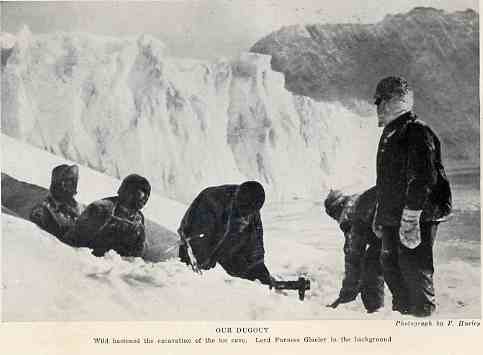
The first consideration, which was even more important than that of food, was to provide shelter. The semi-starvation during the drift on the ice-floe, added to the exposure in the boats, and the inclemencies of the weather encountered after our landing on Elephant Island, had left its mark on a good many of them. Rickenson, who bore up gamely to the last, collapsed from heart-failure. Blackborrow and Hudson could not move. All were frost-bitten in varying degrees and their clothes, which had been worn continuously for six months, were much the worse for wear. The blizzard which sprang up the day that we landed at Cape Wild lasted for a fortnight, often blowing at the rate of seventy to ninety miles an hour, and occasionally reaching even higher figures. The tents which had lasted so well and endured so much were torn to ribbons, with the exception of the square tent occupied by Hurley, James, and Hudson. Sleeping-bags and clothes were wringing wet, and the physical discomforts were tending to produce acute mental depression. The two remaining boats had been turned upside down with one gunwale resting on the snow, and the other raised about two feet on rocks and cases, and under these the sailors and some of the scientists, with the two invalids, Rickenson and Blackborrow, found head-cover at least. Shelter from the weather and warmth to dry their clothes was imperative, so Wild hastened the excavation of the ice-cave in the slope which had been started before I left.
The first priority, even more important than food, was to find shelter. Near starvation during the drift on the ice floe had taken its toll on many of them. So had exposure in the boats and the harsh weather after landing on Elephant Island. Rickenson, who had bravely held out to the last, collapsed from heart failure. Blackborrow and Hudson could not move. All had some degree of frostbite. Their clothes, worn continuously for six months, were badly worn. The blizzard that began on the day we landed at Cape Wild lasted two weeks. Winds often blew at seventy to ninety miles an hour and sometimes even faster. The tents had lasted so well and endured so much, but the blizzard tore them to ribbons. Only the square tent occupied by Hurley, James, and Hudson survived. Sleeping bags and clothes were soaking wet, and the physical discomfort was beginning to cause severe depression. The two remaining boats had been turned upside down. One side of each boat rested on the snow, and the other was raised about two feet on rocks and cases. Under the boats, the sailors, some of the scientists, and the two sick men, Rickenson and Blackborrow, at least had a roof over their heads. They urgently needed shelter from the weather and warmth to dry their clothes. So Wild hurried the excavation of the ice cave in the slope, which had been started before I left.
The high temperature, however, caused a continuous stream of water to drip from the roof and sides of the ice-cave, and as with twenty-two men living in it the temperature would be practically always above freezing, there would have been no hope of dry quarters for them there. Under the direction of Wild they, therefore, collected some big flat stones, having in many cases to dig down under the snow which was covering the beach, and with these they erected two substantial walls four feet high and nineteen feet apart.
However, the high temperature caused water to drip continuously from the roof and sides of the ice cave. With twenty-two men living inside, the temperature would almost always be above freezing. So there would have been no hope of keeping their quarters dry there. Under Wild's direction, the men therefore collected some large, flat stones. In many cases, they had to dig beneath the snow covering the beach to find them. With these stones, they built two sturdy walls, four feet high and nineteen feet apart.
“We are all ridiculously weak, and this part of the work was exceedingly laborious and took us more than twice as long as it would have done had we been in normal health. Stones that we could easily have lifted at other times we found quite beyond our capacity, and it needed two or three of us to carry some that would otherwise have been one man’s load. Our difficulties were added to by the fact that most of the more suitable stones lay at the farther end of the spit, some one hundred and fifty yards away. Our weakness is best compared with that which one experiences on getting up from a long illness; one ‘feels’ well, but physically enervated.
“We are all ridiculously weak, and this part of the work was extremely hard. It took us more than twice as long as it would have if we had been healthy. We could not lift stones that we could easily have lifted at other times. Two or three of us had to carry some stones that one man could normally have carried. Our difficulties were made worse because most of the more suitable stones lay at the far end of the spit, about 150 yards away. Our weakness is best compared to what you experience when you get up after a long illness. You ‘feel’ well, but your body is weak.
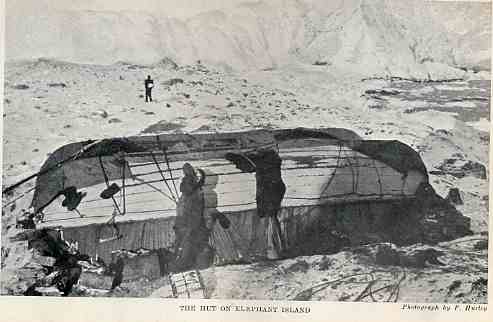
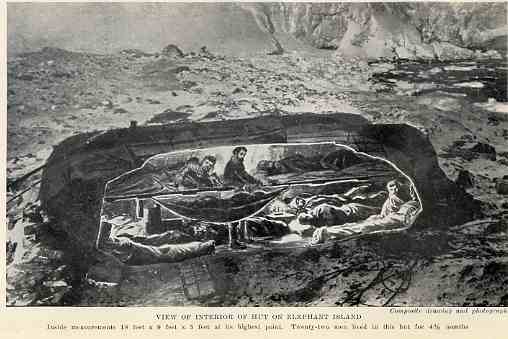
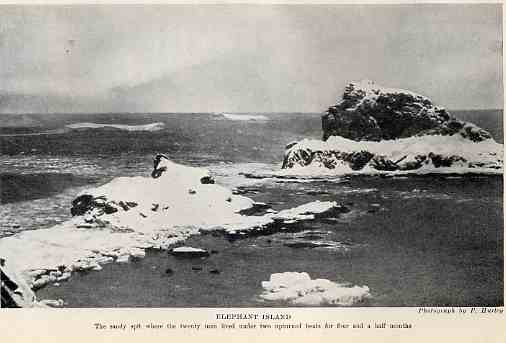
“The site chosen for the hut was the spot where the stove had been originally erected on the night of our arrival. It lay between two large boulders, which, if they would not actually form the walls of the hut, would at least provide a valuable protection from the wind. Further protection was provided to the north by a hill called Penguin Hill at the end of the spit. As soon as the walls were completed and squared off, the two boats were laid upside down on them side by side. The exact adjustment of the boats took some time, but was of paramount importance if our structure was to be the permanent affair that we hoped it would be. Once in place they were securely chocked up and lashed down to the rocks. The few pieces of wood that we had were laid across from keel to keel, and over this the material of one of the torn tents was spread and secured with guys to the rocks. The walls were ingeniously contrived and fixed up by Marston. First he cut the now useless tents into suitable lengths; then he cut the legs of a pair of seaboots into narrow strips, and using these in much the same way that the leather binding is put round the edge of upholstered chairs, he nailed the tent-cloth all round the insides of the outer gunwales of the two boats in such a way that it hung down like a valance to the ground, where it was secured with spars and oars. A couple of overlapping blankets made the door, superseded later by a sack-mouth door cut from one of the tents. This consisted of a sort of tube of canvas sewn on to the tent-cloth, through which the men crawled in or out, tying it up as one would the mouth of a sack as soon as the man had passed through. It is certainly the most convenient and efficient door for these conditions that has ever been invented.
“We chose the spot where the stove had first been set up on the night we arrived. It lay between two large boulders. Even if the boulders did not actually form the hut’s walls, they would provide valuable protection from the wind. Penguin Hill, at the end of the spit, provided further protection to the north. As soon as the walls were finished and squared off, we laid the two boats upside down on them, side by side. Getting the boats into exactly the right position took some time. But it was essential if the structure was to be as lasting as we hoped. Once in place, the boats were securely propped up and lashed to the rocks. We laid our few pieces of wood across the boats, from keel to keel. Over these we spread the material from one of the torn tents and secured it to the rocks with guy ropes. Marston ingeniously devised and fitted the walls. First, he cut the tents, which were now useless, into suitable lengths. Then he cut the legs of a pair of seaboots into narrow strips. He used the strips much like the leather binding around the edge of an upholstered chair. With them, he nailed the tent cloth along the inside of each boat’s outer gunwale. The cloth hung down to the ground like a valance, and he secured it there with spars and oars. Two overlapping blankets made the door. Later, we replaced them with a sack-mouth door cut from one of the tents. This consisted of a tube of canvas sewn onto the tent cloth. The men crawled in or out through the tube. As soon as a man had passed through, it was tied up like the mouth of a sack. It is certainly the most convenient and efficient door ever invented for these conditions.
“Whilst the side walls of the hut were being fixed, others proceeded to fill the interstices between the stones of the end walls with snow. As this was very powdery and would not bind well, we eventually had to supplement it with the only spare blanket and an overcoat. All this work was very hard on our frost-bitten fingers, and materials were very limited.
“While the side walls of the hut were being fixed in place, others filled the gaps between the stones in the end walls with snow. But the snow was very powdery and would not hold together well. So we eventually had to use the only spare blanket and an overcoat as well. All this work was very hard on our frostbitten fingers, and materials were very limited.
“At last all was completed and we were invited to bring in our sodden bags, which had been lying out in the drizzling rain for several hours; for the tents and boats that had previously sheltered them had all been requisitioned to form our new residence.
“At last everything was ready, and we were invited to bring in our soaked bags. They had been lying in the drizzling rain for several hours. That was because the tents and boats that had sheltered them had all been taken to make our new home.
“We took our places under Wild’s direction. There was no squabbling for best places, but it was noticeable that there was something in the nature of a rush for the billets up on the thwarts of the boats.
“We took our places under Wild’s direction. No one argued over the best places, but there seemed to be a rush for spots on the boats’ thwarts.
“Rickenson, who was still very weak and ill, but very cheery, obtained a place in the boat directly above the stove, and the sailors having lived under the Stancomb Wills for a few days while she was upside down on the beach, tacitly claimed it as their own, and flocked up on to its thwarts as one man. There was one ‘upstair’ billet left in this boat, which Wild offered to Hussey and Lees simultaneously, saying that the first man that got his bag up could have the billet. Whilst Lees was calculating the pros and cons Hussey got his bag, and had it up just as Lees had determined that the pros had it. There were now four men up on the thwarts of the Dudley Docker, and the five sailors and Hussey on those of the Stancomb Wills, the remainder disposing themselves on the floor.”
“Rickenson was still very weak and ill, but very cheerful. He found a place in the boat directly above the stove. The sailors had lived under the Stancomb Wills for a few days while she lay upside down on the beach. They silently claimed the boat as their own and climbed onto its thwarts together. One ‘upstairs’ sleeping place remained in this boat. Wild offered it to Hussey and Lees at the same time. He said that the first man to get his bag up could have the place. While Lees was weighing the pros and cons, Hussey fetched his bag. He got it up just as Lees decided that the pros outweighed the cons. There were now four men on the thwarts of the Dudley Docker, and the five sailors and Hussey on those of the Stancomb Wills. The rest settled themselves on the floor.”
The floor was at first covered with snow and ice, frozen in amongst the pebbles. This was cleared out, and the remainder of the tents spread out over the stones. Within the shelter of these cramped but comparatively palatial quarters cheerfulness once more reigned amongst the party. The blizzard, however, soon discovered the flaws in the architecture of their hut, and the fine drift-snow forced its way through the crevices between the stones forming the end walls. Jaeger sleeping-bags and coats were spread over the outside of these walls, packed over with snow and securely frozen up, effectively keeping out this drift.
At first, the floor was covered with snow and ice frozen among the pebbles. The party cleared it away and spread the rest of the tents over the stones. Inside these cramped but comparatively luxurious quarters, the party became cheerful again. But the blizzard soon found the flaws in their hut. Fine drifting snow forced its way through the gaps between the stones in the end walls. They spread Jaeger sleeping bags and coats over the outside of the walls, packed snow over them, and let them freeze securely in place. This effectively kept out the drifting snow.
At first all the cooking was done outside under the lee of some rocks, further protection being provided by a wall of provision-cases. There were two blubber-stoves made from old oil-drums, and one day, when the blizzard was unusually severe, an attempt was made to cook the meals inside the hut. There being no means of escape for the pungent blubber-smoke, the inmates had rather a bad time, some being affected with a form of smoke-blindness similar to snow-blindness, very painful and requiring medical attention.
At first, all the cooking was done outside, sheltered by some rocks. A wall of provision cases provided further protection. There were two blubber stoves made from old oil drums. One day, when the blizzard was unusually severe, the men tried to cook their meals inside the hut. The pungent blubber smoke had no way to escape, so the men had a rather bad time. Some suffered from a form of smoke blindness similar to snow blindness. It was very painful and required medical attention.
A chimney was soon fitted, made by Kerr out of the tin lining of one of the biscuit-cases, and passed through a close-fitting tin grummet sewn into the canvas of the roof just between the keels of the two boats, and the smoke nuisance was soon a thing of the past. Later on, another old oil-drum was made to surround this chimney, so that two pots could be cooked at once on the one stove. Those whose billets were near the stove suffered from the effects of the local thaw caused by its heat, but they were repaid by being able to warm up portions of steak and hooshes left over from previous meals, and even to warm up those of the less fortunate ones, for a consideration. This consisted generally of part of the hoosh or one or two pieces of sugar.
Kerr soon made a chimney from the tin lining of a biscuit case, and it was fitted to the stove. The chimney passed through a close-fitting tin ring sewn into the canvas roof, between the keels of the two boats. The smoke was soon no longer a problem. Later, another old oil drum was fitted around the chimney so that two pots could be cooked at once on the stove. Those who slept near the stove suffered from the melting caused by its heat. But they could warm up portions of steak and hoosh left over from earlier meals. They could even warm up food for the less fortunate, for a fee. The fee was usually some of the hoosh or one or two pieces of sugar.
The cook and his assistant, which latter job was taken by each man in turn, were called about 7 a.m., and breakfast was generally ready by about 10 a.m.
The cook and his assistant were woken around 7 a.m. Each man took a turn as assistant. Breakfast was generally ready around 10 a.m.
Provision-cases were then arranged in a wide circle round the stove, and those who were fortunate enough to be next to it could dry their gear. So that all should benefit equally by this, a sort of “General Post” was carried out, each man occupying his place at meal-times for one day only, moving up one the succeeding day. In this way eventually every man managed to dry his clothes, and life began to assume a much brighter aspect.
We arranged food boxes in a wide circle around the stove. Those lucky enough to sit next to the stove could dry their gear. To make sure everyone benefited equally, we carried out a sort of “General Post.” Each man kept his place at mealtimes for just one day, then moved up one place the next day. In this way, every man eventually managed to dry his clothes, and life began to look much brighter.
The great trouble in the hut was the absence of light. The canvas walls were covered with blubber-soot, and with the snowdrifts accumulating round the hut its inhabitants were living in a state of perpetual night. Lamps were fashioned out of sardine-tins, with bits of surgical bandage for wicks; but as the oil consisted of seal-oil rendered down from the blubber, the remaining fibrous tissue being issued very sparingly at lunch, by the by, and being considered a great delicacy, they were more a means of conserving the scanty store of matches than of serving as illuminants.
The greatest problem in the hut was the lack of light. The canvas walls were covered in soot from burning blubber. Snowdrifts piled up around the hut, leaving its inhabitants in perpetual darkness. They made lamps from sardine tins, using pieces of surgical bandage as wicks. The lamps burned seal oil rendered from blubber. The fibrous tissue left over from rendering was served very sparingly at lunch and, by the way, was considered a great delicacy. But the lamps did more to conserve their scanty supply of matches than to provide light.
Wild was the first to overcome this difficulty by sewing into the canvas wall the glass lid of a chronometer box. Later on three other windows were added, the material in this case being some celluloid panels from a photograph case of mine which I had left behind in a bag. This enabled the occupants of the floor billets who were near enough to read and sew, which relieved the monotony of the situation considerably.
Wild was the first to overcome this difficulty. He sewed the glass lid of a chronometer box into the canvas wall. Later, three other windows were added using celluloid panels from a photograph case I had left behind in a bag. The windows allowed those close enough in the floor billets to read and sew. This made their situation considerably less monotonous.
“Our reading material consisted at this time of two books of poetry, one book of ‘Nordenskjold’s Expedition,’ one or two torn volumes of the ‘Encyclopædia Britannica,’ and a penny cookery book, owned by Marston. Our clothes, though never presentable, as they bore the scars of nearly ten months of rough usage, had to be continually patched to keep them together at all.”
“Our reading material at the time consisted of two books of poetry, a copy of ‘Nordenskjold’s Expedition,’ and one or two torn volumes of the ‘Encyclopædia Britannica.’ We also had a penny cookery book owned by Marston. Our clothes were never presentable, as they showed the wear of nearly ten months of rough use. We had to keep patching them just to hold them together.”
As the floor of the hut had been raised by the addition of loads of clean pebbles, from which most of the snow had been removed, during the cold weather it was kept comparatively dry. When, however, the temperature rose to just above freezing-point, as occasionally happened, the hut became the drainage-pool of all the surrounding hills. Wild was the first to notice it by remarking one morning that his sleeping-bag was practically afloat. Other men examined theirs with a like result, so baling operations commenced forthwith. Stones were removed from the floor and a large hole dug, and in its gloomy depths the water could be seen rapidly rising. Using a saucepan for a baler, they baled out over 100 gallons of dirty water. The next day 150 gallons were removed, the men taking it in turns to bale at intervals during the night; 160 more gallons were baled out during the next twenty-four hours, till one man rather pathetically remarked in his diary, “This is what nice, mild, high temperatures mean to us: no wonder we prefer the cold.” Eventually, by removing a portion of one wall a long channel was dug nearly down to the sea, completely solving the problem. Additional precautions were taken by digging away the snow which surrounded the hut after each blizzard, sometimes entirely obscuring it.
The floor of the hut had been raised with loads of clean pebbles, most of them cleared of snow. This kept the floor relatively dry during cold weather. But when the temperature occasionally rose just above freezing, the hut became a drainage pool for all the surrounding hills. Wild was the first to notice. One morning, he remarked that his sleeping bag was practically afloat. The other men checked their bags and found the same thing, so they immediately began bailing. They removed stones from the floor and dug a large hole. In its gloomy depths, they could see the water rising rapidly. Using a saucepan, they bailed out over 100 gallons of dirty water. The next day they removed 150 gallons, taking turns to bail at intervals during the night. They bailed out another 160 gallons over the next twenty-four hours. One man then remarked rather pathetically in his diary, “This is what nice, mild, high temperatures mean to us: no wonder we prefer the cold.” Eventually, they removed part of one wall and dug a long channel nearly down to the sea. This completely solved the problem. As an added precaution, they dug away the snow surrounding the hut after each blizzard. The snow sometimes hid the hut entirely.
A huge glacier across the bay behind the hut nearly put an end to the party. Enormous blocks of ice weighing many tons would break off and fall into the sea, the disturbance thus caused giving rise to great waves. One day Marston was outside the hut digging up the frozen seal for lunch with a pick, when a noise “like an artillery barrage” startled him. Looking up he saw that one of these tremendous waves, over thirty feet high, was advancing rapidly across the bay, threatening to sweep hut and inhabitants into the sea. A hastily shouted warning brought the men tumbling out, but fortunately the loose ice which filled the bay damped the wave down so much that, though it flowed right under the hut, nothing was carried away. It was a narrow escape, though, as had they been washed into the sea nothing could have saved them.
A huge glacier across the bay behind the hut nearly killed the party. Enormous blocks of ice weighing many tons would break off and fall into the sea, causing huge waves. One day, Marston was outside the hut, using a pick to dig up the frozen seal for lunch. Suddenly, a noise “like an artillery barrage” startled him. He looked up and saw one of these enormous waves rushing across the bay. It was over thirty feet high and threatened to sweep the hut and its inhabitants into the sea. Marston quickly shouted a warning, and the men came tumbling out. Fortunately, the loose ice filling the bay weakened the wave considerably. Though the water flowed right under the hut, nothing was swept away. It was a narrow escape, though. If they had been washed into the sea, nothing could have saved them.
Although they themselves gradually became accustomed to the darkness and the dirt, some entries in their diaries show that occasionally they could realize the conditions under which they were living.
They gradually grew used to the darkness and dirt. But some entries in their diaries show that they occasionally recognized the conditions they were living in.
“The hut grows more grimy every day. Everything is a sooty black. We have arrived at the limit where further increments from the smoking stove, blubber-lamps, and cooking-gear are unnoticed. It is at least comforting to feel that we can become no filthier. Our shingle floor will scarcely bear examination by strong light without causing even us to shudder and express our disapprobation at its state. Oil mixed with reindeer hair, bits of meat, sennegrass, and penguin feathers form a conglomeration which cements the stones together. From time to time we have a spring cleaning, but a fresh supply of flooring material is not always available, as all the shingle is frozen up and buried by deep rifts. Such is our Home Sweet Home.”
“The hut gets dirtier every day. Everything is sooty black. We have reached the point where we no longer notice more soot from the smoking stove, blubber lamps, and cooking gear. It is at least comforting to think that we cannot get any filthier. Even we can hardly examine our shingle floor in a strong light without shuddering and complaining about its condition. Oil, reindeer hair, bits of meat, sennegrass, and penguin feathers form a mass that cements the stones together. From time to time we give the hut a spring cleaning. But fresh shingle for the floor is not always available, because all of it is frozen and buried under deep snowdrifts. Such is our Home Sweet Home.”
“All joints are aching through being compelled to lie on the hard, rubbly floor which forms our bedsteads.”
“All our joints ache because we have to lie on the hard, rubble-covered floor that serves as our beds.”
Again, later on, one writes: “Now that Wild’s window allows a shaft of light to enter our hut, one can begin to ‘see’ things inside. Previously one relied upon one’s sense of touch, assisted by the remarks from those whose faces were inadvertently trodden on, to guide one to the door. Looking down in the semi-darkness to the far end, one observes two very small smoky flares that dimly illuminate a row of five, endeavouring to make time pass by reading or argument. These are Macklin, Kerr, Wordie, Hudson, and Blackborrow—the last two being invalids.
Again, later on, one man writes: “Now that Wild’s window lets a shaft of light into our hut, we can begin to ‘see’ things inside. Before, we relied on touch to find the door. The remarks of those whose faces we accidentally stepped on also helped guide us. Looking down through the dim light to the far end, we see two very small smoky flares. They barely light a row of five men, trying to pass the time by reading or arguing. They are Macklin, Kerr, Wordie, Hudson, and Blackborrow. Hudson and Blackborrow are both ill.
“The centre of the hut is filled with the cases which do duty for the cook’s bed, the meat and blubber boxes, and a mummified-looking object, which is Lees in his sleeping-bag. The near end of the floor space is taken up with the stove, with Wild and McIlroy on one side, and Hurley and James on the other. Marston occupies a hammock most of the night—and day—which is slung across the entrance. As he is large and the entrance very small, he invariably gets bumped by those passing in and out. His vocabulary at such times is interesting.
“The center of the hut is filled with cases that serve as the cook’s bed, boxes of meat and blubber, and a mummified-looking object. The object is Lees in his sleeping bag. At the near end of the floor space is the stove, with Wild and McIlroy on one side and Hurley and James on the other. Marston spends most of the night and day in a hammock slung across the entrance. Because he is large and the entrance is very small, people passing in and out always bump into him. His vocabulary at such times is interesting.
“In the attic, formed by the two upturned boats, live ten unkempt and careless lodgers, who drop boots, mitts, and other articles of apparel on to the men below. Reindeer hairs rain down incessantly day and night, with every movement that they make in their moulting bags. These, with penguin feathers and a little grit from the floor, occasionally savour the hooshes. Thank heaven man is an adaptable brute! If we dwell sufficiently long in this hut, we are likely to alter our method of walking, for our ceiling, which is but four feet six inches high at its highest part, compels us to walk bent double or on all fours.
“Ten unkempt and careless lodgers live in the attic, which is formed by two upturned boats. They drop boots, mittens, and other clothing onto the men below. Day and night, reindeer hair rains down whenever the lodgers move in their shedding bags. The hair, along with penguin feathers and a little grit from the floor, occasionally flavors the hooshes. Thank heaven man is an adaptable brute! If we live in this hut long enough, we are likely to change the way we walk. The ceiling is only four feet six inches high at its highest point, so we must walk bent double or on all fours.
“Our doorway—Cheetham is just crawling in now, bringing a shower of snow with him—was originally a tent entrance. When one wishes to go out, one unties the cord securing the door, and crawls or wriggles out, at the same time exclaiming ‘Thank goodness I’m in the open air!’ This should suffice to describe the atmosphere inside the hut, only pleasant when charged with the overpowering yet appetizing smell of burning penguin steaks.
“Our doorway was originally a tent entrance. Cheetham is just crawling in now, bringing a shower of snow with him. When you want to go out, you untie the cord securing the door and crawl or wriggle out. As you do, you exclaim, ‘Thank goodness I’m in the open air!’ That should give you an idea of the atmosphere inside the hut. It is pleasant only when filled with the overpowering yet appetizing smell of burning penguin steaks.
“From all parts there dangles an odd collection of blubbery garments, hung up to dry, through which one crawls, much as a chicken in an incubator. Our walls of tent-canvas admit as much light as might be expected from a closed Venetian blind. It is astonishing how we have grown accustomed to inconveniences, and tolerate, at least, habits which a little time back were regarded with repugnance. We have no forks, but each man has a sheath-knife and a spoon, the latter in many cases having been fashioned from a piece of box lid. The knife serves many purposes. With it we kill, skin, and cut up seals and penguins, cut blubber into strips for the fire, very carefully scrape the snow off our hut walls, and then after a perfunctory rub with an oily penguin-skin, use it at meals. We are as regardless of our grime and dirt as is the Esquimaux. We have been unable to wash since we left the ship, nearly ten months ago. For one thing we have no soap or towels, only bare necessities being brought with us; and, again, had we possessed these articles, our supply of fuel would only permit us to melt enough ice for drinking purposes. Had one man washed, half a dozen others would have had to go without a drink all day. One cannot suck ice to relieve the thirst, as at these low temperatures it cracks the lips and blisters the tongue. Still, we are all very cheerful.”
“An odd collection of greasy clothes hangs everywhere to dry. We crawl through the clothes much like a chick in an incubator. Our tent canvas walls let in about as much light as a closed Venetian blind. It is astonishing how used we have become to discomfort. At least we tolerate habits that would have disgusted us not long ago. We have no forks, but each man has a sheathed knife and a spoon. Many of the spoons were made from pieces of box lids. The knife serves many purposes. We use it to kill, skin, and cut up seals and penguins, and to cut blubber into strips for the fire. We also use it to scrape snow very carefully off the walls of our hut. Then, after a quick rub with an oily penguin skin, we use it at meals. We are as unconcerned about our grime and dirt as the Eskimos are. We have been unable to wash since we left the ship nearly ten months ago. For one thing, we have no soap or towels. We brought only the bare necessities with us. Even if we had soap and towels, our fuel supply would let us melt only enough ice for drinking. If one man had washed, half a dozen others would have had nothing to drink all day. We cannot suck ice to relieve our thirst because, at these low temperatures, it cracks our lips and blisters our tongues. Still, we are all very cheerful.”
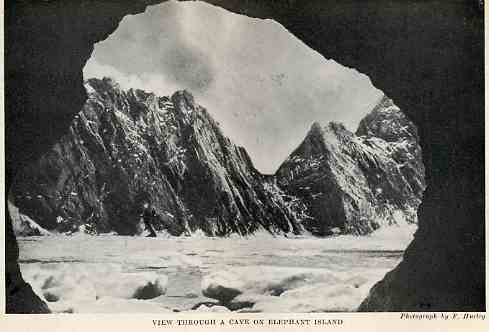
During the whole of their stay on Elephant Island the weather was described by Wild as “simply appalling.” Stranded as they were on a narrow, sandy beach surrounded by high mountains, they saw little of the scanty sunshine during the brief intervals of clear sky. On most days the air was full of snowdrift blown from the adjacent heights. Elephant Island being practically on the outside edge of the pack, the winds which passed over the relatively warm ocean before reaching it clothed it in a “constant pall of fog and snow.”
Wild described the weather throughout their stay on Elephant Island as “simply appalling.” They were stranded on a narrow, sandy beach surrounded by high mountains. Even during the brief periods of clear sky, they saw little of the scarce sunshine. On most days, the air was full of snow blown from the nearby heights. Elephant Island lay almost at the outer edge of the pack ice. The winds passed over the relatively warm ocean before reaching the island, covering it in a “constant pall of fog and snow.”
On April 25, the day after I left for South Georgia, the island was beset by heavy pack-ice, with snow and a wet mist. Next day was calmer, but on the 27th, to quote one of the diaries, they experienced “the most wretched weather conceivable. Raining all night and day, and blowing hard. Wet to the skin.” The following day brought heavy fog and sleet, and a continuance of the blizzard. April ended with a terrific windstorm which nearly destroyed the hut. The one remaining tent had to be dismantled, the pole taken down, and the inhabitants had to lie flat all night under the icy canvas. This lasted well into May, and a typical May day is described as follows: “A day of terrific winds, threatening to dislodge our shelter. The wind is a succession of hurricane gusts that sweep down the glacier immediately south-south-west of us. Each gust heralds its approach by a low rumbling which increases to a thunderous roar. Snow, stones, and gravel are flying about, and any gear left unweighted by very heavy stones is carried away to sea.”
On April 25, the day after I left for South Georgia, heavy pack ice surrounded the island. Snow and wet mist filled the air. The next day was calmer, but on the 27th, one diary recorded “the most miserable weather imaginable. Rain all night and day, and strong winds. Wet to the skin.” The following day brought thick fog and sleet, and the blizzard continued. April ended with a fierce windstorm that nearly destroyed the hut. The men had to take down their one remaining tent and its pole. They lay flat all night under the icy canvas. The stormy weather lasted well into May. One diary described a typical day: “A day of fierce winds, threatening to tear our shelter loose. Hurricane gusts sweep down the glacier immediately south-south-west of us, one after another. Each gust announces its approach with a low rumble that grows into a thunderous roar. Snow, stones, and gravel are flying about. Any gear not held down by very heavy stones is swept away to sea.”
Heavy bales of sennegrass, and boxes of cooking-gear, were lifted bodily in the air and carried away out of sight. Once the wind carried off the floor-cloth of a tent which six men were holding on to and shaking the snow off. These gusts often came with alarming suddenness; and without any warning. Hussey was outside in the blizzard digging up the day’s meat, which had frozen to the ground, when a gust caught him and drove him down the spit towards the sea. Fortunately, when he reached the softer sand and shingle below high-water mark, he managed to stick his pick into the ground and hold on with both hands till the squall had passed.
Heavy bales of sennegrass and boxes of cooking gear were lifted into the air and carried out of sight. Once, the wind carried off a tent’s floorcloth while six men were holding it and shaking the snow off. These gusts often came with alarming suddenness and no warning. Hussey was outside in the blizzard, digging up the day’s meat, which had frozen to the ground. A gust caught him and drove him down the spit towards the sea. Fortunately, he reached the softer sand and shingle below the high-water mark. There, he managed to stick his pick into the ground and hold on with both hands until the squall passed.
On one or two rare occasions they had fine, calm, clear days. The glow of the dying sun on the mountains and glaciers filled even the most materialistic of them with wonder and admiration. These days were sometimes succeeded by calm, clear nights, when, but for the cold, they would have stayed out on the sandy beach all night.
On one or two rare occasions, they had beautiful, calm, clear days. The setting sun lit up the mountains and glaciers. The glow filled even the most materialistic among them with wonder and admiration. Sometimes calm, clear nights followed these days. If it had not been so cold, they would have stayed on the sandy beach all night.
About the middle of May a terrific blizzard sprang up, blowing from sixty to ninety miles an hour, and Wild entertained grave fears for their hut. One curious feature noted in this blizzard was the fact that huge ice-sheets as big as window-panes, and about a quarter of an inch thick, were being hurled about by the wind, making it as dangerous to walk about outside as if one were in an avalanche of splintered glass. Still, these winds from the south and south-west, though invariably accompanied by snow and low temperatures, were welcome in that they drove the pack-ice away from the immediate vicinity of the island, and so gave rise on each occasion to hopes of relief. North-east winds, on the other hand, by filling the bays with ice and bringing thick misty weather, made it impossible to hope for any ship to approach them.
Around the middle of May, a fierce blizzard arose, with winds blowing at sixty to ninety miles an hour. Wild was seriously worried about their hut. The blizzard had one curious feature. The wind hurled huge sheets of ice through the air, each as big as a windowpane and about a quarter of an inch thick. Walking outside was as dangerous as being caught in an avalanche of splintered glass. Still, winds from the south and south-west were welcome, although they always brought snow and low temperatures. They drove the pack ice away from the island, raising hopes of rescue each time. North-east winds, on the other hand, filled the bays with ice and brought thick mist. They made it impossible to hope that any ship could reach them.
Towards the end of May a period of dead calm set in, with ice closely packed all round the island. This gave place to north-east winds and mist, and at the beginning of June came another south-west blizzard, with cold driving snow. “The blizzard increased to terrific gusts during the night, causing us much anxiety for the safety of our hut. There was little sleep, all being apprehensive of the canvas roof ripping off, and the boats being blown out to sea.”
Toward the end of May, the wind died completely, and ice packed tightly around the island. Then northeast winds and mist set in. At the beginning of June, another southwest blizzard brought cold, driving snow. “During the night, the blizzard grew into terrifying gusts, and we worried greatly about the safety of our hut. We slept little, as everyone feared the canvas roof might rip off and the boats might blow out to sea.”
Thus it continued, alternating between south-west blizzards, when they were all confined to the hut, and north-east winds bringing cold, damp, misty weather.
The weather continued to alternate between southwest blizzards and northeast winds. During the blizzards, they were all confined to the hut. The northeast winds brought cold, damp, misty weather.
On June 25 a severe storm from north-west was recorded, accompanied by strong winds and heavy seas, which encroached upon their little sandy beach up to within four yards of their hut.
On June 25, a severe storm from the northwest was recorded, with strong winds and heavy seas. The waves reached across their small sandy beach to within four yards of their hut.
Towards the end of July and the beginning of August they had a few fine, calm, clear days. Occasional glimpses of the sun, with high temperatures, were experienced, after south-west winds had blown all the ice away, and the party, their spirits cheered by Wild’s unfailing optimism, again began to look eagerly for the rescue ship.
Towards the end of July and the beginning of August, they had a few fine, calm, clear days. After southwest winds had blown all the ice away, they occasionally saw the sun and experienced high temperatures. Wild’s unfailing optimism cheered the party’s spirits, and they again began to look eagerly for the rescue ship.
The first three attempts at their rescue unfortunately coincided with the times when the island was beset with ice, and though on the second occasion we approached close enough to fire a gun, in the hope that they would hear the sound and know that we were safe and well, yet so accustomed were they to the noise made by the calving of the adjacent glacier that either they did not hear or the sound passed unnoticed. On August 16 pack was observed on the horizon, and next day the bay was filled with loose ice, which soon consolidated. Soon afterwards huge old floes and many bergs drifted in. “The pack appears as dense as we have ever seen it. No open water is visible, and ‘ice-blink’ girdles the horizon. The weather is wretched—a stagnant calm of air and ocean alike, the latter obscured by dense pack through which no swell can penetrate, and a wet mist hangs like a pall over land and sea. The silence is oppressive. There is nothing to do but to stay in one’s sleeping-bag, or else wander in the soft snow and become thoroughly wet.” Fifteen inches of snow fell in the next twenty-four hours, making over two feet between August 18 and 21. A slight swell next day from the north-east ground up the pack-ice, but this soon subsided, and the pack became consolidated once more. On August 27 a strong west-south-west wind sprang up and drove all this ice out of the bay, and except for some stranded bergs left a clear ice-free sea through which we finally made our way from Punta Arenas to Elephant Island.
Unfortunately, the first three attempts to rescue them coincided with periods when ice surrounded the island. On the second attempt, we came close enough to fire a gun. We hoped they would hear it and know we were safe and well. But they were so used to the noise of ice breaking off the nearby glacier that they either did not hear it or did not notice it. On August 16, pack ice appeared on the horizon. The next day, loose ice filled the bay and soon froze together. Soon afterward, huge old floes and many icebergs drifted in. “The pack ice looks as dense as we have ever seen it. No open water is visible, and ‘ice-blink’ surrounds the horizon. The weather is miserable. The air and ocean are completely still. Dense pack ice covers the ocean, and no swell can pass through it. A wet mist hangs like a shroud over land and sea. The silence is oppressive. There is nothing to do but stay in one’s sleeping bag or wander through the soft snow and get thoroughly wet.” Fifteen inches of snow fell in the next twenty-four hours. That brought the total between August 18 and 21 to more than two feet. The next day, a slight swell from the north-east broke up the pack ice. But the swell soon died down, and the pack ice froze together again. On August 27, a strong west-south-west wind sprang up and drove all the ice out of the bay. Except for some stranded icebergs, the sea was left clear of ice. We finally made our way through it from Punta Arenas to Elephant Island.
As soon as I had left the island to get help for the rest of the Expedition, Wild set all hands to collect as many seals and penguins as possible, in case their stay was longer than was at first anticipated. A sudden rise in temperature caused a whole lot to go bad and become unfit for food, so while a fair reserve was kept in hand too much was not accumulated.
As soon as I left the island to get help for the rest of the Expedition, Wild put everyone to work collecting seals and penguins. He wanted to gather as many as possible in case their stay was longer than expected. A sudden rise in temperature caused a lot of the meat to spoil and become unfit to eat. So they kept a reasonable reserve but did not stockpile too much.
At first the meals, consisting mostly of seal meat with one hot drink per day, were cooked on a stove in the open. The snow and wind, besides making it very unpleasant for the cook, filled all the cooking-pots with sand and grit, so during the winter the cooking was done inside the hut.
At first, meals were cooked on a stove outside. They consisted mostly of seal meat, with one hot drink per day. The snow and wind made cooking very unpleasant and filled all the cooking pots with sand and grit. So during the winter, the cooking was done inside the hut.
A little Cerebos salt had been saved, and this was issued out at the rate of three-quarters of an ounce per man per week. Some of the packets containing the salt had broken, so that all did not get the full ration. On the other hand, one man dropped his week’s ration on the floor of the hut, amongst the stones and dirt. It was quickly collected, and he found to his delight that he had enough now to last him for three weeks. Of course it was not all salt. The hot drink consisted at first of milk made from milk-powder up to about one-quarter of its proper strength. This was later on diluted still more, and sometimes replaced by a drink made from a pea-soup-like packing from the Bovril sledging rations. For midwinter’s day celebrations, a mixture of one teaspoonful of methylated spirit in a pint of hot water, flavoured with a little ginger and sugar, served to remind some of cock-tails and Veuve Cliquot.
A little Cerebos salt had been saved. It was issued at a rate of three-quarters of an ounce per man per week. Some salt packets had broken, so not everyone got the full ration. On the other hand, one man dropped his week’s ration on the hut floor, among the stones and dirt. He quickly collected it and was delighted to find he now had enough to last three weeks. Of course, it was not all salt. At first, the hot drink was made from milk powder, at about one-quarter of its proper strength. Later, the milk was diluted even more. Sometimes it was replaced by a drink made from a pea-soup-like packing from the Bovril sledging rations. For the midwinter’s day celebrations, they mixed one teaspoonful of methylated spirit with a pint of hot water. A little ginger and sugar were added for flavor. The drink reminded some of cocktails and Veuve Cliquot.
At breakfast each had a piece of seal or half a penguin breast. Luncheon consisted of one biscuit on three days a week, nut-food on Thursdays, bits of blubber, from which most of the oil had been extracted for the lamps, on two days a week, and nothing on the remaining day. On this day breakfast consisted of a half-strength sledging ration. Supper was almost invariably seal and penguin, cut up very finely and fried with a little seal blubber.
At breakfast, each person had a piece of seal or half a penguin breast. For lunch, we had one biscuit on three days a week and nut-food on Thursdays. On two days, we had bits of blubber, with most of the oil extracted for the lamps. On the remaining day, we had nothing for lunch. On that day, breakfast consisted of a half-strength sledging ration. Supper was almost always seal and penguin, chopped very finely and fried with a little seal blubber.
There were occasionally very welcome variations from this menu. Some paddies—a little white bird not unlike a pigeon—were snared with a loop of string, and fried, with one water-sodden biscuit, for lunch. Enough barley and peas for one meal all round of each had been saved, and when this was issued it was a day of great celebration. Sometimes, by general consent, the luncheon biscuit would be saved, and, with the next serving of biscuit, was crushed in a canvas bag into a powder and boiled, with a little sugar, making a very satisfying pudding. When blubber was fairly plentiful there was always a saucepan of cold water, made from melting down the pieces of ice which had broken off from the glacier, fallen into the sea, and been washed ashore, for them to quench their thirst in. As the experience of Arctic explorers tended to show that sea-water produced a form of dysentery, Wild was rather diffident about using it. Penguin carcasses boiled in one part of sea-water to four of fresh were a great success, though, and no ill-effects were felt by anybody.
There were occasional, very welcome changes to this menu. Some paddies, small white birds rather like pigeons, were caught with a loop of string. They were fried for lunch, along with one waterlogged biscuit. Enough barley and peas had been saved to give everyone one meal of each. The day these were issued was a day of great celebration. Sometimes everyone agreed to save the lunch biscuit. With the next serving of biscuit, it was crushed to powder in a canvas bag and boiled with a little sugar. This made a very satisfying pudding. When blubber was fairly plentiful, there was always a saucepan of cold water for them to quench their thirst. The water came from melted pieces of ice that had broken off the glacier, fallen into the sea, and washed ashore. The experience of Arctic explorers suggested that seawater caused a form of dysentery, so Wild was rather hesitant to use it. Penguin carcasses boiled in one part seawater to four parts fresh water were a great success, though. Nobody felt any ill effects.
The ringed penguins migrated north the day after we landed at Cape Wild, and though every effort was made to secure as large a stock of meat and blubber as possible, by the end of the month the supply was so low that only one hot meal a day could be served. Twice the usual number of penguin steaks were cooked at breakfast, and the ones intended for supper were kept hot in the pots by wrapping up in coats, etc. “Clark put our saucepanful in his sleeping-bag to-day to keep it hot, and it really was a great success in spite of the extra helping of reindeer hairs that it contained. In this way we can make ten penguin skins do for one day.”
The ringed penguins migrated north the day after we landed at Cape Wild. We made every effort to gather as much meat and blubber as possible. Even so, by the end of the month, supplies were so low that we could serve only one hot meal a day. At breakfast, we cooked twice the usual number of penguin steaks. We kept the steaks for supper hot in the pots by wrapping them in coats and other things. “Today Clark put our saucepanful in his sleeping bag to keep it hot. It really was a great success, despite the extra helping of reindeer hairs it contained. In this way, we can make ten penguin skins last a day.”
Some who were fortunate enough to catch penguins with fairly large undigested fish in their gullets used to warm these up in tins hung on bits of wire round the stove.
Some were lucky enough to catch penguins with fairly large, undigested fish in their throats. They warmed the fish in tins hung on pieces of wire around the stove.
“All the meat intended for hooshes is cut up inside the hut, as it is too cold outside. As the boards which we use for the purpose are also used for cutting up tobacco, when we still have it, a definite flavour is sometimes imparted to the hoosh, which, if anything, improves it.”
“All the meat for hooshes is cut up inside the hut because it is too cold outside. We also use the boards to cut up tobacco, when we still have any. As a result, the hoosh sometimes has a distinct tobacco flavour, which, if anything, improves it.”
Their diet was now practically all meat, and not too much of that, and all the diaries bear witness to their craving for carbohydrates, such as flour, oatmeal, etc. One man longingly speaks of the cabbages which grow on Kerguelen Island. By June 18 there were only nine hundred lumps of sugar left, i.e., just over forty pieces each. Even my readers know what shortage of sugar means at this very date, but from a different cause. Under these circumstances it is not surprising that all their thoughts and conversation should turn to food, past and future banquets, and second helpings that had been once refused.
Their diet was now almost entirely meat, and there was not much of that. All the diaries show how much they craved carbohydrates, such as flour and oatmeal. One man writes longingly of the cabbages that grow on Kerguelen Island. By June 18, only nine hundred lumps of sugar remained, that is, just over forty pieces each. Even my readers know what a sugar shortage means right now, though for a different reason. In these circumstances, it is not surprising that all their thoughts and conversations turned to food. They thought and talked about past and future feasts, and second helpings they had once refused.
A census was taken, each man being asked to state just what he would like to eat at that moment if he were allowed to have anything that he wanted. All, with but one exception, desired a suet pudding of some sort—the “duff” beloved of sailors. Macklin asked for many returns of scrambled eggs on hot buttered toast. Several voted for “a prodigious Devonshire dumpling,” while Wild wished for “any old dumpling so long as it was a large one.” The craving for carbohydrates, such as flour and sugar, and for fats was very real. Marston had with him a small penny cookery book. From this he would read out one recipe each night, so as to make them last. This would be discussed very seriously, and alterations and improvements suggested, and then they would turn into their bags to dream of wonderful meals that they could never reach. The following conversation was recorded in one diary:
We took a poll. Each man was asked what he would most like to eat if he could have anything he wanted. All but one wanted some kind of suet pudding, the “duff” beloved by sailors. Macklin asked for many helpings of scrambled eggs on hot buttered toast. Several voted for “a prodigious Devonshire dumpling,” while Wild wished for “any old dumpling so long as it was a large one.” The craving for carbohydrates, such as flour and sugar, and for fats was very real. Marston had a small cookery book that cost a penny. He read one recipe from it each night, so the recipes would last. The men would discuss each recipe very seriously and suggest changes and improvements. Then they would turn into their sleeping bags and dream of wonderful meals they could never have. One diary recorded the following conversation:
“WILD: ‘Do you like doughnuts?’
“WILD: ‘Do you like doughnuts?’
“McILROY: ‘Rather!’
“McILROY: ‘Absolutely!’
“WILD: ‘Very easily made, too. I like them cold with a little jam.’
“WILD: ‘They are very easy to make, too. I like them cold with a little jam.’
“McILROY: ‘Not bad; but how about a huge omelette?’
“McILROY: ‘Not bad, but how about a huge omelette?’
“WILD: ‘Fine!’ (with a deep sigh).
“WILD: ‘Fine!’ (with a deep sigh).
“Overhead, two of the sailors are discussing, some extraordinary mixture of hash, apple-sauce, beer, and cheese. Marston is in his hammock reading from his penny cookery book. Farther down, some one eulogizes Scotch shortbread. Several of the sailors are talking of spotted dog, sea-pie, and Lockhart’s with great feeling. Some one mentions nut-food, whereat the conversation becomes general, and we all decide to buy one pound’s worth of it as soon as we get to civilization, and retire to a country house to eat it undisturbed. At present we really mean it, too!”
“Overhead, two sailors are discussing an extraordinary mixture of hash, apple sauce, beer, and cheese. Marston is in his hammock, reading from his cheap cookery book. Farther down, someone is praising Scottish shortbread. Several sailors are talking passionately about spotted dog, sea-pie, and Lockhart’s. Someone mentions nut-food, and everyone joins the conversation. We all decide to buy a pound’s worth of nut-food as soon as we reach civilization. Then we will retire to a country house to eat it undisturbed. At the moment, we really mean it, too!”
Midwinter’s day, the great Polar festival, was duly observed. A “magnificent breakfast” of sledging ration hoosh, full strength and well boiled to thicken it, with hot milk was served. Luncheon consisted of a wonderful pudding, invented by Wild, made of powdered biscuit boiled with twelve pieces of mouldy nut-food. Supper was a very finely cut seal hoosh flavoured with sugar.
Midwinter’s day, the great Polar festival, was duly celebrated. A “magnificent breakfast” of sledging ration hoosh was served with hot milk. The hoosh was full strength and well boiled to thicken it. Lunch consisted of a wonderful pudding invented by Wild. It was made of powdered biscuit boiled with twelve pieces of mouldy nut-food. Supper was a hoosh of very finely cut seal, flavoured with sugar.
After supper they had a concert, accompanied by Hussey on his “indispensable banjo.” This banjo was the last thing to be saved off the ship before she sank, and I took it with us as a mental tonic. It was carried all the way through with us, and landed on Elephant Island practically unharmed, and did much to keep the men cheerful. Nearly every Saturday night such a concert was held, when each one sang a song about some other member of the party. If that other one objected to some of the remarks, a worse one was written for the next week.
After supper, they had a concert, with Hussey accompanying them on his “indispensable banjo.” The banjo was the last thing saved from the ship before she sank. I took it with us as a mental tonic. We carried it all the way, and it reached Elephant Island practically unharmed. It did much to keep the men cheerful. They held a concert like this nearly every Saturday night. Each man sang a song about another member of the party. If that person objected to some of the remarks, a worse song was written for the next week.
The cook, who had carried on so well and for so long, was given a rest on August 9, and each man took it in turns to be cook for one week. As the cook and his “mate” had the privilege of scraping out the saucepans, there was some anxiety to secure the job, especially amongst those with the larger appetites. “The last of the methylated spirit was drunk on August 12, and from then onwards the King’s health, ‘sweethearts and wives,’ and ‘the Boss and crew of the Caird,’ were drunk in hot water and ginger every Saturday night.”
The cook had done his job well for a long time, so he was given a rest on August 9. Each man then took a turn as cook for one week. The cook and his “mate” had the privilege of scraping out the saucepans. Because of this, some men were eager to get the job, especially those with larger appetites. “The last of the methylated spirit was drunk on August 12. After that, every Saturday night, they toasted the King’s health, ‘sweethearts and wives,’ and ‘the Boss and crew of the Caird,’ with hot water and ginger.”
The penguins and seals which had migrated north at the beginning of winter had not yet returned, or else the ice-foot, which surrounded the spit to a thickness of six feet, prevented them from coming ashore, so that food was getting short. Old seal-bones, that had been used once for a meal and then thrown away, were dug up and stewed down with sea-water. Penguin carcasses were treated likewise. Limpets were gathered from the pools disclosed between the rocks below high tide, after the pack-ice had been driven away. It was a cold job gathering these little shell-fish, as for each one the whole hand and arm had to be plunged into the icy water, and many score of these small creatures had to be collected to make anything of a meal. Seaweed boiled in sea-water was used to eke out the rapidly diminishing stock of seal and penguin meat. This did not agree with some of the party. Though it was acknowledged to be very tasty it only served to increase their appetite—a serious thing when there was nothing to satisfy it with! One man remarked in his diary: “We had a sumptuous meal to-day—nearly five ounces of solid food each.”
The penguins and seals that had migrated north at the beginning of winter had not yet returned. Or perhaps the ice-foot, six feet thick around the spit, kept them from coming ashore. As a result, food was running short. Old seal bones, already used for a meal and then thrown away, were dug up and stewed in seawater. Penguin carcasses were treated in the same way. After the pack ice had been driven away, we gathered limpets from pools among the rocks below the high-tide mark. Gathering these small shellfish was cold work. For each one, we had to plunge a whole hand and arm into the icy water. Many dozens were needed to make anything like a meal. Seaweed boiled in seawater was used to stretch the rapidly shrinking supply of seal and penguin meat. The seaweed did not agree with some of the party. Though everyone agreed it was very tasty, it only increased their appetite. That was a serious matter when there was nothing to satisfy it! One man remarked in his diary: “We had a sumptuous meal today, nearly five ounces of solid food each.”
It is largely due to Wild, and to his energy, initiative, and resource, that the whole party kept cheerful all along, and, indeed, came out alive and so well. Assisted by the two surgeons, Drs. McIlroy and Macklin, he had ever a watchful eye for the health of each one. His cheery optimism never failed, even when food was very short and the prospect of relief seemed remote. Each one in his diary speaks with admiration of him. I think without doubt that all the party who were stranded on Elephant Island owe their lives to him. The demons of depression could find no foothold when he was around; and, not content with merely “telling,” he was “doing” as much as, and very often more than, the rest. He showed wonderful capabilities of leadership and more than justified the absolute confidence that I placed in him. Hussey, with his cheeriness and his banjo, was another vital factor in chasing away any tendency to downheartedness.
The whole party stayed cheerful throughout, and survived in such good condition, largely thanks to Wild. His energy, initiative, and resourcefulness made the difference. With help from the two surgeons, Drs. McIlroy and Macklin, he kept a close watch on everyone’s health. His cheerful optimism never failed, even when food was scarce and rescue seemed unlikely. Everyone writes of him with admiration in their diaries. I have no doubt that all those stranded on Elephant Island owe their lives to him. Depression could gain no foothold when he was around. He was not content merely with “telling.” He was “doing” as much as everyone else, and very often more. He showed remarkable leadership and more than justified the complete confidence I placed in him. Hussey, with his cheerfulness and his banjo, was another vital force in keeping everyone’s spirits up.
Once they were settled in their hut, the health of the party was quite good. Of course, they were all a bit weak, some were light-headed, all were frost-bitten, and others, later, had attacks of heart failure. Blackborrow, whose toes were so badly frost-bitten in the boats, had to have all five amputated while on the island. With insufficient instruments and no proper means of sterilizing them, the operation, carried out as it was in a dark, grimy hut, with only a blubber-stove to keep up the temperature and with an outside temperature well below freezing, speaks volumes for the skill and initiative of the surgeons. I am glad to be able to say that the operation was very successful, and after a little treatment ashore, very kindly given by the Chilian doctors at Punta Arenas, he has now completely recovered and walks with only a slight limp. Hudson, who developed bronchitis and hip disease, was practically well again when the party was rescued. All trace of the severe frost-bites suffered in the boat journey had disappeared, though traces of recent superficial ones remained on some. All were naturally weak when rescued, owing to having been on such scanty rations for so long, but all were alive and very cheerful, thanks to Frank Wild.
Once the party had settled into their hut, their health was quite good. Of course, they were all a bit weak, some were light-headed, and all had frostbite. Others later suffered attacks of heart failure. Blackborrow’s toes had been so badly frostbitten in the boats that all five had to be amputated on the island. The surgeons had inadequate instruments and no proper way to sterilize them. They operated in a dark, grimy hut, with only a blubber stove for warmth. Outside, the temperature was well below freezing. The operation speaks volumes for their skill and resourcefulness. I am glad to say it was very successful. After some treatment ashore, kindly given by the Chilean doctors at Punta Arenas, Blackborrow has now completely recovered. He walks with only a slight limp. Hudson, who developed bronchitis and hip disease, was almost well again when the party was rescued. All traces of the severe frostbite suffered during the boat journey had disappeared. Some, however, still had signs of recent, superficial frostbite. All were naturally weak when rescued because they had lived on such small rations for so long. But all were alive and very cheerful, thanks to Frank Wild.
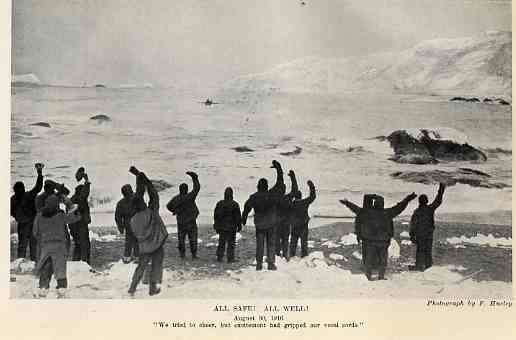
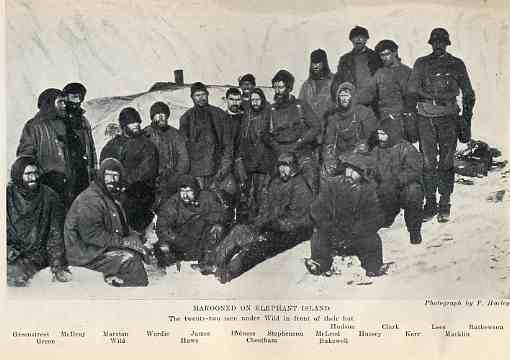
August 30, 1916, is described in their diaries as a “day of wonders.” Food was very short, only two days’ seal and penguin meat being left, and no prospect of any more arriving. The whole party had been collecting limpets and seaweed to eat with the stewed seal bones. Lunch was being served by Wild, Hurley and Marston waiting outside to take a last long look at the direction from which they expected the ship to arrive. From a fortnight after I had left, Wild would roll up his sleeping-bag each day with the remark, “Get your things ready, boys, the Boss may come to-day.” And sure enough, one day the mist opened and revealed the ship for which they had been waiting and longing and hoping for over four months. “Marston was the first to notice it, and immediately yelled out ‘Ship O!’ The inmates of the hut mistook it for a call of ‘Lunch O!’ so took no notice at first. Soon, however, we heard him pattering along the snow as fast as he could run, and in a gasping, anxious voice, hoarse with excitement, he shouted, ‘Wild, there’s a ship! Hadn’t we better light a flare?’ We all made one dive for our narrow door. Those who could not get through tore down the canvas walls in their hurry and excitement. The hoosh-pot with our precious limpets and seaweed was kicked over in the rush. There, just rounding the island which had previously hidden her from our sight, we saw a little ship flying the Chilian flag.
August 30, 1916, is described in their diaries as a “day of wonders.” Food was very scarce. Only two days’ supply of seal and penguin meat remained, and there was no prospect of getting more. Everyone had been collecting limpets and seaweed to eat with the stewed seal bones. Lunch was being served, while Wild, Hurley and Marston waited outside. They wanted one last long look in the direction from which they expected the ship to arrive. Starting two weeks after I left, Wild rolled up his sleeping bag each day and said, “Get your things ready, boys, the Boss may come today.” And sure enough, one day the mist cleared and revealed the ship. They had been waiting, longing and hoping for it for over four months. “Marston was the first to notice it, and immediately shouted, ‘Ship O!’ The men in the hut thought he had called ‘Lunch O!’ and took no notice at first. Soon, though, we heard him pattering over the snow as fast as he could run. Gasping and anxious, his voice hoarse with excitement, he shouted, ‘Wild, there’s a ship! Hadn’t we better light a flare?’ We all dived for the narrow door. Those who could not get through tore down the canvas walls in their hurry and excitement. In the rush, someone kicked over the hoosh-pot with our precious limpets and seaweed. There we saw a little ship flying the Chilean flag. It was just rounding the island that had hidden it from our sight.
“We tried to cheer, but excitement had gripped our vocal chords. Macklin had made a rush for the flagstaff, previously placed in the most conspicuous position on the ice-slope. The running-gear would not work, and the flag was frozen into a solid, compact mass so he tied his jersey to the top of the pole for a signal.
“We tried to cheer, but we were too excited to get the words out. Macklin rushed to the flagpole, which had been placed in the most visible spot on the ice slope. The ropes would not work, and the flag was frozen into a solid lump. So he tied his sweater to the top of the pole as a signal.
“Wild put a pick through our last remaining tin of petrol, and soaking coats, mitts, and socks with it, carried them to the top of Penguin Hill at the end of our spit, and soon, they were ablaze.
“Wild pierced our last tin of petrol with a pick and soaked coats, mitts, and socks in it. He carried them to the top of Penguin Hill at the end of our spit. Soon they were ablaze.
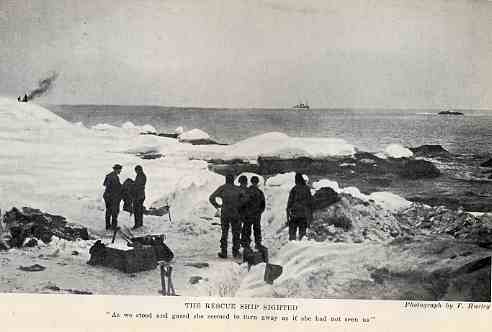
“Meanwhile most of us had gathered on the foreshore watching with anxious eyes for any signs that the ship had seen us, or for any answering signals. As we stood and gazed she seemed to turn away as if she had not seen us. Again and again we cheered, though our feeble cries could certainly not have carried so far. Suddenly she stopped, a boat was lowered, and we could recognize Sir Ernest’s figure as he climbed down the ladder. Simultaneously we burst into a cheer, and then one said to the other, ‘Thank God, the Boss is safe.’ For I think that his safety was of more concern to us than was our own.
“Meanwhile, most of us had gathered on the shore. We watched anxiously for any sign that the ship had seen us, or for a signal in reply. As we stood watching, the ship seemed to turn away, as if it had not seen us. We cheered again and again, though our faint cries could certainly not have carried that far. Suddenly the ship stopped, and a boat was lowered. We could recognize Sir Ernest as he climbed down the ladder. We all cheered at once, and then one of us said to another, ‘Thank God, the Boss is safe.’ I think we were more concerned for his safety than for our own.
“Soon the boat approached near enough for the Boss, who was standing up in the bows, to shout to Wild, ‘Are you all well?’ To which he replied, ‘All safe, all well,’ and we could see a smile light up the Boss’s face as he said, ‘Thank God!’
“Soon the boat came close enough for the Boss, standing at the bow, to shout to Wild, ‘Are you all well?’ Wild replied, ‘All safe, all well.’ We saw a smile light up the Boss’s face as he said, ‘Thank God!’
“Before he could land he threw ashore handsful of cigarettes and tobacco; and these the smokers, who for two months had been trying to find solace in such substitutes as seaweed, finely chopped pipe-bowls, seal meat, and sennegrass, grasped greedily.
“Before he could land, he threw handfuls of cigarettes and tobacco ashore. The smokers grabbed them eagerly. For two months, they had tried to find comfort in substitutes such as seaweed, finely chopped pipe bowls, seal meat, and sennegrass.
“Blackborrow, who could not walk, had been carried to a high rock and propped up in his sleeping-bag, so that he could view the wonderful scene.
“Blackborrow could not walk, so he had been carried to a high rock and propped up in his sleeping bag. From there, he could see the wonderful scene.
“Soon we were tumbling into the boat, and the Chilian sailors, laughing up at us, seemed as pleased at our rescue as we were. Twice more the boat returned, and within an hour of our first having sighted the boat we were heading northwards to the outer world from which we had had no news since October 1914, over twenty-two months before. We are like men awakened from a long sleep. We are trying to acquire suddenly the perspective which the rest of the world has acquired gradually through two years of war. There are many events which have happened of which we shall never know.
“Soon we were tumbling into the boat. The Chilean sailors laughed as they looked up at us, seeming as pleased at our rescue as we were. The boat returned twice more. Within an hour of first seeing the boat, we were heading north toward the outside world. We had heard no news from it since October 1914, more than twenty-two months earlier. We are like men awakened from a long sleep. We are trying to grasp all at once the perspective the rest of the world has gained gradually through two years of war. Many events have happened that we will never know about.
“Our first meal, owing to our weakness and the atrophied state of our stomachs, proved disastrous to a good many. They soon recovered though. Our beds were just shake-downs on cushions and settees, though the officer on watch very generously gave up his bunk to two of us. I think we got very little sleep that night. It was just heavenly to lie and listen to the throb of the engines, instead of to the crack of the breaking floe, the beat of the surf on the ice-strewn shore, or the howling of the blizzard.
“Our first meal made many of us very ill because we were weak and our stomachs had shrunk. They soon recovered, though. Our beds were makeshift, made from cushions and sofas. But the officer on watch very generously gave up his bunk to two of us. I think we got very little sleep that night. It was heavenly just to lie there and listen to the throb of the engines. We no longer had to listen to the cracking of the breaking ice floe, the surf pounding the ice-strewn shore, or the howling of the blizzard.
“We intend to keep August 30 as a festival for the rest of our lives.”
“We plan to celebrate August 30 for the rest of our lives.”
You readers can imagine my feelings as I stood in the little cabin watching my rescued comrades feeding.
You can imagine how I felt as I stood in the little cabin, watching my rescued companions eat.