Chapter 10
Across South Georgia
The sun rose in the sky with every appearance of a fine day, and we grew warmer as we toiled through the soft snow. Ahead of us lay the ridges and spurs of a range of mountains, the transverse range that we had noticed from the bay. We were travelling over a gently rising plateau, and at the end of an hour we found ourselves growing uncomfortably hot. Years before, on an earlier expedition, I had declared that I would never again growl at the heat of the sun, and my resolution had been strengthened during the boat journey. I called it to mind as the sun beat fiercely on the blinding white snow-slope. After passing an area of crevasses we paused for our first meal. We dug a hole in the snow about three feet deep with the adze and put the Primus into it. There was no wind at the moment, but a gust might come suddenly. A hot hoosh was soon eaten and we plodded on towards a sharp ridge between two of the peaks already mentioned. By 11 a.m. we were almost at the crest. The slope had become precipitous and it was necessary to cut steps as we advanced. The adze proved an excellent instrument for this purpose, a blow sufficing to provide a foothold. Anxiously but hopefully I cut the last few steps and stood upon the razor-back, while the other men held the rope and waited for my news. The outlook was disappointing. I looked down a sheer precipice to a chaos of crumpled ice 1500 ft. below. There was no way down for us. The country to the east was a great snow upland, sloping upwards for a distance of seven or eight miles to a height of over 4000 ft. To the north it fell away steeply in glaciers into the bays, and to the south it was broken by huge outfalls from the inland ice-sheet. Our path lay between the glaciers and the outfalls, but first we had to descend from the ridge on which we stood. Cutting steps with the adze, we moved in a lateral direction round the base of a dolomite, which blocked our view to the north. The same precipice confronted us. Away to the north-east there appeared to be a snow-slope that might give a path to the lower country, and so we retraced our steps down the long slope that had taken us three hours to climb. We were at the bottom in an hour. We were now feeling the strain of the unaccustomed marching. We had done little walking since January and our muscles were out of tune. Skirting the base of the mountain above us, we came to a gigantic bergschrund, a mile and a half long and 1000 ft. deep. This tremendous gully, cut in the snow and ice by the fierce winds blowing round the mountain, was semicircular in form, and it ended in a gentle incline. We passed through it, under the towering precipice of ice, and at the far end we had another meal and a short rest. This was at 12:30 p.m. Half a pot of steaming Bovril ration warmed us up, and when we marched again ice-inclines at angles of 45 degrees did not look quite as formidable as before.
The sun rose, and all signs pointed to a fine day. We grew warmer as we worked our way through the soft snow. Ahead lay the ridges and spurs of a mountain range, the crosswise range we had seen from the bay. We were travelling over a gently rising plateau. After an hour, we found ourselves growing uncomfortably hot. Years earlier, on another expedition, I had declared that I would never again complain about the sun’s heat. The boat journey had strengthened that resolve. I remembered it now as the sun beat fiercely on the blinding white snow slope. After passing an area of crevasses, we stopped for our first meal. We used the adze to dig a hole about three feet deep in the snow and put the Primus stove in it. There was no wind just then, but a gust might come suddenly. We soon ate a hot hoosh and trudged on towards a sharp ridge between two of the peaks I mentioned earlier. By 11 a.m. we were nearly at the crest. The slope had become steep, and we had to cut steps as we advanced. The adze proved excellent for the job. One blow was enough to make a foothold. Anxious but hopeful, I cut the last few steps and stood on the narrow ridge. The other men held the rope and waited for my news. The view was disappointing. I looked down a sheer cliff to a jumble of crumpled ice 1,500 feet below. There was no way down for us. To the east lay a vast snow-covered upland. It rose over seven or eight miles to a height of more than 4,000 feet. To the north, glaciers fell steeply into the bays. To the south, huge outflows from the inland ice sheet broke up the upland. Our path lay between the glaciers and the outflows, but first we had to get down from the ridge. We cut steps with the adze and moved sideways around the base of a dolomite formation that blocked our view north. The same cliff faced us there. Far to the northeast, there appeared to be a snow slope that might lead down to lower ground. So we retraced our steps down the long slope that had taken us three hours to climb. We reached the bottom in an hour. We were now feeling the strain of the unfamiliar marching. We had done little walking since January, and our muscles were out of condition. We went around the base of the mountain above us and came to a gigantic bergschrund, a mile and a half long and 1,000 feet deep. Fierce winds blowing around the mountain had cut this enormous gully into the snow and ice. It was semicircular and ended in a gentle slope. We passed through it beneath the towering cliff of ice. At the far end, we had another meal and a short rest. It was 12:30 p.m. Half a pot of steaming Bovril ration warmed us up. When we marched again, ice slopes at angles of 45 degrees no longer looked quite as daunting.
Once more we started for the crest. After another weary climb we reached the top. The snow lay thinly on blue ice at the ridge, and we had to cut steps over the last fifty yards. The same precipice lay below, and my eyes searched vainly for a way down. The hot sun had loosened the snow, which was now in a treacherous condition, and we had to pick our way carefully. Looking back, we could see that a fog was rolling up behind us and meeting in the valleys a fog that was coming up from the east. The creeping grey clouds were a plain warning that we must get down to lower levels before becoming enveloped.
Once again, we set out for the crest. After another exhausting climb, we reached the top. A thin layer of snow covered the blue ice at the ridge. We had to cut steps for the last fifty yards. The same cliff lay below, and I searched in vain for a way down. The hot sun had loosened the snow, making it treacherous, so we had to pick our way carefully. Looking back, we saw fog rolling up behind us. In the valleys, it met fog coming up from the east. The creeping gray clouds were a clear warning. We had to get down to lower ground before the fog surrounded us.
The ridge was studded with peaks, which prevented us getting a clear view either to the right or to the left. The situation in this respect seemed no better at other points within our reach, and I had to decide that our course lay back the way we had come. The afternoon was wearing on and the fog was rolling up ominously from the west. It was of the utmost importance for us to get down into the next valley before dark. We were now up 4500 ft. and the night temperature at that elevation would be very low. We had no tent and no sleeping-bags, and our clothes had endured much rough usage and had weathered many storms during the last ten months. In the distance, down the valley below us, we could see tussock-grass close to the shore, and if we could get down it might be possible to dig out a hole in one of the lower snow-banks, line it with dry grass, and make ourselves fairly comfortable for the night. Back we went, and after a detour we reached the top of another ridge in the fading light. After a glance over the top I turned to the anxious faces of the two men behind me and said, “Come on, boys.” Within a minute they stood beside me on the ice-ridge. The surface fell away at a sharp incline in front of us, but it merged into a snow-slope. We could not see the bottom clearly owing to mist and bad light, and the possibility of the slope ending in a sheer fall occurred to us; but the fog that was creeping up behind allowed no time for hesitation. We descended slowly at first, cutting steps in the snow; then the surface became softer, indicating that the gradient was less severe. There could be no turning back now, so we unroped and slid in the fashion of youthful days. When we stopped on a snow-bank at the foot of the slope we found that we had descended at least 900 ft. in two or three minutes. We looked back and saw the grey fingers of the fog appearing on the ridge, as though reaching after the intruders into untrodden wilds. But we had escaped.
The ridge was dotted with peaks, blocking our view to either side. Other places within reach seemed no better, so I decided we had to go back the way we had come. The afternoon was slipping away, and fog was rolling in ominously from the west. It was vital that we reach the next valley before dark. We were now at 4,500 feet, where the night temperature would be very low. We had no tent or sleeping bags. Our clothes had seen hard use and weathered many storms over the past ten months. In the distance, down the valley below us, we could see tussock grass near the shore. If we could get down, we might be able to dig a hole in a lower snowbank. We could line the hole with dry grass and make ourselves fairly comfortable for the night. We went back and, after a detour, reached the top of another ridge in the fading light. I glanced over the top, then turned to the anxious faces of the two men behind me. “Come on, boys,” I said. Within a minute, they stood beside me on the ice ridge. The surface dropped steeply in front of us, but it merged into a snow slope. Mist and poor light kept us from seeing the bottom clearly. We realized the slope might end in a sheer drop, but the fog creeping up behind us left no time to hesitate. At first, we descended slowly, cutting steps in the snow. Then the surface grew softer, suggesting that the slope was less steep. There was no turning back now, so we untied our ropes and slid down as we had in our youth. We stopped on a snowbank at the foot of the slope. We had descended at least 900 feet in two or three minutes. Looking back, we saw the gray fingers of the fog appearing on the ridge. They seemed to be reaching after the intruders in those unexplored wilds. But we had escaped.
The country to the east was an ascending snow upland dividing the glaciers of the north coast from the outfalls of the south. We had seen from the top that our course lay between two huge masses of crevasses, and we thought that the road ahead lay clear. This belief and the increasing cold made us abandon the idea of camping. We had another meal at 6 p.m. A little breeze made cooking difficult in spite of the shelter provided for the cooker by a hole. Crean was the cook, and Worsley and I lay on the snow to windward of the lamp so as to break the wind with our bodies. The meal over, we started up the long, gentle ascent. Night was upon us, and for an hour we plodded along in almost complete darkness, watching warily for signs of crevasses. Then about 8 p.m. a glow which we had seen behind the jagged peaks resolved itself into the full moon, which rose ahead of us and made a silver pathway for our feet. Along that pathway in the wake of the moon we advanced in safety, with the shadows cast by the edges of crevasses showing black on either side of us. Onwards and upwards through soft snow we marched, resting now and then on hard patches which had revealed themselves by glittering ahead of us in the white light. By midnight we were again at an elevation of about 4000 ft. Still we were following the light, for as the moon swung round towards the north-east, our path curved in that direction. The friendly moon seemed to pilot our weary feet. We could have had no better guide. If in bright daylight we had made that march we would have followed the course that was traced for us that night.
To the east, the land rose into snowy uplands. These divided the glaciers of the north coast from those flowing out to the south. From the top, we had seen that our route lay between two huge fields of crevasses. We thought the way ahead was clear. Because of this and the increasing cold, we gave up the idea of camping. We had another meal at 6 p.m. A light breeze made cooking difficult, even though we had dug a hole to shelter the cooker. Crean was the cook. Worsley and I lay on the snow upwind of the lamp, using our bodies to shield it from the wind. After the meal, we started up the long, gentle slope. Night had fallen, and for an hour we trudged along in almost complete darkness, watching carefully for signs of crevasses. Then, at about 8 p.m., a glow we had seen behind the jagged peaks became the full moon. It rose ahead of us, making a silver path for our feet. We followed that path safely in the moon’s wake, while the edges of crevasses cast black shadows on either side. We marched onward and upward through soft snow. Now and then we rested on hard patches that had glittered ahead of us in the white light. By midnight, we were again at an elevation of about 4,000 feet. We were still following the light. As the moon moved toward the northeast, our path curved in the same direction. The friendly moon seemed to guide our weary feet. We could have had no better guide. Even in bright daylight, we would have followed the course marked out for us that night.
Midnight found us approaching the edge of a great snowfield, pierced by isolated nunataks which cast long shadows like black rivers across the white expanse. A gentle slope to the north-east lured our all-too-willing feet in that direction. We thought that at the base of the slope lay Stromness Bay. After we had descended about 300 ft. a thin wind began to attack us. We had now been on the march for over twenty hours, only halting for our occasional meals. Wisps of cloud drove over the high peaks to the southward, warning us that wind and snow were likely to come. After 1 a.m. we cut a pit in the snow, piled up loose snow around it, and started the Primus again. The hot food gave us another renewal of energy. Worsley and Crean sang their old songs when the Primus was going merrily. Laughter was in our hearts, though not on our parched and cracked lips.
At midnight, we approached the edge of a great snowfield. Isolated nunataks rose through it, casting long shadows like black rivers across the white expanse. A gentle slope to the northeast drew our all too willing feet in that direction. We thought Stromness Bay lay at the bottom of the slope. After we had descended about 300 feet, a thin wind began to bite. We had now been marching for over twenty hours, stopping only for occasional meals. Wisps of cloud blew over the high peaks to the south, warning us that wind and snow were likely. After 1 a.m., we dug a pit in the snow, piled loose snow around it, and lit the Primus stove again. The hot food renewed our energy once more. Worsley and Crean sang their old songs as the Primus burned merrily. Laughter was in our hearts, though not on our parched and cracked lips.
We were up and away again within half an hour, still downward to the coast. We felt almost sure now that we were above Stromness Bay. A dark object down at the foot of the slope looked like Mutton Island, which lies off Husvik. I suppose our desires were giving wings to our fancies, for we pointed out joyfully various landmarks revealed by the now vagrant light of the moon, whose friendly face was cloud-swept. Our high hopes were soon shattered. Crevasses warned us that we were on another glacier, and soon we looked down almost to the seaward edge of the great riven ice-mass. I knew there was no glacier in Stromness and realized that this must be Fortuna Glacier. The disappointment was severe. Back we turned and tramped up the glacier again, not directly tracing our steps but working at a tangent to the south-east. We were very tired.
Within half an hour, we were moving again, still heading down toward the coast. We now felt almost sure that we were above Stromness Bay. A dark object at the foot of the slope looked like Mutton Island, which lies off Husvik. I suppose our hopes were feeding our imaginations. We joyfully pointed out various landmarks as the moonlight flickered through the clouds sweeping across its friendly face. Our high hopes were soon shattered. Crevasses warned us that we were on another glacier. Soon we could see almost to the seaward edge of the great mass of cracked ice. I knew there was no glacier in Stromness and realized that this must be Fortuna Glacier. The disappointment was severe. We turned back and trudged up the glacier again. Instead of following our exact route, we headed diagonally to the south-east. We were very tired.
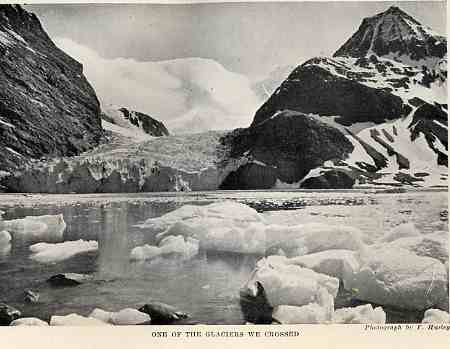
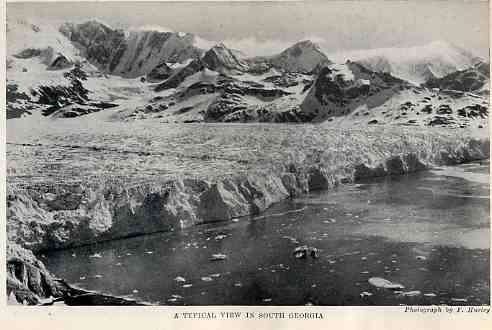
At 5 a.m. we were at the foot of the rocky spurs of the range. We were tired, and the wind that blew down from the heights was chilling us. We decided to get down under the lee of a rock for a rest. We put our sticks and the adze on the snow, sat down on them as close to one another as possible, and put our arms round each other. The wind was bringing a little drift with it and the white dust lay on our clothes. I thought that we might be able to keep warm and have half an hour’s rest this way. Within a minute my two companions were fast asleep. I realized that it would be disastrous if we all slumbered together, for sleep under such conditions merges into death. After five minutes I shook them into consciousness again, told them that they had slept for half an hour, and gave the word for a fresh start. We were so stiff that for the first two or three hundred yards we marched with our knees bent. A jagged line of peaks with a gap like a broken tooth confronted us. This was the ridge that runs in a southerly direction from Fortuna Bay, and our course eastward to Stromness lay across it. A very steep slope led up to the ridge and an icy wind burst through the gap.
At 5 a.m. we reached the foot of the rocky spurs of the range. We were tired, and the wind blowing down from the heights chilled us. We decided to rest in the shelter of a rock. We laid our sticks and the adze on the snow, then sat on them as close together as possible. We put our arms around each other. The wind carried a little drifting snow, and the white dust settled on our clothes. I thought we might keep warm and rest for half an hour this way. Within a minute, my two companions were fast asleep. I realized it would be disastrous if we all fell asleep together. In such conditions, sleep leads to death. After five minutes, I shook them awake. I told them they had slept for half an hour, and gave the word to set off again. We were so stiff that we walked with bent knees for the first two or three hundred yards. Ahead of us was a jagged line of peaks, with a gap like a broken tooth. This was the ridge that runs south from Fortuna Bay. Our eastward route to Stromness lay across it. A very steep slope led up to the ridge, and an icy wind burst through the gap.
We went through the gap at 6 a.m. with anxious hearts as well as weary bodies. If the farther slope had proved impassable our situation would have been almost desperate; but the worst was turning to the best for us. The twisted, wave-like rock formations of Husvik Harbour appeared right ahead in the opening of dawn. Without a word we shook hands with one another. To our minds the journey was over, though as a matter of fact twelve miles of difficult country had still to be traversed. A gentle snow-slope descended at our feet towards a valley that separated our ridge from the hills immediately behind Husvik, and as we stood gazing Worsley said solemnly, “Boss, it looks too good to be true!” Down we went, to be checked presently by the sight of water 2500 ft. below. We could see the little wave-ripples on the black beach, penguins strutting to and fro, and dark objects that looked like seals lolling lazily on the sand. This was an eastern arm of Fortuna Bay, separated by the ridge from the arm we had seen below us during the night. The slope we were traversing appeared to end in a precipice above this beach. But our revived spirits were not to be damped by difficulties on the last stage of the journey, and we camped cheerfully for breakfast. Whilst Worsley and Crean were digging a hole for the lamp and starting the cooker I climbed a ridge above us, cutting steps with the adze, in order to secure an extended view of the country below. At 6.30 a.m. I thought I heard the sound of a steam-whistle. I dared not be certain, but I knew that the men at the whaling-station would be called from their beds about that time. Descending to the camp I told the others, and in intense excitement we watched the chronometer for seven o’clock, when the whalers would be summoned to work. Right to the minute the steam-whistle came to us, borne clearly on the wind across the intervening miles of rock and snow. Never had any one of us heard sweeter music. It was the first sound created by outside human agency that had come to our ears since we left Stromness Bay in December 1914. That whistle told us that men were living near, that ships were ready, and that within a few hours we should be on our way back to Elephant Island to the rescue of the men waiting there under the watch and ward of Wild. It was a moment hard to describe. Pain and ache, boat journeys, marches, hunger and fatigue seemed to belong to the limbo of forgotten things, and there remained only the perfect contentment that comes of work accomplished.
We went through the gap at 6 a.m., anxious and weary. If the slope on the other side had been impassable, our situation would have been almost desperate. But the worst was turning into the best for us. In the early dawn, the twisted, wave-like rock formations of Husvik Harbour appeared straight ahead. Without a word, we shook hands. In our minds, the journey was over, though twelve miles of difficult country still lay ahead. A gentle snow slope led down towards a valley, which separated our ridge from the hills just behind Husvik. As we stood gazing, Worsley said solemnly, “Boss, it looks too good to be true!” We went down, but soon stopped when we saw water 2,500 feet below us. We could see small waves rippling on the black beach, penguins strutting back and forth, and dark objects that looked like seals lying lazily on the sand. This was an eastern arm of Fortuna Bay. The ridge separated it from the arm we had seen below us during the night. The slope we were crossing appeared to end in a cliff above the beach. But our spirits had revived, and we would not let difficulties on the last stage of the journey dampen them. We camped cheerfully for breakfast. While Worsley and Crean dug a hole for the lamp and started the cooker, I climbed a ridge above us. I cut steps with the adze so I could get a wider view of the country below. At 6:30 a.m. I thought I heard a steam whistle. I dared not be certain, but I knew the men at the whaling station would be called from their beds around that time. I climbed down to camp and told the others. In intense excitement, we watched the chronometer for seven o’clock, when the whalers would be called to work. Right on the minute, the steam whistle reached us, carried clearly on the wind across the miles of rock and snow between us. None of us had ever heard sweeter music. It was the first sound made by other people that we had heard since leaving Stromness Bay in December 1914. The whistle told us that men were living nearby and that ships were ready. It told us that within a few hours we would be on our way back to Elephant Island to rescue the men waiting there under Wild’s care. It was a moment hard to describe. Pain and aches, boat journeys, marches, hunger and fatigue seemed to belong among forgotten things. All that remained was the perfect contentment that comes from work accomplished.
My examination of the country from a higher point had not provided definite information, and after descending I put the situation before Worsley and Crean. Our obvious course lay down a snow-slope in the direction of Husvik. “Boys,” I said, “this snow-slope seems to end in a precipice, but perhaps there is no precipice. If we don’t go down we shall have to make a detour of at least five miles before we reach level going. What shall it be?” They both replied at once, “Try the slope.” So we started away again downwards. We abandoned the Primus lamp, now empty, at the breakfast camp and carried with us one ration and a biscuit each. The deepest snow we had yet encountered clogged our feet, but we plodded downward, and after descending about 500 ft., reducing our altitude to 2000 ft. above sea-level, we thought we saw the way clear ahead. A steep gradient of blue ice was the next obstacle. Worsley and Crean got a firm footing in a hole excavated with the adze and then lowered me as I cut steps until the full 50 ft. of our alpine rope was out. Then I made a hole big enough for the three of us, and the other two men came down the steps. My end of the rope was anchored to the adze and I had settled myself in the hole braced for a strain in case they slipped. When we all stood in the second hole I went down again to make more steps, and in this laborious fashion we spent two hours descending about 500 ft. Halfway down we had to strike away diagonally to the left, for we noticed that the fragments of ice loosened by the adze were taking a leap into space at the bottom of the slope. Eventually we got off the steep ice, very gratefully, at a point where some rocks protruded, and we could see then that there was a perilous precipice directly below the point where we had started to cut steps. A slide down a slippery slope, with the adze and our cooker going ahead, completed this descent, and incidentally did considerable damage to our much-tried trousers.
My view of the country from higher up had given me no definite information. After coming down, I put the situation before Worsley and Crean. Our obvious route was down a snow slope toward Husvik. “Boys,” I said, “this snow slope seems to end at a precipice, but perhaps there is no precipice. If we don’t go down, we’ll have to go at least five miles out of our way before reaching level ground. What shall it be?” They both replied at once, “Try the slope.” So we started downward again. We left the empty Primus lamp at the breakfast camp and each carried one ration and a biscuit. The snow was the deepest we had encountered yet, and it weighed down our feet. But we trudged downward, and after about 500 feet we were 2,000 feet above sea level. We thought we could see a clear way ahead. The next obstacle was a steep slope of blue ice. Worsley and Crean found firm footing in a hole cut with the adze. They lowered me as I cut steps, until the full 50 feet of our climbing rope was out. Then I made a hole big enough for the three of us, and the other two men came down the steps. My end of the rope was anchored to the adze. I sat braced in the hole, ready for a strain on the rope if they slipped. Once we were all in the second hole, I went down again to cut more steps. In this slow, difficult way, we spent two hours descending about 500 feet. Halfway down, we had to turn diagonally left. We had noticed that the ice fragments loosened by the adze were falling into space at the bottom of the slope. At last, to our great relief, we left the steep ice where some rocks stuck out. We could then see a dangerous precipice directly below the point where we had started cutting steps. We finished the descent by sliding down a slippery slope, with the adze and our cooker going ahead of us. The slide also did considerable damage to our already battered trousers.
When we picked ourselves up at the bottom we were not more than 1500 ft. above the sea. The slope was comparatively easy. Water was running beneath the snow, making “pockets” between the rocks that protruded above the white surface. The shells of snow over these pockets were traps for our feet; but we scrambled down, and presently came to patches of tussock. A few minutes later we reached the sandy beach. The tracks of some animals were to be seen, and we were puzzled until I remembered that reindeer, brought from Norway, had been placed on the island and now ranged along the lower land of the eastern coast. We did not pause to investigate. Our minds were set upon reaching the haunts of man, and at our best speed we went along the beach to another rising ridge of tussock. Here we saw the first evidence of the proximity of man, whose work, as is so often the ease, was one of destruction. A recently killed seal was lying there, and presently we saw several other bodies bearing the marks of bullet-wounds. I learned later that men from the whaling-station at Stromness sometimes go round to Fortuna Bay by boat to shoot seals.
When we picked ourselves up at the bottom, we were no more than 1,500 feet above the sea. The slope was fairly gentle. Water ran beneath the snow, making “pockets” between the rocks that stuck out above the white surface. The thin snow covering these pockets trapped our feet. But we scrambled down and soon came to patches of tussock grass. A few minutes later, we reached the sandy beach. We could see animal tracks and were puzzled by them. Then I remembered that reindeer brought from Norway had been placed on the island. They now roamed the lower land along the eastern coast. We did not stop to investigate. We were determined to reach people, so we hurried along the beach as fast as we could. We reached another rising ridge of tussock grass. Here we saw the first sign that people were near. As so often happens, the evidence of their work was destruction. A recently killed seal lay there. Soon we saw several other bodies marked by bullet wounds. I learned later that men from the whaling station at Stromness sometimes go by boat to Fortuna Bay to shoot seals.
Noon found us well up the slope on the other side of the bay working east-south-east, and half an hour later we were on a flat plateau, with one more ridge to cross before we descended into Husvik. I was leading the way over this plateau when I suddenly found myself up to my knees in water and quickly sinking deeper through the snow-crust. I flung myself down and called to the others to do the same, so as to distribute our weight on the treacherous surface. We were on top of a small lake, snow-covered. After lying still for a few moments we got to our feet and walked delicately, like Agag, for 200 yds., until a rise in the surface showed us that we were clear of the lake.
By noon, we were well up the slope on the other side of the bay, heading east-southeast. Half an hour later, we reached a flat plateau. We had one more ridge to cross before descending into Husvik. I was leading the way across the plateau when I suddenly found myself knee-deep in water. I was quickly sinking deeper through the crust of snow. I threw myself down and called to the others to do the same, so we could spread our weight across the treacherous surface. We were on top of a small, snow-covered lake. After lying still for a few moments, we got up and walked carefully, like Agag, for 200 yards. Then a rise in the surface showed us that we were clear of the lake.
At 1.30 p.m. we climbed round a final ridge and saw a little steamer, a whaling-boat, entering the bay 2500 ft, below. A few moments later, as we hurried forward, the masts of a sailing-ship lying at a wharf came in sight. Minute figures moving to and fro about the boats caught our gaze, and then we saw the sheds and factory of Stromness whaling-station. We paused and shook hands, a form of mutual congratulation that had seemed necessary on four other occasions in the course of the expedition. The first time was when we landed on Elephant Island, the second when we reached South Georgia, and the third when we reached the ridge and saw the snow-slope stretching below on the first day of the overland journey, then when we saw Husvik rocks.
At 1:30 p.m. we climbed around a final ridge. Below us, 2,500 feet down, a small steamer, a whaling boat, was entering the bay. A few moments later, as we hurried on, we saw the masts of a sailing ship at a wharf. Tiny figures moving around the boats caught our attention. Then we saw the sheds and factory of Stromness whaling-station. We paused and shook hands, congratulating one another as we had felt it necessary to do four times before during the expedition. The first time was when we landed on Elephant Island. The second was when we reached South Georgia. The third was when we reached the ridge and saw the snow slope stretching below us on the first day of the overland journey. The fourth was when we saw Husvik rocks.
Cautiously we started down the slope that led to warmth and comfort. The last lap of the journey proved extraordinarily difficult. Vainly we searched for a safe, or a reasonably safe, way down the steep ice-clad mountain-side. The sole possible pathway seemed to be a channel cut by water running from the upland. Down through icy water we followed the course of this stream. We were wet to the waist, shivering, cold, and tired. Presently our ears detected an unwelcome sound that might have been musical under other conditions. It was the splashing of a waterfall, and we were at the wrong end. When we reached the top of this fall we peered over cautiously and discovered that there was a drop of 25 or 30 ft., with impassable ice-cliffs on both sides. To go up again was scarcely thinkable in our utterly wearied condition. The way down was through the waterfall itself. We made fast one end of our rope to a boulder with some difficulty, due to the fact that the rocks had been worn smooth by the running water. Then Worsley and I lowered Crean, who was the heaviest man. He disappeared altogether in the falling water and came out gasping at the bottom. I went next, sliding down the rope, and Worsley, who was the lightest and most nimble member of the party, came last. At the bottom of the fall we were able to stand again on dry land. The rope could not be recovered. We had flung down the adze from the top of the fall and also the logbook and the cooker wrapped in one of our blouses. That was all, except our wet clothes, that we brought out of the Antarctic, which we had entered a year and a half before with well-found ship, full equipment, and high hopes. That was all of tangible things; but in memories we were rich. We had pierced the veneer of outside things. We had “suffered, starved, and triumphed, grovelled down yet grasped at glory, grown bigger in the bigness of the whole.” We had seen God in His splendours, heard the text that Nature renders. We had reached the naked soul of man.
We carefully started down the slope that led to warmth and comfort. The final stretch of the journey proved extraordinarily difficult. We searched in vain for a safe, or reasonably safe, way down the steep, ice-covered mountainside. The only possible path seemed to be a channel cut by water flowing down from the upland. We followed the stream down through icy water. We were wet to the waist, shivering, cold, and tired. Soon we heard an unwelcome sound that might have been musical under other conditions. It was the splashing of a waterfall, and we were at the wrong end. When we reached the top of the fall, we looked over cautiously. We saw a drop of 25 or 30 feet, with impassable ice cliffs on both sides. In our utterly exhausted condition, going back up was almost unthinkable. The way down was through the waterfall itself. We had some difficulty tying one end of our rope to a boulder. The running water had worn the rocks smooth. Then Worsley and I lowered Crean, who was the heaviest man. He disappeared completely in the falling water and emerged gasping at the bottom. I went next, sliding down the rope. Worsley, the lightest and most nimble member of the party, came last. At the bottom of the fall, we could stand on dry land again. We could not recover the rope. We had thrown the adze down from the top of the fall. We had also thrown down the logbook and the cooker, wrapped in one of our blouses. Those were all we brought out of the Antarctic, apart from our wet clothes. We had entered the Antarctic a year and a half earlier with a well-equipped ship, full equipment, and high hopes. Those were all the tangible things we had, but we were rich in memories. We had broken through the surface of outward things. We had “suffered, starved, and triumphed, grovelled down yet grasped at glory, grown bigger in the bigness of the whole.” We had seen God in his splendours and heard the message that Nature gives. We had reached the naked soul of man.
Shivering with cold, yet with hearts light and happy, we set off towards the whaling-station, now not more than a mile and a half distant. The difficulties of the journey lay behind us. We tried to straighten ourselves up a bit, for the thought that there might be women at the station made us painfully conscious of our uncivilized appearance. Our beards were long and our hair was matted. We were unwashed and the garments that we had worn for nearly a year without a change were tattered and stained. Three more unpleasant-looking ruffians could hardly have been imagined. Worsley produced several safety-pins from some corner of his garments and effected some temporary repairs that really emphasized his general disrepair. Down we hurried, and when quite close to the station we met two small boys ten or twelve years of age. I asked these lads where the manager’s house was situated. They did not answer. They gave us one look—a comprehensive look that did not need to be repeated. Then they ran from us as fast as their legs would carry them. We reached the outskirts of the station and passed through the “digesting-house,” which was dark inside. Emerging at the other end, we met an old man, who started as if he had seen the Devil himself and gave us no time to ask any question. He hurried away. This greeting was not friendly. Then we came to the wharf, where the man in charge stuck to his station. I asked him if Mr. Sorlle (the manager) was in the house.
Shivering with cold but feeling light and happy, we set off toward the whaling station, now no more than a mile and a half away. The difficulties of the journey were behind us. We tried to tidy ourselves up a little. The thought that there might be women at the station made us painfully aware of how uncivilized we looked. Our beards were long, and our hair was matted. We were unwashed, and the clothes we had worn without changing for nearly a year were torn and stained. It would have been hard to imagine three more unpleasant-looking ruffians. Worsley pulled several safety pins from somewhere in his clothes and made some temporary repairs. They really just emphasized his generally ragged appearance. We hurried down and, when we were quite close to the station, met two boys of about ten or twelve. I asked them where the manager’s house was. They did not answer. They gave us one thorough look that did not need repeating. Then they ran from us as fast as their legs would carry them. We reached the edge of the station and passed through the “digesting-house,” which was dark inside. When we came out the other end, we met an old man. He started as if he had seen the Devil himself and hurried away, giving us no time to ask a question. This greeting was not friendly. Then we came to the wharf, where the man in charge stayed at his post. I asked him if Mr. Sorlle (the manager) was in the house.
“Yes,” he said as he stared at us.
“Yes,” he said as he stared at us.
“We would like to see him,” said I.
“We would like to see him,” I said.
“Who are you?” he asked.
“Who are you?” he asked.
“We have lost our ship and come over the island,” I replied.
“We lost our ship and came across the island,” I replied.
“You have come over the island?” he said in a tone of entire disbelief.
“You came across the island?” he said, sounding utterly disbelieving.
The man went towards the manager’s house and we followed him. I learned afterwards that he said to Mr. Sorlle: “There are three funny-looking men outside, who say they have come over the island and they know you. I have left them outside.” A very necessary precaution from his point of view.
The man went toward the manager’s house, and we followed him. I later learned that he told Mr. Sorlle: “There are three funny-looking men outside. They say they have come across the island and know you. I left them outside.” From his point of view, leaving us outside was a very necessary precaution.
Mr. Sorlle came out to the door and said, “Well?”
Mr. Sorlle came to the door and said, “Well?”
“Don’t you know me?” I said.
“Don’t you know me?” I said.
“I know your voice,” he replied doubtfully. “You’re the mate of the Daisy.”
“I recognize your voice,” he replied uncertainly. “You’re the mate of the Daisy.”
“My name is Shackleton,” I said.
“My name is Shackleton,” I said.
Immediately he put out his hand and said, “Come in. Come in.”
He immediately held out his hand and said, “Come in. Come in.”
“Tell me, when was the war over?” I asked.
“Tell me, when did the war end?” I asked.
“The war is not over,” he answered. “Millions are being killed. Europe is mad. The world is mad.”
“The war is not over,” he said. “Millions are being killed. Europe is mad. The world is mad.”
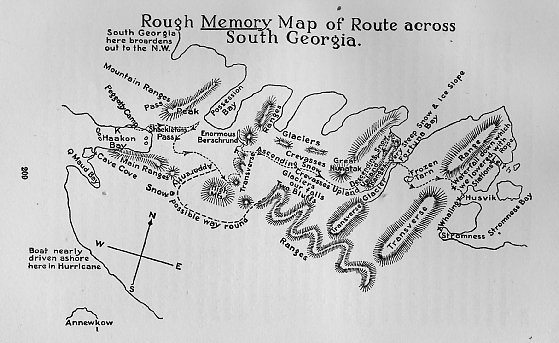
Mr. Sorlle’s hospitality had no bounds. He would scarcely let us wait to remove our freezing boots before he took us into his house and gave us seats in a warm and comfortable room. We were in no condition to sit in anybody’s house until we had washed and got into clean clothes, but the kindness of the station-manager was proof even against the unpleasantness of being in a room with us. He gave us coffee and cakes in the Norwegian fashion, and then showed us upstairs to the bathroom, where we shed our rags and scrubbed ourselves luxuriously.
Mr. Sorlle’s hospitality knew no bounds. He barely let us take off our freezing boots before bringing us into his house. He seated us in a warm, comfortable room. We were in no condition to sit in anyone’s house until we had washed and put on clean clothes. But the station manager was kind enough to put up with the unpleasantness of having us in the room. He gave us coffee and cakes in the Norwegian fashion. Then he showed us upstairs to the bathroom, where we took off our rags and enjoyed a luxurious scrub.
Mr. Sorlle’s kindness did not end with his personal care for the three wayfarers who had come to his door. While we were washing he gave orders for one of the whaling-vessels to be prepared at once in order that it might leave that night for the other side of the island and pick up the three men there. The whalers knew King Haakon Bay, though they never worked on that side of the island. Soon we were clean again. Then we put on delightful new clothes supplied from the station stores and got rid of our superfluous hair. Within an hour or two we had ceased to be savages and had become civilized men again. Then came a splendid meal, while Mr. Sorlle told us of the arrangements he had made and we discussed plans for the rescue of the main party on Elephant Island.
Mr. Sorlle’s kindness went beyond caring for the three travelers who had come to his door. While we washed, he ordered one of the whaling vessels to be prepared at once. It would leave that night for the other side of the island to pick up the three men there. The whalers knew King Haakon Bay, although they never worked on that side of the island. Soon we were clean again. Then we put on delightful new clothes from the station stores and cut off our excess hair. Within an hour or two, we had stopped being savages and become civilized men again. Then came a splendid meal. As we ate, Mr. Sorlle told us what he had arranged, and we discussed plans to rescue the main party on Elephant Island.
I arranged that Worsley should go with the relief ship to show the exact spot where the carpenter and his two companions were camped, while I started to prepare for the relief of the party on Elephant Island. The whaling-vessel that was going round to King Haakon Bay was expected back on the Monday morning, and was to call at Grytviken Harbour, the port from which we had sailed in December 1914, in order that the magistrate resident there might be informed of the fate of the Endurance. It was possible that letters were awaiting us there. Worsley went aboard the whaler at ten o’clock that night and turned in. The next day the relief ship entered King Haakon Bay and he reached Peggotty Camp in a boat. The three men were delighted beyond measure to know that we had made the crossing in safety and that their wait under the upturned James Caird was ended. Curiously enough, they did not recognize Worsley, who had left them a hairy, dirty ruffian and had returned his spruce and shaven self. They thought he was one of the whalers. When one of them asked why no member of the party had come round with the relief, Worsley said, “What do you mean?” “We thought the Boss or one of the others would come round,” they explained. “What’s the matter with you?” said Worsley. Then it suddenly dawned upon them that they were talking to the man who had been their close companion for a year and a half. Within a few minutes the whalers had moved our bits of gear into their boat. They towed off the James Caird and hoisted her to the deck of their ship. Then they started on the return voyage. Just at dusk on Monday afternoon they entered Stromness Bay, where the men of the whaling-station mustered on the beach to receive the rescued party and to examine with professional interest the boat we had navigated across 800 miles of the stormy ocean they knew so well.
I arranged for Worsley to go with the relief ship. He would show the crew exactly where the carpenter and his two companions were camped. Meanwhile, I began preparing to rescue the party on Elephant Island. The whaling vessel going to King Haakon Bay was expected back on Monday morning. It was to call at Grytviken Harbour, the port we had sailed from in December 1914. There, the resident magistrate could be told what had happened to the Endurance. It was possible that letters were waiting for us there. Worsley boarded the whaler at ten o’clock that night and went to bed. The next day, the relief ship entered King Haakon Bay, and Worsley reached Peggotty Camp in a boat. The three men were overjoyed to learn that we had crossed safely. Their wait under the upturned James Caird was over. Curiously, they did not recognize Worsley. He had left them looking like a hairy, dirty ruffian and returned neat and clean-shaven. They thought he was one of the whalers. One of them asked why no member of the party had come with the relief ship. “What do you mean?” Worsley said. “We thought the Boss or one of the others would come round,” they explained. “What’s the matter with you?” said Worsley. Then they suddenly realized they were talking to the man who had been their close companion for a year and a half. Within a few minutes, the whalers had moved our gear into their boat. They towed the James Caird away and hoisted her onto the deck of their ship. Then they began the return voyage. Just as dusk fell on Monday afternoon, they entered Stromness Bay. The men from the whaling station gathered on the beach to welcome the rescued party. They also examined our boat with professional interest. We had navigated her across 800 miles of the stormy ocean they knew so well.
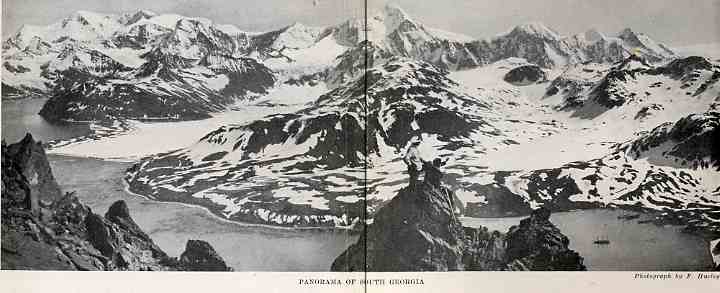
When I look back at those days I have no doubt that Providence guided us, not only across those snowfields, but across the storm-white sea that separated Elephant Island from our landing-place on South Georgia. I know that during that long and racking march of thirty-six hours over the unnamed mountains and glaciers of South Georgia it seemed to me often that we were four, not three. I said nothing to my companions on the point, but afterwards Worsley said to me, “Boss, I had a curious feeling on the march that there was another person with us.” Crean confessed to the same idea. One feels “the dearth of human words, the roughness of mortal speech” in trying to describe things intangible, but a record of our journeys would be incomplete without a reference to a subject very near to our hearts.
When I look back on those days, I have no doubt that Providence guided us across those snowfields. Providence also guided us across the storm-whitened sea between Elephant Island and our landing place on South Georgia. During the long, grueling thirty-six-hour march over South Georgia’s unnamed mountains and glaciers, I often felt there were four of us, not three. I said nothing about the feeling to my companions. But afterward Worsley said to me, “Boss, I had a curious feeling on the march that there was another person with us.” Crean admitted he had felt the same. When trying to describe things we cannot touch, one feels “the dearth of human words, the roughness of mortal speech.” But an account of our journeys would be incomplete without mentioning a subject so close to our hearts.