Chapter 8
Escape from the Ice
On April 7 at daylight the long-desired peak of Clarence Island came into view, bearing nearly north from our camp. At first it had the appearance of a huge berg, but with the growing light we could see plainly the black lines of scree and the high, precipitous cliffs of the island, which were miraged up to some extent. The dark rocks in the white snow were a pleasant sight. So long had our eyes looked on icebergs that apparently grew or dwindled according to the angles at which the shadows were cast by the sun; so often had we discovered rocky islands and brought in sight the peaks of Joinville Land, only to find them, after some change of wind or temperature, floating away as nebulous cloud or ordinary berg; that not until Worsley, Wild, and Hurley had unanimously confirmed my observation was I satisfied that I was really looking at Clarence Island. The land was still more than sixty miles away, but it had to our eyes something of the appearance of home, since we expected to find there our first solid footing after all the long months of drifting on the unstable ice. We had adjusted ourselves to the life on the floe, but our hopes had been fixed all the time on some possible landing-place. As one hope failed to materialize, our anticipations fed themselves on another. Our drifting home had no rudder to guide it, no sail to give it speed. We were dependent upon the caprice of wind and current; we went whither those irresponsible forces listed. The longing to feel solid earth under our feet filled our hearts.
At daylight on April 7, the long-awaited peak of Clarence Island came into view, almost directly north of our camp. At first it looked like a huge iceberg. But as the light grew, we could clearly see the black lines of loose rock and the island’s high, steep cliffs. A mirage made the cliffs appear somewhat higher. The dark rocks against the white snow were a welcome sight. For so long, we had watched icebergs that seemed to grow or shrink as the sun cast shadows from different angles. So often, we had spotted rocky islands or the peaks of Joinville Land, only to see them drift away. A change in wind or temperature would reveal them as hazy clouds or ordinary icebergs. So I was not satisfied that I was really looking at Clarence Island until Worsley, Wild, and Hurley all confirmed it. The land was still more than sixty miles away, but to our eyes it looked something like home. We expected to find our first solid footing there after all those long months drifting on unstable ice. We had adjusted to life on the ice floe, but all the while we had pinned our hopes on a possible landing place. As one hope failed to come true, we turned to another. Our drifting home had no rudder to guide it and no sail to give it speed. We depended on the whims of wind and current, and went wherever those unpredictable forces took us. Our hearts were filled with longing to feel solid ground beneath our feet.
In the full daylight Clarence Island ceased to look like land and had the appearance of a berg of more than eight or ten miles away, so deceptive are distances in the clear air of the Antarctic. The sharp white peaks of Elephant Island showed to the west of north a little later in the day.
In full daylight, Clarence Island no longer looked like land. It looked like an iceberg more than eight or ten miles away. Distances can be that deceptive in the clear Antarctic air. Later that day, the sharp white peaks of Elephant Island appeared to the west of north.
“I have stopped issuing sugar now, and our meals consist of seal meat and blubber only, with 7 ozs. of dried milk per day for the party,” I wrote. “Each man receives a pinch of salt, and the milk is boiled up to make hot drinks for all hands. The diet suits us, since we cannot get much exercise on the floe and the blubber supplies heat. Fried slices of blubber seem to our taste to resemble crisp bacon. It certainly is no hardship to eat it, though persons living under civilized conditions probably would shudder at it. The hardship would come if we were unable to get it.”
“I have stopped giving out sugar. Our meals now consist only of seal meat and blubber, with 7 ounces of dried milk per day for the group,” I wrote. “Each man gets a pinch of salt, and the milk is boiled to make hot drinks for everyone. The diet suits us because we cannot get much exercise on the ice floe, and the blubber provides warmth. Fried slices of blubber taste like crisp bacon to us. Eating blubber is certainly no hardship, though people living in civilized conditions would probably shudder at the thought. The hardship would come if we could not get it.”
I think that the palate of the human animal can adjust itself to anything. Some creatures will die before accepting a strange diet if deprived of their natural food. The Yaks of the Himalayan uplands must feed from the growing grass, scanty and dry though it may be, and would starve even if allowed the best oats and corn.
I think the human palate can adjust to anything. Some creatures will die rather than eat unfamiliar food if deprived of their natural diet. The yaks of the Himalayan uplands must eat growing grass, however sparse and dry it may be. They would starve even if given the best oats and corn.
“We still have the dark water-sky of the last week with us to the south-west and west, round to the north-east. We are leaving all the bergs to the west and there are few within our range of vision now. The swell is more marked to-day, and I feel sure we are at the verge of the floe-ice. One strong gale, followed by a calm would scatter the pack, I think, and then we could push through. I have been thinking much of our prospects. The appearance of Clarence Island after our long drift seems, somehow, to convey an ultimatum. The island is the last outpost of the south and our final chance of a landing-place. Beyond it lies the broad Atlantic. Our little boats may be compelled any day now to sail unsheltered over the open sea with a thousand leagues of ocean separating them from the land to the north and east. It seems vital that we shall land on Clarence Island or its neighbour, Elephant Island. The latter island has attraction for us, although as far as I know nobody has ever landed there. Its name suggests the presence of the plump and succulent sea-elephant. We have an increasing desire in any case to get firm ground under our feet. The floe has been a good friend to us, but it is reaching the end of its journey, and it is liable at any time now to break up and fling us into the unplumbed sea.”
“We still have the dark water-sky we have seen all week, stretching from the southwest and west around to the northeast. We are leaving all the icebergs to the west, and few are now within sight. The swell is stronger today, and I feel sure we are at the edge of the floe-ice. I think one strong gale, followed by calm weather, would scatter the pack ice. Then we could push through. I have been thinking a great deal about our prospects. Somehow, the sight of Clarence Island after our long drift seems like an ultimatum. The island is the last outpost of the south and our final chance to land. Beyond it lies the broad Atlantic. Any day now, our little boats may have to sail without shelter on the open sea. A thousand leagues of ocean would separate them from the land to the north and east. It seems vital that we land on Clarence Island or its neighbour, Elephant Island. Elephant Island appeals to us, although, as far as I know, nobody has ever landed there. Its name suggests that we might find plump, succulent sea-elephants there. In any case, we are increasingly eager to get firm ground under our feet. The ice floe has been a good friend to us, but it is nearing the end of its journey. It could break up at any time now and fling us into the deep, unmeasured sea.”
A little later, after reviewing the whole situation in the light of our circumstances, I made up my mind that we should try to reach Deception Island. The relative positions of Clarence, Elephant, and Deception Islands can be seen on the chart. The two islands first named lay comparatively near to us and were separated by some eighty miles of water from Prince George Island, which was about 150 miles away from our camp on the berg. From this island a chain of similar islands extends westward, terminating in Deception Island. The channels separating these desolate patches of rock and ice are from ten to fifteen miles wide. But we knew from the Admiralty sailing directions that there were stores for the use of shipwrecked mariners on Deception Island, and it was possible that the summer whalers had not yet deserted its harbour. Also we had learned from our scanty records that a small church had been erected there for the benefit of the transient whalers. The existence of this building would mean to us a supply of timber, from which, if dire necessity urged us, we could construct a reasonably seaworthy boat. We had discussed this point during our drift on the floe. Two of our boats were fairly strong, but the third, the James Caird, was light, although a little longer than the others. All of them were small for the navigation of these notoriously stormy seas, and they would be heavily loaded, so a voyage in open water would be a serious undertaking. I fear that the carpenter’s fingers were already itching to convert pews into topsides and decks. In any case, the worst that could befall us when we had reached Deception Island would be a wait until the whalers returned about the middle of November.
A little later, after reviewing our whole situation, I decided that we should try to reach Deception Island. The chart shows the positions of Clarence, Elephant, and Deception Islands in relation to one another. Clarence and Elephant Islands were relatively close to us. About eighty miles of water separated them from Prince George Island, which was about 150 miles from our camp on the berg. A chain of similar islands stretches westward from Prince George Island, ending at Deception Island. The channels between these desolate patches of rock and ice are ten to fifteen miles wide. But we knew from the Admiralty sailing directions that Deception Island had supplies for shipwrecked sailors. It was also possible that the summer whalers had not yet left its harbour. Our limited records also told us that a small church had been built there for the visiting whalers. The church would provide us with timber. If we were desperate, we could use it to build a reasonably seaworthy boat. We had discussed this possibility while drifting on the floe. Two of our boats were fairly strong, but the third, the James Caird, was light, though a little longer than the others. All were small for sailing these notoriously stormy seas, and they would be heavily loaded. A voyage in open water would therefore be a serious undertaking. I fear the carpenter was already itching to turn pews into the sides and decks of a boat. In any case, once we reached Deception Island, the worst that could happen was a wait until the whalers returned around the middle of November.
Another bit of information gathered from the records of the west side of the Weddell Sea related to Prince George Island. The Admiralty “Sailing Directions,” referring to the South Shetlands, mentioned a cave on this island. None of us had seen that cave or could say if it was large or small, wet or dry; but as we drifted on our floe and later, when navigating the treacherous leads and making our uneasy night camps, that cave seemed to my fancy to be a palace which in contrast would dim the splendours of Versailles.
Another piece of information from the records of the western Weddell Sea concerned Prince George Island. The Admiralty “Sailing Directions” mentioned a cave on the island in its account of the South Shetlands. None of us had seen the cave or knew whether it was large or small, wet or dry. But as we drifted on our floe, I imagined the cave as a palace that would make Versailles look dim. I still imagined it that way later, as we navigated the treacherous leads and made our uneasy camps at night.
The swell increased that night and the movement of the ice became more pronounced. Occasionally a neighbouring floe would hammer against the ice on which we were camped, and the lesson of these blows was plain to read. We must get solid ground under our feet quickly. When the vibration ceased after a heavy surge, my thoughts flew round to the problem ahead. If the party had not numbered more than six men a solution would not have been so hard to find; but obviously the transportation of the whole party to a place of safety, with the limited means at our disposal, was going to be a matter of extreme difficulty. There were twenty-eight men on our floating cake of ice, which was steadily dwindling under the influence of wind, weather, charging floes, and heavy swell. I confess that I felt the burden of responsibility sit heavily on my shoulders; but, on the other hand, I was stimulated and cheered by the attitude of the men. Loneliness is the penalty of leadership, but the man who has to make the decisions is assisted greatly if he feels that there is no uncertainty in the minds of those who follow him, and that his orders will be carried out confidently and in expectation of success.
The swell grew stronger that night, and the ice moved more noticeably. Now and then, a nearby floe slammed against the ice where we had camped. The warning was clear. We had to get onto solid ground quickly. After each heavy surge, the ice stopped shaking and my thoughts turned to the problem ahead. If there had been no more than six men in the party, a solution would have been easier to find. But getting the whole party to safety with our limited resources would clearly be extremely difficult. Twenty-eight men were on our floating sheet of ice. Wind, weather, colliding floes, and the heavy swell were steadily shrinking it. I admit that the weight of responsibility bore heavily on me. But the men's attitude encouraged and cheered me. Leadership brings loneliness. Yet the man who must make the decisions is greatly helped when he knows his followers have no doubts. He is also helped when he knows they will carry out his orders confidently and expect to succeed.
The sun was shining in the blue sky on the following morning (April 8). Clarence Island showed clearly on the horizon, and Elephant Island could also be distinguished. The single snow-clad peak of Clarence Island stood up as a beacon of safety, though the most optimistic imagination could not make an easy path of the ice and ocean that separated us from that giant, white and austere.
The sun shone in a blue sky the following morning (April 8). Clarence Island was clearly visible on the horizon, and we could also make out Elephant Island. Clarence Island’s single snow-covered peak stood like a beacon of safety. Yet even the most optimistic imagination could not make the ice and ocean between us and that giant, white and stern, seem easy to cross.
“The pack was much looser this morning, and the long rolling swell from the north-east is more pronounced than it was yesterday. The floes rise and fall with the surge of the sea. We evidently are drifting with the surface current, for all the heavier masses of floe, bergs, and hummocks are being left behind. There has been some discussion in the camp as to the advisability of making one of the bergs our home for the time being and drifting with it to the west. The idea is not sound. I cannot be sure that the berg would drift in the right direction. If it did move west and carried us into the open water, what would be our fate when we tried to launch the boats down the steep sides of the berg in the sea-swell after the surrounding floes had left us? One must reckon, too, the chance of the berg splitting or even overturning during our stay. It is not possible to gauge the condition of a big mass of ice by surface appearance. The ice may have a fault, and when the wind, current, and swell set up strains and tensions, the line of weakness may reveal itself suddenly and disastrously. No, I do not like the idea of drifting on a berg. We must stay on our floe till conditions improve and then make another attempt to advance towards the land.”
“The pack ice was much looser this morning. The long, rolling swell from the northeast is stronger than it was yesterday. The floes rise and fall with the sea. We are clearly drifting with the surface current. All the heavier floes, bergs, and hummocks are being left behind. Some in camp have discussed making a berg our home for now and drifting west with it. The idea is not sound. I cannot be sure the berg would drift in the right direction. Even if it moved west and carried us into open water, what would happen to us then? The surrounding floes would have left us. We would have to launch the boats down the berg’s steep sides in the swell. We must also consider the chance that the berg might split or even overturn while we are on it. We cannot judge the condition of a large mass of ice by its surface. The ice may have a fault. Wind, current, and swell can put it under strain. A weak point may then reveal itself suddenly and with disastrous results. No, I do not like the idea of drifting on a berg. We must stay on our floe until conditions improve. Then we will make another attempt to reach land.”
At 6.30 p.m. a particularly heavy shock went through our floe. The watchman and other members of the party made an immediate inspection and found a crack right under the James Caird and between the other two boats and the main camp. Within five minutes the boats were over the crack and close to the tents. The trouble was not caused by a blow from another floe. We could see that the piece of ice we occupied had slewed and now presented its long axis towards the oncoming swell. The floe, therefore, was pitching in the manner of a ship, and it had cracked across when the swell lifted the centre, leaving the two ends comparatively unsupported. We were now on a triangular raft of ice, the three sides measuring, roughly, 90, 100, and 120 yds. Night came down dull and overcast, and before midnight the wind had freshened from the west. We could see that the pack was opening under the influence of wind, wave, and current, and I felt that the time for launching the boats was near at hand. Indeed, it was obvious that even if the conditions were unfavourable for a start during the coming day, we could not safely stay on the floe many hours longer. The movement of the ice in the swell was increasing, and the floe might split right under our camp. We had made preparations for quick action if anything of the kind occurred. Our case would be desperate if the ice broke into small pieces not large enough to support our party and not loose enough to permit the use of the boats.
At 6:30 p.m., a particularly heavy shock ran through our ice floe. The watchman and other members of the party immediately inspected it. They found a crack right under the James Caird, between the other two boats and the main camp. Within five minutes, the boats were across the crack and close to the tents. The shock had not been caused by a collision with another floe. We could see that our piece of ice had turned, so its long axis faced the oncoming swell. The floe was pitching like a ship. It had cracked across when the swell lifted its center, leaving the two ends relatively unsupported. We were now on a triangular raft of ice, with sides measuring roughly 90, 100, and 120 yards. Night fell under a dull, overcast sky. Before midnight, the wind from the west had grown stronger. We could see the pack ice opening up under the influence of wind, waves, and current. I felt that the time to launch the boats was near. Indeed, even if conditions were unfavorable for setting out the next day, we could not safely stay on the floe many hours longer. The ice was moving more in the swell, and the floe might split right under our camp. We had prepared to act quickly if anything like that happened. Our situation would be desperate if the ice broke into small pieces. The pieces might be too small to support our party but not loose enough to let us use the boats.
The following day was Sunday (April 9), but it proved no day of rest for us. Many of the important events of our Expedition occurred on Sundays, and this particular day was to see our forced departure from the floe on which we had lived for nearly six months, and the start of our journeyings in the boats.
The next day was Sunday (April 9), but it was no day of rest for us. Many important events of our Expedition happened on Sundays. On this Sunday, we were forced to leave the ice floe where we had lived for nearly six months. We began our journey in the boats.
“This has been an eventful day. The morning was fine, though somewhat overcast by stratus and cumulus clouds; moderate south-south-westerly and south-easterly breezes. We hoped that with this wind the ice would drift nearer to Clarence Island. At 7 a.m. lanes of water and leads could be seen on the horizon to the west. The ice separating us from the lanes was loose, but did not appear to be workable for the boats. The long swell from the north-west was coming in more freely than on the previous day and was driving the floes together in the utmost confusion. The loose brash between the masses of ice was being churned to mudlike consistency, and no boat could have lived in the channels that opened and closed around us. Our own floe was suffering in the general disturbance, and after breakfast I ordered the tents to be struck and everything prepared for an immediate start when the boats could be launched.”
“This has been an eventful day. The morning was fine, though partly covered by stratus and cumulus clouds. Moderate breezes blew from the south-southwest and southeast. We hoped these winds would carry the ice closer to Clarence Island. At 7 a.m. we could see lanes of open water on the western horizon. The ice between us and the lanes was loose, but it did not seem possible to get the boats through it. The long swell from the northwest was coming in more freely than the day before. It was driving the floes together in utter confusion. The loose fragments between the masses of ice were being churned into a mudlike mixture. No boat could have survived in the channels opening and closing around us. Our own floe was being damaged in the general disturbance. After breakfast, I ordered the tents taken down and everything made ready. We would leave immediately once the boats could be launched.”
I had decided to take the James Caird myself, with Wild and eleven men. This was the largest of our boats, and in addition to her human complement she carried the major portion of the stores. Worsley had charge of the Dudley Docker with nine men, and Hudson and Crean were the senior men on the Stancomb Wills.
I had decided to take charge of the James Caird myself, with Wild and eleven men aboard. The James Caird was our largest boat. It carried most of the supplies as well as the men. Worsley was in charge of the Dudley Docker with nine men, and Hudson and Crean were the senior men on the Stancomb Wills.
Soon after breakfast the ice closed again. We were standing by, with our preparations as complete as they could be made, when at 11 a.m. our floe suddenly split right across under the boats. We rushed our gear on to the larger of the two pieces and watched with strained attention for the next development. The crack had cut through the site of my tent. I stood on the edge of the new fracture, and, looking across the widening channel of water, could see the spot where for many months my head and shoulders had rested when I was in my sleeping-bag. The depression formed by my body and legs was on our side of the crack. The ice had sunk under my weight during the months of waiting in the tent, and I had many times put snow under the bag to fill the hollow. The lines of stratification showed clearly the different layers of snow. How fragile and precarious had been our resting-place! Yet usage had dulled our sense of danger. The floe had become our home, and during the early months of the drift we had almost ceased to realize that it was but a sheet of ice floating on unfathomed seas. Now our home was being shattered under our feet, and we had a sense of loss and incompleteness hard to describe.
Soon after breakfast, the ice closed again. We stood ready, with our preparations as complete as possible. Then, at 11 a.m., our floe suddenly split right across beneath the boats. We rushed our gear onto the larger piece and watched anxiously to see what would happen next. The crack had cut through the place where my tent had stood. I stood at the edge of the break and looked across the widening channel of water. I could see the spot where my head and shoulders had rested in my sleeping bag for many months. The hollow made by my body and legs was on our side of the crack. The ice had sunk under my weight during the months I had spent waiting in the tent. I had often put snow under my sleeping bag to fill the hollow. The lines in the ice clearly showed the different layers of snow. How fragile and precarious our resting place had been! Yet familiarity had dulled our sense of danger. The floe had become our home. During the early months of the drift, we had almost forgotten that it was only a sheet of ice floating on seas of unknown depth. Now our home was breaking apart beneath our feet. We felt a sense of loss and incompleteness that is hard to describe.
The fragments of our floe came together again a little later, and we had our lunch of seal meat, all hands eating their fill. I thought that a good meal would be the best possible preparation for the journey that now seemed imminent, and as we would not be able to take all our meat with us when we finally moved, we could regard every pound eaten as a pound rescued. The call to action came at 1 p.m. The pack opened well and the channels became navigable. The conditions were not all one could have desired, but it was best not to wait any longer. The Dudley Docker and the Stancomb Wills were launched quickly. Stores were thrown in, and the two boats were pulled clear of the immediate floes towards a pool of open water three miles broad, in which floated a lone and mighty berg. The James Caird was the last boat to leave, heavily loaded with stores and odds and ends of camp equipment. Many things regarded by us as essentials at that time were to be discarded a little later as the pressure of the primitive became more severe. Man can sustain life with very scanty means. The trappings of civilization are soon cast aside in the face of stern realities, and given the barest opportunity of winning food and shelter, man can live and even find his laughter ringing true.
The pieces of our ice floe came together again a little later. We had seal meat for lunch, and everyone ate their fill. I thought a good meal would be the best possible preparation for the journey that now seemed close. And since we could not take all our meat when we finally moved, every pound eaten was a pound saved. The call to action came at 1 p.m. The pack ice opened wide, and the channels became navigable. Conditions were not ideal, but it was best not to wait any longer. The Dudley Docker and the Stancomb Wills were launched quickly. Supplies were thrown in, and the two boats were pulled clear of the nearby ice floes. They headed toward a pool of open water three miles across, where a single enormous iceberg floated. The James Caird was the last boat to leave. It was heavily loaded with supplies and odds and ends of camp equipment. Many things we then considered essential would soon be discarded as the pressure of primitive conditions grew more severe. A person can stay alive with very little. The trappings of civilization are soon cast aside in the face of harsh realities. Given the barest chance of finding food and shelter, a person can live and even laugh with genuine joy.
The three boats were a mile away from our floe home at 2 p.m. We had made our way through the channels and had entered the big pool when we saw a rush of foam-clad water and tossing ice approaching us, like the tidal bore of a river. The pack was being impelled to the east by a tide-rip, and two huge masses of ice were driving down upon us on converging courses. The James Caird was leading. Starboarding the helm and bending strongly to the oars, we managed to get clear. The two other boats followed us, though from their position astern at first they had not realized the immediate danger. The Stancomb Wills was the last boat and she was very nearly caught, but by great exertion she was kept just ahead of the driving ice. It was an unusual and startling experience. The effect of tidal action on ice is not often as marked as it was that day. The advancing ice, accompanied by a large wave, appeared to be travelling at about three knots; and if we had not succeeded in pulling clear we would certainly have been swamped.
At 2 p.m., the three boats were a mile from the ice floe we had called home. We had made our way through the channels and entered the big pool. Then we saw foaming water and tossing ice rushing toward us, like a tidal bore in a river. A strong tidal current was pushing the pack ice east, and two huge masses of ice were bearing down on us from converging directions. The James Caird was leading. We turned the helm to starboard and rowed hard, managing to get clear. The other two boats followed us, though at first, being behind us, they had not realized the immediate danger. The Stancomb Wills was last and was very nearly caught. But with great effort, her crew kept her just ahead of the advancing ice. It was an unusual and startling experience. Tidal action does not often have such a pronounced effect on ice as it did that day. The advancing ice, accompanied by a large wave, appeared to be moving at about three knots. If we had not managed to row clear, we would certainly have been swamped.
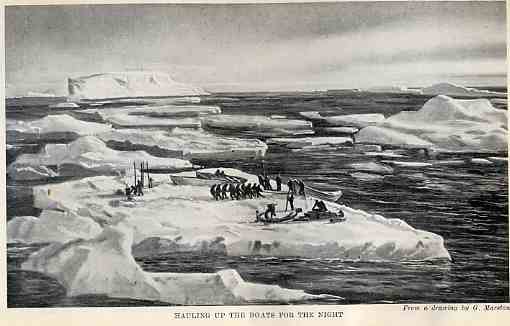
We pulled hard for an hour to windward of the berg that lay in the open water. The swell was crashing on its perpendicular sides and throwing spray to a height of sixty feet. Evidently there was an ice-foot at the east end, for the swell broke before it reached the berg-face and flung its white spray on to the blue ice-wall. We might have paused to have admired the spectacle under other conditions; but night was coming on apace, and we needed a camping-place. As we steered north-west, still amid the ice-floes, the Dudley Docker got jammed between two masses while attempting to make a short cut. The old adage about a short cut being the longest way round is often as true in the Antarctic as it is in the peaceful countryside. The James Caird got a line aboard the Dudley Docker, and after some hauling the boat was brought clear of the ice again. We hastened forward in the twilight in search of a flat, old floe, and presently found a fairly large piece rocking in the swell. It was not an ideal camping-place by any means, but darkness had overtaken us. We hauled the boats up, and by 8 p.m. had the tents pitched and the blubber-stove burning cheerily. Soon all hands were well fed and happy in their tents, and snatches of song came to me as I wrote up my log.
We rowed hard for an hour on the windward side of the iceberg that lay in the open water. The swell crashed against its vertical sides, throwing spray sixty feet into the air. There was clearly an ice-foot at the east end. The swell broke before it reached the iceberg’s face, flinging white spray onto the blue ice wall. Under other conditions, we might have stopped to admire the sight. But night was coming quickly, and we needed a place to camp. As we headed northwest, still among the ice floes, the Dudley Docker tried to take a shortcut and became jammed between two masses of ice. The old saying that a shortcut is the longest way round is often as true in the Antarctic as in the peaceful countryside. The James Caird got a line aboard the Dudley Docker, and after some hauling, the boat was pulled clear of the ice. We hurried on through the twilight, looking for a flat, old floe. Before long, we found a fairly large piece of ice rocking in the swell. It was far from an ideal campsite, but darkness had overtaken us. We hauled the boats up, and by 8 p.m. we had pitched the tents and had the blubber-stove burning cheerfully. Soon everyone was well fed and happy in their tents. As I wrote up my log, snatches of song reached me.
Some intangible feeling of uneasiness made me leave my tent about 11 p.m. that night and glance around the quiet camp. The stars between the snow-flurries showed that the floe had swung round and was end on to the swell, a position exposing it to sudden strains. I started to walk across the floe in order to warn the watchman to look carefully for cracks, and as I was passing the men’s tent the floe lifted on the crest of a swell and cracked right under my feet. The men were in one of the dome-shaped tents, and it began to stretch apart as the ice opened. A muffled sound, suggestive of suffocation, came from beneath the stretching tent. I rushed forward, helped some emerging men from under the canvas, and called out, “Are you all right?”
An uneasy feeling I couldn’t explain made me leave my tent around 11 p.m. that night and look around the quiet camp. Between snow flurries, the stars showed that the ice floe had turned end on to the swell. This position exposed it to sudden stresses. I started across the floe to warn the watchman to look carefully for cracks. As I passed the men’s tent, the floe rose on the crest of a swell and cracked right under my feet. The men were in one of the dome-shaped tents, which began to stretch apart as the ice opened. A muffled sound came from beneath the stretching tent, as if someone were suffocating. I rushed forward, helped some men out from under the canvas, and called out, “Are you all right?”
“There are two in the water,” somebody answered. The crack had widened to about four feet, and as I threw myself down at the edge, I saw a whitish object floating in the water. It was a sleeping-bag with a man inside. I was able to grasp it, and with a heave lifted man and bag on to the floe. A few seconds later the ice-edges came together again with tremendous force. Fortunately, there had been but one man in the water, or the incident might have been a tragedy. The rescued bag contained Holness, who was wet down to the waist but otherwise unscathed. The crack was now opening again. The James Caird and my tent were on one side of the opening and the remaining two boats and the rest of the camp on the other side. With two or three men to help me I struck my tent; then all hands manned the painter and rushed the James Caird across the opening crack. We held to the rope while, one by one, the men left on our side of the floe jumped the channel or scrambled over by means of the boat. Finally I was left alone. The night had swallowed all the others and the rapid movement of the ice forced me to let go the painter. For a moment I felt that my piece of rocking floe was the loneliest place in the world. Peering into the darkness; I could just see the dark figures on the other floe. I hailed Wild, ordering him to launch the Stancomb Wills, but I need not have troubled. His quick brain had anticipated the order and already the boat was being manned and hauled to the ice-edge. Two or three minutes later she reached me, and I was ferried across to the Camp.
“There are two in the water,” someone answered. The crack had widened to about four feet. I threw myself down at the edge and saw a whitish object floating in the water. It was a sleeping bag with a man inside. I grabbed the bag and heaved it and the man onto the floe. A few seconds later, the edges of the ice came together again with tremendous force. Fortunately, only one man had been in the water, or the incident might have been a tragedy. The rescued man was Holness. He was wet down to the waist but otherwise unharmed. The crack was now opening again. The James Caird and my tent were on one side of the opening. The other two boats and the rest of the camp were on the other side. With help from two or three men, I took down my tent. Then everyone grabbed the boat’s rope and rushed the James Caird across the widening crack. We held the rope while the men left on our side of the floe crossed one by one. They either jumped the channel or scrambled across by means of the boat. Finally, I was left alone. The night had swallowed all the others, and the rapid movement of the ice forced me to release the rope. For a moment, I felt that my piece of rocking floe was the loneliest place in the world. Peering into the darkness, I could just make out the dark figures on the other floe. I called out to Wild and ordered him to launch the Stancomb Wills, but I need not have bothered. His quick mind had anticipated the order. Already, the men were getting into the boat and hauling it to the ice edge. Two or three minutes later, the boat reached me, and I was ferried across to the camp.
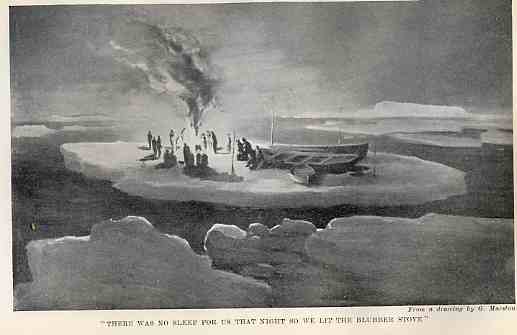
We were now on a piece of flat ice about 200 ft. long and 100 ft. wide. There was no more sleep for any of us that night. The killers were blowing in the lanes around, and we waited for daylight and watched for signs of another crack in the ice. The hours passed with laggard feet as we stood huddled together or walked to and fro in the effort to keep some warmth in our bodies. We lit the blubber-stove at 3 a.m., and with pipes going and a cup of hot milk for each man, we were able to discover some bright spots in our outlook. At any rate, we were on the move at last, and if dangers and difficulties lay ahead we could meet and overcome them. No longer were we drifting helplessly at the mercy of wind and current.
We were now on a flat piece of ice about 200 feet long and 100 feet wide. None of us slept again that night. Killer whales surfaced and breathed in the open water around us. We waited for daylight and watched for signs of another crack in the ice. The hours passed slowly as we huddled together or walked back and forth, trying to keep warm. We lit the blubber stove at 3 a.m. With our pipes going and a cup of hot milk for each man, we could see some bright spots in our situation. At least we were moving at last. If dangers and difficulties lay ahead, we could face and overcome them. We were no longer drifting helplessly at the mercy of the wind and current.
The first glimmerings of dawn came at 6 a.m., and I waited anxiously for the full daylight. The swell was growing, and at times our ice was surrounded closely by similar pieces. At 6.30 a.m. we had hot hoosh, and then stood by waiting for the pack to open. Our chance came at 8, when we launched the boats, loaded them, and started to make our way through the lanes in a northerly direction. The James Caird was in the lead, with the Stancomb Wills next and the Dudley Docker bringing up the rear. In order to make the boats more seaworthy we had left some of our shovels, picks, and dried vegetables on the floe, and for a long time we could see the abandoned stores forming a dark spot on the ice. The boats were still heavily loaded. We got out of the lanes, and entered a stretch of open water at 11 a.m. A strong easterly breeze was blowing, but the fringe of pack lying outside protected us from the full force of the swell, just as the coral-reef of a tropical island checks the rollers of the Pacific. Our way was across the open sea, and soon after noon we swung round the north end of the pack and laid a course to the westward, the James Caird still in the lead. Immediately our deeply laden boats began to make heavy weather. They shipped sprays, which, freezing as they fell, covered men and gear with ice, and soon it was clear that we could not safely proceed. I put the James Caird round and ran for the shelter of the pack again, the other boats following. Back inside the outer line of ice the sea was not breaking. This was at 3 p.m., and all hands were tired and cold. A big floeberg resting peacefully ahead caught my eye, and half an hour later we had hauled up the boats and pitched camp for the night. It was a fine, big, blue berg with an attractively solid appearance, and from our camp we could get a good view of the surrounding sea and ice. The highest point was about 15 ft. above sea-level. After a hot meal all hands, except the watchman, turned in. Every one was in need of rest after the troubles of the previous night and the unaccustomed strain of the last thirty-six hours at the oars. The berg appeared well able to withstand the battering of the sea, and too deep and massive to be seriously affected by the swell; but it was not as safe as it looked. About midnight the watchman called me and showed me that the heavy north-westerly swell was undermining the ice. A great piece had broken off within eight feet of my tent. We made what inspection was possible in the darkness, and found that on the westward side of the berg the thick snow covering was yielding rapidly to the attacks of the sea. An ice-foot had formed just under the surface of the water. I decided that there was no immediate danger and did not call the men. The north-westerly wind strengthened during the night.
The first light of dawn appeared at 6 a.m., and I waited anxiously for full daylight. The swell was growing, and at times other pieces of ice crowded around our floe. At 6:30 a.m. we had hot hoosh, then stood ready, waiting for the pack ice to open. Our chance came at 8. We launched the boats, loaded them, and began making our way north through the channels. The James Caird led, with the Stancomb Wills next and the Dudley Docker bringing up the rear. To make the boats safer at sea, we had left some shovels, picks, and dried vegetables on the floe. For a long time we could see the abandoned supplies as a dark spot on the ice. The boats were still heavily loaded. At 11 a.m. we left the channels and entered a stretch of open water. A strong easterly breeze was blowing, but the outer fringe of pack ice protected us from the full swell. It held back the waves as a tropical island’s coral reef holds back the Pacific rollers. Our route lay across the open sea. Soon after noon we rounded the north end of the pack and headed west, with the James Caird still leading. Our heavily loaded boats immediately began to struggle in the rough water. Spray came aboard and froze as it fell, covering men and gear with ice. Soon it was clear that we could not safely go on. I turned the James Caird around and headed back to the shelter of the pack, with the other boats following. Inside the outer line of ice, the waves were not breaking. It was 3 p.m., and all the men were tired and cold. A large floeberg lay peacefully ahead and caught my eye. Half an hour later we had hauled up the boats and made camp for the night. It was a fine, large, blue berg that looked reassuringly solid. From our camp we had a good view of the surrounding sea and ice. Its highest point was about 15 feet above sea level. After a hot meal, everyone except the watchman went to sleep. Everyone needed rest after the troubles of the previous night and the unfamiliar strain of rowing for the past thirty-six hours. The berg seemed strong enough to withstand the pounding sea. It also seemed too deep and massive to be seriously affected by the swell. But it was not as safe as it looked. Around midnight the watchman called me and showed me that the heavy northwesterly swell was wearing away the ice. A great piece had broken off within eight feet of my tent. We inspected the berg as best we could in the dark. On its western side, we found that the sea was rapidly wearing away the thick snow cover. An ice-foot had formed just below the water’s surface. I decided there was no immediate danger and did not wake the men. The northwesterly wind grew stronger during the night.
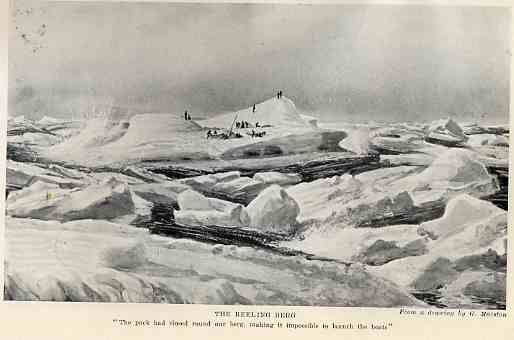
The morning of April 11 was overcast and misty. There was a haze on the horizon, and daylight showed that the pack had closed round our berg, making it impossible in the heavy swell to launch the boats. We could see no sign of the water. Numerous whales and killers were blowing between the floes, and Cape pigeons, petrels, and fulmars were circling round our berg. The scene from our camp as the daylight brightened was magnificent beyond description, though I must admit that we viewed it with anxiety. Heaving hills of pack and floe were sweeping towards us in long undulations, later to be broken here and there by the dark lines that indicated open water. As each swell lifted around our rapidly dissolving berg it drove floe-ice on to the ice-foot, shearing off more of the top snow-covering and reducing the size of our camp. When the floes retreated to attack again the water swirled over the ice-foot, which was rapidly increasing in width. The launching of the boats under such conditions would be difficult. Time after time, so often that a track was formed, Worsley, Wild, and I, climbed to the highest point of the berg and stared out to the horizon in search of a break in the pack. After long hours had dragged past, far away on the lift of the swell there appeared a dark break in the tossing field of ice. Æons seemed to pass, so slowly it approached. I noticed enviously the calm peaceful attitudes of two seals which lolled lazily on a rocking floe. They were at home and had no reason for worry or cause for fear. If they thought at all, I suppose they counted it an ideal day for a joyous journey on the tumbling ice. To us it was a day that seemed likely to lead to no more days. I do not think I had ever before felt the anxiety that belongs to leadership quite so keenly. When I looked down at the camp to rest my eyes from the strain of watching the wide white expanse broken by that one black ribbon of open water, I could see that my companions were waiting with more than ordinary interest to learn what I thought about it all. After one particularly heavy collision somebody shouted sharply, “She has cracked in the middle.” I jumped off the look-out station and ran to the place the men were examining. There was a crack, but investigation showed it to be a mere surface break in the snow with no indication of a split in the berg itself. The carpenter mentioned calmly that earlier in the day he had actually gone adrift on a fragment of ice. He was standing near the edge of our camping-ground when the ice under his feet parted from the parent mass. A quick jump over the widening gap saved him.
The morning of April 11 was overcast and misty. A haze lay on the horizon. In the daylight, we could see that the pack ice had closed around our berg. The heavy swell made it impossible to launch the boats through the ice. We could see no sign of open water. Numerous whales and killer whales were blowing between the floes. Cape pigeons, petrels, and fulmars circled our berg. As the daylight grew brighter, the view from our camp was magnificent beyond description. Even so, I must admit that we watched it with anxiety. Heaving hills of pack ice and floes swept toward us in long waves. Later, dark lines appeared here and there, showing breaks of open water. Each swell rose around our rapidly dissolving berg and drove floes onto the ice-foot at its base. The floes sheared off more of the snow covering the top, shrinking our camp. When the floes retreated before striking again, water swirled over the ice-foot, which was rapidly growing wider. Launching the boats under such conditions would be difficult. Worsley, Wild, and I climbed to the highest point of the berg again and again. We went so often that we wore a track. Each time, we stared toward the horizon, searching for a break in the pack. After long hours had dragged by, a dark break appeared far away in the tossing ice, lifted into view by a swell. It approached so slowly that it seemed to take ages. I envied the calm, peaceful posture of two seals lounging lazily on a rocking floe. They were at home and had no reason to worry or fear anything. If they thought at all, I suppose they considered it an ideal day for a joyful journey on the tumbling ice. For us, it was a day that seemed likely to be our last. I do not think I had ever felt the anxiety of leadership so keenly before. Watching the wide white expanse strained my eyes. Only one black ribbon of open water broke the view. When I looked down at the camp to rest my eyes, I could see my companions waiting. They were more interested than usual in hearing what I thought about it all. After one especially heavy collision, somebody shouted sharply, “She has cracked in the middle.” I jumped down from the lookout and ran to the place the men were examining. There was a crack, but we found that it was only a surface break in the snow. There was no sign that the berg itself had split. The carpenter calmly mentioned that earlier in the day he had actually drifted away on a piece of ice. He had been standing near the edge of our camp when the ice beneath his feet broke away from the main mass. A quick jump over the widening gap saved him.
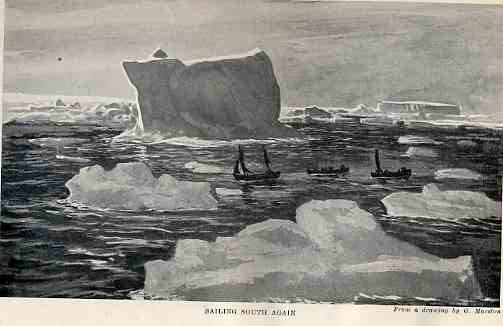
The hours dragged on. One of the anxieties in my mind was the possibility that we would be driven by the current through the eighty-mile gap between Clarence Island and Prince George Island into the open Atlantic; but slowly the open water came nearer, and at noon it had almost reached us. A long lane, narrow but navigable, stretched out to the south-west horizon. Our chance came a little later. We rushed our boats over the edge of the reeling berg and swung them clear of the ice-foot as it rose beneath them. The James Caird was nearly capsized by a blow from below as the berg rolled away, but she got into deep water. We flung stores and gear aboard and within a few minutes were away. The James Caird and Dudley Docker had good sails and with a favourable breeze could make progress along the lane, with the rolling fields of ice on either side. The swell was heavy and spray was breaking over the ice-floes. An attempt to set a little rag of sail on the Stancomb Wills resulted in serious delay. The area of sail was too small to be of much assistance, and while the men were engaged in this work the boat drifted down towards the ice-floe, where her position was likely to be perilous. Seeing her plight, I sent the Dudley Docker back for her and tied the James Caird up to a piece of ice. The Dudley Docker had to tow the Stancomb Wills, and the delay cost us two hours of valuable daylight. When I had the three boats together again we continued down the lane, and soon saw a wider stretch of water to the west; it appeared to offer us release from the grip of the pack. At the head of an ice-tongue that nearly closed the gap through which we might enter the open space was a wave-worn berg shaped like some curious antediluvian monster, an icy Cerberus guarding the way. It had head and eyes and rolled so heavily that it almost overturned. Its sides dipped deep in the sea, and as it rose again the water seemed to be streaming from its eyes, as though it were weeping at our escape from the clutch of the floes. This may seem fanciful to the reader, but the impression was real to us at the time. People living under civilized conditions, surrounded by Nature’s varied forms of life and by all the familiar work of their own hands, may scarcely realize how quickly the mind, influenced by the eyes, responds to the unusual and weaves about it curious imaginings like the firelight fancies of our childhood days. We had lived long amid the ice, and we half-unconsciously strove to see resemblances to human faces and living forms in the fantastic contours and massively uncouth shapes of berg and floe.
The hours dragged on. I feared the current might carry us through the eighty-mile gap between Clarence Island and Prince George Island. Beyond it lay the open Atlantic. But the open water slowly came nearer, and by noon it had almost reached us. A long, narrow lane of water stretched to the south-west horizon. It was narrow, but the boats could pass through it. Our chance came a little later. We rushed our boats over the edge of the rocking berg. As the ice-foot rose beneath them, we swung the boats clear of it. The James Caird was nearly capsized by a blow from below as the berg rolled away, but she reached deep water. We threw stores and gear aboard and were away within minutes. The James Caird and Dudley Docker had good sails. With a favorable breeze, they could make progress along the lane, with rolling fields of ice on either side. The swell was heavy, and spray broke over the ice-floes. We tried to set a small scrap of sail on the Stancomb Wills, but it caused a serious delay. The sail was too small to be much help. While the men were working on it, the boat drifted toward an ice-floe, where she was likely to be in danger. Seeing her trouble, I sent the Dudley Docker back for her and tied the James Caird to a piece of ice. The Dudley Docker had to tow the Stancomb Wills, and the delay cost us two hours of valuable daylight. Once I had the three boats together again, we continued down the lane. Soon we saw a wider stretch of water to the west. It seemed to offer us a way out of the grip of the pack. A tongue of ice nearly closed the gap through which we could enter the open water. At its tip was a wave-worn berg, shaped like a strange prehistoric monster. It was an icy Cerberus guarding the way. It had a head and eyes and rolled so heavily that it almost overturned. Its sides dipped deep into the sea. As it rose again, water seemed to stream from its eyes, as though it were weeping at our escape from the floes. This may seem fanciful to the reader, but the impression was real to us at the time. People living in civilized surroundings may scarcely realize how quickly the mind responds to unusual sights. Surrounded by Nature’s varied forms of life and the familiar work of their own hands, they may scarcely realize how quickly the mind weaves curious imaginings around such sights, like our childhood fancies in the firelight. We had lived among the ice for a long time. Almost without realizing it, we tried to see human faces and living forms in the fantastic contours and huge, awkward shapes of berg and floe.
At dusk we made fast to a heavy floe, each boat having its painter fastened to a separate hummock in order to avoid collisions in the swell. We landed the blubber-stove, boiled some water in order to provide hot milk, and served cold rations. I also landed the dome tents and stripped the coverings from the hoops. Our experience of the previous day in the open sea had shown us that the tents must be packed tightly. The spray had dashed over the bows and turned to ice on the cloth, which had soon grown dangerously heavy. Other articles off our scanty equipment had to go that night. We were carrying only the things that had seemed essential, but we stripped now to the barest limit of safety. We had hoped for a quiet night, but presently we were forced to cast off, since pieces of loose ice began to work round the floe. Drift-ice is always attracted to the lee side of a heavy floe, where it bumps and presses under the influence of the current. I had determined not to risk a repetition of the last night’s experience and so had not pulled the boats up. We spent the hours of darkness keeping an offing from the main line of pack under the lee of the smaller pieces. Constant rain and snow squalls blotted out the stars and soaked us through, and at times it was only by shouting to each other that we managed to keep the boats together. There was no sleep for anybody owing to the severe cold, and we dare not pull fast enough to keep ourselves warm since we were unable to see more than a few yards ahead. Occasionally the ghostly shadows of silver, snow, and fulmar petrels flashed close to us, and all around we could hear the killers blowing, their short, sharp hisses sounding like sudden escapes of steam. The killers were a source of anxiety, for a boat could easily have been capsized by one of them coming up to blow. They would throw aside in a nonchalant fashion pieces of ice much bigger than our boats when they rose to the surface, and we had an uneasy feeling that the white bottoms of the boats would look like ice from below. Shipwrecked mariners drifting in the Antarctic seas would be things not dreamed of in the killers’ philosophy, and might appear on closer examination to be tasty substitutes for seal and penguin. We certainly regarded the killers with misgivings.
At dusk we tied up to a large, heavy ice floe. Each boat’s rope was tied to a separate mound of ice to prevent collisions in the swell. We brought the blubber stove ashore, boiled water for hot milk, and served cold rations. I also brought the dome tents ashore and removed their coverings from the hoops. Our experience in the open sea the day before had shown us that the tents had to be tightly packed. Spray had swept over the bows and frozen on the canvas, which soon became dangerously heavy. That night we also had to discard other items from our scanty equipment. We had brought only what had seemed essential, but now we cut back to the bare minimum for safety. We had hoped for a quiet night, but soon we had to cast off. Loose pieces of ice were beginning to drift around the floe. Drift ice is always drawn to the sheltered side of a heavy floe, where the current makes it bump and press against the floe. I had decided not to risk another experience like the previous night’s, so I had not pulled the boats up. We spent the dark hours keeping away from the main edge of the pack ice, sheltered by smaller pieces. Constant squalls of rain and snow hid the stars and soaked us through. At times we could keep the boats together only by shouting to one another. No one slept because of the severe cold. We could see only a few yards ahead, so we dared not row fast enough to keep warm. Now and then, the ghostly shadows of silver, snow, and fulmar petrels flashed close by. All around us we could hear the killer whales blowing. Their short, sharp hisses sounded like sudden bursts of steam. The whales worried us because one could easily capsize a boat by coming up to breathe. As they rose to the surface, they casually tossed aside pieces of ice much bigger than our boats. We had an uneasy feeling that the white bottoms of the boats would look like ice from below. Shipwrecked sailors drifting in Antarctic seas would be creatures beyond anything the whales had imagined. On closer inspection, we might seem like tasty substitutes for seals and penguins. We certainly viewed the killer whales with misgivings.
Early in the morning of April 12 the weather improved and the wind dropped. Dawn came with a clear sky, cold and fearless. I looked around at the faces of my companions in the James Caird and saw pinched and drawn features. The strain was beginning to tell. Wild sat at the rudder with the same calm, confident expression that he would have worn under happier conditions; his steel-blue eyes looked out to the day ahead. All the people, though evidently suffering, were doing their best to be cheerful, and the prospect of a hot breakfast was inspiriting. I told all the boats that immediately we could find a suitable floe the cooker would be started and hot milk and Bovril would soon fix everybody up. Away we rowed to the westward through open pack, floes of all shapes and sizes on every side of us, and every man not engaged in pulling looking eagerly for a suitable camping-place. I could gauge the desire for food of the different members by the eagerness they displayed in pointing out to me the floes they considered exactly suited to our purpose. The temperature was about 10° Fahr., and the Burberry suits of the rowers crackled as the men bent to the oars. I noticed little fragments of ice and frost falling from arms and bodies. At eight o’clock a decent floe appeared ahead and we pulled up to it. The galley was landed, and soon the welcome steam rose from the cooking food as the blubber-stove flared and smoked. Never did a cook work under more anxious scrutiny. Worsley, Crean, and I stayed in our respective boats to keep them steady and prevent collisions with the floe, since the swell was still running strong, but the other men were able to stretch their cramped limbs and run to and fro “in the kitchen,” as somebody put it. The sun was now rising gloriously. The Burberry suits were drying and the ice was melting off our beards. The steaming food gave us new vigour, and within three-quarters of an hour we were off again to the west with all sails set. We had given an additional sail to the Stancomb Wills and she was able to keep up pretty well. We could see that we were on the true pack-edge, with the blue, rolling sea just outside the fringe of ice to the north. White-capped waves vied with the glittering floes in the setting of blue water, and countless seals basked and rolled on every piece of ice big enough to form a raft.
Early on the morning of April 12, the weather improved and the wind dropped. Dawn came with a clear sky, cold and fearless. I looked at my companions in the James Caird and saw their pinched, drawn faces. The strain was beginning to show. Wild sat at the rudder with the same calm, confident expression he would have worn in happier conditions. His steel-blue eyes looked out at the day ahead. Everyone was clearly suffering, but all were doing their best to be cheerful. The prospect of a hot breakfast lifted our spirits. I told all the boats that we would start the cooker as soon as we found a suitable floe. Hot milk and Bovril would soon put everyone right. We rowed west through loosely packed ice, with floes of every shape and size on all sides. Every man who was not rowing eagerly searched for a suitable camping place. I could tell how hungry each man was by how eagerly he pointed out floes he thought perfect for our purpose. The temperature was about 10° Fahrenheit, and the rowers’ Burberry suits crackled as the men bent to their oars. I noticed small pieces of ice and frost falling from their arms and bodies. At eight o’clock a decent floe appeared ahead, and we rowed up to it. The cooking equipment was brought ashore, and the blubber stove flared and smoked. Soon the welcome steam rose from the cooking food. Never had a cook worked under such anxious scrutiny. Worsley, Crean, and I stayed in our respective boats to keep them steady and prevent collisions with the floe. The swell was still strong. But the other men could stretch their cramped limbs and run back and forth “in the kitchen,” as somebody called it. The sun was now rising gloriously. The Burberry suits were drying, and the ice was melting off our beards. The steaming food gave us new strength. Within three-quarters of an hour, we were heading west again with all sails set. We had given an extra sail to the Stancomb Wills, and she was able to keep up fairly well. We could see that we were at the true edge of the pack ice. The blue, rolling sea lay just beyond the fringe of ice to the north. White-capped waves competed with the glittering floes against the blue water. Countless seals basked and rolled on every piece of ice big enough to serve as a raft.
We had been making westward with oars and sails since April 9, and fair easterly winds had prevailed. Hopes were running high as to the noon observation for position. The optimists thought that we had done sixty miles towards our goal, and the most cautious guess gave us at least thirty miles. The bright sunshine and the brilliant scene around us may have influenced our anticipations. As noon approached I saw Worsley, as navigating officer, balancing himself on the gunwale of the Dudley Docker with his arm around the mast, ready to snap the sun. He got his observation and we waited eagerly while he worked out the sight. Then the Dudley Docker ranged up alongside the James Caird and I jumped into Worsley’s boat in order to see the result. It was a grievous disappointment. Instead of making a good run to the westward we had made a big drift to the south-east. We were actually thirty miles to the east of the position we had occupied when we left the floe on the 9th. It has been noted by sealers operating in this area that there are often heavy sets to the east in the Belgica Straits, and no doubt it was one of these sets that we had experienced. The originating cause would be a north-westerly gale off Cape Horn, producing the swell that had already caused us so much trouble. After a whispered consultation with Worsley and Wild, I announced that we had not made as much progress as we expected, but I did not inform the hands of our retrograde movement.
Since April 9, we had been heading west using oars and sails, with favorable easterly winds. We had high hopes for the noon observation of our position. The optimists thought we had traveled sixty miles toward our goal. Even the most cautious estimate put us at least thirty miles closer. The bright sunshine and the brilliant scene around us may have raised our expectations. As noon approached, I saw Worsley, our navigating officer, balancing on the gunwale of the Dudley Docker. He had his arm around the mast and was ready to take a sighting of the sun. He took the sighting, and we waited eagerly while he calculated our position. Then the Dudley Docker came alongside the James Caird, and I jumped into Worsley’s boat to see the result. It was a bitter disappointment. Instead of making good progress westward, we had drifted far to the southeast. We were actually thirty miles east of the position we had left on the floe on the 9th. Sealers working in this area have noted that strong eastward currents often occur in the Belgica Straits. No doubt we had encountered one of these currents. It would have been caused by a northwesterly gale off Cape Horn. The gale would also have produced the swell that had already caused us so much trouble. After a whispered consultation with Worsley and Wild, I announced that we had not made as much progress as expected. But I did not tell the men that we had moved backward.
The question of our course now demanded further consideration. Deception Island seemed to be beyond our reach. The wind was foul for Elephant Island, and as the sea was clear to the south-west; I discussed with Worsley and Wild the advisability of proceeding to Hope Bay on the mainland of the Antarctic Continent, now only eighty miles distant. Elephant Island was the nearest land, but it lay outside the main body of pack, and even if the wind had been fair we would have hesitated at that particular time to face the high sea that was running in the open. We laid a course roughly for Hope Bay, and the boats moved on again. I gave Worsley a line for a berg ahead and told him, if possible, to make fast before darkness set in. This was about three o’clock in the afternoon. We had set sail, and as the Stancomb Wills could not keep up with the other two boats I took her in tow, not being anxious to repeat the experience of the day we left the reeling berg. The Dudley Docker went ahead, but came beating down towards us at dusk. Worsley had been close to the berg, and he reported that it was unapproachable. It was rolling in the swell and displaying an ugly ice-foot. The news was bad. In the failing light we turned towards a line of pack, and found it so tossed and churned by the sea that no fragment remained big enough to give us an anchorage and shelter. Two miles away we could see a larger piece of ice, and to it we managed, after some trouble, to secure the boats. I brought my boat bow on to the floe, whilst Howe, with the painter in his hand, stood ready to jump. Standing up to watch our chance, while the oars were held ready to back the moment Howe had made his leap, I could see that there would be no possibility of getting the galley ashore that night. Howe just managed to get a footing on the edge of the floe, and then made the painter fast to a hummock. The other two boats were fastened alongside the James Caird. They could not lie astern of us in a line, since cakes of ice came drifting round the floe and gathering under its lee. As it was we spent the next two hours poling off the drifting ice that surged towards us. The blubber-stove could not be used, so we started the Primus lamps. There was a rough, choppy sea, and the Dudley Docker could not get her Primus under way, something being adrift. The men in that boat had to wait until the cook on the James Caird had boiled up the first pot of milk.
We now had to reconsider our course. Deception Island seemed beyond our reach. The wind was against us for Elephant Island, but the sea was clear to the south-west. So I discussed with Worsley and Wild whether we should head for Hope Bay on the Antarctic mainland. It was now only eighty miles away. Elephant Island was the nearest land, but it lay outside the main body of pack ice. Even if the wind had been favorable, we would have hesitated to face the high seas then running in the open water. We set a course roughly towards Hope Bay, and the boats moved on again. I gave Worsley a course towards an iceberg ahead and told him to tie up to it before dark, if possible. It was about three o’clock in the afternoon. We had set sail, but the Stancomb Wills could not keep up with the other two boats. So I took her in tow. I did not want to repeat our experience on the day we left the rocking iceberg. The Dudley Docker went ahead, but sailed back towards us against the wind at dusk. Worsley had been close to the iceberg and reported that he could not approach it. It was rolling in the swell, exposing a dangerous shelf of ice at its base. The news was bad. In the fading light we turned towards a line of pack ice. But the sea had tossed and churned it so much that no piece remained large enough to give us an anchorage and shelter. Two miles away we could see a larger piece of ice. After some trouble, we managed to secure the boats to it. I brought my boat bow first against the floe. Howe stood ready to jump, with the bow rope in his hand. I stood up to watch for our chance. The oars were held ready to row backwards the moment Howe jumped. I could see that there would be no possibility of getting the galley ashore that night. Howe just managed to gain a foothold on the edge of the floe. He then tied the bow rope to a mound of ice. The other two boats were fastened alongside the James Caird. They could not lie in a line behind us because cakes of ice drifted around the floe and gathered on its sheltered side. Even so, we spent the next two hours using poles to push away the drifting ice that surged towards us. We could not use the blubber-stove, so we lit the Primus lamps. The sea was rough and choppy, and the men in the Dudley Docker could not get their Primus going because something had come loose. They had to wait until the cook on the James Caird had boiled the first pot of milk.
The boats were bumping so heavily that I had to slack away the painter of the Stancomb Wills and put her astern. Much ice was coming round the floe and had to be poled off. Then the Dudley Docker, being the heavier boat, began to damage the James Caird, and I slacked the Dudley Docker away. The James Caird remained moored to the ice, with the Dudley Docker and the Stancomb Wills in line behind her. The darkness had become complete, and we strained our eye to see the fragments of ice that threatened us. Presently we thought we saw a great berg bearing down upon us, its form outlined against the sky, but this startling spectacle resolved itself into a low-lying cloud in front of the rising moon. The moon appeared in a clear sky. The wind shifted to the south-east as the light improved and drove the boats broadside on towards the jagged edge of the floe. We had to cut the painter of the James Caird and pole her off, thus losing much valuable rope. There was no time to cast off. Then we pushed away from the floe, and all night long we lay in the open, freezing sea, the Dudley Docker now ahead, the James Caird astern of her, and the Stancomb Wills third in the line. The boats were attached to one another by their painters. Most of the time the Dudley Docker kept the James Caird and the Stancomb Wills up to the swell, and the men who were rowing were in better pass than those in the other boats, waiting inactive for the dawn. The temperature was down to 4° below zero, and a film of ice formed on the surface of the sea. When we were not on watch we lay in each other’s arms for warmth. Our frozen suits thawed where our bodies met, and as the slightest movement exposed these comparatively warm spots to the biting air, we clung motionless, whispering each to his companion our hopes and thoughts. Occasionally from an almost clear sky came snow-showers, falling silently on the sea and laying a thin shroud of white over our bodies and our boats.
The boats were bumping together so heavily that I had to loosen the Stancomb Wills's painter and let her drift behind. Much ice was coming around the floe, and we had to push it away with poles. Then the Dudley Docker, being the heavier boat, began to damage the James Caird, so I let her drift back too. The James Caird remained tied to the ice, with the Dudley Docker and the Stancomb Wills in line behind her. It was now completely dark, and we strained our eyes to see the pieces of ice that threatened us. Soon we thought we saw a great iceberg bearing down on us, its shape outlined against the sky. But the alarming sight turned out to be a low cloud in front of the rising moon. The moon appeared in a clear sky. As the light improved, the wind shifted to the south-east and drove the boats sideways towards the jagged edge of the floe. We had to cut the James Caird's painter and push her away with poles, losing much valuable rope. There was no time to untie it. Then we pushed away from the floe and spent all night on the open, freezing sea. The Dudley Docker was now in front, with the James Caird behind her and the Stancomb Wills third in line. The boats were tied to one another by their painters. Most of the time, the Dudley Docker kept the James Caird and the Stancomb Wills facing into the swell. The men rowing were better off than those in the other boats, who waited inactive for dawn. The temperature was down to 4° below zero, and a thin layer of ice formed on the sea. When we were not on watch, we lay in each other's arms for warmth. Our frozen suits thawed where our bodies touched. The slightest movement exposed these relatively warm spots to the biting air, so we clung motionless. We whispered our hopes and thoughts to each other. Now and then snow showers fell silently from an almost clear sky onto the sea. They laid a thin white shroud over our bodies and our boats.
The dawn of April 13 came clear and bright, with occasional passing clouds. Most of the men were now looking seriously worn and strained. Their lips were cracked and their eyes and eyelids showed red in their salt-encrusted faces. The beards even of the younger men might have been those of patriarchs, for the frost and the salt spray had made them white. I called the Dudley Docker alongside and found the condition of the people there was no better than in the James Caird. Obviously we must make land quickly, and I decided to run for Elephant Island. The wind had shifted fair for that rocky isle, then about one hundred miles away, and the pack that separated us from Hope Bay had closed up during the night from the south. At 6 p.m. we made a distribution of stores among the three boats, in view of the possibility of their being separated. The preparation of a hot breakfast was out of the question. The breeze was strong and the sea was running high in the loose pack around us. We had a cold meal, and I gave orders that all hands might eat as much as they pleased, this concession being due partly to a realization that we would have to jettison some of our stores when we reached open sea in order to lighten the boats. I hoped, moreover, that a full meal of cold rations would compensate to some extent for the lack of warm food and shelter. Unfortunately, some of the men were unable to take advantage of the extra food owing to seasickness. Poor fellows, it was bad enough to be huddled in the deeply laden, spray-swept boats, frost-bitten and half-frozen, without having the pangs of seasickness added to the list of their woes. But some smiles were caused even then by the plight of one man, who had a habit of accumulating bits of food against the day of starvation that he seemed always to think was at hand, and who was condemned now to watch impotently while hungry comrades with undisturbed stomachs made biscuits, rations, and sugar disappear with extraordinary rapidity.
The dawn of April 13 was clear and bright, with occasional clouds passing overhead. Most of the men now looked seriously worn and strained. Their lips were cracked, and their eyes and eyelids were red against their salt-encrusted faces. Even the younger men had beards like those of patriarchs. Frost and salt spray had turned them white. I called the Dudley Docker alongside and found its crew in no better condition than those in the James Caird. We clearly had to reach land quickly, so I decided to head for Elephant Island. The wind had shifted in our favor for that rocky island, then about one hundred miles away. Meanwhile, the pack ice separating us from Hope Bay had closed in from the south overnight. At 6 p.m. we divided the supplies among the three boats in case they became separated. Making a hot breakfast was out of the question. The wind was strong, and the sea was rough among the loose pack ice around us. We ate a cold meal, and I ordered that everyone could eat as much as they wanted. I allowed this partly because I realized we would have to throw some supplies overboard to lighten the boats once we reached open sea. I also hoped that a full meal of cold rations would make up somewhat for the lack of warm food and shelter. Unfortunately, seasickness kept some of the men from taking advantage of the extra food. Poor fellows, it was bad enough to be huddled in the heavily loaded boats, swept by spray, frostbitten, and half-frozen. Now some had the pains of seasickness added to their troubles. But even then, one man's plight brought some smiles. He had a habit of saving bits of food for the day when starvation would come, which he always seemed to think was near. Now he could only watch helplessly as hungry comrades with steady stomachs made biscuits, rations, and sugar disappear with extraordinary speed.
We ran before the wind through the loose pack, a man in the bow of each boat trying to pole off with a broken oar the lumps of ice that could not be avoided. I regarded speed as essential. Sometimes collisions were not averted. The James Caird was in the lead, where she bore the brunt of the encounter with lurking fragments, and she was holed above the water-line by a sharp spur of ice, but this mishap did not stay us. Later the wind became stronger and we had to reef sails, so as not to strike the ice too heavily. The Dudley Docker came next to the James Caird and the Stancomb Wills followed. I had given order that the boats should keep 30 or 40 yds. apart, so as to reduce the danger of a collision if one boat was checked by the ice. The pack was thinning, and we came to occasional open areas where thin ice had formed during the night. When we encountered this new ice we had to shake the reef out of the sails in order to force a way through. Outside of the pack the wind must have been of hurricane force. Thousands of small dead fish were to be seen, killed probably by a cold current and the heavy weather. They floated in the water and lay on the ice, where they had been cast by the waves. The petrels and skua-gulls were swooping down and picking them up like sardines off toast.
We sailed before the wind through the loose pack ice. A man in the bow of each boat used a broken oar to push away unavoidable lumps of ice. I considered speed essential. Sometimes we could not avoid collisions. The James Caird was in the lead and took the worst of the impacts with hidden fragments of ice. A sharp spur of ice punched a hole above her waterline, but we did not stop. Later, the wind grew stronger, and we had to reef the sails so we would not hit the ice too hard. The Dudley Docker came next, followed by the Stancomb Wills. I had ordered the boats to keep 30 or 40 yards apart. This would reduce the danger of a collision if ice stopped one of them. The pack ice was thinning, and we came to occasional open areas where thin ice had formed overnight. When we met this new ice, we had to let out the reefed sails to force our way through. Outside the pack ice, the wind must have been of hurricane force. Thousands of small dead fish could be seen, probably killed by a cold current and the heavy weather. They floated in the water and lay on the ice, where the waves had thrown them. Petrels and skua gulls swooped down and picked them up like sardines off toast.
We made our way through the lanes till at noon we were suddenly spewed out of the pack into the open ocean. Dark blue and sapphire green ran the seas. Our sails were soon up, and with a fair wind we moved over the waves like three Viking ships on the quest of a lost Atlantis. With the sheet well out and the sun shining bright above, we enjoyed for a few hours a sense of the freedom and magic of the sea, compensating us for pain and trouble in the days that had passed. At last we were free from the ice, in water that our boats could navigate. Thoughts of home, stifled by the deadening weight of anxious days and nights, came to birth once more, and the difficulties that had still to be overcome dwindled in fancy almost to nothing.
We made our way through the lanes in the ice until, at noon, we were suddenly spewed out into the open ocean. The sea was dark blue and sapphire green. We soon raised our sails, and a favorable wind carried us over the waves. We moved like three Viking ships searching for a lost Atlantis. With the sails let out and the sun shining brightly above, we enjoyed a few hours of freedom and the magic of the sea. This made up for the pain and trouble of the past days. At last we were free of the ice, in water our boats could navigate. Thoughts of home had been stifled by the numbing weight of anxious days and nights. Now those thoughts returned, and the difficulties we still had to overcome seemed to shrink almost to nothing.
During the afternoon we had to take a second reef in the sails, for the wind freshened and the deeply laden boats were shipping much water and steering badly in the rising sea. I had laid the course for Elephant Island and we were making good progress. The Dudley Docker ran down to me at dusk and Worsley suggested that we should stand on all night; but already the Stancomb Wills was barely discernible among the rollers in the gathering dusk, and I decided that it would be safer to heave to and wait for the daylight. It would never have done for the boats to have become separated from one another during the night. The party must be kept together, and, moreover, I thought it possible that we might overrun our goal in the darkness and not be able to return. So we made a sea-anchor of oars and hove to, the Dudley Docker in the lead, since she had the longest painter. The James Caird swung astern of the Dudley Docker and the Stancomb Wills again had the third place. We ate a cold meal and did what little we could to make things comfortable for the hours of darkness. Rest was not for us. During the greater part of the night the sprays broke over the boats and froze in masses of ice, especially at the stern and bows. This ice had to be broken away in order to prevent the boats growing too heavy. The temperature was below zero and the wind penetrated our clothes and chilled us almost unbearably. I doubted if all the men would survive that night. One of our troubles was lack of water. We had emerged so suddenly from the pack into the open sea that we had not had time to take aboard ice for melting in the cookers, and without ice we could not have hot food. The Dudley Docker had one lump of ice weighing about ten pounds, and this was shared out among all hands. We sucked small pieces and got a little relief from thirst engendered by the salt spray, but at the same time we reduced our bodily heat. The condition of most of the men was pitiable. All of us had swollen mouths and we could hardly touch the food. I longed intensely for the dawn. I called out to the other boats at intervals during the night, asking how things were with them. The men always managed to reply cheerfully. One of the people on the Stancomb Wills shouted, “We are doing all right, but I would like some dry mitts.” The jest brought a smile to cracked lips. He might as well have asked for the moon. The only dry things aboard the boats were swollen mouths and burning tongues. Thirst is one of the troubles that confront the traveller in polar regions. Ice may be plentiful on every hand, but it does not become drinkable until it is melted, and the amount that may be dissolved in the mouth is limited. We had been thirsty during the days of heavy pulling in the pack, and our condition was aggravated quickly by the salt spray. Our sleeping-bags would have given us some warmth, but they were not within our reach. They were packed under the tents in the bows, where a mail-like coating of ice enclosed them, and we were so cramped that we could not pull them out.
During the afternoon, we had to reef the sails a second time, reducing their area. The wind grew stronger, and the heavily loaded boats were taking on a lot of water. They were also hard to steer in the rising seas. I had set a course for Elephant Island, and we were making good progress. At dusk, the Dudley Docker came alongside me, and Worsley suggested that we continue sailing through the night. But the Stancomb Wills was already barely visible among the rolling waves in the fading light. I decided it would be safer to heave to, holding the boats in place, and wait for daylight. It would never do for the boats to become separated during the night. The party had to be kept together. I also thought we might pass our goal in the dark and be unable to return. So we made a sea-anchor from oars and hove to. The Dudley Docker led because she had the longest towing rope. The James Caird swung into place behind the Dudley Docker, and the Stancomb Wills again took third place. We ate a cold meal and did what little we could to make ourselves comfortable for the dark hours ahead. There would be no rest for us. For most of the night, spray broke over the boats and froze in masses of ice, especially at the stern and bows. The ice had to be broken away to keep the boats from becoming too heavy. The temperature was below zero, and the wind cut through our clothes and chilled us almost beyond endurance. I doubted whether all the men would survive the night. One of our troubles was a lack of water. We had emerged so suddenly from the pack ice into the open sea that we had no time to take aboard ice to melt in the cookers. Without ice, we could not have hot food. The Dudley Docker had one lump of ice weighing about ten pounds, and it was shared among everyone. We sucked small pieces, which gave us a little relief from the thirst caused by the salt spray. But at the same time, the ice lowered our body heat. Most of the men were in a pitiable condition. All of us had swollen mouths, and we could hardly touch the food. I longed intensely for dawn. At intervals during the night, I called out to the other boats and asked how they were doing. The men always managed to reply cheerfully. One of the men on the Stancomb Wills shouted, “We are doing all right, but I would like some dry mitts.” The joke brought a smile to cracked lips. He might as well have asked for the moon. The only dry things aboard the boats were swollen mouths and burning tongues. Thirst is one of the troubles facing a traveler in polar regions. Ice may be plentiful on every side, but it is not drinkable until it melts. There is a limit to how much ice a person can melt in the mouth. We had been thirsty during the days of hard rowing in the pack ice, and the salt spray quickly made our condition worse. Our sleeping bags would have given us some warmth, but they were out of reach. They were packed under the tents in the bows, where a coating of ice enclosed them like armor. We were so cramped that we could not pull them out.
At last daylight came, and with the dawn the weather cleared and the wind fell to a gentle south-westerly breeze. A magnificent sunrise heralded in what we hoped would be our last day in the boats. Rose-pink in the growing light, the lofty peak of Clarence Island told of the coming glory of the sun. The sky grew blue above us and the crests of the waves sparkled cheerfully. As soon as it was light enough we chipped and scraped the ice off the bows and sterns. The rudders had been unshipped during the night in order to avoid the painters catching them. We cast off our ice-anchor and pulled the oars aboard. They had grown during the night to the thickness of telegraph-poles while rising and falling in the freezing seas, and had to be chipped clear before they could be brought inboard.
At last daylight came. The weather cleared at dawn, and the wind dropped to a gentle breeze from the southwest. A magnificent sunrise marked what we hoped would be our last day in the boats. In the growing light, the towering peak of Clarence Island glowed rose pink, promising the glory of the rising sun. The sky turned blue above us, and the wave crests sparkled cheerfully. As soon as it was light enough, we chipped and scraped the ice off the bows and sterns. We had removed the rudders during the night to keep the painters, the ropes attached to the boats, from catching on them. We cast off our ice anchor and pulled the oars aboard. During the night, ice had coated the oars as they rose and fell in the freezing seas. The oars had grown as thick as telegraph poles, and we had to chip the ice off before bringing them aboard.
We were dreadfully thirsty now. We found that we could get momentary relief by chewing pieces of raw seal meat and swallowing the blood, but thirst came back with redoubled force owing to the saltness of the flesh. I gave orders, therefore, that meat was to be served out only at stated intervals during the day or when thirst seemed to threaten the reason of any particular individual. In the full daylight Elephant Island showed cold and severe to the north-north-west. The island was on the bearings that Worsley had laid down, and I congratulated him on the accuracy of his navigation under difficult circumstances, with two days dead reckoning while following a devious course through the pack-ice and after drifting during two nights at the mercy of wind and waves. The Stancomb Wills came up and McIlroy reported that Blackborrow’s feet were very badly frost-bitten. This was unfortunate, but nothing could be done. Most of the people were frost-bitten to some extent, and it was interesting to notice that the “oldtimers,” Wild, Crean, Hurley, and I, were all right. Apparently we were acclimatized to ordinary Antarctic temperature, though we learned later that we were not immune.
We were terribly thirsty now. We found brief relief by chewing raw seal meat and swallowing the blood. But the salty meat made our thirst return twice as strongly. So I ordered that meat be handed out only at set times during the day. It could also be given to anyone whose thirst seemed to threaten their sanity. In full daylight, Elephant Island looked cold and forbidding to the north-northwest. The island lay on the bearing Worsley had calculated. I congratulated him on the accuracy of his navigation under difficult conditions. For two days he had navigated by dead reckoning while we took a winding course through the pack ice. We had also spent two nights drifting at the mercy of wind and waves. The Stancomb Wills came alongside, and McIlroy reported that Blackborrow’s feet were very badly frostbitten. This was unfortunate, but nothing could be done. Most of the men had some frostbite. It was interesting to notice that the “oldtimers,” Wild, Crean, Hurley, and I, were all right. Apparently we were used to ordinary Antarctic temperatures, though we later learned that we were not immune to frostbite.
All day, with a gentle breeze on our port bow, we sailed and pulled through a clear sea. We would have given all the tea in China for a lump of ice to melt into water, but no ice was within our reach. Three bergs were in sight and we pulled towards them, hoping that a trail of brash would be floating on the sea to leeward; but they were hard and blue, devoid of any sign of cleavage, and the swell that surged around them as they rose and fell made it impossible for us to approach closely. The wind was gradually hauling ahead, and as the day wore on the rays of the sun beat fiercely down from a cloudless sky on pain-racked men. Progress was slow, but gradually Elephant Island came nearer. Always while I attended to the other boats, signalling and ordering, Wild sat at the tiller of the James Caird. He seemed unmoved by fatigue and unshaken by privation. About four o’clock in the afternoon a stiff breeze came up ahead and, blowing against the current, soon produced a choppy sea. During the next hour of hard pulling we seemed to make no progress at all. The James Caird and the Dudley Docker had been towing the Stancomb Wills in turn, but my boat now took the Stancomb Wills in tow permanently, as the James Caird could carry more sail than the Dudley Docker in the freshening wind.
All day, with a gentle breeze on our port bow, we sailed and rowed through a clear sea. We would have given all the tea in China for a lump of ice to melt for water. But no ice was within reach. We could see three icebergs and rowed toward them. We hoped to find a trail of broken ice floating on the sheltered side. But the icebergs were hard and blue, with no sign of splitting. They rose and fell in the swell that surged around them, making it impossible to approach closely. The wind gradually shifted toward us. As the day wore on, the sun beat fiercely from a cloudless sky onto the men, who were racked with pain. Progress was slow, but Elephant Island gradually drew nearer. While I watched over the other boats, signaling and giving orders, Wild stayed at the tiller of the James Caird. He seemed unaffected by fatigue and unshaken by hardship. Around four in the afternoon, a strong wind came up against us. Blowing against the current, it soon made the sea choppy. We rowed hard for the next hour, but seemed to make no progress at all. The James Caird and the Dudley Docker had been taking turns towing the Stancomb Wills. But my boat now took the Stancomb Wills in tow permanently. The James Caird could carry more sail than the Dudley Docker in the strengthening wind.
We were making up for the south-east side of Elephant Island, the wind being between north-west and west. The boats, held as close to the wind as possible, moved slowly, and when darkness set in our goal was still some miles away. A heavy sea was running. We soon lost sight of the Stancomb Wills, astern of the James Caird at the length of the painter, but occasionally the white gleam of broken water revealed her presence. When the darkness was complete I sat in the stern with my hand on the painter, so that I might know if the other boat broke away, and I kept that position during the night. The rope grew heavy with the ice as the unseen seas surged past us and our little craft tossed to the motion of the waters. Just at dusk I had told the men on the Stancomb Wills that if their boat broke away during the night and they were unable to pull against the wind, they could run for the east side of Clarence Island and await our coming there. Even though we could not land on Elephant Island, it would not do to have the third boat adrift.
We were heading for the southeastern side of Elephant Island, with the wind coming from between northwest and west. The boats sailed as close to the wind as possible, but moved slowly. When darkness fell, our goal was still some miles away. The sea was rough. We soon lost sight of the Stancomb Wills, which was behind the James Caird, at the end of the painter, or tow rope. But occasionally the white gleam of breaking waves showed us where she was. When darkness had fully set in, I sat in the stern with my hand on the painter. That way I would know if the other boat broke away. I stayed there through the night. Ice built up on the rope and made it heavy as the unseen seas surged past us. Our little boat tossed on the water. Just at dusk, I had spoken to the men on the Stancomb Wills. I told them what to do if their boat broke away during the night and they could not row against the wind. They could head for the east side of Clarence Island and wait for us there. Even if we could not land on Elephant Island, we could not leave the third boat adrift.
It was a stern night. The men, except the watch, crouched and huddled in the bottom of the boat, getting what little warmth they could from the soaking sleeping-bags and each other’s bodies. Harder and harder blew the wind and fiercer and fiercer grew the sea. The boat plunged heavily through the squalls and came up to the wind, the sail shaking in the stiffest gusts. Every now and then, as the night wore on, the moon would shine down through a rift in the driving clouds, and in the momentary light I could see the ghostly faces of men, sitting up to trim the boat as she heeled over to the wind. When the moon was hidden its presence was revealed still by the light reflected on the streaming glaciers of the island. The temperature had fallen very low, and it seemed that the general discomfort of our situation could scarcely have been increased; but the land looming ahead was a beacon of safety, and I think we were all buoyed up by the hope that the coming day would see the end of our immediate troubles. At least we would get firm land under our feet. While the painter of the Stancomb Wills tightened and drooped under my hand, my thoughts were busy with plans for the future.
It was a brutal night. Except for the men on watch, everyone crouched together in the bottom of the boat. They drew what little warmth they could from the soaked sleeping bags and each other’s bodies. The wind blew harder and harder, and the sea grew fiercer and fiercer. The boat plunged heavily through the squalls and turned into the wind, its sail shaking in the strongest gusts. Now and then, as the night went on, the moon shone through a gap in the racing clouds. In that brief light, I could see the ghostly faces of the men. They sat up to balance the boat as it heeled over in the wind. Even when clouds hid the moon, its light reflected off the island’s streaming glaciers. The temperature had fallen very low, and it seemed our situation could hardly have been more uncomfortable. But the land looming ahead was a beacon of safety. I think we were all encouraged by the hope that the coming day would end our immediate troubles. At least we would have firm ground under our feet. As the Stancomb Wills’s painter, or towline, tightened and slackened under my hand, my thoughts were busy with plans for the future.
Towards midnight the wind shifted to the south-west, and this change enabled us to bear up closer to the island. A little later the Dudley Docker ran down to the James Caird, and Worsley shouted a suggestion that he should go ahead and search for a landing-place. His boat had the heels of the James Caird, with the Stancomb Wills in tow. I told him he could try, but he must not lose sight of the James Caird. Just as he left me a heavy snow-squall came down, and in the darkness the boats parted. I saw the Dudley Docker no more. This separation caused me some anxiety during the remaining hours of the night. A cross-sea was running and I could not feel sure that all was well with the missing boat. The waves could not be seen in the darkness, though the direction and force of the wind could be felt, and under such conditions, in an open boat, disaster might overtake the most experienced navigator. I flashed our compass-lamp on the sail in the hope that the signal would be visible on board the Dudley Docker, but could see no reply. We strained our eyes to windward in the darkness in the hope of catching a return signal and repeated our flashes at intervals.
Around midnight, the wind shifted to the south-west, allowing us to steer closer to the island. A little later, the Dudley Docker came alongside the James Caird. Worsley shouted that he could go ahead and look for a landing place. His boat was faster than the James Caird, which had the Stancomb Wills in tow. I told him he could try, but he must not lose sight of the James Caird. Just as he left, a heavy snow squall came down, and the boats became separated in the darkness. I did not see the Dudley Docker again. The separation caused me some anxiety during the rest of the night. Waves were crossing from different directions, and I could not be sure that all was well with the missing boat. We could not see the waves in the darkness, though we could feel the wind’s direction and force. In an open boat under such conditions, disaster could overtake even the most experienced navigator. I flashed our compass lamp on the sail, hoping the signal would be visible aboard the Dudley Docker, but I could see no reply. We strained our eyes toward the wind in the darkness, hoping to catch a return signal, and repeated our flashes at intervals.
My anxiety, as a matter of fact, was groundless. I will quote Worsley’s own account of what happened to the Dudley Docker:
In fact, my fears were unfounded. I will quote Worsley’s own account of what happened to the Dudley Docker:
“About midnight we lost sight of the James Caird with the Stancomb Wills in tow, but not long after saw the light of the James Caird’s compass-lamp, which Sir Ernest was flashing on their sail as a guide to us. We answered by lighting our candle under the tent and letting the light shine through. At the same time we got the direction of the wind and how we were hauling from my little pocket-compass, the boat’s compass being smashed. With this candle our poor fellows lit their pipes, their only solace, as our raging thirst prevented us from eating anything. By this time we had got into a bad tide-rip, which, combined with the heavy, lumpy sea, made it almost impossible to keep the Dudley Docker from swamping. As it was we shipped several bad seas over the stern as well as abeam and over the bows, although we were ‘on a wind.’ Lees, who owned himself to be a rotten oarsman, made good here by strenuous baling, in which he was well seconded by Cheetham. Greenstreet, a splendid fellow, relieved me at the tiller and helped generally. He and Macklin were my right and left bowers as stroke-oars throughout. McLeod and Cheetham were two good sailors and oars, the former a typical old deep-sea salt and growler, the latter a pirate to his finger-tips. In the height of the gale that night Cheetham was buying matches from me for bottles of champagne, one bottle per match (too cheap; I should have charged him two bottles). The champagne is to be paid when he opens his pub in Hull and I am able to call that way.... We had now had one hundred and eight hours of toil, tumbling, freezing, and soaking, with little or no sleep. I think Sir Ernest, Wild, Greenstreet, and I could say that we had no sleep at all. Although it was sixteen months since we had been in a rough sea, only four men were actually seasick, but several others were off colour.
“About midnight we lost sight of the James Caird, which was towing the Stancomb Wills. But soon afterward, we saw the light of the James Caird’s compass lamp. Sir Ernest was flashing it on their sail to guide us. We answered by lighting our candle under the tent and letting its light shine through. At the same time, my little pocket compass showed us the wind’s direction and the course we were sailing. The boat’s compass had been smashed. Our poor fellows used the candle to light their pipes, their only comfort, since our raging thirst kept us from eating anything. By then we had entered a bad tide rip. Together with the heavy, uneven sea, it made it almost impossible to keep the Dudley Docker from swamping. Even though we were sailing ‘on a wind,’ several heavy seas broke over the stern, sides, and bows. Lees, who admitted he was a rotten oarsman, made up for it by bailing hard, with good help from Cheetham. Greenstreet, a splendid fellow, took over from me at the tiller and helped wherever he could. Throughout the voyage, he and Macklin were my right and left hands as stroke oarsmen. McLeod and Cheetham were both good sailors and oarsmen. McLeod was a typical old deep sea sailor and grumbler, while Cheetham was a pirate to his fingertips. At the height of the gale that night, Cheetham was buying matches from me for bottles of champagne, one bottle per match. That was too cheap. I should have charged him two bottles. He is to pay me the champagne when he opens his pub in Hull and I can call there.... We had now endured one hundred and eight hours of hard work, tossing, freezing, and soaking, with little or no sleep. I think Sir Ernest, Wild, Greenstreet, and I could say that we had not slept at all. Although we had not been in a rough sea for sixteen months, only four men were actually seasick, but several others felt unwell.
“The temperature was 20° below freezing-point; fortunately, we were spared the bitterly low temperature of the previous night. Greenstreet’s right foot got badly frost-bitten, but Lees restored it by holding it in his sweater against his stomach. Other men had minor frost-bites, due principally to the fact that their clothes were soaked through with salt water.... We were close to the land as the morning approached, but could see nothing of it through the snow and spindrift. My eyes began to fail me. Constant peering to windward, watching for seas to strike us, appeared to have given me a cold in the eyes. I could not see or judge distance properly, and found myself falling asleep momentarily at the tiller. At 3 a.m. Greenstreet relieved me there. I was so cramped from long hours, cold, and wet, in the constrained position one was forced to assume on top of the gear and stores at the tiller, that the other men had to pull me amidships and straighten me out like a jack-knife, first rubbing my thighs, groin, and stomach.
“The temperature was 20° below freezing. Fortunately, we were spared the bitterly low temperature of the previous night. Greenstreet’s right foot was badly frostbitten, but Lees restored it by holding it inside his sweater against his stomach. Other men had minor frostbite, mainly because their clothes were soaked through with salt water.... As morning approached, we were close to land, but we could not see it through the snow and blowing spray. My eyesight began to fail. Constantly peering into the wind, watching for waves that might strike us, seemed to have given me a cold in my eyes. I could not see or judge distance properly, and I kept falling asleep briefly at the tiller. At 3 a.m. Greenstreet took over at the tiller. I was cramped from the long hours, cold, and wet. I had been forced to sit in an awkward position on top of the gear and supplies while steering. The other men had to pull me to the middle of the boat. They first rubbed my thighs, groin, and stomach, then straightened me out like a jackknife.
“At daylight we found ourselves close alongside the land, but the weather was so thick that we could not see where to make for a landing. Having taken the tiller again after an hour’s rest under the shelter (save the mark!) of the dripping tent, I ran the Dudley Docker off before the gale, following the coast around to the north. This course for the first hour was fairly risky, the heavy sea before which we were running threatening to swamp the boat, but by 8 a.m. we had obtained a slight lee from the land. Then I was able to keep her very close in, along a glacier front, with the object of picking up lumps of fresh-water ice as we sailed through them. Our thirst was intense. We soon had some ice aboard, and for the next hour and a half we sucked and chewed fragments of ice with greedy relish.
“At daylight we found ourselves close to land, but visibility was so poor that we could not see where to land. I rested for an hour under the shelter (if you can call it that!) of the dripping tent. Then I took the tiller again and steered the Dudley Docker before the gale, following the coast north. For the first hour this course was fairly risky. The heavy seas driving us along threatened to swamp the boat, but by 8 a.m. the land gave us a little shelter. Then I was able to keep the boat very close to shore, along a glacier front. I wanted to pick up lumps of fresh-water ice as we sailed through them. Our thirst was intense. We soon had some ice aboard, and for the next hour and a half we eagerly sucked and chewed fragments of it.
“All this time we were coasting along beneath towering rocky cliffs and sheer glacier-faces, which offered not the slightest possibility of landing anywhere. At 9.30 a.m. we spied a narrow, rocky beach at the base of some very high crags and cliff, and made for it. To our joy, we sighted the James Caird and the Stancomb Wills sailing into the same haven just ahead of us. We were so delighted that we gave three cheers, which were not heard aboard the other boats owing to the roar of the surf. However, we soon joined them and were able to exchange experiences on the beach.”
“All this time, we were sailing along beneath towering rocky cliffs and sheer glacier faces. There was no possibility of landing anywhere along them. At 9:30 a.m., we spotted a narrow, rocky beach at the foot of some very high cliffs and headed for it. To our joy, we saw the James Caird and the Stancomb Wills sailing into the same haven just ahead of us. We were so delighted that we gave three cheers. But the people aboard the other boats could not hear us over the roar of the surf. Soon, however, we joined them and were able to share our experiences on the beach.”
Our experiences on the James Caird had been similar, although we had not been able to keep up to windward as well as the Dudley Docker had done. This was fortunate as events proved, for the James Caird and Stancomb Wills went to leeward of the big bight the Dudley Docker entered and from which she had to turn out with the sea astern. We thus avoided the risk of having the Stancomb Wills swamped in the following sea. The weather was very thick in the morning. Indeed at 7 a.m. we were right under the cliffs, which plunged sheer into the sea, before we saw them. We followed the coast towards the north, and ever the precipitous cliffs and glacier-faces presented themselves to our searching eyes. The sea broke heavily against these walls and a landing would have been impossible under any conditions. We picked up pieces of ice and sucked them eagerly. At 9 a.m. at the north-west end of the island we saw a narrow beach at the foot of the cliffs. Outside lay a fringe of rocks heavily beaten by the surf but with a narrow channel showing as a break in the foaming water. I decided that we must face the hazards of this unattractive landing-place. Two days and nights without drink or hot food had played havoc with most of the men, and we could not assume that any safer haven lay within our reach. The Stancomb Wills was the lighter and handier boat—and I called her alongside with the intention of taking her through the gap first and ascertaining the possibilities of a landing before the James Caird made the venture. I was just climbing into the Stancomb Wills when I saw the Dudley Docker coming up astern under sail. The sight took a great load off my mind.
Our experiences on the James Caird had been similar, although we had not held our course into the wind as well as the Dudley Docker. As it turned out, this was fortunate. The James Caird and Stancomb Wills passed downwind of the large bay that the Dudley Docker entered. She had to turn back out with the waves coming from behind. We thus avoided the risk of the Stancomb Wills being swamped by the waves behind her. The weather was very foggy that morning. In fact, at 7 a.m. we were right under the cliffs before we saw them. They dropped sheer into the sea. We followed the coast north, always watching the steep cliffs and glacier faces ahead. The sea broke heavily against these walls, and landing would have been impossible under any conditions. We picked up pieces of ice and sucked them eagerly. At 9 a.m., at the north-west end of the island, we saw a narrow beach at the foot of the cliffs. A fringe of rocks lay offshore, heavily beaten by the surf. But a break in the foaming water showed a narrow channel. I decided that we must face the hazards of this unpromising landing place. Two days and nights without drink or hot food had taken a severe toll on most of the men. We could not assume that a safer haven lay within our reach. The Stancomb Wills was the lighter, more maneuverable boat, so I called her alongside. I intended to take her through the gap first and see whether a landing was possible. Then the James Caird could make the attempt. I was just climbing into the Stancomb Wills when I saw the Dudley Docker approaching from behind under sail. The sight took a great load off my mind.
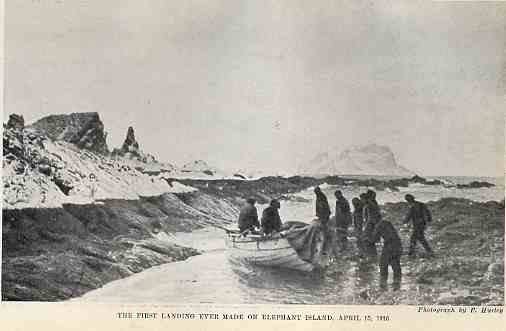
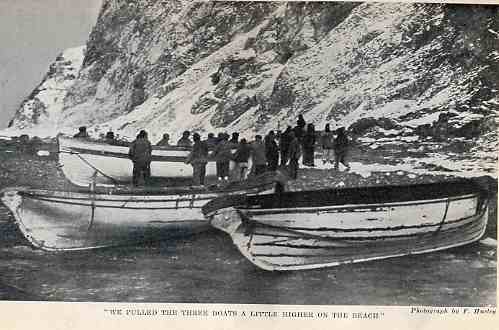
Rowing carefully and avoiding the blind rollers which showed where sunken rocks lay, we brought the Stancomb Wills towards the opening in the reef. Then, with a few strong strokes we shot through on the top of a swell and ran the boat on to a stony beach. The next swell lifted her a little farther. This was the first landing ever made on Elephant Island, and a thought came to me that the honour should belong to the youngest member of the Expedition, so I told Blackborrow to jump over. He seemed to be in a state almost of coma, and in order to avoid delay I helped him, perhaps a little roughly, over the side of the boat. He promptly sat down in the surf and did not move. Then I suddenly realized what I had forgotten, that both his feet were frost-bitten badly. Some of us jumped over and pulled him into a dry place. It was a rather rough experience for Blackborrow, but, anyhow, he is now able to say that he was the first man to sit on Elephant Island. Possibly at the time he would have been willing to forgo any distinction of the kind. We landed the cook with his blubber-stove, a supply of fuel and some packets of dried milk, and also several of the men. Then the rest of us pulled out again to pilot the other boats through the channel. The James Caird was too heavy to be beached directly, so after landing most of the men from the Dudley Docker and the Stancomb Wills I superintended the transhipment of the James Caird’s gear outside the reef. Then we all made the passage, and within a few minutes the three boats were aground. A curious spectacle met my eyes when I landed the second time. Some of the men were reeling about the beach as if they had found an unlimited supply of alcoholic liquor on the desolate shore. They were laughing uproariously, picking up stones and letting handfuls of pebbles trickle between their fingers like misers gloating over hoarded gold. The smiles and laughter, which caused cracked lips to bleed afresh, and the gleeful exclamations at the sight of two live seals on the beach made me think for a moment of that glittering hour of childhood when the door is open at last and the Christmas-tree in all its wonder bursts upon the vision. I remember that Wild, who always rose superior to fortune, bad and good, came ashore as I was looking at the men and stood beside me as easy and unconcerned as if he had stepped out of his car for a stroll in the park.
We rowed carefully toward the opening in the reef, avoiding the unbroken waves that showed where submerged rocks lay. Then, with a few strong strokes, we took the Stancomb Wills through on top of a swell and onto a stony beach. The next swell lifted the boat a little farther ashore. This was the first landing ever made on Elephant Island. I thought the honor should belong to the youngest member of the Expedition, so I told Blackborrow to jump overboard. He seemed almost unconscious, and to avoid delay I helped him over the side, perhaps a little roughly. He immediately sat down in the surf and did not move. Then I suddenly realized what I had forgotten: both his feet were badly frostbitten. Some of us jumped overboard and pulled him to a dry place. It was a rather rough experience for Blackborrow, but at least he can now say he was the first man to sit on Elephant Island. At the time, he might have been willing to give up any such honor. We put the cook ashore with his blubber-stove, some fuel and packets of dried milk. Several of the men also landed. Then the rest of us rowed out again to guide the other boats through the channel. The James Caird was too heavy to be brought directly onto the beach. So, after landing most of the men from the Dudley Docker and the Stancomb Wills, I supervised the transfer of the James Caird’s gear outside the reef. Then we all passed through the channel, and within a few minutes all three boats were aground. A curious sight met my eyes when I landed the second time. Some of the men were staggering around the beach as if they had found an unlimited supply of alcohol on the desolate shore. They were laughing wildly, picking up stones and letting handfuls of pebbles trickle through their fingers like misers admiring their hoarded gold. Their smiles and laughter made their cracked lips bleed again. At the sight of two live seals on the beach, they shouted with delight. For a moment, the scene reminded me of a magical hour in childhood. The door is finally opened, and the Christmas tree appears in all its wonder. I remember Wild coming ashore as I watched the men. Wild always rose above his circumstances, whether good or bad. He stood beside me, as relaxed and unconcerned as if he had stepped out of his car for a walk in the park.
Soon half a dozen of us had the stores ashore. Our strength was nearly exhausted and it was heavy work carrying our goods over the rough pebbles and rocks to the foot of the cliff, but we dare not leave anything within reach of the tide. We had to wade knee-deep in the icy water in order to lift the gear from the boats. When the work was done we pulled the three boats a little higher on the beach and turned gratefully to enjoy the hot drink the cook had prepared. Those of us who were comparatively fit had to wait until the weaker members of the party had been supplied; but every man had his pannikin of hot milk in the end, and never did anything taste better. Seal steak and blubber followed, for the seals that had been careless enough to await our arrival on the beach had already given up their lives. There was no rest for the cook. The blubber-stove flared and spluttered fiercely as he cooked, not one meal, but many meals, which merged into a day-long bout of eating. We drank water and ate seal meat until every man had reached the limit of his capacity.
Soon, about six of us had brought the supplies ashore. We were nearly exhausted, and carrying our goods over the rough pebbles and rocks to the foot of the cliff was hard work. But we could not risk leaving anything within reach of the tide. We had to wade knee-deep into the icy water to lift the gear from the boats. When we finished, we pulled the three boats a little farther up the beach. Then we gratefully turned to the hot drink the cook had prepared. Those of us who were relatively fit had to wait until the weaker members of the party had been served. But every man eventually had his cup of hot milk, and nothing had ever tasted better. Seal steak and blubber followed. The seals that had been careless enough to wait for us on the beach had already given up their lives. There was no rest for the cook. The blubber stove flared and sputtered fiercely as he cooked not one meal, but many. The meals merged into a day-long bout of eating. We drank water and ate seal meat until every man had eaten and drunk as much as he could.
The tents were pitched with oars for supports, and by 3 p.m. our camp was in order. The original framework of the tents had been cast adrift on one of the floes in order to save weight. Most of the men turned in early for a safe and glorious sleep, to be broken only by the call to take a turn on watch. The chief duty of the watchman was to keep the blubber-stove alight, and each man on duty appeared to find it necessary to cook himself a meal during his watch, and a supper before he turned in again.
We pitched the tents using oars as supports, and by 3 p.m. our camp was in order. We had left the original tent frames adrift on an ice floe to save weight. Most of the men turned in early for a safe and glorious sleep, interrupted only when they were called to take a turn on watch. The watchman’s main duty was to keep the blubber-stove alight. Each man on watch seemed to find it necessary to cook himself a meal during his shift, and a supper before he went back to bed.
Wild, Worsley, and Hurley accompanied me on an inspection of our beach before getting into the tents. I almost wished then that I had postponed the examination until after sleep, but the sense of caution that the uncertainties of polar travel implant in one’s mind had made me uneasy. The outlook we found to be anything but cheering. Obvious signs showed that at spring tides the little beach would be covered by the water right up to the foot of the cliffs. In a strong north-easterly gale, such as we might expect to experience at any time, the waves would pound over the scant barrier of the reef and break against the sheer sides of the rocky wall behind us. Well-marked terraces showed the effect of other gales, and right at the back of the beach was a small bit of wreckage not more than three feet long, rounded by the constant chafing it had endured. Obviously we must find some better resting-place. I decided not to share with the men the knowledge of the uncertainties of our situation until they had enjoyed the full sweetness of rest untroubled by the thought that at any minute they might be called to face peril again. The threat of the sea had been our portion during many, many days, and a respite meant much to weary bodies and jaded minds.
Wild, Worsley, and Hurley joined me to inspect our beach before we went into the tents. I almost wished I had waited until after we had slept. But polar travel had taught me to be cautious in the face of uncertainty, and I felt uneasy. What we found was anything but encouraging. Clear signs showed that at spring tides, water would cover the little beach right up to the foot of the cliffs. A strong northeasterly gale could strike at any time. In such a gale, waves would pound over the low barrier of the reef and break against the sheer rock wall behind us. Clearly marked terraces showed the effects of other gales. At the very back of the beach lay a small piece of wreckage, no more than three feet long. Constant rubbing had worn it smooth and round. We clearly had to find a better place to rest. I decided not to tell the men how uncertain our situation was until they had fully enjoyed their rest. I did not want them troubled by the thought that they might be called to face danger again at any moment. We had lived under the threat of the sea for many, many days. A break from it meant a great deal to our weary bodies and exhausted minds.
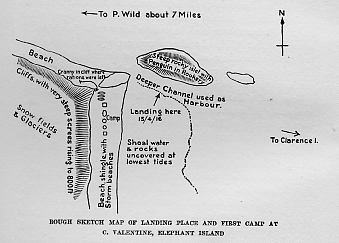
The accompanying plan will indicate our exact position more clearly than I can describe it. The cliffs at the back of the beach were inaccessible except at two points where there were steep snow-slopes. We were not worried now about food, for, apart from our own rations, there were seals on the beach and we could see others in the water outside the reef. Every now and then one of the animals would rise in the shallows and crawl up on the beach, which evidently was a recognized place of resort for its kind. A small rocky island which protected us to some extent from the north-westerly wind carried a ringed-penguin rookery. These birds were of migratory habit and might be expected to leave us before the winter set in fully, but in the meantime they were within our reach. These attractions, however, were overridden by the fact that the beach was open to the attack of wind and sea from the north-east and east. Easterly gales are more prevalent than western in that area of the Antarctic during the winter. Before turning in that night I studied the whole position and weighed every chance of getting the boats and our stores into a place of safety out of reach of the water. We ourselves might have clambered a little way up the snow-slopes, but we could not have taken the boats with us. The interior of the island was quite inaccessible. We climbed up one of the slopes and found ourselves stopped soon by overhanging cliffs. The rocks behind the camp were much weathered, and we noticed the sharp, unworn boulders that had fallen from above. Clearly there was a danger from overhead if we camped at the back of the beach. We must move on. With that thought in mind I reached my tent and fell asleep on the rubbly ground, which gave a comforting sense of stability. The fairy princess who would not rest on her seven downy mattresses because a pea lay underneath the pile might not have understood the pleasure we all derived from the irregularities of the stones, which could not possibly break beneath us or drift away; the very searching lumps were sweet reminders of our safety.
The accompanying plan shows our exact position more clearly than I can describe it. The cliffs behind the beach were inaccessible except at two points, where steep snow slopes led up them. We were no longer worried about food. Besides our own rations, there were seals on the beach, and we could see others in the water beyond the reef. Now and then a seal would surface in the shallows and crawl onto the beach. The beach was evidently a familiar gathering place for seals. A small rocky island sheltered us somewhat from the northwesterly wind. It was home to a ringed-penguin rookery. These birds were migratory and might be expected to leave before winter fully set in. In the meantime, though, they were within our reach. These advantages, however, were outweighed by the beach’s exposure to wind and sea from the northeast and east. During winter in that part of the Antarctic, easterly gales are more common than westerly ones. Before turning in that night, I considered our entire situation. I weighed every chance of getting the boats and stores somewhere safe, out of reach of the water. We could have clambered a little way up the snow slopes, but we could not have taken the boats with us. The island’s interior was completely inaccessible. We climbed one of the slopes, but overhanging cliffs soon stopped us. The rocks behind the camp were badly weathered, and we noticed sharp, unworn boulders that had fallen from above. Clearly, if we camped at the back of the beach, we would be in danger from falling rocks. We had to move on. With that thought in mind, I reached my tent and fell asleep on the stony ground. The ground gave me a comforting sense of stability. A fairy princess could not rest on her seven down mattresses because a pea lay beneath the pile. She might not have understood the pleasure we all took in the uneven stones beneath us. The stones could not possibly break beneath us or drift away. Even the lumps that pressed into us were sweet reminders of our safety.
Early next morning (April 15) all hands were astir. The sun soon shone brightly and we spread out our wet gear to dry, till the beach looked like a particularly disreputable gipsy camp. The boots and clothing had suffered considerably during our travels. I had decided to send Wild along the coast in the Stancomb Wills to look for a new camping-ground, and he and I discussed the details of the journey while eating our breakfast of hot seal steak and blubber. The camp I wished to find was one where the party could live for weeks or even months in safety, without danger from sea or wind in the heaviest winter gale. Wild was to proceed westwards along the coast and was to take with him four of the fittest men, Marston, Crean, Vincent, and McCarthy. If he did not return before dark we were to light a flare, which would serve him as a guide to the entrance of the channel. The Stancomb Wills pushed off at 11 a.m. and quickly passed out of sight around the island. Then Hurley and I walked along the beach towards the west, climbing through a gap between the cliff and a great detached pillar of basalt. The narrow strip of beach was cumbered with masses of rock that had fallen from the cliffs. We struggled along for two miles or more in the search for a place where we could get the boats ashore and make a permanent camp in the event of Wild’s search proving fruitless, but after three hours’ vain toil we had to turn back. We had found on the far side of the pillar of basalt a crevice in the rocks beyond the reach of all but the heaviest gales. Rounded pebbles showed that the seas reached the spot on occasions. Here I decided to depot ten cases of Bovril sledging ration in case of our having to move away quickly. We could come back for the food at a later date if opportunity offered.
Early the next morning (April 15), everyone was up and about. The sun soon shone brightly, and we spread out our wet gear to dry. The beach came to look like a particularly disreputable gipsy camp. Our boots and clothing had suffered considerably during our travels. I had decided to send Wild along the coast in the Stancomb Wills to look for a new campsite. We discussed the journey over our breakfast of hot seal steak and blubber. I wanted to find a camp where the party could live safely for weeks or even months. It needed to be safe from the sea and wind in the heaviest winter gale. Wild was to head west along the coast with four of the fittest men, Marston, Crean, Vincent, and McCarthy. If he did not return before dark, we would light a flare to guide him to the channel entrance. The Stancomb Wills pushed off at 11 a.m. and quickly disappeared around the island. Then Hurley and I walked west along the beach. We climbed through a gap between the cliff and a great detached pillar of basalt. The narrow strip of beach was littered with masses of rock that had fallen from the cliffs. We struggled on for two miles or more, looking for a place to bring the boats ashore and make a permanent camp. We needed a place in case Wild’s search failed. But after three hours of fruitless effort, we had to turn back. On the far side of the basalt pillar, we had found a crevice sheltered from all but the heaviest gales. Rounded pebbles showed that the sea reached the spot on occasion. I decided to store ten cases of Bovril sledging ration there, in case we had to move away quickly. We could come back for the food later if we had the chance.
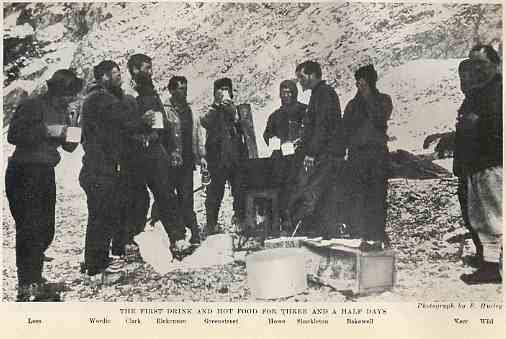
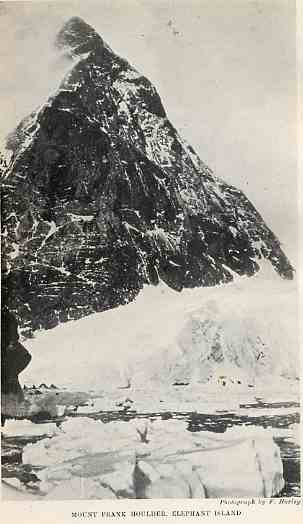
Returning to the camp, we found the men resting or attending to their gear. Clark had tried angling in the shallows off the rocks and had secured one or two small fish. The day passed quietly. Rusty needles were rubbed bright on the rocks and clothes were mended and darned. A feeling of tiredness—due, I suppose, to reaction after the strain of the preceding days—overtook us, but the rising tide, coming farther up the beach than it had done on the day before, forced us to labour at the boats, which we hauled slowly to a higher ledge. We found it necessary to move our makeshift camp nearer the cliff. I portioned out the available ground for the tents, the galley, and other purposes, as every foot was of value. When night arrived the Stancomb Wills was still away, so I had a blubber-flare lit at the head of the channel.
When we returned to camp, we found the men resting or tending to their gear. Clark had tried fishing in the shallow water off the rocks and caught one or two small fish. The day passed quietly. We rubbed rusty needles bright on the rocks and mended and darned clothes. We felt tired, probably from the strain of the preceding days. But the rising tide came farther up the beach than it had the day before. It forced us to work on the boats, hauling them slowly to a higher ledge. We also had to move our makeshift camp closer to the cliff. I divided the available ground among the tents, the galley, and other uses, since every foot mattered. When night fell, the Stancomb Wills was still away, so I had a blubber flare lit at the head of the channel.
About 8 p.m. we heard a hail in the distance. We could see nothing, but soon like a pale ghost out of the darkness came the boat, the faces of the men showing white in the glare of the fire. Wild ran her on the beach with the swell, and within a couple of minutes we had dragged her to a place of safety. I was waiting Wild’s report with keen anxiety, and my relief was great when he told me that he had discovered a sandy spit seven miles to the west, about 200 yds. long, running out at right angles to the coast and terminating at the seaward end in a mass of rock. A long snow-slope joined the spit at the shore end, and it seemed possible that a “dugout” could be made in the snow. The spit, in any case, would be a great improvement on our narrow beach. Wild added that the place he described was the only possible camping-ground he had seen. Beyond, to the west and south-west, lay a frowning line of cliffs and glaciers, sheer to the water’s edge. He thought that in very heavy gales either from the south-west or east the spit would be spray-blown, but that the seas would not actually break over it. The boats could be run up on a shelving beach.
Around 8 p.m. we heard someone call out in the distance. We could see nothing, but soon the boat appeared like a pale ghost out of the darkness. The men’s faces looked white in the glare of the fire. Wild rode a swell onto the beach, and within a couple of minutes we had dragged the boat to safety. I was waiting anxiously for Wild’s report. I was greatly relieved when he told me he had found a sandy spit seven miles to the west. It was about 200 yards long and extended from the coast at a right angle. A mass of rock lay at its seaward end. A long snow slope joined the spit at the shore end. It seemed possible that a “dugout” could be made in the snow. In any case, the spit would be a great improvement on our narrow beach. Wild added that it was the only possible campsite he had seen. Beyond it, to the west and southwest, lay a forbidding line of cliffs and glaciers. They rose sheer from the water’s edge. He thought that very heavy gales from either the southwest or east would blow spray over the spit. But he did not think the seas would actually break over it. The boats could be pulled up onto a gently sloping beach.
After hearing this good news I was eager to get away from the beach camp. The wind when blowing was favourable for the run along the coast. The weather had been fine for two days and a change might come at any hour. I told all hands that we would make a start early on the following morning. A newly killed seal provided a luxurious supper of steak and blubber, and then we slept comfortably till the dawn.
After hearing this good news, I was eager to leave the beach camp. When the wind blew, it was favorable for traveling along the coast. The weather had been fine for two days, and it could change at any hour. I told everyone we would leave early the next morning. A freshly killed seal gave us a luxurious supper of steak and blubber. Then we slept comfortably until dawn.
The morning of April 17 came fine and clear. The sea was smooth, but in the offing we could see a line of pack, which seemed to be approaching. We had noticed already pack and bergs being driven by the current to the east and then sometimes coming back with a rush to the west. The current ran as fast as five miles an hour, and it was a set of this kind that had delayed Wild on his return from the spit. The rise and fall of the tide was only about five feet at this time, but the moon was making for full and the tides were increasing. The appearance of ice emphasized the importance of getting away promptly. It would be a serious matter to be prisoned on the beach by the pack. The boats were soon afloat in the shallows, and after a hurried breakfast all hands worked hard getting our gear and stores aboard. A mishap befell us when we were launching the boats. We were using oars as rollers, and three of these were broken, leaving us short for the journey that had still to be undertaken. The preparations took longer than I had expected; indeed, there seemed to be some reluctance on the part of several men to leave the barren safety of the little beach and venture once more on the ocean. But the move was imperative, and by 11 a.m. we were away, the James Caird leading. Just as we rounded the small island occupied by the ringed penguins the “willywaw” swooped down from the 2000-ft. cliffs behind us, a herald of the southerly gale that was to spring up within half an hour.
The morning of April 17 was fine and clear. The sea was smooth, but offshore we could see a line of pack ice that seemed to be approaching. We had already seen pack ice and icebergs driven east by the current, then sometimes rushing back west. The current ran as fast as five miles an hour. A current like this had delayed Wild on his return from the spit. The tide rose and fell only about five feet at this time. But the moon was approaching full, and the tides were increasing. The appearance of ice made it even more important to get away quickly. It would be serious if the pack ice trapped us on the beach. The boats were soon afloat in the shallows. After a hurried breakfast, all hands worked hard to load our gear and stores aboard. We had a mishap while launching the boats. We were using oars as rollers, and three broke, leaving us short for the journey still ahead. The preparations took longer than I had expected. In fact, several men seemed reluctant to leave the barren safety of the little beach and venture onto the ocean again. But we had to move, and by 11 a.m. we were away, with the James Caird leading. Just as we rounded the small island where the ringed penguins lived, the “willywaw” swept down from the 2,000-foot cliffs behind us. It was a sign of the southerly gale that would spring up within half an hour.
Soon we were straining at the oars with the gale on our bows. Never had we found a more severe task. The wind shifted from the south to the south-west, and the shortage of oars became a serious matter. The James Caird, being the heaviest boat, had to keep a full complement of rowers, while the Dudley Docker and the Stancomb Wills went short and took turns using the odd oar. A big swell was thundering against the cliffs and at times we were almost driven on to the rocks by swirling green waters. We had to keep close inshore in order to avoid being embroiled in the raging sea, which was lashed snow-white and quickened by the furious squalls into a living mass of sprays. After two hours of strenuous labour we were almost exhausted, but we were fortunate enough to find comparative shelter behind a point of rock. Overhead towered the sheer cliffs for hundreds of feet, the sea-birds that fluttered from the crannies of the rock dwarfed by the height. The boats rose and fell in the big swell, but the sea was not breaking in our little haven, and we rested there while we ate our cold ration. Some of the men had to stand by the oars in order to pole the boats off the cliff-face.
Soon we were straining at the oars, with the gale blowing against our bows. We had never faced a harder task. The wind shifted from the south to the southwest, and the shortage of oars became a serious problem. The James Caird was the heaviest boat and needed a full crew of rowers. The Dudley Docker and the Stancomb Wills had to make do with fewer oars, taking turns with the spare one. Huge swells thundered against the cliffs. At times the swirling green water almost drove us onto the rocks. We had to stay close to shore to avoid being caught in the raging sea. Furious squalls whipped it into a living mass of white spray. After two hours of hard work, we were almost exhausted. Fortunately, we found some shelter behind a rocky point. Sheer cliffs towered hundreds of feet above us, dwarfing the seabirds that fluttered from cracks in the rock. The boats rose and fell on the big swells, but the sea was not breaking in our little haven. We rested there and ate our cold ration. Some men had to stay at the oars to push the boats away from the cliff face.
After half an hour’s pause I gave the order to start again. The Dudley Docker was pulling with three oars, as the Stancomb Wills had the odd one, and she fell away to leeward in a particularly heavy squall. I anxiously watched her battling up against wind and sea. It would have been useless to take the James Caird back to the assistance of the Dudley Docker since we were hard pressed to make any progress ourselves in the heavier boat. The only thing was to go ahead and hope for the best. All hands were wet to the skin again and many men were feeling the cold severely. We forged on slowly and passed inside a great pillar of rock standing out to sea and towering to a height of about 2400 ft. A line of reef stretched between the shore and this pillar, and I thought as we approached that we would have to face the raging sea outside; but a break in the white surf revealed a gap in the reef and we laboured through, with the wind driving clouds of spray on our port beam. The Stancomb Wills followed safely. In the stinging spray I lost sight of the Dudley Docker altogether. It was obvious she would have to go outside the pillar as she was making so much leeway, but I could not see what happened to her and I dared not pause. It was a bad time. At last, about 5 p.m., the James Caird and the Stancomb Wills reached comparatively calm water and we saw Wild’s beach just ahead of us. I looked back vainly for the Dudley Docker.
After a half-hour pause, I ordered everyone to start again. The Dudley Docker was rowing with three oars because the Stancomb Wills had the spare one. In a particularly heavy squall, the Dudley Docker drifted downwind. I watched anxiously as the boat battled against wind and sea. It would have been useless to take the James Caird back to help. Our boat was heavier, and we were struggling to make any progress ourselves. All we could do was go ahead and hope for the best. Everyone was soaked to the skin again, and many men were suffering badly from the cold. We pushed slowly on and passed between the shore and a huge pillar of rock standing offshore. It towered about 2,400 feet high. A reef stretched between the shore and the pillar. As we approached, I thought we would have to face the raging sea outside the reef. But a break in the white surf revealed a gap, and we struggled through it. The wind drove clouds of spray against our port side. The Stancomb Wills followed safely. In the stinging spray, I lost sight of the Dudley Docker altogether. The boat was drifting so far downwind that it would clearly have to go outside the pillar. But I could not see what happened to it, and I dared not stop. It was a bad time. At last, about 5 p.m., the James Caird and the Stancomb Wills reached relatively calm water. We saw Wild’s beach just ahead. I looked back for the Dudley Docker, but could not see it.
Rocks studded the shallow water round the spit and the sea surged amongst them. I ordered the Stancomb Wills to run on to the beach at the place that looked smoothest, and in a few moments the first boat was ashore, the men jumping out and holding her against the receding wave. Immediately I saw she was safe I ran the James Caird in. Some of us scrambled up the beach through the fringe of the surf and slipped the painter round a rock, so as to hold the boat against the backwash. Then we began to get the stores and gear out, working like men possessed, for the boats could not be pulled up till they had been emptied. The blubber-stove was quickly alight and the cook began to prepare a hot drink. We were labouring at the boats when I noticed Rickenson turn white and stagger in the surf. I pulled him out of reach of the water and sent him up to the stove, which had been placed in the shelter of some rocks. McIlroy went to him and found that his heart had been temporarily unequal to the strain placed upon it. He was in a bad way and needed prompt medical attention. There are some men who will do more than their share of work and who will attempt more than they are physically able to accomplish. Rickenson was one of these eager souls. He was suffering, like many other members of the Expedition, from bad salt-water boils. Our wrists, arms, and legs were attacked. Apparently this infliction was due to constant soaking with sea-water, the chafing of wet clothes, and exposure.
Rocks dotted the shallow water around the spit, and the sea surged among them. I ordered the Stancomb Wills to land at the smoothest-looking part of the beach. Within moments, the first boat was ashore. The men jumped out and held her against the retreating wave. As soon as I saw that she was safe, I brought in the James Caird. Some of us scrambled up the beach through the edge of the surf and looped the bow rope around a rock. This held the boat against the water flowing back out to sea. Then we began unloading the supplies and equipment, working like men possessed. We could not pull the boats up the beach until they were empty. The blubber stove was quickly lit, and the cook began preparing a hot drink. While we were working at the boats, I saw Rickenson turn pale and stagger in the surf. I pulled him out of the water’s reach and sent him up to the stove, sheltered by some rocks. McIlroy went to him and found that his heart had temporarily been unable to cope with the strain. He was in a bad way and needed immediate medical attention. Some men will do more than their share of work and attempt more than they are physically able to do. Rickenson was one of these eager souls. Like many other members of the Expedition, he was suffering from severe salt-water boils. Our wrists, arms, and legs were affected. Apparently, the boils were caused by constant soaking in seawater, the rubbing of wet clothes, and exposure.
I was very anxious about the Dudley Docker, and my eyes as well as my thoughts were turned eastward as we carried the stores ashore; but within half an hour the missing boat appeared, labouring through the spume-white sea, and presently she reached the comparative calm of the bay. We watched her coming with that sense of relief that the mariner feels when he crosses the harbour-bar. The tide was going out rapidly, and Worsley lightened the Dudley Docker by placing some cases on an outer rock, where they were retrieved subsequently. Then he beached his boat, and with many hands at work we soon had our belongings ashore and our three craft above high-water mark. The spit was by no means an ideal camping-ground; it was rough, bleak, and inhospitable—just an acre or two of rock and shingle, with the sea foaming around it except where the snow-slope, running up to a glacier, formed the landward boundary. But some of the larger rocks provided a measure of shelter from the wind, and as we clustered round the blubber-stove, with the acrid smoke blowing into our faces, we were quite a cheerful company. After all, another stage of the homeward journey had been accomplished and we could afford to forget for an hour the problems of the future. Life was not so bad. We ate our evening meal while the snow drifted down from the surface of the glacier, and our chilled bodies grew warm. Then we dried a little tobacco at the stove and enjoyed our pipes before we crawled into our tents. The snow had made it impossible for us to find the tide-line and we were uncertain how far the sea was going to encroach upon our beach. I pitched my tent on the seaward side of the camp so that I might have early warning of danger, and, sure enough, about 2 a.m. a little wave forced its way under the tent-cloth. This was a practical demonstration that we had not gone far enough back from the sea, but in the semi-darkness it was difficult to see where we could find safety. Perhaps it was fortunate that experience had inured us to the unpleasantness of sudden forced changes of camp. We took down the tents and re-pitched them close against the high rocks at the seaward end of the spit, where large boulders made an uncomfortable resting-place. Snow was falling heavily. Then all hands had to assist in pulling the boats farther up the beach, and at this task we suffered a serious misfortune. Two of our four bags of clothing had been placed under the bilge of the James Caird, and before we realized the danger a wave had lifted the boat and carried the two bags back into the surf. We had no chance of recovering them. This accident did not complete the tale of the night’s misfortunes. The big eight-man tent was blown to pieces in the early morning. Some of the men who had occupied it took refuge in other tents, but several remained in their sleeping-bags under the fragments of cloth until it was time to turn out.
I was very anxious about the Dudley Docker. As we carried the stores ashore, my eyes and thoughts kept turning eastward. But within half an hour the missing boat appeared, struggling through the foam-white sea. Soon she reached the comparative calm of the bay. As we watched her approach, we felt the relief a sailor feels when crossing the sandbar at a harbor entrance. The tide was going out rapidly, so Worsley lightened the Dudley Docker by placing some cases on a rock offshore. They were retrieved later. Then he beached his boat. With many hands at work, we soon had our belongings ashore and all three boats above the high-water mark. The spit was far from an ideal campsite. It was rough, bleak, and inhospitable, just an acre or two of rock and shingle. The sea foamed around it except on the landward side, where a snow slope rose to a glacier. But some of the larger rocks offered a little shelter from the wind. We gathered around the blubber stove, and despite the acrid smoke blowing into our faces, we were quite cheerful. After all, we had completed another stage of the journey home. We could afford to forget our future problems for an hour. Life was not so bad. We ate our evening meal as snow drifted down from the surface of the glacier, and our chilled bodies grew warm. Then we dried a little tobacco at the stove and enjoyed our pipes before crawling into our tents. The snow had made it impossible to find the tide line, so we did not know how far the sea would reach up the beach. I pitched my tent on the seaward side of the camp so that I would have early warning of danger. Sure enough, at about 2 a.m., a small wave pushed its way under the tent cloth. This showed us plainly that we had not camped far enough from the sea. But in the dim light, it was hard to see where we could find safety. Perhaps it was fortunate that experience had made us used to the discomfort of suddenly having to move camp. We took down the tents and pitched them again close against the high rocks at the seaward end of the spit. There, large boulders made an uncomfortable resting place. Snow was falling heavily. Then everyone had to help pull the boats farther up the beach. During this work, we suffered a serious misfortune. Two of our four bags of clothing had been placed under the hull of the James Caird. Before we realized the danger, a wave lifted the boat and swept both bags into the surf. We had no chance of recovering them. But that was not the end of the night's misfortunes. Early in the morning, the large eight-man tent was blown to pieces. Some of the men who had slept in it took refuge in other tents. But several stayed in their sleeping bags under the scraps of cloth until it was time to get up.
A southerly gale was blowing on the morning of April 18 and the drifting snow was covering everything. The outlook was cheerless indeed, but much work had to be done and we could not yield to the desire to remain in the sleeping-bags. Some sea-elephants were lying about the beach above high-water mark, and we killed several of the younger ones for their meat and blubber. The big tent could not be replaced, and in order to provide shelter for the men we turned the Dudley Docker upside down and wedged up the weather side with boulders. We also lashed the painter and stern-rope round the heaviest rocks we could find, so as to guard against the danger of the boat being moved by the wind. The two bags of clothing were bobbing about amid the brash and glacier-ice to the windward side of the spit, and it did not seem possible to reach them. The gale continued all day, and the fine drift from the surface of the glacier was added to the big flakes of snow falling from the sky. I made a careful examination of the spit with the object of ascertaining its possibilities as a camping-ground. Apparently, some of the beach lay above high-water mark and the rocks that stood above the shingle gave a measure of shelter. It would be possible to mount the snow-slope towards the glacier in fine weather, but I did not push my exploration in that direction during the gale. At the seaward end of the spit was the mass of rock already mentioned. A few thousand ringed penguins, with some gentoos, were on these rocks, and we had noted this fact with a great deal of satisfaction at the time of our landing. The ringed penguin is by no means the best of the penguins from the point of view of the hungry traveller, but it represents food. At 8 a.m. that morning I noticed the ringed penguins mustering in orderly fashion close to the water’s edge, and thought that they were preparing for the daily fishing excursion; but presently it became apparent that some important move was on foot. They were going to migrate, and with their departure much valuable food would pass beyond our reach. Hurriedly we armed ourselves with pieces of sledge-runner and other improvised clubs, and started towards the rookery. We were too late. The leaders gave their squawk of command and the columns took to the sea in unbroken ranks. Following their leaders, the penguins dived through the surf and reappeared in the heaving water beyond. A very few of the weaker birds took fright and made their way back to the beach, where they fell victims later to our needs; but the main army went northwards and we saw them no more. We feared that the gentoo penguins might follow the example of their ringed cousins, but they stayed with us; apparently they had not the migratory habit. They were comparatively few in number, but from time to time they would come in from the sea and walk up our beach. The gentoo is the most strongly marked of all the smaller varieties of penguins as far as colouring is concerned, and it far surpasses the adelie in weight of legs and breast, the points that particularly appealed to us.
A southerly gale was blowing on the morning of April 18, and drifting snow covered everything. The outlook was indeed bleak, but much work had to be done. We could not give in to our desire to stay in our sleeping bags. Some sea-elephants were lying on the beach above the high-water mark. We killed several of the younger ones for their meat and blubber. We could not put the big tent back up, so we turned the Dudley Docker upside down to shelter the men. We propped up the side facing the wind with boulders. We also tied the bow and stern ropes around the heaviest rocks we could find, to keep the wind from moving the boat. The two bags of clothing were bobbing among the brash ice and glacier ice on the windward side of the spit. It did not seem possible to reach them. The gale continued all day. Fine snow blowing off the glacier added to the large flakes falling from the sky. I carefully examined the spit to see whether it could serve as a campsite. Apparently, some of the beach lay above the high-water mark, and rocks rising above the shingle offered some shelter. In fine weather, we could climb the snow slope towards the glacier, but I did not explore that way during the gale. At the seaward end of the spit was the mass of rock I have already mentioned. A few thousand ringed penguins and some gentoos were on the rocks. We had noticed them with great satisfaction when we landed. The ringed penguin is by no means the best penguin for a hungry traveller, but it is food. At 8 a.m. that morning, I noticed the ringed penguins gathering in an orderly fashion near the water’s edge. I thought they were preparing for their daily fishing trip, but soon it became clear that an important move was underway. They were going to migrate, and much valuable food would pass beyond our reach when they left. We hurriedly armed ourselves with pieces of sledge-runner and other makeshift clubs, then set out for the rookery. We were too late. The leaders gave a commanding squawk, and the columns entered the sea in unbroken ranks. Following their leaders, the penguins dived through the surf and reappeared in the heaving water beyond. A very few of the weaker birds took fright and returned to the beach. They later fell victim to our need for food. But the main army went north, and we saw them no more. We feared that the gentoo penguins might follow the example of their ringed cousins, but they stayed with us. Apparently, they did not have the habit of migrating. They were comparatively few, but from time to time they came in from the sea and walked up our beach. The gentoo has the boldest colouring of all the smaller varieties of penguin. It also far surpasses the adelie in the weight of its legs and breast, the parts that particularly appealed to us.
The deserted rookery was sure to be above high-water mark at all times; and we mounted the rocky ledge in search of a place to pitch our tents. The penguins knew better than to rest where the sea could reach them even when the highest tide was supported by the strongest gale. The disadvantages of a camp on the rookery were obvious. The smell was strong, to put it mildly, and was not likely to grow less pronounced when the warmth of our bodies thawed the surface. But our choice of places was not wide, and that afternoon we dug out a site for two tents in the debris of the rookery, levelling it off with snow and rocks. My tent, No. 1, was pitched close under the cliff, and there during my stay on Elephant Island I lived. Crean’s tent was close by, and the other three tents, which had fairly clean snow under them, were some yards away. The fifth tent was a ramshackle affair. The material of the torn eight-man tent had been drawn over a rough framework of oars, and shelter of a kind provided for the men who occupied it.
The abandoned rookery was sure to be above the high-water mark at all times. So we climbed the rocky ledge, looking for a place to pitch our tents. The penguins knew better than to rest where the sea could reach them, even at the highest tide and in the strongest gale. The disadvantages of camping on the rookery were obvious. The smell was strong, to put it mildly. It was unlikely to grow any less noticeable when our body heat thawed the surface. But we had few places to choose from. That afternoon we dug out a site for two tents in the rookery debris, levelling it with snow and rocks. My tent, No. 1, was pitched close against the cliff. I lived there during my stay on Elephant Island. Crean’s tent was close by, and the other three tents stood a few yards away on fairly clean snow. The fifth tent was a makeshift affair. The material from the torn eight-man tent had been pulled over a rough framework of oars. It gave the men who occupied it some kind of shelter.
The arrangement of our camp, the checking of our gear, the killing and skinning of seals and sea-elephants occupied us during the day, and we took to our sleeping-bags early. I and my companions in No. 1 tent were not destined to spend a pleasant night. The heat of our bodies soon melted the snow and refuse beneath us and the floor of the tent became an evil smelling yellow mud. The snow drifting from the cliff above us weighted the sides of the tent, and during the night a particularly stormy gust brought our little home down on top of us. We stayed underneath the snow-laden cloth till the morning, for it seemed a hopeless business to set about re-pitching the tent amid the storm that was raging in the darkness of the night.
We spent the day setting up camp, checking our gear, and killing and skinning seals and sea elephants. We went to our sleeping bags early. My companions and I in tent No. 1 were not going to have a pleasant night. Our body heat soon melted the snow and refuse beneath us, and the tent floor turned into foul-smelling yellow mud. Snow drifting down from the cliff above weighed down the sides of the tent. During the night, a particularly strong gust brought our little home down on top of us. We stayed under the snow-covered canvas until morning. It seemed hopeless to try to put the tent up again in the storm raging in the darkness.
The weather was still bad on the morning of April 19. Some of the men were showing signs of demoralization. They were disinclined to leave the tents when the hour came for turning out, and it was apparent they were thinking more of the discomforts of the moment than of the good fortune that had brought us to sound ground and comparative safety. The condition of the gloves and headgear shown me by some discouraged men illustrated the proverbial carelessness of the sailor. The articles had frozen stiff during the night, and the owners considered, it appeared, that this state of affairs provided them with a grievance, or at any rate gave them the right to grumble. They said they wanted dry clothes and that their health would not admit of their doing any work. Only by rather drastic methods were they induced to turn to. Frozen gloves and helmets undoubtedly are very uncomfortable, and the proper thing is to keep these articles thawed by placing them inside one’s shirt during the night.
The weather was still bad on the morning of April 19. Some of the men were showing signs of losing heart. They were reluctant to leave their tents when it was time to get up. Clearly, they were thinking more about their immediate discomfort than the good fortune that had brought us to solid ground and relative safety. Some discouraged men showed me their gloves and headgear. Their condition illustrated the proverbial carelessness of sailors. The items had frozen stiff overnight, and their owners seemed to think this gave them a grievance, or at least a right to complain. They said they wanted dry clothes and that their health would not allow them to work. Only fairly drastic measures persuaded them to get to work. Frozen gloves and helmets are undoubtedly very uncomfortable. The proper thing to do is keep them thawed by putting them inside one’s shirt overnight.
The southerly gale, bringing with it much snow, was so severe that as I went along the beach to kill a seal I was blown down by a gust. The cooking-pots from No. 2 tent took a flying run into the sea at the same moment. A case of provisions which had been placed on them to keep them safe had been capsized by a squall. These pots, fortunately, were not essential, since nearly all our cooking was done over the blubber-stove. The galley was set up by the rocks close to my tent, in a hole we had dug through the debris of the penguin rookery. Cases of stores gave some shelter from the wind and a spread sail kept some of the snow off the cook when he was at work. He had not much idle time. The amount of seal and sea-elephant steak and blubber consumed by our hungry party was almost incredible. He did not lack assistance—the neighbourhood of the blubber-stove had attractions for every member of the party; but he earned everybody’s gratitude by his unflagging energy in preparing meals that to us at least were savoury and satisfying. Frankly, we needed all the comfort that the hot food could give us. The icy fingers of the gale searched every cranny of our beach and pushed relentlessly through our worn garments and tattered tents. The snow, drifting from the glacier and falling from the skies, swathed us and our gear and set traps for our stumbling feet. The rising sea beat against the rocks and shingle and tossed fragments of floe-ice within a few feet of our boats. Once during the morning the sun shone through the racing clouds and we had a glimpse of blue sky; but the promise of fair weather was not redeemed. The consoling feature of the situation was that our camp was safe. We could endure the discomforts, and I felt that all hands would be benefited by the opportunity for rest and recuperation.
The southerly gale brought heavy snow. It was so strong that a gust blew me down as I went along the beach to kill a seal. At the same moment, the cooking pots from No. 2 tent went flying into the sea. A squall had knocked over a case of provisions placed on top of the pots to keep them safe. Fortunately, the pots were not essential, since nearly all our cooking was done over the blubber stove. The galley stood among the rocks close to my tent, in a hole we had dug through the debris of the penguin rookery. Cases of supplies gave some shelter from the wind. A spread sail kept some of the snow off the cook while he worked. He had little idle time. The amount of seal and sea elephant steak and blubber our hungry party ate was almost incredible. He had plenty of help, since the area around the blubber stove attracted everyone in the party. But his tireless work earned everyone’s gratitude. His meals were tasty and satisfying, at least to us. Frankly, we needed all the comfort that hot food could give us. The icy fingers of the gale searched every corner of our beach. The wind pushed relentlessly through our worn clothes and tattered tents. Snow drifted from the glacier and fell from the sky. It covered us and our gear and set traps for our stumbling feet. The rising sea beat against the rocks and pebbles. It tossed pieces of floe ice within a few feet of our boats. Once that morning, the sun shone through the racing clouds, and we caught a glimpse of blue sky. But the promise of fair weather was not fulfilled. The comforting fact was that our camp was safe. We could endure the discomfort, and I felt everyone would benefit from the chance to rest and recover.