Chapter 7
Patience Camp
The apathy which seemed to take possession of some of the men at the frustration of their hopes was soon dispelled. Parties were sent out daily in different directions to look for seals and penguins. We had left, other than reserve sledging rations, about 110 lbs. of pemmican, including the dog-pemmican, and 300 lbs. of flour. In addition there was a little tea, sugar, dried vegetables, and suet. I sent Hurley and Macklin to Ocean Camp to bring back the food that we had had to leave there. They returned with quite a good load, including 130 lbs. of dry milk, about 50 lbs. each of dog-pemmican and jam, and a few tins of potted meats. When they were about a mile and a half away their voices were quite audible to us at Ocean Camp, so still was the air.
Some of the men seemed overcome by apathy when their hopes were frustrated, but it soon passed. Every day, parties went out in different directions to look for seals and penguins. Apart from reserve sledging rations, we had about 110 lbs. of pemmican, including dog-pemmican, and 300 lbs. of flour. We also had a little tea, sugar, dried vegetables, and suet. I sent Hurley and Macklin to Ocean Camp to bring back the food we had had to leave there. They returned with a good load. It included 130 lbs. of dry milk, about 50 lbs. each of dog-pemmican and jam, and a few tins of potted meat. When they were about a mile and a half away, we could hear their voices clearly at Ocean Camp. The air was so still.
We were, of course, very short of the farinaceous element in our diet. The flour would last ten weeks. After that our sledging rations would last us less than three months. Our meals had to consist mainly of seal and penguin; and though this was valuable as an anti-scorbutic, so much so that not a single case of scurvy occurred amongst the party, yet it was a badly adjusted diet, and we felt rather weak and enervated in consequence.
Of course, our diet was very short of starchy foods. The flour would last ten weeks. After that, our sledging rations would last less than three months. Our meals had to consist mainly of seal and penguin. This food was valuable in preventing scurvy. In fact, not a single member of the party developed scurvy. Even so, the diet was badly balanced, and as a result we felt rather weak and drained.
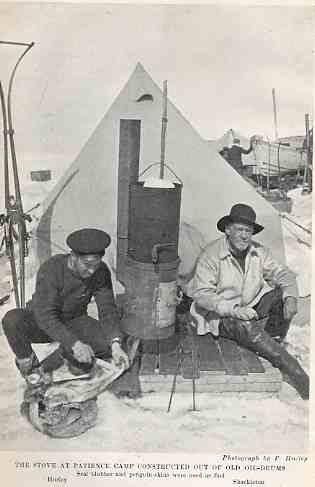
“The cook deserves much praise for the way he has stuck to his job through all this severe blizzard. His galley consists of nothing but a few boxes arranged as a table, with a canvas screen erected around them on four oars and the two blubber-stoves within. The protection afforded by the screen is only partial, and the eddies drive the pungent blubber-smoke in all directions.”
“The cook deserves great praise for sticking to his job throughout this severe blizzard. His galley is nothing more than a few boxes arranged as a table. A canvas screen surrounds them, supported by four oars, with two blubber stoves inside. The screen offers only partial protection, and swirling winds drive the strong-smelling blubber smoke in all directions.”
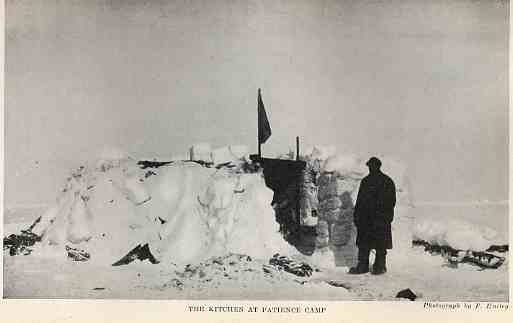
After a few days we were able to build him an igloo of ice-blocks, with a tarpaulin over the top as a roof.
After a few days, we were able to build him an igloo from blocks of ice. We used a tarpaulin for the roof.
“Our rations are just sufficient to keep us alive, but we all feel that we could eat twice as much as we get. An average day’s food at present consists of ½ lb. of seal with ¾ pint of tea for breakfast, a 4-oz. bannock with milk for lunch, and ¾ pint of seal stew for supper. That is barely enough, even doing very little work as we are, for of course we are completely destitute of bread or potatoes or anything of that sort. Some seem to feel it more than others and are continually talking of food; but most of us find that the continual conversation about food only whets an appetite that cannot be satisfied. Our craving for bread and butter is very real, not because we cannot get it, but because the system feels the need of it.”
“Our rations are just enough to keep us alive, but we all feel we could eat twice as much. A typical day’s food now is ½ lb. of seal and ¾ pint of tea for breakfast. Lunch is a 4-oz. bannock with milk, and supper is ¾ pint of seal stew. That is barely enough, even though we are doing very little work. Of course, we have no bread, potatoes, or anything of that kind. Some feel the shortage more than others and talk about food all the time. But most of us find that constantly talking about food only sharpens an appetite we cannot satisfy. Our craving for bread and butter is very real. It is not simply because we cannot get them, but because our bodies feel the need for them.”
Owing to this shortage of food and the fact that we needed all that we could get for ourselves, I had to order all the dogs except two teams to be shot. It was the worst job that we had had throughout the Expedition, and we felt their loss keenly.
Food was short, and we needed all we could get for ourselves. So I had to order all the dogs except two teams to be shot. It was the worst job we had faced during the Expedition, and we felt their loss deeply.
I had to be continually rearranging the weekly menu. The possible number of permutations of seal meat were decidedly limited. The fact that the men did not know what was coming gave them a sort of mental speculation, and the slightest variation was of great value.
I had to keep rearranging the weekly menu. There were very few ways to prepare seal meat. Not knowing what was coming gave the men something to speculate about, and even the slightest variation was valuable.
“We caught an adelie to-day (January 26) and another whale was seen at close quarters, but no seals.
“We caught an Adélie penguin today (January 26) and saw another whale up close, but no seals.
“We are now very short of blubber, and in consequence one stove has to be shut down. We only get one hot beverage a day, the tea at breakfast. For the rest we have iced water. Sometimes we are short even of this, so we take a few chips of ice in a tobacco-tin to bed with us. In the morning there is about a spoonful of water in the tin, and one has to lie very still all night so as not to spill it.”
“We are now very short of blubber, so we have to shut down one stove. We get only one hot drink a day, tea at breakfast. The rest of the time, we have iced water. Sometimes we are short of water too, so we take a few chips of ice to bed in a tobacco tin. By morning, there is about a spoonful of water in the tin. We have to lie very still all night so we do not spill it.”
To provide some variety in the food, I commenced to use the sledging ration at half strength twice a week.
To add some variety to the food, I started using the sledging ration at half strength twice a week.
The ice between us and Ocean Camp, now only about five miles away and actually to the south-west of us, was very broken, but I decided to send Macklin and Hurley back with their dogs to see if there was any more food that could be added to our scanty stock. I gave them written instructions to take no undue risk or cross any wide-open leads, and said that they were to return by midday the next day. Although they both fell through the thin ice up to their waists more than once, they managed to reach the camp. They found the surface soft and sunk about two feet. Ocean Camp, they said, “looked like a village that had been razed to the ground and deserted by its inhabitants.” The floor-boards forming the old tent-bottoms had prevented the sun from thawing the snow directly underneath them, and were in consequence raised about two feet above the level of the surrounding floe.
The ice between us and Ocean Camp was badly broken. The camp was now only about five miles away, to the southwest of us. But I decided to send Macklin and Hurley back with their dogs to look for more food to add to our meager supplies. I gave them written instructions not to take unnecessary risks or cross any wide stretches of open water. I told them to return by midday the next day. Although both men fell through the thin ice up to their waists more than once, they managed to reach the camp. They found that the surface was soft and had sunk about two feet. Ocean Camp, they said, “looked like a village that had been razed to the ground and deserted by its inhabitants.” The floorboards that had formed the old tent floors had kept the sun from thawing the snow directly beneath them. As a result, the boards stood about two feet above the surrounding ice floe.
The storehouse next the galley had taken on a list of several degrees to starboard, and pools of water had formed everywhere. They collected what food they could find and packed a few books in a venesta sledging-case, returning to Patience Camp by about 8 p.m. I was pleased at their quick return, and as their report seemed to show that the road was favourable, on February 2 I sent back eighteen men under Wild to bring all the remainder of the food and the third boat, the Stancomb Wills. They started off at 1 a.m., towing the empty boat-sledge on which the James Caird had rested, and reached Ocean Camp about 3.30 a.m.
The storehouse next to the galley had tilted several degrees to starboard, and pools of water had formed everywhere. The men collected what food they could find and packed a few books in a venesta sledging-case. They returned to Patience Camp at about 8 p.m. I was pleased that they had returned so quickly. Their report suggested that the route was favourable, so on February 2 I sent eighteen men back under Wild. They were to bring back all the remaining food and the third boat, the Stancomb Wills. They set off at 1 a.m., towing the empty boat-sledge that had carried the James Caird. They reached Ocean Camp at about 3:30 a.m.
“We stayed about three hours at the Camp, mounting the boat on the sledge, collecting eatables, clothing, and books. We left at 6 a.m., arriving back at Patience Camp with the boat at 12.30 p.m., taking exactly three times as long to return with the boat as it did to pull in the empty sledge to fetch it. On the return journey we had numerous halts while the pioneer party of four were busy breaking down pressure-ridges and filling in open cracks with ice-blocks, as the leads were opening up. The sun had softened the surface a good deal, and in places it was terribly hard pulling. Every one was a bit exhausted by the time we got back, as we are not now in good training and are on short rations. Every now and then the heavy sledge broke through the ice altogether and was practically afloat. We had an awful job to extricate it, exhausted as we were. The longest distance which we managed to make without stopping for leads or pressure-ridges was about three quarters of a mile.
“We stayed at the camp for about three hours. We mounted the boat on the sledge and collected food, clothing, and books. We left at 6 a.m. and arrived back at Patience Camp with the boat at 12:30 p.m. The return trip with the boat took exactly three times as long as pulling the empty sledge to fetch it. On the return journey, we stopped many times. A party of four went ahead, breaking down pressure ridges and filling open cracks with blocks of ice, as the leads were opening up. The sun had softened the surface considerably, and in places pulling was terribly hard. Everyone was somewhat exhausted by the time we got back, because we were no longer in good condition and were on short rations. Every now and then, the heavy sledge broke through the ice completely and was almost afloat. Exhausted as we were, we had an awful job getting it out. The longest distance we managed without stopping for leads or pressure ridges was about three quarters of a mile.
“About a mile from Patience Camp we had a welcome surprise. Sir Ernest and Hussey sledged out to meet us with dixies of hot tea, well wrapped up to keep them warm.
“About a mile from Patience Camp, we had a welcome surprise. Sir Ernest and Hussey came out by sledge to meet us. They brought pots of hot tea, well wrapped to keep them warm.
“One or two of the men left behind had cut a moderately good track for us into the camp, and they harnessed themselves up with us, and we got in in fine style.
“One or two of the men left behind had cut a fairly good path into the camp for us. They joined us in the harness, and we made it into camp in fine style.
“One excellent result of our trip was the recovery of two cases of lentils weighing 42 lbs. each.”
“One excellent result of our trip was that we recovered two cases of lentils, each weighing 42 pounds.”
The next day I sent Macklin and Crean back to make a further selection of the gear, but they found that several leads had opened up during the night, and they had to return when within a mile and a half of their destination. We were never able to reach Ocean Camp again. Still, there was very little left there that would have been of use to us.
The next day, I sent Macklin and Crean back to select more gear. But several leads, or open stretches of water in the ice, had opened overnight. They had to turn back when they were within a mile and a half of Ocean Camp. We were never able to reach Ocean Camp again. Still, very little was left there that would have been useful to us.
By the middle of February the blubber question was a serious one. I had all the discarded seals’ heads and flippers dug up and stripped of every vestige of blubber. Meat was very short too. We still had our three months’ supply of sledging food practically untouched; we were only to use this as a last resort. We had a small supply of dog-pemmican, the dogs that were left being fed on those parts of the seals that we could not use. This dog-pemmican we fried in suet with a little flour and made excellent bannocks.
By the middle of February, the shortage of blubber had become serious. I had all the discarded seals’ heads and flippers dug up and stripped of every trace of blubber. Meat was also very scarce. Our three-month supply of sledging food was still practically untouched. We were to use it only as a last resort. We had a small supply of dog pemmican. The remaining dogs were fed the parts of the seals that we could not use. We fried the dog pemmican in suet with a little flour and made excellent bannocks.
Our meat supply was now very low indeed; we were reduced to just a few scraps. Fortunately, however, we caught two seals and four emperor penguins, and next day forty adelies. We had now only forty days’ food left, and the lack of blubber was being keenly felt. All our suet was used up, so we used seal-blubber to fry the meat in. Once we were used to its fishy taste we enjoyed it; in fact, like Oliver Twist, we wanted more.
Our meat supply was now extremely low. We had only a few scraps left. Fortunately, though, we caught two seals and four emperor penguins, and forty adelies the next day. We now had only forty days’ food left, and we keenly felt the shortage of blubber. All our suet was gone, so we used seal blubber to fry the meat. Once we got used to its fishy taste, we enjoyed it. In fact, like Oliver Twist, we wanted more.
On Leap Year day, February 29, we held a special celebration, more to cheer the men up than for anything else. Some of the cynics of the party held that it was to celebrate their escape from woman’s wiles for another four years. The last of our cocoa was used to-day. Henceforth water, with an occasional drink of weak milk, is to be our only beverage. Three lumps of sugar were now issued to each man daily.
On Leap Day, February 29, we held a special celebration, mostly to cheer the men up. Some of the cynics in the party said we were celebrating their escape from women’s tricks for another four years. We used the last of our cocoa today. From now on, our only drinks will be water and the occasional cup of weak milk. Each man was now given three lumps of sugar a day.
One night one of the dogs broke loose and played havoc with our precious stock of bannocks. He ate four and half of a fifth before he could be stopped. The remaining half, with the marks of the dog’s teeth on it, I gave to Worsley, who divided it up amongst his seven tent-mates; they each received about half a square inch.
One night, one of the dogs broke loose and raided our precious supply of bannocks. He ate four and half of a fifth before we could stop him. I gave the remaining half, marked with the dog’s teeth, to Worsley. He divided it among his seven tentmates. They each received about half a square inch.
Lees, who was in charge of the food and responsible for its safe keeping, wrote in his diary: “The shorter the provisions the more there is to do in the commissariat department, contriving to eke out our slender stores as the weeks pass by. No housewife ever had more to do than we have in making a little go a long way.
Lees was in charge of the food and responsible for keeping it safe. He wrote in his diary: “The less food we have, the more work there is in managing it. We have to find ways to make our meager supplies last as the weeks go by. No housewife ever had more to do than we do to make a little go a long way.
“Writing about the bannock that Peter bit makes one wish now that one could have many a meal that one has given to the dog at home. When one is hungry, fastidiousness goes to the winds and one is only too glad to eat up any scraps regardless of their antecedents. One is almost ashamed to write of all the titbits one has picked up here, but it is enough to say that when the cook upset some pemmican on to an old sooty cloth and threw it outside his galley, one man subsequently made a point of acquiring it and scraping off the palatable but dirty compound.”
“Writing about the bannock that Peter bit makes one wish for the many meals one has given the dog at home. When one is hungry, one stops being fussy. One is only too glad to eat any scraps, regardless of where they came from. One is almost ashamed to write about all the morsels one has picked up here. But one example is enough. The cook spilled some pemmican onto an old, sooty cloth and threw the cloth outside his galley. Later, one man made a point of getting the cloth and scraping off the tasty but dirty mixture.”
Another man searched for over an hour in the snow where he had dropped a piece of cheese some days before, in the hopes of finding a few crumbs. He was rewarded by coming across a piece as big as his thumb-nail, and considered it well worth the trouble.
Another man spent over an hour searching the snow where he had dropped a piece of cheese some days earlier. He hoped to find a few crumbs. He found a piece as big as his thumbnail and thought it was well worth the trouble.
By this time blubber was a regular article of our diet—either raw, boiled, or fried. “It is remarkable how our appetites have changed in this respect. Until quite recently almost the thought of it was nauseating. Now, however, we positively demand it. The thick black oil which is rendered down from it, rather like train-oil in appearance and cod-liver oil in taste, we drink with avidity.”
By this time, blubber was a regular part of our diet, eaten raw, boiled, or fried. “It is remarkable how our appetites have changed. Until quite recently, even the thought of blubber was almost enough to make us sick. Now, though, we actually demand it. We eagerly drink the thick black oil rendered from the blubber. It looks rather like train oil and tastes like cod-liver oil.”
We had now about enough farinaceous food for two meals all round, and sufficient seal to last for a month. Our forty days’ reserve sledging rations, packed on the sledges, we wished to keep till the last.
We now had enough starchy food for about two meals each, and enough seal meat to last a month. We wanted to save our forty days’ reserve sledging rations, packed on the sledges, until the last.
But, as one man philosophically remarked in his diary:
But, as one man reflected in his diary:
“It will do us all good to be hungry like this, for we will appreciate so much more the good things when we get home.”
“Being hungry like this will do us all good. We’ll appreciate the good things so much more when we get home.”
Seals and penguins now seemed to studiously avoid us, and on taking stock of our provisions on March 21 I found that we had only sufficient meat to last us for ten days, and the blubber would not last that time even, so one biscuit had to be our midday meal.
Seals and penguins now seemed to deliberately avoid us. On March 21, I checked our supplies and found we had only enough meat for ten days. The blubber would not last even that long, so we had to make one biscuit our midday meal.
Our meals were now practically all seal meat, with one biscuit at midday; and I calculated that at this rate, allowing for a certain number of seals and penguins being caught, we could last for nearly six months. We were all very weak though, and as soon as it appeared likely that we should leave our floe and take to the boats I should have to considerably increase the ration. One day a huge sea-leopard climbed on to the floe and attacked one of the men. Wild, hearing the shouting, ran out and shot it. When it was cut up, we found in its stomach several undigested fish. These we fried in some of its blubber, and so had our only “fresh” fish meal during the whole of our drift on the ice.
Our meals now consisted almost entirely of seal meat, with one biscuit at midday. I calculated that, at this rate, we could last nearly six months, provided we caught a certain number of seals and penguins. We were all very weak, though. As soon as it seemed likely that we would leave our ice floe and take to the boats, I would have to increase the ration considerably. One day, a huge sea leopard climbed onto the floe and attacked one of the men. Wild heard the shouting, ran out, and shot it. When the sea leopard was cut up, we found several undigested fish in its stomach. We fried the fish in some of the sea leopard's blubber. So we had our only “fresh” fish meal during our entire drift on the ice.
“As fuel is so scarce we have had to resort to melting ice for drinking-water in tins against our bodies, and we treat the tins of dog-pemmican for breakfast similarly by keeping them in our sleeping-bags all night.
“Because fuel is so scarce, we have to melt ice for drinking water in tins held against our bodies. We also keep tins of dog pemmican in our sleeping bags all night to warm them for breakfast.
“The last two teams of dogs were shot to-day (April 2) the carcasses being dressed for food. We had some of the dog-meat cooked, and it was not at all bad—just like beef, but, of course, very tough.”
“The last two dog teams were shot today (April 2). The carcasses were prepared for food. We cooked some of the dog meat, and it was not bad at all. It was just like beef, but, of course, very tough.”
On April 5 we killed two seals, and this, with the sea-leopard of a few days before, enabled us to slightly increase our ration. Everybody now felt much happier; such is the psychological effect of hunger appeased.
On April 5 we killed two seals. Together with the sea-leopard we had killed a few days earlier, they allowed us to slightly increase our ration. Everyone now felt much happier. Such is the effect of satisfying hunger on the mind.
On cold days a few strips of raw blubber were served out to all hands, and it is wonderful how it fortified us against the cold.
On cold days, everyone was given a few strips of raw blubber. It was wonderful how much the blubber helped us withstand the cold.
Our stock of forty days’ sledging rations remained practically untouched, but once in the boats they were used at full strength.
Our supply of forty days’ sledging rations remained almost untouched. But once in the boats, we used the full rations.
When we first settled down at Patience Camp the weather was very mild. New Year’s Eve, however, was foggy and overcast, with some snow, and next day, though the temperature rose to 38° Fahr., it was “abominably cold and wet underfoot.” As a rule, during the first half of January the weather was comparatively warm, so much so that we could dispense with our mitts and work outside for quite long periods with bare hands. Up till the 13th it was exasperatingly warm and calm. This meant that our drift northwards, which was almost entirely dependent on the wind, was checked. A light southerly breeze on the 16th raised all our hopes, and as the temperature was dropping we were looking forward to a period of favourable winds and a long drift north.
When we first settled at Patience Camp, the weather was very mild. New Year’s Eve, however, was foggy and overcast, with some snow. The next day, though the temperature rose to 38°F, it was “abominably cold and wet underfoot.” Generally, the weather was fairly warm during the first half of January. It was so warm that we could go without mittens and work outside with bare hands for quite long periods. Until the 13th, it was frustratingly warm and calm. This slowed our drift north, which depended almost entirely on the wind. A light southerly breeze on the 16th raised all our hopes. As the temperature was dropping, we looked forward to favorable winds and a long drift north.
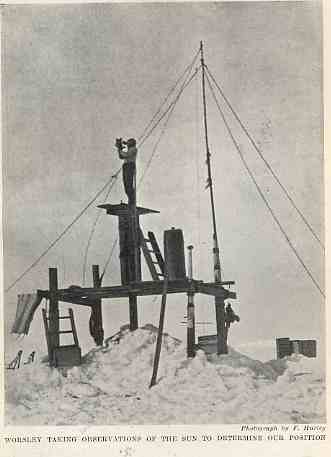
On the 18th it had developed into a howling south-westerly gale, rising next day to a regular blizzard with much drift. No one left the shelter of his tent except to feed the dogs, fetch the meals from the galley for his tent, or when his turn as watchman came round. For six days this lasted, when the drift subsided somewhat, though the southerly wind continued, and we were able to get a glimpse of the sun. This showed us to have drifted 84 miles north in six days, the longest drift we had made. For weeks we had remained on the 67th parallel, and it seemed as though some obstruction was preventing us from passing it. By this amazing leap, however, we had crossed the Antarctic Circle, and were now 146 miles from the nearest land to the west of us—Snow Hill—and 357 miles from the South Orkneys, the first land directly to the north of us.
By the 18th, the wind had become a howling southwesterly gale. The next day, it grew into a full blizzard, with much drifting snow. No one left the shelter of his tent except to feed the dogs, fetch meals from the galley for his tent, or take his turn as watchman. This lasted six days. Then the drifting snow eased somewhat, though the southerly wind continued, and we were able to glimpse the sun. The sun showed us that we had drifted 84 miles north in six days, our longest drift yet. For weeks we had remained on the 67th parallel, and it seemed as though some obstruction was preventing us from crossing it. With this amazing leap, however, we had crossed the Antarctic Circle. We were now 146 miles from the nearest land to the west, Snow Hill, and 357 miles from the South Orkneys, the first land directly to the north.
As if to make up for this, an equally strong north-easterly wind sprang up next day, and not only stopped our northward drift but set us back three miles to the south. As usual, high temperatures and wet fog accompanied these northerly winds, though the fog disappeared on the afternoon of January 25, and we had the unusual spectacle of bright hot sun with a north-easterly wind. It was as hot a day as we had ever had. The temperature was 36° Fahr. in the shade and nearly 80° Fahr. inside the tents. This had an awful effect on the surface, covering it with pools and making it very treacherous to walk upon. Ten days of northerly winds rather damped our spirits, but a strong southerly wind on February 4, backing later, to south-east, carried us north again. High temperatures and northerly winds soon succeeded this, so that our average rate of northerly drift was about a mile a day in February. Throughout the month the diaries record alternately “a wet day, overcast and mild,” and “bright and cold with light southerly winds.” The wind was now the vital factor with us and the one topic of any real interest.
As if to make up for this, an equally strong wind sprang up from the northeast the next day. It stopped our northward drift and pushed us three miles south. As usual, warm temperatures and wet fog came with these northerly winds. But the fog cleared on the afternoon of January 25. We had the unusual sight of bright, hot sun with a northeasterly wind. It was as hot a day as we had ever had. The temperature was 36° Fahrenheit in the shade and nearly 80° inside the tents. The heat had a terrible effect on the surface, covering it with pools and making it very treacherous to walk on. Ten days of northerly winds rather dampened our spirits. But on February 4, a strong southerly wind carried us north again. It later shifted to the southeast. Warm temperatures and northerly winds soon returned. As a result, our northward drift averaged about a mile a day in February. Throughout the month, the diaries alternately record “a wet day, overcast and mild” and “bright and cold with light southerly winds.” The wind was now the crucial factor for us and the one topic of any real interest.
The beginning of March brought cold, damp, calm weather, with much wet snow and overcast skies. The effect of the weather on our mental state was very marked. All hands felt much more cheerful on a bright sunny day, and looked forward with much more hope to the future, than when it was dull and overcast. This had a much greater effect than an increase in rations.
Early March brought cold, damp, calm weather, with lots of wet snow and cloudy skies. The weather had a clear effect on our mood. On bright, sunny days, everyone felt much more cheerful and hopeful about the future than on dull, cloudy days. The weather affected our mood much more than an increase in food rations.
A south-easterly gale on the 13th lasting for five days sent us twenty miles north, and from now our good fortune, as far as the wind was concerned, never left us for any length of time. On the 20th we experienced the worst blizzard we had had up to that time, though worse were to come after landing on Elephant Island. Thick snow fell, making it impossible to see the camp from thirty yards off. To go outside for a moment entailed getting covered all over with fine powdery snow, which required a great deal of brushing off before one could enter again.
A southeasterly gale began on the 13th and lasted five days, sending us twenty miles north. From then on, our good fortune with the wind never left us for long. On the 20th, we experienced the worst blizzard we had seen so far, though worse would come after we landed on Elephant Island. Thick snow fell, making it impossible to see the camp from thirty yards away. Even a moment outside left us covered in fine, powdery snow. We had to brush it off thoroughly before we could go back inside.
As the blizzard eased up, the temperature dropped and it became bitterly cold. In our weak condition, with torn, greasy clothes, we felt these sudden variations in temperature much more than we otherwise would have done. A calm, clear, magnificently warm day followed, and next day came a strong southerly blizzard. Drifts four feet deep covered everything, and we had to be continually digging up our scanty stock of meat to prevent its being lost altogether. We had taken advantage of the previous fine day to attempt to thaw out our blankets, which were frozen stiff and could be held out like pieces of sheet-iron; but on this day, and for the next two or three also, it was impossible to do anything but get right inside one’s frozen sleeping-bag to try and get warm. Too cold to read or sew, we had to keep our hands well inside, and pass the time in conversation with each other.
As the blizzard eased, the temperature dropped and it became bitterly cold. We were weak, and our clothes were torn and greasy. Because of this, we felt these sudden changes in temperature much more than we otherwise would have. A calm, clear, magnificently warm day followed. The next day, a strong blizzard came from the south. Snowdrifts four feet deep covered everything. We had to keep digging up our small supply of meat so it would not be lost altogether. We had used the previous fine day to try to thaw our blankets. They were frozen stiff and could be held out like sheets of iron. But during the blizzard and for the next two or three days, we could do nothing but crawl right inside our frozen sleeping bags and try to get warm. It was too cold to read or sew, so we kept our hands well inside and passed the time talking to one another.
“The temperature was not strikingly low as temperatures go down here, but the terrific winds penetrate the flimsy fabric of our fragile tents and create so much draught that it is impossible to keep warm within. At supper last night our drinking-water froze over in the tin in the tent before we could drink it. It is curious how thirsty we all are.”
“The temperature was not especially low for this part of the world. But the fierce winds cut through the thin fabric of our fragile tents. They create so much of a draft that we cannot keep warm inside. At supper last night, our drinking water froze over in the tin inside the tent before we could drink it. It is strange how thirsty we all are.”
Two days of brilliant warm sunshine succeeded these cold times, and on March 29 we experienced, to us, the most amazing weather. It began to rain hard, and it was the first rain that we had seen since we left South Georgia sixteen months ago. We regarded, it as our first touch with civilization, and many of the men longed for the rain and fogs of London.
Two days of brilliant, warm sunshine followed the cold weather. On March 29, we experienced weather that amazed us. It began to rain hard. It was the first rain we had seen since leaving South Georgia sixteen months earlier. We saw the rain as our first contact with civilization. Many of the men longed for the rain and fog of London.
Strong south winds with dull, overcast skies and occasional high temperatures were now our lot till April 7, when the mist lifted and we could make out what appeared to be land to the north.
Strong south winds, dull, overcast skies, and occasional high temperatures continued until April 7. Then the mist lifted, and we could make out what appeared to be land to the north.
Although the general drift of our ice-floe had indicated to us that we must eventually drift north, our progress in that direction was not by any means uninterrupted. We were at the mercy of the wind, and could no more control our drift than we could control the weather.
The general drift of our ice floe showed that we would eventually drift north. But our progress in that direction was far from steady. We were at the mercy of the wind and could no more control our drift than we could control the weather.
A long spell of calm, still weather at the beginning of January caused us some anxiety by keeping us at about the latitude that we were in at the beginning of December. Towards the end of January, however, a long drift of eighty-four miles in a blizzard cheered us all up. This soon stopped and we began a slight drift to the east. Our general drift now slowed up considerably, and by February 22 we were still eighty miles from Paulet Island, which now was our objective. There was a hut there and some stores which had been taken down by the ship which went to the rescue of Nordenskjold’s Expedition in 1904, and whose fitting out and equipment I had charge of. We remarked amongst ourselves what a strange turn of fate it would be if the very cases of provisions which I had ordered and sent out so many years before were now to support us during the coming winter. But this was not to be. March 5 found us about forty miles south of the longitude of Paulet Island, but well to the east of it; and as the ice was still too much broken up to sledge over, it appeared as if we should be carried past it. By March 17 we were exactly on a level with Paulet Island but sixty miles to the east. It might have been six hundred for all the chance that we had of reaching it by sledging across the broken sea-ice in its present condition.
A long spell of calm, still weather at the beginning of January caused us some anxiety. It kept us at about the same latitude we had been at in early December. Towards the end of January, however, we drifted eighty-four miles during a blizzard. This cheered us all up. But the long drift soon stopped, and we began to drift slightly east. Our overall drift now slowed considerably. By February 22, we were still eighty miles from Paulet Island, which was now our destination. There was a hut on the island, along with some supplies. The ship sent to rescue Nordenskjold’s Expedition in 1904 had taken the supplies there. I had been in charge of fitting out and equipping that ship. We said to one another what a strange turn of fate it would be if we survived the coming winter on the very cases of provisions I had ordered and sent out so many years before. But this was not to be. By March 5, we were about forty miles south of the longitude of Paulet Island, but well to the east of it. The ice was still too broken up to travel over by sledge, so it seemed we would be carried past the island. By March 17, we were exactly level with Paulet Island but sixty miles to the east. The island might as well have been six hundred miles away. We had just as little chance of reaching it by sledge across the sea ice in its broken state.
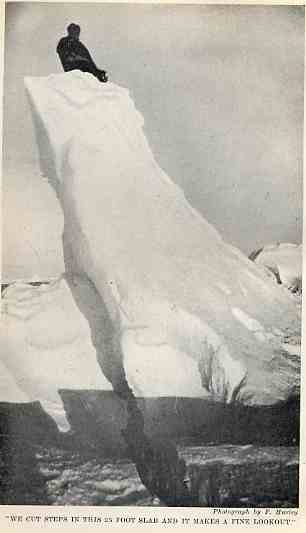
Our thoughts now turned to the Danger Islands, thirty-five miles away. “It seems that we are likely to drift up and down this coast from south-west to north-east and back again for some time yet before we finally clear the point of Joinville Island; until we do we cannot hope for much opening up, as the ice must be very congested against the south-east coast of the island, otherwise our failure to respond to the recent south-easterly gale cannot be well accounted for. In support of this there has been some very heavy pressure on the north-east side, of our floe, one immense block being up-ended to a height of 25 ft. We saw a Dominican gull fly over to-day, the first we have seen since leaving South Georgia; it is another sign of our proximity to land. We cut steps in this 25-ft. slab, and it makes a fine look-out. When the weather clears we confidently expect to see land.”
Our thoughts now turned to the Danger Islands, thirty-five miles away. “It seems we may continue drifting back and forth along this coast, from southwest to northeast, for some time. We must finally clear the point of Joinville Island before we can hope for much open water. The ice must be heavily congested against the island’s southeast coast. Otherwise, it is hard to explain why the recent southeasterly gale did not move us. This explanation is supported by the heavy pressure on the northeast side of our floe. One immense block of ice was pushed upright to a height of 25 feet. We saw a Dominican gull fly over today, the first we have seen since leaving South Georgia. It is another sign that we are close to land. We cut steps in the 25-foot slab, and it makes a fine lookout. When the weather clears, we confidently expect to see land.”
A heavy blizzard obscured our view till March 23. “‘Land in sight’ was reported this morning. We were sceptical, but this afternoon it showed up unmistakably to the west, and there can be no further doubt about it. It is Joinville Island, and its serrated mountain ranges, all snow-clad, are just visible on the horizon. This barren, inhospitable-looking land would be a haven of refuge to us if we could but reach it. It would be ridiculous to make the attempt though, with the ice all broken up as it is. It is too loose and broken to march over, yet not open enough to be able to launch the boats.” For the next two or three days we saw ourselves slowly drifting past the land, longing to reach it yet prevented from doing so by the ice between, and towards the end of March we saw Mount Haddington fade away into the distance.
A heavy blizzard blocked our view until March 23. “‘Land in sight’ was reported this morning. We were skeptical, but this afternoon the land appeared unmistakably to the west. There can be no further doubt about it. It is Joinville Island. Its jagged mountain ranges, all covered in snow, are just visible on the horizon. This barren, unwelcoming land would be a refuge for us if we could only reach it. But it would be ridiculous to try, with the ice so broken up. The ice is too loose and broken to walk over, yet not open enough to launch the boats.” For the next two or three days, we watched ourselves drift slowly past the land. We longed to reach it, but the ice between us and the land prevented us. Toward the end of March, we saw Mount Haddington fade into the distance.
Our hopes were now centred on Elephant Island or Clarence Island, which lay 100 miles almost due north of us.
Our hopes now rested on Elephant Island or Clarence Island. Both lay 100 miles almost due north of us.
If we failed to reach either of them we might try for South Georgia, but our chances of reaching it would be very small.
If we failed to reach either of them, we might try for South Georgia. But our chances of reaching South Georgia would be very small.