Chapter 6
The March Between
With the exception of the night-watchman we turned in at 11 p.m., and at 3 a.m. on December 23 all hands were roused for the purpose of sledging the two boats, the James Caird and the Dudley Docker, over the dangerously cracked portion to the first of the young floes, whilst the surface still held its night crust. A thick sea-fog came up from the west, so we started off finally at 4.30 a.m., after a drink of hot coffee.
Everyone except the night watchman went to bed at 11 p.m. At 3 a.m. on December 23, all hands were woken to haul the two boats, the James Caird and the Dudley Docker, on sledges across the dangerously cracked ice to the first of the young floes. We needed to do this while the surface still had its crust from the night. A thick sea fog came in from the west, so we finally set off at 4.30 a.m., after a drink of hot coffee.
Practically all hands had to be harnessed to each boat in succession, and by dint of much careful manipulation and tortuous courses amongst the broken ice we got both safely over the danger-zone.
Almost everyone had to be harnessed to each boat in turn. With careful maneuvering along winding routes through the broken ice, we got both boats safely across the danger zone.
We then returned to Ocean Camp for the tents and the rest of the sledges, and pitched camp by the boats about one and a quarter miles off. On the way back a big seal was caught which provided fresh food for ourselves and for the dogs. On arrival at the camp a supper of cold tinned mutton and tea was served, and everybody turned in at 2 p.m. It was my intention to sleep by day and march by night, so as to take advantage of the slightly lower temperatures and consequent harder surfaces.
We then returned to Ocean Camp for the tents and the remaining sledges. We set up camp by the boats, about one and a quarter miles away. On the way back, we caught a large seal, which provided fresh food for us and the dogs. When we arrived at camp, we had supper of cold canned mutton and tea. Everyone went to bed at 2 p.m. I planned to sleep during the day and march at night, when the slightly lower temperatures made the surface harder.
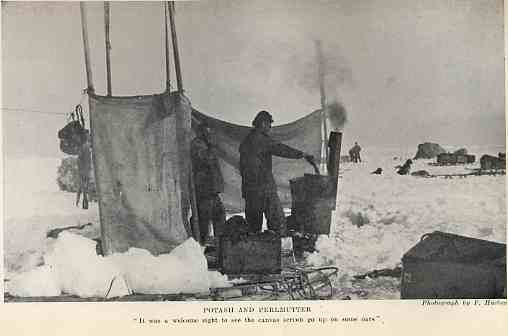
At 8 p.m. the men were roused, and after a meal of cold mutton and tea, the march was resumed. A large open lead brought us to a halt at 11 p.m., whereupon we camped and turned in without a meal. Fortunately just at this time the weather was fine and warm. Several men slept out in the open at the beginning of the march. One night, however, a slight snow-shower came on, succeeded immediately by a lowering of the temperature. Worsley, who had hung up his trousers and socks on a boat, found them iced-up and stiff; and it was quite a painful process for him to dress quickly that morning. I was anxious, now that we had started, that we should make every effort to extricate ourselves, and this temporary check so early was rather annoying. So that afternoon Wild and I ski-ed out to the crack and found that it had closed up again. We marked out the track with small flags as we returned. Each day, after all hands had turned in, Wild and I would go ahead for two miles or so to reconnoitre the next day’s route, marking it with pieces of wood, tins, and small flags. We had to pick the road which though it might be somewhat devious, was flattest and had least hummocks. Pressure-ridges had to be skirted, and where this was not possible the best place to make a bridge of ice-blocks across the lead or over the ridge had to be found and marked. It was the duty of the dog-drivers to thus prepare the track for those who were toiling behind with the heavy boats. These boats were hauled in relays, about sixty yards at a time. I did not wish them to be separated by too great a distance in case the ice should crack between them, and we should be unable to reach the one that was in rear. Every twenty yards or so they had to stop for a rest and to take breath, and it was a welcome sight to them to see the canvas screen go up on some oars, which denoted the fact that the cook had started preparing a meal, and that a temporary halt, at any rate, was going to be made. Thus the ground had to be traversed three times by the boat-hauling party. The dog-sledges all made two, and some of them three, relays. The dogs were wonderful. Without them we could never have transported half the food and gear that we did.
At 8 p.m. the men were woken, and after a meal of cold mutton and tea, we resumed the march. At 11 p.m. a large stretch of open water brought us to a halt. We camped there and went to bed without a meal. Fortunately, the weather was fine and warm just then. At the beginning of the march, several men slept out in the open. One night, however, a light snow shower came on, followed immediately by a drop in temperature. Worsley had hung his trousers and socks on a boat, and he found them icy and stiff. Dressing quickly that morning was quite painful for him. Now that we had started, I was anxious that we make every effort to get ourselves free. This temporary setback so early on was rather annoying. So that afternoon Wild and I skied out to the crack and found that it had closed again. We marked the route with small flags on our way back. Each day, after everyone had gone to bed, Wild and I would go ahead about two miles to scout the next day’s route. We marked it with pieces of wood, tins, and small flags. We had to choose the flattest route, with the fewest ice hummocks, even if it was somewhat indirect. We had to go around pressure ridges where possible. Where we could not, we had to find and mark the best place to build a bridge of ice blocks across the open water or over the ridge. The dog drivers had the duty of preparing the route in this way for the men struggling behind with the heavy boats. The boats were hauled in relays, about sixty yards at a time. I did not want them separated by too great a distance. The ice might crack between them, leaving us unable to reach the boat at the rear. Every twenty yards or so, the men had to stop to rest and catch their breath. The sight of a canvas screen being raised on some oars was welcome to them. It meant that the cook had started preparing a meal and that they would be stopping for a while, at least. In this way, the boat hauling party had to cross the ground three times. All the dog sledges made two relay trips, and some made three. The dogs were wonderful. Without them we could never have transported half the food and gear we did.
We turned in at 7 p.m. that night, and at 1 a.m. next day, the 25th, and the third day of our march, a breakfast of sledging ration was served. By 2 a.m. we were on the march again. We wished one another a merry Christmas, and our thoughts went back to those at home. We wondered, too, that day, as we sat down to our “lunch” of stale, thin bannock and a mug of thin cocoa, what they were having at home.
We went to bed at 7 p.m. that night. Breakfast of sledging rations was served at 1 a.m. the next day, the 25th, our third day of marching. By 2 a.m. we were marching again. We wished one another a merry Christmas, and our thoughts turned to those at home. Later that day, we sat down to our “lunch” of stale, thin bannock and a mug of weak cocoa. We wondered what those at home were having.
All hands were very cheerful. The prospect of a relief from the monotony of life on the floe raised all our spirits. One man wrote in his diary: “It’s a hard, rough, jolly life, this marching and camping; no washing of self or dishes, no undressing, no changing of clothes. We have our food anyhow, and always impregnated with blubber-smoke; sleeping almost on the bare snow and working as hard as the human physique is capable of doing on a minimum of food.”
Everyone was very cheerful. The prospect of a break from the monotony of life on the ice floe lifted all our spirits. One man wrote in his diary: “Marching and camping is a hard, rough, jolly life. We do not wash ourselves or our dishes, undress, or change our clothes. We eat our food however we can, and it always tastes of blubber smoke. We sleep almost on the bare snow and work as hard as the human body can on very little food.”
We marched on, with one halt at 6 a.m., till half-past eleven. After a supper of seal steaks and tea we turned in. The surface now was pretty bad. High temperatures during the day made the upper layers of snow very soft, and the thin crust which formed at night was not sufficient to support a man. Consequently, at each step we went in over our knees in the soft wet snow. Sometimes a man would step into a hole in the ice which was hidden by the covering of snow, and be pulled up with a jerk by his harness. The sun was very hot and many were suffering from cracked lips.
We marched on until 11:30, stopping once at 6 a.m. After a supper of seal steaks and tea, we went to bed. The surface was now quite bad. High daytime temperatures made the upper layers of snow very soft. The thin crust that formed at night was not strong enough to support a man. As a result, we sank past our knees in the soft, wet snow with every step. Sometimes a man would step into a hole in the ice hidden by snow. His harness would pull him up with a jerk. The sun was very hot, and many men had cracked lips.
Two seals were killed to-day. Wild and McIlroy, who went out to secure them, had rather an exciting time on some very loose, rotten ice, three killer-whales in a lead a few yards away poking up their ugly heads as if in anticipation of a feast.
Two seals were killed today. Wild and McIlroy went out to retrieve them and had an exciting time on some very loose, rotten ice. In a channel of open water a few yards away, three killer whales poked up their ugly heads as if anticipating a feast.
Next day, December 26, we started off again at 1 a.m. “The surface was much better than it has been for the last few days, and this is the principal thing that matters. The route, however, lay over very hummocky floes, and required much work with pick and shovel to make it passable for the boat-sledges. These are handled in relays by eighteen men under Worsley. It is killing work on soft surfaces.”
The next day, December 26, we set off again at 1 a.m. “The surface was much better than it had been for the past few days, and that is what matters most. However, the route crossed ice floes covered in ridges. We had to do a lot of work with picks and shovels to clear a path for the boat-sledges. Eighteen men under Worsley handle the sledges in shifts. It is exhausting work on soft surfaces.”
At 5 a.m. we were brought up by a wide open lead after an unsatisfactorily short march. While we waited, a meal of tea and two small bannocks was served, but as 10 a.m. came and there were no signs of the lead closing we all turned in.
At 5 a.m., a wide stretch of open water stopped us after a disappointingly short march. While we waited, we were served tea and two small bannocks. But by 10 a.m., there were no signs of the open water closing, so we all went to sleep.
It snowed a little during the day and those who were sleeping outside got their sleeping-bags pretty wet.
It snowed a little during the day, and the people sleeping outside got their sleeping bags pretty wet.
At 9.30 p.m. that night we were off again. I was, as usual, pioneering in front, followed by the cook and his mate pulling a small sledge with the stove and all the cooking gear on. These two, black as two Mohawk Minstrels with the blubber-soot, were dubbed “Potash and Perlmutter.” Next come the dog teams, who soon overtake the cook, and the two boats bring up the rear. Were it not for these cumbrous boats we should get along at a great rate, but we dare not abandon them on any account. As it is we left one boat, the Stancomb Wills, behind at Ocean Camp, and the remaining two will barely accommodate the whole party when we leave the floe.
At 9:30 p.m. that night, we set off again. As usual, I went ahead to find the way. The cook and his mate followed, pulling a small sledge carrying the stove and all the cooking gear. Both were as black as two Mohawk Minstrels from the blubber soot, and were nicknamed “Potash and Perlmutter.” Next came the dog teams, which soon overtook the cook. The two boats brought up the rear. Without these cumbersome boats, we could travel much faster, but we could not abandon them under any circumstances. We had already left one boat, the Stancomb Wills, behind at Ocean Camp. The remaining two would barely hold the whole party when we left the floe.
We did a good march of one and a half miles that night before we halted for “lunch” at 1 a.m., and then on for another mile, when at 5 a.m. we camped by a little sloping berg.
We made a good march of one and a half miles that night before stopping for “lunch” at 1 a.m. Then we marched another mile and camped at 5 a.m. beside a small, sloping iceberg.
Blackie, one of Wild’s dogs, fell lame and could neither pull nor keep up with the party even when relieved of his harness, so had to be shot.
Blackie, one of Wild’s dogs, became lame. He could not pull or keep up with the party, even after his harness was removed. So he had to be shot.
Nine p.m. that night, the 27th, saw us on the march again. The first 200 yds. took us about five hours to cross, owing to the amount of breaking down of pressure-ridges and filling in of leads that was required. The surface, too, was now very soft, so our progress was slow and tiring. We managed to get another three-quarters of a mile before lunch, and a further mile due west over a very hummocky floe before we camped at 5.30 a.m. Greenstreet and Macklin killed and brought in a huge Weddell seal weighing about 800 lbs., and two emperor penguins made a welcome addition to our larder.
At 9 p.m. that night, the 27th, we set out again. The first 200 yards took us about five hours. We had to break down pressure ridges and fill in gaps in the ice. The surface was also very soft, so our progress was slow and tiring. We managed another three-quarters of a mile before lunch. Then we traveled another mile due west over a very uneven ice floe before camping at 5:30 a.m. Greenstreet and Macklin killed and brought in a huge Weddell seal weighing about 800 pounds. Two emperor penguins were also a welcome addition to our food supply.
I climbed a small tilted berg nearby. The country immediately ahead was much broken up. Great open leads intersected the floes at all angles, and it all looked very unpromising. Wild and I went out prospecting as usual, but it seemed too broken to travel over.
I climbed a small, tilted iceberg nearby. The ice immediately ahead was badly broken up. Large stretches of open water cut across the ice floes at all angles, and the whole scene looked very unpromising. Wild and I went out to scout as usual, but the ice seemed too broken up to travel over.
“December 29.—After a further reconnaissance the ice ahead proved quite un-negotiable, so at 8.30 p.m. last night, to the intense disappointment of all, instead of forging ahead, we had to retire half a mile so as to get on a stronger floe, and by 10 p.m. we had camped and all hands turned in again. The extra sleep was much needed, however disheartening the check may be.”
“December 29. After another survey, we found that the ice ahead was impossible to cross. So at 8.30 p.m. last night, to everyone’s intense disappointment, we had to retreat half a mile instead of pressing forward. We did this to reach a stronger ice floe. By 10 p.m. we had made camp, and everyone went to bed again. The extra sleep was much needed, however disheartening the setback may be.”
During the night a crack formed right across the floe, so we hurriedly shifted to a strong old floe about a mile and a half to the east of our present position. The ice all around was now too broken and soft to sledge over, and yet there was not sufficient open water to allow us to launch the boats with any degree of safety. We had been on the march for seven days; rations were short and the men were weak. They were worn out with the hard pulling over soft surfaces, and our stock of sledging food was very small. We had marched seven and a half miles in a direct line and at this rate it would take us over three hundred days to reach the land away to the west. As we only had food for forty-two days there was no alternative, therefore, but to camp once more on the floe and to possess our souls with what patience we could till conditions should appear more favourable for a renewal of the attempt to escape. To this end, we stacked our surplus provisions, the reserve sledging rations being kept lashed on the sledges, and brought what gear we could from our but lately deserted Ocean Camp.
During the night, a crack formed right across the floe. We hurriedly moved to a strong old floe about a mile and a half east of our position. The ice all around was now too broken and soft to sledge over. Yet there was not enough open water to launch the boats with any safety. We had been on the march for seven days. Rations were short, and the men were weak. They were worn out from pulling hard over soft surfaces, and our supply of sledging food was very small. We had marched seven and a half miles in a straight line. At this rate, it would take us over three hundred days to reach the land to the west. Since we had food for only forty-two days, we had no choice but to camp on the floe again. We had to be as patient as we could until conditions seemed better for another attempt to escape. We stacked our spare provisions, leaving the reserve sledging rations lashed to the sledges. We also brought what gear we could from Ocean Camp, which we had only recently abandoned.
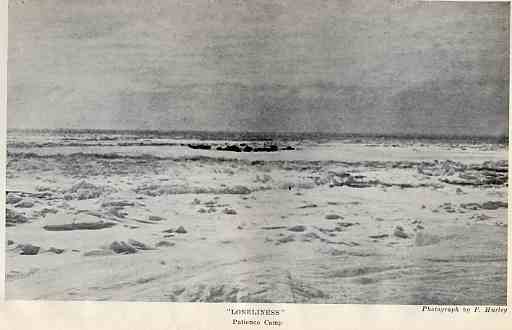
Our new home, which we were to occupy for nearly three and a half months, we called “Patience Camp.”
We would live in our new home for nearly three and a half months. We called it “Patience Camp.”