Chapter 12
Seventy-two days without a port—Whales and birds—A peep into the Spray's galley—Flying-fish for breakfast—A welcome at Apia—A visit from Mrs. Robert Louis Stevenson—At Vailima—Samoan hospitality—Arrested for fast riding—An amusing merry-go-round—Teachers and pupils of Papauta College—At the mercy of sea-nymphs.
Seventy-two days without stopping at a port. Whales and birds. A look inside the Spray's galley. Flying fish for breakfast. A welcome at Apia. A visit from Mrs. Robert Louis Stevenson. At Vailima. Samoan hospitality. Arrested for riding too fast. An amusing merry-go-round. Teachers and pupils of Papauta College. At the mercy of sea-nymphs.
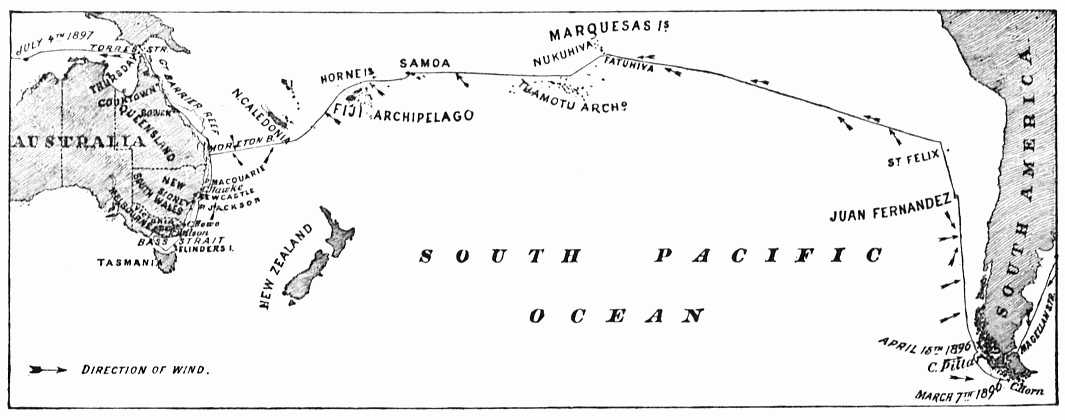
To be alone forty-three days would seem a long time, but in reality, even here, winged moments flew lightly by, and instead of my hauling in for Nukahiva, which I could have made as well as not, I kept on for Samoa, where I wished to make my next landing. This occupied twenty-nine days more, making seventy-two days in all. I was not distressed in any way during that time. There was no end of companionship; the very coral reefs kept me company, or gave me no time to feel lonely, which is the same thing, and there were many of them now in my course to Samoa.
Being alone for forty-three days might seem like a long time. But in fact, even here, the moments flew by lightly. Instead of sailing in to Nukahiva, which I could easily have reached, I continued toward Samoa. I wanted to make my next landing there. That took another twenty-nine days, making seventy-two days in all. I was not troubled in any way during that time. There was no end to the companionship. Even the coral reefs kept me company, or gave me no time to feel lonely, which amounts to the same thing. And there were many reefs now along my course to Samoa.
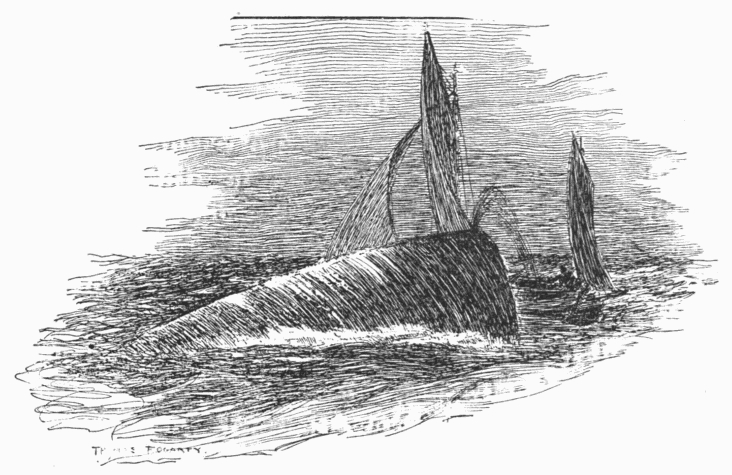
First among the incidents of the voyage from Juan Fernandez to Samoa (which were not many) was a narrow escape from collision with a great whale that was absent-mindedly plowing the ocean at night while I was below. The noise from his startled snort and the commotion he made in the sea, as he turned to clear my vessel, brought me on deck in time to catch a wetting from the water he threw up with his flukes. The monster was apparently frightened. He headed quickly for the east; I kept on going west. Soon another whale passed, evidently a companion, following in its wake. I saw no more on this part of the voyage, nor did I wish to.
There were few incidents on the voyage from Juan Fernandez to Samoa. The first was a narrow escape from a collision with a huge whale. It was mindlessly plowing through the ocean at night while I was below deck. The startled whale snorted and churned the sea as it turned to avoid my vessel. The noise brought me on deck just in time to be soaked by water thrown up by its tail. The monster was apparently frightened. It headed quickly east, while I kept going west. Soon another whale passed, evidently a companion, following in the first whale's wake. I saw no more whales on this part of the voyage, and I did not want to.
Hungry sharks came about the vessel often when she neared islands or coral reefs. I own to a satisfaction in shooting them as one would a tiger. Sharks, after all, are the tigers of the sea. Nothing is more dreadful to the mind of a sailor, I think, than a possible encounter with a hungry shark.
Hungry sharks often came near the vessel when it approached islands or coral reefs. I admit I took satisfaction in shooting them, as one would shoot a tiger. Sharks, after all, are the tigers of the sea. I think nothing is more frightening to a sailor than the possibility of encountering a hungry shark.
A number of birds were always about; occasionally one poised on the mast to look the Spray over, wondering, perhaps, at her odd wings, for she now wore her Fuego mainsail, which, like Joseph's coat, was made of many pieces. Ships are less common on the Southern seas than formerly. I saw not one in the many days crossing the Pacific.
Several birds were always nearby. Occasionally, one perched on the mast to look over the Spray. Perhaps it wondered at her odd wings, for she was now carrying her Fuego mainsail. Like Joseph's coat, the sail was made of many pieces. Ships are less common in the Southern seas than they used to be. I did not see a single one during the many days I spent crossing the Pacific.
My diet on these long passages usually consisted of potatoes and salt cod and biscuits, which I made two or three times a week. I had always plenty of coffee, tea, sugar, and flour. I carried usually a good supply of potatoes, but before reaching Samoa I had a mishap which left me destitute of this highly prized sailors' luxury. Through meeting at Juan Fernandez the Yankee Portuguese named Manuel Carroza, who nearly traded me out of my boots, I ran out of potatoes in mid-ocean, and was wretched thereafter. I prided myself on being something of a trader; but this Portuguese from the Azores by way of New Bedford, who gave me new potatoes for the older ones I had got from the Colombia, a bushel or more of the best, left me no ground for boasting. He wanted mine, he said, "for changee the seed." When I got to sea I found that his tubers were rank and unedible, and full of fine yellow streaks of repulsive appearance. I tied the sack up and returned to the few left of my old stock, thinking that maybe when I got right hungry the island potatoes would improve in flavor. Three weeks later I opened the bag again, and out flew millions of winged insects! Manuel's potatoes had all turned to moths. I tied them up quickly and threw all into the sea.
On these long passages, I usually ate potatoes, salt cod, and biscuits. I made biscuits two or three times a week. I always had plenty of coffee, tea, sugar, and flour. I usually carried a good supply of potatoes, but before reaching Samoa, a mishap left me without this prized sailors' luxury. At Juan Fernandez, I met a Yankee Portuguese named Manuel Carroza, who nearly traded me out of my boots. Because of him, I ran out of potatoes in mid-ocean and was miserable afterward. I prided myself on being something of a trader. But this Portuguese from the Azores, by way of New Bedford, left me nothing to boast about. He gave me new potatoes in exchange for the older ones I had gotten from the Colombia. I gave him a bushel or more of the best. He said he wanted mine "for changee the seed." Once at sea, I found that his potatoes were rotten and inedible, with thin, disgusting yellow streaks throughout. I tied up the sack and went back to the few potatoes left from my old stock. I thought that perhaps the island potatoes would taste better when I got really hungry. Three weeks later, I opened the bag again, and out flew millions of winged insects! Manuel's potatoes had all turned to moths. I quickly tied up the sack and threw it all into the sea.
Manuel had a large crop of potatoes on hand, and as a hint to whalemen, who are always eager to buy vegetables, he wished me to report whales off the island of Juan Fernandez, which I have already done, and big ones at that, but they were a long way off.
Manuel had a large crop of potatoes on hand. Whalers are always eager to buy vegetables, so he wanted me to report whales off Juan Fernandez as a hint to them. I have already done so, and reported big whales at that, but they were a long way off.
Taking things by and large, as sailors say, I got on fairly well in the matter of provisions even on the long voyage across the Pacific. I found always some small stores to help the fare of luxuries; what I lacked of fresh meat was made up in fresh fish, at least while in the trade-winds, where flying-fish crossing on the wing at night would hit the sails and fall on deck, sometimes two or three of them, sometimes a dozen. Every morning except when the moon was large I got a bountiful supply by merely picking them up from the lee scuppers. All tinned meats went begging.
All in all, as sailors say, I managed fairly well for provisions, even on the long voyage across the Pacific. I always had some small supplies to add a touch of luxury to my meals. Fresh fish made up for the fresh meat I lacked, at least while I was in the trade winds. There, flying fish crossing through the air at night would hit the sails and fall on deck. Sometimes there were two or three, and sometimes a dozen. Every morning except when the moon was large, I got a plentiful supply. I only had to pick the fish up from the deck drains on the sheltered side. All the canned meat went uneaten.
On the 16th of July, after considerable care and some skill and hard work, the Spray cast anchor at Apia, in the kingdom of Samoa, about noon. My vessel being moored, I spread an awning, and instead of going at once on shore I sat under it till late in the evening, listening with delight to the musical voices of the Samoan men and women.
On July 16, after considerable care, some skill, and hard work, the Spray anchored at Apia, in the kingdom of Samoa, around noon. Once my vessel was moored, I put up an awning. Instead of going ashore at once, I sat beneath the awning until late that evening. I listened with delight to the musical voices of the Samoan men and women.
A canoe coming down the harbor, with three young women in it, rested her paddles abreast the sloop. One of the fair crew, hailing with the naive salutation, "Talofa lee" ("Love to you, chief"), asked:
A canoe carrying three young women came down the harbor and stopped paddling alongside the sloop. One of the lovely crew members called out with the innocent greeting, "Talofa lee" ("Love to you, chief"), and asked:
"Schoon come Melike?"
"Is the schooner from America?"
"Love to you," I answered, and said, "Yes."
"Love to you," I replied, and said, "Yes."
"You man come 'lone?"
"Did you come alone?"
Again I answered, "Yes."
Again I answered, "Yes."
"I don't believe that. You had other mans, and you eat 'em."
"I don't believe that. You had other men, and you ate them."
At this sally the others laughed. "What for you come long way?" they asked.
The others laughed at this remark. "Why did you come such a long way?" they asked.
"To hear you ladies sing," I replied.
"To hear you ladies sing," I replied.
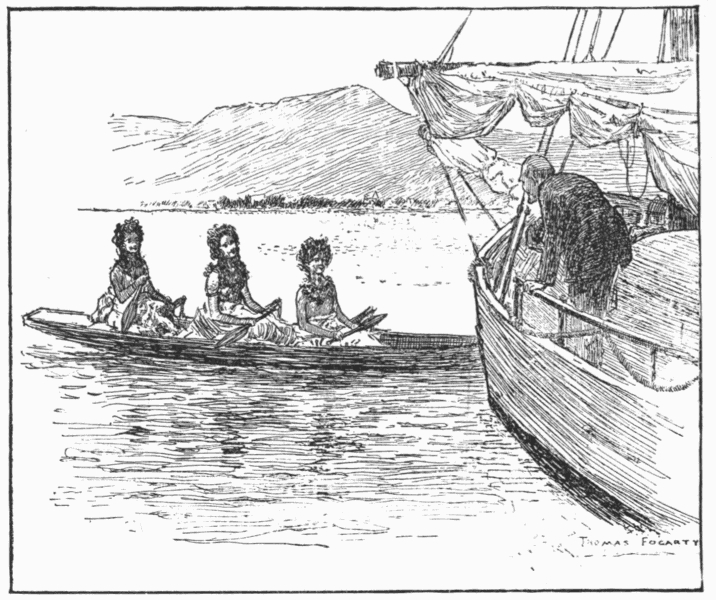
"Oh, talofa lee!" they all cried, and sang on. Their voices filled the air with music that rolled across to the grove of tall palms on the other side of the harbor and back. Soon after this six young men came down in the United States consul-general's boat, singing in parts and beating time with their oars. In my interview with them I came off better than with the damsels in the canoe. They bore an invitation from General Churchill for me to come and dine at the consulate. There was a lady's hand in things about the consulate at Samoa. Mrs. Churchill picked the crew for the general's boat, and saw to it that they wore a smart uniform and that they could sing the Samoan boatsong, which in the first week Mrs. Churchill herself could sing like a native girl.
"Oh, talofa lee!" they all cried, and kept singing. Their voices filled the air with music. It rolled across the harbor to the grove of tall palms on the other side and back again. Soon afterward, six young men came down in the United States consul-general's boat. They sang in parts and kept time with their oars. I had better luck talking with them than with the young women in the canoe. They brought an invitation from General Churchill to dine at the consulate. A woman's touch could be seen in the running of the consulate in Samoa. Mrs. Churchill chose the crew for the general's boat. She made sure they wore smart uniforms and could sing the Samoan boatsong. Within her first week, Mrs. Churchill herself could sing it like a native girl.
Next morning bright and early Mrs. Robert Louis Stevenson came to the Spray and invited me to Vailima the following day. I was of course thrilled when I found myself, after so many days of adventure, face to face with this bright woman, so lately the companion of the author who had delighted me on the voyage. The kindly eyes, that looked me through and through, sparkled when we compared notes of adventure. I marveled at some of her experiences and escapes. She told me that, along with her husband, she had voyaged in all manner of rickety craft among the islands of the Pacific, reflectively adding, "Our tastes were similar."
Bright and early the next morning, Mrs. Robert Louis Stevenson came to the Spray and invited me to Vailima the following day. After so many days of adventure, I was thrilled to meet this lively woman. Until recently, she had been the companion of the author whose writing had delighted me on the voyage. Her kind eyes seemed to look right through me, and they sparkled as we compared our adventures. I was amazed by some of her experiences and narrow escapes. She told me that she and her husband had sailed among the Pacific islands in all kinds of rickety boats. Reflecting on this, she added, "Our tastes were similar."
Following the subject of voyages, she gave me the four beautiful volumes of sailing directories for the Mediterranean, writing on the fly-leaf of the first:
Continuing on the subject of voyages, she gave me four beautiful volumes of sailing guides for the Mediterranean. On the first volume’s flyleaf, she wrote:
To CAPTAIN SLOCUM. These volumes have been read and re-read many times by my husband, and I am very sure that he would be pleased that they should be passed on to the sort of seafaring man that he liked above all others. FANNY V. DE G. STEVENSON.
To CAPTAIN SLOCUM. My husband read these volumes many times. And I am very sure he would be pleased to see them passed on to the kind of seafaring man he liked above all others. FANNY V. DE G. STEVENSON.
Mrs. Stevenson also gave me a great directory of the Indian Ocean. It was not without a feeling of reverential awe that I received the books so nearly direct from the hand of Tusitala, "who sleeps in the forest." Aolele, the Spray will cherish your gift.
Mrs. Stevenson also gave me a large directory of the Indian Ocean. I felt reverent awe as I received the books, almost directly from the hand of Tusitala, "who sleeps in the forest." Aolele, the Spray will cherish your gift.
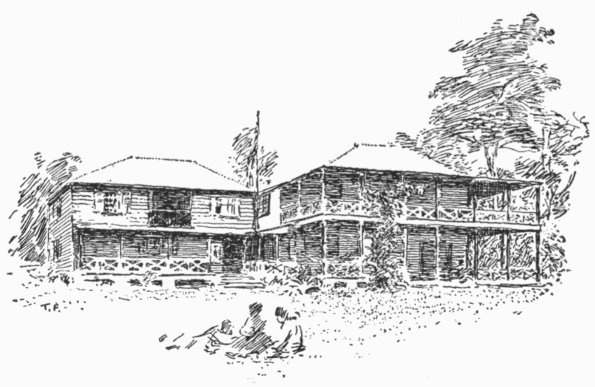
The novelist's stepson, Mr. Lloyd Osbourne, walked through the Vailima mansion with me and bade me write my letters at the old desk. I thought it would be presumptuous to do that; it was sufficient for me to enter the hall on the floor of which the "Writer of Tales," according to the Samoan custom, was wont to sit.
The novelist's stepson, Mr. Lloyd Osbourne, walked through the Vailima mansion with me. He invited me to write my letters at the old desk. I thought it would be presumptuous to use the desk. It was enough for me to enter the hall where the "Writer of Tales" used to sit on the floor, following Samoan custom.
Coming through the main street of Apia one day, with my hosts, all bound for the Spray, Mrs. Stevenson on horseback, I walking by her side, and Mr. and Mrs. Osbourne close in our wake on bicycles, at a sudden turn in the road we found ourselves mixed with a remarkable native procession, with a somewhat primitive band of music, in front of us, while behind was a festival or a funeral, we could not tell which. Several of the stoutest men carried bales and bundles on poles. Some were evidently bales of tapa-cloth. The burden of one set of poles, heavier than the rest, however, was not so easily made out. My curiosity was whetted to know whether it was a roast pig or something of a gruesome nature, and I inquired about it. "I don't know," said Mrs. Stevenson, "whether this is a wedding or a funeral. Whatever it is, though, captain, our place seems to be at the head of it."
One day, my hosts and I were traveling down Apia's main street, all heading for the Spray. Mrs. Stevenson was on horseback, and I walked beside her. Mr. and Mrs. Osbourne followed close behind on bicycles. At a sudden turn in the road, we found ourselves mixed in with a remarkable native procession. A somewhat primitive band played in front of us, while behind us was either a festival or a funeral. We could not tell which. Several of the strongest men carried bales and bundles on poles. Some were clearly bales of tapa-cloth. But one load, heavier than the rest, was harder to make out. I was curious to know whether it was a roast pig or something gruesome, so I asked about it. "I don't know," said Mrs. Stevenson, "whether this is a wedding or a funeral. Whatever it is, though, captain, our place seems to be at the head of it."
The Spray being in the stream, we boarded her from the beach abreast, in the little razeed Gloucester dory, which had been painted a smart green. Our combined weight loaded it gunwale to the water, and I was obliged to steer with great care to avoid swamping. The adventure pleased Mrs. Stevenson greatly, and as we paddled along she sang, "They went to sea in a pea-green boat." I could understand her saying of her husband and herself, "Our tastes were similar."
The Spray was anchored in the stream, and we boarded her from the beach opposite. We crossed in a small, cut-down Gloucester dory, painted a bright green. Our combined weight brought its gunwales down to the water, so I had to steer very carefully to avoid swamping it. Mrs. Stevenson greatly enjoyed the adventure. As we paddled along, she sang, "They went to sea in a pea-green boat." I could understand why she said of herself and her husband, "Our tastes were similar."
As I sailed farther from the center of civilization I heard less and less of what would and what would not pay. Mrs. Stevenson, in speaking of my voyage, did not once ask me what I would make out of it. When I came to a Samoan village, the chief did not ask the price of gin, or say, "How much will you pay for roast pig?" but, "Dollar, dollar," said he; "white man know only dollar."
As I sailed farther from the center of civilization, I heard less and less about what would or would not pay. When Mrs. Stevenson spoke about my voyage, she never asked what I would make from it. When I came to a Samoan village, the chief did not ask the price of gin. Nor did he say, "How much will you pay for roast pig?" Instead, he said, "Dollar, dollar. White men know only dollars."
"Never mind dollar. The tapo has prepared ava; let us drink and rejoice." The tapo is the virgin hostess of the village; in this instance it was Taloa, daughter of the chief. "Our taro is good; let us eat. On the tree there is fruit. Let the day go by; why should we mourn over that? There are millions of days coming. The breadfruit is yellow in the sun, and from the cloth-tree is Taloa's gown. Our house, which is good, cost but the labor of building it, and there is no lock on the door."
"Never mind the dollar. The tapo has prepared ava. Let us drink and rejoice." The tapo is the village’s virgin hostess. In this case, she was Taloa, the chief’s daughter. "Our taro is good. Let us eat. There is fruit on the tree. Let the day pass. Why should we mourn its passing? Millions of days are still to come. The breadfruit is yellow in the sun, and Taloa’s gown comes from the cloth-tree. Our house is good and cost only the labor of building it. There is no lock on the door."
While the days go thus in these Southern islands we at the North are struggling for the bare necessities of life.
While the days pass this way in these southern islands, we in the North struggle for the bare necessities of life.
For food the islanders have only to put out their hand and take what nature has provided for them; if they plant a banana-tree, their only care afterward is to see that too many trees do not grow. They have great reason to love their country and to fear the white man's yoke, for once harnessed to the plow, their life would no longer be a poem.
For food, the islanders need only reach out and take what nature has provided. If they plant a banana tree, their only care afterward is to make sure too many trees do not grow. They have every reason to love their country and fear the white man's yoke. For once harnessed to the plow, their life would no longer be a poem.
The chief of the village of Caini, who was a tall and dignified Tonga man, could be approached only through an interpreter and talking man. It was perfectly natural for him to inquire the object of my visit, and I was sincere when I told him that my reason for casting anchor in Samoa was to see their fine men, and fine women, too. After a considerable pause the chief said: "The captain has come a long way to see so little; but," he added, "the tapo must sit nearer the captain." "Yack," said Taloa, who had so nearly learned to say yes in English, and suiting the action to the word, she hitched a peg nearer, all hands sitting in a circle upon mats. I was no less taken with the chiefs eloquence than delighted with the simplicity of all he said. About him there was nothing pompous; he might have been taken for a great scholar or statesman, the least assuming of the men I met on the voyage. As for Taloa, a sort of Queen of the May, and the other tapo girls, well, it is wise to learn as soon as possible the manners and customs of these hospitable people, and meanwhile not to mistake for over-familiarity that which is intended as honor to a guest. I was fortunate in my travels in the islands, and saw nothing to shake one's faith in native virtue.
The chief of the village of Caini was a tall, dignified Tonga man. I could speak to him only through an interpreter and talking man. It was perfectly natural for him to ask why I had come. I sincerely told him that I had anchored in Samoa to see their fine men, and fine women, too. After a long pause, the chief said: "The captain has come a long way to see so little; but," he added, "the tapo must sit nearer the captain." "Yack," said Taloa, who had almost learned to say yes in English. We were all sitting in a circle on mats, and she moved a little closer as she spoke. I was as impressed by the chief's eloquence as I was delighted by the simplicity of everything he said. There was nothing pompous about him. He might have been taken for a great scholar or statesman, and he was the least assuming man I met on the voyage. As for Taloa, who was a sort of Queen of the May, and the other tapo girls, well, it is wise to learn the customs of these hospitable people as soon as possible. In the meantime, one should not mistake a gesture of honor to a guest for over-familiarity. I was fortunate in my travels through the islands and saw nothing to shake one's faith in native virtue.
To the unconventional mind the punctilious etiquette of Samoa is perhaps a little painful. For instance, I found that in partaking of ava, the social bowl, I was supposed to toss a little of the beverage over my shoulder, or pretend to do so, and say, "Let the gods drink," and then drink it all myself; and the dish, invariably a cocoanut-shell, being empty, I might not pass it politely as we would do, but politely throw it twirling across the mats at the tapo.
For someone who dislikes convention, Samoa’s strict etiquette is perhaps a little painful. For example, I found I was expected to toss a little ava from the social bowl over my shoulder, or pretend to. I was then supposed to say, "Let the gods drink," and drink it all myself. The drinking vessel was always a coconut shell. Once it was empty, I could not politely pass it along as we would. Instead, I had to politely throw it spinning across the mats to the tapo.
My most grievous mistake while at the islands was made on a nag, which, inspired by a bit of good road, must needs break into a smart trot through a village. I was instantly hailed by the chief's deputy, who in an angry voice brought me to a halt. Perceiving that I was in trouble, I made signs for pardon, the safest thing to do, though I did not know what offense I had committed. My interpreter coming up, however, put me right, but not until a long palaver had ensued. The deputy's hail, liberally translated, was: "Ahoy, there, on the frantic steed! Know you not that it is against the law to ride thus through the village of our fathers?" I made what apologies I could, and offered to dismount and, like my servant, lead my nag by the bridle. This, the interpreter told me, would also be a grievous wrong, and so I again begged for pardon. I was summoned to appear before a chief; but my interpreter, being a wit as well as a bit of a rogue, explained that I was myself something of a chief, and should not be detained, being on a most important mission. In my own behalf I could only say that I was a stranger, but, pleading all this, I knew I still deserved to be roasted, at which the chief showed a fine row of teeth and seemed pleased, but allowed me to pass on.
My worst mistake on the islands happened while I was riding a horse. Encouraged by a stretch of good road, the horse broke into a brisk trot through a village. The chief's deputy immediately called out and angrily ordered me to stop. Realizing I was in trouble, I gestured for forgiveness. That seemed the safest thing to do, though I did not know what I had done wrong. My interpreter came up and explained my offense, but only after a long discussion. Loosely translated, the deputy had called out: "Hey, you there on the frantic horse! Don't you know it's against the law to ride like that through the village of our fathers?" I apologized as best I could. I offered to get off and lead my horse by the bridle, as my servant was doing. The interpreter told me that would also be a serious offense, so I begged for forgiveness again. I was ordered to appear before a chief. But my interpreter was witty and a bit of a rogue. He explained that I was something of a chief myself and should not be held up. I was, he said, on a very important mission. All I could say for myself was that I was a stranger. But even after offering all these excuses, I knew I still deserved to be roasted. At that, the chief showed a fine row of teeth and seemed pleased, but he let me pass.
The chief of the Tongas and his family at Caini, returning my visit, brought presents of tapa-cloth and fruits. Taloa, the princess, brought a bottle of cocoanut-oil for my hair, which another man might have regarded as coming late.
The chief of the Tongas and his family returned my visit at Caini, bringing gifts of tapa cloth and fruit. Taloa, the princess, brought a bottle of coconut oil for my hair. Another man might have thought the gift came too late.
It was impossible to entertain on the Spray after the royal manner in which I had been received by the chief. His fare had included all that the land could afford, fruits, fowl, fishes, and flesh, a hog having been roasted whole. I set before them boiled salt pork and salt beef, with which I was well supplied, and in the evening took them all to a new amusement in the town, a rocking-horse merry-go-round, which they called a "kee-kee," meaning theater; and in a spirit of justice they pulled off the horses' tails, for the proprietors of the show, two hard-fisted countrymen of mine, I grieve to say, unceremoniously hustled them off for a new set, almost at the first spin. I was not a little proud of my Tonga friends; the chief, finest of them all, carried a portentous club. As for the theater, through the greed of the proprietors it was becoming unpopular, and the representatives of the three great powers, in want of laws which they could enforce, adopted a vigorous foreign policy, taxing it twenty-five per cent, on the gate-money. This was considered a great stroke of legislative reform!
I could not entertain my guests aboard the Spray in the royal style the chief had shown me. His feast had included everything the land could provide: fruit, poultry, fish, and meat, including a whole roasted pig. I served them boiled salt pork and salt beef, both of which I had plenty. That evening, I took them all to a new amusement in town, a rocking-horse merry-go-round. They called it a "kee-kee," meaning theater. In the interests of justice, they pulled off the horses' tails. The owners had hustled them off almost as soon as the ride began, to make room for new riders. I am sorry to say that the two owners were tightfisted countrymen of mine. I was quite proud of my Tonga friends. The chief, the finest of them all, carried a formidable club. As for the theater, the owners' greed was making it unpopular. The representatives of the three great powers lacked laws they could enforce, so they adopted a vigorous foreign policy. They taxed the theater twenty-five percent of its ticket receipts. This was considered a great stroke of legislative reform!
It was the fashion of the native visitors to the Spray to come over the bows, where they could reach the head-gear and climb aboard with ease, and on going ashore to jump off the stern and swim away; nothing could have been more delightfully simple. The modest natives wore lava-lava bathing-dresses, a native cloth from the bark of the mulberry-tree, and they did no harm to the Spray. In summer-land Samoa their coming and going was only a merry every-day scene. One day the head teachers of Papauta College, Miss Schultze and Miss Moore, came on board with their ninety-seven young women students. They were all dressed in white, and each wore a red rose, and of course came in boats or canoes in the cold-climate style. A merrier bevy of girls it would be difficult to find. As soon as they got on deck, by request of one of the teachers, they sang "The Watch on the Rhine," which I had never heard before. "And now," said they all, "let's up anchor and away." But I had no inclination to sail from Samoa so soon. On leaving the Spray these accomplished young women each seized a palm-branch or paddle, or whatever else would serve the purpose, and literally paddled her own canoe. Each could have swum as readily, and would have done so, I dare say, had it not been for the holiday muslin.
Native visitors to the Spray usually came aboard over the bow. There they could easily reach the rigging at the front of the boat and climb aboard. When they went ashore, they jumped off the stern and swam away. Nothing could have been more delightfully simple. The modest natives wore lava-lava bathing clothes made from mulberry bark, and they did no harm to the Spray. In the summer warmth of Samoa, their coming and going was simply a cheerful everyday scene. One day, the head teachers of Papauta College, Miss Schultze and Miss Moore, came aboard with their ninety-seven young women students. The students were all dressed in white, and each wore a red rose. Of course, they came in boats or canoes, as people do in colder climates. It would be hard to find a happier group of girls. As soon as they got on deck, one of the teachers asked them to sing "The Watch on the Rhine." I had never heard it before. "And now," they all said, "let's raise the anchor and sail away." But I had no wish to leave Samoa so soon. When these accomplished young women left the Spray, each took a palm branch, a paddle, or whatever else would do. Each literally paddled her own canoe. Each could have swum just as easily. I dare say each would have done so, had it not been for the holiday muslin they wore.
It was not uncommon at Apia to see a young woman swimming alongside a small canoe with a passenger for the Spray. Mr. Trood, an old Eton boy, came in this manner to see me, and he exclaimed, "Was ever king ferried in such state?" Then, suiting his action to the sentiment, he gave the damsel pieces of silver till the natives watching on shore yelled with envy. My own canoe, a small dugout, one day when it had rolled over with me, was seized by a party of fair bathers, and before I could get my breath, almost, was towed around and around the Spray, while I sat in the bottom of it, wondering what they would do next. But in this case there were six of them, three on a side, and I could not help myself. One of the sprites, I remember, was a young English lady, who made more sport of it than any of the others.
In Apia, it was common to see a young woman swimming beside a small canoe carrying a passenger to the Spray. Mr. Trood, a former Eton student, came to see me this way. He exclaimed, "Was any king ever ferried in such style?" To match his words, he gave the young woman pieces of silver. The natives watching from shore shouted with envy. One day, my own canoe, a small dugout, tipped over with me in it. A group of lovely bathers seized the canoe. Before I had hardly caught my breath, they were towing it around and around the Spray. I sat in the bottom, wondering what they would do next. But there were six of them, three on each side, and I could do nothing to stop them. I remember that one of the playful girls was a young English lady. She had more fun with it than any of the others.