Chapter 11
The islanders at Juan Fernandez entertained with Yankee doughnuts—The beauties of Robinson Crusoe's realm—The mountain monument to Alexander Selkirk—Robinson Crusoe's cave—A stroll with the children of the island—Westward ho! with a friendly gale—A month's free sailing with the Southern Cross and the sun for guides—Sighting the Marquesas—Experience in reckoning.
The islanders of Juan Fernandez are treated to Yankee doughnuts. The beauties of Robinson Crusoe's realm. The mountain monument to Alexander Selkirk. Robinson Crusoe's cave. A walk with the island's children. Westward with a friendly gale. A month of free sailing, guided by the Southern Cross and the sun. Sighting the Marquesas. Experience in navigation.
The Spray being secured, the islanders returned to the coffee and doughnuts, and I was more than flattered when they did not slight my buns, as the professor had done in the Strait of Magellan. Between buns and doughnuts there was little difference except in name. Both had been fried in tallow, which was the strong point in both, for there was nothing on the island fatter than a goat, and a goat is but a lean beast, to make the best of it. So with a view to business I hooked my steelyards to the boom at once, ready to weigh out tallow, there being no customs officer to say, "Why do you do so?" and before the sun went down the islanders had learned the art of making buns and doughnuts. I did not charge a high price for what I sold, but the ancient and curious coins I got in payment, some of them from the wreck of a galleon sunk in the bay no one knows when, I sold afterward to antiquarians for more than face-value. In this way I made a reasonable profit. I brought away money of all denominations from the island, and nearly all there was, so far as I could find out.
Once the Spray was secured, the islanders returned to the coffee and doughnuts. I was more than flattered that they did not slight my buns, as the professor had done in the Strait of Magellan. There was little difference between buns and doughnuts except their names. Both had been fried in tallow, which was the best thing about them. Nothing on the island was fatter than a goat, and even at its best, a goat is a lean beast. So, with business in mind, I immediately hooked my steelyards to the boom, ready to weigh out tallow. There was no customs officer to ask, "Why do you do so?" Before sunset, the islanders had learned how to make buns and doughnuts. I did not charge much for what I sold. But I received some old and unusual coins in payment. Some came from the wreck of a galleon that had sunk in the bay, no one knows when. I later sold the coins to antiquarians for more than their face value. In this way, I made a reasonable profit. I took money of every denomination away from the island and, as far as I could tell, nearly all the money there was.
Juan Fernandez, as a place of call, is a lovely spot. The hills are well wooded, the valleys fertile, and pouring down through many ravines are streams of pure water. There are no serpents on the island, and no wild beasts other than pigs and goats, of which I saw a number, with possibly a dog or two. The people lived without the use of rum or beer of any sort. There was not a police officer or a lawyer among them. The domestic economy of the island was simplicity itself. The fashions of Paris did not affect the inhabitants; each dressed according to his own taste. Although there was no doctor, the people were all healthy, and the children were all beautiful. There were about forty-five souls on the island all told. The adults were mostly from the mainland of South America. One lady there, from Chile, who made a flying-jib for the Spray, taking her pay in tallow, would be called a belle at Newport. Blessed island of Juan Fernandez! Why Alexander Selkirk ever left you was more than I could make out.
Juan Fernandez is a lovely place to stop. The hills are well wooded, the valleys are fertile, and streams of pure water flow down many ravines. There are no snakes on the island. The only wild animals are pigs and goats, and possibly a dog or two. I saw a number of pigs and goats. The people lived without rum or beer of any kind. There was not a police officer or a lawyer among them. Life on the island was simplicity itself. Paris fashions did not affect the inhabitants. Each person dressed according to their own taste. Although there was no doctor, the people were all healthy, and the children were all beautiful. There were about forty-five people on the island in all. Most of the adults came from the mainland of South America. One lady from Chile made a flying-jib for the Spray and accepted tallow as payment. She would be called a belle at Newport. Blessed island of Juan Fernandez! I could never understand why Alexander Selkirk left you.
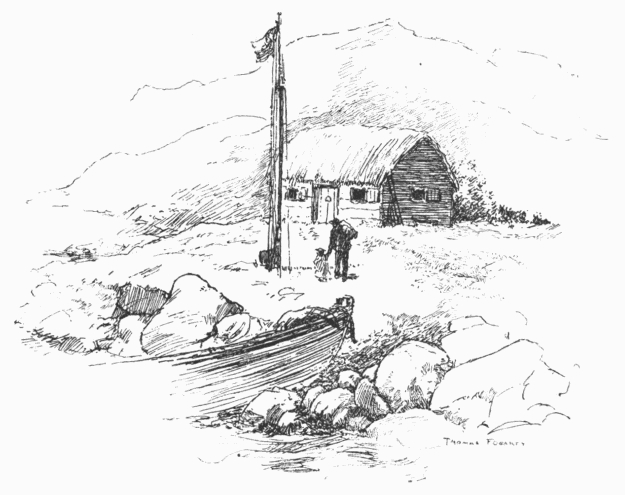
A large ship which had arrived some time before, on fire, had been stranded at the head of the bay, and as the sea smashed her to pieces on the rocks, after the fire was drowned, the islanders picked up the timbers and utilized them in the construction of houses, which naturally presented a ship-like appearance. The house of the king of Juan Fernandez, Manuel Carroza by name, besides resembling the ark, wore a polished brass knocker on its only door, which was painted green. In front of this gorgeous entrance was a flag-mast all ataunto, and near it a smart whale-boat painted red and blue, the delight of the king's old age.
A large ship had arrived some time earlier, on fire, and had run aground at the head of the bay. After the fire was put out, the sea smashed the ship to pieces on the rocks. As this happened, the islanders collected the timbers and used them to build houses, which naturally looked like ships. The house of Manuel Carroza, the king of Juan Fernandez, looked like the ark. Its only door was painted green and had a polished brass knocker. In front of this splendid entrance stood a fully rigged flagpole. Near it was a fine red and blue whaleboat, the delight of the king's old age.
I of course made a pilgrimage to the old lookout place at the top of the mountain, where Selkirk spent many days peering into the distance for the ship which came at last. From a tablet fixed into the face of the rock I copied these words, inscribed in Arabic capitals:
Of course, I made a pilgrimage to the old lookout at the top of the mountain. Selkirk spent many days there, looking into the distance for the ship that finally came. I copied these words from a tablet set into the rock, where they were inscribed in Arabic capitals:
IN MEMORY OF ALEXANDER SELKIRK, MARINER,
IN MEMORY OF ALEXANDER SELKIRK, SAILOR,
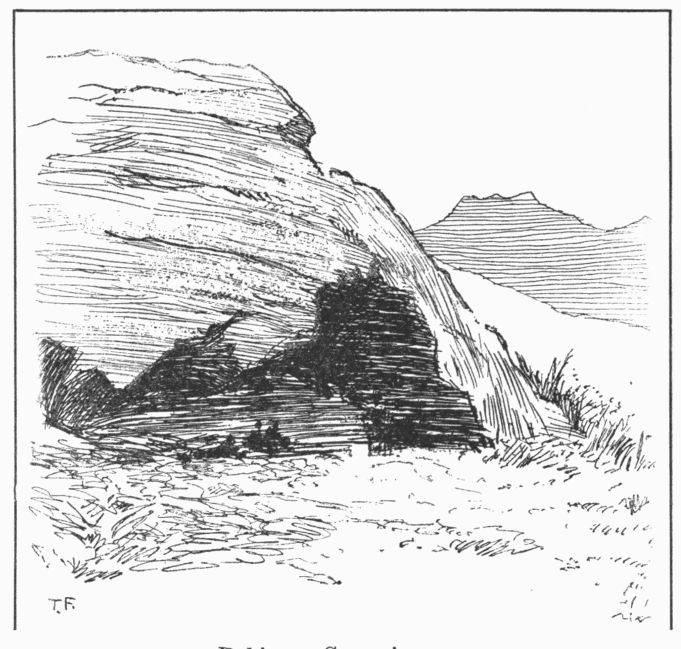
The cave in which Selkirk dwelt while on the island is at the head of the bay now called Robinson Crusoe Bay. It is around a bold headland west of the present anchorage and landing. Ships have anchored there, but it affords a very indifferent berth. Both of these anchorages are exposed to north winds, which, however, do not reach home with much violence. The holding-ground being good in the first-named bay to the eastward, the anchorage there may be considered safe, although the undertow at times makes it wild riding.
The cave where Selkirk lived on the island is at the head of what is now called Robinson Crusoe Bay. The bay lies around a steep headland west of the present anchorage and landing place. Ships have anchored there, but it is a rather poor place to anchor. Both anchorages are exposed to north winds, though the winds do not reach them with much force. In the first bay mentioned, to the east, the seabed holds anchors well. The anchorage there may therefore be considered safe, although the undertow sometimes makes ships ride wildly at anchor.
I visited Robinson Crusoe Bay in a boat, and with some difficulty landed through the surf near the cave, which I entered. I found it dry and inhabitable. It is located in a beautiful nook sheltered by high mountains from all the severe storms that sweep over the island, which are not many; for it lies near the limits of the trade-wind regions, being in latitude 35 ½ degrees. The island is about fourteen miles in length, east and west, and eight miles in width; its height is over three thousand feet. Its distance from Chile, to which country it belongs, is about three hundred and forty miles.
I visited Robinson Crusoe Bay by boat and landed near the cave with some difficulty through the surf. I went inside and found it dry and suitable for living in. The cave sits in a beautiful sheltered spot. High mountains protect it from all the severe storms that sweep over the island. There are not many such storms, because the island lies near the edge of the trade wind region, at 35½ degrees latitude. The island is about fourteen miles long from east to west and eight miles wide. It rises over three thousand feet. It belongs to Chile and is about three hundred and forty miles from the mainland.
Juan Fernandez was once a convict station. A number of caves in which the prisoners were kept, damp, unwholesome dens, are no longer in use, and no more prisoners are sent to the island.
Juan Fernandez was once a prison colony. Prisoners were kept in several damp, unhealthy caves that are no longer used. No more prisoners are sent to the island.
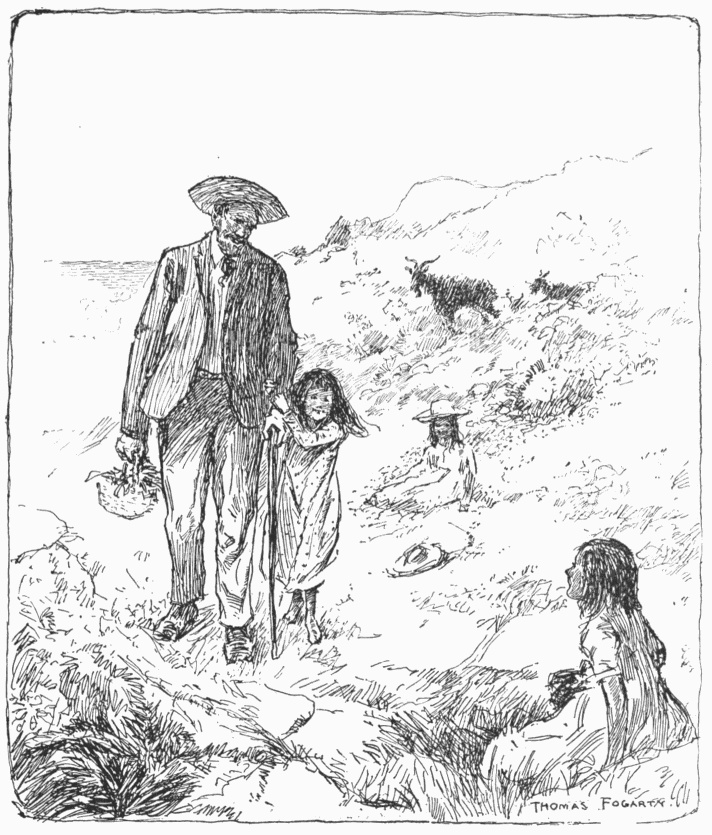
The pleasantest day I spent on the island, if not the pleasantest on my whole voyage, was my last day on shore,—but by no means because it was the last,—when the children of the little community, one and all, went out with me to gather wild fruits for the voyage. We found quinces, peaches, and figs, and the children gathered a basket of each. It takes very little to please children, and these little ones, never hearing a word in their lives except Spanish, made the hills ring with mirth at the sound of words in English. They asked me the names of all manner of things on the island. We came to a wild fig-tree loaded with fruit, of which I gave them the English name. "Figgies, figgies!" they cried, while they picked till their baskets were full. But when I told them that the cabra they pointed out was only a goat, they screamed with laughter, and rolled on the grass in wild delight to think that a man had come to their island who would call a cabra a goat.
My last day ashore was the most pleasant day I spent on the island, if not on my whole voyage. But that was by no means because it was my last day ashore. All the children in the little community went out with me to gather wild fruit for the voyage. We found quinces, peaches, and figs, and the children gathered a basket of each. It takes very little to please children. These little ones had never heard a word except Spanish in their lives, and the sound of English words made them fill the hills with laughter. They asked me the names of all kinds of things on the island. We came to a wild fig tree loaded with fruit, and I gave them its English name. "Figgies, figgies!" they cried, picking until their baskets were full. But when I told them that the cabra they pointed out was only a goat, they screamed with laughter. They rolled on the grass in wild delight at the thought that a man had come to their island who would call a cabra a goat.
The first child born on Juan Fernandez, I was told, had become a beautiful woman and was now a mother. Manuel Carroza and the good soul who followed him here from Brazil had laid away their only child, a girl, at the age of seven, in the little churchyard on the point. In the same half-acre were other mounds among the rough lava rocks, some marking the burial-place of native-born children, some the resting-places of seamen from passing ships, landed here to end days of sickness and get into a sailors' heaven.
I was told that the first child born on Juan Fernandez had grown into a beautiful woman and was now a mother. Manuel Carroza and the good soul who had followed him here from Brazil had buried their only child. She was a girl of seven, laid to rest in the little churchyard on the point. In the same half-acre, other mounds lay among the rough lava rocks. Some marked the graves of children born on the island. Others were the resting places of sailors from passing ships, brought ashore here to end their days of sickness and enter a sailors' heaven.
The greatest drawback I saw in the island was the want of a school. A class there would necessarily be small, but to some kind soul who loved teaching and quietude life on Juan Fernandez would, for a limited time, be one of delight.
The greatest drawback I saw on the island was the lack of a school. A class there would have to be small. But for a kind soul who loved teaching and quiet, life on Juan Fernandez would be delightful for a limited time.
On the morning of May 5, 1896, I sailed from Juan Fernandez, having feasted on many things, but on nothing sweeter than the adventure itself of a visit to the home and to the very cave of Robinson Crusoe. From the island the Spray bore away to the north, passing the island of St. Felix before she gained the trade-winds, which seemed slow in reaching their limits.
On the morning of May 5, 1896, I sailed from Juan Fernandez. I had feasted on many things, but nothing was sweeter than the adventure itself: visiting the home and very cave of Robinson Crusoe. From the island, the Spray headed north, passing the island of St. Felix before reaching the trade winds. The trade winds seemed slow to reach their limits.
If the trades were tardy, however, when they did come they came with a bang, and made up for lost time; and the Spray, under reefs, sometimes one, sometimes two, flew before a gale for a great many days, with a bone in her mouth, toward the Marquesas, in the west, which, she made on the forty-third day out, and still kept on sailing. My time was all taken up those days—not by standing at the helm; no man, I think, could stand or sit and steer a vessel round the world: I did better than that; for I sat and read my books, mended my clothes, or cooked my meals and ate them in peace. I had already found that it was not good to be alone, and so I made companionship with what there was around me, sometimes with the universe and sometimes with my own insignificant self; but my books were always my friends, let fail all else. Nothing could be easier or more restful than my voyage in the trade-winds.
If the trade winds were late, though, they arrived with a bang and made up for lost time. With her sails reefed, sometimes once and sometimes twice, the Spray raced before a gale for many days. She had a bone in her mouth as she sailed west toward the Marquesas. She reached the islands on the forty-third day out and kept right on sailing. My time was fully occupied during those days, but not by steering. I do not think anyone could stand or sit at the helm and steer a vessel around the world. I did better than that. I sat and read my books, mended my clothes, or cooked and ate my meals in peace. I had already found that it was not good to be alone, so I made companions of what was around me. Sometimes I found company in the universe, and sometimes in my own insignificant self. But my books were always my friends, even if everything else failed. Nothing could have been easier or more restful than my voyage in the trade winds.
I sailed with a free wind day after day, marking the position of my ship on the chart with considerable precision; but this was done by intuition, I think, more than by slavish calculations. For one whole month my vessel held her course true; I had not, the while, so much as a light in the binnacle. The Southern Cross I saw every night abeam. The sun every morning came up astern; every evening it went down ahead. I wished for no other compass to guide me, for these were true. If I doubted my reckoning after a long time at sea I verified it by reading the clock aloft made by the Great Architect, and it was right.
I sailed with a favorable wind day after day, marking my ship’s position on the chart quite precisely. But I think I did this more by intuition than by painstaking calculations. For a whole month, my vessel stayed on course. During that time, I did not even have a light in the compass binnacle. Every night I saw the Southern Cross off to the side. Every morning the sun rose behind me, and every evening it set ahead of me. I wanted no other compass to guide me, for these guides were true. If I doubted my navigation after a long time at sea, I checked it by reading the clock in the sky made by the Great Architect. My navigation was right.
There was no denying that the comical side of the strange life appeared. I awoke, sometimes, to find the sun already shining into my cabin. I heard water rushing by, with only a thin plank between me and the depths, and I said, "How is this?" But it was all right; it was my ship on her course, sailing as no other ship had ever sailed before in the world. The rushing water along her side told me that she was sailing at full speed. I knew that no human hand was at the helm; I knew that all was well with "the hands" forward, and that there was no mutiny on board.
There was no denying the funny side of this strange life. Sometimes I woke to find the sun already shining into my cabin. I heard water rushing past, with only a thin plank between me and the depths. I said, "What is going on?" But everything was all right. My ship was on course, sailing as no other ship had ever sailed before in the world. The water rushing along her side told me she was sailing at full speed. I knew no human hand was at the helm. I knew all was well with "the hands" forward, and that there was no mutiny on board.
The phenomena of ocean meteorology were interesting studies even here in the trade-winds. I observed that about every seven days the wind freshened and drew several points farther than usual from the direction of the pole; that is, it went round from east-southeast to south-southeast, while at the same time a heavy swell rolled up from the southwest. All this indicated that gales were going on in the anti-trades. The wind then hauled day after day as it moderated, till it stood again at the normal point, east-southeast. This is more or less the constant state of the winter trades in latitude 12 degrees S., where I "ran down the longitude" for weeks. The sun, we all know, is the creator of the trade-winds and of the wind system over all the earth. But ocean meteorology is, I think, the most fascinating of all. From Juan Fernandez to the Marquesas I experienced six changes of these great palpitations of sea-winds and of the sea itself, the effect of far-off gales. To know the laws that govern the winds, and to know that you know them, will give you an easy mind on your voyage round the world; otherwise you may tremble at the appearance of every cloud. What is true of this in the trade-winds is much more so in the variables, where changes run more to extremes.
Ocean weather patterns were interesting to study, even here in the trade winds. I observed that about every seven days, the wind grew stronger and shifted several points toward the pole. It turned from east-southeast to south-southeast. At the same time, a heavy swell rolled in from the southwest. All this indicated that gales were blowing in the anti-trades. As the wind weakened, it shifted day after day until it returned to its normal direction, east-southeast. This was more or less the usual pattern of the winter trade winds at 12 degrees south latitude. There I "ran down the longitude" for weeks. As we all know, the sun creates the trade winds and the wind system across the whole earth. But I think ocean weather is the most fascinating of all. From Juan Fernandez to the Marquesas, I experienced six of these great pulses of wind and sea, caused by distant gales. Knowing the laws that govern the winds, and knowing that you know them, will give you peace of mind on a voyage around the world. Otherwise, you may tremble at the sight of every cloud. This is true in the trade winds, and even more so in the variable winds, where changes are more extreme.
To cross the Pacific Ocean, even under the most favorable circumstances, brings you for many days close to nature, and you realize the vastness of the sea. Slowly but surely the mark of my little ship's course on the track-chart reached out on the ocean and across it, while at her utmost speed she marked with her keel still slowly the sea that carried her. On the forty-third day from land,—a long time to be at sea alone,—the sky being beautifully clear and the moon being "in distance" with the sun, I threw up my sextant for sights. I found from the result of three observations, after long wrestling with lunar tables, that her longitude by observation agreed within five miles of that by dead-reckoning.
Even under the best conditions, crossing the Pacific Ocean brings you close to nature for many days. You come to realize how vast the sea is. Slowly but surely, the line marking my little ship's course on the chart stretched out across the ocean. Yet even at her highest speed, she still moved slowly, her keel marking the sea that carried her. It was the forty-third day since I had left land, a long time to be alone at sea. The sky was beautifully clear, and the moon was "in distance" with the sun, so I raised my sextant to take sightings. After taking three observations and struggling at length with the lunar tables, I calculated my longitude. It agreed within five miles of the longitude I had calculated by dead reckoning.
This was wonderful; both, however, might be in error, but somehow I felt confident that both were nearly true, and that in a few hours more I should see land; and so it happened, for then I made the island of Nukahiva, the southernmost of the Marquesas group, clear-cut and lofty. The verified longitude when abreast was somewhere between the two reckonings; this was extraordinary. All navigators will tell you that from one day to another a ship may lose or gain more than five miles in her sailing-account, and again, in the matter of lunars, even expert lunarians are considered as doing clever work when they average within eight miles of the truth.
This was wonderful. Both reckonings might have been wrong, but somehow I felt confident that both were nearly right. I felt sure that I would see land within a few hours. And so it happened. I sighted the island of Nukahiva, the southernmost of the Marquesas group, rising high and sharply outlined. When I was abreast of the island, the verified longitude was somewhere between the two reckonings. This was extraordinary. All navigators will tell you that a ship's sailing account may gain or lose more than five miles from one day to the next. And when it comes to lunar observations, even expert lunarians are considered to be doing clever work if they average within eight miles of the true position.
I hope I am making it clear that I do not lay claim to cleverness or to slavish calculations in my reckonings. I think I have already stated that I kept my longitude, at least, mostly by intuition. A rotator log always towed astern, but so much has to be allowed for currents and for drift, which the log never shows, that it is only an approximation, after all, to be corrected by one's own judgment from data of a thousand voyages; and even then the master of the ship, if he be wise, cries out for the lead and the lookout.
I hope I have made it clear that I do not claim to be clever or to rely on painstaking calculations in my navigation. I think I have already said that I kept track of my longitude mostly by intuition. A rotator log always trailed behind the ship, but it could not show currents or drift, and these had to be taken into account. So the log gave only an approximation, which had to be corrected by judgment based on the experience of a thousand voyages. Even then, a wise shipmaster calls for the lead to measure the depth and for a lookout.
Unique was my experience in nautical astronomy from the deck of the Spray—so much so that I feel justified in briefly telling it here. The first set of sights, just spoken of, put her many hundred miles west of my reckoning by account. I knew that this could not be correct. In about an hour's time I took another set of observations with the utmost care; the mean result of these was about the same as that of the first set. I asked myself why, with my boasted self-dependence, I had not done at least better than this. Then I went in search of a discrepancy in the tables, and I found it. In the tables I found that the column of figures from which I had got an important logarithm was in error. It was a matter I could prove beyond a doubt, and it made the difference as already stated. The tables being corrected, I sailed on with self-reliance unshaken, and with my tin clock fast asleep. The result of these observations naturally tickled my vanity, for I knew that it was something to stand on a great ship's deck and with two assistants take lunar observations approximately near the truth. As one of the poorest of American sailors, I was proud of the little achievement alone on the sloop, even by chance though it may have been.
My experience with nautical astronomy aboard the Spray was unique. I think it deserves a brief telling here. The first set of observations I mentioned placed her many hundreds of miles west of my calculated position. I knew that could not be right. About an hour later, I took another set of observations with the greatest care. Their average result was about the same as the first set's. I asked myself why, with all my boasting about self-reliance, I had not done better. Then I looked for an error in the tables, and I found one. The column of figures from which I had taken an important logarithm was wrong. I could prove the error beyond a doubt, and it accounted for the difference I have described. Once I had corrected the tables, I sailed on with my self-reliance unshaken and my tin clock fast asleep. The result of these observations naturally pleased my vanity. I knew it was an achievement to stand on a large ship's deck with two assistants and take lunar observations that came reasonably close to the truth. As one of the poorest of American sailors, I was proud of my little achievement alone on the sloop, even if it may have been a matter of chance.
I was en rapport now with my surroundings, and was carried on a vast stream where I felt the buoyancy of His hand who made all the worlds. I realized the mathematical truth of their motions, so well known that astronomers compile tables of their positions through the years and the days, and the minutes of a day, with such precision that one coming along over the sea even five years later may, by their aid, find the standard time of any given meridian on the earth.
I was now in tune with my surroundings. I was carried along on a vast stream, where I felt the supporting hand of him who made all the worlds. I understood the mathematical truth of their movements. Astronomers know these movements so well that they compile tables of the worlds’ positions by year, day, and minute. The tables are so precise that someone sailing the sea even five years later may use them to find the standard time at any meridian on earth.
To find local time is a simpler matter. The difference between local and standard time is longitude expressed in time—four minutes, we all know, representing one degree. This, briefly, is the principle on which longitude is found independent of chronometers. The work of the lunarian, though seldom practised in these days of chronometers, is beautifully edifying, and there is nothing in the realm of navigation that lifts one's heart up more in adoration.
Finding local time is simpler. The difference between local and standard time is longitude expressed in time. As we all know, four minutes represents one degree. Briefly, this is the principle used to find longitude without chronometers. The work of the lunarian is rarely practiced in these days of chronometers, but it is beautifully instructive. Nothing in navigation lifts the heart more in adoration.