Chapter 10
Running to Port Angosto in a snow-storm—A defective sheetrope places the Spray in peril—The Spray as a target for a Fuegian arrow—The island of Alan Erric—Again in the open Pacific—The run to the island of Juan Fernandez—An absentee king—At Robinson Crusoe's anchorage.
Sailing to Port Angosto in a snowstorm. A faulty sheet rope puts the Spray in danger. The Spray becomes the target of a Fuegian arrow. The island of Alan Erric. Back in the open Pacific. Sailing to the island of Juan Fernandez. An absent king. At Robinson Crusoe's anchorage.
Another gale had then sprung up, but the wind was still fair, and I had only twenty-six miles to run for Port Angosto, a dreary enough place, where, however, I would find a safe harbor in which to refit and stow cargo. I carried on sail to make the harbor before dark, and she fairly flew along, all covered with snow, which fell thick and fast, till she looked like a white winter bird. Between the storm-bursts I saw the headland of my port, and was steering for it when a flaw of wind caught the mainsail by the lee, jibed it over, and dear! dear! how nearly was this the cause of disaster; for the sheet parted and the boom unshipped, and it was then close upon night. I worked till the perspiration poured from my body to get things adjusted and in working order before dark, and, above all, to get it done before the sloop drove to leeward of the port of refuge. Even then I did not get the boom shipped in its saddle. I was at the entrance of the harbor before I could get this done, and it was time to haul her to or lose the port; but in that condition, like a bird with a broken wing, she made the haven. The accident which so jeopardized my vessel and cargo came of a defective sheet-rope, one made from sisal, a treacherous fiber which has caused a deal of strong language among sailors.
Another gale had sprung up, but the wind was still favorable. I had only twenty-six miles to sail to Port Angosto. It was a dreary enough place, but I would find a safe harbor there to refit and stow cargo. I kept up sail to reach the harbor before dark. The sloop fairly flew along, covered in snow that fell thick and fast, until she looked like a white winter bird. Between bursts of the storm, I saw the headland at Port Angosto and steered toward it. Then a sudden gust caught the mainsail from the wrong side and swung it across the boat. Dear, dear, how nearly that caused a disaster! The sheet rope snapped and the boom came loose, and night was close upon us. I worked until sweat poured from my body, trying to put everything back in working order before dark. Above all, I had to finish before the sloop drifted downwind past the harbor of refuge. Even then, I had not managed to secure the boom in its saddle. I was at the harbor entrance before I could do it, and I had to turn her in or miss the port. But in that condition, like a bird with a broken wing, she reached the haven. The accident that so endangered my vessel and cargo was caused by a defective sheet rope made of sisal. That treacherous fiber has inspired a good deal of strong language among sailors.
I did not run the Spray into the inner harbor of Port Angosto, but came to inside a bed of kelp under a steep bluff on the port hand going in. It was an exceedingly snug nook, and to make doubly sure of holding on here against all williwaws I moored her with two anchors and secured her besides, by cables to trees. However, no wind ever reached there except back flaws from the mountains on the opposite side of the harbor. There, as elsewhere in that region, the country was made up of mountains. This was the place where I was to refit and whence I was to sail direct, once more, for Cape Pillar and the Pacific.
I did not take the Spray into the inner harbor of Port Angosto. Instead, I anchored among kelp beneath a steep bluff on the left as I entered. It was an extremely sheltered spot. To make doubly sure the boat would hold against all williwaws, I moored her with two anchors and secured her to trees with cables as well. However, the only wind that ever reached the spot came in gusts from the mountains across the harbor. As elsewhere in that region, mountains made up the landscape. Here I would refit the boat and once more sail directly for Cape Pillar and the Pacific.
I remained at Port Angosto some days, busily employed about the sloop. I stowed the tallow from the deck to the hold, arranged my cabin in better order, and took in a good supply of wood and water. I also mended the sloop's sails and rigging, and fitted a jigger, which changed the rig to a yawl, though I called the boat a sloop just the same, the jigger being merely a temporary affair.
I stayed at Port Angosto for several days, keeping busy with work on the sloop. I moved the tallow from the deck to the hold, put my cabin in better order, and took aboard plenty of wood and water. I also mended the sails and rigging and fitted a jigger, changing the rig to a yawl. I still called the boat a sloop, though, because the jigger was only temporary.
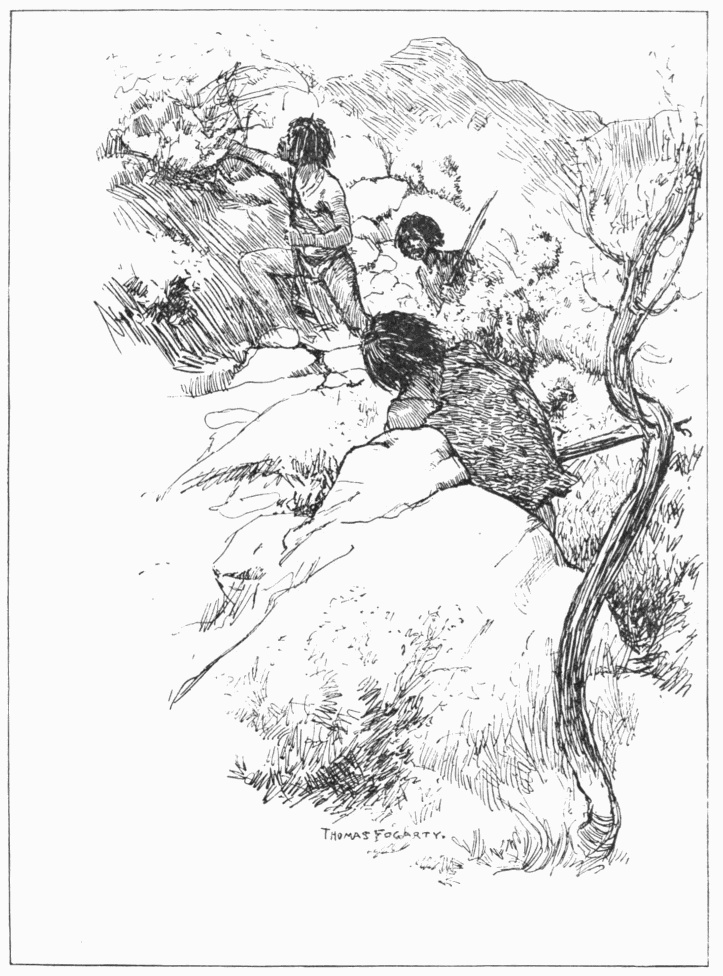
I never forgot, even at the busiest time of my work there, to have my rifle by me ready for instant use; for I was of necessity within range of savages, and I had seen Fuegian canoes at this place when I anchored in the port, farther down the reach, on the first trip through the strait. I think it was on the second day, while I was busily employed about decks, that I heard the swish of something through the air close by my ear, and heard a "zip"-like sound in the water, but saw nothing. Presently, however, I suspected that it was an arrow of some sort, for just then one passing not far from me struck the mainmast, where it stuck fast, vibrating from the shock—a Fuegian autograph. A savage was somewhere near, there could be no doubt about that. I did not know but he might be shooting at me, with a view to getting my sloop and her cargo; and so I threw up my old Martini-Henry, the rifle that kept on shooting, and the first shot uncovered three Fuegians, who scampered from a clump of bushes where they had been concealed, and made over the hills. I fired away a good many cartridges, aiming under their feet to encourage their climbing. My dear old gun woke up the hills, and at every report all three of the savages jumped as if shot; but they kept on, and put Fuego real estate between themselves and the Spray as fast as their legs could carry them. I took care then, more than ever before, that all my firearms should be in order and that a supply of ammunition should always be ready at hand. But the savages did not return, and although I put tacks on deck every night, I never discovered that any more visitors came, and I had only to sweep the deck of tacks carefully every morning after.
Even at the busiest times of my work there, I never forgot to keep my rifle ready beside me. I had to work within range of savages. On my first trip through the strait, I had seen Fuegian canoes here when I anchored farther down the reach. I think it was on the second day, while I was busy on deck, that I heard something swish through the air close to my ear. Then I heard a "zip"-like sound in the water, but saw nothing. Soon, though, I suspected it was some kind of arrow. Just then, another passed not far from me and struck the mainmast. It stuck there, vibrating from the impact, a Fuegian autograph. There could be no doubt that a savage was somewhere nearby. For all I knew, he might be shooting at me to get my sloop and its cargo. So I raised my old Martini-Henry, the rifle that kept on shooting. My first shot brought three Fuegians out of a clump of bushes where they had been hiding. They scampered away over the hills. I fired quite a few cartridges, aiming under their feet to encourage them to climb. My dear old gun woke up the hills, and at every shot all three savages jumped as if they had been hit. But they kept going, putting Fuego real estate between themselves and the Spray as fast as their legs could carry them. After that, I took more care than ever to keep all my firearms in working order and ammunition ready at hand. But the savages did not return. Although I put tacks on deck every night, I never found that any more visitors had come. I only had to sweep the tacks carefully off the deck every morning afterward.
As the days went by, the season became more favorable for a chance to clear the strait with a fair wind, and so I made up my mind after six attempts, being driven back each, time, to be in no further haste to sail. The bad weather on my last return to Port Angosto for shelter brought the Chilean gunboat Condor and the Argentine cruiser Azopardo into port. As soon as the latter came to anchor, Captain Mascarella, the commander, sent a boat to the Spray with the message that he would take me in tow for Sandy Point if I would give up the voyage and return—the thing farthest from my mind. The officers of the Azopardo told me that, coming up the strait after the Spray on her first passage through, they saw Black Pedro and learned that he had visited me. The Azopardo, being a foreign man-of-war, had no right to arrest the Fuegian outlaw, but her captain blamed me for not shooting the rascal when he came to my sloop.
As the days passed, the season became more favorable for clearing the strait with a fair wind. I had tried six times and been driven back each time, so I decided not to rush into sailing again. On my last return to Port Angosto for shelter, bad weather also brought the Chilean gunboat Condor and the Argentine cruiser Azopardo into port. As soon as the Azopardo anchored, her commander, Captain Mascarella, sent a boat to the Spray. He offered to tow me to Sandy Point if I gave up the voyage and returned. That was the farthest thing from my mind. The officers of the Azopardo told me they had come up the strait after the Spray on her first passage through. They had seen Black Pedro and learned that he had visited me. The Azopardo was a foreign warship and had no right to arrest the Fuegian outlaw. But her captain blamed me for not shooting the rascal when he came to my sloop.
I procured some cordage and other small supplies from these vessels, and the officers of each of them mustered a supply of warm flannels, of which I was most in need. With these additions to my outfit, and with the vessel in good trim, though somewhat deeply laden, I was well prepared for another bout with the Southern, misnamed Pacific, Ocean.
I got some rope and other small supplies from these vessels. The officers of each vessel also gathered warm flannel clothing for me, which I needed most. With these additions to my supplies, I was well prepared for another bout with the Southern Pacific Ocean. My vessel was in good condition, though somewhat heavily loaded. The Pacific was a poor name for that ocean.
In the first week in April southeast winds, such as appear about Cape Horn in the fall and winter seasons, bringing better weather than that experienced in the summer, began to disturb the upper clouds; a little more patience, and the time would come for sailing with a fair wind.
In the first week of April, southeast winds began to stir the upper clouds. These winds come to Cape Horn in fall and winter, bringing better weather than in summer. With a little more patience, the time would come to sail with a favorable wind.
At Port Angosto I met Professor Dusen of the Swedish scientific expedition to South America and the Pacific Islands. The professor was camped by the side of a brook at the head of the harbor, where there were many varieties of moss, in which he was interested, and where the water was, as his Argentine cook said, "muy rico." The professor had three well-armed Argentines along in his camp to fight savages. They seemed disgusted when I filled water at a small stream near the vessel, slighting their advice to go farther up to the greater brook, where it was "muy rico." But they were all fine fellows, though it was a wonder that they did not all die of rheumatic pains from living on wet ground.
At Port Angosto, I met Professor Dusen of the Swedish scientific expedition to South America and the Pacific Islands. The professor was camped beside a brook at the head of the harbor. Many varieties of moss grew there, and he was interested in them. The water there was, as his Argentine cook said, "muy rico." The professor had three well-armed Argentines in his camp to fight savages. They seemed disgusted when I filled up on water at a small stream near the vessel. I had ignored their advice to go farther up to the larger brook, where the water was "muy rico." But they were all fine fellows. Still, it was a wonder that they did not all die of rheumatic pains from living on wet ground.
Of all the little haps and mishaps to the Spray at Port Angosto, of the many attempts to put to sea, and of each return for shelter, it is not my purpose to speak. Of hindrances there were many to keep her back, but on the thirteenth day of April, and for the seventh and last time, she weighed anchor from that port. Difficulties, however, multiplied all about in so strange a manner that had I been given to superstitious fears I should not have persisted in sailing on a thirteenth day, notwithstanding that a fair wind blew in the offing. Many of the incidents were ludicrous. When I found myself, for instance, disentangling the sloop's mast from the branches of a tree after she had drifted three times around a small island, against my will, it seemed more than one's nerves could bear, and I had to speak about it, so I thought, or die of lockjaw, and I apostrophized the Spray as an impatient farmer might his horse or his ox. "Didn't you know," cried I—"didn't you know that you couldn't climb a tree!" But the poor old Spray had essayed, and successfully too, nearly everything else in the Strait of Magellan, and my heart softened toward her when I thought of what she had gone through. Moreover, she had discovered an island. On the charts this one that she had sailed around was traced as a point of land. I named it Alan Erric Island, after a worthy literary friend whom I had met in strange by-places, and I put up a sign, "Keep off the grass," which, as discoverer, was within my rights.
I will not recount all the little events and mishaps that befell the Spray at Port Angosto. Nor will I describe the many attempts to put to sea or each return for shelter. Many obstacles held her back, but on April 13 she weighed anchor from that port for the seventh and last time. Difficulties multiplied around us in such a strange way that, had I been superstitious, I would not have persisted in sailing on the thirteenth, even though a favorable wind was blowing offshore. Many of the incidents were ridiculous. At one point, the sloop drifted three times around a small island against my will. I found myself untangling her mast from a tree’s branches. It seemed more than my nerves could bear. I thought I had to speak about it or die of lockjaw, so I scolded the Spray as an impatient farmer might scold his horse or ox. "Didn't you know," I cried, "didn't you know that you couldn't climb a tree!" But the poor old Spray had tried nearly everything else in the Strait of Magellan, and had succeeded too. My heart softened toward her when I thought of what she had been through. Moreover, she had discovered an island. On the charts, the island she had sailed around was shown as a point of land. I named it Alan Erric Island, after a worthy literary friend whom I had met in strange out-of-the-way places. I also put up a sign saying "Keep off the grass", which was within my rights as the discoverer.
Now at last the Spray carried me free of Tierra del Fuego. If by a close shave only, still she carried me clear, though her boom actually hit the beacon rocks to leeward as she lugged on sail to clear the point. The thing was done on the 13th of April, 1896. But a close shave and a narrow escape were nothing new to the Spray.
At last, the Spray carried me clear of Tierra del Fuego. It was a close call, but she made it. Her boom actually struck the beacon rocks downwind as she strained under sail to round the point. This happened on April 13, 1896. But close calls and narrow escapes were nothing new to the Spray.
The waves doffed their white caps beautifully to her in the strait that day before the southeast wind, the first true winter breeze of the season from that quarter, and here she was out on the first of it, with every prospect of clearing Cape Pillar before it should shift. So it turned out; the wind blew hard, as it always blows about Cape Horn, but she had cleared the great tide-race off Cape Pillar and the Evangelistas, the outermost rocks of all, before the change came. I remained at the helm, humoring my vessel in the cross seas, for it was rough, and I did not dare to let her take a straight course. It was necessary to change her course in the combing seas, to meet them with what skill I could when they rolled up ahead, and to keep off when they came up abeam.
That day in the strait, the waves beautifully tipped their white caps to her in the southeast wind. It was the season’s first true winter breeze from that direction. She was out in it as soon as it began, with every prospect of clearing Cape Pillar before the wind shifted. And so she did. The wind blew hard, as it always does around Cape Horn. But before it changed, she had cleared the great tide-race off Cape Pillar and the Evangelistas, the outermost rocks of all. I stayed at the helm, guiding my vessel carefully through the cross seas. It was rough, and I did not dare let her sail a straight course. I had to change her course in the breaking seas. When waves rose ahead, I met them as skillfully as I could. When they came from the side, I steered away from them.
On the following morning, April 14, only the tops of the highest mountains were in sight, and the Spray, making good headway on a northwest course, soon sank these out of sight. "Hurrah for the Spray!" I shouted to seals, sea-gulls, and penguins; for there were no other living creatures about, and she had weathered all the dangers of Cape Horn. Moreover, she had on her voyage round the Horn salved a cargo of which she had not jettisoned a pound. And why should not one rejoice also in the main chance coming so of itself?
The next morning, April 14, only the tops of the highest mountains were still visible. The Spray was making good progress on a northwest course and soon left them out of sight. "Hurrah for the Spray!" I shouted to the seals, seagulls, and penguins. There were no other living creatures around, and the boat had survived all the dangers of Cape Horn. Moreover, on her voyage around the Horn, she had salvaged a cargo without throwing a pound of it overboard. And why shouldn't one also rejoice when such a chance for profit comes along of its own accord?
I shook out a reef, and set the whole jib, for, having sea-room, I could square away two points. This brought the sea more on her quarter, and she was the wholesomer under a press of sail. Occasionally an old southwest sea, rolling up, combed athwart her, but did no harm. The wind freshened as the sun rose half-mast or more, and the air, a bit chilly in the morning, softened later in the day; but I gave little thought to such things as these.
I let out a reef and set the full jib. Because I had room at sea, I could turn two points away from the wind. This brought the waves more toward the boat’s rear quarter. With the extra sail, she handled them better. Now and then, a lingering wave from the southwest rolled up and broke across her, but did no harm. The wind grew stronger as the sun rose halfway up the sky or higher. The air was a little chilly in the morning but grew milder later in the day. I gave little thought to such things, though.
One wave, in the evening, larger than others that had threatened all day,—one such as sailors call "fine-weather seas,"-broke over the sloop fore and aft. It washed over me at the helm, the last that swept over the Spray off Cape Horn. It seemed to wash away old regrets. All my troubles were now astern; summer was ahead; all the world was again before me. The wind was even literally fair. My "trick" at the wheel was now up, and it was 5 p.m. I had stood at the helm since eleven o'clock the morning before, or thirty hours.
That evening, a wave broke over the sloop from bow to stern. It was larger than the others that had threatened all day, the kind sailors call "fine-weather seas." It washed over me at the helm. It was the last wave to sweep over the Spray off Cape Horn. It seemed to wash away old regrets. All my troubles were now behind me. Summer was ahead, and all the world was before me again. The wind was even blowing in my favor. My "trick" at the wheel was now over. It was 5 p.m., and I had stood at the helm since eleven o'clock the morning before, a total of thirty hours.
Then was the time to uncover my head, for I sailed alone with God. The vast ocean was again around me, and the horizon was unbroken by land. A few days later the Spray was under full sail, and I saw her for the first time with a jigger spread, This was indeed a small incident, but it was the incident following a triumph. The wind was still southwest, but it had moderated, and roaring seas had turned to gossiping waves that rippled and pattered against her sides as she rolled among them, delighted with their story. Rapid changes went on, those days, in things all about while she headed for the tropics. New species of birds came around; albatrosses fell back and became scarcer and scarcer; lighter gulls came in their stead, and pecked for crumbs in the sloop's wake.
It was time to take off my hat, for I sailed alone with God. The vast ocean surrounded me again, and no land broke the horizon. A few days later, the Spray was under full sail. For the first time, I saw her with a jigger sail spread. This was a small event, but it followed a triumph. The wind was still from the southwest, but it had eased. The roaring seas had become chattering waves that rippled and pattered against her sides. She rolled among them, delighted with their story. As she headed for the tropics, everything around her changed rapidly. New kinds of birds appeared. Albatrosses fell behind and became fewer and fewer. Lighter gulls took their place and pecked for crumbs in the sloop's wake.
On the tenth day from Cape Pillar a shark came along, the first of its kind on this part of the voyage to get into trouble. I harpooned him and took out his ugly jaws. I had not till then felt inclined to take the life of any animal, but when John Shark hove in sight my sympathy flew to the winds. It is a fact that in Magellan I let pass many ducks that would have made a good stew, for I had no mind in the lonesome strait to take the life of any living thing.
Ten days after leaving Cape Pillar, a shark came along. It was the first shark on this part of the voyage to get into trouble. I harpooned him and took out his ugly jaws. Until then, I had not felt like killing any animal. But when John Shark came into view, my sympathy went out the window. In fact, in Magellan, I had let many ducks pass that would have made a good stew. In that lonely strait, I had no desire to kill any living thing.
From Cape Pillar I steered for Juan Fernandez, and on the 26th of April, fifteen days out, made that historic island right ahead.
From Cape Pillar, I steered toward Juan Fernandez. On April 26, after fifteen days at sea, I sighted the historic island straight ahead.
The blue hills of Juan Fernandez, high among the clouds, could be seen about thirty miles off. A thousand emotions thrilled me when I saw the island, and I bowed my head to the deck. We may mock the Oriental salaam, but for my part I could find no other way of expressing myself.
The blue hills of Juan Fernandez rose high among the clouds, visible about thirty miles away. A thousand emotions swept through me when I saw the island, and I bowed my head to the deck. We may mock the Oriental salaam, but I could find no other way to express myself.
The wind being light through the day, the Spray did not reach the island till night. With what wind there was to fill her sails she stood close in to shore on the northeast side, where it fell calm and remained so all night. I saw the twinkling of a small light farther along in a cove, and fired a gun, but got no answer, and soon the light disappeared altogether. I heard the sea booming against the cliffs all night, and realized that the ocean swell was still great, although from the deck of my little ship it was apparently small. From the cry of animals in the hills, which sounded fainter and fainter through the night, I judged that a light current was drifting the sloop from the land, though she seemed all night dangerously near the shore, for, the land being very high, appearances were deceptive.
The wind was light all day, so the Spray did not reach the island until night. With what little wind filled her sails, she sailed close to the northeast shore. There the wind died, and it remained calm all night. I saw a small light twinkling farther along in a cove and fired a gun. But I got no answer, and soon the light disappeared altogether. I heard the sea booming against the cliffs all night. I realized that the ocean swell was still great, although it looked small from the deck of my little ship. I heard animals crying in the hills, and their cries grew fainter and fainter through the night. From this, I judged that a light current was drifting the sloop away from the land. Even so, she seemed dangerously close to shore all night. The land was very high, so appearances were deceptive.
Soon after daylight I saw a boat putting out toward me. As it pulled near, it so happened that I picked up my gun, which was on the deck, meaning only to put it below; but the people in the boat, seeing the piece in my hands, quickly turned and pulled back for shore, which was about four miles distant. There were six rowers in her, and I observed that they pulled with oars in oar-locks, after the manner of trained seamen, and so I knew they belonged to a civilized race; but their opinion of me must have been anything but flattering when they mistook my purpose with the gun and pulled away with all their might. I made them understand by signs, but not without difficulty, that I did not intend to shoot, that I was simply putting the piece in the cabin, and that I wished them to return. When they understood my meaning they came back and were soon on board.
Soon after daylight, I saw a boat heading toward me. As it came closer, I happened to pick up my gun from the deck, intending only to put it below. But when the people in the boat saw the gun in my hands, they quickly turned back toward shore. The shore was about four miles away. Six people were rowing the boat, and I noticed that they used oars in oarlocks, like trained seamen. So I knew they belonged to a civilized race. But their opinion of me must have been anything but flattering. They had mistaken my purpose with the gun and rowed away with all their might. With some difficulty, I made them understand by signs that I did not intend to shoot. I was simply putting the gun in the cabin, and I wanted them to return. When they understood me, they came back and were soon on board.
One of the party, whom the rest called "king," spoke English; the others spoke Spanish. They had all heard of the voyage of the Spray through the papers of Valparaiso, and were hungry for news concerning it. They told me of a war between Chile and the Argentine, which I had not heard of when I was there. I had just visited both countries, and I told them that according to the latest reports, while I was in Chile, their own island was sunk. (This same report that Juan Fernandez had sunk was current in Australia when I arrived there three months later.)
One of the group, whom the others called "king," spoke English. The others spoke Spanish. They had all read about the Spray's voyage in the Valparaiso papers and were eager for news of it. They told me about a war between Chile and the Argentine. I had heard nothing about it when I was there. I had just visited both countries. I told them that, according to the latest reports while I was in Chile, their own island had sunk. (The same report that Juan Fernandez had sunk was circulating in Australia when I arrived there three months later.)
I had already prepared a pot of coffee and a plate of doughnuts, which, after some words of civility, the islanders stood up to and discussed with a will, after which they took the Spray in tow of their boat and made toward the island with her at the rate of a good three knots. The man they called king took the helm, and with whirling it up and down he so rattled the Spray that I thought she would never carry herself straight again. The others pulled away lustily with their oars. The king, I soon learned, was king only by courtesy. Having lived longer on the island than any other man in the world,—thirty years,—he was so dubbed. Juan Fernandez was then under the administration of a governor of Swedish nobility, so I was told. I was also told that his daughter could ride the wildest goat on the island. The governor, at the time of my visit, was away at Valparaiso with his family, to place his children at school. The king had been away once for a year or two, and in Rio de Janeiro had married a Brazilian woman who followed his fortunes to the far-off island. He was himself a Portuguese and a native of the Azores. He had sailed in New Bedford whale-ships and had steered a boat. All this I learned, and more too, before we reached the anchorage. The sea-breeze, coming in before long, filled the Spray's sails, and the experienced Portuguese mariner piloted her to a safe berth in the bay, where she was moored to a buoy abreast the settlement.
I had already prepared a pot of coffee and a plate of doughnuts. After a few polite words, the islanders eagerly set about eating and drinking. Then they took the Spray in tow and headed toward the island at a good three knots. The man they called king took the helm. He swung it back and forth so wildly that he rattled the Spray, and I thought she would never sail straight again. The others rowed hard. I soon learned that the king was called king only as a courtesy. He had lived on the island for thirty years, longer than any other man in the world, so he was given the title. I was told that Juan Fernandez was then administered by a governor of Swedish nobility. I was also told that his daughter could ride the wildest goat on the island. During my visit, the governor was away in Valparaiso with his family, placing his children in school. The king had once been away for a year or two. In Rio de Janeiro, he had married a Brazilian woman who followed him to the far-off island. He was Portuguese, a native of the Azores. He had sailed on New Bedford whaling ships and had steered a boat. I learned all this and more before we reached the anchorage. Before long, the sea breeze filled the Spray's sails. The experienced Portuguese mariner guided her safely into the bay, where she was moored to a buoy opposite the settlement.